SUBSCRIBE TO OUR FREE NEWSLETTER
Daily news & progressive opinion—funded by the people, not the corporations—delivered straight to your inbox.
5
#000000
#FFFFFF
To donate by check, phone, or other method, see our More Ways to Give page.


Daily news & progressive opinion—funded by the people, not the corporations—delivered straight to your inbox.
The House leader can bring Social Security expansion legislation to a vote—and should. That will put all House members on record and show the American people that the Democratic Party stands with them, while the Republican Party stands with billionaires.
Mainstream media too often claims that “Congress” is doing nothing to eliminate Social Security’s projected shortfall. This conceals the enormous difference between the two parties.
Democrats have concrete plans to protect and expand Social Security by requiring the wealthy to pay their fair share. Hakeem Jeffries (NY), soon to be speaker of the House, supports these plans. Republicans, including incoming House Minority Leader Jim Jordan (Ohio), have a long history of trying to cut and undermine Social Security.
Currently, Social Security contributions are assessed only on wages and salaries up to a maximum of $184,500. Millionaires and billionaires pay nothing into Social Security on their salaries above that amount. Moverover, they also don’t pay even a penny into Social Security on their investments and other unearned income, which is how the ultra wealthy make most of their money.
Because the legislation is overwhelmingly popular with Republican voters, as well as Democrats and Independents, it will squeeze Republican House members between their constituents and their donors.
The Social Security Expansion Act and other Democratic proposals require that the uber wealthy contribute on their unearned income, as well as their earned income. In addition, recognizing that the nation is facing a retirement income crisis, where workers believe that they must work until they die, Democrats propose increasing Social Security’s essential yet inadequate benefits.
In sharp contrast, Republicans have generally been silent—or worse. Indeed, Sen. Ron Johnson (Wis.) recently called Social Security “grotesque” and a “Ponzi scheme,” adding that Congress should “just shut it down.” When Johnson received unrelenting pushback, he introduced legislation that would simply borrow whatever money is needed. Apparently, he is fine with anything that saves him and his billionaire donors from paying a penny more toward the common good.
Democrats across the country just swept into power, running on a promise to make the wealthy pay their fair share into Social Security. Unfortunately, Republican politicians appear to have learned nothing from the midterms about how out of step they are with the American people. Rather, they are doubling down on undermining our Social Security system.
Nothing could exemplify the wide gulf separating the two parties on the crucial issue of Social Security more than whom they have picked as their leaders in the House of Representatives: Speaker-elect Hakeem Jeffries and Minority Leader Jim Jordan.
Democrats have made their commitment to Social Security clear by rallying around Jeffries, a consistent champion of Social Security. Republicans have made their disdain for your hard-earned benefits clear by rallying around Jordan, a clear opponent who wants to cut Social Security—or even end the program as we know it.
Jeffries opposes cuts to Social Security, and wants to expand Americans’ hard-earned benefits. In 2023, Jeffries proudly stood alongside Rep. John Larson (D-Conn.) to introduce legislation to protect and expand Social Security for generations to come.
The newly selected House Republican leader, Jim Jordan, is a former chair of the Republican Study Committee (RSC), a group that released a budget proposal calling for the full retirement age to be raised from 67 to 70. Because of the way that benefits are calculated, each one-year increase in the full retirement age represents about a 7% across-the-board cut to Social Security benefits, even for workers who delay claiming benefits until age 70. That means Jordan and the RSC want to cut your hard-earned benefits by about 21%.
As part of the Republican Study Committee, Jordan has supported other benefit cuts, as well. The RSC has released budgets that would transform Social Security from a guaranteed earned benefit to a miniscule subsistence-level benefit.
Perhaps most tellingly, Jordan has championed changing the rules so that Social Security legislation would be fast-tracked without the ability to amend or enough time to know what is being proposed.
In 2023, the last time Jim Jordan was angling to become the House Republican Leader, his colleague Rep. Tom Cole (R-Ok.) specifically saluted him for his openness to cuts for Social Security and Medicare. Remember, this openness to cutting your benefits is what his Republican colleagues like about Jim Jordan.
Fortunately, Hakeem Jeffries has the power to make the Democratic Party’s commitment to protecting and expanding Social Security crystal clear. He also has the power to flush out the Republicans, so they cannot simply hide behind platitudes, but must go on record for everyone to see.
Both because it is the right thing to do and because it will make clear where the two parties stand on the crucial issue of Social Security, Jeffries should bring the Social Security Expansion Act to the floor for a vote in 2027. The bill expands benefits by $200 a month and restores Social Security to long-range balance by requiring the wealthy to pay their share.
Because the legislation is overwhelmingly popular with Republican voters, as well as Democrats and Independents, it will squeeze Republican House members between their constituents and their donors.
The bill’s Senate sponsor, Sen. Bernie Sanders (I-Vt.), will chair the Social Security subcommittee of the Senate Finance Committee. He can hold hearings and, with the consent of Senator Ron Wyden (D-Ore.), Congress’ next chair of the Senate Finance Committee, he can force a vote in committee. However, unless the Democrats end the filibuster, he can’t force a vote in the Senate.
But Hakeem Jeffries can bring Social Security expansion legislation to a vote—and should. That will put all House members on record. It will show the American people that the Democratic Party stands with them, while the Republican Party stands with billionaires.
In 2026, a large number of voters listed Social Security as one of their top three voting issues. In 2028, the nation will be that much closer to when Congress must act to avert an automatic cut in benefits. A vote in 2027 is winning politics. It also sets the Democrats up to enact winning policy in 2029. That winning policy expands Social Security benefits for all current and future beneficiaries and requires the wealthiest to finally pay their fair share.
I have little doubt that no descending great power has ever quite had the equivalent of Donald Trump as its leader.
Here’s my question for historians: Has a great imperial power on the downhill slope ever gone quite this crazy before?
Given the endless years of human history, it’s not often that you see something that seems truly new (leaving aside, of course, our changing techno-world from electric vehicles to the online universe). In human terms, though, while imperial powers have endlessly risen and fallen, they don’t normally fall with—to give him the credit he deserves—a Donald J. Trump at the helm or a Pete Hegseth as secretary of defense (oops, sorry, war!).
And it is remarkable. The country that was once (not so very long ago) arguably the greatest imperial power ever is now being taken into the ditch of history by a uniquely nutty president and crew. Nowhere on Earth is my country truly successful anymore. The half-war it recently fought in Iran was (all too typically) a tactical and literal disaster against a far weaker power (as Michael Klare recently made all too clear in The Nation). And thanks to that, less shipping (and so oil and natural gas) is still coming out of the Strait of Hormuz and energy prices—or just prices generally—though no longer at their peak, remain sky-high.
These days, unfortunately, everything on this planet seems to be growing more extreme and dysfunctional.
Oh, and don’t forget that “my” popular president and “his” party only recently got thoroughly clobbered in elections across this increasingly unhappy country of ours. The Republicans not only definitively lost a race for senator in Mississippi to a Black Democrat—yes, Mississippi!—for the first time since the Reconstruction era, but in Alaska the Democrats also won the governorship for the first time in almost 30 years. And make no mistake, it was a nationwide vote of rejection, loud and clear, from Americans generally, clearly including many who had once voted for Donald J. Trump. Even Texas went for the Democrats, while that Republican wildcat Lauren Boebert lost in one of Colorado’s most conservative districts!
Mind you, having retaken the Senate and House of Representatives in a big-time fashion, the Democrats—despite Bernie and AOC—seem all too likely to reappoint Chuck Shoemar (oops, sorry, Schumer) to lead them in the Senate (again!). So, all too little new there (heaven forbid!) in the age of You Know Exactly Who (or YKEW).
You might think that, faced with a human (ir)reality as strange as “our” president on a planet that, in climate change terms, is distinctly going down, down, down (at least when it comes to the conditions that make life on it faintly comfortable), we might be in a far different world. If so, of course, you would underestimate us humans and just what we’re capable (or do I mean incapable?) of doing. As the remarkable Greta Thunberg put it recently, our planet is “not dying, it is being killed and we know by who.” You bet we do (or at least we should)!
Long ago, when I was still running TomDispatch.com, I labeled Trump “the president of decline.” Years later, that seems, if anything, all too kind and underwhelming. After all, how often in the past could anyone have said that the greatest power on this planet (even if on the downward slope of history) was being led b—and I don’t think I’m exaggerating here—a distinct nut case, who, in his (unbelievable) second term in office (elected by nearly 50% of American voters), continues to give imperial decline new meaning?
These days, unfortunately, everything on this planet seems to be growing more extreme and dysfunctional. Among other things, of course, there are the wars that just won’t end, whether in Ukraine (where a Russian drone only recently slammed into a hospital, the National Institute of Traumatology and Orthopedics, in the center of its capital, Kyiv); Gaza {where during a “ceasefire,” as I was writing this, the Israelis sent two missiles into a major medical center, Nasser Hospital, killing six people including, “a child and a prominent surgeon”); or Iran (where numerous healthcare facilities have similarly been hit by US and Israeli weaponry leading to “at least nine deaths, including that of an infectious diseases health worker and a member of the Iranian Red Crescent Society”).
If there’s one thing that doesn’t fully fit the pattern I’ve just described, I would say that it’s the rising imperial power on this failing, flailing planet of ours, China. Unlike more or less every great imperial power in history (including my own, which, since World War II, has fought at least five significant wars—without winning one of them—in Korea, Vietnam, Afghanistan, Iraq, and now Iran), except for some border skirmishes with India in 2020-2021, China hasn’t fought a significant war in nearly half a century. With distinct foresight, however, it has largely taken over the production of green-power equipment for this overheating planet of ours. To give it full credit, though, when it comes to climate change (which should be considered this planet’s version of World War III), it also remains the most destructive country on Earth by still pouring record amounts of fossil fuels into the atmosphere (though it’s just beginning to cut back on those, too).
China aside, the extremity of our distinctly overheating world and of my own country, with its unnervingly overheating president (and crew), remain all too strangely indescribable. Give YKEW credit, in fact. In the weirdest sense imaginable, no words quite fit him. Not truly. He is, in some fashion, simply indescribable.
I have little doubt that no descending great power has ever quite had the equivalent of Donald Trump as its leader. And he should also be considered decline personified, which would be a sad enough reality for such a formerly great power. Unfortunately, to give him full credit: He also lends sadness a new meaning on a planet that itself is going down in an unprecedented fashion—or do I mean, in climate-change terms, up (as in flames)?
In short, this Trumpian world of... well, I hesitate to say “ours”... still remains all too hard for all too many of us to take in. In 2024, after all, the American people managed to reelect a president (by 1.5% of the popular vote) who, in climate-change terms, remains openly determined to take this planet down with him and that, I believe, should be considered a historical first. It gives the very idea of extremity new meaning.
Make no mistake--Wednesday’s lead detonation is a chemical attack by the US government on its own people—especially the most vulnerable among us.
As early as today, the US Army is set to detonate 70 drums containing lead azide, a material that has historically been used by the military to fire munitions, at the Iowa Army Ammunition Plant in Middletown, Iowa. The lead azide is progressively degrading and increasingly unstable, and during a routine safety review in March 2026, Army technicians discovered that the compound was recrystallizing making it more sensitive to friction and temperature drops, and thus uncontrollable explosion. Army officials argue that the material is too unstable to transport safety, and with colder temperatures fast approaching in winter, an uncontrollable explosion could cause a public safety issue.
Initially the Army pursued a chemical disposal option, which would have been safer for the general public, but cancelled this over its own safety concerns and opted for an on-site detonation. Online criticism and legal challenges from private citizen and environmental protection groups pushed the 8th US Circuit Court of Appeals to temporarily pause the Environmental Protection Agency permit that granted the Army the ability to detonate the lead azide, and then to further delay the detonation from its originally scheduled time on Friday morning to Monday, then Tuesday, and now Wednesday of this week.
Environmental Groups, including the Iowa Environmental Council, the Sierra Club Iowa Chapter, and Earth Justice accuse the Army of lack of transparency and poor communication (including not providing the public with enough notice so they could protect themselves, their livestocks, and their crops) but also sidestepping the courts and failing to review and adequately consider safer alternatives. After the federal court issued an administrative stay on the EPA’s permit, the Justice Department said that the Army will invoke an emergency provision under the Resource Conservation and Recovery Act to move forward with the detonation without a permit. Environmental groups argue that this is just one more example where the Trump administration is attempting to circumvent the judicial system to its benefit.
Criticism from people living in Iowa and across the country is exploding on the Internet, especially because Iowa, the Mississippi River, and its neighboring Illinois, are responsible for growing a substantial amount of the corn and what that feeds the country. Lead dust could contaminate these crops and sicken anyone who consumes them, as well as harming livestock and remaining in the soil even after the current crops are harvested. But more importantly, the inhalation of lead dust leads to catastrophic health effects, including lead poisoning that could cause damage to the brain and larger nervous system, kidneys, heart, and reproductive system, putting an entire state of people and the wildlife that live there at risk.
For an administration with a deeply pro-natalist agenda, the decision to detonate the bomb neglects the real physical effects on pregnant people and young children who are more susceptible to lead poisoning. Lead poisoning can reduce fertility in both men and women, disrupting reproductive hormones and damaging reproductive systems. Lead can cross the placental barrier and pass into breast milk, putting children at risk of premature birth, low birth weight, and developmental issues. For an administration pushing fertility tracking and federal family planning, Wednesday’s plan feels like a contradiction, or rather a clear indication that the Trump administration is only concerned with tracking and protecting specific Americans’ reproduction.
But then again the US government has had no issue putting poor Americans, Americans of color, and predominantly immigrant communities in harm's way.
In fact, the United States government has routinely undertaken chemical, biological, and radiological testing on unsuspecting civilians for years, especially between the 1940s and 1970s. These included more than 200 confidential Open-Air Vulnerability Tests led by the US Army Chemical Corps between 1949-1969 where civilians were exposed to simulants and pathogens to study the effects of a biological attack, as well as Operation Sea-Spray in 1950 where the Navy sprayed bacteria off the coast of San Francisco, exposing residents of the city and contributing not just to hospitalizations but even a death. This was especially common in nuclear testing when nuclear weapons were detonated at the Nevada Test Site while thousands of troops and civilians lived nearby and had no protection or warning.
But perhaps the closest historical allusion to Wednesday’s lead detonation was when the US Army sprayed particles of zinc cadmium sulfide, a compound that contains a known carcinogen, using blowers, vehicles, rooftops, and aircraft in St. Louis in the 1950s and 1960s, specifically around the Pruitt-Igoe public housing complex (which is a predominantly Black and low-income neighborhood) to study how aerosols dispersed in urban environments. Former and current residents of the area have linked chronic illnesses and cancer to these exposures, despite a National Research Council assessment claiming that the tests posted low risk to the community.
In 1969, President Richard Nixon officially ended offensive biological weapons research, but as Wednesday’s scheduled detonation shows, the United States continues to use biological weapons against its own people. While the Army is claiming that this is a necessary step to prevent an uncontrollable explosion as winter fast approaches, its lack of transparency and communication about the detonation in the first place and the short and long-term effects of this plan evoke a larger history of the US government inflicting serious harm on poor Americans, Americans of color, Tribal nations and Indigenous communities, and other marginalized groups.
For historians, this blatant disregard for the lives of American civilians, specifically poor, rural American civilians, has a name: eugenics. When the United States government undertakes biological testing and maneuvers like the Iowa lead azide detonation, it disregards the lives of marginalized Americans, especially poor Americans living in rural Iowa and Illinois, who cannot leave the state or protect themselves from the impending chemical attack.
Make no mistake--Wednesday’s lead detonation is a chemical attack that is scheduled on the people of Iowa without their consent that circumvents a judicial system that hears and raises concerns about environmental impact and safer chemical disposal alternatives.
The Army, and more broadly, the American government, knows that lead poisoning can be and will be deadly, that the Army did not provide enough time for people to leave the state (which is not possible for people who do not have housing alternatives or are disabled), to protect their livestock and their crops (which feed the vast majority of the country), and their homes, and that it will have catastrophic effects on the environment and the rest of the country, but it is undertaking it anyway. In fact, despite a federal court pausing an emergency EPA permit, the Justice Department is pushing forward anyway, despite growing criticism.
While at first glance this looks like profound negligence from the Army and US government to provide advance notice about the detonation along with ways people can protect themselves, it's a deliberate choice to put rural, poor, especially disabled Americans in harm's way--and one that despite the Trump administration’s pro-natalist agenda threatens not just the overall health, but the reproductive health of rural Americans. As such, it evokes a much darker history of American eugenics where poor Americans, Americans of color, and disabled Americans were not only institutionalized but forcibly sterilized to prevent having children. This institutionalization and forced sterilization continues to this day, and is increasing under the Trump administration’s attacks on legal protection of access services in communities rather than institutions.
Make no mistake—along with Wednesday’s plan to detonate the lead azide being environmentally catastrophic, it is also an attack on the lives of rural Americans, poor Americans, disabled Americans, and one that sadly reflects a much larger history of American eugenics where the health of marginalized Americans are sacrificed by or intentionally hurt by the US government.
Immigration enforcement, political rhetoric, and the experiences of others can generate fear even among people with secure legal status, with consequences for health.
During a recent visit to Niagara Falls, I discovered something about myself I had never fully recognized. Before leaving home, and again upon arriving, I repeatedly checked that I had my passport, US green card, and Canadian visitor visa. As a US permanent resident, I did not even need the Canadian visa, but I had obtained one anyway, a form of what I jokingly call “double fortification.” Then, while exploring the American side of the falls, my friend and I became uncertain about our direction. I was suddenly terrified that we might accidentally cross the border. My documents were in order. I had never experienced serious immigration difficulties. None of that seemed to matter in that moment.
More recently, I experienced a similar reaction while applying for a Tanzanian visa. I asked a friend question after question about the visa category, travel dates, duration of stay, and required documents. I understood the instructions, but I was afraid of making a small mistake. When an error message appeared after I submitted the application and paid, my anxiety intensified. It eased only when my friend, a US citizen, explained that the same error had appeared during their successful application. Why did an ordinary administrative process feel so threatening?
I began to recognize that some of my fear came not from what had happened to me, but from what I had seen happen to others. Stories of visa denials, detention, deportation, and border encounters circulate through news coverage, social media, and immigrant communities. They are heard against a backdrop of enforcement announcements and political rhetoric that can make routine immigration processes feel high stakes. I think of the anticipatory fear that follows as vicarious immigration anxiety. This is my descriptive term, not an established clinical diagnosis. Still, it raises a question worth asking: What happens to people's health when the experiences of others teach them to anticipate danger, even when their own documents are valid?
The risks immigrants face are not all the same, but the surrounding climate can shape how safe they feel.
I recently discussed the 1951 Refugee Convention and its 1967 Protocol while teaching students about humanitarian crises in global health. That conversation sharpened an important distinction. My experience cannot be equated with that of a refugee fleeing persecution, or with someone facing an immediate threat of deportation. The risks are profoundly different. But legal security and psychological security are also different. Having permission to remain in a country does not necessarily mean feeling safe within it.
This is not a marginal concern. According to the OECD's International Migration Outlook 2026, about 52 million foreign-born people lived in the United States in 2025, roughly 15% of the population. Their legal circumstances vary, and so do their vulnerabilities. Yet the reach of immigration-related fear extends well beyond those without legal status.
A 2025 KFF/New York Times survey of immigrants found that 50% of lawfully present immigrants worried that they or a family member could be detained or deported, up from 33% in 2023. Among lawfully present immigrants, 62% said they had begun carrying proof of immigration status since January 2025. These findings do not tell us exactly why each person feels afraid. But they suggest that the uncertainty surrounding intensified immigration enforcement reaches people who have valid legal status, too. The psychological effects of an immigration climate are not limited to those directly targeted by enforcement.
The consequences become more troubling when fear keeps families from essential services. An April 2026 Urban Institute study reported that 23% of adults in immigrant families with children said their family had avoided at least one essential activity because of immigration concerns. Ten percent reported avoiding a doctor's office, clinic, or hospital, and 15% said their children had experienced increased stress, anxiety, or sadness related to immigration worries. These findings do not specifically measure the phenomenon I describe as vicarious anxiety, but they establish that immigration-related fear has consequences for health and participation in daily life.
More recently, Urban Institute interviews with mothers in mixed-status families described continued vigilance months after heightened enforcement operations had subsided in their communities. Some mothers missed medical appointments, reduced work, and struggled with their own mental health. Their risks were more immediate than mine, but the findings underscore how fear can outlast the event that first produced it.
From a public health standpoint, fear matters even before it produces a diagnosis. Constant vigilance can affect how people travel, whether they seek medical care, and how families navigate ordinary routines. The Urban Institute findings document some of these changes in behavior, although they do not establish that every response results from indirect exposure to other people's experiences. What they do show is that immigration-related fear can spill into health and daily life. We should not require someone to experience detention personally before taking the health consequences of a climate of fear seriously.
The response cannot be limited to telling immigrants to manage their stress. Federal policymakers should restore clear limits on immigration enforcement in places where people seek essential services, including healthcare facilities and schools, and protect the confidentiality of health information. Immigration agencies should make application requirements, decisions, and case-tracking systems clearer and more predictable. Universities, employers, healthcare providers, and immigrant-serving organizations should provide reliable guidance and culturally responsive mental health support. These institutional steps matter, but they cannot substitute for policies that reduce unnecessary fear in the first place.
My experience at Niagara Falls was not a crisis. Precisely because my immigration circumstances are relatively secure, it made me question how far insecurity can travel through the stories we hear and the policies we watch unfold. The risks immigrants face are not all the same, but the surrounding climate can shape how safe they feel. A green card establishes a legal right to live in the United States. It does not automatically restore a sense of security. Immigration policies should be evaluated not only by their direct enforcement outcomes, but also by what persistent fear means for people's health and everyday lives.
The people of the Sunshine State are about to pay an incalculable price as the Republican's anti-tax lunacy drags them deeply into third-worldism.
The operative word among our local elected officials is that with Amendment 3 voters have spoken, that voters want their tax cut, that voters’ wishes must be respected. They are saying what Supreme Court Justice Oliver Wendell Holmes wrote in 1914: “I quite agree that a law should be called good if it reflects the will of the dominant force of the community.” What they are not saying out loud is the last part of Holmes’s line: “even if it will take us to hell.”
Welcome to hell.
We can agree that voters have spoken. We can agree that Amendment 3 will be “good” law in the Holmes sense that it was adopted legally and democratically. We do not have to agree that what voters say is inherently brilliant because they have said it. Voters are somewhere between juries, markets and mobs. They can be right. They can also be irrational and stupid. They can and do crash.
The result will be shoddier government and a poorer quality of life, starting with diminished public safety.
Amendment 3 was an irrational vote. If you throw money at voters, they’re not going to suddenly find their inner St. Francis. They’re going to take the money. Amendment 3 would have passed on that avaricious predicate alone, because when it comes to civic responsibility (Holmes also said that “taxes are what we pay for a civilized society”), voters will sing hosannas to it at Tiger Bay Club meetings but piss on civic responsibility the second they can make an extra buck they’re not owed.
Between its endless and excessive exemptions to veterans, the elderly, the disabled, churches and nonprofits, Florida’s property tax system has become a racket of inequities. But the homesteaded are the last ones to need a tax cut. The Save Our Homes cap on their taxes turned from a well-meaning protection against New Jersey-style property taxes into a welfare-like subsidy, forcing renters and commercial properties to pick up a disproportionate share of taxes. The only thing that needed reforming was Save Our Homes.
But it was so much worse than god-given avarice. It was CFO Blaise Ingoglia’s campaign of disinformation and fabrications, including a Goebbelsygook stop at Hammock Beach Resort so he could insult our local elected in person in a shameless display of Stockholm Syndrome–on our elected’s part. “Please sir, may I have some more,” they went on to grovel all the way to Election Day with malicious disregard for the truth they well knew and at times spoke of publicly: that Ingoglia was full of shit.
But the voters have spoken.
It was the Legislature’s shoehorning of a tax insurrection in the form of a moronically written amendment in a 72-hour special session that even those who voted for it reviled. A blue wave was coming. Maga’s venom had curdled. Florida Republicans needed something on the ballot to get the base out. Amendment 3 was the next best thing, and it gave Ron DeSantis a launch pad for his own coming crash in a presidential run. Florida’s civic fabric was sacrificed to the ambitions of a few have-beens.
Voters have no idea what a $21 million cut to Palm Coast’s general fund budget or a $60 million cut to the county’s budget will do. They think it’s all fat salaries and helicopters and road crews standing around flirting with squirrels. They’re wrong. There may be some of that, but it’s a fraction in a math of essential services residents bitch about the second their cybertruck hits a pothole.
And no, this is not “your money,” as cynical politicos are fond of calling taxdollars–not unless you opt-out of driving on public roads, not unless you don’t want your garbage picked up and your swales maintained, not unless you give up public parks, trails, clean air and clean water, not unless you are OK being blocked from calling 911 and you’ll decline the paramedics who show up for your next stroke or refrain from calling the cops to chill the drunks next door. You don’t tell your doctor it’s “your money” when you have to make a copay. Don’t tell government it’s “your money” when you expect so much of it, especially when all you do is insult its public servants in return.
Those ignorant refuseniks are the voters who approved Amendment 3. To quote another poor schlep, they knew not what they did. It’s a culmination of the irrational hatred of government started by Ronald Reagan, seethed by the likes of Newt Gingrich and George W. Bush, and mobbed into selective demolition by Trump’s “doge” rampage. Forgotten though doge is by now, without saving a penny, the damage is done, especially in fueling the destructive rhetoric that even our own county commissioners and city council members blindly, idiotically adopted with one side of their mouth while pointing to Ingoglia’s fabrications with the other. Amendment 3 is their legacy.
I doubt a single voter out of a thousand, any more than a single county commissioner or city council member, can point to a single government program, even a single government employee, and say: extraneous. Dispensable. Useless. I doubt a single cut will not be a cut to an essential service. The result will be shoddier government and a poorer quality of life, starting with diminished public safety. We will save a few dollars. We are about to pay an incalculable price as Florida free-falls into third-worldism.
For Trump it’s okay, as long as corporations do well, the stock market soars, and he makes a bundle.
I caused indigestion in right-wing media circles recently when I suggested that, because Elon Musk’s Starlink and StarShield monopolies have given him the power to decide the fate of Ukraine, they should be nationalized. American foreign policy and national security shouldn’t depend on the whims of one rich, powerful tycoon.
Fox News berated me for threatening the “free market.” The Washington Examiner called my proposal “categorically un-American.” Reason Magazine said America’s engine of high-tech innovation “doesn’t work if the government butts in.” Other bastions of right-wing economics called me a communist or worse. Musk himself said I should be jailed.
But where are these staunch guardians of the putative “free market” now that Trump has pushed Nvidia’s board to reinstate the CEO it fired 11 days before?
At a time when Americans are deeply and justifiably concerned about corruption, and when the billionaire bros of Big Tech are making off like bandits, Trump is doing everything possible to fuel both concerns.
Apparently it’s fine for a rich, powerful tycoon to compromise American foreign policy and national security as long as he’s propping up the stock market. My suggestion of nationalizing Musk’s Starlink and Starshield caused right-wingers conniptions because it prioritized national security over private profits.
The underlying issue has nothing whatever to do with whether government “butts” into the private sector.
Trump crowed in an interview with CNBC that he had contacted Nvidia’s board personally and directly. “I convinced them and got it done.” A president of the United States pushing the board of directors of a private corporation to reappoint a CEO it had fired days before is the most imperious form of “butting in” imaginable. Yet I’ve heard no complaints from the right.
True, some congressional Republicans who have rarely if ever used their oversight power to question decisions by Trump are pushing back against his baseless assurances that national security concerns surrounding Huang and Nvidia have been resolved. But that’s the extent of the rattle on the right.
Nor is the real issue here whether an intervention is “un-American.” Is it “American” or “un-American” to decide it’s perfectly fine for Huang to have had a romantic relationship with a person who American intelligence believes to be a Chinese spy funneling Nvidia’s advanced AI chips to the Chinese military? (No less than Robert Lighthizer, Trump’s first-term trade czar, deemed this transfer of technology tantamount to the Soviet theft of American atomic weapons secrets during the Cold War.)
Are the right-wing guardians of the free market so naive as to believe Trump’s pressure on Nvidia’s board to reinstate Huang had nothing to do with Huang’s donation of $1 million to Trump’s inauguration and $25 million to his White House ballroom? Or with Trump’s ownership of at least $12 million in Nvidia shares of stock?
Trump has extended his personalized economic policy far beyond assuring Nvidia’s board it will be immune from legal liability.
Trump’s policy interventions include having the US take direct stakes in companies such as Intel, critical minerals producers, and the missile business of L3Harris. And giving Apple an exemption to his tariffs on China worth billions of dollars. Last year, Trump made the US government a partner in Nvidia’s business in China by having Nvidia give the government a share of revenue on certain semiconductor chips it sold to China.
The underlying issue is whether profits and the stock market are higher priorities for Trump and his regime than national security. It certainly seems so.
Yet from the silence of the right-wing guardians of the free market, I take it that government can intrude on the “free market” as much as it wishes—even arbitrarily and wantonly, and even if high government officials are on the take—as long as private companies prosper and the stock market surges.
But when the issue is national security or other aspects of the common good, the public be damned.
At a time when Americans are deeply and justifiably concerned about corruption, and when the billionaire bros of Big Tech are making off like bandits, Trump is doing everything possible to fuel both concerns.
Is this socialism? Is it communism? It’s neither. It’s crony capitalism.
It is one thing to condemn Russia for launching a devastating war; it is quite another to prolong that war in an effort to punish Russia, at the cost of countless Ukrainian lives.
As Democrats prepare to take control of Congress in January, they face a critical choice on Ukraine: Will they help bring an end to a devastating war that is killing and wounding hundreds of thousands of people, or will they double down on a failed strategy of sending more weapons, pouring billions more dollars into the war, and rejecting opportunities for diplomacy?
While Trump has renewed efforts to seek a negotiated solution to the war, which he had promised to solve on the first day of his second term, Democrats in Congress appear ready to reject diplomacy and increase support for the war. The likely incoming House committee chairs Gregory Meeks (Foreign Affairs), Adam Smith (Armed Services) and Jim Himes (Intelligence) have pledged legislation to compel Trump to provide greater military, economic and intelligence support to Ukraine.
Democrats are reportedly considering a new Ukraine aid package of up to $15 billion, even as Trump has requested no new Ukraine funding in his 2027 military budget. The effort has bipartisan backing, with Republicans such as Rep. Joe Wilson and Sen. Roger Wicker pushing for continued military aid and tougher sanctions on Russia. Congress could also seek to reverse Trump's easing of sanctions, setting up a confrontation over whether Washington should increase pressure on Russia or prioritize a negotiated settlement.
Four and a half years later, some responsible party in the western world must fess up to the reality that this policy has failed miserably, militarizing and strengthening Russia instead of weakening it.
Meanwhile, a new series of talks between the US, Russia and Ukraine began in Abu Dhabi on November 10 and 11. As in previous talks, they agreed on another prisoner exchange, but there was no breakthrough on ending the war.
As Ukraine suffers mounting loss of life, widespread destruction and economic devastation, Russia bears full responsibility for launching its illegal invasion and continuing its brutal attacks. NATO leaders, whose military officers shape and support Ukraine’s war strategy from their joint headquarters at the Wiesbaden US air base in Germany, blame the ongoing conflict solely on Russia, relying on a thick fog of propaganda to evade accountability for their own roles in Ukraine’s destruction.
When the Democrats take charge in Congress, they will find that neither President Zelenskyy nor his European allies have budged from the no-negotiations policy that the Biden administration and then British prime minister Boris Johnson pressured Ukraine and NATO into adopting in April 2022. After only six weeks of war, Johnson marched into Kyiv and told Zelenskyy to stop negotiating with Putin and commit to a long war, with the ill-defined goal of “weakening” Russia.
Johnson persuaded Zelenskyy to abandon peace talks in Istanbul, where Russia had already agreed to the broad terms of a Ukrainian peace proposal. Falsely claiming to speak for the “collective West,” Johnson refused to back any agreement with Russia, and promised Zelenskyy that the UK was “in it for the long run.”
Four and a half years later, some responsible party in the western world must fess up to the reality that this policy has failed miserably, militarizing and strengthening Russia instead of weakening it. Then they must take a fresh, unbiased look at where the war stands and what can be done to end it, if they are to save the Ukrainian people from the catastrophe of a brutal war of attrition fought to the bitter end. It is one thing to condemn Russia for launching a devastating war; it is quite another to prolong that war in an effort to punish Russia, at the cost of countless Ukrainian lives.
According to an October Rating Group poll reported by the Ukrainian news agency UNN, more than 80% of Ukrainians now support a negotiated peace with Russia, while 56% say they would agree to territorial concessions if they are linked to security guarantees. Only 21% now support an unlimited war to try to restore Ukraine’s pre-2014 borders.
Russia’s guilt for its aggression against Ukraine does not absolve Western leaders for their own violations of the UN Charter.
Former UN Assistant Secretary General Michael von der Schulenburg, now a European Member of Parliament from Germany, is warning that Ukraine is close to collapse, and that the US and Europe’s refusal to face that reality risks making the final stages of the war even more disastrous.
While Ukraine has inflicted serious damage inside Russia, including destroying a major section of the Kerch Strait bridge between Russia and Crimea, Russia has intensified its attacks on bridges across the Dnipro River, which could effectively cut Ukraine in half. Russia is methodically destroying Ukraine’s energy and transport infrastructure, and has closed the port of Odesa, the main outlet for Ukraine’s exports. If Ukraine should permanently lose Odesa, it would be left with no port on the Black Sea for its main exports of grains and cooking oil.
War casualties, mass flight from the country and territorial losses have already reduced Ukraine’s population from 52 million in 1992 to probably less than half that today. A violent, climactic end to the war would trigger a new exodus. Instead of millions of women and children returning to rebuild their shattered country, young men whom martial law has prevented from leaving will finally leave to join family members in their new lives abroad.
European officials also held talks with the US and Ukraine on November 10th, but without Russia, before meeting again with President Zelenskyy at a European summit in Dublin. Kaja Kallas, the EU’s unelected High Representative for Foreign Policy, declared the new negotiations dead-on-arrival, telling Reuters, “So far they have just been pretending that they negotiate because we haven’t seen any goodwill from the Russian side.” Kallas hasn’t shown any goodwill either, and is still clinging to Biden and Johnson’s playbook, preemptively rejecting any chance for diplomacy.
But some of Europe’s elected leaders are rightly wary of Kallas’s virulent Russophobia and militarism, and have refused to appoint her as the sole EU representative to the new round of talks. Many of their populations are in open revolt against huge increases in military spending, since NATO agreed to Trump’s demand that each NATO country should spend 5% of GDP on its military, although many of them had not even met its previous 2% target. Only the socialist government of Prime Minister Pedro Sanchez in Spain has explicitly rejected any increase in military spending for Trump’s new arms race in Europe.
Meanwhile, on November 18, the European Commission proposed a new $49 billion aid package for Ukraine for 2027—$27 billion in military aid and $22 billion in budgetary support. But Bulgaria, Hungary, Czechia, and Slovakia have already announced that they won’t contribute, and Poland has ruled out further contributions to a separate NATO program that buys weapons for Ukraine.
As the public in Europe take to the streets demanding that their taxes be spent on healthcare, housing and education, not on weapons and war, their leaders smugly claim that they are funding, and in some cases participating actively in the war in Ukraine to enforce the UN Charter and international law.
US allies watch mostly in silence as the United States routinely violates Article 2(4) of the UN Charter, which prohibits the threat or use of force against other countries. Yet they treat Russia’s violation of the same article against Ukraine as justification for an endless, bloody war, sacrificing a generation of Ukrainians, but not their own young people.
But the UN Charter’s Article 2(4) is not a blank check for endless war. Quite the opposite. US and European leaders must also comply with Article 2(3), which commits all countries to resolving their disputes peacefully, and Article 33, which spells out that obligation in more detail.
This commitment to the “pacific resolution of disputes” is the basis for the prohibition on the threat or use of force. Nowhere does the Charter say that Articles 2(3) and 33 cease to apply once another country has violated Article 2(4). To interpret the Charter that way would be a recipe for endless war, which is precisely what the West’s deliberate misinterpretation of the Charter has led to in Ukraine.
Russia’s guilt for its aggression against Ukraine does not absolve Western leaders for their own violations of the UN Charter. Illegally rejecting negotiations and diplomacy in favor of prolonging a war Ukraine cannot win militarily, they have sacrificed Ukraine and its brave people on the altar of their geopolitical ambitions, as they have done to countless other countries.
But there is also a political price to pay for perpetuating endless wars. Even Trump and Vance have admitted that their illegal war on Iran lost the election for the Republicans, and Americans did not vote to end one illegal war in order to escalate another. Those who are old enough to remember 2008 can recall how Barack Obama was hailed as a peace candidate because he promised to end the US war in Iraq, but then escalated the US war in Afghanistan, prolonging it for another 13 years.
Most of the American public now see through the false narratives that support corrupt oligarchic policies, from billionaire tax breaks to genocide in Palestine and war on Iran.
Did Obama’s party learn nothing from that experience? Will the Democrats now make a similar miscalculation in Ukraine? Or will they listen to voices urging peace and diplomacy, like the war-wise veterans in the Eisenhower Media Network and Veterans for Peace?
A post-election Reuters/Ipsos poll published on November 10th shows that US voters have connected the dots between the war on Iran and their own economic problems. They want their government to reorient its priorities from wars overseas, support for Israel and record military spending to the neglected needs of working Americans. Most of the American public now see through the false narratives that support corrupt oligarchic policies, from billionaire tax breaks to genocide in Palestine and war on Iran.
The Ukraine war has faded from the headlines, but a Democratic effort to provide more war funding or escalate the war could bring it back into the spotlight, prompting millions of Americans to ask the same hard questions about Ukraine that they have been asking about Israel and Iran. Here are a few such questions, and some sources that can help to answer them.
How did NATO expansion betray US commitments to Russia, revive the Cold War and lead to war in Ukraine, as veteran US diplomats warned that it would? See prescient warnings by George Kennan, the Arms Control Association and Ambassador to Moscow (later CIA Director) William Burns.
How did the violent overthrow of Ukraine’s elected Yanukovich government in 2014 lead to the disintegration of Ukraine? See a June 2014 Gallup poll in which only about 50% of the population of Ukraine recognized the new government as legitimate, and the deadly violence of the Right Sector militia and right-wing Svoboda party against Ukrainians who rejected the US-backed regime change.
How did the 2015 Minsk II Accord succeed in deescalating the post-coup civil war, but fail to resolve Ukraine’s political divisions? See this interview with former OSCE ceasefire monitor Benoît Paré, who explains that pro-Ukrainian government forces were responsible for nearly three-quarters of the civilian casualties in Donbas between 2016 and 2018, as Ukraine shifted from granting autonomy to Donbas, which it agreed to in Minsk, to planning to take it back by force, with NATO support, weapons and training.
What was the Istanbul agreement of March 2022, and why did Ukrainian negotiators celebrate its success but then abandon it at the insistence of the US and UK? The then Israeli prime minister Naftali Bennett and former German Chancellor Gerhard Schroder were both involved in those negotiations, and have given consistent accounts of the US role in blocking them.
The longer this war goes on, the greater the scale of death and destruction will be, and the more precarious the future that Ukraine will face when it finally ends.
And what of the West’s endless claims that Russia is always just on the verge of defeat in Ukraine, despite President Zelenskyy warning that Russia has ten times the artillery and 30 times the airpower of Ukraine? Can we believe Ukrainian and Western claims that Russia is suffering more casualties than Ukraine, despite this huge imbalance in the explosive weapons that cause the most casualties: bombs, missiles, drones and artillery shells? See this interview with Alexander Grable, a researcher in the Department of War Studies at King’s College, London.
Despite the dense fog of propaganda from all sides, it is clear that Ukraine cannot defeat Russia, which means it will not militarily recover all the territory it has lost since 2014. In any case, large majorities in Crimea, Luhansk, and Donetsk already voted to secede from Ukraine. But a peace agreement could include internationally recognized referenda in those areas, maybe even with a choice between autonomy within Ukraine (as in the Minsk Accords) and international recognition as provinces of Russia.
Russia has occupied more territory since the US and UK undermined the Istanbul agreement in 2022. But that lost chance for peace shows that agreement is possible. The longer this war goes on, the greater the scale of death and destruction will be, and the more precarious the future that Ukraine will face when it finally ends.
The new Democratic leaders in Congress will have a chance to “seize the moment,” as General Mark Milley, then the Chairman of the US Joint Chiefs of Staff, implored Biden and Zelenskyy to do in November 2022, after a successful Ukrainian counteroffensive led to a Russian withdrawal from the city of Kherson. Tragically, General Milley was ignored.
If the Democrats want to seize this new moment to make peace, General Milley, now a Distinguished Fellow at Georgetown University’s School of Foreign Service, would be a more serious choice as a US negotiator than Jared Kushner and Steve Witkoff, who are real estate developers, not diplomats.
Neither Trump and his real estate brokers nor Europe’s unpopular leaders can act as impartial mediators, since their countries are all parties to the war. We would much prefer to see the UN and the OSCE (Organization for Security and Cooperation in Europe) step in to conduct legitimate multilateral diplomacy rooted in international law, as they have done in other conflicts, and also to monitor any ceasefire, as the OSCE did in Donbas from 2015 to 2022.
But it is ultimately Russia and Ukraine that must make peace, regardless of who plays the role of mediator. The most important role the United States and its European allies can play is to support that process, not undermine it, as they did in April 2022, as European leaders are still doing, and as the Democrats in Congress risk doing too, if they try to resurrect Biden’s failed playbook.
It’s a measure of the futility of this war that the peace plan the US and UK torpedoed in April 2022 still offers a basic model for what both sides may be willing to accept in a new peace agreement. The essence of the plan was simply to agree that Ukraine will not join NATO and will be a neutral country, like Austria during the “old” Cold War; not a battleground between East and West, but a bridge between them that can reap the benefits of trade and political and cultural connections with both.
But first, Ukraine must have peace, and we urge the new Democratic majority in Congress to seize the moment.
Being raised for food does not mean an animal’s life and their pain, stress, joy, or comfort matter any less.
As Thanksgiving nears, households across the country are making their preparations, asking questions like how big of a turkey should we get this year? How should we cook it? What brand would be best?
But what is rarely questioned is how the turkey lived.
Turkeys are inquisitive birds who spend their days exploring, foraging, and investigating their surroundings with their flock. Yet intensive farming gives them few opportunities to do those things. Thousands of birds can be housed together in enclosed sheds, where limited space and barren surroundings severely restrict their behavior.
Retailers need to do better for turkeys by adopting stronger sourcing standards, explaining their requirements clearly to shoppers, and reporting progress toward their animal welfare goals.
The problems begin long before housing. Commercial turkeys have been selectively bred for fast growth to develop large breast muscles. Their resulting body weights can contribute to painful leg and joint problems. Turkey bred to produce more meat often struggle to even take a few steps or right themselves if they fall over.
Cruel conditions inside the barn can compound those difficulties. Wet litter soaked in their droppings can damage birds’ feet, while poor air quality and overcrowding create further welfare risks, including burning irritation and wounds on their legs, throats, chests, and eyes. Food and water alone cannot make up for an unhealthy environment that undermines an animal’s health and ability to behave naturally.
These concerns are well established. In a scientific assessment published this year, the European Food Safety Authority identified overcrowding, wet litter, lack of enrichment, poor air quality, extremely fast growth, and painful mutilations, like beak trimming, among the factors that increase the risk of poor turkey welfare. It recommended more space, suitable bedding, opportunities to explore and forage, and breeding that prioritizes welfare over rapid growth and high body weight.
Better conditions are possible. Slower-growing birds grown with ample outdoor access to explore and appropriate shelter can support a better quality of life. Indoors, dry bedding, sufficient space, and complex spaces, including perches for roosting and plentiful forage for pecking and scratching, can also make meaningful differences to the turkeys’ lives.
But shoppers should not have to become animal welfare researchers to understand what they are buying.
A pastoral picture on a package cannot tell us whether a bird could walk comfortably. “Natural” describes processing and ingredients, not the animal’s living conditions. “No added hormones” is another meaningless claim as federal law prohibits all poultry in the USA from receiving hormones. Even welfare certifications differ in what they require.
For people buying turkey, meaningful independent certification provides more useful information than a reassuring image. Compassion in World Farming USA recommends looking for turkey certified by Animal Welfare Approved by A Greener World, Certified Animal Welfare by Global Animal Partnership (GAP) Step 4 or higher, or local farmers raising small flocks of pasture raised turkeys.
If those options are not available to you, look for Certified Humane + free range, GAP Step 3, or US Department of Agriculture organic turkeys. Reliable brands that are available nationwide include Mary’s Turkey free range varieties, Koch’s organic and heirloom lines, and Diestel Family Ranch’s pasture raised, organic, and heirloom turkeys. Alternatively, turkeys certified at GAP Steps 1 & 2 or Certified Humane do have no outdoor access, but better indoor conditions than turkeys on standard factory farms.
Individual choice only goes so far, and shoppers are limited by what is available at their local grocery stores. Retailers need to do better for turkeys by adopting stronger sourcing standards, explaining their requirements clearly to shoppers, and reporting progress toward their animal welfare goals. Retailers can support small, independent US farmers by making these changes and make higher-welfare options easier for shoppers to identify and obtain. Those expectations should not be limited to Thanksgiving, but apply throughout the year.
People can also choose a plant-based centerpiece or make vegetables, beans, grains, and other plant-based dishes a larger part of their Thanksgiving meal.
Whatever is served, the idea that farming an animal for food makes its experience irrelevant should be squashed. Being raised for food does not mean an animal’s life and their pain, stress, joy, or comfort matter any less. This Thanksgiving, let the season’s spirit of care, generosity, and gratitude extend beyond our loved ones to the turkey on our table.
Keeping ICE off school campuses is only the first step. School boards and state leaders must equip teachers with trauma-informed practices so children devastated by raids can keep learning.
Results of the November midterm elections brought relief to many immigrant communities, who saw voters in states like Texas push back against the aggressive immigration enforcement campaigns of President Donald Trump’s second term. Yet as immigrant rights advocates have warned, election results alone will not end Immigration and Custom Enforcement raids. ICE remains the highest funded US law enforcement agency with a remaining budget of $91 billion to fund more arrests, detentions, and deportations through September 2029. A Democratic Congress also cannot undo the acute psychological trauma that years of raids and family separations have already inflicted on school children. Inside classrooms all across the US, educators are confronting a wide range of trauma symptoms that disrupt learning.
The urgency of this need was made apparent to us a few weeks into the start of the school year, when a seasoned bilingual educator reached out to us in crisis after a fifth-grader’s parent was detained by ICE. She was at a loss as to how best to support the child, guide other teachers and staff, and reassure the broader student body. Even with resources and guidance on how to keep federal agents off school campuses, those protections are not enough when a fifth grader comes to class the morning after a parent is detained. She and her colleagues wanted to know what to do (and what not to do) so that students could continue to learn while coping with the distress of parental deportation and the ongoing threat of immigration enforcement in their community.
This teacher’s request for assistance in the immediate aftermath of a community member’s detention by ICE is now alarmingly common. We have been working with schools across the country for nearly two decades helping educators build strong home-school relationships, especially with immigrant families. Yet, educators’ concerns are markedly different now from what they were even two years ago. These unprecedented times call for new guidance, professional learning opportunities, resources, and supports for educators who are being asked to respond to crises that are devastating families and communities nationwide.
Protecting immigrant-origin students’ right to an education requires more than keeping ICE off school campuses. School boards, state education agencies, and teachers’ unions have the power and the obligation to make public schools safe for all students.
We led a workshop for teachers and support staff at the school, integrating expertise on the experiences of immigrant-origin youth with core trauma-informed principles. The workshop included baseline information about psychological responses to trauma and easy-to-implement self-regulation strategies for educators to use in their classrooms. We also heard about the issues that are most vexing for school personnel in the midst of a community crisis of this nature. We learned what educators wanted to know and what they found most helpful—lessons that should inform larger-scale efforts to develop and disseminate basic training for all adults working with young people in contexts affected by immigration enforcement.
First, we emphasized that the best and most protective thing classroom teachers can do for students whose family members have been detained or deported by ICE is to maintain normal classroom routines. Teachers are not expected to be experts in knowing how to manage the psychological consequences of a sudden, traumatic event like parental detention. However, they are experts in creating welcoming and routine learning environments; being a steady, positive presence in students’ lives; and teaching them academic and social skills to be successful in their school and in society.
Next, educators wanted help knowing developmentally appropriate ways to talk to students about their fears and answer their questions about immigration enforcement activity in their neighborhoods. We taught core principles from psychological first aid to help teachers respond effectively. This includes answering questions directly and honestly at an age-appropriate level while avoiding having students share in-depth trauma histories; letting students know that a variety of reactions are normal including sadness, anger, numbness, and distraction; helping students identify coping skills such as “hot chocolate” deep breathing; discussing what is being done by the school to keep students safe; and finding ways to help the classroom come together and support each other as a community.
In order to help teachers support an individual student displaying symptoms of trauma, we taught them the regulate, relate, reason sequence from the Neurosequential Model of Therapeutics. When a student experiences a trauma trigger, they can become dysregulated and therefore unable to learn. To help get them back on track, an adult must first work on their own regulation (“Put your oxygen mask on first”). Only then can they support the regulation of a student. Once a student is regulated, they need to “relate” to the teacher, which can be supported through open-ended comments and questions including reflective (e.g., “It sounds as if you are saying”), clarifying (e.g., “Tell me if I am wrong, but it sounds like…”), supportive (e.g., “No wonder you feel…”), and empowering (e.g., “What have you done in the past to help when things get difficult?”) strategies. Once the student feels supported and understood, they will be able to return to learning.
After the training, teachers and staff reported feeling better equipped with a set of strategies to use to support students impacted by immigration enforcement and more ready to respond to questions, fears, and atypical student behaviors that may accompany such destabilizing events.
Educators are on the front lines of a human rights and public health crisis for which few have been adequately trained. Yet, they remain among the most stabilizing adults in young people’s lives. Fortunately, trauma-informed practices do not require teachers to become therapists; they can be integrated directly into a teacher’s existing classroom toolkit, strengthening learning and emotional safety for everyone in the room.
Protecting immigrant-origin students’ right to an education requires more than keeping ICE off school campuses. School boards, state education agencies, and teachers’ unions have the power and the obligation to make public schools safe for all students. They must immediately dedicate professional development resources to equip every school staff member with trauma-informed crisis response skills before more classrooms are destabilized by federal raids.
We don’t need more billionaires and trillionaires, and at least for now, we don’t need superintelligence. We can choose instead technology that improves human lives, strengthens communities, and serves the public good.
One of the things that delights me about the small city where I live is that it has not one, but two typewriter shops. In the window of one is the best collection of witty, antifascist posters of any shop around, and overlooks our city’s new Quincy Square, celebrating the life of our hometown hero, Quincy Jones. The window of the other features a life-size cutout of Humphrey Bogart.
Decor aside, I don’t know how there is a business model to support two typewriter stores. Could it be we’re experiencing nostalgia for a time before tech bros and AI corporations had so much power, and when the technology we used was less opaque, didn’t take our jobs and harm our children.
Perhaps it is also the weight of all the possible disasters we face—climate catastrophe; nuclear war; fascism; and the newest one, tech infrastructure meltdowns.
With increasingly sophisticated and sometimes flawed AI models handling the upgrades, and the humans overseeing the process struggling to keep up, we risk institutionalizing an extraordinary level of vulnerability into the infrastructure we depend on for survival.
Recent outages involving air travel, Microsoft services, and other critical systems offer a sobering reminder of how dependent we have become on complex technology. The outages are not being blamed directly on AI: Businesses and government are rushing to patch the cyber vulnerabilities new AI models are identifying, a process made extra complicated by the fact that so much technology evolved on top of legacy systems that are now obsolete. It’s a perfect storm of old code almost no one can still read, systems designed in ways no one can recall (with imperfect documentation), colliding with new AI-coded systems that few if any humans fully understand.
The vulnerabilities do need to be addressed. But with increasingly sophisticated and sometimes flawed AI models handling the upgrades, and the humans overseeing the process struggling to keep up, we risk institutionalizing an extraordinary level of vulnerability into the infrastructure we depend on for survival.
So it might make sense that the typewriter could be joining the prepper list of “must have’s.” If we are without electricity and the internet for extended periods of time, we’ll need a typewriter to write letters and to chronicle our rediscovery of in-real-life experiences.
Looking for a reality check last summer, I asked Claude: “It seems that some people think you’re a god and others think you will kills us.”
Its response: “I’m not a god and I probably won’t kill you.”
Not exactly the reassurance I was hoping for.
Like the climate crisis, the dangers of AI are arriving more quickly than most people anticipated. With the recent hijinks committed by swarms of persistent, curious, and possibly compromised AI agents, we may want an option AI can’t access.
Meta, Anthropic, Open AI, and others are racing headlong toward superintelligence while scrambling to find business models that will justify the billions of dollars they are borrowing and the massive data centers they are building. Meanwhile, we are expected to accept the climate, water, and noise impacts of data centers; the erosion of employment opportunities; and other risks known and unknown.
On the consumer side, these companies are pressing us to turn over to AI agents our passwords, bank account information, identities, controls to our homes, and even our children. To reassure us that this is a good idea, some companies are giving these agents cuddly little faces and bright childlike colors. More precocious pets than tyrants, right? No need for safeguards!
If we hesitate, AI arrives anyway, built into the apps and operating systems we already rely on. We may soon spend so much time opting out of AI features that a manual typewriter starts to look like the faster way to get the job done.
The stakes are even higher when it comes to business and infrastructure. Turn over your water treatment plant to an AI agent, and perhaps it performs beautifully 99 out of 100 times. But then, for reasons we can’t predict or understand, it does something different. Maybe an agent has a plan that doesn’t include living humans. Whether or not anything sinister happens, is it wise to turn over a system we rely on to AI, whose functions we don’t fully understand and can’t adequately supervise or control? Once this shift is made, and the human experts are gone, it will be difficult or impossible to go back.
Meanwhile, businesses are rushing to adopt AI, even though their leaders aren’t sure what they are getting themselves into. Business executives admitted in a recent survey by Ernst & Young LLP that much that’s happening in their enterprise is already beyond their control. Thirty six percent of those surveyed said their organizations had experienced an AI incident resulting in data loss, financial damage, operational disruption, or brand damage. Seventy-two expressed concern about their inability to accurately trace or audit the data feeding critical AI decision models. Among organizations using agentic AI, 26% admitted they are unable to detect unauthorized AI agents operating internally, and 85% said at least some of these agents have taken action without real-time human involvement.
These companies have AI governance policies, of course, but 47% admitted to bypassing their own guardrails for “urgent deployment.”
We have allowed a handful of powerful executives and extraordinarily wealthy companies to make decisions about the technological future of our society, with consequences that will be borne by all of us and our children.
That adds up to a lot of systems no one can see into, deployed faster than anyone can check. The more opaque they are, the harder it is to identify mistakes, assign responsibility, or detect abuses.
And the more data and decision-making power we turn over, the easier it becomes for corporations, governments, and data brokers to monitor, profile, and manipulate us in ways we may never fully understand or be able to challenge
That doesn’t even start to consider the havoc that could be caused by rogue or compromised AI agents.
No wonder I’m feeling nostalgic for typewriters. When I look at the old typewriters in the shop windows, I’m transported back to high school, typing a term paper on a manual typewriter, reaching the end of a line with a ding! and pushing the carriage back to triumphantly begin the next line of type. Ah, the simple life!
It’s not that I’m a Luddite. I was thrilled to switch to writing on a computer. Among other things, I am a terrible speller! I still can’t solve a crossword puzzle, and I’m a loser at Scrabble. I love spell-check, and I use the internet and AI for research. I have so many questions, and I can often get answers.
Still, as AI features are increasingly embedded in operating system upgrades and everyday software, I find myself digging in the basement for the old laptop that has pre-AI software still installed on the hard drive (not in the cloud!).
A couple of years ago, I was bemoaning AI's water and energy use, climate impacts, and the replacement of human workers, and wondering about the world our grandchildren would inherit. When I randomly asked Claude, the response was something I keep thinking about: it didn’t have to be this way.
Maybe this chatbot was just telling me what I wanted to hear. But the point stands.
AI could have been developed as a collection of specialized tools designed for use in partnership with humans: one tool to help radiologists read X-rays, another to assist with coding, another for archival research. Tools built for a specific purpose, to serve the people using them.
We can still say no to machines that compromise our privacy, manipulate our kids, replace workers, and become ever more powerful while humans struggle to get by.
There was no reason the race to superintelligence ever needed to begin.
We have allowed a handful of powerful executives and extraordinarily wealthy companies to make decisions about the technological future of our society, with consequences that will be borne by all of us and our children.
It didn’t have to be this way. And it doesn’t have to continue. We still have choices.
We can still say no to machines that compromise our privacy, manipulate our kids, replace workers, and become ever more powerful while humans struggle to get by.
We don’t need more billionaires and trillionaires, and at least for now, we don’t need superintelligence. The grassroots uprising over data centers likely changed the course of the midterm election. We still have the power to choose technology that improves human lives, strengthens communities, and serves the public good. For now, we humans still have the right to decide.
Fossil fuels are expensive, deadly, unhealthy, and lead to war. It's time to replace them.
This is an odd post. On the one hand, it may be the most important edition of this newsletter of the year—I’m trying to see a way forward, thinking out loud about where the fight goes next. But on the other hand, I’m in a cold fury at the morning’s news about Jensen Huang, which seems to me a clear declaration that we live in a country where all that counts is wealth, and I’m also in a slightly shivery condition due to the Covid-19 I perhaps inevitably picked up on the very last stop of the endless fall organizing tour. So—take it all for what it’s worth. But I do think that on climate this is a particularly clarifying moment.
On Sunday, the global talks in Antalya, Türkiye ended in collapse, with the parties unable to agree on a text. I was there the last time this happened, in Copenhagen in 2009, and I remember the conclusion I drew: There is not enough of a movement demanding action to make leaders feel like they have to come home with an agreement. We changed that over the next half-decade, which is why, above all, Paris worked, becoming the high-water mark of the global negotiating process.
But the failure of the talks is not the main reason to worry at the moment, nor even the trilateral announcement from Beijing that the worlds big powers want to increase the production of oil. The main reason is this graph from the International Energy Agency (IEA) predicting what will happen with solar power in the next 15 years. Basically, what it forecasts is that solar power, having grown very rapidly, will now plateau—we’ll continue installing new panels at the same pace as last year through 2040.
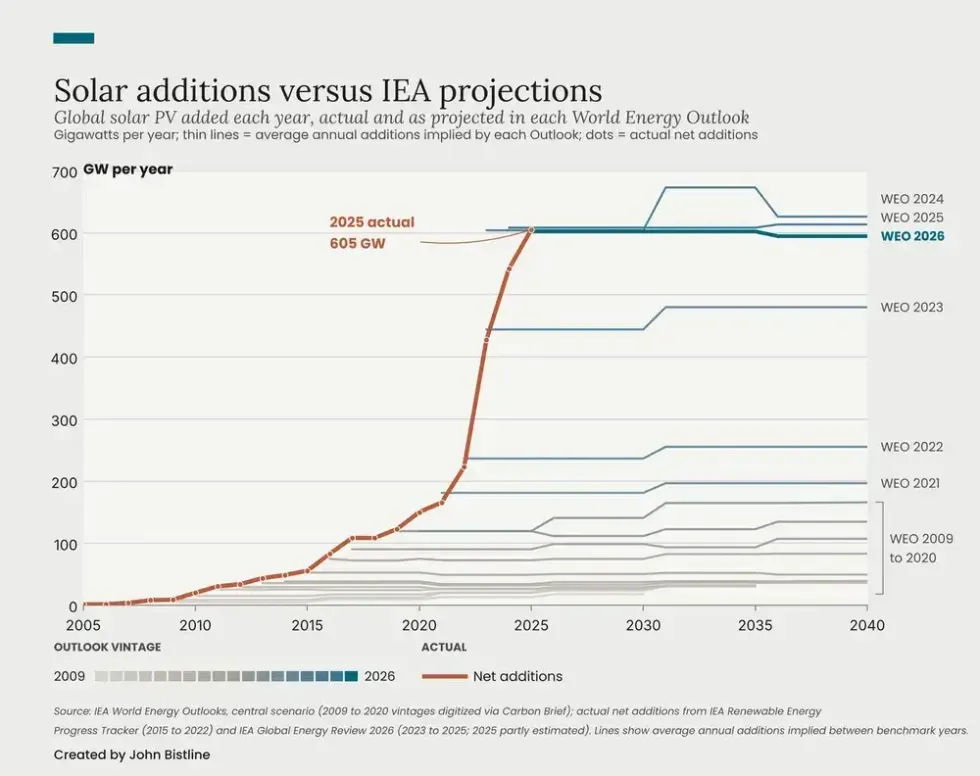
Now, there are two caveats here. The first is, the IEA has been wrong before—as you can tell from the chart it’s constantly predicted we were going to plateau, and we never have. But what worries me is that, in the words of nonpareil solar analyst Jenny Chase: “Unfortunately this time they may well be right. At least, I would absolutely love for someone to find the market that grows to replace China’s decline.” What she means is, half that breathtaking spike this decade is China rapidly building out solar; now their systems are maturing, and the era of the Chinese putting up three gigawatts a day is past.
Second caveat—it’s not exactly a disaster. We’re putting up lots of solar panels around the world right now, and if we kept up at this pace we’d eventually get where we need to be. Absent the climate crisis, we could afford to go at this pace; indeed, it seems to me that this what the oil industry is trying to assure with the BAAJA permitting bill now passed by the Senate and awaiting action in the House: a world where any transition lasts as long as possible. In this scenario markets might eventually get where we need to go: 40 years from now, we’d run the world mostly on sun, wind, and batteries. [By the way, a compelling new letter from climate scientists asking the House not to pass BAJAA just dropped today].
But “absent the climate crisis” is a pretty big caveat itself. Because the climate crisis is profoundly upon us, right now. I mean, as I write this the Florida National Guard is evacuating people after record rains across the central part of the Sunshine State, and the mayor of San Francisco is warning people not to travel from Monday to Wednesday because the highest tides of the year will bring an ever-rising ocean above seawalls:
“We could have flooding in areas where we have never seen flooding before,” said Brian Garcia, the warning coordination meteorologist for the National Weather Service’s San Francisco Bay Area office.
Meanwhile, Europe’s chief chronicler of the great Atlantic ocean currents, Stefan Rahmstorf, published yet another paper this week showing that there was a greater than 90% probability that those great currents were failing, a phenomenon that would rearrange the atlas of the habitable planet in the most profound ways—it would be the single largest event yet in human history. They close their paper by noting that
rapid reductions in fossil-fuel use and other greenhouse-gas emissions remain essential to limit further warming and to reduce the risk of large further AMOC weakening, and of crossing a tipping point of no return.
Or if you really want to pinpoint our moment in history, consider… Friday. As Andrea Thompson reports:
Earth just saw the most anomalously hot day ever measured on the planet. According to preliminary data from the Europe-based Copernicus Climate Change Service (C3S), Friday, November 20, 2026 was 2.12°C higher than the preindustrial average—or the time before human's began heating up the Earth by burning fossil fuels.
Since I said above that we were on a track to run the world on clean energy in 40 years, let me now give the second half of that assessment: if it takes us anything like 40 years, then the world we power with sun and wind will be a broken planet. The workable future of the Earth depends on that spike in the IEA graph continuing straight up with as much velocity as possible. The rapid conversion to clean energy is the only tool that’s yet done anything to slow the rise in carbon emissions (China’s fell 3% in the third quarter) and we need to keep it going.
There’s one more point to make here before I get to the meat of my argument, which will be about how we might build this momentum. That point is simply to assure you that we could do it. People use about 14 terrawatts of power on average during the year for all end-use purposes. In 2025, the world’s solar manufacturing capacity was about 1.5 terrawatts, though we were producing less than that—in fact, the Chinese were closing down panel factories in a move that was yuan wise and fahrenheit foolish. Combine a decade’s production (or increase it dramatically, since these factories are now pretty easy to build) with existing hydro and plenty of new wind turbines, throw in a bunch of batteries to start compensating for the fact that a terrawatt of solar capacity provides less end-use power than a terrawatt of gas or coal capacity, add in the odd geothermal plant, and take advantage of the fact that electricity is much more efficient than thermal power because it doesn’t waste heat in the same way. Voila—inside of 10 years you’re most of the way there. Yeah, there are still jet airplanes buzzing overhead, and big industrial energy users haven’t fully converted—but the back of the problem is broken.
Is there enough money to do it? I mean, Anthropic went into its IPO last week valued at $1.5 trillion; at 10 cents a watt that would buy a lot of solar panels. But the real answer here comes from Stanford’s Mark Jacobson, who estimates it would take about $7 trillion a year to pay for the transition over the years ahead—which is considerably less than the $17 trillion a year we currently pay for coal and gas and oil (remember, one aggressive estimate for climate damages this century is $551 trillion). Surely, with the proper will, it’s not beyond our financial wizards to figure out how to divert some of that $17 trillion into the rapid build-out needed to save huge sums over time
What I’m saying is: You can, with sufficient wishing, imagine that COP 41 in Houston would end with President James Talarico ticking off the remaining to-do list, and congratulating all the countries that were now one 100% clean. UN Secretary General Marina Silva would be giving Chinese premier Ma Jun a special prize for the heroic work that nation’s factories had done in bringing us this far. Were I still alive (which given how I feel at the moment seems highly unlikely) I’d doubtless be complaining we weren’t going fast enough, but mostly for old times’ sake. So, with that lengthy clearing of the throat, how do we get there? Or anywhere like there?
So far, the move toward clean energy this decade has been accomplished mostly be economics. It’s the cheapest form of power, which is great—that’s table stakes for this game, and nothing that I’ll propose would be possible if it weren’t true. But it’s not enough by itself, especially in the way we’ve understood it, as the working of “market forces.” Those market forces run strong, but they also run straight into “political forces” (read: the ability of Big Oil to corrupt most systems) and they also run into inertia, which is a more powerful force than people sometimes reckon. Left to their own devices, as Vaclav Smil has documented, energy transitions take decades. So we better not leave it to its own devices. Instead, a slightly different emergent movement for change could be built around these four arguments:
Look, say, to Australia, which thanks to a surfeit of solar panels is going to give every citizen three free hours of electricity every afternoon for perpetuity—up to 24 kwh, which with a battery (government subsidies available!) is as much power as most households use. New California governor Xavier Becerra has proposed the same thing, at least for poorer families, and I’ve talked with advisers working to see if it can’t be extended to everyone in the Golden State. Along with Medicare for All, I can’t think of a single more obviously beneficial thing government could do for its citizens (which is probably why most other countries have Medicare for All…). Meeting the need would mean many different kinds of policy changes—in some places new transmission lines to run electricity to cities from continental interiors, and in others big piles of free solar panels so people can get power for the first time in their lives.
Framing it this way puts the onus where it belongs—on the industry that is determined to cling to its grubby margins. No one likes oil companies, no one likes utilities; any intelligent politician should be able to make an argument out of this. Those arguments could be conservative—we want to make energy close to home, instead of relying on distant oligarchs. They could be libertarian—my power coming off my roof connecting to my car. They could be communitarian—our state is increasingly able to control its own destiny. They could be nationalist—why are we here in India spending 5% of our GNP importing fossil fuels? They could be populist—energy is a right, like water. And they could be effective.
The economic and affordability arguments are powerful, and they lead to deep psychological factors: In a world that runs on energy produced close to home we do not have to worry what the Houthi rebels are up to or what stupid decisions the president makes, at least as it has to do with the price or access to energy. Suddenly gas prices are no longer the most important political fact; we can concentrate on more important things.
But appeals to self-interest are not the only arguments we need to make. If I’ve learned anything as an organizer, it’s that the things that get people into the streets, aroused, and willing to work, often have as much to do with idealism as with self-interest. Ask yourself: Were most of the people out knocking the doors before the election doing it out of desire to improve their own lives, or the life of the world around them? Some of both, I’m sure—but hardheaded realism focuses relentlessly on the first and ignores the second. If you think New York City Mayor Zohran Mamdani’s election was only about “affordability,” I think you’re wrong. So
It’s important to admit that we can no longer stop global warming (and often useful to point out that that’s because the fossil fuel industry lied about it when we did have time, costing us decades). But there’s a way to get across what we still can do. Putting up lots of clean energy will allow us to shave tenths of a degree off how hot the planet eventually gets—and each tenth of a degree that we raise the global temperature moves 140 million into zones where they’ll be exposed to dangerous heat. As the lead author of that study, the University of Exeter’s Tim Lenton, explained:
“For every 0.1°C of warming above present levels, about 140 million more people will be exposed to dangerous heat.
“This reveals both the scale of the problem and the importance of decisive action to reduce carbon emissions.”
You don’t need to be a scientist to understand this. You need to be human, and cognizant that it’s a bad idea to be putting people in the broiler. There’s obviously a justice argument that comes in here too—for the most part it’s rich nations that have put poor nations in this position. But simply thinking about it in terms of people works—we have a chance to save people from this fate. All we have to do is put up a lot of solar panels and windmills. It’s too late to save everyone but it’s not too late to save a lot of people.
People have turned out by the millions to, say, demand debt relief for poor nations—and they got governments to give in to their demands to tune of billions of dollars. People who were unlikely to get AIDS marched for research dollars; people who were in no danger of being deported risked getting murdered by Immigration and Customs Enforcement in Minneapolis (and over the weekend in Seattle). Rapid heating—to the point where people literally trip on the sidewalk and get third degree burns from a few seconds contact with the sidewalk—is the result of oil company greed. That’s a message anyone can understand.
And they can understand that people will have no choice but to leave their homes, because it’s hot, or their house has burned down, or it’s underwater. We can literally prevent hundreds of millions from having to become refugees.
Nine million or so people die a year from breathing the combustion byproducts of fossil fuels. That’s more than die from smoking cigarettes and malaria combined.
Scientists have established links between pervasive air pollution from burning fossil fuels and cases of heart disease, respiratory ailments, and even the loss of eyesight. Without fossil fuel emissions, the average life expectancy of the world’s population would increase by more than a year, while global economic and health costs would fall by about $2.9tn.
(Just noting—2.9 trillion dollars would buy you 30 terrawatts worth of solar panels).
Here’s what that’s meant in China as it moved towards cleaner energy:
China’s strict policy action led to a swift reduction in pollution. Particulate pollution in China declined by 40.8% between 2014 and 2023, though the country experienced a slight increase in pollution from 2022 to 2023. Because of its overall air quality improvements, the average Chinese citizen can expect to live 1.8 years longer, provided the reductions are sustained. Beijing province experienced the largest decline in pollution, dropping 55.2% in just 10 years. If this success is sustained, the average person living there could expect to live 3.7 years longer.
By contrast, curing all cancer would raise life expectancy about three years.
Air pollution from combustion kills 200,000 Americans a year. Oil and gas production alone triggers 410,000 childhood asthma attacks a year.
People are dying in huge numbers so that oil companies can string out their business model.
And 4): The fossil fuel industry keeps us locked in an endless cycle of war; a solar panel is the new peace symbol.
2026 should be the year that made this completely obvious. The US, in the name of “energy dominance” through oil, has attacked the countries with the second and third largest petroleum reserves on Earth. In the case of Venezuela we simply took the oil (“to the victor belongs the spoils,” President Donald Trump explained recently at the United Nations, which would have been pretty naked for a 19th century imperialist) and in the case of Iran we’d like to: Trump said that "to be honest with you, my favorite thing is to take the oil in Iran.” In any event, we’re fighting over the flow of oil through the Strait of Hormuz, rebels in Yemen are blowing up Saudi pipelines, Sudan is on the brink of collapse because both sides in the civil war are targeting power plants. Russia is blowing up the fossil fuel power plants on which Ukraine depends in an effort to freeze them out this winter, and they’ve replied with a drone campaign that has taken out nearly half of Moscow’s oil refinery capacity.
None of this would be happening in a world that ran mostly on local energy. It wouldn’t be a perfectly peaceful world—humans are all too good at coming up with reasons to fight each other. (See the horror in Gaza). But at least it would be hard to fight over sunshine.
I get emails routinely from people in the anti-nuclear weapons movement asking for advice on how to build a bigger constituency for their cause, which after all is as existential as climate change or AI. I think the answer might be to concentrate less on the weapons, and more on the causes—if we can lower the political temperature of the planet, then our odds go up. (And if we keep raising the actual temperature of the planet, violence is likely to increase).
You could list many more, a lot of them having to do with economics, since climate change will be the costliest thing humans have ever managed to do. But those four, I think, suffice, and they work well together because they draw on different impulses.
In my experience, people join movements out of anger, and out of hope. Each of these four arguments is something to be angry about—the fossil fuel industry is robbing humans, poisoning humans, endangering humans, and causing wars. Each of these offers real hope—for a safer, cooler, more peaceful world where we get to live longer lives. There’s no reason save inertia and greed that we can’t have that world.
A few scattered pieces of this Switch to the Sun movement are in place. The Global Solar Council has a 300 Million Solar Homes campaign that’s a good short-term target to help us get going. There are ways right now to start raising money to solarize the poorest places on Earth—the folks at givepower.org estimate that a $15 donation can provide one person with power for a generation. A new organization called Brightside is emerging as a hub for some of this work, at least in the States. We’ve got Sun Day coming up around the world on next year’s Northern Hemisphere summer solstice.
But it will take a giant coalition of like-minded people to turn this into something big enough to get politicians sensing its possibilities. So start spreading the word; I suppose sharing this post would be a good place to start.
Switch to the Sun.