

SUBSCRIBE TO OUR FREE NEWSLETTER
Daily news & progressive opinion—funded by the people, not the corporations—delivered straight to your inbox.
5
#000000
#FFFFFF
To donate by check, phone, or other method, see our More Ways to Give page.
Daily news & progressive opinion—funded by the people, not the corporations—delivered straight to your inbox.
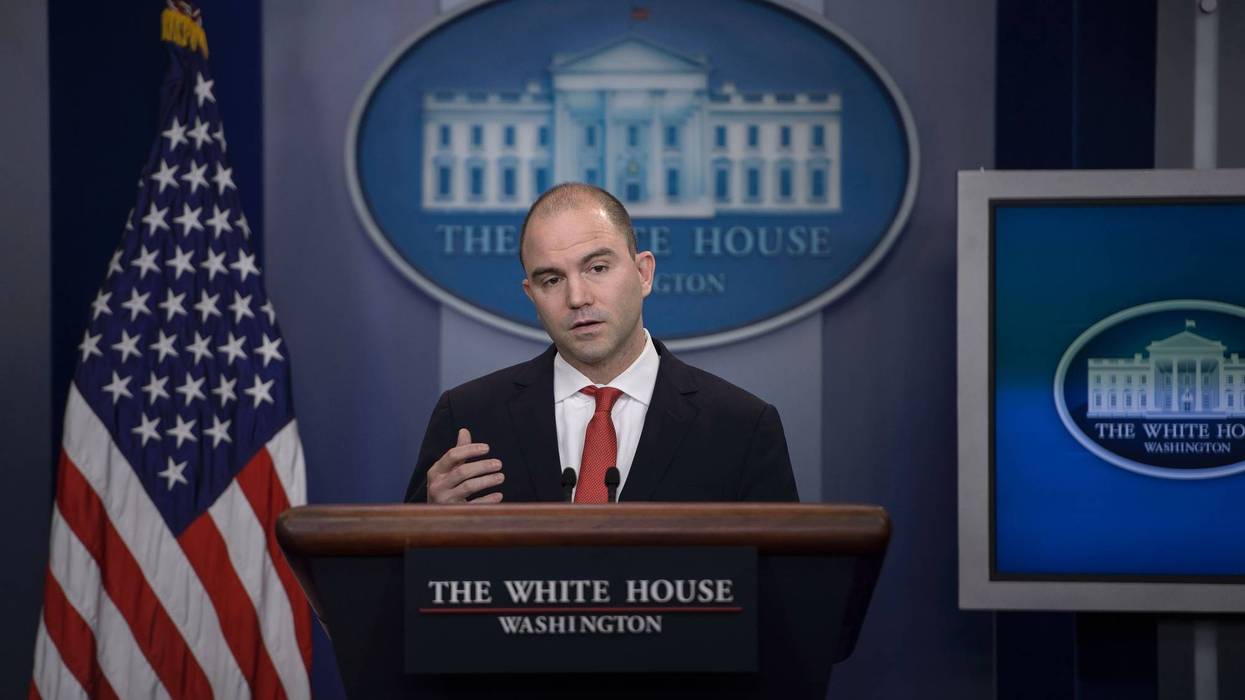
"We like to frame our wars as virtuous, but they are not," says Ben Rhodes.
Ben Rhodes, who served deputy national security advisor under former US President Barack Obama from 2009 to 2017, has done a fair number of mea culpas in the years since he left government service. But a New York Times op-ed published Wednesday punctuates with a fresh admission: "We like to frame our wars as virtuous, but they are not."
Rhodes comes to this statement circuitously as he writes about recent time spent with Graham Platner, the US Army and Marine veteran who served tours in both the Iraq and Afghanistan wars as an infantryman who is now running as a Democrat for the US Senate in Maine to unseat Republican Sen. Susan Collins.
Platner, who has recently opened up a double-digit lead against his primary rival, two-time Maine Gov. Janet Mills, has been an outspoken anti-war voice since putting his hat in the ring for elected office and Rhodes, who cut his teeth defending the forever wars during the Obama years, says Democratic Party leaders—and voters wherever they are—would be wise to listen to what he has to say.
"The forever war has been destroying America from within, like an organism that must keep growing to survive, filling us with fear of outsiders and contempt for one another," writes Rhodes.
Most Democrats, observes Rhodes, don't talk about war the way Platner does, and that's not just a feature of his wartime experience compared to those in positions of power or paid to pontificate for think tanks or on the corporate news networks.
After traveling around with Platner on the campaign trail in Maine, Rhodes concludes that "Americans must change their relationship to war itself."
"One reason we have a hard time reckoning with the forever war is that it undermines our own story," he continues. "We like to think of America as a force for good, acting out of enlightened self-interest, our military fighting for freedom around the globe. Is that really what’s been happening?"
In their conversation, Platner explained that "most people get it," suggesting those who live and work in the real world, outside of DC or within media echo chambers, understand the costs of the nation's endless wars. “Do you think this country should spend more on schools and hospitals and less on bombs?" asked Platner rhetorically. "A lot of people are like, yeah, that’s pretty obvious.”
When Platner had his epiphany that the wars he fought in Iraq and Afghanistan were a mistake, Rhodes said he, still working for the White House in those years, was exactly the kind of person the soldier was thinking of when he said that the "people running the war didn’t even seem to know the point of the war," calling it "a self-licking ice cream cone" that could not admit its failures.
"Listening to [Platner] talk, I knew intuitively what he was saying," writes Rhodes. "I would have been one of those people back in 2011, believing that what we were doing was helping Afghans."
For someone so enmeshed in the politics of US war-making and defending the foreign policy of past US governments from criticism, Rhodes confesses the pitfalls of American exceptionalism and where it can lead. And again, he quotes Platner:
We are so broken emotionally when it comes to our politics that we’ve literally created this story that it’s inherent in being a competent political leader to kill civilians. If you’re not willing to do some hard things and drop some bombs, then you’re not up to the task of power. I think it’s the opposite. You’re not up to the task of being in power if you do not think about the cost of violence. If that’s not at the front of your mind, then I don’t think you are morally in the right place to be in positions of power.
Such an argument directly implicates not just past presidents, but certainly US President Donald Trump, currently waging a new war of choice against Iran, as well as his Defense Secretary Pete Hegseth, who openly celebrates the killing prowess ("lethality") of the US military while characterizing the laws of war as impediments.
Contextualizing why he has come to conclude that contemporary US wars lack virtue, Rhodes writes that the conflicts we have been waging abroad for most of this century have also done tremendous and lasting damage here at home. "They resemble," writes Rhodes, "a declining empire sowing chaos along its periphery as a matter of strategy: Economic and political elites profit while the Americans who fight suffer along with the places they attack."
As Platner told Rhodes, such admissions must be spoken about publicly in order for them to lead to meaningful change in the country. And voices like Platner's, argues Rhodes, must be listened to because the "visceral and moral reckoning he advocates is the only way to truly dismantle the forever war, change our priorities and detoxify our country."
"To save ourselves, we must stop this cycle of violence," Rhodes concludes. "We must find meaning not in our capacity to kill or control others, but in each other."
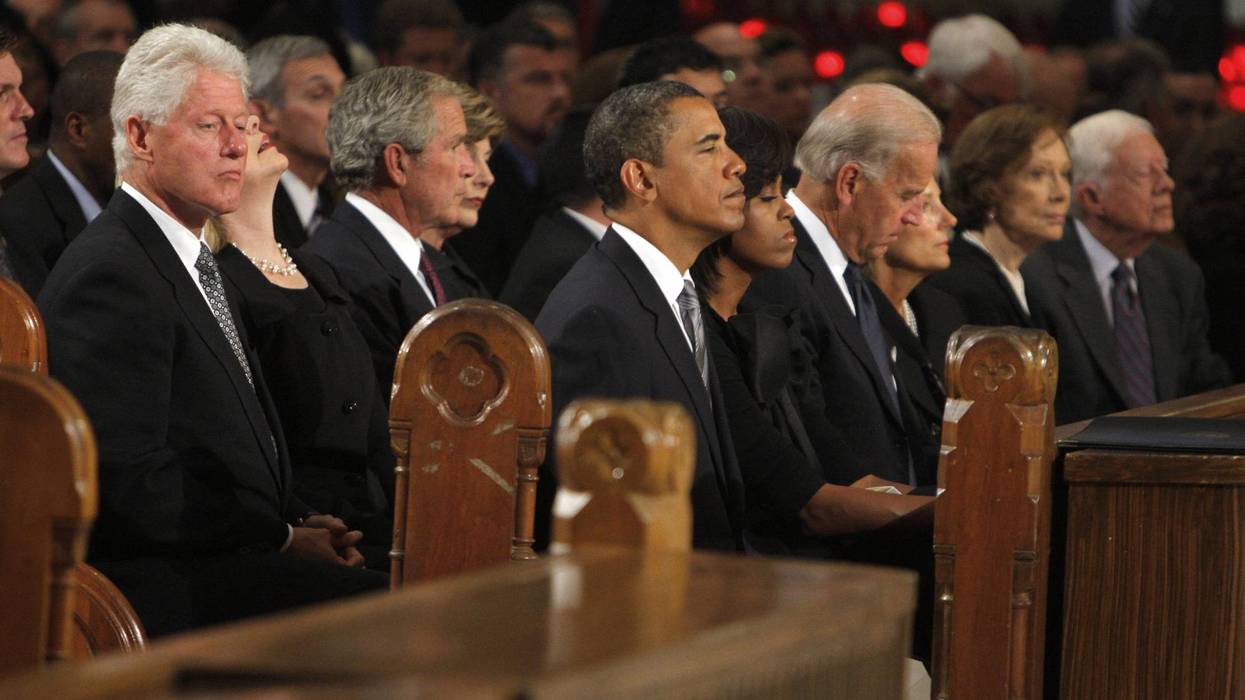
These former presidents should mobilize the citizenry from the grassroots to the Capitol and take on the unpopular Tyrant Trump; instead, they are living luxurious lives and are largely AWOL.
What should the American people, especially the hundreds of millions of their voters, expect Presidents Bill Clinton, George W. Bush, Barack Obama, and Joe Biden to do against the vicious, serial law-violating, violent, corrupt, agency-dismantling Donald Trump and the crony Trumpsters who are wrecking our government and our economy?
These former presidents should mobilize the citizenry from the grassroots to the Capitol and take on the unpopular Tyrant Trump. Having sworn to uphold the Constitution and “…take Care that the Laws be faithfully executed,” they should strongly uphold their patriotic duty to resist tyranny and save our Republic and our besieged democratic institutions, and stop the assault on our civil liberties and civil rights.
Our former presidents all get along with each other. They have the stature to:
Instead, they are living luxurious lives and are largely AWOL from connecting with the existing but overwhelmed civic opposition to Trump. Bush is painting landscapes as Trump has destroyed his AIDS program in Africa, and the Bush wing of the Republican Party. Obama has campaigned for Abigail Spanberger and Mikie Sherrill as governors of Virginia and New Jersey, satirizing Trump in some of his speeches. His present passion, however, is the March Madness basketball championships. Clinton has left it up to Hillary, who wrote a guarded New York Times op-ed back on March 28, 2025, taking Trump to task for jeopardizing our national security and not “preparing for real fights with America’s adversaries.”
Then there is Joe Biden, who received then President-elect Trump and Melania on the morning of January 20, 2025, with the gracious “welcome home.” In return, Biden got that afternoon and every day since hundreds of foul epithets from Trump, scapegoating him for almost everything he could fabricate, including solar energy and wind power projects. Delaware Joe managed a few critical replies at a Democratic Party dinner in Nebraska on November 7, 2025. “Trump has taken a wrecking ball not only to the people’s house but to the Constitution, to the rule of law, to our very democracy.” Unfortunately, Biden has mostly been silent.
Credit these retired presidents with knowing the historic dangers and existing damages of the TRUMP DUMP in Washington and around the country. They also know their supporters would be very receptive to their organized, persistent leadership from them to send Trump back to Mar-a-Lago. Why are they AWOL?
First, they fear Trump’s retaliation, upsetting their comfortable lives. Trump is now deep in the QUICKSAND of the Middle East. He is being pilloried by a million stickers at gas pumps picturing Trump pointing to the booming price per gallon and saying, “I did that.” He is openly declaring there should be no elections in November and continues to send or keep his storm troopers in America’s cities. An expanding police state is not exactly a credible perch for effective profanity. Show a modest bit of moxie!
A second excuse is that they have done some of what Trump is doing:
True enough. But people live in the present and are most worried about what Dangerous Donald is doing NOW to their livelihoods, freedoms, health and safety, and the consequences in casualties and their tax dollars of another endless war.
Our former presidents have no excuses. They simply lack a modicum of courage. Remember Aristotle declared, “Courage is the first of human qualities because it is the quality which guarantees the others.”
The current political climate demands the powerful emergence of the four previous presidents of our country. The federal district courts are ruling heavily against Trump’s “Injustice Department,” though Trump retains a slightly weakening claim on six Supreme Court Injustices. People of all backgrounds are marching and demonstrating in huge numbers. This weekend, the “No Kings” rallies (he’s already a dictator) anticipate 10 million people nationwide.
The business community, particularly small businesses, are feeling serious harm from Trump’s tariffs, wars, cancelled contracts, and inflationary policies. The labor unions have never been under such attack (notably the federal employees’ union members whose contracts he has torn up), and they are simmering with anger. The universities are also under His illegal shakedown attacks.
What explains the mainstream media’s virtual ignoring of this ABDICATION by these ex-presidents? The reporters mostly despise Trump, who has slandered them (calling them “deranged and demented” for starters) and has extortionately sued news organizations and journalists for millions of dollars and coerced settlements.
The media have reported that some ex-agency officials under the former presidents have excoriated Trump, such as Samantha Power, for closing the major lifesaving Agency for International Development. The formidable Rohit Chopra, who directed the Consumer Financial Protection Bureau under Biden, is not reticent to verbally defend his nearly closed-down agency, which had saved consumers many billions of dollars.
However, they are not covering the abdication by BIG GUYS—our former presidents. I have tried in vain to find out why by calling reporters and editors. Maybe you’ll have better luck. Try calling these numbers: The Washington Post: 202-334-6000; The New York Times: 800-698-4637; Associated Press: 212-621-1500; NPR: 202-513-2000; The Wall Street Journal: 212-416-2000.
You may break through and help save our Republic!
My students weren’t angry; they were frustrated. They’d been stripped of their dignity by their own president.
I teach 12th-grade English at an urban high school in upstate New York. The poverty rate here is high. And violent crime is a common occurrence. When people ask what I’ve learned from doing this job for 18 years, I tell them I’ve come to see how hard it is to be a Black or brown person in America. And the president is making that even harder, which in turn makes my job as an urban educator harder.
February 6, on his Truth Social platform, Donald Trump posted a 62-second clip of Barack and Michelle Obama’s faces imposed over the bodies of apes. As word of this got around school on Friday, multiple students of color came to me. They wanted to know—needed to know—if Trump’s “Truth” was real. I gave it to ‘em straight. Yes, the Commander-in-Chief had trafficked in one of the oldest, most-painful tropes against African Americans. These students weren’t angry. They were frustrated. They’d been stripped of their dignity by their own president. Friday was a very difficult day at my school.
Regarding the post, Press Secretary Karoline Leavitt said, "Please stop the fake outrage and report on something today that actually matters to the American public.”
This Trumpian brand of race-baiting is nothing new. You might remember Trump’s opening salvo to the citizenry was Birtherism. To enter political life by asserting Barack Obama was born in Kenya, Trump signaled an alliance with those who despised Obama because of his skin color. Trump’s depraved conspiracy was meant to make us see Obama—a self-made, sophisticated Black man—as a savage, running around some mud-hut village in loin cloth and war paint. It wasn’t a dog whistle. It was a bullhorn.
In the end, Biff Tannen always crashes his car into manure. And that’s what’s going to happen to Trump.
Do I think Trump hates Black people? No, I think Trump thrives on division, and racial division is a provocateur every time. I harken back to what then-VP Kamala Harris said about Trump on the debate stage in 2024, “It's a tragedy that we have someone who wants to be president who has consistently, over the course of his career, attempted to use race to divide the American people."
Whether it’s race or some other subject, Trump never misses a chance to pit the electorate against itself. Anything from Rob Reiner to the Superbowl halftime show, it’s all fodder for a good fight. Our country has never been more divided. Don’t believe me? Scroll through Facebook, Instagram, X (Twitter), etc. The knives are out. The name calling is ugly. And it’s all about Trump. As long as Trump controls the bully pulpit, we have no hope for unity. He’ll never stop fanning the flames.
This, I suppose, is the Shakespearean flaw of a president (and a person) who must be the center of attention at all times, even if it’s manufactured attention. You might remember, in his pre-political life, Trump routinely planted stories about himself in the New York papers and tabloid magazines, using the alias John Barron to brag about “Trump’s” celebrity connections and romantic relationships.
Maybe Trump suffers from what columnist Maureen Dowd called “Obama Derangement Syndrome.” While I’m certain that’s true, or sort of true, Trump targets migrants, women, and his perceived opponents with equal cruelty. Trump’s ascension to the top of our federal government is akin to Biff Tannen winning Lorraine at the end of Back to the Future. “What’re you lookin’ at, butthead?” Who’d root for that? Apparently 77 million Americans would.
The thing about bullies, even powerful ones like Trump: Deep down, they’re cowards who lack accountability. A few hours after Ms. Leavitt claimed the public didn’t care about Trump’s post, the administration changed its story: “A White House staffer erroneously made the post. It has been taken down.” Pinning this on a make-pretend staffer? It simply doesn’t get more Biff Tannen than that.
John F. Kennedy once said, “A rising tide lifts all ships,” meaning when something good happens to the system, everyone benefits. So what’s the net result of a president who tells lies, violates the law, uses the Oval Office to enrich himself and his family, orders the Justice Department to punish his enemies? Who “benefits” inside that system?
As a teacher of 12th graders, I wish we hadn’t heaped such a seismic amount of chaos upon the next generation. But I’m also optimistic. I believe these young people will guide our broken country out of the darkness, perhaps fueled by the dignity-stripping frustration they felt when they realized Trump’s “Truth” was real.
In the end, Biff Tannen always crashes his car into manure. And that’s what’s going to happen to Trump. History will regard the Trump Era as malignantly divisive, and Trump as nothing but a two-bit bully. Bullies never win. They don’t know how to win.
Needless to say, if anyone else, from a CEO to a cashier, had posted the Obamas as apes on their social media, they’d be out of a job before breakfast.
Speaking with reporters aboard Air Force One on Friday, Trump was asked if he’d apologize for his “racist” post. The president replied, "No, I didn't make a mistake."