SUBSCRIBE TO OUR FREE NEWSLETTER
Daily news & progressive opinion—funded by the people, not the corporations—delivered straight to your inbox.
5
#000000
#FFFFFF
To donate by check, phone, or other method, see our More Ways to Give page.
Daily news & progressive opinion—funded by the people, not the corporations—delivered straight to your inbox.
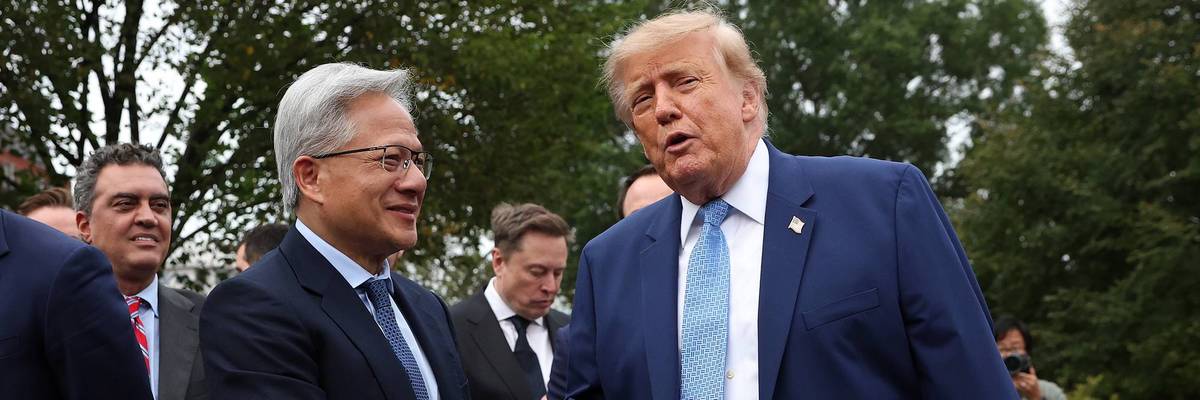
President Donald Trump greets Nvidia CEO Jensen Huang, as Trump and AI executives hold a media briefing following a meeting on artificial intelligence outside the West Wing of the White House on September 29, 2026 in Washington, DC. The meeting comes as some have called for a slowdown in AI development amid rising safety concerns.
For Trump it’s okay, as long as corporations do well, the stock market soars, and he makes a bundle.
I caused indigestion in right-wing media circles recently when I suggested that, because Elon Musk’s Starlink and StarShield monopolies have given him the power to decide the fate of Ukraine, they should be nationalized. American foreign policy and national security shouldn’t depend on the whims of one rich, powerful tycoon.
Fox News berated me for threatening the “free market.” The Washington Examiner called my proposal “categorically un-American.” Reason Magazine said America’s engine of high-tech innovation “doesn’t work if the government butts in.” Other bastions of right-wing economics called me a communist or worse. Musk himself said I should be jailed.
But where are these staunch guardians of the putative “free market” now that Trump has pushed Nvidia’s board to reinstate the CEO it fired 11 days before?
At a time when Americans are deeply and justifiably concerned about corruption, and when the billionaire bros of Big Tech are making off like bandits, Trump is doing everything possible to fuel both concerns.
Apparently it’s fine for a rich, powerful tycoon to compromise American foreign policy and national security as long as he’s propping up the stock market. My suggestion of nationalizing Musk’s Starlink and Starshield caused right-wingers conniptions because it prioritized national security over private profits.
The underlying issue has nothing whatever to do with whether government “butts” into the private sector.
Trump crowed in an interview with CNBC that he had contacted Nvidia’s board personally and directly. “I convinced them and got it done.” A president of the United States pushing the board of directors of a private corporation to reappoint a CEO it had fired days before is the most imperious form of “butting in” imaginable. Yet I’ve heard no complaints from the right.
True, some congressional Republicans who have rarely if ever used their oversight power to question decisions by Trump are pushing back against his baseless assurances that national security concerns surrounding Huang and Nvidia have been resolved. But that’s the extent of the rattle on the right.
Nor is the real issue here whether an intervention is “un-American.” Is it “American” or “un-American” to decide it’s perfectly fine for Huang to have had a romantic relationship with a person who American intelligence believes to be a Chinese spy funneling Nvidia’s advanced AI chips to the Chinese military? (No less than Robert Lighthizer, Trump’s first-term trade czar, deemed this transfer of technology tantamount to the Soviet theft of American atomic weapons secrets during the Cold War.)
Are the right-wing guardians of the free market so naive as to believe Trump’s pressure on Nvidia’s board to reinstate Huang had nothing to do with Huang’s donation of $1 million to Trump’s inauguration and $25 million to his White House ballroom? Or with Trump’s ownership of at least $12 million in Nvidia shares of stock?
Trump has extended his personalized economic policy far beyond assuring Nvidia’s board it will be immune from legal liability.
Trump’s policy interventions include having the US take direct stakes in companies such as Intel, critical minerals producers, and the missile business of L3Harris. And giving Apple an exemption to his tariffs on China worth billions of dollars. Last year, Trump made the US government a partner in Nvidia’s business in China by having Nvidia give the government a share of revenue on certain semiconductor chips it sold to China.
The underlying issue is whether profits and the stock market are higher priorities for Trump and his regime than national security. It certainly seems so.
Yet from the silence of the right-wing guardians of the free market, I take it that government can intrude on the “free market” as much as it wishes—even arbitrarily and wantonly, and even if high government officials are on the take—as long as private companies prosper and the stock market surges.
But when the issue is national security or other aspects of the common good, the public be damned.
At a time when Americans are deeply and justifiably concerned about corruption, and when the billionaire bros of Big Tech are making off like bandits, Trump is doing everything possible to fuel both concerns.
Is this socialism? Is it communism? It’s neither. It’s crony capitalism.
This country and this world are at a monumental crossroads. US voters have an opportunity to beat back the forces of fascism and confront the billionaires who are rigging the economy, our media system, and our democracy, making it increasingly impossible for ordinary people to get by. We’re not just talking about the election. We’re talking about what must be done once these fascist elements are vanquished from power. We need a bolder set of solutions than what either major party has so far been willing to offer and a working-class movement ready to fight like hell for it. Trump didn't emerge from nowhere. The conditions that fueled MAGA authoritarianism were created by decades of radical neoliberal economic policies and a corrupt political system dominated by corporate interests. They slashed taxes on the super-rich, promising that the benefits would trickle down. They said giveaways to the corporate titans would make life more affordable for the rest of us. It was all bullshit. And when a bitter, betrayed populace searches for someone to blame, right-wing demagogues have little trouble finding scapegoats. People know when they're being lied to, but you won't hear any of this from the corporate media. Only independent journalism—powered and funded by people who believe in building a better world—can deliver truly trustworthy daily news. If you share our vision, please contribute whatever you can to sustain our work. |
I caused indigestion in right-wing media circles recently when I suggested that, because Elon Musk’s Starlink and StarShield monopolies have given him the power to decide the fate of Ukraine, they should be nationalized. American foreign policy and national security shouldn’t depend on the whims of one rich, powerful tycoon.
Fox News berated me for threatening the “free market.” The Washington Examiner called my proposal “categorically un-American.” Reason Magazine said America’s engine of high-tech innovation “doesn’t work if the government butts in.” Other bastions of right-wing economics called me a communist or worse. Musk himself said I should be jailed.
But where are these staunch guardians of the putative “free market” now that Trump has pushed Nvidia’s board to reinstate the CEO it fired 11 days before?
At a time when Americans are deeply and justifiably concerned about corruption, and when the billionaire bros of Big Tech are making off like bandits, Trump is doing everything possible to fuel both concerns.
Apparently it’s fine for a rich, powerful tycoon to compromise American foreign policy and national security as long as he’s propping up the stock market. My suggestion of nationalizing Musk’s Starlink and Starshield caused right-wingers conniptions because it prioritized national security over private profits.
The underlying issue has nothing whatever to do with whether government “butts” into the private sector.
Trump crowed in an interview with CNBC that he had contacted Nvidia’s board personally and directly. “I convinced them and got it done.” A president of the United States pushing the board of directors of a private corporation to reappoint a CEO it had fired days before is the most imperious form of “butting in” imaginable. Yet I’ve heard no complaints from the right.
True, some congressional Republicans who have rarely if ever used their oversight power to question decisions by Trump are pushing back against his baseless assurances that national security concerns surrounding Huang and Nvidia have been resolved. But that’s the extent of the rattle on the right.
Nor is the real issue here whether an intervention is “un-American.” Is it “American” or “un-American” to decide it’s perfectly fine for Huang to have had a romantic relationship with a person who American intelligence believes to be a Chinese spy funneling Nvidia’s advanced AI chips to the Chinese military? (No less than Robert Lighthizer, Trump’s first-term trade czar, deemed this transfer of technology tantamount to the Soviet theft of American atomic weapons secrets during the Cold War.)
Are the right-wing guardians of the free market so naive as to believe Trump’s pressure on Nvidia’s board to reinstate Huang had nothing to do with Huang’s donation of $1 million to Trump’s inauguration and $25 million to his White House ballroom? Or with Trump’s ownership of at least $12 million in Nvidia shares of stock?
Trump has extended his personalized economic policy far beyond assuring Nvidia’s board it will be immune from legal liability.
Trump’s policy interventions include having the US take direct stakes in companies such as Intel, critical minerals producers, and the missile business of L3Harris. And giving Apple an exemption to his tariffs on China worth billions of dollars. Last year, Trump made the US government a partner in Nvidia’s business in China by having Nvidia give the government a share of revenue on certain semiconductor chips it sold to China.
The underlying issue is whether profits and the stock market are higher priorities for Trump and his regime than national security. It certainly seems so.
Yet from the silence of the right-wing guardians of the free market, I take it that government can intrude on the “free market” as much as it wishes—even arbitrarily and wantonly, and even if high government officials are on the take—as long as private companies prosper and the stock market surges.
But when the issue is national security or other aspects of the common good, the public be damned.
At a time when Americans are deeply and justifiably concerned about corruption, and when the billionaire bros of Big Tech are making off like bandits, Trump is doing everything possible to fuel both concerns.
Is this socialism? Is it communism? It’s neither. It’s crony capitalism.