SUBSCRIBE TO OUR FREE NEWSLETTER
Daily news & progressive opinion—funded by the people, not the corporations—delivered straight to your inbox.
5
#000000
#FFFFFF
To donate by check, phone, or other method, see our More Ways to Give page.
This is an odd post. On the one hand, it may be the most important edition of this newsletter of the year—I’m trying to see a way forward, thinking out loud about where the fight goes next. But on the other hand, I’m in a cold fury at the morning’s news about Jensen Huang, which seems to me a clear declaration that we live in a country where all that counts is wealth, and I’m also in a slightly shivery condition due to the Covid-19 I perhaps inevitably picked up on the very last stop of the endless fall organizing tour. So—take it all for what it’s worth. But I do think that on climate this is a particularly clarifying moment.
On Sunday, the global talks in Antalya, Türkiye ended in collapse, with the parties unable to agree on a text. I was there the last time this happened, in Copenhagen in 2009, and I remember the conclusion I drew: There is not enough of a movement demanding action to make leaders feel like they have to come home with an agreement. We changed that over the next half-decade, which is why, above all, Paris worked, becoming the high-water mark of the global negotiating process.
But the failure of the talks is not the main reason to worry at the moment, nor even the trilateral announcement from Beijing that the worlds big powers want to increase the production of oil. The main reason is this graph from the International Energy Agency (IEA) predicting what will happen with solar power in the next 15 years. Basically, what it forecasts is that solar power, having grown very rapidly, will now plateau—we’ll continue installing new panels at the same pace as last year through 2040.
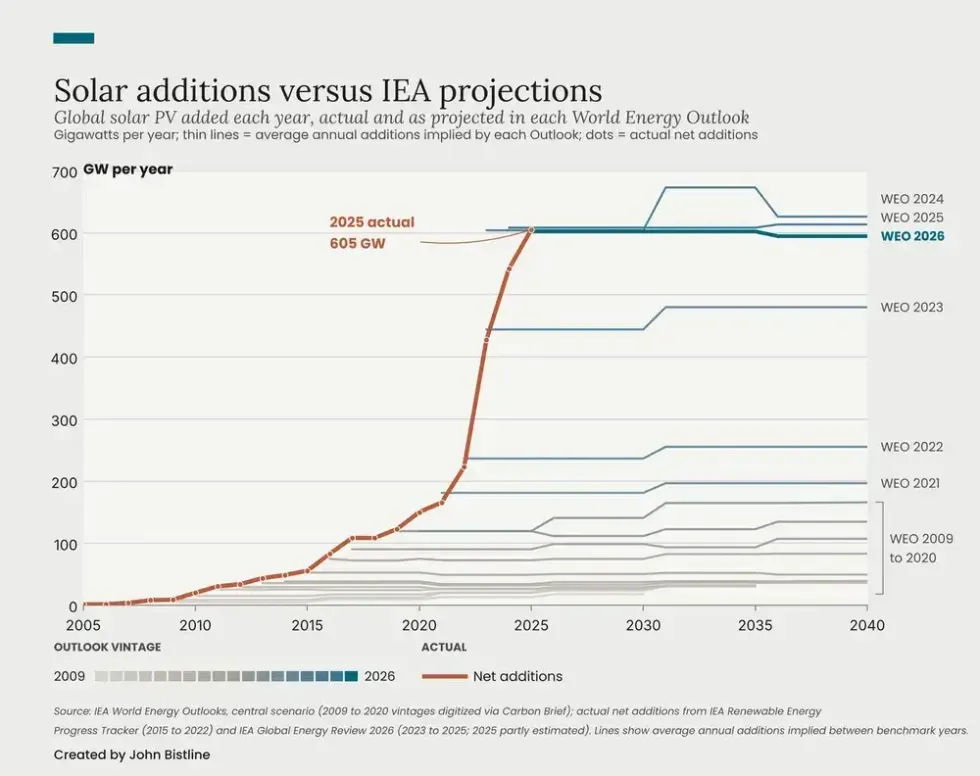
Now, there are two caveats here. The first is, the IEA has been wrong before—as you can tell from the chart it’s constantly predicted we were going to plateau, and we never have. But what worries me is that, in the words of nonpareil solar analyst Jenny Chase: “Unfortunately this time they may well be right. At least, I would absolutely love for someone to find the market that grows to replace China’s decline.” What she means is, half that breathtaking spike this decade is China rapidly building out solar; now their systems are maturing, and the era of the Chinese putting up three gigawatts a day is past.
Second caveat—it’s not exactly a disaster. We’re putting up lots of solar panels around the world right now, and if we kept up at this pace we’d eventually get where we need to be. Absent the climate crisis, we could afford to go at this pace; indeed, it seems to me that this what the oil industry is trying to assure with the BAAJA permitting bill now passed by the Senate and awaiting action in the House: a world where any transition lasts as long as possible. In this scenario markets might eventually get where we need to go: 40 years from now, we’d run the world mostly on sun, wind, and batteries. [By the way, a compelling new letter from climate scientists asking the House not to pass BAJAA just dropped today].
But “absent the climate crisis” is a pretty big caveat itself. Because the climate crisis is profoundly upon us, right now. I mean, as I write this the Florida National Guard is evacuating people after record rains across the central part of the Sunshine State, and the mayor of San Francisco is warning people not to travel from Monday to Wednesday because the highest tides of the year will bring an ever-rising ocean above seawalls:
“We could have flooding in areas where we have never seen flooding before,” said Brian Garcia, the warning coordination meteorologist for the National Weather Service’s San Francisco Bay Area office.
Meanwhile, Europe’s chief chronicler of the great Atlantic ocean currents, Stefan Rahmstorf, published yet another paper this week showing that there was a greater than 90% probability that those great currents were failing, a phenomenon that would rearrange the atlas of the habitable planet in the most profound ways—it would be the single largest event yet in human history. They close their paper by noting that
rapid reductions in fossil-fuel use and other greenhouse-gas emissions remain essential to limit further warming and to reduce the risk of large further AMOC weakening, and of crossing a tipping point of no return.
Or if you really want to pinpoint our moment in history, consider… Friday. As Andrea Thompson reports:
Earth just saw the most anomalously hot day ever measured on the planet. According to preliminary data from the Europe-based Copernicus Climate Change Service (C3S), Friday, November 20, 2026 was 2.12°C higher than the preindustrial average—or the time before human's began heating up the Earth by burning fossil fuels.
Since I said above that we were on a track to run the world on clean energy in 40 years, let me now give the second half of that assessment: if it takes us anything like 40 years, then the world we power with sun and wind will be a broken planet. The workable future of the Earth depends on that spike in the IEA graph continuing straight up with as much velocity as possible. The rapid conversion to clean energy is the only tool that’s yet done anything to slow the rise in carbon emissions (China’s fell 3% in the third quarter) and we need to keep it going.
There’s one more point to make here before I get to the meat of my argument, which will be about how we might build this momentum. That point is simply to assure you that we could do it. People use about 14 terrawatts of power on average during the year for all end-use purposes. In 2025, the world’s solar manufacturing capacity was about 1.5 terrawatts, though we were producing less than that—in fact, the Chinese were closing down panel factories in a move that was yuan wise and fahrenheit foolish. Combine a decade’s production (or increase it dramatically, since these factories are now pretty easy to build) with existing hydro and plenty of new wind turbines, throw in a bunch of batteries to start compensating for the fact that a terrawatt of solar capacity provides less end-use power than a terrawatt of gas or coal capacity, add in the odd geothermal plant, and take advantage of the fact that electricity is much more efficient than thermal power because it doesn’t waste heat in the same way. Voila—inside of 10 years you’re most of the way there. Yeah, there are still jet airplanes buzzing overhead, and big industrial energy users haven’t fully converted—but the back of the problem is broken.
Is there enough money to do it? I mean, Anthropic went into its IPO last week valued at $1.5 trillion; at 10 cents a watt that would buy a lot of solar panels. But the real answer here comes from Stanford’s Mark Jacobson, who estimates it would take about $7 trillion a year to pay for the transition over the years ahead—which is considerably less than the $17 trillion a year we currently pay for coal and gas and oil (remember, one aggressive estimate for climate damages this century is $551 trillion). Surely, with the proper will, it’s not beyond our financial wizards to figure out how to divert some of that $17 trillion into the rapid build-out needed to save huge sums over time
What I’m saying is: You can, with sufficient wishing, imagine that COP 41 in Houston would end with President James Talarico ticking off the remaining to-do list, and congratulating all the countries that were now one 100% clean. UN Secretary General Marina Silva would be giving Chinese premier Ma Jun a special prize for the heroic work that nation’s factories had done in bringing us this far. Were I still alive (which given how I feel at the moment seems highly unlikely) I’d doubtless be complaining we weren’t going fast enough, but mostly for old times’ sake. So, with that lengthy clearing of the throat, how do we get there? Or anywhere like there?
So far, the move toward clean energy this decade has been accomplished mostly be economics. It’s the cheapest form of power, which is great—that’s table stakes for this game, and nothing that I’ll propose would be possible if it weren’t true. But it’s not enough by itself, especially in the way we’ve understood it, as the working of “market forces.” Those market forces run strong, but they also run straight into “political forces” (read: the ability of Big Oil to corrupt most systems) and they also run into inertia, which is a more powerful force than people sometimes reckon. Left to their own devices, as Vaclav Smil has documented, energy transitions take decades. So we better not leave it to its own devices. Instead, a slightly different emergent movement for change could be built around these four arguments:
Look, say, to Australia, which thanks to a surfeit of solar panels is going to give every citizen three free hours of electricity every afternoon for perpetuity—up to 24 kwh, which with a battery (government subsidies available!) is as much power as most households use. New California governor Xavier Becerra has proposed the same thing, at least for poorer families, and I’ve talked with advisers working to see if it can’t be extended to everyone in the Golden State. Along with Medicare for All, I can’t think of a single more obviously beneficial thing government could do for its citizens (which is probably why most other countries have Medicare for All…). Meeting the need would mean many different kinds of policy changes—in some places new transmission lines to run electricity to cities from continental interiors, and in others big piles of free solar panels so people can get power for the first time in their lives.
Framing it this way puts the onus where it belongs—on the industry that is determined to cling to its grubby margins. No one likes oil companies, no one likes utilities; any intelligent politician should be able to make an argument out of this. Those arguments could be conservative—we want to make energy close to home, instead of relying on distant oligarchs. They could be libertarian—my power coming off my roof connecting to my car. They could be communitarian—our state is increasingly able to control its own destiny. They could be nationalist—why are we here in India spending 5% of our GNP importing fossil fuels? They could be populist—energy is a right, like water. And they could be effective.
The economic and affordability arguments are powerful, and they lead to deep psychological factors: In a world that runs on energy produced close to home we do not have to worry what the Houthi rebels are up to or what stupid decisions the president makes, at least as it has to do with the price or access to energy. Suddenly gas prices are no longer the most important political fact; we can concentrate on more important things.
But appeals to self-interest are not the only arguments we need to make. If I’ve learned anything as an organizer, it’s that the things that get people into the streets, aroused, and willing to work, often have as much to do with idealism as with self-interest. Ask yourself: Were most of the people out knocking the doors before the election doing it out of desire to improve their own lives, or the life of the world around them? Some of both, I’m sure—but hardheaded realism focuses relentlessly on the first and ignores the second. If you think New York City Mayor Zohran Mamdani’s election was only about “affordability,” I think you’re wrong. So
It’s important to admit that we can no longer stop global warming (and often useful to point out that that’s because the fossil fuel industry lied about it when we did have time, costing us decades). But there’s a way to get across what we still can do. Putting up lots of clean energy will allow us to shave tenths of a degree off how hot the planet eventually gets—and each tenth of a degree that we raise the global temperature moves 140 million into zones where they’ll be exposed to dangerous heat. As the lead author of that study, the University of Exeter’s Tim Lenton, explained:
“For every 0.1°C of warming above present levels, about 140 million more people will be exposed to dangerous heat.
“This reveals both the scale of the problem and the importance of decisive action to reduce carbon emissions.”
You don’t need to be a scientist to understand this. You need to be human, and cognizant that it’s a bad idea to be putting people in the broiler. There’s obviously a justice argument that comes in here too—for the most part it’s rich nations that have put poor nations in this position. But simply thinking about it in terms of people works—we have a chance to save people from this fate. All we have to do is put up a lot of solar panels and windmills. It’s too late to save everyone but it’s not too late to save a lot of people.
People have turned out by the millions to, say, demand debt relief for poor nations—and they got governments to give in to their demands to tune of billions of dollars. People who were unlikely to get AIDS marched for research dollars; people who were in no danger of being deported risked getting murdered by Immigration and Customs Enforcement in Minneapolis (and over the weekend in Seattle). Rapid heating—to the point where people literally trip on the sidewalk and get third degree burns from a few seconds contact with the sidewalk—is the result of oil company greed. That’s a message anyone can understand.
And they can understand that people will have no choice but to leave their homes, because it’s hot, or their house has burned down, or it’s underwater. We can literally prevent hundreds of millions from having to become refugees.
Nine million or so people die a year from breathing the combustion byproducts of fossil fuels. That’s more than die from smoking cigarettes and malaria combined.
Scientists have established links between pervasive air pollution from burning fossil fuels and cases of heart disease, respiratory ailments, and even the loss of eyesight. Without fossil fuel emissions, the average life expectancy of the world’s population would increase by more than a year, while global economic and health costs would fall by about $2.9tn.
(Just noting—2.9 trillion dollars would buy you 30 terrawatts worth of solar panels).
Here’s what that’s meant in China as it moved towards cleaner energy:
China’s strict policy action led to a swift reduction in pollution. Particulate pollution in China declined by 40.8% between 2014 and 2023, though the country experienced a slight increase in pollution from 2022 to 2023. Because of its overall air quality improvements, the average Chinese citizen can expect to live 1.8 years longer, provided the reductions are sustained. Beijing province experienced the largest decline in pollution, dropping 55.2% in just 10 years. If this success is sustained, the average person living there could expect to live 3.7 years longer.
By contrast, curing all cancer would raise life expectancy about three years.
Air pollution from combustion kills 200,000 Americans a year. Oil and gas production alone triggers 410,000 childhood asthma attacks a year.
People are dying in huge numbers so that oil companies can string out their business model.
And 4): The fossil fuel industry keeps us locked in an endless cycle of war; a solar panel is the new peace symbol.
2026 should be the year that made this completely obvious. The US, in the name of “energy dominance” through oil, has attacked the countries with the second and third largest petroleum reserves on Earth. In the case of Venezuela we simply took the oil (“to the victor belongs the spoils,” President Donald Trump explained recently at the United Nations, which would have been pretty naked for a 19th century imperialist) and in the case of Iran we’d like to: Trump said that "to be honest with you, my favorite thing is to take the oil in Iran.” In any event, we’re fighting over the flow of oil through the Strait of Hormuz, rebels in Yemen are blowing up Saudi pipelines, Sudan is on the brink of collapse because both sides in the civil war are targeting power plants. Russia is blowing up the fossil fuel power plants on which Ukraine depends in an effort to freeze them out this winter, and they’ve replied with a drone campaign that has taken out nearly half of Moscow’s oil refinery capacity.
None of this would be happening in a world that ran mostly on local energy. It wouldn’t be a perfectly peaceful world—humans are all too good at coming up with reasons to fight each other. (See the horror in Gaza). But at least it would be hard to fight over sunshine.
I get emails routinely from people in the anti-nuclear weapons movement asking for advice on how to build a bigger constituency for their cause, which after all is as existential as climate change or AI. I think the answer might be to concentrate less on the weapons, and more on the causes—if we can lower the political temperature of the planet, then our odds go up. (And if we keep raising the actual temperature of the planet, violence is likely to increase).
You could list many more, a lot of them having to do with economics, since climate change will be the costliest thing humans have ever managed to do. But those four, I think, suffice, and they work well together because they draw on different impulses.
In my experience, people join movements out of anger, and out of hope. Each of these four arguments is something to be angry about—the fossil fuel industry is robbing humans, poisoning humans, endangering humans, and causing wars. Each of these offers real hope—for a safer, cooler, more peaceful world where we get to live longer lives. There’s no reason save inertia and greed that we can’t have that world.
A few scattered pieces of this Switch to the Sun movement are in place. The Global Solar Council has a 300 Million Solar Homes campaign that’s a good short-term target to help us get going. There are ways right now to start raising money to solarize the poorest places on Earth—the folks at givepower.org estimate that a $15 donation can provide one person with power for a generation. A new organization called Brightside is emerging as a hub for some of this work, at least in the States. We’ve got Sun Day coming up around the world on next year’s Northern Hemisphere summer solstice.
But it will take a giant coalition of like-minded people to turn this into something big enough to get politicians sensing its possibilities. So start spreading the word; I suppose sharing this post would be a good place to start.
Switch to the Sun.
This is an odd post. On the one hand, it may be the most important edition of this newsletter of the year—I’m trying to see a way forward, thinking out loud about where the fight goes next. But on the other hand, I’m in a cold fury at the morning’s news about Jensen Huang, which seems to me a clear declaration that we live in a country where all that counts is wealth, and I’m also in a slightly shivery condition due to the Covid-19 I perhaps inevitably picked up on the very last stop of the endless fall organizing tour. So—take it all for what it’s worth. But I do think that on climate this is a particularly clarifying moment.
On Sunday, the global talks in Antalya, Türkiye ended in collapse, with the parties unable to agree on a text. I was there the last time this happened, in Copenhagen in 2009, and I remember the conclusion I drew: There is not enough of a movement demanding action to make leaders feel like they have to come home with an agreement. We changed that over the next half-decade, which is why, above all, Paris worked, becoming the high-water mark of the global negotiating process.
But the failure of the talks is not the main reason to worry at the moment, nor even the trilateral announcement from Beijing that the worlds big powers want to increase the production of oil. The main reason is this graph from the International Energy Agency (IEA) predicting what will happen with solar power in the next 15 years. Basically, what it forecasts is that solar power, having grown very rapidly, will now plateau—we’ll continue installing new panels at the same pace as last year through 2040.
Now, there are two caveats here. The first is, the IEA has been wrong before—as you can tell from the chart it’s constantly predicted we were going to plateau, and we never have. But what worries me is that, in the words of nonpareil solar analyst Jenny Chase: “Unfortunately this time they may well be right. At least, I would absolutely love for someone to find the market that grows to replace China’s decline.” What she means is, half that breathtaking spike this decade is China rapidly building out solar; now their systems are maturing, and the era of the Chinese putting up three gigawatts a day is past.
Second caveat—it’s not exactly a disaster. We’re putting up lots of solar panels around the world right now, and if we kept up at this pace we’d eventually get where we need to be. Absent the climate crisis, we could afford to go at this pace; indeed, it seems to me that this what the oil industry is trying to assure with the BAAJA permitting bill now passed by the Senate and awaiting action in the House: a world where any transition lasts as long as possible. In this scenario markets might eventually get where we need to go: 40 years from now, we’d run the world mostly on sun, wind, and batteries. [By the way, a compelling new letter from climate scientists asking the House not to pass BAJAA just dropped today].
But “absent the climate crisis” is a pretty big caveat itself. Because the climate crisis is profoundly upon us, right now. I mean, as I write this the Florida National Guard is evacuating people after record rains across the central part of the Sunshine State, and the mayor of San Francisco is warning people not to travel from Monday to Wednesday because the highest tides of the year will bring an ever-rising ocean above seawalls:
“We could have flooding in areas where we have never seen flooding before,” said Brian Garcia, the warning coordination meteorologist for the National Weather Service’s San Francisco Bay Area office.
Meanwhile, Europe’s chief chronicler of the great Atlantic ocean currents, Stefan Rahmstorf, published yet another paper this week showing that there was a greater than 90% probability that those great currents were failing, a phenomenon that would rearrange the atlas of the habitable planet in the most profound ways—it would be the single largest event yet in human history. They close their paper by noting that
rapid reductions in fossil-fuel use and other greenhouse-gas emissions remain essential to limit further warming and to reduce the risk of large further AMOC weakening, and of crossing a tipping point of no return.
Or if you really want to pinpoint our moment in history, consider… Friday. As Andrea Thompson reports:
Earth just saw the most anomalously hot day ever measured on the planet. According to preliminary data from the Europe-based Copernicus Climate Change Service (C3S), Friday, November 20, 2026 was 2.12°C higher than the preindustrial average—or the time before human's began heating up the Earth by burning fossil fuels.
Since I said above that we were on a track to run the world on clean energy in 40 years, let me now give the second half of that assessment: if it takes us anything like 40 years, then the world we power with sun and wind will be a broken planet. The workable future of the Earth depends on that spike in the IEA graph continuing straight up with as much velocity as possible. The rapid conversion to clean energy is the only tool that’s yet done anything to slow the rise in carbon emissions (China’s fell 3% in the third quarter) and we need to keep it going.
There’s one more point to make here before I get to the meat of my argument, which will be about how we might build this momentum. That point is simply to assure you that we could do it. People use about 14 terrawatts of power on average during the year for all end-use purposes. In 2025, the world’s solar manufacturing capacity was about 1.5 terrawatts, though we were producing less than that—in fact, the Chinese were closing down panel factories in a move that was yuan wise and fahrenheit foolish. Combine a decade’s production (or increase it dramatically, since these factories are now pretty easy to build) with existing hydro and plenty of new wind turbines, throw in a bunch of batteries to start compensating for the fact that a terrawatt of solar capacity provides less end-use power than a terrawatt of gas or coal capacity, add in the odd geothermal plant, and take advantage of the fact that electricity is much more efficient than thermal power because it doesn’t waste heat in the same way. Voila—inside of 10 years you’re most of the way there. Yeah, there are still jet airplanes buzzing overhead, and big industrial energy users haven’t fully converted—but the back of the problem is broken.
Is there enough money to do it? I mean, Anthropic went into its IPO last week valued at $1.5 trillion; at 10 cents a watt that would buy a lot of solar panels. But the real answer here comes from Stanford’s Mark Jacobson, who estimates it would take about $7 trillion a year to pay for the transition over the years ahead—which is considerably less than the $17 trillion a year we currently pay for coal and gas and oil (remember, one aggressive estimate for climate damages this century is $551 trillion). Surely, with the proper will, it’s not beyond our financial wizards to figure out how to divert some of that $17 trillion into the rapid build-out needed to save huge sums over time
What I’m saying is: You can, with sufficient wishing, imagine that COP 41 in Houston would end with President James Talarico ticking off the remaining to-do list, and congratulating all the countries that were now one 100% clean. UN Secretary General Marina Silva would be giving Chinese premier Ma Jun a special prize for the heroic work that nation’s factories had done in bringing us this far. Were I still alive (which given how I feel at the moment seems highly unlikely) I’d doubtless be complaining we weren’t going fast enough, but mostly for old times’ sake. So, with that lengthy clearing of the throat, how do we get there? Or anywhere like there?
So far, the move toward clean energy this decade has been accomplished mostly be economics. It’s the cheapest form of power, which is great—that’s table stakes for this game, and nothing that I’ll propose would be possible if it weren’t true. But it’s not enough by itself, especially in the way we’ve understood it, as the working of “market forces.” Those market forces run strong, but they also run straight into “political forces” (read: the ability of Big Oil to corrupt most systems) and they also run into inertia, which is a more powerful force than people sometimes reckon. Left to their own devices, as Vaclav Smil has documented, energy transitions take decades. So we better not leave it to its own devices. Instead, a slightly different emergent movement for change could be built around these four arguments:
Look, say, to Australia, which thanks to a surfeit of solar panels is going to give every citizen three free hours of electricity every afternoon for perpetuity—up to 24 kwh, which with a battery (government subsidies available!) is as much power as most households use. New California governor Xavier Becerra has proposed the same thing, at least for poorer families, and I’ve talked with advisers working to see if it can’t be extended to everyone in the Golden State. Along with Medicare for All, I can’t think of a single more obviously beneficial thing government could do for its citizens (which is probably why most other countries have Medicare for All…). Meeting the need would mean many different kinds of policy changes—in some places new transmission lines to run electricity to cities from continental interiors, and in others big piles of free solar panels so people can get power for the first time in their lives.
Framing it this way puts the onus where it belongs—on the industry that is determined to cling to its grubby margins. No one likes oil companies, no one likes utilities; any intelligent politician should be able to make an argument out of this. Those arguments could be conservative—we want to make energy close to home, instead of relying on distant oligarchs. They could be libertarian—my power coming off my roof connecting to my car. They could be communitarian—our state is increasingly able to control its own destiny. They could be nationalist—why are we here in India spending 5% of our GNP importing fossil fuels? They could be populist—energy is a right, like water. And they could be effective.
The economic and affordability arguments are powerful, and they lead to deep psychological factors: In a world that runs on energy produced close to home we do not have to worry what the Houthi rebels are up to or what stupid decisions the president makes, at least as it has to do with the price or access to energy. Suddenly gas prices are no longer the most important political fact; we can concentrate on more important things.
But appeals to self-interest are not the only arguments we need to make. If I’ve learned anything as an organizer, it’s that the things that get people into the streets, aroused, and willing to work, often have as much to do with idealism as with self-interest. Ask yourself: Were most of the people out knocking the doors before the election doing it out of desire to improve their own lives, or the life of the world around them? Some of both, I’m sure—but hardheaded realism focuses relentlessly on the first and ignores the second. If you think New York City Mayor Zohran Mamdani’s election was only about “affordability,” I think you’re wrong. So
It’s important to admit that we can no longer stop global warming (and often useful to point out that that’s because the fossil fuel industry lied about it when we did have time, costing us decades). But there’s a way to get across what we still can do. Putting up lots of clean energy will allow us to shave tenths of a degree off how hot the planet eventually gets—and each tenth of a degree that we raise the global temperature moves 140 million into zones where they’ll be exposed to dangerous heat. As the lead author of that study, the University of Exeter’s Tim Lenton, explained:
“For every 0.1°C of warming above present levels, about 140 million more people will be exposed to dangerous heat.
“This reveals both the scale of the problem and the importance of decisive action to reduce carbon emissions.”
You don’t need to be a scientist to understand this. You need to be human, and cognizant that it’s a bad idea to be putting people in the broiler. There’s obviously a justice argument that comes in here too—for the most part it’s rich nations that have put poor nations in this position. But simply thinking about it in terms of people works—we have a chance to save people from this fate. All we have to do is put up a lot of solar panels and windmills. It’s too late to save everyone but it’s not too late to save a lot of people.
People have turned out by the millions to, say, demand debt relief for poor nations—and they got governments to give in to their demands to tune of billions of dollars. People who were unlikely to get AIDS marched for research dollars; people who were in no danger of being deported risked getting murdered by Immigration and Customs Enforcement in Minneapolis (and over the weekend in Seattle). Rapid heating—to the point where people literally trip on the sidewalk and get third degree burns from a few seconds contact with the sidewalk—is the result of oil company greed. That’s a message anyone can understand.
And they can understand that people will have no choice but to leave their homes, because it’s hot, or their house has burned down, or it’s underwater. We can literally prevent hundreds of millions from having to become refugees.
Nine million or so people die a year from breathing the combustion byproducts of fossil fuels. That’s more than die from smoking cigarettes and malaria combined.
Scientists have established links between pervasive air pollution from burning fossil fuels and cases of heart disease, respiratory ailments, and even the loss of eyesight. Without fossil fuel emissions, the average life expectancy of the world’s population would increase by more than a year, while global economic and health costs would fall by about $2.9tn.
(Just noting—2.9 trillion dollars would buy you 30 terrawatts worth of solar panels).
Here’s what that’s meant in China as it moved towards cleaner energy:
China’s strict policy action led to a swift reduction in pollution. Particulate pollution in China declined by 40.8% between 2014 and 2023, though the country experienced a slight increase in pollution from 2022 to 2023. Because of its overall air quality improvements, the average Chinese citizen can expect to live 1.8 years longer, provided the reductions are sustained. Beijing province experienced the largest decline in pollution, dropping 55.2% in just 10 years. If this success is sustained, the average person living there could expect to live 3.7 years longer.
By contrast, curing all cancer would raise life expectancy about three years.
Air pollution from combustion kills 200,000 Americans a year. Oil and gas production alone triggers 410,000 childhood asthma attacks a year.
People are dying in huge numbers so that oil companies can string out their business model.
And 4): The fossil fuel industry keeps us locked in an endless cycle of war; a solar panel is the new peace symbol.
2026 should be the year that made this completely obvious. The US, in the name of “energy dominance” through oil, has attacked the countries with the second and third largest petroleum reserves on Earth. In the case of Venezuela we simply took the oil (“to the victor belongs the spoils,” President Donald Trump explained recently at the United Nations, which would have been pretty naked for a 19th century imperialist) and in the case of Iran we’d like to: Trump said that "to be honest with you, my favorite thing is to take the oil in Iran.” In any event, we’re fighting over the flow of oil through the Strait of Hormuz, rebels in Yemen are blowing up Saudi pipelines, Sudan is on the brink of collapse because both sides in the civil war are targeting power plants. Russia is blowing up the fossil fuel power plants on which Ukraine depends in an effort to freeze them out this winter, and they’ve replied with a drone campaign that has taken out nearly half of Moscow’s oil refinery capacity.
None of this would be happening in a world that ran mostly on local energy. It wouldn’t be a perfectly peaceful world—humans are all too good at coming up with reasons to fight each other. (See the horror in Gaza). But at least it would be hard to fight over sunshine.
I get emails routinely from people in the anti-nuclear weapons movement asking for advice on how to build a bigger constituency for their cause, which after all is as existential as climate change or AI. I think the answer might be to concentrate less on the weapons, and more on the causes—if we can lower the political temperature of the planet, then our odds go up. (And if we keep raising the actual temperature of the planet, violence is likely to increase).
You could list many more, a lot of them having to do with economics, since climate change will be the costliest thing humans have ever managed to do. But those four, I think, suffice, and they work well together because they draw on different impulses.
In my experience, people join movements out of anger, and out of hope. Each of these four arguments is something to be angry about—the fossil fuel industry is robbing humans, poisoning humans, endangering humans, and causing wars. Each of these offers real hope—for a safer, cooler, more peaceful world where we get to live longer lives. There’s no reason save inertia and greed that we can’t have that world.
A few scattered pieces of this Switch to the Sun movement are in place. The Global Solar Council has a 300 Million Solar Homes campaign that’s a good short-term target to help us get going. There are ways right now to start raising money to solarize the poorest places on Earth—the folks at givepower.org estimate that a $15 donation can provide one person with power for a generation. A new organization called Brightside is emerging as a hub for some of this work, at least in the States. We’ve got Sun Day coming up around the world on next year’s Northern Hemisphere summer solstice.
But it will take a giant coalition of like-minded people to turn this into something big enough to get politicians sensing its possibilities. So start spreading the word; I suppose sharing this post would be a good place to start.
Switch to the Sun.