
SUBSCRIBE TO OUR FREE NEWSLETTER
Daily news & progressive opinion—funded by the people, not the corporations—delivered straight to your inbox.
5
#000000
#FFFFFF
To donate by check, phone, or other method, see our More Ways to Give page.


Daily news & progressive opinion—funded by the people, not the corporations—delivered straight to your inbox.
"This ruling strengthens our democracy by safeguarding access to the ballot for all eligible voters including naturalized citizens who were unfairly targeted and removed from the rolls," said one case litigant.
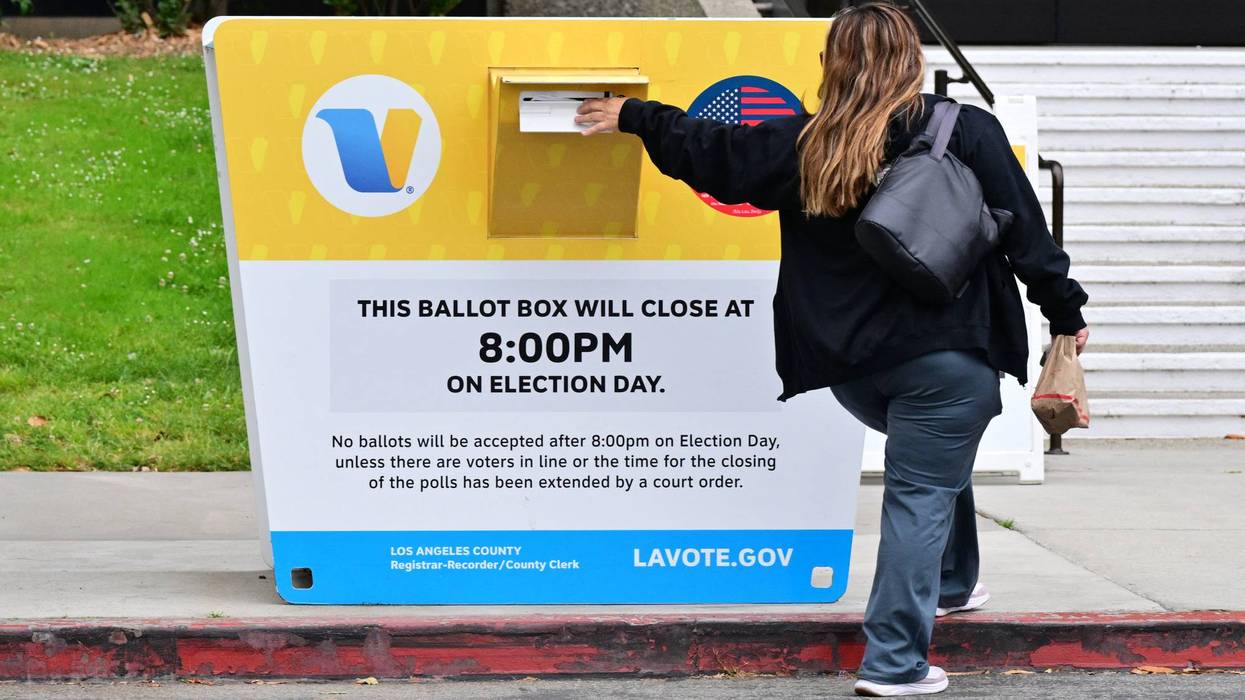
Citing a U.S. law prohibiting states from removing people from their registered voter lists within 90 days of an election, a U.S. federal judge on Wednesday ordered Alabama officials to pause a controversial voter roll purge until after next month's contest.
U.S. District Judge Anna Manasco—an appointee of former President Donald Trump, the 2024 Republican nominee—wrote in her preliminary injunction that GOP Alabama Secretary of State Wes Allen violated the National Voter Registration Act (NVRA) by launching a campaign purportedly targeting "noncitizens registered to vote."
"Allen blew the [NVRA] deadline when he announced a purge program to begin 84 days before the 2024 general election," Manasco said, adding that the secretary of state "later admitted that his purge list included thousands of United States citizens (in addition to far fewer noncitizens, who are ineligible to vote), and in any event, referred everyone on the purge list to the Alabama attorney general for criminal investigation."
The Biden administration's Department of Justice, along with civil and voting rights groups, last month sued Allen and the state of Alabama over the policy's timing. Individual Alabama voters also filed suit claiming the purge targeted naturalized U.S. citizens.
Allen's program removed more than 3,000 people from Alabama's voter rolls and referred them for criminal prosecution. However, more than 2,000 targeted individuals have since been deemed eligible to vote. Manasco's ruling gave Alabama officials three days to restore the active status of all wrongfully purged voters.
Responding to the decision, U.S. Assistant Attorney General Kristen Clarke of the Justice Department's Civil Rights Division said that "this action sends a clear message that the Justice Department will work to ensure that the rights of eligible voters are protected."
"The National Voter Registration Act's 90-day 'quiet period provision' is an important safeguard to prevent erroneous eleventh-hour efforts that stand to disenfranchise eligible voters," Clarke added. "The Justice Department remains steadfast in our resolve to protect voters from unlawful removal from the registration rolls and to ensure that states comply with the mandate of federal law."
Litigants in the challenge to Allen's voter removal program also welcomed Wednesday's ruling.
"We are pleased with the court's swift action to protect Alabama voters from an unlawful purge and ensure they can fully participate in the upcoming elections," League of Women Voters of Alabama president Kathy Jones said in a statement following Manasco's decision. "This ruling strengthens our democracy by safeguarding access to the ballot for all eligible voters including naturalized citizens who were unfairly targeted and removed from the rolls."
Campaign Legal Center senior legal counsel Kate Huddleston said: "No U.S. citizen should be afraid to vote, and we are proud to have defended Alabamians ahead of the upcoming election. Today's court decision helps protect Alabama citizens' freedom to register and vote without concerns about government interference or intimidation."
Janette McCarthy Wallace, general counsel at the NAACP, noted that "for over 115 years, the NAACP has been fighting for the right to vote," and while "the suppression tactics may look different... the intent remains the same—silencing Black and other vulnerable voices."
"This decision is a victory for Nebraskans, democracy, and the rule of law," said one ACLU attorney.
Democracy defenders on Wednesday welcomed a Nebraska Supreme Court
ruling that orders state election officials to comply with a law allowing former felons to vote immediately after they complete their sentences instead of waiting two years.
Nebraska's unicameral Legislature voted 38-6 in favor of LB 20 on April 11. Although Republican Gov. Jim Pillen declined to sign the bill, the measure took effect the following week, as the Nebraska Constitution allows lawmakers to enact laws without gubernatorial consent five days after a bill's passage if the Legislature is still in session.
After allowing the Legislature to pass the law, Pillen explained that Nebraska Attorney General Mike Hilgers and Secretary of State Bob Evnen—both Republicans—"have identified significant potential constitutional infirmities regarding the bill" and encouraged them to "promptly take such measures as are appropriate" to redress these purported flaws.
In July, Evnen ordered county election offices to stop registering former felons who have not received official pardons, claiming LB 20 is "unconstitutional."
The Nebraska Supreme Court justices did not rule on the law's constitutionality, as the state constitution requires five members of the tribunal to declare legislation unconstitutional.
"Because the requisite number of judges have not found that the statutory amendments are unconstitutional, we issue a peremptory writ of mandamus directing the secretary and the election commissioners to implement the statutory amendments immediately," the court's split decision states.
The ruling referred to Patty and Selma Bouvier—the chain-smoking twin sisters of Marge Simpson from TV's long-running animated series "The Simpsons"—in a swipe at Hilgers and Evnen for overstepping their authority by opining on the constitutionality of LB 20.
"Only the Nebraska Supreme Court declares statutes unconstitutional," the decision states. "The [five-justice] supermajority requirement is also well known. Patty and Selma at the Department of Motor Vehicles may not be constitutional scholars, but they know that they are expected to follow the law."
Plaintiff Gregory Spung of Ohama said that Wednesday's ruling left him feeling "ecstatic."
"For so long, I was uncertain if my voice would truly count under this law," he said. "Today's decision reaffirms the fundamental principle that every vote matters. It's a victory not just for me, but for thousands of Nebraskans who can now exercise their right to vote with confidence."
ACLU of Nebraska legal and policy counsel Jane Seu said: "This is justice. Given the sheer scale of disenfranchisement that this decision corrects, there is no question that it will be remembered as one of our state's most consequential voting rights decisions."
"For Nebraskans who have been caught up in this mess for the last few months, the key takeaway is this: If you are done with all terms of your sentence, you are eligible to vote, and there is now a court decision backing that up," Seu added. "Now is the time to know your rights, get registered, and make a plan to vote."
The ACLU—which along with the ACLU of Nebraska, Civic Nebraska, and the law firm Faegre Drinker sued on behalf of Nebraskans seeking ballot access under the new law—said that the voting rights of approximately 7,000 people hung in the balance.
As The Associated Pressnoted following Wednesday's ruling:
Many of them reside in Nebraska's Omaha-centered 2nd Congressional District, where both the race for president and the makeup of Congress could be in play. Nebraska overall is heavily Republican but is one of only two states—the other is Maine—that apportions its Electoral College votes by congressional district. The Omaha-area district has twice awarded its one vote to Democratic presidential candidates—to Barack Obama in 2008 and again to Joe Biden in 2020. In a 2024 presidential race shown by polling to be a dead heat, a single electoral vote could determine who wins.
"This decision is a victory for Nebraskans, democracy, and the rule of law," ACLU Voting Rights Project staff attorney Jonathan Topaz said of Wednesday's ruling.
"Secretary of State Evnen and Attorney General Hilgers attempted to overturn two decades of rights restoration law by executive fiat and re-disenfranchise thousands of Nebraska citizens heading into a presidential election," he continued. "We are grateful the Nebraska Supreme Court invalidated this lawless attempt to reinstate permanent felony disenfranchisement and are thrilled for the thousands of eligible Nebraska voters who will be able to cast ballots in November and beyond."
"We also urge the state to extend its voter registration deadline," Topaz added. "Thousands of Nebraskans have lost months to register due to the secretary's unlawful directive, and they should be allowed sufficient time to register to vote ahead of the November election."
Nebraska's online voter registration deadline is Friday. In-person registration ends October 25. Early voting in the state began on October 7.
As voter registration surges ahead of the November 5 contest between Democratic Vice President Kamala Harris and former Republican President Donald Trump, GOP federal and state lawmakers are trying to make it harder to vote.
In July, for example, U.S. House Republicans passed Rep. Chip Roy's (R-Texas) Safeguard American Voter Eligibility (SAVE) Act, which would require proof of American citizenship to vote in federal elections. Republicans claim the bill is meant to fix the virtually nonexistent "problem" of noncitizen voter fraud.
State-level examples include legislation signed last year by Republican Florida Gov. Ron DeSantis limiting voter registration drives, with fines of up to $250,000 for violators.
Last week, the Sentencing Project, a decarceration advocacy group, published a report estimating that 4 million U.S. adults are ineligible to vote in November's election due to felony disenfranchisement, including a disproportionate number of people of color.
Earlier this year, a federal court struck down a 19th-century North Carolina law criminalizing people who vote while on parole, probation, or post-release supervision due to a felony conviction. Similar legal battles are playing out in other states. The Minnesota Supreme Court recently upheld a law signed in 2023 by Gov. Tim Walz—the 2024 Democratic vice presidential candidate—restoring former felons' voting rights upon completion of their sentences.
Last December, Democratic U.S. lawmakers led by Rep. Ayanna Pressley of Massachusetts and Sen. Peter Welch of Vermont introduced legislation to end former felon disenfranchisement in federal elections and guarantee incarcerated people the right to vote.
Currently, only Maine, Vermont, and the District of Columbia allow all incarcerated people to vote while behind bars.
David Miller was terminated by the University of Bristol for expressing beliefs including that Zionism is "ideologically bound to lead to the practices of apartheid, ethnic cleansing, and genocide."
An employment court in the United Kingdom this week published its full ruling in the case of David Miller, a University of Bristol professor whose firing due to alleged antisemitism was deemed wrongful by the same tribunal earlier this year.
In February, the Employment Tribunal found that Miller was unjustly dismissed in 2021 from his position as a professor of political sociology at the University of Bristol following complaints by Jewish students who felt "unsafe and unprotected" on campus.
Miller argued before the tribunal that Zionism—the movement for a Jewish homeland in Palestine—"necessarily calls for the displacement and disenfranchisement of non-Jews in favor of Jews, and it is therefore ideologically bound to lead to the practices of apartheid, ethnic cleansing, and genocide."
Employment Judge Rohan Pirani wrote in the tribunal's new unanimous 120-page judgment that Miller's views on Zionism are "worthy of respect in a democratic society," are "not incompatible with human dignity," and are not in "conflict with the fundamental rights of others."
Pirani said Miller's stance "amounted to a philosophical belief" and that while it was "ill-judged to express himself in the way he did," his actions were legal, "not antisemitic, did not incite violence, and did not pose any threat to any person's health or safety."
In a social media post on Tuesday, Miller welcomed the tribunal's finding that his beliefs are "protected" and are not—as the University of Bristol attempted to argue—"akin to Nazism."
"It is self-evident that racism is wrong and offensive to human dignity," Miller added. "Zionism, being inherently racist, imperialist, and colonial, is therefore also offensive to human dignity. It is because I believed this and was 'prepared to say it out loud' that I believe I lost my job."
In the tribunal's ruling, Pirani wrote that Miller's views on Zionism were "related to his area of academic expertise and research and were informed by that research and expertise."
According to the decision:
The claimant went on to explain what he regards as the overtly racist and colonial framing within the works of Zionism's founding ideologues. He also references the fact that Amnesty International and Human Rights Watch have found Israel to be "an apartheid state." The claimant gave examples in his evidence of what he regards as "racist laws" which he claims are a necessary corollary of Zionism and Israel's laws regarding emigration or "return."
"We conclude that [Miller's views] have played a significant role in his life for many years," Pirani wrote. "We are satisfied that they are genuinely held. He is and was a committed anti-Zionist and his views on this topic have played a significant role in his life for many years."
Numerous pro-Palestine academics, artists, media professionals, and others have been fired or otherwise punished in Western nations since before the current war on Gaza for which Israel is on trial for genocide at the International Court of Justice. Such incidents have increased dramatically since last October. Jews who support Palestinian liberation and oppose Israeli crimes in Palestine and beyond have not been spared from such repercussions.
The U.K. tribunal's judgment stands in stark contrast to a pair of bills passed since last October by the U.S. House of Representatives declaring that anti-Zionism is antisemitism and affirming the International Holocaust Remembrance Alliance's (IHRA) controversial working definition of antisemitism, which, while not explicitly mentioning anti-Zionism, includes "denying the Jewish people their right to self-determination" and "claiming that the existence of a state of Israel is a racist endeavor."
Pirani's ruling cites a professor who noted that the IHRA definition is "controversial," with "some believing that it is imprecise and can be used to conflate criticism of the policies of the Israeli government and of Zionism with antisemitism."
"As demand for electric vehicles increases, manufacturers must ensure people's human rights are respected."
A transition away from the fossil fuels that have powered vehicles across the globe for decades, worsening the climate emergency, is sorely needed—but an analysis out Tuesday warns that companies spearheading the shift toward electric vehicles must do so while obeying internationally recognized human rights principles, and exposes how the firms have exploited communities in pursuit of minerals for EV batteries.
In a new report, Recharge for Rights, Amnesty International ranked the human rights records of 13 major EV manufacturers, including China-based BYD, Mercedes-Benz, Tesla, and Mitsubishi, on a scale of 1-90.
None of the companies scored higher than 51, with Amnesty researchers identifying the companies' practices of forced evictions to make way for mining, subjecting workers to dangerous conditions, violating Indigenous peoples' rights, and exposing communities to environmental harm.
"While some progress was made, across the board, the scores were a massive disappointment," said Agnès Callamard, secretary general of Amnesty.
The companies have all stepped up mining development efforts as the International Energy Agency has said demand for minerals used in EV batteries—including cobalt, lithium, nickel, and copper—is expected to increase ninefold between 2024-50. Mineral industry analysts say more than 350 new mines will need to be opened by 2035 to meet demand.
But in the rush to extract the minerals, Callamard said, the companies are "putting immense pressures on mining-affected communities."
"The human rights abuses tied to the extraction of energy transition minerals are alarming and pervasive and the industry's response is sorely lacking," she said. "As demand for electric vehicles increases, manufacturers must ensure people's human rights are respected."
Previous research by Amnesty has found that "industrial cobalt is linked to forced evictions in the Democratic Republic of Congo," said Callamard. "Car companies need to use their massive leverage as global minerals buyers to influence upstream mining companies and smelters to mitigate these human rights risks."
The report ranked companies on whether they have publicly available human rights policies, monitor human rights due diligence, and remediate human rights grievances.
BYD, the world's second-largest EV manufacturer, performed the worst on the group's scorecard, with 11 out of 90. Along with Hyundai and Mitsubishi, also low performers, the company published little to no information about its human rights due diligence.
"None of these three multinationals published information demonstrating that they are trying to understand the human rights impacts of their battery metal sourcing," said Amnesty. "None of the three companies reported mapping these supply chains, nor demonstrated that they had identified specific risks."
Mercedes-Benz was the highest performing company with 51 out of 90, indicating "a moderate demonstration of alignment with international standards."
Amnesty called on companies to implement human rights due diligence processes "to identify, prevent, mitigate, and account for how they address adverse human rights impacts that they may cause, contribute to, or be directly linked to through their operations, products, or services."
All carmakers must bring their due diligence efforts "in line with international human rights standards" as outlined in the United Nations Guiding Principles on Business and Human Rights, said Callamard. "We are also calling on governments to strengthen their own human rights due diligence regulation over the companies incorporated on their territories or their exports and import licenses."
Companies and the governments that import and export their goods must acknowledge that "human rights isn't just a fluff phrase, but an issue they take seriously," added Callamard. "It's time to shift gears and ensure electric vehicles don't leave behind a legacy of human rights abuses—instead, the industry must drive a just energy future that leaves no one behind."