

SUBSCRIBE TO OUR FREE NEWSLETTER
Daily news & progressive opinion—funded by the people, not the corporations—delivered straight to your inbox.
5
#000000
#FFFFFF
To donate by check, phone, or other method, see our More Ways to Give page.
Daily news & progressive opinion—funded by the people, not the corporations—delivered straight to your inbox.

Consumers bore the vast majority of the costs of Trump's illegal tariffs, but it's the large corporations that raised prices who are seeing massive refunds.
Congressional Progressive Caucus Chair Greg Casar (D-Texas) said on Monday that "every single cent" of the refunds for President Donald Trump's illegal tariffs should go to consumers who bore the brunt of the financial strain rather than the large corporations currently receiving them.
"Apple got a $2.2 billion tariff refund. Amazon got $600 million," Casar wrote in a post to social media. "Trump is sending the 'refunds' to the companies, not working people."
The Supreme Court struck down many of Trump's sweeping tariffs in February, ruling that he could not impose them unilaterally using powers under the International Emergency Economic Powers Act of 1977.
A group of 25 Democratic states sued the Trump administration on Monday for once again attempting to reimpose the tariffs under a different law, the 1974 Trade Act.
According to the Congressional Budget Office report from February 2026, about 70% of the tariffs were being passed onto consumers in the form of higher prices, while businesses absorbed about 30% of the cost.
Companies were able to pass on even more of the costs to consumers by hiking prices of domestic goods as well, meaning ordinary people were forced to swallow about 95% of the overall cost.
Yale's Budget Lab estimated that Trump's full tariff regime was costing the average household about $2,400 annually. Even after the Supreme Court rolled them back, the Budget Lab estimates that households will pay an extra $1,100 per year.
But the system for refunding the approximately $166 billion taken as part of the unlawful tariff regime allows only "importers" to apply for reimbursement, meaning the refunds have largely flowed to big companies who get to decide how much, if any, of the windfall they want to trickle down. So far, it does not seem to be very much.
Amazon disclosed on Thursday that it was participating in the refund process and that it had received over $600 million from the federal government in quarter two.
Brian Olsavsky, Amazon’s finance chief, said there was a "limited set of circumstances” in which the company could find examples of it directly passing prices along to consumers, since third-parties are the importers for most products, but said it would refund them when they could be identified.
He added that the refunds would also be invested in “low prices for customers," though he provided no details on how that would work.
Apple, meanwhile, is one of the biggest beneficiaries of the refunds. In a press release on Thursday, the company celebrated that the tariff refunds on their own were worth “2 percentage points” of its 50.1% gross margin, which AppleInsider calculated put the total refund at about $2.2 billion, though its most recent earnings report did not disclose the full amount.
But there's no indication that any of that windfall will be seen by consumers, even through lowered prices, let alone through any sort of reimbursement program.
"While Apple is celebrating its margins, it won’t stop your next MacBook Air from becoming more expensive and more scarce," wrote Kyle Barr on Monday for Gizmodo. "Last month, Apple increased prices for practically all its various products."
Other companies have also received or are expecting refunds in the billions or hundreds of millions, including Ford, General Motors, UPS, Nike, and Walmart, though only some have indicated plans to pass on even part of the savings to consumers.
Rep. Mark Pocan said it was "just another transfer of wealth from everyday Americans to mega-corporations."
Several pieces of legislation have been introduced in Congress aiming to provide tariff relief for consumers.
One bill introduced by Reps. Rosa DeLauro (D-Conn.) and Frank Mrvan (D-Ind.) would require companies to reduce prices in accordance with the size of the refund they receive. Another from Rep. Mike Thompson (D-Calif.) would create an individual tariff refund tax credit and tax corporations unless they absorbed tariff costs rather than passing them to consumers.
None of these bills have advanced out of committee or received a floor vote.
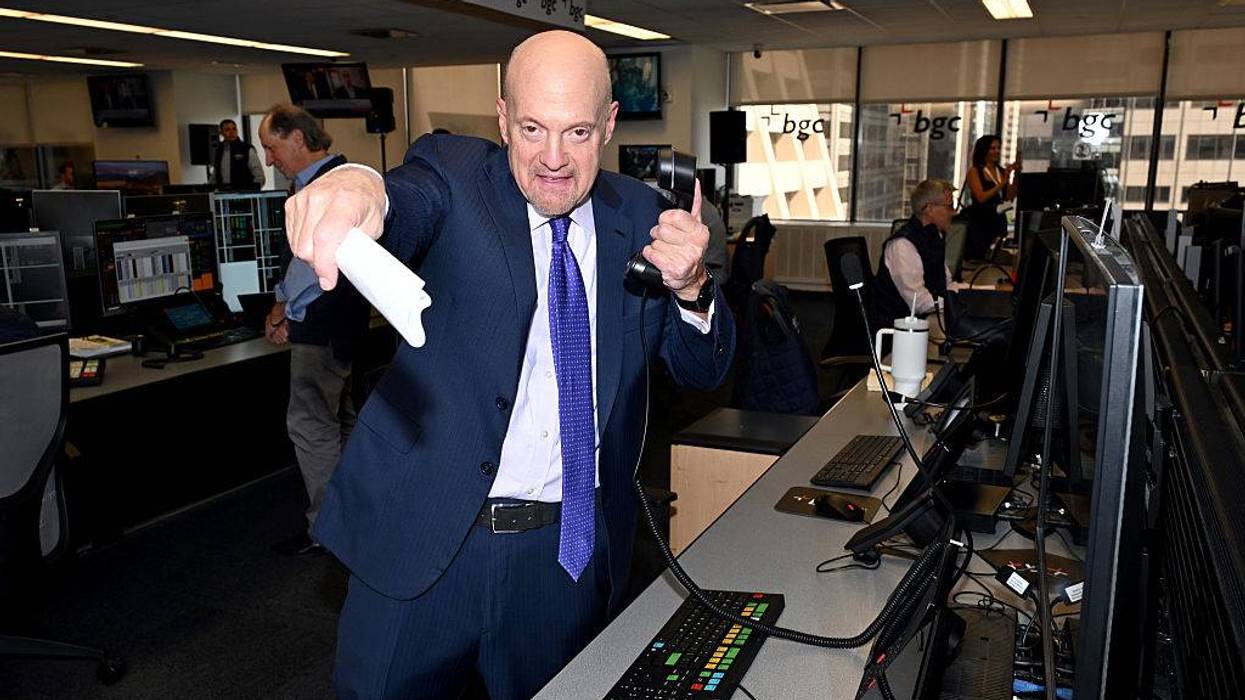
"Cramer here is having what should be the normal reaction to Trump actively insider trading on his own decisions," said journalist Ryan Grim.
One of Wall Street's most recognizable gurus, Jim Cramer, became notably tongue-tied on Monday after President Donald Trump’s recent stock-trading spree entered into a televised conversation with his colleagues on CNBC.
Disclosures published by the US Office of Government Ethics last week revealed that Trump in the first quarter of 2026 carried out over 3,700 stock transactions, including over 30 stock purchases worth $1 million or more.
As noted by The Financial Times, Trump's investments included transactions involving Tesla, Nvidia, Apple, Meta, Visa, Citi, Boeing, Qualcomm, and GE Aerospace, whose executives all accompanied the president on his trip to China last week.
When CNBC co-host Carl Quintanilla brought up these trades during Monday's edition of "Squawk on the Street," Cramer spent ten straight seconds mumbling incoherently.
This promoted co-host David Faber to reassure viewers that "we're not having technical difficulties here," even as Cramer appeared to short circuit.
OMFG the CNBC anchors were puffing up the value of chipmaker Intel, they brought up Trump doing personal trades in the stock, and Jim Cramer stuttered for 15 seconds straight and then was quiet.
Was Cramer shocked by the corruption or mad Trump was picking better stocks? pic.twitter.com/oCl3ypNids
— Matt Stoller (@matthewstoller) May 18, 2026
Journalist Ryan Grim said that Cramer's reaction to mention of Trump's trades was understandable given that some of the companies whose stocks he traded have been direct beneficiaries of the president's illegal war with Iran and other policies.
"Cramer here is having what should be the normal reaction to Trump actively insider trading on his own decisions," remarked Grim. "Just sputtering speechlessness."
Journalist Judd Legum on Monday published an analysis of the Trump stock trades in which he identified multiple instances where the president purchased stocks of companies shortly before—or in some cases, on the exact same day—that he publicly singled them out for praise.
Specifically, Legum found that Trump bought tens of thousands of dollars' worth of shares in biotech firm Thermo Fisher Scientific on the same day he took a tour of one of its manufacturing facilities, and hundreds of thousands of dollars' worth of shares in Apple on the same day he delivered a speech calling it "a great company," while saying then-CEO Tim Cook has "done a good job."
Trump also bought up shares in Micron Technology and then described it as "one of the hottest companies" during an interview with Fox News just one day later.
And nine days after buying millions of dollars' worth of shares in Dell, Trump delivered a speech in Georgia where he told his audience to "go out and buy a Dell computer."
In analyzing the trades, Legum explained how Trump has destroyed any remaining guardrails preventing US presidents from using their office to personally enrich themsleves.
"If Trump wanted to legally remove himself from investment decisions he could do so by creating a qualified blind trust," Legum wrote. "Instead, before returning to the White House, Trump transferred his assets in a trust that is managed by his son, Donald Trump Jr. There are no legal or practical barriers preventing Trump from being involved in the management of his assets."
Rep. Dan Goldman (D-NY) warned Trump that details of his assorted stock trades would eventually come to light.
"This smells like blatant and criminal insider trading," Goldman wrote in a social media post. "Even worse, Trump is personally profiting off of his illegal deportation dragnet. Since we know congressional Republicans will pretend like they never saw this and won’t do a thing, anyone involved in these trades should preserve their records for my investigation in January 2027."
"Capitulating to an authoritarian regime is never the right move,” the app's developer said.
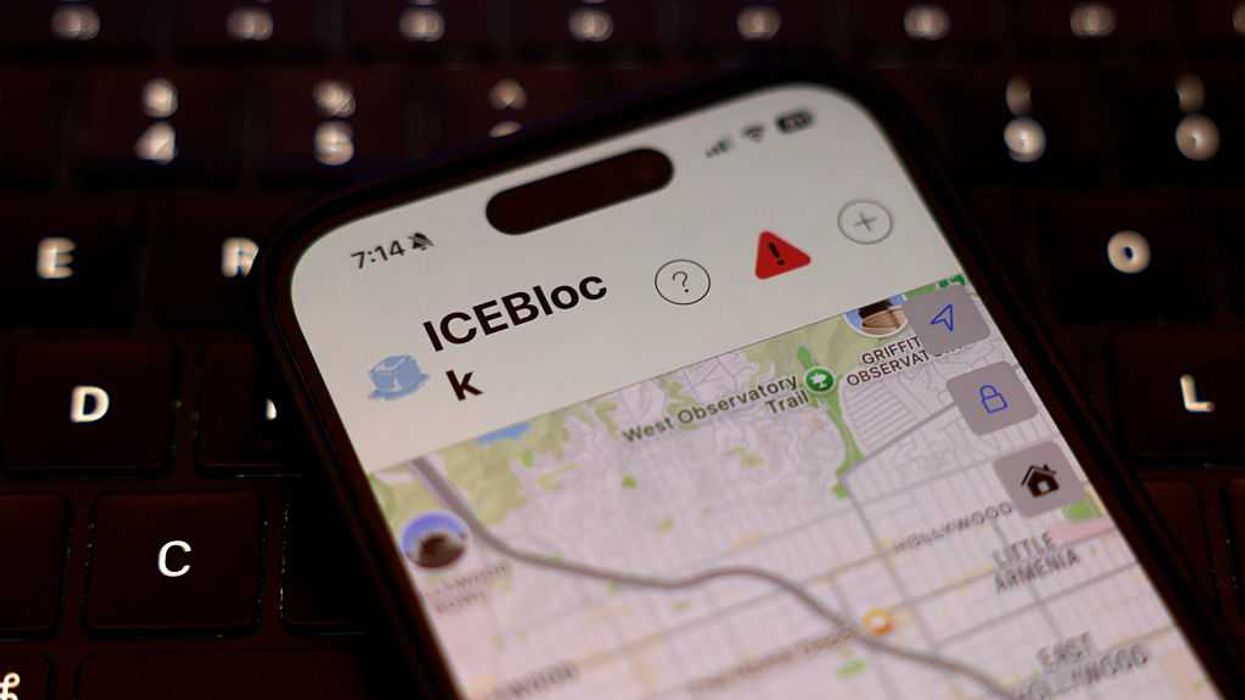
Caving to what the developer described as "pressure from the Trump administration," Apple has removed an application that allowed users to report and track US Immigration and Customs Enforcement operations in their area.
"ICEBlock," which has over 1 million downloads, allowed users to report sightings of ICE agents within a "5-mile radius of your current location" to alert immigrants and others in the community fearful of being swept up in President Donald Trump's "mass deportation" crusade.
Its developer, Joshua Aaron, told NBC News that he created it in April because he felt like he was “watching history repeat itself” when he saw things like “5-year-olds in courtrooms with no representation” and “college students being disappeared for their political opinions.”
“When I saw what was happening in this country, I really just wanted to do something to help fight back,” he said.
Downloads of the app surged in June as the administration accelerated its deportation efforts, aiming for a daily quota of 3,000 arrests. That's also when CNN published a piece about the app that caught the attention of the Department of Homeland Security (DHS).
DHS Secretary Kristi Noem said she was "working with the Department of Justice to see if we can prosecute them [CNN]" for reporting on the app, which she said was "actively encouraging people to avoid law enforcement activities, operations."
Courts have long held that recording the actions of law enforcement is protected by the First Amendment of the US Constitution. Aaron contended, in a statement emailed to 404 Media, that "ICEBlock is no different from crowd-sourcing speed traps, which every notable mapping application, including Apple's own Maps app, implements as part of its core services."
Fox Business reported Thursday that Apple had removed ICEBlock following direct pressure from the Justice Department, including Attorney General Pam Bondi.
"We reached out to Apple today demanding they remove the ICEBlock app from their App Store—and Apple did so," Bondi said in a statement. "ICEBlock is designed to put ICE agents at risk just for doing their jobs, and violence against law enforcement is an intolerable red line that cannot be crossed."
Following the shooting at an ICE facility in Dallas last week, which resulted in the deaths of two detainees and the critical injury of another, federal officials claimed that the shooter had used ICE tracking apps; however, they stopped short of naming any specific app or claiming that he used it to plan the shooting. Aaron has dismissed these charges as politically motivated.
Aaron shared a copy of Apple's email informing him that ICEBlock had been removed with 404 Media. It said the program violated the App Store's policy against "objectionable content," specifically its section banning "defamatory discriminatory, or mean-spirited content, including references or commentary about religion, race, sexual orientation, gender, national/ethnic origin, or other targeted groups, particularly if the app is likely to humiliate, intimidate, or harm a targeted individual or group.”
The email then said, "Information provided to Apple by law enforcement shows that your app violates Guideline 1.1.1 because its purpose is to provide location information about law enforcement officers that can be used to harm such officers individually or as a group.”
Aaron disputed this characterization, saying: “Apple has claimed they received information from law enforcement that ICEBlock served to harm law enforcement officers. This is patently false.”
Apple has said it also removed "similar apps" from the App Store, citing law enforcement concerns.
The removals come as immigration operations around the country have drawn increasing national scrutiny, with a number of high-profile acts of brutality in just the past week.
On Tuesday night, just hours after Trump said US soldiers should use American cities as "training grounds," federal law enforcement agents descended upon an apartment complex in Chicago where witnesses told the Chicago Sun-Times they broke down residents’ doors, smashed furniture and belongings, and dragged dozens of people, including children, into U-Haul vans as part of an operation that nabbed 37 people.
Last week, an agent was filmed throwing an Ecuadorian asylum seeker to the ground shortly after her husband was detained in front of their family at an immigration courthouse in New York City, where they'd come for an immigration hearing. DHS briefly put the officer on leave, calling his conduct "unacceptable," before returning him to the job three days later.
On Tuesday, a photojournalist had to be hospitalized after an ICE agent pushed him to the ground at the same facility, leading him to hit his head on the floor.
“I am incredibly disappointed by Apple's actions today. Capitulating to an authoritarian regime is never the right move,” Aaron wrote. “We are determined to fight this with everything we have. Our mission has always been to protect our neighbors from the terror this administration continues to [rain] down on the people of this nation. We will not be deterred. We will not stop. #resist."
Amnesty International says Big Tech's consolidation of power "has profound implications for human rights, particularly the rights to privacy, nondiscrimination, and access to information."
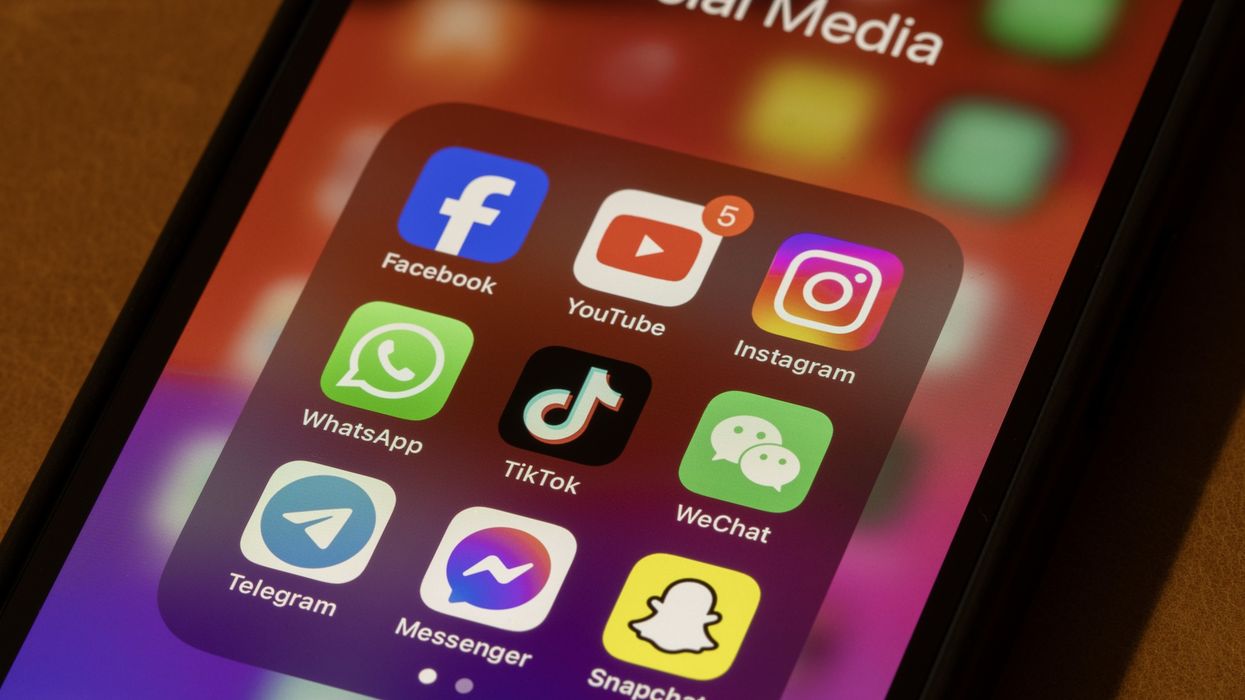
One of the world's leading human rights groups, Amnesty International, is calling on governments worldwide to "break up with Big Tech" by reining in the growing influence of tech and social media giants.
A report published Thursday by Amnesty highlights five tech companies: Alphabet (Google), Meta, Microsoft, Amazon, and Apple, which Hannah Storey, an advocacy and policy adviser on technology and human rights at Amnesty, describes as "digital landlords who determine the shape and form of our online interaction."
These five companies collectively have billions of active users, which the report says makes them akin to "utility providers."
"This concentration of power," the report says, "has profound implications for human rights, particularly the rights to privacy, nondiscrimination, and access to information."
The report emphasizes the "pervasive surveillance" by Google and Meta, which profit from "harvesting and monetizing vast quantities of our personal data."
"The more data they collect, the more dominant they become, and the harder it is for competitors to challenge their position," the report says. "The result is a digital ecosystem where users have little meaningful choice or control over how their data is used."
Meanwhile, Google's YouTube, as well as Facebook and Instagram—two Meta products—function using algorithms "optimized for engagement and profit," which emphasize content meant to provoke strong emotions and outrage from users.
"In an increasingly polarized context, the report says, "this can contribute to the rapid spread of discriminatory speech and even incitement to violence, which has had devastating consequences in several crisis and conflict-affected areas."
The report notes several areas around the globe where social media algorithms amplified ethnic hatred. It cites past research showing how Facebook's algorithm helped to "supercharge" dehumanizing rhetoric that fueled the ethnic cleansing of the Rohingya in Myanmar and the violence in Ethiopia's Tigray War.
More broadly, it says, the ubiquity of these tech companies in users' lives gives them outsized influence over access to information.
"Social media platforms shape what millions of people see online, often through opaque algorithms that prioritize engagement over accuracy or diversity," it says. "Documented cases of content removal, inconsistent moderation, and algorithmic bias highlight the dangers of allowing a handful of companies to act as gatekeepers of the digital public sphere."
Amnesty argues that international human rights law requires governments worldwide to intervene to protect their people from abuses by tech companies.
"States and competition authorities should use competition laws as part of their human rights toolbox," it says. "States should investigate and sanction anti-competitive behaviours that harm human rights, prevent regulatory capture, and prevent harmful monopolies from forming."
Amnesty also calls on these states to consider the possible human rights impacts of artificial intelligence, which it describes as the "next phase" of Big Tech's growing dominance, with Microsoft, Amazon, and Google alone controlling 60% of the global cloud computing market.
"Addressing this dominance is critical, not only as a matter of market fairness but as a pressing human rights issue," Storey said. "Breaking up these tech oligarchies will help create an online environment that is fair and just."
"Just one authoritarian thing after another."
US President Donald Trump's White House has reportedly created a scorecard that rates American corporations and trade groups based on how fervently they have promoted Trump's agenda, a move that critics described as part of the president's authoritarian approach to governing and dealing with private businesses.
Axios, which first reported on the White House scorecard Friday, explained that the document "rates 553 companies and trade associations on how hard they worked to support and promote President Trump's 'One Big Beautiful Bill,'" which includes massive corporate tax breaks and unprecedented cuts to safety net programs.
"Factors in the rating include social media posts, press releases, video testimonials, ads, attendance at White House events, and other engagement related to 'OB3,' as the megabill is known internally," the outlet reported. "The organizations' support is ranked as strong, moderate, or low. Axios has learned that 'examples of good partners' on the White House list include Uber, DoorDash, United, Delta, AT&T, Cisco, Airlines for America, and the Steel Manufacturers Association."
The spreadsheet is reportedly being circulated to senior White House staffers and is expected to evolve to gauge companies' support for other aspects of the president's agenda. Corporations that decline to praise Trump's policies—or dare to criticize them—could face government retribution.
"Just one authoritarian thing after another," Rachel Barnhart, a Democratic member of the Monroe County, New York Legislature, wrote in response to the Axios story.
News of the internal "loyalty rating" spreadsheet comes days after Trump reached an unprecedented deal with the chip giants Nvidia and Advanced Micro Devices that critics likened to a strongman-style "shakedown." The companies agreed to pay the US government 15% of their revenues from exports to China in exchange for obtaining export licenses.
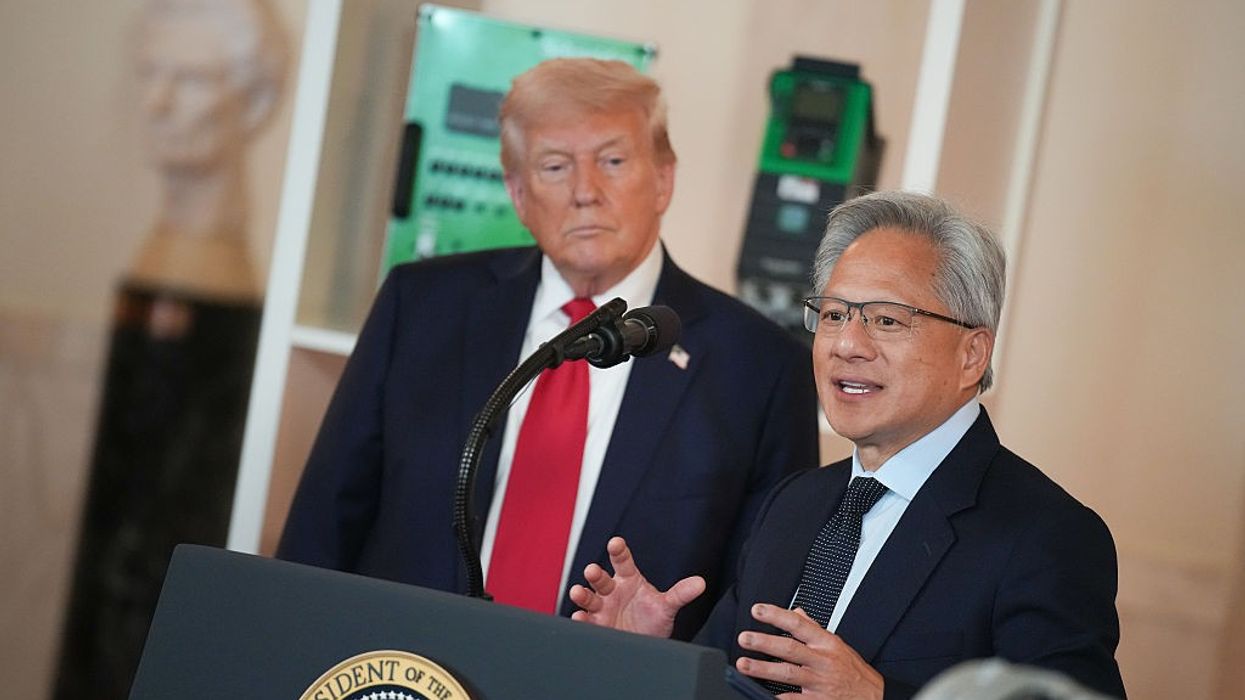
Trump, who has reported substantial holdings in Nvidia, has hosted company CEO Jensen Huang—one of the richest men in the world—at the White House at least twice this year. Huang has effusively praised the president, calling his policies "visionary."
That's just one example of how major CEOs have sought to flatter Trump, who has proven willing to publicly attack executives—and even demand their resignation.
Fortune noted Wednesday that "Apple CEO Tim Cook gave Trump a customized glass plaque mounted on a 24-karat gold stand last week, when he announced his company’s $100 billion investment in domestic production."
Cook also donated $1 million to Trump's inaugural fund.
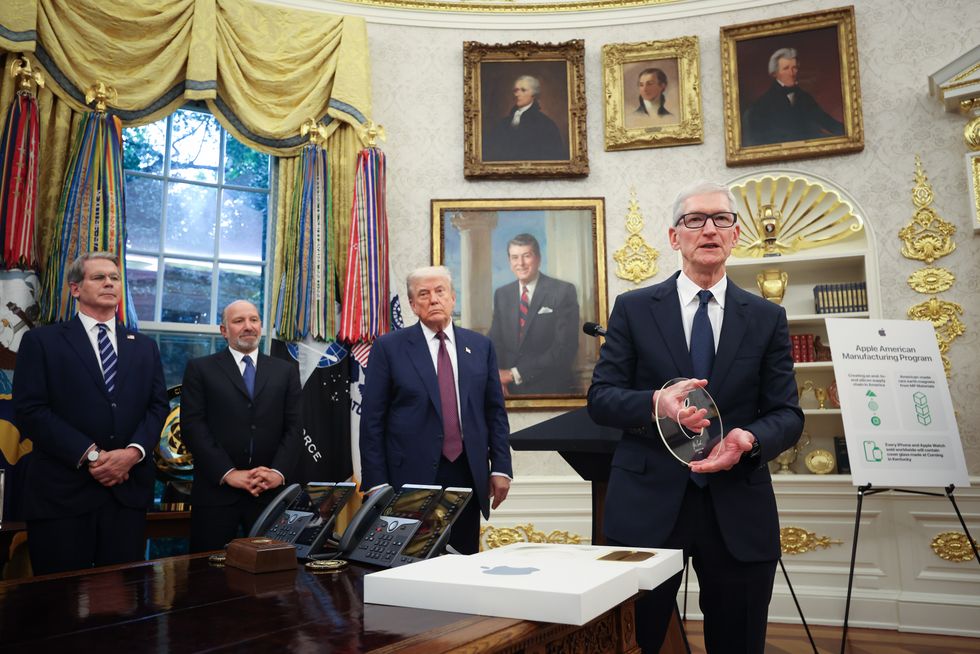
Companies that have worked to get in the president's good graces appear to be reaping significant rewards.
A Public Citizen analysis published earlier this week found that companies spending big in support of Trump are among the chief beneficiaries of his administration's deregulatory blitz and retreat from corporate crime enforcement.
"Tech corporations facing ongoing federal investigations and enforcement lawsuits that are at risk of being dropped or weakened following the industry's influence efforts include Amazon, Apple, ByteDance, Google, Meta, OpenAI, Snap, Uber, Zoom, and Musk-helmed corporations The Boring Company, Neuralink, SpaceX, Tesla, X, and xAI," the group said.
Business journalist Bill Saporito wrote in an op-ed for The New York Times earlier this week that "in ripping up numerous business regulations, Donald Trump seems intent on replacing them with himself."
"The recipient corporations don't necessarily want Mr. Trump's meddling, particularly given his fun house view of economics," Saporito added, "but they can't get away from it."
"Want a tax break or special favor from the government? No problem," Sen. Bernie Sanders quipped.
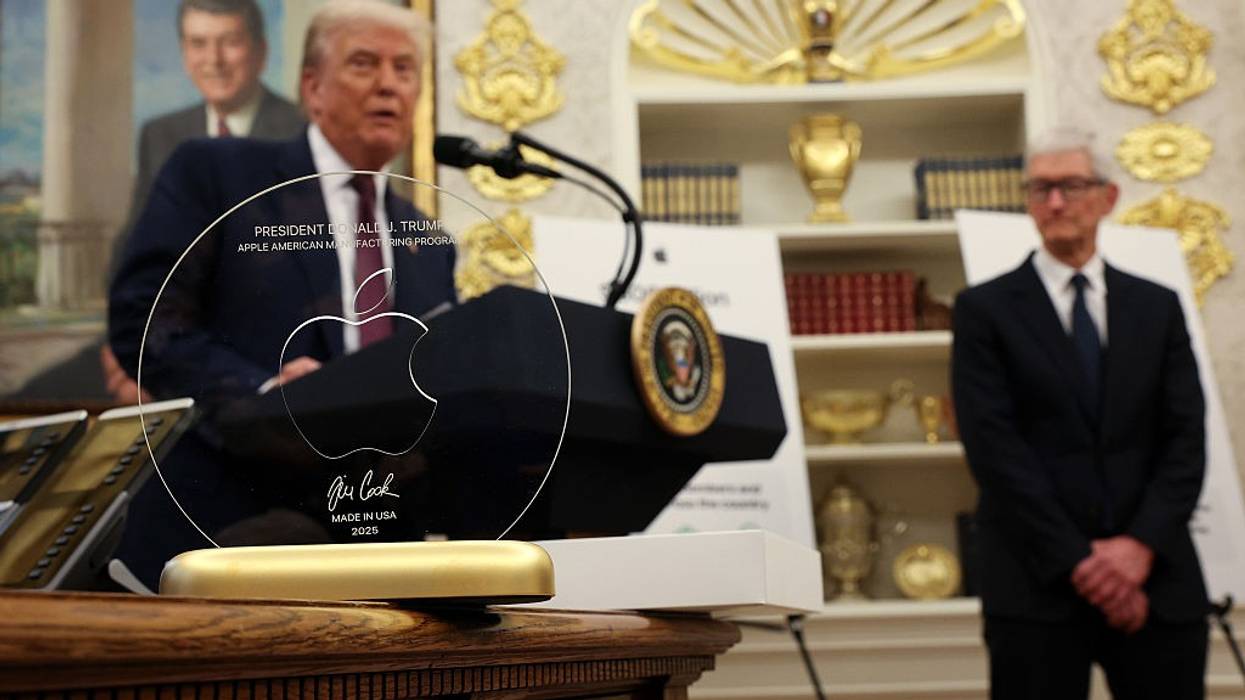
Sen. Bernie Sanders on Friday tore into Apple CEO Tim Cook for scoring a special tax break for his company while presenting U.S. President Donald Trump with a 24-karat gold statue.
As reported by The Washington Post earlier, Cook presented Trump with the gold statue during an event at the White House in which the president announced that Apple would be exempt from the hefty 100% tariffs that he announced this week on imported semiconductors.
In a post on X, Sanders (I-Vt.) linked Trump's reception of the Apple statue to his decision to accept a luxury jet from the Qatari royal family that he will take with him after he leaves office.
"Want a tax break or special favor from the government? No problem," Sanders wrote. "If, unlike Qatar, you can't afford to give Trump a $400 million plane, just walk into the White House with a modest gold statue like Apple CEO Tim Cook. That works, too. Kleptocracy in action."
Sanders' denunciation of Trump's pay-to-play governance comes as he is planning to travel to West Virginia and North Carolina this weekend as the latest stop in his "Fighting Oligarchy" tour in which he'll hammer the recently passed Republican budget package that axed $1 trillion in funding from Medicaid over the span of a decade.
This argument could prove particularly effective in West Virginia, where KFF estimates that 513,000 residents, or roughly 29% of the population, are enrolled in either Medicaid or the Children's Health Insurance Program. What's more, KFF estimates that nearly half of all births in West Virginia are financed by Medicaid.
"I believe from the bottom of my heart, that whether you are in a red state, whether you're in a blue state or a purple state, the American people do not want to see massive tax breaks for billionaires and cuts to Medicaid, education, and nutrition," Sanders said in a Facebook video announcing his trip to the state.
Sanders is scheduled to speak in the city of Wheeling on Friday night before heading to stops in the cities of Lenore and Charleston on Saturday. On Sunday, he's headed to North Carolina, for events in Greensboro and Asheville.
"All these goodies were paid for in part by denying families healthcare," said the executive director of Americans for Tax Fairness. "The tradeoff couldn't be more clear or more cruel."
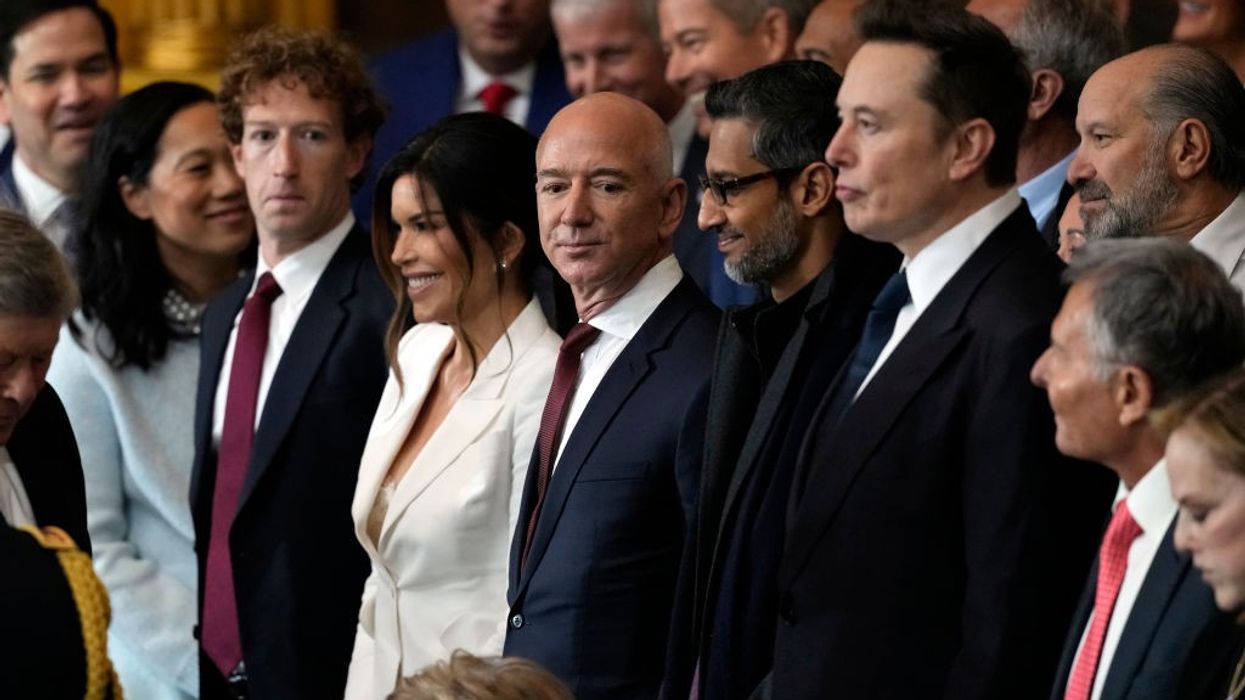
A report released on Monday by Americans for Tax Fairness found that the profits of America's biggest corporations surged by $100 billion last year and were roughly twice the total profits these companies reported in 2017.
The Americans for Tax Fairness (ATF) report, which was based on data collected by Fortune, found that the 100 biggest companies in the U.S. recorded collective after-tax profits of $1.2 trillion during a time when American voters have consistently told pollsters they are having trouble paying for groceries.
Big tech companies led the way in terms of total profits last year, with Google parent company Alphabet raking in $100 billion in after-tax profits, followed by Apple with $94 billion in profits, Microsoft with $88 billion in profits, and Nvidia with $73 billion in profits. Holding company Berkshire Hathaway was the only non-tech firm to post such gaudy numbers, as its yearly profits in 2024 totaled $89 billion.
ATF noted that corporate America was raking in these big profits even before congressional Republicans passed their massive budget law that included even more tax cuts designed to benefit the country's largest companies.
David Kass, ATF's executive director, said the GOP's budget package looks even more extreme given what we now know about the financial health of corporate balance sheets.
"Most Americans know in their bones that huge corporations don't need any more tax cuts, but the newest data on the revenue and profits of the nation's biggest firms confirms that hunch," he said. "Among the giveaways to the rich and powerful in the recently enacted Trump-GOP tax scam are roughly $900 billion in loophole openers, ranging from accelerated depreciation to a more generous interest deduction. All these goodies were paid for in part by denying families healthcare, taking food from hungry kids, and boosting household utility prices. The tradeoff couldn't be more clear or more cruel."
ATF also contended that American workers have little to show for these corporate tax cuts, as "the nation's largest firms have spent $3.2 trillion on stock repurchases and $2.1 trillion on dividends" since the first GOP-passed corporate tax package came into law in 2017.
Polls have shown the GOP budget package, which was signed into law by U.S. President Donald Trump last month, to be extremely unpopular with voters. An analysis conducted recently by data journalist G. Elliott Morris found that the budget law "is likely the most unpopular budget ever, is the second most unpopular piece of key legislation since the 1990s, and the most unpopular key law, period, over the same period."
"What happened in that call?" asked the Democratic senator. "I'm pressing for answers."
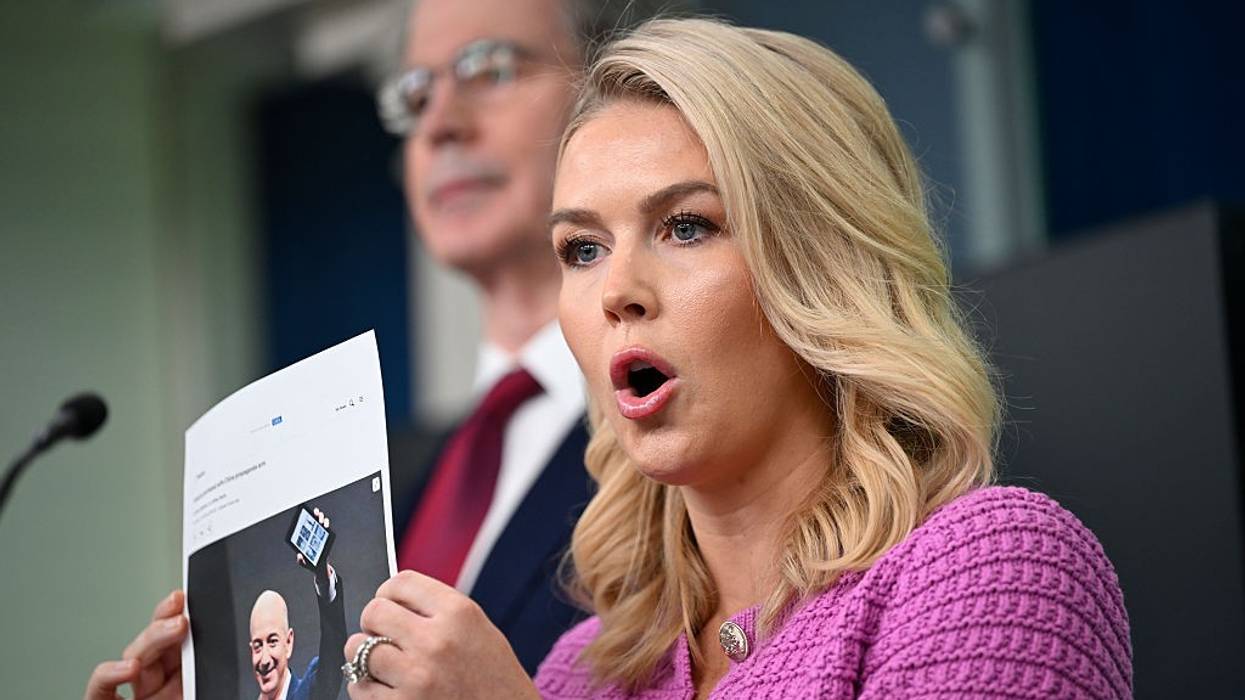
U.S. Sen. Elizabeth Warren on Wednesday pressed Jeff Bezos for answers after the Amazon founder abruptly ditched a reported plan to display tariff costs to customers following a phone call with President Donald Trump.
On Tuesday, the White House lashed out at what Press Secretary Karoline Leavitt called "a hostile and political act" following reporting by Punchbowl News that Amazon "will display how much of an item's cost is derived from tariffs—right next to the product's total listed price."
"Yesterday's activity appears to be another example of Big Tech working together with President Trump to seek special favors."
However, after Trump and Bezos spoke over the phone, the president called the multibillionaire "a good guy" who "solved the problem very quickly."
In a letter to Bezos, Warren (D-Mass.) wrote that "these reports raise questions about the nature of your conversations with President Trump, acnd what promises or favors you may have received in exchange for your subservience to him."
"Yesterday's activity appears to be another example of Big Tech working together with President Trump to seek special favors or support his policies in what can appear to be a quid pro quo," the senator continued—an assertion refuted as "inaccurate" by an Amazon spokesperson.
Amazon had plans to show customers how much Trump tariffs are raising prices. Then Bezos got on the phone with Trump and reversed course. What happened in that call? I'm pressing for answers.
[image or embed]
— Elizabeth Warren (@warren.senate.gov) May 1, 2025 at 7:58 AM
"If Amazon had followed through on any plans to provide transparency on tariff costs, it could have provided important information for consumers, allowing them to find out for themselves some of the true costs of President Trump's broad and chaotic tariff policies," Warren added.
Approximately 70% of the products sold on Amazon made in China, which Trump recently hit with a 145% levy on a sweeping range of imported goods. China retaliated with a 125% tariff on U.S. imports. Economists are in near-universal agreement that such tariffs are a regressive tax on consumers. According to reports citing Chinese state media, the Trump administration has reached out to Beijing seeking talks on de-escalating the mutually destructive trade war.
Warren previously pressed Apple CEO Tim Cook over the Trump administration's massive tariff exemptions for company products including iPhones, computers, and microprocessors.
"My concerns about the potential for tariff-related corruption to benefit Big Tech firms—who provided millions in donations to the Trump inaugural committee—and other insiders as the president rolls out, reverses, and modifies his policies have become more acute with each passing day," the senator said in her letter.

"Our analysis would indicate that tax avoidance continues to be hard-wired into corporate structures," said the CEO of the Fair Tax Foundation.
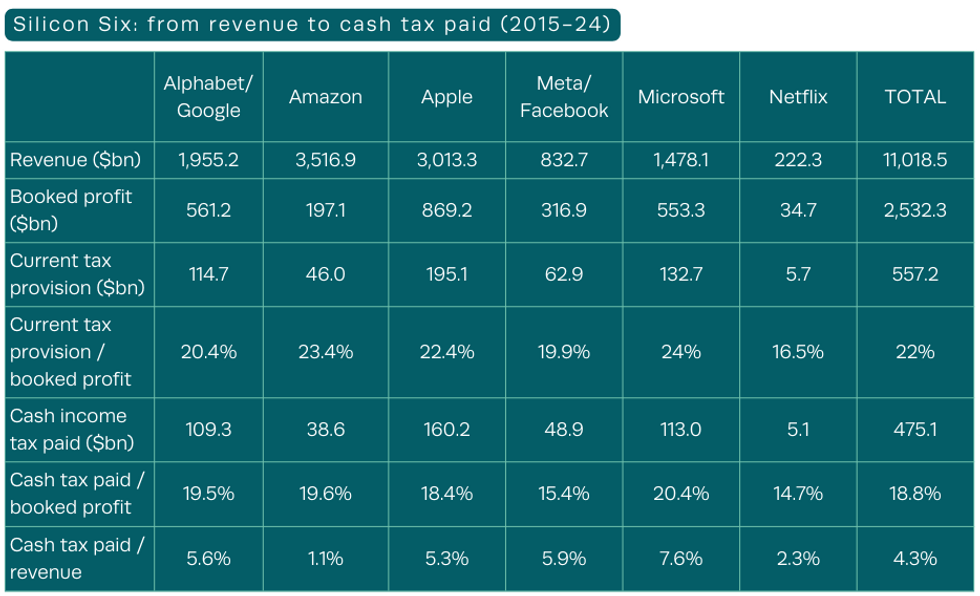
A report published Tuesday to coincide with the tax filing deadline in the United States found that, over the past decade, six of the country's largest tech corporations have paid nearly $278 billion less in taxes than they should have under statutory tax rates worldwide.
The analysis by the Fair Tax Foundation (FTF) estimates that the so-called "Silicon Six"—Amazon, Meta, Alphabet, Netflix, Apple, and Microsoft—paid an average corporate income tax rate of 18.8% on a combined $2.5 trillion in profits between 2015 and 2024.
That's well below the average statutory corporate tax rate during that period in the U.S. (29.7%) and globally (27%), resulting in a "tax gap" of $277.8 billion.
"Our analysis would indicate that tax avoidance continues to be hard-wired into corporate structures," said Paul Monaghan, FTF's chief executive officer. "The Silicon Six's corporate income tax contributions are, in percentage terms, way below what sectors such as banking and energy are paying in many parts of the world."
Of the six corporate behemoths examined in the report, Amazon is the worst tax offender, according to FTF—but all of the companies are guilty of what the group called "aggressive" practices to avoid taxation.
The companies have also benefited greatly from the foreign-derived intangible income tax break. FTF said that, thanks to the tax break, "much of the Silicon Six's overseas revenue is subject to 'tax haven' level rates" in the U.S.
"This is especially so at Meta (Facebook), Alphabet (Google), and Netflix, where the foreign-derived intangible income (FDII) deduction reduced their effective tax rate by a substantial five percentage points each in 2024," the new analysis found. "The FDII has been worth $30 billion to the Silicon Six over the past three years alone."
The analysis comes as Republicans in the U.S. Congress and President Donald Trump work to advance another round of tax cuts that would predominantly benefit wealthy Americans and large corporations. The Trump administration is also trying to gut the Internal Revenue Service with large-scale workforce cuts, which would further hinder the agency's ability to pursue rich tax cheats.
FTF's new report notes the "enormous political influence" that the Silicon Six exert to preserve and enhance their tax benefits: The six companies spent a combined $115 million lobbying the U.S. government and the European Union last year.
To prevent corporate tax avoidance that is costing governments around the world billions of dollars in revenue that could be spent on education, healthcare, and other priorities, FTF said the U.S. should "end the FDII tax break" and back a 15% global minimum tax on multinational corporations.
In February, Trump withdrew the U.S. from a tax agreement that included a global minimum levy.
FTF also urged other governments to "give more serious consideration to the degree to which the Silicon Six's overseas revenue is subject to low levels of corporate income tax and develop more assertive responses to ensure that a fairer tax contribution is secured and so that more equitable business competition can operate within their jurisdictions."
Trump has too many ways to punish them.
Friends,
As tens of millions of Americans hussle to pay their taxes, President Donald Trump has put the entire global economy into chaos. 401(k)s are tanking, savings are shrinking, treasury bonds are losing value, supply chains are convulsing.
Even America’s oligarchs are petrified. They contributed millions to Trump’s inauguration. Many invested heavily in his campaign. They lavished praise on the new president and have supported his every move—in order to benefit from his promised big tax cut.
But the chaos he’s unleashed on the world economy is causing many of them to go public with their worries.
“Obviously,” Jamie Dimon, JPMorgan Chase’s chief executive, said in a conference call with reporters, “the China stuff is significant. We don’t know the full effect.”
But we do know that global investors are fleeing Treasury bonds, which had been the safest place to put money in the world. That may not be the full effect, but it’s a huge and frightening one.
By Friday morning, Dimon was warning that the economy faced “considerable turbulence” from the tariffs, while echoing Trump’s assertion that the immediate turmoil was nothing to worry about. “I really almost don’t care fundamentally about what the economy does in the next two quarters,” Dimon said. “That isn’t that important. We’ll get through that. We’ve had recessions before and all of that.”
Oops. The word “recession” coming out of the mouth of the CEO of the largest bank in the United States? That itself is extraordinarily worrying.
Notably, JPMorgan has added nearly half a billion dollars to its financial cushion, preparing for losses from customers who won’t be able to pay credit card debts and loans.
Other oligarchs are repeating the R word.
In a Friday interview on CNBC, BlackRock’s chief executive, Laurence D. Fink, warned that the American economy was “very close—if not in—a recession now.” Fink admitted that in its push for tariffs, the United States had become “the global destabilizer” and that the trade war “went beyond anything I could have imagined in my 49 years in finance.”
Yesterday, Dan Ives, an analyst for Wedbush Securities, told investors that “the mass confusion created by this constant news flow out of the White House is dizzying for the industry and investors and creating massive uncertainty and chaos for companies trying to plan their supply chain, inventory, and demand.”
Many oligarchs continue to kiss Trump’s derriere while at the same time trying to signal to major investors that they’re sane. It’s tricky. “A willingness to adjust a strategy based on new facts and data is a sign of the strength of a leader,” Bill Ackman, the chief executive of the hedge fund Pershing Square, pirouetted on social media yesterday. “It is not an indication of weakness.”
No. It’s an indication of insanity.
“Sentiment has obviously deteriorated,” Robin Vince, chief executive of BNY, one of the world’s largest banks, said in an interview. “Time is not our friend.”
When they speak in the passive tense like this, you know they’re pulling their punches.
None dare come right out and say it: Trump is f*cking out of his mind and crashing the entire world economy. “It’s not smart to criticize the president,” said Robert K. Steel, a veteran Wall Street executive and top Treasury Department official under President George W. Bush.
Not smart because Trump has too many ways to punish them.
Last month, the Trump Organization sued the giant financial services company Capital One for shutting the organization’s accounts after the January 6, 2021, attack on the Capitol.
The oligarchs know Trump has many ways to reward them, too.
On Friday, Tim Cook, CEO of Apple, got a reprieve from Trump’s tariffs on China, which would have just about killed Apple’s iPhone profits. (The exclusions apply to smartphones and other electronics.)
Cleverly, Cook, and Apple had announced last Monday that, as a result of a conversation between Cook and Trump, Apple would be investing more than $500 billion in the United States over the next four years and creating thousands of jobs, in what looked like “a bet on America.”
It was BS. The $500 billion figure was simply what Apple had already planned, including everything from Apple’s day-to-day activities with thousands of suppliers in all 50 states to the operation of its domestic data centers, as well as its investments in Apple TV+ and other projects already manufactured in the country.
The announcement mentioned a new advanced manufacturing plant in Houston to produce servers that support Apple’s AI, but the plant is owned by Foxconn, which is doing the investing. (Apple has perfected the art of outsourcing capital expenditures to its partners without risking its own money.)
But yesterday, Trump backtracked even on the electronics reprieve, calling it “temporary.” China, meanwhile, put a stop to shipments of rare earth materials critical to semiconductors and much of our military technology.
Where and how will this chaos end? The oligarch’s main line in to Trump is through Treasury Secretary Scott Bessent, who apparently talked Trump down from the worst of his tariff craziness last week.
But Bessent himself is part of the chaos. He and others inside the White House are all saying radically different things. No one is in charge. Some, like Elon Musk and trade adviser Peter Navarro, are openly taking potshots at each other.
Bessent, a member of the billionaires club, doesn’t even get what this economic chaos is doing to average Americans. Last weekend, he said on NBC’s “Meet the Press” that people who want to retire now aren’t paying attention to the stock market: “They don’t look at the day-to-day fluctuations of what’s happening.”
Hello?
The oligarchs won’t tell Trump how much chaos he’s unleashed, and they don’t even know how the chaos is affecting average people. The oligarchy is almost as incompetent and out of touch as is Trump.
But average people comprise the real economy. They’re also taxpayers. And their worried discussions over their kitchen tables spell even worse trouble ahead for the economy—and far worse ahead for Trump and his Republican Party.