5
#000000
#FFFFFF
To donate by check, phone, or other method, see our More Ways to Give page.
Daily news & progressive opinion—funded by the people, not the corporations—delivered straight to your inbox.
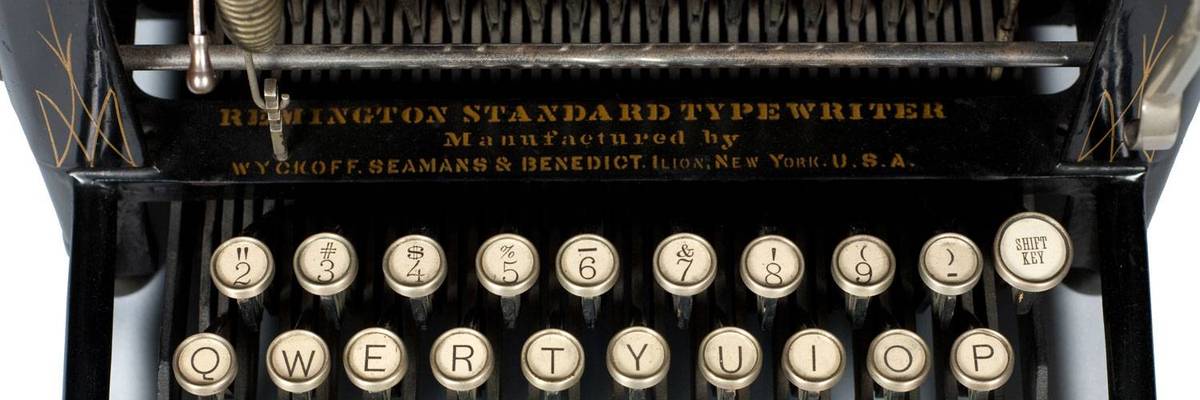
A Remington No.2 typewriter keyboard is pictured.
We don’t need more billionaires and trillionaires, and at least for now, we don’t need superintelligence. We can choose instead technology that improves human lives, strengthens communities, and serves the public good.
One of the things that delights me about the small city where I live is that it has not one, but two typewriter shops. In the window of one is the best collection of witty, antifascist posters of any shop around, and overlooks our city’s new Quincy Square, celebrating the life of our hometown hero, Quincy Jones. The window of the other features a life-size cutout of Humphrey Bogart.
Decor aside, I don’t know how there is a business model to support two typewriter stores. Could it be we’re experiencing nostalgia for a time before tech bros and AI corporations had so much power, and when the technology we used was less opaque, didn’t take our jobs and harm our children.
Perhaps it is also the weight of all the possible disasters we face—climate catastrophe; nuclear war; fascism; and the newest one, tech infrastructure meltdowns.
With increasingly sophisticated and sometimes flawed AI models handling the upgrades, and the humans overseeing the process struggling to keep up, we risk institutionalizing an extraordinary level of vulnerability into the infrastructure we depend on for survival.
Recent outages involving air travel, Microsoft services, and other critical systems offer a sobering reminder of how dependent we have become on complex technology. The outages are not being blamed directly on AI: Businesses and government are rushing to patch the cyber vulnerabilities new AI models are identifying, a process made extra complicated by the fact that so much technology evolved on top of legacy systems that are now obsolete. It’s a perfect storm of old code almost no one can still read, systems designed in ways no one can recall (with imperfect documentation), colliding with new AI-coded systems that few if any humans fully understand.
The vulnerabilities do need to be addressed. But with increasingly sophisticated and sometimes flawed AI models handling the upgrades, and the humans overseeing the process struggling to keep up, we risk institutionalizing an extraordinary level of vulnerability into the infrastructure we depend on for survival.
So it might make sense that the typewriter could be joining the prepper list of “must have’s.” If we are without electricity and the internet for extended periods of time, we’ll need a typewriter to write letters and to chronicle our rediscovery of in-real-life experiences.
Looking for a reality check last summer, I asked Claude: “It seems that some people think you’re a god and others think you will kills us.”
Its response: “I’m not a god and I probably won’t kill you.”
Not exactly the reassurance I was hoping for.
Like the climate crisis, the dangers of AI are arriving more quickly than most people anticipated. With the recent hijinks committed by swarms of persistent, curious, and possibly compromised AI agents, we may want an option AI can’t access.
Meta, Anthropic, Open AI, and others are racing headlong toward superintelligence while scrambling to find business models that will justify the billions of dollars they are borrowing and the massive data centers they are building. Meanwhile, we are expected to accept the climate, water, and noise impacts of data centers; the erosion of employment opportunities; and other risks known and unknown.
On the consumer side, these companies are pressing us to turn over to AI agents our passwords, bank account information, identities, controls to our homes, and even our children. To reassure us that this is a good idea, some companies are giving these agents cuddly little faces and bright childlike colors. More precocious pets than tyrants, right? No need for safeguards!
If we hesitate, AI arrives anyway, built into the apps and operating systems we already rely on. We may soon spend so much time opting out of AI features that a manual typewriter starts to look like the faster way to get the job done.
The stakes are even higher when it comes to business and infrastructure. Turn over your water treatment plant to an AI agent, and perhaps it performs beautifully 99 out of 100 times. But then, for reasons we can’t predict or understand, it does something different. Maybe an agent has a plan that doesn’t include living humans. Whether or not anything sinister happens, is it wise to turn over a system we rely on to AI, whose functions we don’t fully understand and can’t adequately supervise or control? Once this shift is made, and the human experts are gone, it will be difficult or impossible to go back.
Meanwhile, businesses are rushing to adopt AI, even though their leaders aren’t sure what they are getting themselves into. Business executives admitted in a recent survey by Ernst & Young LLP that much that’s happening in their enterprise is already beyond their control. Thirty six percent of those surveyed said their organizations had experienced an AI incident resulting in data loss, financial damage, operational disruption, or brand damage. Seventy-two expressed concern about their inability to accurately trace or audit the data feeding critical AI decision models. Among organizations using agentic AI, 26% admitted they are unable to detect unauthorized AI agents operating internally, and 85% said at least some of these agents have taken action without real-time human involvement.
These companies have AI governance policies, of course, but 47% admitted to bypassing their own guardrails for “urgent deployment.”
We have allowed a handful of powerful executives and extraordinarily wealthy companies to make decisions about the technological future of our society, with consequences that will be borne by all of us and our children.
That adds up to a lot of systems no one can see into, deployed faster than anyone can check. The more opaque they are, the harder it is to identify mistakes, assign responsibility, or detect abuses.
And the more data and decision-making power we turn over, the easier it becomes for corporations, governments, and data brokers to monitor, profile, and manipulate us in ways we may never fully understand or be able to challenge
That doesn’t even start to consider the havoc that could be caused by rogue or compromised AI agents.
No wonder I’m feeling nostalgic for typewriters. When I look at the old typewriters in the shop windows, I’m transported back to high school, typing a term paper on a manual typewriter, reaching the end of a line with a ding! and pushing the carriage back to triumphantly begin the next line of type. Ah, the simple life!
It’s not that I’m a Luddite. I was thrilled to switch to writing on a computer. Among other things, I am a terrible speller! I still can’t solve a crossword puzzle, and I’m a loser at Scrabble. I love spell-check, and I use the internet and AI for research. I have so many questions, and I can often get answers.
Still, as AI features are increasingly embedded in operating system upgrades and everyday software, I find myself digging in the basement for the old laptop that has pre-AI software still installed on the hard drive (not in the cloud!).
A couple of years ago, I was bemoaning AI's water and energy use, climate impacts, and the replacement of human workers, and wondering about the world our grandchildren would inherit. When I randomly asked Claude, the response was something I keep thinking about: it didn’t have to be this way.
Maybe this chatbot was just telling me what I wanted to hear. But the point stands.
AI could have been developed as a collection of specialized tools designed for use in partnership with humans: one tool to help radiologists read X-rays, another to assist with coding, another for archival research. Tools built for a specific purpose, to serve the people using them.
We can still say no to machines that compromise our privacy, manipulate our kids, replace workers, and become ever more powerful while humans struggle to get by.
There was no reason the race to superintelligence ever needed to begin.
We have allowed a handful of powerful executives and extraordinarily wealthy companies to make decisions about the technological future of our society, with consequences that will be borne by all of us and our children.
It didn’t have to be this way. And it doesn’t have to continue. We still have choices.
We can still say no to machines that compromise our privacy, manipulate our kids, replace workers, and become ever more powerful while humans struggle to get by.
We don’t need more billionaires and trillionaires, and at least for now, we don’t need superintelligence. The grassroots uprising over data centers likely changed the course of the midterm election. We still have the power to choose technology that improves human lives, strengthens communities, and serves the public good. For now, we humans still have the right to decide.
This country and this world are at a monumental crossroads. US voters have an opportunity to beat back the forces of fascism and confront the billionaires who are rigging the economy, our media system, and our democracy, making it increasingly impossible for ordinary people to get by. We’re not just talking about the election. We’re talking about what must be done once these fascist elements are vanquished from power. We need a bolder set of solutions than what either major party has so far been willing to offer and a working-class movement ready to fight like hell for it. Trump didn't emerge from nowhere. The conditions that fueled MAGA authoritarianism were created by decades of radical neoliberal economic policies and a corrupt political system dominated by corporate interests. They slashed taxes on the super-rich, promising that the benefits would trickle down. They said giveaways to the corporate titans would make life more affordable for the rest of us. It was all bullshit. And when a bitter, betrayed populace searches for someone to blame, right-wing demagogues have little trouble finding scapegoats. People know when they're being lied to, but you won't hear any of this from the corporate media. Only independent journalism—powered and funded by people who believe in building a better world—can deliver truly trustworthy daily news. If you share our vision, please contribute whatever you can to sustain our work. |
One of the things that delights me about the small city where I live is that it has not one, but two typewriter shops. In the window of one is the best collection of witty, antifascist posters of any shop around, and overlooks our city’s new Quincy Square, celebrating the life of our hometown hero, Quincy Jones. The window of the other features a life-size cutout of Humphrey Bogart.
Decor aside, I don’t know how there is a business model to support two typewriter stores. Could it be we’re experiencing nostalgia for a time before tech bros and AI corporations had so much power, and when the technology we used was less opaque, didn’t take our jobs and harm our children.
Perhaps it is also the weight of all the possible disasters we face—climate catastrophe; nuclear war; fascism; and the newest one, tech infrastructure meltdowns.
With increasingly sophisticated and sometimes flawed AI models handling the upgrades, and the humans overseeing the process struggling to keep up, we risk institutionalizing an extraordinary level of vulnerability into the infrastructure we depend on for survival.
Recent outages involving air travel, Microsoft services, and other critical systems offer a sobering reminder of how dependent we have become on complex technology. The outages are not being blamed directly on AI: Businesses and government are rushing to patch the cyber vulnerabilities new AI models are identifying, a process made extra complicated by the fact that so much technology evolved on top of legacy systems that are now obsolete. It’s a perfect storm of old code almost no one can still read, systems designed in ways no one can recall (with imperfect documentation), colliding with new AI-coded systems that few if any humans fully understand.
The vulnerabilities do need to be addressed. But with increasingly sophisticated and sometimes flawed AI models handling the upgrades, and the humans overseeing the process struggling to keep up, we risk institutionalizing an extraordinary level of vulnerability into the infrastructure we depend on for survival.
So it might make sense that the typewriter could be joining the prepper list of “must have’s.” If we are without electricity and the internet for extended periods of time, we’ll need a typewriter to write letters and to chronicle our rediscovery of in-real-life experiences.
Looking for a reality check last summer, I asked Claude: “It seems that some people think you’re a god and others think you will kills us.”
Its response: “I’m not a god and I probably won’t kill you.”
Not exactly the reassurance I was hoping for.
Like the climate crisis, the dangers of AI are arriving more quickly than most people anticipated. With the recent hijinks committed by swarms of persistent, curious, and possibly compromised AI agents, we may want an option AI can’t access.
Meta, Anthropic, Open AI, and others are racing headlong toward superintelligence while scrambling to find business models that will justify the billions of dollars they are borrowing and the massive data centers they are building. Meanwhile, we are expected to accept the climate, water, and noise impacts of data centers; the erosion of employment opportunities; and other risks known and unknown.
On the consumer side, these companies are pressing us to turn over to AI agents our passwords, bank account information, identities, controls to our homes, and even our children. To reassure us that this is a good idea, some companies are giving these agents cuddly little faces and bright childlike colors. More precocious pets than tyrants, right? No need for safeguards!
If we hesitate, AI arrives anyway, built into the apps and operating systems we already rely on. We may soon spend so much time opting out of AI features that a manual typewriter starts to look like the faster way to get the job done.
The stakes are even higher when it comes to business and infrastructure. Turn over your water treatment plant to an AI agent, and perhaps it performs beautifully 99 out of 100 times. But then, for reasons we can’t predict or understand, it does something different. Maybe an agent has a plan that doesn’t include living humans. Whether or not anything sinister happens, is it wise to turn over a system we rely on to AI, whose functions we don’t fully understand and can’t adequately supervise or control? Once this shift is made, and the human experts are gone, it will be difficult or impossible to go back.
Meanwhile, businesses are rushing to adopt AI, even though their leaders aren’t sure what they are getting themselves into. Business executives admitted in a recent survey by Ernst & Young LLP that much that’s happening in their enterprise is already beyond their control. Thirty six percent of those surveyed said their organizations had experienced an AI incident resulting in data loss, financial damage, operational disruption, or brand damage. Seventy-two expressed concern about their inability to accurately trace or audit the data feeding critical AI decision models. Among organizations using agentic AI, 26% admitted they are unable to detect unauthorized AI agents operating internally, and 85% said at least some of these agents have taken action without real-time human involvement.
These companies have AI governance policies, of course, but 47% admitted to bypassing their own guardrails for “urgent deployment.”
We have allowed a handful of powerful executives and extraordinarily wealthy companies to make decisions about the technological future of our society, with consequences that will be borne by all of us and our children.
That adds up to a lot of systems no one can see into, deployed faster than anyone can check. The more opaque they are, the harder it is to identify mistakes, assign responsibility, or detect abuses.
And the more data and decision-making power we turn over, the easier it becomes for corporations, governments, and data brokers to monitor, profile, and manipulate us in ways we may never fully understand or be able to challenge
That doesn’t even start to consider the havoc that could be caused by rogue or compromised AI agents.
No wonder I’m feeling nostalgic for typewriters. When I look at the old typewriters in the shop windows, I’m transported back to high school, typing a term paper on a manual typewriter, reaching the end of a line with a ding! and pushing the carriage back to triumphantly begin the next line of type. Ah, the simple life!
It’s not that I’m a Luddite. I was thrilled to switch to writing on a computer. Among other things, I am a terrible speller! I still can’t solve a crossword puzzle, and I’m a loser at Scrabble. I love spell-check, and I use the internet and AI for research. I have so many questions, and I can often get answers.
Still, as AI features are increasingly embedded in operating system upgrades and everyday software, I find myself digging in the basement for the old laptop that has pre-AI software still installed on the hard drive (not in the cloud!).
A couple of years ago, I was bemoaning AI's water and energy use, climate impacts, and the replacement of human workers, and wondering about the world our grandchildren would inherit. When I randomly asked Claude, the response was something I keep thinking about: it didn’t have to be this way.
Maybe this chatbot was just telling me what I wanted to hear. But the point stands.
AI could have been developed as a collection of specialized tools designed for use in partnership with humans: one tool to help radiologists read X-rays, another to assist with coding, another for archival research. Tools built for a specific purpose, to serve the people using them.
We can still say no to machines that compromise our privacy, manipulate our kids, replace workers, and become ever more powerful while humans struggle to get by.
There was no reason the race to superintelligence ever needed to begin.
We have allowed a handful of powerful executives and extraordinarily wealthy companies to make decisions about the technological future of our society, with consequences that will be borne by all of us and our children.
It didn’t have to be this way. And it doesn’t have to continue. We still have choices.
We can still say no to machines that compromise our privacy, manipulate our kids, replace workers, and become ever more powerful while humans struggle to get by.
We don’t need more billionaires and trillionaires, and at least for now, we don’t need superintelligence. The grassroots uprising over data centers likely changed the course of the midterm election. We still have the power to choose technology that improves human lives, strengthens communities, and serves the public good. For now, we humans still have the right to decide.