

SUBSCRIBE TO OUR FREE NEWSLETTER
Daily news & progressive opinion—funded by the people, not the corporations—delivered straight to your inbox.
5
#000000
#FFFFFF
To donate by check, phone, or other method, see our More Ways to Give page.
Daily news & progressive opinion—funded by the people, not the corporations—delivered straight to your inbox.
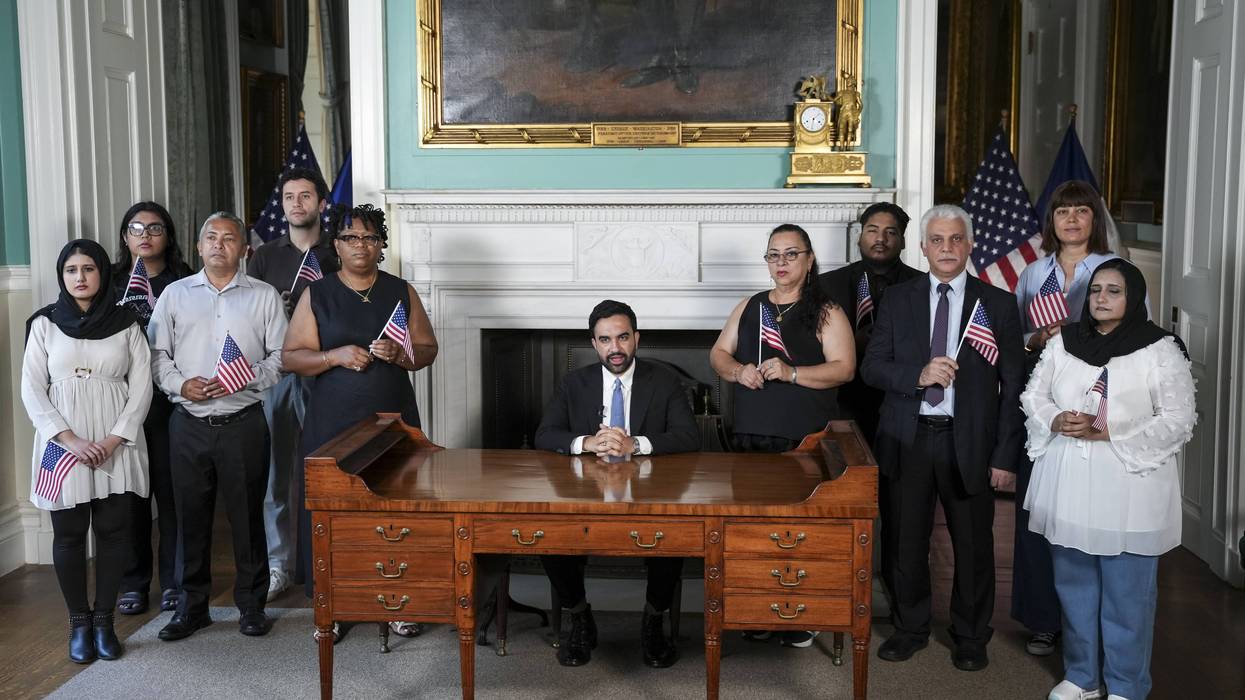
"At every moment in our past, those who led through exclusion and isolation have tried to win power for themselves by turning us against one another."
New York City Mayor Zohran Mamdani on Friday delivered a speech commemorating the 250th anniversary of the founding of the United States of America that drew a sharp contrast with President Donald Trump's vision for the country.
Speaking from New York City Hall, Mamdani recounted how his city had long served as a refuge for people from across the globe who came seeking a new life an opportunity.
It was these immigrants who ultimately shaped New York and made it into what it is today, said Mamdani—who is an immigrant and among the rising number of democratic socialists who have recently won at the ballot box.
The mayor then moved to the present day, where he took aim at the anti-immigrant rhetoric and policies emanating from Trump and his MAGA movement.
"The story of America has been written by those who have so often been told by those with power and influence and wealth that they were anything but exceptional," Mamdani said. "For generation after generation, we have been told that when the world has sent its people to our shores, it has not sent its best."
Mamdani took aim at the ideology espoused by many rich and powerful people who see America as "an arena of supremacy, where only a select few are allowed freedom, where not all are created equal."
"America, if you ask them, becomes less the more people it welcomes," the mayor continued. "America, they will tell you, belongs only to those with the right accent or the right shade of skin. The rest of us, they insist, should be grateful for merely being allowed to visit."
"How small they are," Mamdani remarked. "How weak, how unoriginal. At every moment in our past, those who led through exclusion and isolation have tried to win power for themselves by turning us against one another."
The mayor then pivoted to a more hopeful tone by arguing that "time and again, including 250 years ago, those forces of division have been vanquished by the forces of progress."
Mamdani insisted that the greed shown by American oligarchs and the division sown by its current political leadership are "not all we see when we look for America."
"We see it too in the nurse who works a double shift and then stops on her way home to check on her ailing neighbor," he said. "Yes, we see in America corporate landlords for whom negligence is a business model. We see it too in the father who tucks his children into bed in a ceiling stained with leaks, who wakes before dawn to go to work, and who still believes this country can do better by his family."
In his conclusion, Mamdani paid tribute to "those ideals upon which our nation was built," which he described as "strong enough to endure any authoritarian regime, but only if we reach for them."
"Ours is a nation working each day towards the perfection in which it was conceived," he said. "A nation striving each day to better itself. Therein lies the work of America: The striving, the bettering, the reaching towards perfection. What a privilege each of us has to live in a nation that every one of its inhabitants can shape."
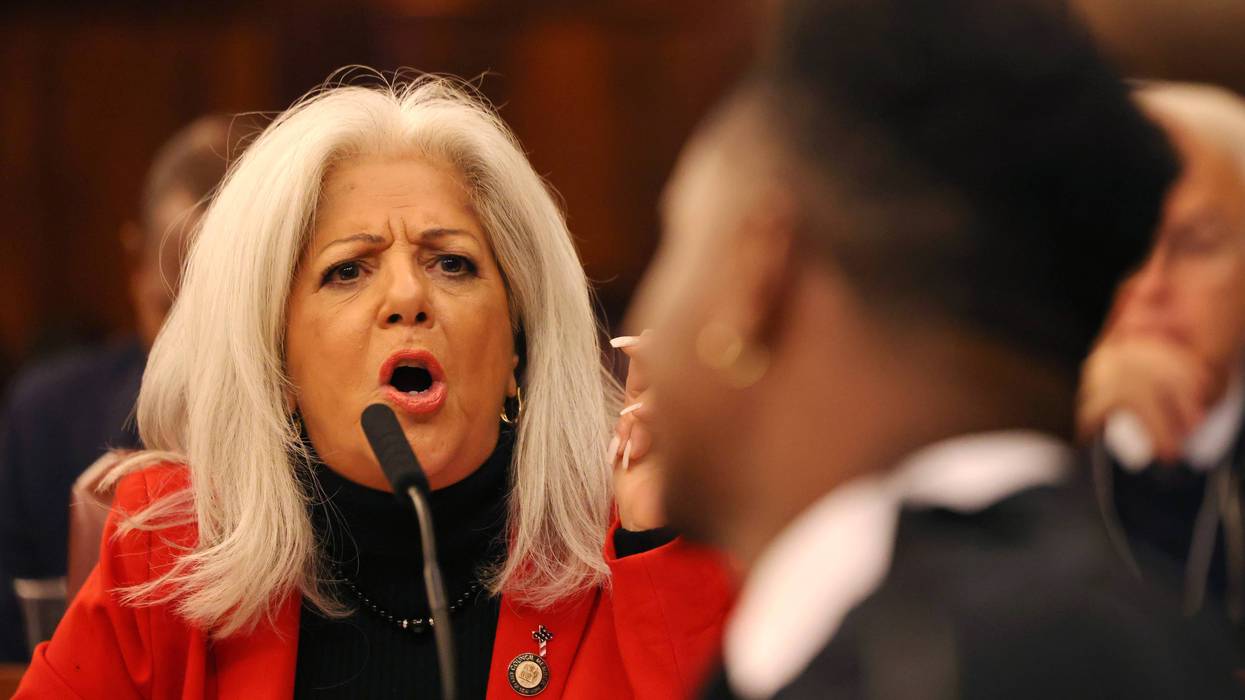
"Yet another example of Vickie Paladino calling for the federal government to retaliate against people she disagrees with," said congressional candidate Darializa Avila Chevalier.
Darializa Avila Chevalier, the progressive organizer whose primary victory over five-term Democratic Congressman Adriano Espaillat last week stunned the party's establishment, was among those calling for the expulsion of New York City Council member Vickie Paladino Tuesday night after the Republican issued "a thinly veiled call" for the government "to kill" democratic socialists.
On the social media platform X, Paladino posted an image of the Democratic Socialists of America (DSA) 2025-27 National Political Committee, including national co-chairs Ashik Siddique and Megan Romer, and mused that in the past, government agencies may have mobilized to kill the 27 people in the picture to stop their left-wing activities.
"There was a time in our history, not too long ago, when the CIA/FBI would’ve made sure unabashed revolutionaries like this were neutralized one way or another," said Paladino (R-19). "In fact, that was basically the entire point of having them."
Paladino appeared to be referring to the FBI's Counterintelligence Program (COINTELPRO), which surveilled, infiltrated, and tried to disrupt groups and movements that fought for civil rights and against the US war in Vietnam. COINTELPRO was involved in the 1969 raid in Chicago in which police killed Black Panther Party leaders Fred Hampton and Mark Clark.
"This is insane," said US Rep. Rashida Tlaib (D-Mich.) after Paladino suggested the US government should use the FBI and CIA to "neutralize" DSA organizers, who are working to elect advocates for Medicare for All, universal childcare, and abolishing US Immigration and Customs Enforcement, among other increasingly popular progressive proposals.
Chevalier, a member of the DSA's New York City chapter, called for Paladino to be "expelled."
"We need public leaders who will fight for a politics of life and the council member has shown time and time again that she does not," said Chevalier.
Paladino's call to "neutralize" left-wing organizers came a day after she urged New York City police to "run over" protesters who were blocking officers on bikes. Last December, Paladino said the US should "take very seriously the need to begin the expulsion of Muslims from Western nations," and last June she suggested New York City Mayor Zohran Mamdani, a democratic socialist who was then a primary candidate, should be deported.
The Brooklyn Young Democrats also accused Paladino of "encouraging political violence" and called on the City Council to condemn her comments "and consider appropriate action—including expulsion."
Ryan Deitsch, co-founder of the gun control group A March for Our Lives, addressed the New York Police Department and Police Commissioner Jessica Tisch, asking whether Paladino's threat raised any "red flags."
The council member's comments came less than a week after a number of progressive primary victories in New York City, including Chevalier's. The election results led centrist Democrats to quickly mobilize against democratic socialist candidates, warning that progressive contenders are “bomb-throwers, not problem solvers"—even as Mamdani secured a two-year rent freeze that will affect roughly 1 million rent-stabilized apartments, as New Yorkers and people across the country struggle with rising costs.
One DSA organizer said in response to Paladino, "Imagine if Zohran Mamdani said something about having the [Republican National Committee] chair and co-chair 'neutralized one way or another' with a secret police force."
"Expel Vickie Paladino from the NYC Council," they added, "and have her arrested and charged for making a terrorist threat."

The defeat of two prominent pro-Israel members of Congress by challengers who were critical of Israeli policies and supporters of justice for Palestinians represents a turning point.
For the past half century, the American Israel Public Affairs Committee, or AIPAC, largely held sway in elections in both political parties. They threatened and intimidated those who opposed them and, when a critic of Israel was defeated, they boasted of victory, holding it up for others as a lesson. Last week’s Democratic primary elections in New York City, in which three insurgent critics of Israeli policies defeated AIPAC-endorsed candidates, point to what may be the end of an era for the pro-Israel lobby.
AIPAC’s approach to politics and elections was smart. Formed by the Conference of Presidents of Major Jewish Organizations, they were connected from the outset to an impressive national network of American Jewish leaders, activists, and, more importantly, donors—all of whom they used effectively to influence members of Congress and Senators to embrace pro-Israel positions.
They didn’t just go to elected officials in Washington asking them to endorse particular pieces of legislation; they had local leaders in a congressperson’s district make the pitch. When new candidates were running, they’d have local representatives offer to help write their Middle East policy positions. Implicit in the visit and the offers were both the promise of support if the elected official or candidates did what was asked of them and the threat of opposition if they did not.
To back up their efforts, AIPAC spawned a network of PACs—political action committees—that would raise hundreds of thousands of dollars to distribute for or against candidates depending on their positions on Israel. AIPAC claimed they didn’t coordinate the work of the PACs (which would be a violation of election laws). But, as most of these PACs were headed by AIPAC board members or their families and their pattern of contributions were too obvious to have not been coordinated, it was clear that they were.
In this new era a real debate over US Middle East policy will take place.
AIPAC was also strategic in the their operations. Not everyone benefited from their largesse. Chairs of important congressional committees and very supportive members of Congress who faced tough reelections received bundled contributions. When elected officials repeatedly stepped out of line, their opponents would be the beneficiaries of large amounts of PAC monies and bundled contributions from individual pro-Israel donors with ties to AIPAC.
Overall, the amounts were not overwhelming but sufficient to send a message. Four decades ago, we found total amounts given by AIPAC’s PACs and their individual donors amounted to about $4 million in each election, with a handful of candidates receiving the bulk of this. When a few elected officials who’d been critical of Israel were defeated by opponents who’d been backed by AIPAC, the lobby would crow about their victory, whether or not their support had been a factor. Their goal was to spread the message to other electeds: “Fear us, or you too can be defeated.”
With the end of federal regulations limiting the oversight of independent expenditures in election campaigns, AIPAC and other pro-Israel groups took advantage by creating “super-PACs” that could raise and spend tens of millions of dollars in each election. Instead of the cumbersome job of stealthily coordinating dozens of federally regulated PACs limited in the amounts they could receive from individual donors and give to each candidate, these unregulated super-PACs could receive seven figure contributions from individuals and spend that same amount to help or hurt the candidates of their choosing. In 2022 and 2024 they effectively targeted a handful of candidates who were critical of Israel and spent millions to defeat each of them.
In the aftermath of Israel’s genocidal war on Gaza, we’ve witnessed a dramatic collapse of support for Israel in public opinion—especially among Democrats. In this new environment AIPAC can no longer pick and choose a few candidates to make examples. They now face new challenges weekly. Over 110 US representatives and senators have supported stopping military assistance to Israel because of its violations of Palestinian rights. Dozens of electeds have charged Israel with genocide and hundreds of congressmembers and candidates have pledged that their campaigns will reject any support from AIPAC. In fact, AIPAC has become so toxic that they’ve been forced to create new entities or rely on alternates as repositories for the funds they raise to distribute to candidates.
Despite these adjustments, the hurdles being confronted by pro-Israel forces are proving to be too much. Israel’s behaviors continue to alienate more voters. The more money AIPAC spends, the more toxic its brand has become—even when they win, they lose support for their heavy-handed tactics. Which brings us to last week’s New York primaries.
The defeat of two prominent pro-Israel members of Congress by challengers who were critical of Israeli policies and supporters of justice for Palestinians and the victory in an open race of a candidate who’d been a leader of pro-Palestinian campus protests in New York represents a turning point in US politics. It wasn’t just that AIPAC and its allies spent millions in these failed efforts—these elections were upfront about Israeli policies and Palestinian rights.
What had been the hallmark of pro-Israel groups’ past involvement in campaigns was the lengths to which they’d go to not make support for Israel a public issue. They would raise money from their supporters based on Israel, but that would not be the topic of their expenditures. They would spend money on ads criticizing a candidate’s age, their “radical agenda,” or some of their youthful improprieties. But they’d never mention that their involvement was because of the candidate’s position on Israel. This was the case in these New York contests. Many issues were important to voters, especially frustration with the tired failed policies of the Democratic Party establishment. But they were also about Israel, and voters knew it.
The reactions from the pro-Israel side have been predictable. Some have accused the targeting of AIPAC’s money and influence as unfair or even antisemitic—as if for decades AIPAC hadn’t boasted of its money and influence as the source of its power. Others have claimed that as a result of this election, “Jews no longer feel safe in New York,” ignoring the fact that in the most prominent of the three contests in which a pro-Israel Jewish member of Congress was defeated, the victor was also Jewish and a self-proclaimed progressive Zionist who strongly opposed Israel’s genocide against Palestinians. There’s also a bizarre effort to accuse pro-Palestinian candidates and voters of fracturing the Democratic Party when for decades AIPAC did its best to fracture the party and country by forcing politicians to toe the line or face defeat. Finally, there is the desperate effort to dismiss the entire election as being just about New York and having nothing to do with the rest of the US, ignoring the fact that the national political landscape has changed with these same types of contests taking place everywhere.
The bottom line is that after a half century AIPAC’s hold over politics has been weakened. It won’t go away anytime soon, but in this new era a real debate over US Middle East policy will take place. Thank you, New York voters.