SUBSCRIBE TO OUR FREE NEWSLETTER
Daily news & progressive opinion—funded by the people, not the corporations—delivered straight to your inbox.
5
#000000
#FFFFFF
To donate by check, phone, or other method, see our More Ways to Give page.


Daily news & progressive opinion—funded by the people, not the corporations—delivered straight to your inbox.
While the attack comes over two years into Russia's war on Ukraine, an adviser for the Ukrainian president said the neighboring nation "certainly has nothing to do with the shooting/explosions in the Crocus City Hall."
UPDATE:
Russia's Investigative Committee announced Saturday that the death toll has increased to 133 and said in a statement that "unfortunately, the number of victims could increase."
Eleven people were detained, including four who were directly involved in the attack, according to a statement from the Russian Federal Security Service, or FSB.
EARLIER:
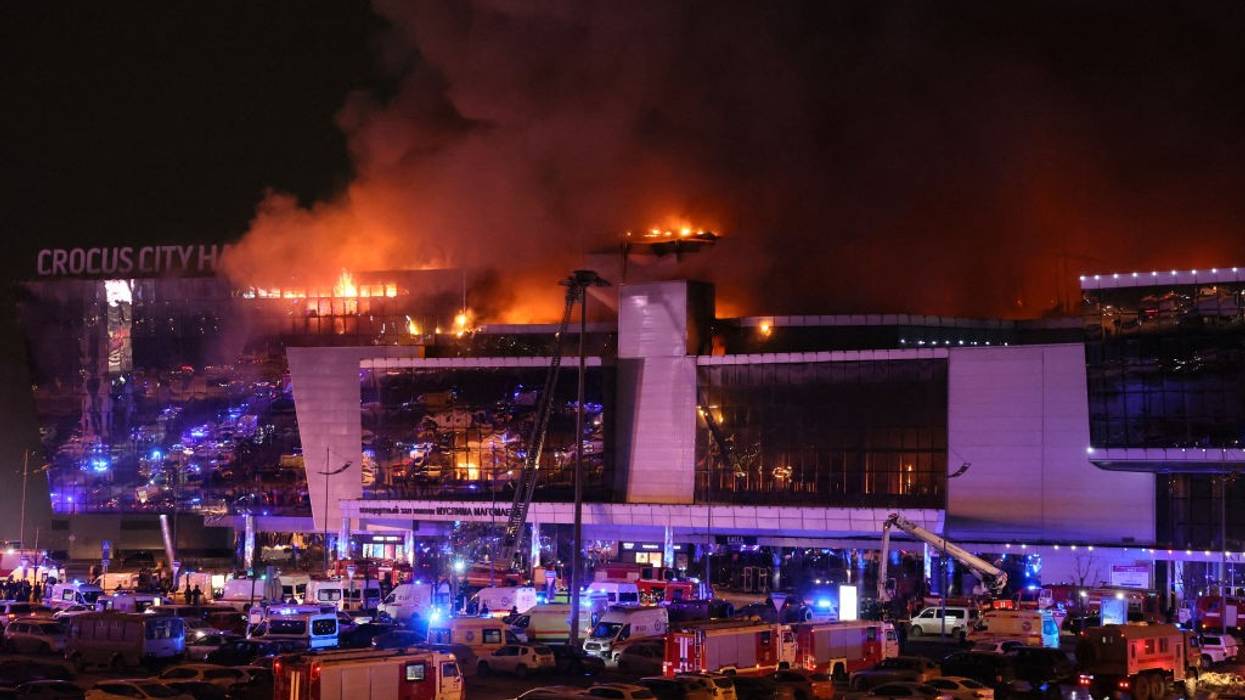
The Islamic State claimed responsibility for an attack in which at least dozens of people were killed and wounded when individuals reportedly armed with automatic weapons opened fire at Crocus City Hall, a concert venue in suburban Moscow, Russia.
"According to preliminary data, as a result of the terrorist attack at the Crocus City Hall building 40 people were killed and over 100 were injured," Russia's Federal Security Service (FSB) said in a statement reported by TASS.
Citing eyewitnesses, the Russian news agency reported that the group of unidentified men "armed with assault rifles went on a shooting spree in the lobby and then inside the concert hall just before a concert by the rock band Picnic."
As The Moscow Times detailed:
According to a journalist who was at Crocus City Hall during the attack, a grenade or an incendiary bomb was thrown after the shooting broke out and caused a fire.
"People in the hall were lying down on the floor to escape from the shooting, lying between 15 and 20 minutes, after which they began to crawl out. Many managed to get out," the unnamed journalist was quoted as saying by RIA Novosti.
The attack comes on the heels of Russian President Vladimir Putin's contested reelection and over two years into Russia's invasion of Ukraine, which has received weapons support from around the world, including the United States.
In a lengthy social media post, Mykhailo Podolyak, an adviser to Ukrainian President Volodymyr Zelenskyy, said that "Ukraine certainly has nothing to do with the shooting/explosions in the Crocus City Hall."
"There is not the slightest doubt that the events in the Moscow suburbs will contribute to a sharp increase in military propaganda, accelerated militarization, expanded mobilization, and, ultimately, the scaling up of the war," Podolyak added. "And also to justify manifest genocidal strikes against the civilian population of Ukraine."
According to The Guardian, John Kirby, the White House national security spokesperson, told reporters that "there's no indication at this time that Ukraine, or Ukrainians were involved in the shooting... We're taking a look at it, but I would disabuse you at this early hour of any connection to Ukraine."
Asked whether the attack signals cracks in Putin's regime, Kirby said that "there are people in Moscow and in Russia that object to the way Mr. Putin is governing the country, but I don't think we, at this early hour, can make a link between the shopping mall attack and political motivations. I think... we just need more time and we need to learn more information."
"Russia's weakness is obvious," said Ukrainian President Volodymyr Zelenskyy as events unfolded in Russia. "And the longer Russia keeps its troops and mercenaries on our land, the more chaos, pain, and problems it will have for itself later."
(Update: 9:00 am, Sunday, June 25)
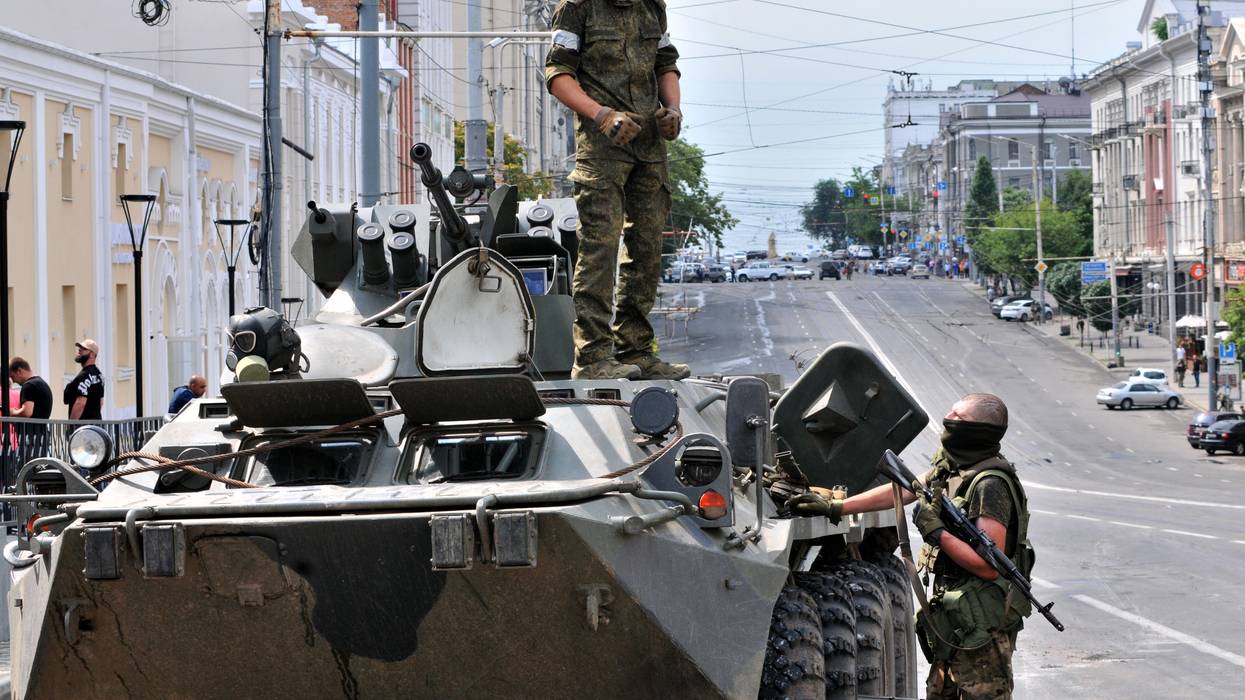
Wagner Group leader Yevgeny Prigozhin left Rostov-on-Don, Russia late Saturday after announcing abruptly that he had called off his forces' march to Moscow and ordered them to leave the southern city, a key strategic location in Russia's war against Ukraine.
Prigozhin agreed to leave Russia go to Belarus under a deal reportedly brokered by Belarusian President Alexander Lukashenko, whose government is strongly allied with Russian President Vladimir Putin. Belarus has allowed Russian troops to station there since Russia's invasion of Ukraine in February 2022 and Putin said earlier this month that Russia has begun deploying "tactical" nuclear weapons in the former Soviet state.
Under the deal, Prigozhin and his forces will not face charges for taking over military facilities in Rostov-on-Don on Saturday, which Putin had said amounted to treason.
Earlier:
Ukrainian officials on Saturday said the takeover of a key strategic Russian city by the Wagner Group, a private mercenary force with close ties to Russian President Vladimir Putin, was a sign of a burgeoning civil war in the country that invaded Ukraine 16 months ago.
The group's seizure of military facilities in Rostov-on-Don in southern Russia was a sign of Putin's "weakness," said Ukrainian President Volodymyr Zelenskyy as many in his country kept a close watch on the chaos unfolding in the country whose invasion has killed more than 9,000 civilians, injured more than 15,000, and forced more than six million people to flee Ukraine.
"Anyone who chooses the path of evil destroys himself," said Zelenskyy on social media. "Sends columns of soldiers to destroy the lives of another country—and cannot stop them from fleeing and betraying when life resists... [Putin] despises people and throws hundreds of thousands into the war—in order to eventually barricade himself in the Moscow region from those whom he himself armed."
"Russia's weakness is obvious," Zelenskyy added. "Full-scale weakness. And the longer Russia keeps its troops and mercenaries on our land, the more chaos, pain, and problems it will have for itself later."
The Wagner Group is headed by Yevgeny Prigozhin, a member of the Russian elite who in the past secured lucrative construction and catering contracts from the government, the latter of which earned him the nickname "Putin's chef." He was one of 13 Russians indicted by a federal grand jury in the United States in 2018 for interfering in the 2016 U.S. presidential election.
Prigozhin's mercenary army first began exerting influence during Russia's illegal annexation of Crimea in 2014, and has since been deployed to further Russian interests in countries including Syria, Libya, Central African Republic, Sudan, and Mozambique.
"Today we are actually witnessing the beginning of a civil war."
"There's a trend or pattern around what happens when Wagner is involved in an armed conflict," Sorcha MacLeod, chair of the United Nations Working Group on mercenary groups, told The New York Times last year. "The conflict is prolonged, involves heavy weaponry, civilians are impacted in a substantial way, human rights violations and war crimes increase substantially, and there's no access to justice for victims."
Prigozhin has in recent months rebuked the military leadership of Putin's war on Ukraine, saying generals have not provided his forces with enough resources.
On Friday he accused Putin's military of attacking his fighters' encampments and called the Ukraine invasion a "racket" before announcing that the Wagner Group had taken control of Rostov-on-Don.
The Times verified footage showing Prigozhin entering a military complex in the city.
The mercenary group was headed toward Moscow on Saturday as Russian officials accused Prigozhin of attempting to mount a coup against Putin. The state news agency, TASS, reported that the Russian prosecutor general had charged Prigozhin with armed mutiny.
Putin accused Prigozhin of treason in an address to Russians and said he "will do everything to defend the country."
Mykhailo Podolyak, an adviser to Zelenskyy, said the turmoil between Putin and the Wagner Group signifies that "the start of the Ukrainian counteroffensive finally destabilized the Russian elites, intensifying the internal split that arose after the defeat in Ukraine."
"Today we are actually witnessing the beginning of a civil war," he said.
The Wagner Group's actions are "a sign of the collapse of the ruling regime," Ukrainian military intelligence spokesperson Andriy Yusov told Suspilne, Ukraine's state news agency, "and such processes will intensify."
A top aide to Ukrainian President Volodymyr Zelenskyy denied Moscow's allegation, calling it a false pretext for "a large-scale terrorist attack."
This is a developing story... Check back for possible updates...
Moscow on Wednesday accused Ukraine of attempting to assassinate Russian President Vladimir Putin after two unmanned Ukrainian drones reportedly struck the Kremlin.
In a statement, Russia's presidential press service said that "timely actions taken by military and special services" disabled the drones.
"Their fall and the fragments scattered around on the territory of the Kremlin caused no casualties or material damage," said the press service, which noted that "the Russian president was not harmed."
A spokesperson for the Ukrainian armed forces said in response to the Russian government's claims that "we do not have such information" and called Moscow's comments "political statements."
Video footage posted online showed smoke emerging from the Kremlin after an object exploded over the complex:
The alleged attack could spur another deadly escalation of a war that has dragged on for more than a year with no end in sight, as substantive diplomatic negotiations remain nonexistent and heavy weaponry continues to flow into the war zone.
"Russia reserves the right to take retaliatory measures whenever and wherever it sees fit," the Russian presidential press service said Wednesday after the alleged attack, which Moscow called "a pre-planned act of terrorism and an attempt on the life of the Russian president."
Mykhailo Podolyak, a top aide to Ukrainian President Volodymyr Zelenskyy, responded on Twitter that Ukraine is waging "an exclusively defensive war and does not attack targets on the territory of the Russian Federation."
"Russia is clearly preparing a large-scale terrorist attack," Podolyak added, arguing that claims of an assassination attempt against Putin give Moscow "grounds to justify its attacks on civilians."
On Monday, Russia launched a missile attack in Ukraine that reportedly killed two people and wounded 40.
Interim president Oleksandr Turchynov on Monday was the latest to indicate that the spiraling violence in an increasingly divided Ukraine looks more and more like civil war as efforts to contain uprisings in the east against Kiev's authority have only elevated the violence in recent days.
"War is in effect being waged against us, and we must be ready to repel this aggression," said Turchynov in a televised address from Kiev and referring to violence in the cities of Odessa, Slavyansk, and elsewhere over the weekend.
According to Agence France-Presse, the latest high-level warning from Kiev comes as Ukraine spirals "further into a chaos that many fear could result in open civil war."
Turchynov has called up additional forces and reintroduced conscription for military-aged Ukrainians citing fear of a Russian invasion on the eastern border.
This AFP video report shows how some regular Ukrainians are preparing for "civil war":
Report: civilians in Ukraine ready for civil warCitizens of the Ukrainian city of Luhansk, 30 kilometres from the Russian border, are learning how to use Kalashnikovs in case the ...
Meanwhile, in and around the city of Slavyansk on Monday, journalists reported that opposing factions were exchanging heavy gunfire and that loud explosions could be heard throughout the area.
And in Donetsk, militias opposed to Kiev's rule and calling for a referendum vote on their autonomy have now taken full control of the city despite continued threats from the Ukraine army.
"What is happening in the east is not a short-term action," said Vasyl Krutov, who heads the Kiev government's military operations in the east. "This is essentially a war."
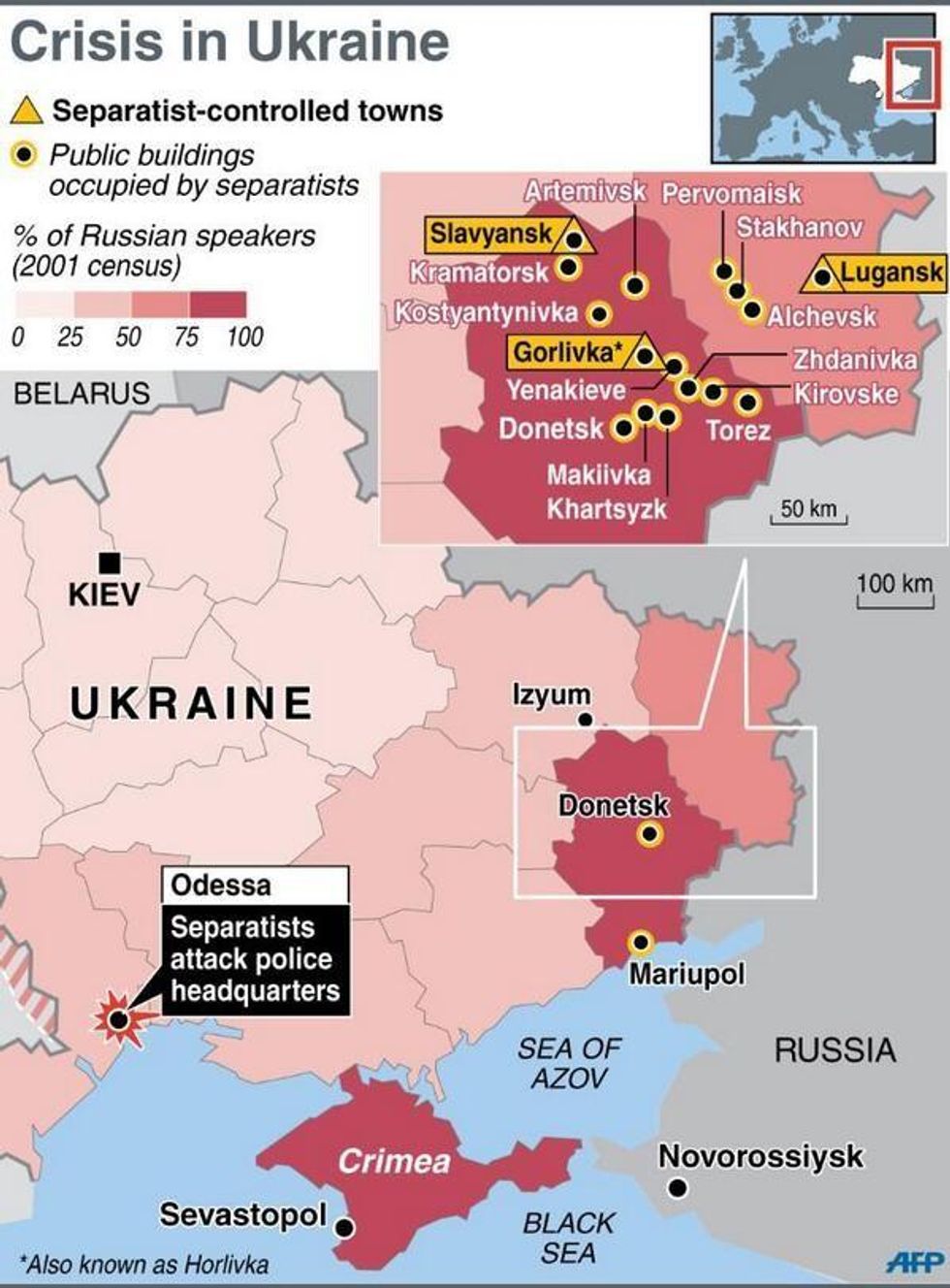
As the following map by AFP shows, the number of cities in open revolt against the Kiev government is growing:

The Associated Press reports:
Ukraine is facing its worst crisis in decades as the polarised nation of 46 million tries to decide whether to look towards Europe, as its western regions want to do, or improve ties with Russia, which is favoured by the many Russian-speakers in the east.
In the last few weeks, anti-government forces have stormed and seized government buildings and police stations in a dozen eastern Ukrainian cities. Authorities in Kiev - who blame Russia for backing the insurgents - have up to now been largely powerless to react.
And since Russia has kept tens of thousands of troops along Ukraine's eastern border - and annexed its key Black Sea peninsula of Crimea last month - Ukraine's central government fears Russia could try to invade and grab more territory.
Since the government began trying to take back the buildings late last week, Slavyansk has been under a tight security cordon. Movement in and out of the city has ground almost to a halt, causing shortages in basic supplies. Lines have been seen at grocery stores.
The goals of the insurgency are ostensibly geared towards pushing for broader powers of autonomy for the region, but some insurgents favour separatism, and the annexation of Crimea looms over the entire political and military discussion.
Following Friday's violence in Odessa and the growing number of revolts in the east, former U.S. ambassador to Moscow, Michael McFaul, spoke with Time magazine and made this warning: "The last 24 hours was a major escalation," told TIME. "This is real. This is war."
NSA whistleblower Edward Snowden, according to the New York Times, sought the legal counsel of an attorney expert in criminal cases related to the 'U.S. Espionage Act,' under which the Justice Department has filed multiple charges against him.
"[Snowden] does not believe that the 'felon' label is the right word for someone whose act of conscience has revitalized democratic oversight of the intelligence community and is leading to historic reforms." --Ben Wizner, ACLU attorney
Snowden, who remains in Russia where he lives under temporary asylum status, outraged the national security community in Washington, DC after disclosing a trove of internal National Security Agency documents that revealed the previously unknown scale of the U.S. surveillance apparatus that operates both domestically and across the globe.
Hailed as a 'courageous' whistleblower and hero by civil libertarians and transparency advocates worldwide, the U.S. government has continued to say it will prosecute Snowden to the fullest extent of the law if and when they can bring him into custody.
According to Times, Snowden sought legal counsel last year in order to combat charges by the government and possibly arrange a plea agreement by which he could return to the United States. The newspaper reports:
The lawyer, according to people familiar with the investigation, is Plato Cacheris, who has represented defendants in some of the highest-profile cases involving Espionage Act charges, including the convicted spies Aldrich Ames and Robert Hanssen and the convicted leaker Lawrence Franklin.
But nearly a year after Mr. Cacheris became involved, no agreement appears imminent, and government officials said the negotiations remained at an early stage.
The officials and others who discussed the case and Mr. Cacheris's involvement in it spoke on condition of anonymity, citing the sensitivity of the talks.
Mr. Snowden, who now lives in Moscow, where he received temporary asylum, was charged last year with multiple violations of the Espionage Act. He faces up to 30 years in prison, and prosecutors could easily add more counts.
In a phone call, Mr. Cacheris said only: "It's not something that I want to discuss, so I have no comment."
Earlier this month, the journalists who worked most closely with the documents provided by Snowden were awarded the Pulitzer Prize for public service journalism.
Snowden's defenders say that without his disclosures, the public would still be in the dark about the surveillance programs that even President Obama--not to mention a federal court judge and numerous legal experts--determined likely go too far.
Quoted in the Times, Ben Wizner, a staff attorney with the ACLU who is also acting counsel for Snowden, said his 30-year-old client "is interested in returning home."
"[Snowden] is and always has been on America's side," Wizner continued. "He would cooperate in extraordinary ways in the right circumstances. But he does not believe that the 'felon' label is the right word for someone whose act of conscience has revitalized democratic oversight of the intelligence community and is leading to historic reforms."
_________________________________________________________________
MEMORANDUM TO: The President
FROM: Veteran Intelligence Professionals for Sanity (VIPS)
SUBJECT: Russia, Ukraine, and the U.S. National Interest
Dear Mr. President:
We the undersigned are veteran intelligence, military, and law enforcement officers. Taken together, our years of service to our country total nearly 200 years. Unlike many experts and advisers who base their arguments on abstract notions about the international scene, our insights are drawn from a depth of hands-on experience inside the U.S .government -- here and abroad.
Given this background, we share a profound understanding of the great responsibility that accompanies great power. We feel an obligation to lay our views on Ukraine before you -- the more so, inasmuch as the airwaves, TV, and newspapers are giving a great deal of space to the same pundits and academics who got Iraq so wrong just over a decade ago.
A number of us, in our government roles, were involved with policy relating to the then-Soviet Union and also with its successor state, the Russian Federation. We have observed the recent slide of Moscow toward a more authoritarian form of government and have also been concerned over the playing-out of great power rivalry over Ukraine.
Our still-vivid memories of the Cold War and the harm it inflicted on the world's security prompts us to argue that the troubles in Ukraine should not be permitted to usher in a return to a bipolar world in which two heavily armed superpowers confront each other at every level, including on a global scale.
We are particularly concerned over what appears to be a largely unfocused yet virulent mood among members of Congress and the mainstream media to "do something" about Russia -- a sentiment that is both ill-advised and quite the reverse of what this nation should be doing to nurture a constructive and ultimately beneficial relationship with Moscow and the rest of Europe.
While we support U.S. efforts to aid the development of a pluralistic democracy in Ukraine, including assistance in conducting free and fair elections, we believe that military support and direct involvement by U.S. troops is a step that will virtually guarantee escalation of the conflict, possibly leading to direct confrontation between two nuclear-armed great powers -- a situation that should, and can, be easily avoided if the interests of all countries, including Russia, are taken into account.
To put it in stark terms, Russian engagement with Ukraine -- a country that is on Moscow's doorstep and which is, in part, ethnically Russian -- does not threaten vital U.S. interests; nor does it threaten any U.S. interests; nor does it threaten any U.S. allies. Washington's response should be a measured one, based on the actual risks versus possible gains. Sanctions should be employed with considerable restraint, as their effectiveness is questionable and they frequently serve only to harden adversarial positions. Significant military moves, whether unilateral or in conjunction with NATO, should be avoided as they can be seen as provocative while providing no solution to existing disagreements.
We argue for more, not less, diplomatic engagement, based on our own experience as witnesses to many missed opportunities over the past 50-plus years, in which the United States -- to our regret -- has found itself all too often on the wrong side of history. The Bay of Pigs fiasco in 1961 entrenched communism in Cuba; indiscriminate U.S. support of anti-communist groups and political parties in Europe both weakened fledgling democracies and strengthened corruption; overtures by former Soviet President Mikhail Gorbachev for complete nuclear disarmament were dismissed, encouraging nuclear proliferation among other states.
When the Soviet Union finally fell, specific agreements not to expand into the former Warsaw Pact states were promptly ignored, with both NATO and the European Union quickly moving eastward. The rape of the Russian economy in the 1990s, engineered by Western "entrepreneurs" working with local oligarchs followed. It was described as "shock therapy" at the time, but most Russians more accurately view the events as wholesale pillage, fueling much of the current mistrust of the West.
Russia could hardly have been expected to ignore Washington's de facto encouragement and achievement of "regime change" in Ukraine -- resulting in the unseating of the duly elected (though thoroughly corrupt) government in Kiev. Moreover, continued efforts by the West to draw Ukraine into NATO would guarantee Russian hostility for many years to come. Both of these are existential issues for Moscow; may we remind you of the U.S. parallel in the enforcement of the Monroe Doctrine in our own "backyard."
In our view, the situation need not spin out of control. The door is still open to enforcing the measures agreed upon on April 17 in Geneva. Russia's willingness to continue to work with us on destruction of Syria's chemical weapons and on the Iranian nuclear issue remains encouraging and could foster cooperation on other mutual interests.
Perspective
As for Crimea, with all the misleading rhetoric filling the air waves, we want to remind you that Crimea became part of Russia in the late 18th Century. Sixty years ago, Ukrainian Nikita Khrushchev, who was then head of the Soviet Communist Party, simply gave Crimea to the Ukraine -- one of the 15 "republics" comprising the former Union of Soviet Socialist Republics (USSR). There was no referendum at the time; it appeared not much more than a formality since all areas of the USSR danced to Moscow's tune.
The transfer of Crimea to Ukraine began to matter significantly in 1991, when the Soviet Union imploded and Crimeans found themselves no longer citizens of Russia. President Vladimir Putin addressed this directly in his major speech of March 18 when he recalled that Russia had "humbly accepted" the situation in 1991. He explained that Russia "was going through such hard times then that realistically it was incapable of protecting its interests."
Today, Russia is capable of protecting its interests in the areas it calls its "near frontier." It will not accept the incorporation of Ukraine into NATO. Attempts to force that issue will not make Europe more secure; rather, it will increase the danger of war.
There is an important step you can take, Mr. President. We recommend that you ask NATO to formally rescind the following part of the declaration agreed to by the NATO heads of state in Bucharest on April 3, 2008: "NATO welcomes Ukraine's and Georgia's Euro-Atlantic aspirations for membership in NATO. We agreed today that these countries will become members of NATO."
Meanwhile, let cooler heads prevail. Sending significant numbers of military forces into countries bordering Ukraine amounts to pouring gasoline on what are now relatively isolated and limited outbreaks of fire, mostly in eastern Ukraine. The fragile accord reached in Geneva on April 17 can still provide the basis for discussion among mature leaders and prevent the kind of provocation, machismo, and escalation that 100 years ago launched the war that was supposed to end all wars. Two short decades later came the Second World War.
In the wake of that carnage, Winston Churchill made an observation that is equally applicable to our 21st Century: "To jaw, jaw, jaw, is better than to war, war, war."
Respectfully submitted for the Steering Group, Veteran Intelligence Professionals for Sanity:
William Binney, former Technical Director, World Geopolitical & Military Analysis; co-founder, SIGINT Automation Research Center (ret.)
Thomas Drake, former Defense Intelligence Senior Executive Service, NSA
Philip Giraldi, CIA, Operations Officer (ret.)
Larry Johnson, CIA & State Department (ret.)
David MacMichael, former Senior Estimates Officer, National Intelligence Council (ret.)
Ray McGovern, former chief of CIA's Soviet Foreign Policy Branch & presidential briefer (ret.)
Tom Maertens, former Foreign Service Officer and National Security Council Director for Non-Proliferation
Elizabeth Murray, former Deputy National Intelligence Officer for the Near East, National Intelligence Council (ret.)
Todd E. Pierce, US Army Judge Advocate General Corps (ret.)
Coleen Rowley, former Chief Division Counsel & FBI Special Agent (ret.)
Conditions on the ground in eastern Ukraine remain volatile and unpredictable as Monday brought the attempted assassination of one city's mayor while another city experienced a local insurrection resulting in the takeover of government buildings.
Also on Monday, the White House announced a new round of sanctions against Russia, blaming President Putin for the continued unrest. The sanctions include restrictions on high-level and wealthy Russian citizens as well as export controls on technology. President Obama said the U.S. is keeping even stronger measures "in reserve" for the moment.
In eastern Ukraine's second-largest city of Kharkiv early Monday, Mayor Hennady Kerne is said to be "fighting for his life" after being shot in the back by unknown assailants early in the morning. Kernes has deep ties to Moscow and has been critical of those in Kiev who participated in the overthrow of the ousted Viktor Yanukovych earlier this year.
However, as the Guardian's Luke Harding reports, it's possible Kernes had enemies on both sides of the debate over the future of his city:
It was unclear who was behind the apparent assassination attempt. Kernes was a leading figure in the Party of Regions of Ukraine's ex-president Viktor Yanukovych. The mayor had bitterly attacked the Maidan demonstrations which saw Yanukovych flee to Russia in February. A flamboyant figure, with alleged ties to organized crime in the 1990s, he had backed closer ties with Moscow.
Since the change in government in Kiev, however, Kernes's statements had become distinctly more patriotic. He has stated that Kharkiv, an eastern university city near the Russian border, should remain part of Ukraine. A billionaire, he has also claimed that he was himself a victim of Yanukovych's corrupt system.
Posting on Facebook, a senior Kharkiv journalist Zurab Alasania blamed Russia for Monday's shooting. He noted that the mayor had not changed his routine of going for a morning dip in a Kharkiv lake, despite the deteriorating security situation in the east.
"The Russian Federation is identifying and liquidating key centres of resistance," Alasania posted on Facebook.
In Kostyantynivka, another eastern city located approximately 100 miles from the Russian border, armed men with a pro-Russian message stormed local government offices. According to the Associated Press:
After the seizure, about 15 armed men guarded the building. Some posed for pictures with residents while others distributed St. George's ribbons, the symbol of the pro-Russia movement.
Kostyantynivka is just 35 kilometers (22 miles) south of Slovyansk, a major city in eastern Ukraine that has been in insurgents' hands for more than three weeks now.
In Donetsk, one of the other key cities in the region refusing to bow to Kiev rule, armed individuals took over a television station on Sunday and "ordered it to start broadcasting Russian state TV."
In the city of Slovyansk, one of eight international observers from the Organization for Security and Cooperation in Europe (or OSCE) taken by militia members was released on Sunday, but the other seven continue to be held under suspicion of being NATO spies.
Before the weekend, Russia's Foreign Minister Sergei Lavrov said that those occupying government buildings in the east would lay down their arms if those maintaining similar encampments in Kiev and other western cities would do the same.
The crisis gripping Ukraine has plunged transatlantic relations to their lowest point since the Cold War and threatens to send Ukraine into an armed conflict with potentially dire consequences for the country and the wider region.
Moscow's alleged meddling in eastern Ukraine and its earlier annexation of Crimea spurred worldwide rebukes and much international commentary regarding the growing East-West divide. But one aspect that we have heard less about is the corporate struggle for Ukraine's oil and natural gas. By some accounts, it is this struggle that is as much to blame for the current crisis as any geopolitical tug-of-war between East and West.
Ukraine has Europe's third-largest shale gas reserves at 42 trillion cubic feet, according to the U.S. Energy Information Administration. While for years U.S. oil companies have been pressing for shale gas development in countries such as Britain, Poland, France and Bulgaria only to be rebuffed by significant opposition from citizens and local legislators concerned about the environmental impacts of shale gas extraction - including earthquakes and groundwater contamination caused by hydraulic fracturing or "fracking" - there has been considerably less opposition in Ukraine, a country that has been embroiled in numerous gas disputes with the Russian Federation in recent years.
"At the time of Yanukovych's ouster in February, Chevron and the Ukrainian government had been negotiating an operating agreement for the shale development effort in western Ukraine, and Chevron spokesman Cameron Van Ast said that the negotiations would go forward despite Yanukovych fleeing the country."
Russia's state-owned Gazprom, controlling nearly one-fifth of the world's gas reserves, supplies more than half of Ukraine's gas annually, and about 30 percent of Europe's. It has often used this as political and economic leverage over Kiev and Brussels, cutting gas supplies repeatedly over the past decade (in the winters of 2005-2006, 2007-2008, and again in 2008-2009), leading to energy shortages not only in Ukraine, but Western European countries as well. This leverage, however, came under challenge in 2013 as Ukraine took steps towards breaking its dependence on Russian gas.
On Nov. 5, 2013 (just a few weeks before the Maidan demonstrations began in Kiev), Chevron signed a 50-year agreement with the Ukrainian government to develop oil and gas in western Ukraine. According to the New York Times, "The government said that Chevron would spend $350 million on the exploratory phase of the project and that the total investment could reach $10 billion."
In announcing the deal, President Viktor Yanukovych said that it "will let Ukraine satisfy its gas needs completely and, under the optimistic scenario, export energy resources by 2020." Reuters characterized the deal as "another step in a drive for more energy independence from Russia."
The United States offered its diplomatic support, with Geoffrey Pyatt, the U.S. ambassador to Ukraine, saying, "I'm very determined to cooperate with the Ukrainian government in strengthening Ukraine's energy independence."
U.S. Assistant Secretary of State for Europe Victoria Nuland spoke at an international business conference sponsored by Chevron on Dec. 13, 2013, after just returning from Kiev where she handed out cookies and sandwiches to demonstrators on the Maidan. In her speech, she urged Ukraine to sign a new deal with the IMF which would "send a positive signal to private markets and would increase foreign direct investment that is so urgently needed in Ukraine." This is important for putting Ukraine "on the path to strengthening the sort of stable and predictable business environment that investors require," she said.
Although stability and predictability are not exactly the words that people would associate with Ukraine these days, Western energy companies have continued to maneuver for corporate rights over Ukraine's shale gas deposits. Last fall, officials were in negotiations with an ExxonMobil-led consortium to explore for hydrocarbons off Ukraine's western Black Sea coast.
On Nov. 27, the Ukrainian government signed another production-sharing agreement with a consortium of investors led by Italian energy company Eni to develop unconventional hydrocarbons in the Black Sea. "We have attracted investors which will within five to seven years maximum double Ukraine's domestic gas production," Yanukovych said following the agreement.
At the time of Yanukovych's ouster in February, Chevron and the Ukrainian government had been negotiating an operating agreement for the shale development effort in western Ukraine, and Chevron spokesman Cameron Van Ast said that the negotiations would go forward despite Yanukovych fleeing the country. "We are continuing to finalize our joint operating agreement and the government continues to be supportive," Van Ast said.
Royal Dutch Shell is also engaged in the country, having signed an agreement last year with the government of Yanukovych to explore a shale formation in eastern Ukraine. When it comes to Crimea, numerous oil companies including Chevron, Shell, ExxonMobil, Repsol and even Petrochina have shown interest in developing its offshore energy assets.
Believing that Crimea's onshore and offshore fields will live up to expectations, these companies have greatly expanded their exploration of the Black Sea off the Crimean peninsula. Some analysts believe that one of Vladimir Putin's motivations for annexing Crimea was to ensure that Gazprom will control Crimean offshore energy assets - in addition to ensuring the continued use of Crimea as host to Russia's Black Sea Fleet.
It is clear that all of these oil and gas companies - backed by their governments, including those of the Russian Federation and the United States - are deeply embroiled in the Ukrainian crisis, with much invested and much at stake. But with their disproportionate influence over Ukraine's future, it should be kept in mind that the number one responsibility of any corporation is to increase profit margins for its shareholders, not necessarily to promote the democracy or sovereignty of the countries they are operating in.
This is particularly the case for Chevron and Shell, both of which have been implicated in major human rights violations in Nigeria. Chevron has been accused of recruiting and supplying Nigerian military forces involved in massacres of environmental protesters in the oil-rich Niger Delta, and Shell has faced charges of complicity in torture and other human rights abuses against the Ogoni people of southern Nigeria.
With this in mind, the Ukrainian people - whether in the east of the country or the west - might want to rethink what is meant by "energy independence," and whether the future they seek can truly be met by placing their hopes in the benevolence of foreign oil and gas companies.
Ukraine's interim Prime Minister Arseny Yatseniuk did not mince words on Friday as he invoked the possibility that the crisis in Ukraine could quickly spiral out of control and spark a Third World War.
"The world has not yet forgotten World War Two, but Russia already wants to start World War Three," Yatseniuk told his cabinet in remarks broadcast live from Kiev. "Attempts at military conflict in Ukraine will lead to a military conflict in Europe."
Tensions in the former Soviet-bloc country returned to high levels on Thursday following assaults on outposts manned by pro-Russian Ukrainians in the east by special forces sent by the Kiev government. At least five people were reported killed in one clash.
That incident and other movements by Ukraine soldiers against those in the east demanding referendums to decide their future political affiliations spurred Russian President Vladimir Putin to say that further violence would result in unspecified "consequences."
At the diplomatic level, the situation continues to deteriooriate as Russian, U.S., and Ukraine officials trade threats as the detente reached in Geneva last weeks begins to rapidly fade.
"The West wants -- and this is how it all began -- to seize control of Ukraine because of their own political ambitions, not in the interests of the Ukrainian people," said Russian Foreign Minister Sergei Lavrov in response to new threats of sanctions coming from the Obama administration.
As Reuters reports:
Yatseniuk took office in February after pro-European protests prompted the Kremlin-backed president to flee to Russia.
Ukraine plans to hold an election to replace Viktor Yanukovich on May 25, but the Russian-speaking east of the country has been disrupted by pro-Moscow militants who have taken over the city of Slaviansk and public buildings elsewhere, demanding to follow Crimea into being annexed by Russia.
Russia denies involvement but has denounced the Ukrainian government, which it says is illegitimate and backed by "fascist" Ukrainian nationalists, and has threatened to move in to protect ethnic Russians and Russian-speakers in Ukraine.
_________________________

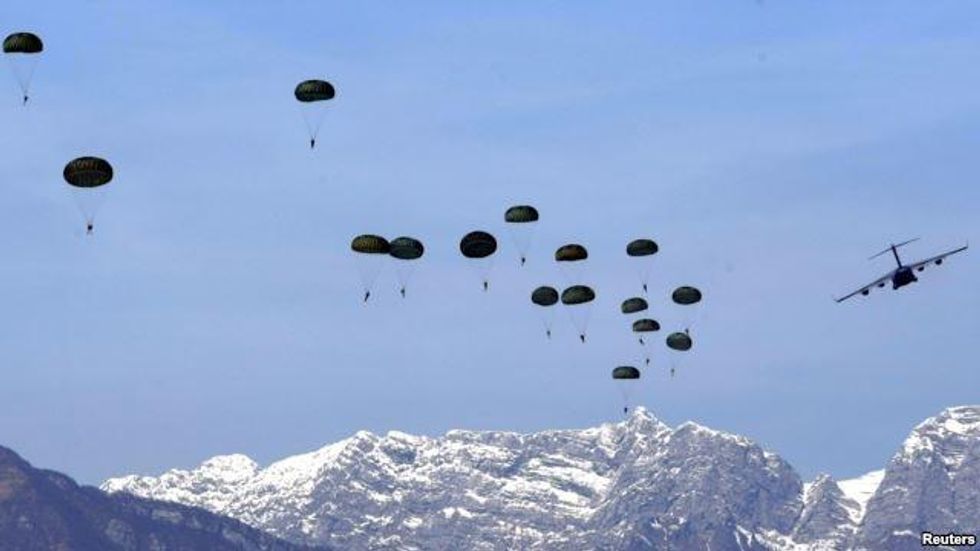
Pentagon spokesperson Rear Adm. John Kirby made the announcement Tuesday, characterizing the deployment of approximately 600 troops as "exercises" that would last about a month.
The soldiers, said Kirby, should be seen as "a very tangible representation of our commitment to our security obligations in Europe" against what he described as "Russian aggression."
Regarding the upcoming rotation of U.S. troops, he added, "We encourage our NATO partners to likewise look for opportunities of their own to do this same kind of thing for one another."
On Wednesday morning, Russia announced "snap" naval exercises for members of its fleet in the Caspian Sea.
With U.S. Vice President Joe Biden in Ukraine on Tuesday, high-level promises of new aid from the U.S. government were promised to the interim government in Kiev as new violence in the eastern regions of the country called into question the ability of a fragile truce to maintain itself.
According to agency reporting and the Guardian:
The [Russian naval drills] will last seven days and involve around 10 naval vessels and 400 sailors. The Caspian Sea is bordered by Iran, Russia, Kazakhstan, Turkmenistan and Azerbaijan - a region that is crisscrossed by oil and natural gas pipelines.
Ukraine relaunched military operations against pro-Kremlin separatists late on Tuesday, hours after Biden ended his visit to Kiev in which he warned Russia over its actions in the former Soviet republic.
Ukraine's acting president, Oleksandr Turchynov, said he was ordering the military to restart operations against the rebels after the discovery of two "brutally tortured" bodies in Slavyansk.
One of them, he said, was that of a recently kidnapped local councilor from a nearby town who belonged to his party.
Speaking with radio host John Batchelor, Stephen F. Cohen, professor of history at New York University and Princeton, says the most recent events have more or less proven that a new 'Cold War' is now underway with the Obama administration executing what appears to be a policy of "containment" against the government of Russian President Vladimir Putin.
Meanwhile, independent journalist and editor of Consortium News Robert Parry is warning that the continued propaganda emanating from Washington over the conflict is designed to prepare the American people "to accept and perhaps even cheer a massacre of eastern Ukrainians who have risen up against the coup regime in Kiev."
In "Official Washington," Parry argues:
the stage is now set for what could be a massacre of Ukrainian civilians who have risen up against the putschists who seized control of Kiev in a Feb. 22 coup that overthrew elected President Viktor Yanukovych. The violent putsch was spearheaded by neo-Nazi militias, some of which have now been incorporated into Ukraine's National Guard and dispatched to the front lines in eastern Ukraine.
If the slaughter of the eastern Ukrainian protesters does come, you can expect Official Washington to be supportive. Whereas the Kiev protesters who seized government buildings in February were deemed "pro-democracy" activists even as they overthrew a democratically elected leader, the eastern Ukrainian protesters, who still consider Yanukovych their legitimate president, are dismissed as "terrorists." And, we all know what happens to "terrorists."
_________________________________________