

SUBSCRIBE TO OUR FREE NEWSLETTER
Daily news & progressive opinion—funded by the people, not the corporations—delivered straight to your inbox.
5
#000000
#FFFFFF
To donate by check, phone, or other method, see our More Ways to Give page.
Daily news & progressive opinion—funded by the people, not the corporations—delivered straight to your inbox.
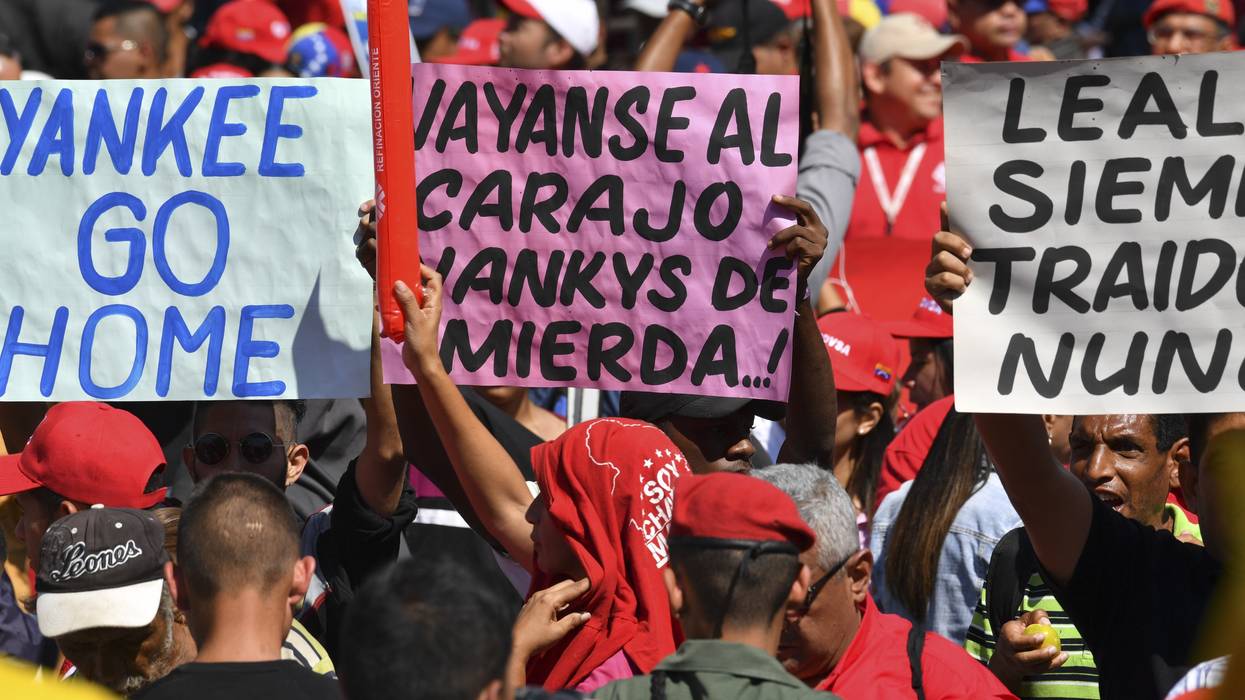
Under a hybrid system of sanctions and licenses, control is maintained and money is made.
In the wake of Washington’s January 3 military attack and then problematic détente with Caracas, corporate media suggest a meaningful shift in Venezuela policy, implying relief for a country long subjected to economic coercion. However, far from dismantling the sanctions regime, the US has merely adjusted its application through licensing mechanisms, leaving the core structure of coercive measures fully intact.
Reuters reported, “US lifts some Venezuela sanctions,” followed by news of sanctions being further “eased.” Both NBC News and ABC News likewise reported sanctions “eased,” while the Financial Times wrote that Washington “relaxes sanctions.” Reuters later found that “US waives many of the sanctions,” and the Los Angeles Times noted “targeted relief from sanctions.” The Washington Office on Latin America (WOLA) described a “huge easing of sanctions.”
In fact, there is no evidence of any revocation of executive orders, removal of Venezuela-related sanctions authorities, and certainly no formal termination or suspension of Washington’s sanctions regime.
At a February 21 meeting I attended in Venezuela, Anti-Blockade Vice Minister William Castillo described sanctions as a “policy of extermination.” These measures, “the most cruel aggression against our people,” had been renewed the day before by President Donald Trump. To do so, he had to certify the original mistruth first fabricated by Barack Obama in 2015: that Venezuela poses an “extraordinary threat” to US national security.
As grave as the direct US military aggression has been—including 157 fatalities since last September in alleged drug interdictions of small craft in the Caribbean and eastern Pacific—the body count from the coercive economic measures has been far higher.
Castillo cited 1,087 measures imposed by the US and another 916 by its echo, the European Union. These unilateral coercive measures have a corrosive effect on popular support for the government, which is precisely the purpose of this form of collective punishment, illegal under international law.
In 2023, Castillo described Washington’s economic aggression as a means to destroy Venezuela without having to invade. The Bolivarian Revolution’s successful resistance, including positive GDP growth while under siege, suggests why the US felt compelled to escalate with a military incursion on January 3, killing over 100 and kidnapping the country’s lawful head of state and his wife.
In Castillo’s words, the US escalated from “a war without gunpowder… against the civilian population” to an actual one. As grave as the direct US military aggression has been—including 157 fatalities since last September in alleged drug interdictions of small craft in the Caribbean and eastern Pacific—the body count from the coercive economic measures has been far higher. Former United Nations Special Rapporteur Alfred de Zayas estimated that sanctions have caused over 100,000 excess deaths.
There is even a literal playbook on how to apply sanctions to inflict “pain” on civilians for “maximum effectiveness.” The author of The Art of Sanctions is Richard Nephew, a former US State Department senior official in the Biden administration who was responsible for implementing such policies.
What has happened in practice is a much more limited form of relief under the sanctions regime. The Treasury’s Office of Foreign Asset Control (OFAC) has issued broad licenses allowing certain dealings primarily with Venezuela’s state oil (PDVSA) and gold (Minerven) sectors.
OFAC licenses carve out limited exceptions principally benefiting US and other foreign corporations, not necessarily the Venezuelan people. Activities are authorized that would otherwise be illegal under US law, even though such activities are lawful under international law. They come with conditions, limits, and reporting requirements and can be revoked at any time.
In practical terms, sanctions remain in place, although certain transactions are temporarily allowed under strict licensing rules. “The result is a hybrid scheme in which formal sanctions and operational licenses coexist, enabling limited flows of economic activity,” according to Misión Verdad.
This flexible arrangement of sanctions combined with licenses allows US and other foreign corporations to make a profit off of the coercive system. Under sanctions alone, the targeted people overwhelmingly suffer but, secondarily, US and other corporations are shut out. Under this hybrid system, control is maintained and money is made.
However, most foreign investors are reluctant to make important investment decisions when there is uncertainty, especially given Mr. Trump’s mercurial reputation. A temporary license does not provide the security that corporations normally require. Recuperating the Venezuelan oil industry would necessitate “a gigantic investment.” Such investments will be unlikely if Venezuela is sanctioned, the licenses notwithstanding.
Meanwhile, Venezuelan President Nicolás Maduro and “First Combatant” Cilia Flores remain in a New York City jail, reportedly in solitary confinement.
Regarding what happened on January 3, corporate media sources overwhelmingly use relatively anodyne terms such as “downfall,” “removal,” or “ouster,” rather than the more pointed “kidnapping” or “abduction.” When the legality of this clearly illegal act of war is questioned by either the media or by the Democrats, it is mainly confined to whether President Trump required congressional approval.
Likewise, application of international law regarding the illegality of unilateral coercive measures is largely absent from media coverage. Where legal issues appear, they tend to address mechanics (e.g., the US-controlled fund arrangement), rather than whether sanctions themselves violate international law.
Acting President Delcy Rodríguez views ending interference by foreign actors in Venezuela’s internal affairs as a precondition for credible elections.
When media outlets express concern about Washington’s restrictions, it is often that easing them would “reward Maduro loyalists.” While the plight of the Venezuelan people may be acknowledged, the blame is mainly attributed to corruption and economic mismanagement, with little if any opprobrium for sanctions.
As former political science professor at the Universidad de Oriente Steve Ellner (pers. comm.), notes, corruption and mismanagement do exist. But the overwhelming factor has been the sanctions regime. The blockade targeted Venezuela’s oil industry—at one point accounting for 99% of foreign-exchange earnings—forcing the country out of normal dollar-denominated markets and into black markets to survive.
What Alfred de Zayas dubs the “human rights industry” similarly exhibits a convenient blind spot regarding sanctions. WOLA, for example, advocates “addressing the complex humanitarian emergency.” Yet the NGO strongly opposes sanctions relief for the people, because the coercive measures are such an effective “pressure” tool on the leadership.
Former WOLA staffer David Smilde is preoccupied with “restoring” American-style democracy by imposing pressure on the “regime.” He argues, “The democratic transition in Venezuela… requires the support of international organizations.”
In contrast, acting President Delcy Rodríguez views ending interference by foreign actors in Venezuela’s internal affairs as a precondition for credible elections. In particular, she calls for the US “blockade and sanctions against Venezuela [to] cease.” With sanctions still in place, the US remains the biggest obstacle to free and fair elections in Venezuela.

Cuba's Deputy Foreign Minister Carlos Fernandez de Cossio said he hoped the people of the United States would ask, "Why does our government treat the whole population of Cuba this way?"
More than 96,000 Cubans, including 11,000 children, are "waiting for surgery" due to a fuel shortage caused by the American blockade, the country's deputy foreign minister, Carlos Fernandez de Cossio, said on Sunday.
The numbers cited by the minister on NBC's "Meet the Press" on Sunday were first reported earlier this month by Cuban Minister of Public Health José Ángel Portal Miranda, who explained that President Donald Trump's policy of “energy asphyxiation," using tariffs to threaten countries out of importing fuel to Cuba, has devastated its National Health Service.
The policy has left Cuba unable to import oil from abroad for more than three months, reducing its fuel supply by about 90% and leading to periodic blackouts and strict energy rationing.
Using the severely limited electricity at its disposal, Cuba's health system has been forced to prioritize continuing cancer treatments and other lifesaving procedures, putting those awaiting non-urgent surgeries on the sidelines.
Last month, a specialist at a hospital in Holguín told Diario de Cuba that the surgeries canceled included "uncomplicated hernias, cataract surgeries, some non-urgent gynecological procedures, and scheduled orthopedic surgeries."
Other healthcare professionals said that nobody was being admitted to the hospital for tests and that it was running low on basic supplies like syringes, IV tubing, and antibiotics, which could not be delivered due to fuel shortages. Most of those that have been used had to be donated by family members or purchased for exorbitant prices on the black market.
Jorge Barrera, a reporter for CBC News, spoke with patients and employees at Havana’s National Institute of Cardiology and Cardiovascular Surgery this weekend and found it to be at about half capacity, and that nonessential care has been virtually all suspended.
"Even though the health system is a point of pride for Cuba... something that they export to the rest of the world," Barrera explained, "because of this crisis, because of the impact it's had on the skyrocketing prices, it's just not enough for them to make ends meet. So people are quitting... to find other ways to make money to feed their families."
Experts with the United Nations have condemned the blockade of Cuba as "a serious violation of international law." Condemnations have grown louder over the past week as Trump said he believed he'd have "the honor of taking Cuba" after it collapsed.
De Cossio said he hoped the people of the United States would ask "Why does our government treat the whole population of Cuba this way?" and that they'd "understand that it's not correct to treat another nation the way the US is doing simply to try to achieve political goals."
The US blockade of Cuba is largely unpopular with the American public. A poll published last week by YouGov found that just 28% of adult US citizens said they approved of the US blocking oil shipments to the country, while 46% said they opposed it.
Asked by anchor Kristen Welker about suggestions from Trump that Cuba would collapse "on its own" without the need for the US to intervene militarily, De Cossio retorted, "What does 'on its own' mean when it’s being forced by the United States?"
Prior to Trump's further measures to isolate Cuba in January, the US had placed Cuba under an economic embargo for more than 60 years, which severely hampered the country's economic development and has cost Cuba trillions of dollars since it began, according to the UN.
"It’s a very bizarre statement, and it’s claimed by most US politicians repeatedly that Cuba will collapse on its own," De Cossio said. "Then why does the US government need to employ so many resources, so much political capital, so many human resources to try to destroy the economy of another country? Evidently, it implies that the country does not have the characteristics to collapse on its own."

Israeli and US officials seem unaware that the crimes they now condemn are ones they themselves have long justified as legitimate military actions.
In recent days, Israel and the United States have expressed outrage over the deliberate and indiscriminate targeting of civilians and civilian residences and infrastructure in Israel and the Gulf by Iranian forces.
They have cited the illegality of such attacks, urged global condemnation, and demanded that human rights organizations speak out. Having spent years weakening the laws meant to protect civilians, they are now discovering that those same laws are too fragile to protect their own people.
Israeli and US officials seem unaware that the crimes they now condemn are ones they themselves have long justified as legitimate military actions.
Take cluster munitions. Following Iran’s reported use of these indiscriminate weapons on March 9 around Tel Aviv, Israeli officials condemned their use in populated areas. “The Iranian regime is firing cluster bombs at Israeli civilians. Their deliberate and repeated use against civilians shows that the Iranian terror regime is seeking to maximize civilian deaths and harm,” declared Israel’s foreign ministry, which provided an infographic explaining how the weapon—banned by 124 countries—is inherently indiscriminate. The Pentagon echoed the criticism, with Adm. Brad Cooper, the chief of US Central Command, condemning Iran’s use of “inherently indiscriminate” cluster munitions.
Yet in 2006 Israel fired more than four million cluster munitions into southern Lebanon, turning large swaths of the country into a no-go zone while insisting their use was a military necessity. Unexploded cluster munitions continue to terrorize Lebanese civilians, maiming and killing at least 400 people as they detonated years after the war. Israel reportedly resumed using cluster munitions in Lebanon in 2025 but would neither confirm nor deny doing so.
Israel’s vast use of these weapons in 2006 helped spur the 2010 Convention on Cluster Munitions, banning them as inherently indiscriminate. Yet Israel and the United States — along with Russia and Iran — have refused to ratify the treaty, insisting they may be used legitimately in wartime. In 2023 and 2024, the Biden administration shipped large quantities of cluster munitions to Ukraine despite warnings that unexploded ordnance would endanger civilians for decades to come. The consequences are now clear: having challenged the ban on these weapons, Israel now finds its own civilians under attack from them.
Iranian attacks on Israeli and Gulf civilian infrastructure — from residences to schools to water desalination plants — have drawn similar condemnations as unlawful attacks on civilians, even though such strikes have been preceded or followed by unlawful attacks on Iranian civilians and infrastructure. On March 8, the United Nations Security Council issued a resolution singling out Iranian attacks on civilians for condemnation, even though Israeli and US forces had also struck a girls’ school, civilian residences, and an Iranian water desalination plant, among other civilian sites. Even AIPAC chimed in, bemoaning that Iran was “killing civilians” in Bahrain following a strike that killed a young woman on March 9.
These condemnations ring hollow in the wake of Israel’s vast destruction of residential buildings, schools, universities, and agricultural lands in Gaza, leaving the territory buried under 61 billion tons of rubble and largely uninhabitable, and more than 75,000 people, the majority women and children, dead. For more than three years since its latest war in Gaza, Israel has defended its assault on Palestinian civilians as military necessity, blamed Hamas for “starting” the war, and rejected condemnations as products of bias and antisemitism.
Israeli and US officials have gone further still, at times rejecting very applicability of international law. “I don’t need international law,” asserted President Donald Trump earlier this year; adding “my own morality” is “the only thing that can stop me.”
For its part, Israel rejects the status of Palestine as occupied territory under the Geneva Conventions and the prohibition on the acquisition of territory by force; both US and Israeli officials reject the jurisdiction of the International Court of Justice and the International Criminal Court. “Secretary of War” Pete Hegseth has suggested dispensing with international humanitarian law altogether, declaring that the United States should employ “maximum lethality, not tepid legality” and give “no quarter, no mercy to our enemies” – rhetoric that, when applied in an armed conflict, constitutes a war crime.
Such contempt for international law may seem convenient for states that believe their power shields them from consequences. But in a world where destructive force is widely distributed, weakening the rules meant to protect civilians invites others to do the same. The result is not greater security but a downward spiral in which every side claims necessity while civilians pay the price.
International humanitarian law was never meant to protect only one side’s people. It protects civilians precisely because it binds all parties equally. When powerful states defy those rules, they do more than harm their adversaries; they weaken the only framework that can protect their own civilians in return. If governments truly want to safeguard their people, the answer is not selective outrage but consistent compliance: uphold the law, apply it universally, and defend it even when it constrains your own actions.