

SUBSCRIBE TO OUR FREE NEWSLETTER
Daily news & progressive opinion—funded by the people, not the corporations—delivered straight to your inbox.
5
#000000
#FFFFFF
To donate by check, phone, or other method, see our More Ways to Give page.
Daily news & progressive opinion—funded by the people, not the corporations—delivered straight to your inbox.
If this sounds like paranoia, it’s only because we’ve already forgotten that we lived through it once before.
Donald Trump is already telling us he’s going to try to steal the 2026 election, and the fact that he’s saying it now, months in advance, is the whole tell.
Back in February he stood up and declared that “Republicans ought to nationalize the voting,” floated taking over the vote in fifteen states his party doesn’t control, and returned to the lie he’s been pushing for a decade, that mail-in ballots are crawling with fraud.
They aren’t. Americans have voted by mail for more than a century and a half, and the Brennan Center has shown over and over that you’re likelier to be struck by lightning than to commit mail-ballot fraud.
The fraud claim was never an argument: it’s an excuse for voter suppression, its own form of election fraud. When you convince tens of millions of people that the only way your side can possibly lose is if the other side cheats, you’ve prepared them to swallow whatever you “have to do to protect the vote,” and to reject the result as illegitimate if you lose anyway. That’s the groundwork, and they’re laying it right now in the open.
The measures themselves are extraordinary. This spring Trump signed an executive order trying to seize federal control over how states run their elections, and when the courts blocked most of it, his administration found a back door through, of all places, the Post Office.
The Postal Service has proposed a rule that would let it refuse to deliver mail-in ballots in any state that won’t first hand over its complete list of mail voters to the federal government, a rule the NAACP says is built to disenfranchise voters and that twenty-three Democratic-led states are now suing to stop.
Steve Bannon went on his podcast and promised that “we’re gonna have ICE surround the polls come November,” and when reporters asked the White House to rule it out, the press secretary wouldn’t. More than forty-eight million Americans voted by mail in 2024.
These men want the power to decide whose ballot gets carried to the mailbox and who feels safe enough to show up in person.
If you’re wondering why they’re working this hard to keep you from voting, the answer slipped out of Todd Blanche’s mouth this spring.
Standing on a stage at the Conservative Political Action Conference (CPAC) outside Dallas, the man who’d been Trump’s personal criminal defense lawyer and who now runs the Justice Department as acting Attorney General told the crowd that :
“[E]verybody’s afraid that the next administration, if we don’t win, we’re going to all be investigated and indicted.”
He meant it as a rallying cry. What he actually delivered was a confession: you don’t spend your evenings bracing for an indictment unless some quiet part of you already knows what you’ve done.
A reckoning is coming for the people breaking the law for this president, and they can feel it.
And now the White House is even discussing completely blowing up the Constitution and the right of habeas corpus, which dates back to the year 1215 when the British elite forced King John to sign the Magna Carta on the plain at Runnymede. As the New York Times reported this morning:
“Suspending habeas corpus was one of two radical ideas Mr. Miller had been pushing that alarmed Mr. Scharf. The other was invoking the Insurrection Act to deploy the military to enforce the law on American streets as protests grew against deportation sweeps.”
Todd Blanche, in particular, has every reason to be worried: he knows who Trump really is, and what he’s capable of.
He’s the lawyer who defended Trump in the New York hush-money trial that ended in thirty-four felony convictions, and in the federal cases over January 6th and the classified documents stashed at Mar-a-Lago.
He’s also the guy who’s now hiding three million Epstein documents and cut the cushy, puppy-filled deal with Ghislaine Maxwell for keeping her mouth shut.
Now he presides over a Justice Department that he and Trump have remade into a personal instrument of vengeance, complete with a Hitler-like 60-foot banner of Trump’s leering face on its façade, and the president has just nominated him to hold the office permanently.
So when Blanche says out loud that he’s afraid, he isn’t being paranoid. He’s being a good lawyer, reading the room, and the room he’s reading is called “history.”
It reminds me of two lawyers I learned about when we lived in Germany, because the men doing Trump’s legal dirty work today are walking a road that better-dressed men walked ninety years ago, and, as a result, we know exactly where it leads.
The first is Hans Frank, who started out as Adolf Hitler’s personal attorney, defending Hitler and his Nazi thugs in court all through the 1920s the way Blanche once stood behind Trump at the defense table.
When Hitler took power, Frank was rewarded. He became the Reich’s chief jurist, president of the Academy for German Law, and eventually Governor-General of occupied Poland, where he presided over ghettos, mass plunder, and slaughter on a scale that’s still hard to grasp.
Frank was the respectable face of the regime, the man who insisted there was a legal theory for everything. At the Nuremberg trials he was found guilty of war crimes and crimes against humanity, and on October 16, 1946, the respectable lawyer was hanged.
The second man is Roland Freisler, and if Frank shows you what happens to the enabler, Freisler shows you what happens to the judge who decides — like Blanche has argued and John Roberts went along with — that the law is simply whatever Dear Leader wants it to be.
Freisler ran the Volksgerichtshof, the People’s Court, a tribunal stood up outside Germany’s constitutional structure for the express purpose of producing the verdicts the regime demanded. He handed down thousands of death sentences in three years.
He screamed at defendants from the bench, ordered their microphones cut, condemned the young students of the White Rose resistance to the guillotine for the crime of printing leaflets, and sent the officers of the July 20th plot to be hanged within hours of their show trials.
Freisler never faced a Nuremberg of his own, but only because an American bomb fell on his courthouse in February 1945 while he was reportedly clutching a defendant’s case file. The defendant lived; the judge did not. There’s a grim justice in the fact that the one man who most weaponized the law against his fellow citizens was killed holding the very file he was using to destroy one of them.
I stood in the small plaza at the University of Munich back in 1988, the Geschwister-Scholl-Platz, named for Hans and Sophie Scholl, where the two of them were caught scattering their leaflets from the gallery before Freisler sent them to die. They were the Renee Good and Alex Pretti of their time.
The university has since pressed bronze replicas of those scattered leaflets right into the pavement, so that today you walk over them and have to stop.
You think, standing there, about how ordinary the machinery of all this was. It wasn’t run by monsters in uniform alone. It was run by men like Todd Blanche and John Roberts, men with law degrees, men who told themselves they were just interpreting the statutes, just following the orders, just serving the head of state.
And every honest accounting that came afterward, from Nuremberg onward, rejected that excuse and established the principle that a directive from above does not protect the man who carries it out.
That principle is precisely what must be keeping Todd Blanche awake, because we’re already watching the American version, as Mark Twain once said, rhyme.
When Trump wanted his enemies prosecuted, the career professionals balked, so the administration installed Lindsey Halligan, another former Trump personal lawyer with no prosecutorial experience whatsoever, as a U.S. attorney, and she promptly indicted James Comey and Letitia James.
In a contrast with Germany in 1933, a federal judge threw both cases out, ruled her appointment unlawful, and other judges in the district were so disgusted that one of them now puts an asterisk beside her name on every court filing.
Thankfully, at least so far, these are not the actions of a legal system that’s fully surrendered (although Aileen Cannon may soon have a word). They’re the actions of one that’s still fighting back, and that fight is the whole ballgame.
But it gets worse, because that same executive order about mail-in voting also directs the Department of Homeland Security to build its own state-by-state lists of who’s eligible to vote, exactly the kind of national database you’d assemble if your real plan was to pressure states into purging their rolls.
If that sounds like paranoia, it’s only because we’ve already forgotten that we lived through it. In 2000, Jeb Bush’s secretary of state, Katherine Harris, who also happened to be co-chair of his brother George’s Florida campaign, hired a private firm to scrub the voter rolls using a list of supposed felons that included eight thousand names shipped in from Texas.
The matching was deliberately loose, flagging anyone whose last name was an 80 percent match to a felon’s, and the Brennan Center later found that at least twelve thousand eligible voters were wrongly purged, twenty-two times George W. Bush’s 537-vote margin. Black Floridians were eleven percent of the electorate and forty-one percent of the people thrown off the rolls.
Bush took the presidency by that sliver, and the Florida Supreme Court-ordered recount that would have caught the theft was shut down by a Supreme Court whose deciding majority included a justice his own father had put on the bench, Clarence Thomas, whose wife was at that very moment collecting résumés for a Bush administration, and Antonin Scalia, whose sons worked for firms representing Bush, neither of whom saw any reason to step aside.
That’s the voter merge-and-purge playbook, and they’re dusting it off on a national scale for this November with new, borrowed-from-Putin tweaks. Or at least they’re trying their hardest to.
When the Reichstag finally voted itself out of existence in March 1933, uniformed storm troopers lined the walls of the chamber so the legislators would understand the price of voting no.
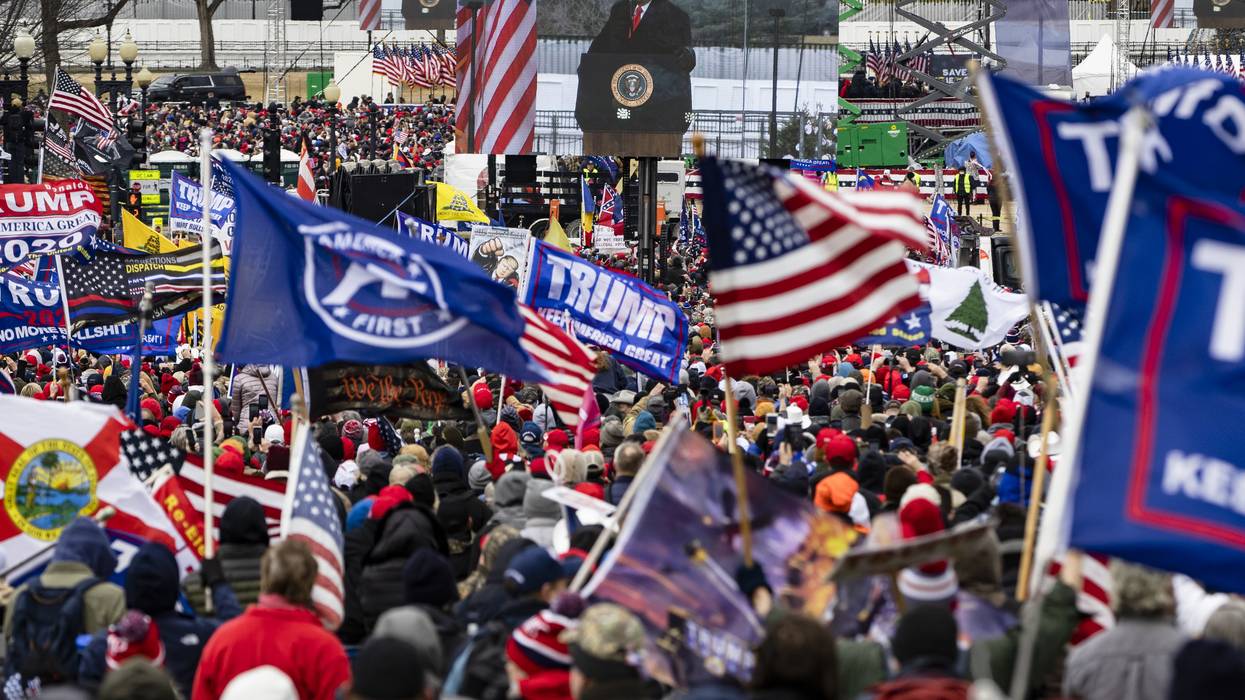
That’s the tradition these men are drawing from, and we’d be fools not to be clear-eyed and ready for just about anything between now and November. After all, we all watched what Trump and his lickspittles did on January 6th, 2021, killing four police officers as they tried to “hang Mike Pence.”
But here’s the difference between Germany in 1933 and America in 2026 and, as Wendy Lawrence argues in a brilliant recent essay, it comes down to timing.
The Germans got their decisive vote after the seizure of power, when a newly seated Reichstag rubber-stamped the Enabling Act and handed Hitler everything. We get ours before. Which is why they’re so frantically trying to suppress the vote.
The November midterms will arrive while the courts are still ruling against this administration, while subpoenas can still be issued, while the power of the purse still belongs to whoever controls the House.
A Democratic majority doesn’t need to convict anyone to change everything. It can deny the appropriations that fund the deployments and the detention machine, it can compel sworn testimony and drag the concealed directives into daylight, and it can restore a Justice Department willing to enforce laws like Section 242, the Reconstruction-era statute that makes it a felony for any official to strip any citizen of their constitutional rights.
The Supreme Court’s immunity ruling shields the president’s official acts, but it shields no one beneath him. The agents, the contractors, the lawyers who signed the unlawful papers, all of them remain fully exposed, and a future attorney general can act on that.
Trump understands this perfectly, which is why he told House Republicans that they have to win the midterms because otherwise “they’ll find a reason to impeach me.” It’s why his people muse about ICE at the polls and write rules to choke off the mail. It’s why Stephen Miller is reportedly pushing to suspend habeas corpus. It’s why Trump promised to “pardon everyone who has come within 200 feet of the Oval [Office].”
These lawyers and judges aren’t afraid of impeachment as an abstraction: they’re afraid of the reckoning that oversight makes possible, the same reckoning Hans Frank met at the end of a rope and Roland Freisler escaped only by dying.
The coming reckoning — unless they can stop it this fall — isn’t vengeance. It’s the rule of law standing back up after being knocked down, and in this country that recovery still runs through a ballot box which the members of the Reichstag of 1933 no longer had.
So, make sure you’re registered, and make sure everyone you know is too, at vote.org, and if you vote by mail, request your ballot early this fall and send it back early so no postal rule can run out the clock on you.
Save the nonpartisan Election Protection hotline in your phone, 866-OUR-VOTE, and call it the moment anyone tries to intimidate you at a polling place, because no badge and no uniform has the right to stand between you and your vote.
Call your representatives through the Capitol Switchboard at 202-224-3121 and remind them that funding lawless deployments, gutting oversight, suspending habeas corpus, and letting the Post Office police our ballots are against the Constitution.
Keep an eye on your own statehouse at openstates.org, where this fight is being waged district by district.

The wealth and power accumulated by these two deeply flawed men—and how horrible and cruel they are as people—is evidence of how far we’ve fallen.
Elon Musk has just become the world’s first trillionaire. Donald Trump is America’s first dictator. But they have more in common than their economic and political dominance.
To describe both as selfish narcissists would be a wild understatement. Both are maniacally obsessed with increasing their own personal wealth, power, and control.
Both have been willing to break laws, norms, and other social constraints in pursuit of these goals. Both have manipulated, bribed, conned, robbed, and bullied their ways to dominance.
Trump tried to overturn the results of the 2020 election, was impeached twice, found criminally liable for cooking his corporate books, and civilly liable for sexual abuse.
Musk paid a quarter of a billion dollars to get Trump elected president, then ran Trump’s illegal and hugely destructive DOGE. Musk’s SpaceX has all the hallmarks of a gigantic Ponzi scheme in which insiders pocket the winnings and leave latecomers holding the bag.
Both pride themselves on paying little or no taxes. Trump famously said that paying not paying federal income taxes "makes me smart." Musk paid zero taxes in 2018.
Both are notoriously lacking in empathy; they view all relationships as transactions. Trump refuses to be a "consoler-in-chief" in national tragedies and openly withholds sympathy for families of political opponents who die. (When Rob Reiner and his wife were murdered, Trump asserted they were killed “due to the anger [Reiner] caused others through his massive, unyielding, and incurable affliction with a mind crippling disease known as TRUMP DERANGEMENT SYNDROME.”)
Musk has stated that "the fundamental weakness of Western civilization is empathy” — arguing that a society can only afford to practice broad empathy if it operates from a position of systemic strength.
Both regard themselves as omnipotent and invincible. Both lash out verbally or physically at anyone who crosses them, often getting into raging disputes and fights.
To the extent they have any belief beyond their own omnipotence, it’s white male nationalism. “Whites are a rapidly dying minority,” Musk wrote his 240 million followers in a January post on X. In a February post, he declared that “there has been unrelenting hate and poisonous propaganda in the West against anyone White, straight or male over the past decade or more,” adding, “No more guilt trips. ENOUGH.”
Musk has suggested that race plays a detrimental role in hiring. He’s touted the role of white people in eliminating slavery. He’s accused public figures of racism against white and Asian people.
In recent months, Musk has increased his online posts about perceived threats to whiteness, or what he views as calls for a “genocide” against white people. Over the past seven months, he has posted 850 times about race, nearly daily and triple the rate for the previous two years.
Trump also has a well-documented history of white supremacist actions and rhetoric, including the 1973 lawsuit brought against Trump management for allegedly discriminating against Black renters; his full-page ads in 1989 calling for the death penalty for the five Black and Latino teenagers eventually exonerated in the Central Park jogger case; his leading role in the debunked, racially-charged conspiracy theory that Barack Obama was not born in the United States; his 2016 accusation that Mexican immigrants were criminals and “rapists;” his 2017 “Muslim ban;” his “fine people on both sides” of the violent white supremacist rally in Charlottesville; his view of Haiti, El Salvador, and African nations as “shithole” countries; his determination to erase Black history from America’s classrooms; and his campaign against diversity, equity, and inclusion.
Both Musk and Trump have pushed the conspiracy theory that Democrats are seeking to import undocumented immigrants so they can take over the U.S. government forever.
Both have fomented white nationalism abroad. Trump was an enthusiastic ally of Viktor Orbán, who saw Western civilization threatened by Muslim immigration into Europe. Many people in Trump’s circle continue to support and encourage leaders of the European far-right.
Musk, too, encourages white nationalism abroad. During the recent anti-immigrant protests and riots in the United Kingdom—particularly in Belfast and London—Musk posted that “civil war is inevitable” and urged British protesters to “fight back or die” (prompting British Prime Minister Keir Starmer to condemn Musk’s comments as “dangerous.”) In response to the recent killing in Belfast, Musk blamed “murderous migrants beheading innocent people in their home town.” He shared an image of the stabbing suspect, who is Black, alongside the caption declaring “millions must go.” And he reposted messages claiming that Starmer “hates white people.”
Researchers from the nonprofit watchdog Center for Countering Digital Hate report that “Musk’s amplification” of anti-migrant narratives to his hundreds of millions of followers was “instrumental” in provoking the violence in Belfast: “No individual played a bigger role in spreading [hateful] content on X than Musk himself.”
Both Trump and Musk also have long histories of misogyny.
Throughout his business and political careers, Trump has frequently disparaged women, describing female opponents and journalists as “disgusting,” “slobs,” and “piggy.” He has a well-documented history of sexual aggression. A federal jury found him liable for sexual abuse and defamation against writer E. Jean Carroll, awarding her millions in damages. And he has appointed conservative judges instrumental in rulings that overturned long-standing reproductive rights.
Musk, too, has faced frequent claims of misogyny and sexism. Eight former SpaceX engineers filed a lawsuit detailing a pervasive “’Animal House’” culture — accusing Musk of creating a hostile environment, treating female employees as sexual objects, and retaliating when employees challenged his sexism. Separate reports have also emerged alleging that Musk engaged in inappropriate relationships and persistent advances toward employees, including asking them to bear his children.
Musk has 14 kids with different mothers, and talks about them as a “legion,” as in a Roman military unit. “To reach legion-level before the apocalypse,” he told one of his partners, “we will need to use surrogates.” He has frequently drawn ire for promoting a “bro culture” and mocking femininity. He sparked a major online debate by stating that “Instagram is for girls” and has repeatedly shared or amplified sexist theories and extremist content regarding traditional gender roles.
*. *. *
The question, then, is why have two such loathsome men come to dominate America and much of the rest of the world at this point in history? Is there something about American capitalism or culture in the 21st century that has given both such extraordinary power?
Part of the answer, it seems to me, is a loss of our sense of common good — a decline of the role of public honor and public shame, and a disintegration of public morality — which has allowed, even encouraged, these two dangerous men to acquire such untrammeled wealth and power.
The idea of “the common good” was once widely understood and accepted in America. After all, the U.S. Constitution was designed for “We the people” seeking to “promote the general welfare”— not for “me the selfish jerk seeking as much wealth and power as possible.”
To be sure, the Gilded Age, which ran from the late 1880s to the 1910s, was dominated by a few extraordinarily wealthy men who violated social norms and monopolized the economy. “The public be damned,” said William Henry Vanderbilt, head of the New York Central Railroad.
But the reign of these “robber barons” ended when the American public — outraged by their abuses of wealth and power — rose up to demand reform and a return to the common good.
Subsequently, during the Great Depression of the 1930s and World War II, Americans faced common perils that required that we work together for the common good. Many of us — both white and black Americans — were motivated to fight for civil rights and voting rights in the 1960s. And a sense of common good moved many of us to act against the injustice of the Vietnam War, and others of us to serve bravely in that besotted conflict.
Yet the common good is no longer a fashionable idea. The phrase is rarely uttered today. It feels slightly corny and antiquated if not irrelevant. There is no longer any restraint on aggressive men (almost all of them men) using whatever means possible to accumulate vast wealth and power on a scale that exceeds even the Gilded Age.
This moral breakdown is not one of personal, private, religious morality. It’s a breakdown in public morality — in a broad understanding of what we owe one another as members of the same society. Trump and Musk exemplify that breakdown. The wealth and power accumulated by these two deeply flawed men is evidence of how far we’ve fallen, and the scale of the challenge we face to rectify it.

Some of the very worst people history has devised have now landed on the beaches of our world, armed to the teeth, and intent on turning this planet into a heat zone.
What a planet! I only wish I could tell my grandfather about it. He arrived in this country, an immigrant from what’s now Ukraine, in March 1888—or so his daughter, my Aunt Hilda, wrote me once upon a distant time. Here’s how she began that long-ago message to me: “Your grandfather, Moore Engelhardt, a boy of 16, arrived in New York from Europe in March 1888. It was during the famous blizzard, and after a sea voyage of about 30 days. He had no money. He often said that he had a German 50-cent piece in his pocket when he landed. His trip had to be in the cheapest part of the ship—way down below steerage. Poor boy, I’m sure he was seasick a good deal of the time. Since he was alone, he sort of attached himself to a family of a lot of children and, for the first few months in America, I imagine he slept behind the stove in somebody’s kitchen.”
As a boy of 14, he had, my aunt reported, challenged the local rabbi where he lived to give him back some of the money his father had donated to the rabbi—money his mother had made and that they needed just to live. And when the rabbi refused, he evidently hit him and then ran away from home. The rest, as they say, is history.
I barely knew him. He died when I was about five years old and I have only the faintest memory of standing beside him, holding his hand, while he leaned on his cane. But in the end, he managed to turn that 50 cents into a business in Brooklyn, New York. He got clobbered in (but made it through) the Great Depression of the 1930s, and even built a couple of buildings in Brooklyn that he named after my dad and Hilda. Sometimes I wonder what he’d think about our strange Trumpian world today. After all, we’re on an increasingly disturbed planet, where, in some places, as the heat rises, the storms intensify, wildfires grow ever fiercer, sea levels rise, and... well, you get the idea... ever more people are finding that they simply can’t stay in their worlds anymore and migration of the sort my grandfather once engaged in is growing exponentially.
And President Donald J. Trump doesn’t like that one little bit. I have no doubt that, had he been president back in 1888, he would have wanted to chuck my grandpa, a wandering Jew from what’s now Ukraine, out on his ear.
And yet, you might also think of “our” president as a migration-causer extraordinaire. After all, whether he likes it or not, he is indeed the climate-change president. And give him credit, though he’s not the sun (not faintly), he certainly has proven himself distinctly capable of upping the heat in this world of ours exponentially and I don’t just mean by doing everything he can under the (yes!) sun to deny that climate change is even happening. Of course, he’s labelled it a “con job“ and claimed its potential threat to our health is a “scam.”
What he’s attempting to do on (and to) this planet of ours will, in the not-at-all-distant future, prove to be a disaster of an almost unimaginable sort—from trying to increase the use of coal, oil, and natural gas, to interfering in plans to use wind and solar power. In doing so, of course, he’s also turning our future over to that other great imperial power of the moment, the New Green Power of Planet Earth, China (despite the fact that it’s also still using record amounts of fossil fuels). Someday, without a doubt, Donald Trump will—yes!—undoubtedly be seen as the D(and a 1/2)P or Disaster (and a Half) President.
Even his fierce attempts to get rid of any immigrants (who aren’t, of course, White South Africans) by flying them first to deportation camps and then out of the country are only further heating this planet of ours, as Alexandra Villarreal of the Guardian pointed out recently. That staggering number of flights is “producing hundreds of thousands of metric tons of climate-damaging carbon emissions as officials shuttle unprecedented numbers of people to detention centers far from home and deport them to countries across the world.” US Immigration and Customs Enforcement’s air operations are estimated to have pumped 370,240 tons of carbon emissions into the air in 2025 alone, “up 88% from the year before.”
Imagine that! Fortunately, as the (remarkable) Guardian also reported, explain it as you will, red states actually seem to be leading Democratic-led states in the build-out of clean-energy capacity. Despite its powerful links to the gas and oil industry, Texas, for instance, is now the country’s leading clean-energy superpower because of its remarkable build-out of wind power. Recently, it even overtook California (yes, California!) when it comes to utility-scale solar power. (Yikes! Who would even believe it? Not Donald Trump, that’s for sure!)
Still, it is remarkable to have had a climate-change-denier elected president of the most powerful country on Earth not once, but twice! And that’s not all that he and his crew are denying. Only recently, for instance, Secretary of Offense (oops, sorry, Defense) Pete Hegseth compared the (non-White) immigrants now entering Europe to the soldiers who stormed the beaches of Normandy, France, in June 1944 (one of whom I knew as a kid). As he put it recently, “Sadly, today, different European beaches are stormed by different dangerous ideologies. Beaches in Spain, in Italy, in Greece and Bulgaria. Boats and men arrive. When will European capitals do something about that invasion?”
As I sit here sweating on an early June day in New York City that has almost hit 90 degrees in a world heating towards the boiling point ever faster, I’m all too aware that Donald Trump, Pete Hegseth, and the rest of that grim clan have launched their own invasion—of planet Earth itself. They have indeed landed on the beaches of our world, armed to the teeth, and intent on turning this planet into a heat zone. (And we haven’t even noticed the half of it yet because our oceans have so far absorbed so much of that heat.)
Yes, there are obviously many, many problems when it comes to Trump, Hegseth, and crew, but in the end, none matters more than their urge to heat this planet to the boiling point. Their version of governing certainly gives the phrase “hell on earth” new meaning.