

SUBSCRIBE TO OUR FREE NEWSLETTER
Daily news & progressive opinion—funded by the people, not the corporations—delivered straight to your inbox.
5
#000000
#FFFFFF
To donate by check, phone, or other method, see our More Ways to Give page.
Daily news & progressive opinion—funded by the people, not the corporations—delivered straight to your inbox.

"Republicans are rubber stamps for Donald Trump on everything else," said Sen. Chris Van Hollen. "This may be the one area where they've decided not to play ball."
President Donald Trump is reportedly planning to escalate his campaign to eliminate the filibuster in the US Senate.
According to a Tuesday report from Axios, Trump plans to relentlessly harass Republican senators until they accept his demands to kill the filibuster, which imposes a 60-vote threshold for closing debate on most legislation in the Senate ahead of a final vote.
One Trump adviser told the publication that the president plans to be relentless in lobbying Republicans to end the filibuster in a way he never was before.
"He will call them at 3 o'clock in the morning," they said. "He will blow them up in their districts. He will call them un-American. He will call them old creatures of a dying institution. Believe you me, he's going to make their lives just hell."
Another adviser told Axios that Trump is "really mad" about Democrats being able to force a government shutdown—now tied for the longest in history—even when Republicans have control of the US House, Senate, and presidency.
The official White House account on X even got into the action on Tuesday with an all-caps post demanding that GOP senators "TERMINATE THE FILIBUSTER!!!"
Even so, there so far is no indication that enough Republican senators are going to obey Trump's orders on this issue, especially since three of them—Sens. Lisa Murkowski (R-Alaska), Bill Cassidy (R-La.), and Susan Collins (R-Maine)—voted to convict him at his second impeachment trial in 2021.
Many Republicans, including former Senate GOP Leader Mitch McConnell (R-Ky.), have long taken the view that the filibuster is a net benefit for their party given that it gives them the ability to indefinitely stall most progressive legislation.
In fact, Fox News reported on Tuesday that current Senate Majority Leader John Thune (R-SD) believes there are at most a dozen Republican votes in his caucus in favor of scrapping the filibuster.
In an interview with Axios, Sen. Chris Van Hollen (D-Md.) expressed confidence that Republicans wouldn't really walk the plank for Trump on this issue.
"Republicans are rubber stamps for Donald Trump on everything else," he said. "This may be the one area where they've decided not to play ball."
During former President Joe Biden's term, 49 Senate Democrats voted to eliminate the filibuster but were blocked from getting to the majority by then-Sens. Joe Manchin (D-W.Va.) and Kyrsten Sinema (D-Ariz.), both of whom would eventually leave the Democratic Party to become independents.

"I hate to say I told you so but... I fucking told you so," wrote progressive journalist Mehdi Hasan, who repeatedly urged Senate Democrats to end the filibuster during Joe Biden's presidency.
US President Donald Trump late Thursday urged Senate Republicans to scrap the legislative filibuster to end the prolonged government shutdown without Democratic support—the kind of scenario progressives warned about when imploring Democrats to eliminate the 60-vote threshold during former President Joe Biden's term.
In an all-caps post to Truth Social, Trump wrote that "THE CHOICE IS CLEAR—INITIATE THE 'NUCLEAR OPTION,' GET RID OF THE FILIBUSTER AND, MAKE AMERICA GREAT AGAIN!"
Trump noted Democrats' failure to terminate the filibuster when they controlled Congress under Biden, pointing specifically to the central role that Joe Manchin and Kyrsten Sinema—both of whom have since left office and the Democratic Party—played in obstructing filibuster reform.
"Just a short while ago, the Democrats, while in power, fought for three years to do this, but were unable to pull it off because of Senators Joe Manchin of West Virginia and Kyrsten Sinema of Arizona. Never have the Democrats fought so hard to do something because they knew the tremendous strength that terminating the Filibuster would give them," Trump wrote. "Now I want to do it in order to take advantage of the Democrats."
With the filibuster intact, 60 votes are required to pass most legislation in the Senate. Republicans currently hold 53 Senate seats.
Progressives warned repeatedly during Biden's presidency that Republicans wouldn't hesitate to scrap the filibuster in the future should the 60-vote threshold become a severe hindrance to their agenda. Abolishing the legislative filibuster to end the shutdown would clear the way for other Republican policy proposals to get through the Senate with simple-majority support.
"I spent the entire Biden presidency warning idiotic establishment Senate Dems and Biden who opposed getting rid of the filibuster that Trump and the GOP would come back to power and do it themselves," journalist Mehdi Hasan wrote Thursday in response to the president's demands. "I hate to say I told you so but... I fucking told you so."
Adam Jentleson, former chief of staff for Sen. John Fetterman (D-Pa.) and a vocal advocate of ending the filibuster, noted that "it's pretty easy" to initiate the "nuclear option" on the filibuster "because despite everything, the Senate is a majority rule institution, per the Founders' design."
"The rule that overrides all other rules is that a majority of senators can vote at any time to change the rules—including getting rid of the filibuster, which the Founders abhorred anyway," Jentleson wrote late Thursday. "They could do it tomorrow! No preparation needed."
Trump's demand comes as millions of people across the US are set to lose federal nutrition assistance due to the shutdown and the administration's illegal refusal to tap emergency funds to pay out the benefits.
Millions of Americans are also facing the prospect of skyrocketing health insurance premiums as Trump and congressional Republicans decline to support extending Affordable Care Act subsidies that are set to expire at the end of the year.
Senate Majority Leader John Thune (R-S.D.) said earlier this month that he would oppose scrapping the filibuster to end the shutdown, but he could change his position amid Trump's pressure campaign.
One progressive, Rep. Ro Khanna (D-Calif.), has called for a filibuster carveout that would allow senators to keep the government open with a simple-majority vote.
"I've been consistent on this," Khanna said in an interview in early October. "I said this when Biden was president, and I'm now saying it when Trump's president."
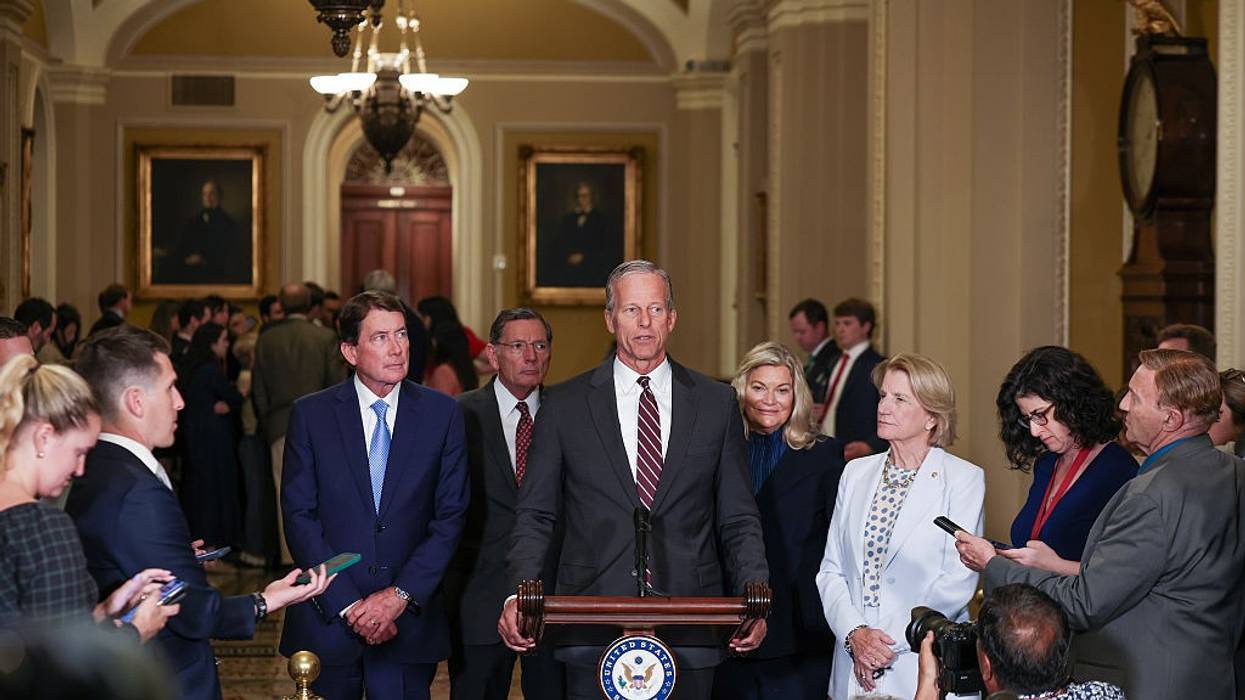
"Senate Republicans have now set the stage to potentially do the same thing in service of adding nongermane, devastating policy provisions to their horrific reconciliation bill," one watchdog warned.
Senate Republicans late Wednesday made use of arcane procedural maneuvers to bypass the chamber's 60-vote filibuster and move ahead with a measure to overturn federal waivers that allowed California to set tougher vehicle pollution standards.
The 51-46 party-line vote came after the Senate parliamentarian, the unelected arbiter of the chamber's procedures, said that the Environmental Protection Agency waivers issued at the tail-end of the Biden administration did not qualify as federal rules for the purpose of the Congressional Review Act (CRA).
The CRA gives lawmakers a limited window to overturn federal rules, and resolutions brought under the law are not subject to the Senate filibuster. The Republican-controlled House voted earlier this month to repeal the California waivers with a CRA resolution, paving the way for Senate action.
On Wednesday, Senate Republicans engaged in a procedural gambit that allowed them to skirt the filibuster while claiming they did not vote to overrule the parliamentarian. As The New York Times explained, Republicans "argued that the situation was 'novel'... allowing the Senate to establish its own course of action since no exact precedents existed."
Lisa Gilbert, co-president of the progressive watchdog group Public Citizen, warned in a statement that the GOP move sets a dangerous precedent, potentially laying the groundwork for Republicans to bypass parliamentarian rulings on provisions of the sprawling reconciliation package that the House passed Thursday morning.
"Tonight they voted to disregard clear legal requirements in their own statutes and rulebook, jettison the judgment of the Senate's referees, and sow long-term chaos so they could pass a brazenly corrupt handout to Big Polluters," said Gilbert. "It's outrageous, dangerous, and reckless in the extreme."
"Senate Republicans have now set the stage to potentially do the same thing in service of adding nongermane, devastating policy provisions to their horrific reconciliation bill of tax handouts for the wealthy and cuts to our social safety net," Gilbert added.
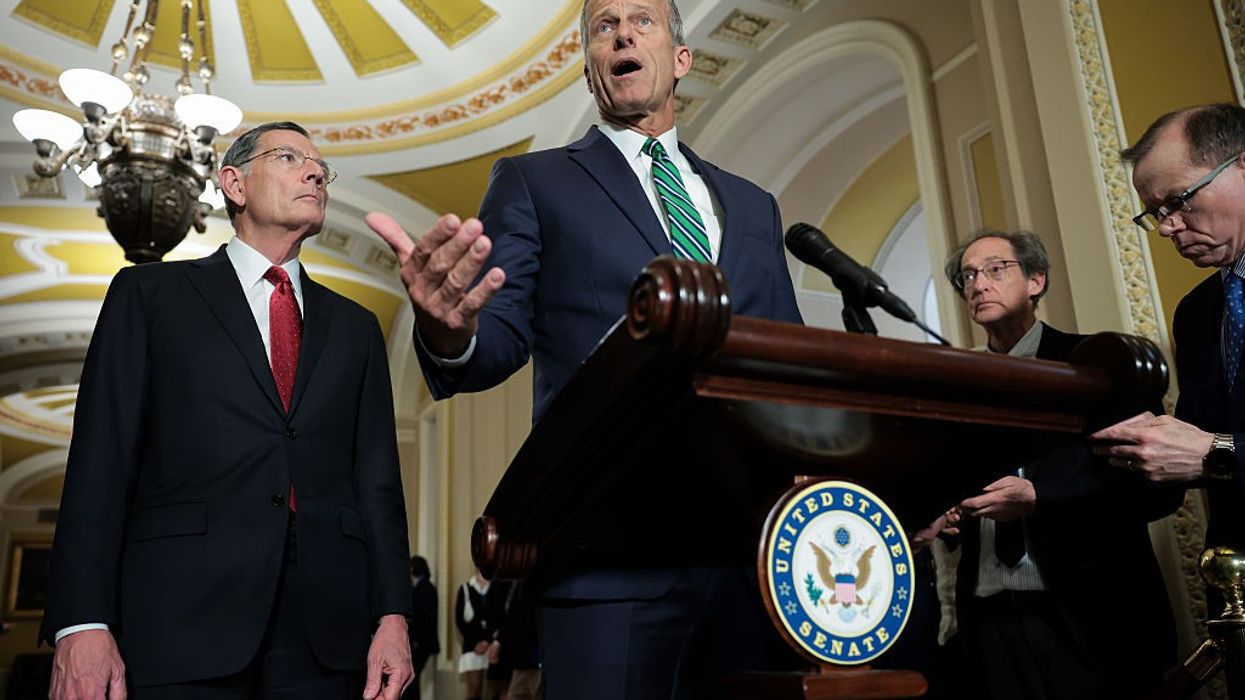
With Trump in office and the wholesale dismantling of democracy underway, one watchdog called what Republicans are planning "the last thing the country needs right now."
But critics warned that the implications of the Republican plan, which the party's leadership is still discussing, are far-reaching and could enable the GOP to advance other unpopular elements of their pro-corporate, far-right agenda.
"If senators are willing to overrule the Senate parliamentarian and circumvent Senate rules on the filibuster for the Congressional Review Act, there is nothing to stop them from going nuclear over and over with policies that would harm Americans and destabilize our democracy," said Lisa Gilbert, co-president of the consumer advocacy group Public Citizen, on Thursday. "This could happen with other CRA proposals or in the reconciliation process."
The CRA allows lawmakers to review and—with the support of a simple majority in both chambers of Congress—overturn federal rules within a limited timeframe. CRA resolutions of disapproval are not subject to the Senate's 60-vote filibuster, a relic of the Jim Crow era that Republicans have selectively defended or scrapped depending on whether they're in the majority.
Republicans want to use the filibuster-proof CRA to block California's Clean Air Act waivers, but the Senate parliamentarian—the chamber's unelected arbiter of Senate rules and procedures—has said the waivers don't qualify as rules subject to the CRA.
Defying the parliamentarian—something Republicans have already done as they craft their bill to slash safety net programs and taxes for the rich—to undo the waivers would effectively gut the filibuster, opponents of the GOP plan warned. Earlier this month, the Republican-controlled House voted to revoke the California waivers using the CRA.
"Anti-democratic and authoritarian measures, corporate giveaways, and rights infringements that could never become law if normal Senate rules were followed—legislation making it harder to vote, repealing core environmental standards, stripping abortion rights, and more—might suddenly become law," Gilbert warned Thursday. "A backdoor nuclear option sets an atrocious precedent and must not be allowed. Critical checks hang in the balance."
"Think about how the Trump administration might abuse this."
Sen. Sheldon Whitehouse (D-R.I.), the top Democrat on the Senate Environment and Public Works Committee, echoed those concerns, saying in a floor speech Thursday that "the import of overruling the parliamentarian extends far beyond CRA resolutions."
"Think about how the Trump administration might abuse this," said Whitehouse. "Everyone knows by now that President Trump has a beef with a whole host of media outlets, some of which are licensed by the Federal Communications Commission. What's to stop the FCC from submitting CBS' license as a 'rule' and members from introducing a disapproval resolution? Is this really the path we want to go down?"
In a floor speech of his own, Sen. Alex Padilla (D-Calif.) directly quoted Senate Majority Leader John Thune's (R-S.D.) warning earlier this year against overruling the parliamentarian.
"That's totally akin to killing the filibuster. We can't go there," Thune said in January. "People need to understand that."
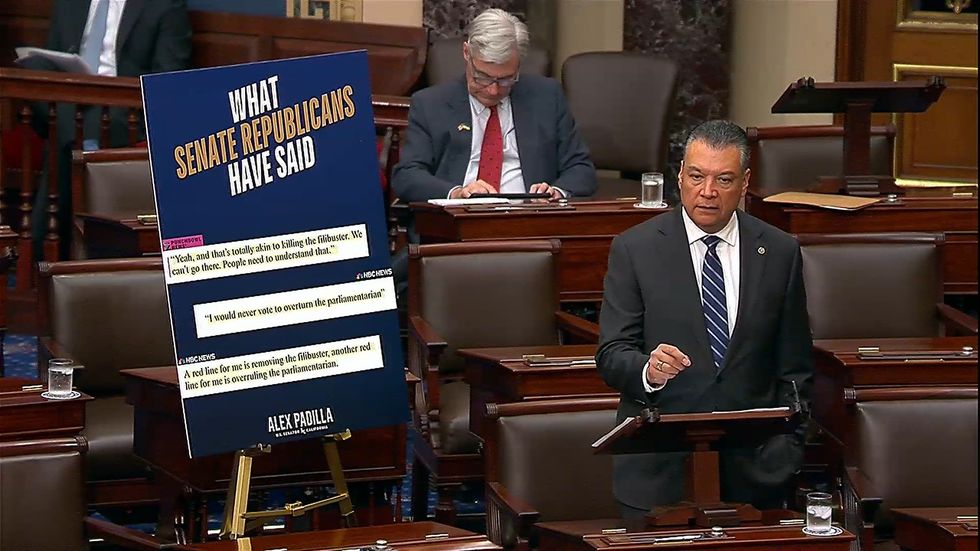 Sen. Alex Padilla (D-Calif.) delivers a speech on the Senate floor on May 8, 2025. (Photo: Sen. Alex Padilla)
Earlier this week, Thune said his caucus is "still looking at" voting on a CRA resolution to revoke the California waivers. Senate Majority Whip John Barrasso (R-Wyo.) told Axios last week that the upper chamber would "absolutely" take up the House-passed CRA resolution.
Gilbert of Public Citizen said Thursday that "this backdoor nuclear option would not only make the Senate more like the House—it would make the Senate more like the chaotic, make-it-up-as-you-go White House."
"That's the last thing the country needs right now," she added.

"This is so important," said Rep. Pramila Jayapal. "Congress needs to step up and codify abortion rights—and we do that by ending the filibuster."
The Democratic presidential nominee, U.S. Vice President Kamala Harris, on Tuesday endorsed eliminating the filibuster to codify Roe v. Wade, the federal abortion rights ruling that was overturned two years ago.
"It is well within our reach to hold onto the majority in the Senate and take back the House," Harris, a former U.S. senator, toldWisconsin Public Radio. "I would also emphasize that while the presidential election is extremely important and dispositive of where we go moving forward, it also is about what we need to do to hold onto the Senate and win seats in the House."
"I think we should eliminate the filibuster for Roe," she continued. "And get us to the point where 51 votes would be what we need to actually put back in law the protections for reproductive freedom and for the ability of every person and every woman to make decisions about their own body and not have their government tell them what to do."
Multiple current lawmakers joined a wide range of reproductive rights advocates in welcoming Harris' comments about ending the filibuster, which requires 60 of the Senate's 100 members to agree to hold a final vote on a bill.
"This is so important," said Rep. Pramila Jayapal (D-Wash.), who chairs the Congressional Progressive Caucus and has shared her own abortion story. "Abortion access is under attack as extreme MAGA Republicans pass cruel laws to strip away our rights. Congress needs to step up and codify abortion rights—and we do that by ending the filibuster."
Unable to pass any defenses of reproductive healthcare in the divided Senate, Majority Leader Chuck Schumer (D-N.Y.) has instead held recent votes on legislation regarding abortion, birth control, and in vitro fertilization (IVF) to call out Republicans.
"The filibuster is an undemocratic rule that prevents us from passing policies that a majority of Americans want. Look no further than last week's IVF vote," Sen. Tina Smith (D-Minn.) said Tuesday. "Could not agree more with Vice President Harris."
The Hill reported that after Harris' comments, Schumer told journalists that if Senate Democrats retain their majority next year, they will discuss creating an abortion "carveout" in the filibuster rule to pass abortion rights legislation.
Meanwhile, the campaign of former President Donald Trump, the Republican nominee for the November election, claimed on social media Tuesday that Harris' position is a "real threat to democracy."
In response, Nina Turner, a senior fellow at the Institute on Race, Power, and Political Economy, declared that "the filibuster is anti-democratic in nature. It's a rule that takes the votes necessary in the Senate from 50 to 60."
Another critic of Harris' position was
retiring Sen. Joe Manchin (I-W.Va.), a key supporter of the filibuster. According to CNN's Manu Raju, the former Democrat—who left the party in May—responded to the vice president's remarks by saying, "Shame on her."
"She knows the filibuster is the Holy Grail of democracy. It's the only thing that keeps us talking and working together. If she gets rid of that, then this would be the House on steroids," Manchin continued, adding that he wouldn't support Harris for president.
Veteran Democratic political strategist Tom Bonier
said that "defending 'the filibuster' over women's bodily autonomy is one heck of a way for Joe Manchin to leave the scene. Though I imagine this lack of endorsement helps Harris much more than it hurts her."
While Manchin was a Democrat, he was a major obstructionist of the party's agenda under President Joe Biden—who backed a filibuster carveout for legislation to codify abortion rights in 2022. The other primary defender of the filibuster is Kyrsten Sinema (I-Ariz.), who ditched the Democratic Party later that year and is also leaving the chamber after this term.
In the absence of federal legislation, GOP state lawmakers have ramped up efforts to restrict reproductive freedom since the U.S. Supreme Court's right-wing justices—including three Trump appointees— reversed Roe with their June 2022 Dobbs v. Jackson Women's Health Organization decision.
Given the Republican-led attacks, reproductive freedom has been a major focus of the presidential contest. While Trump has
bragged about his role in reversing Roe, Harris has blamed him for states' recently enacted and deadly abortion bans.
It is "great to finally hear Kamala Harris be clear as our candidate about ending the filibuster to restore abortion rights nationwide," For All founder Kai Newkirk said Tuesday. "Abolishing the Jim Crow relic minority veto is essential to undo abortion bans and deliver the progress our nation needs."

Gerrymandering and the filibuster are holding back wage increases, the right to unionize, and other benefits for workers.
New waves of workers are standing up and demanding fair treatment on the job — from the fast food workers of the Fight for $15 to the workers at companies like Starbucks, Trader Joe’s, and Volkswagen that are fighting for a union and a fair contract.
But as these workers have made significant gains, they’ve simultaneously run into huge barriers: our broken democratic systems. That’s why one of the most important priorities for advancing worker power is democracy reform.
In particular, that means reforming the anti-democratic filibuster in the U.S. Senate and ending partisan and racial gerrymandering, which have made state legislatures unresponsive to worker needs.
Take the Fight for $15. Over the last decade, the brave workers driving this inspiring campaign have won wage increases in half the states and scores of cities. As a result, about half of our workforce will soon be covered by a $15 minimum wage — one of the highest among industrialized countries. But the other half languishes with one of the lowest minimum wages in the developed world. The federal minimum wage remains frozen at a paltry $7.25.
Despite the fact that more than 80 percent of Democratic, independent, and Republican voters want to raise the minimum wage, no Republican-led legislature has passed a genuine increase in decades. Many have not only blocked state wage increases, but also passed punitive “preemption” laws to prevent cities from stepping in to ensure fair wages. Not coincidentally, many of these are among the most gerrymandered.
At the federal level, there’s a similar dynamic: Republicans in the Senate have used the anti-democratic filibuster for years to block increases in the federal minimum wage despite strong voter support.
Workers fighting to form a union face similar roadblocks. Employees who demand a fair shake routinely face retaliation from their employers — and those who defy the odds and win a union election often endure years of stonewalling as corporations refuse to negotiate a contract. Others, such as app-based workers at Uber and Doordash, have been denied the right to unionize at all.
The PRO Act would remove these roadblocks and modernize our broken labor laws to give workers a real opportunity to join a union and negotiate with their employers over fair pay and benefits, protection against extreme heat, how AI is deployed in their workplaces, and more.
But while 70 percent of voters, including a majority of Republicans, back the PRO Act, the threat of a Republican filibuster in the Senate prevents it from advancing.
Fortunately, there’s new and long overdue momentum for addressing these anti-democratic roadblocks.
Senator Chuck Schumer announced recently that if they win this year, Democrats plan to prioritize key democracy reforms, including reforming the filibuster to empower a simple majority of the Senate to pass the Freedom to Vote Act and John Lewis Voting Rights Act. These crucial voting rights bills include new limits on racial and partisan gerrymandering — the practices that have made many state legislatures so unresponsive to worker needs.
But safeguarding fair elections is only the first step. The next step must be removing the filibuster — which has a long and ugly history of being used to deny people of color basic rights in our nation — as an obstacle to restoring protections for workers. In an echo of Jim Crow, senators today are using the threat of a filibuster to protect a broken labor law system that denies all workers, and especially workers of color, a fair chance to join a union and earn a decent minimum wage.
The rights of workers to earn a living wage and have a voice in their workplaces are fundamental for our democracy. The key next steps for making those rights real is to restore our democracy by ending both gerrymandering and the filibuster.
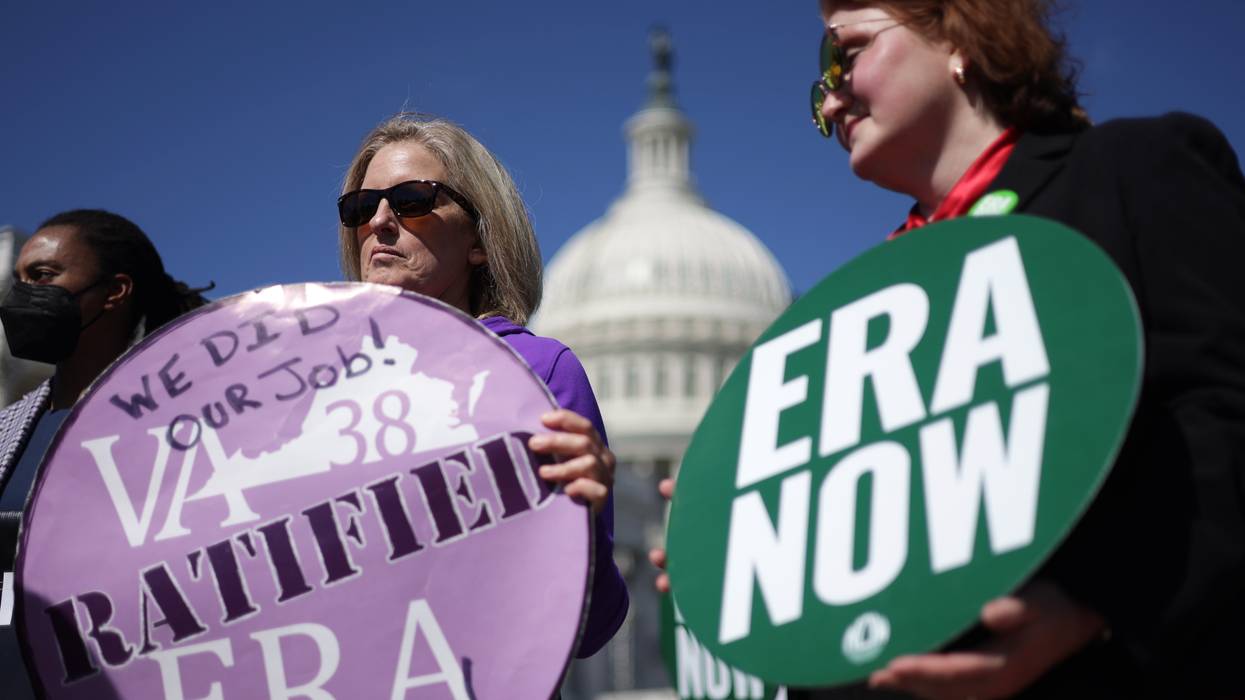
"It is shameful that despite the significant advances made in recent history, Americans continue to face discrimination on the basis of sex and lack equal rights in the Constitution," said the League of Women Voters CEO.
Equal Rights Amendment supporters on Thursday slammed the vast majority of U.S. Senate Republicans for filibustering a resolution that would make the 100-year-old measure the 28th Amendment to the Constitution.
The 51-47 vote to invoke cloture was short of the 60 needed for final consideration of the resolution. Sens. Susan Collins (R-Maine) and Lisa Murkowski (R-Alaska) were the only Republicans to join all Democrats present in supporting a vote on the ERA. Sen. Dianne Feinstein (D-Calif.) remains absent from the chamber, recovering from shingles.
"Today is a disappointing day for women," declared League of Women Voters of the United States CEO Virginia Kase Solomón. "Our nation's elected leaders have failed yet again to see us as equal members of this democracy."
"It is shameful that despite the significant advances made in recent history, Americans continue to face discrimination on the basis of sex and lack equal rights in the Constitution," she said. "Inequality hurts everyone, and we must not continue to be a nation that harmfully excludes and marginalizes women."
“We believe in the power of women to create a more perfect democracy, and that includes equal rights under the law, first and foremost," Kase Solomón added. "A strong democracy doesn't discriminate against women but empowers women. We will keep fighting, and we will keep showing up to hold our legislators accountable. Equality is essential to our democracy."
Kristin Rowe-Finkbeiner, executive director and CEO of MomsRising, agreed the vote was "a real disappointment," adding that "at this time when moms and women—and especially moms and women of color—face devastating wage discrimination, when our country has failed to adopt the programs and policies that would help parents and all caregivers achieve economic security, and when our bodily autonomy and access to reproductive healthcare is being gutted, all lawmakers from both political parties should support enshrining equal rights for women into our constitution."
"Still, we are encouraged by the fact that this vote took place today; it is evidence that this essential constitutional amendment remains on lawmakers' agenda," she said. "We will build from here. Moms want Congress to pass the Equal Rights Amendment, so states can ratify it at last."
First introduced in 1923, the ERA states:
Section 1: Equality of rights under the law shall not be denied or abridged by the United States or by any state on account of sex.
Section 2: The Congress shall have the power to enforce, by appropriate legislation, the provisions of this article.
Section 3: This amendment shall take effect two years after the date of ratification.
While the amendment passed both chambers of Congress in 1972, it must also be ratified by three-quarters of all state legislatures, or 38 states—a quota that wasn't hit until a 2020 vote in Virginia, decades after the 1982 ratification deadline.
The resolution blocked in the Senate on Thursday—led by Murkowski and Sen. Ben Cardin (D-Md.)—would have eliminated that deadline so the ERA could take effect.
Some amendment supporters in the U.S. House of Representatives marched through the Capitol to the Senate Chamber on Thursday chanting "ERA now!"
Among them was Rep. Ayanna Pressley (D-Mass.)—co-chair of the Congressional ERA Caucus with Rep. Cori Bush (D-Mo.)—who said after the vote that "once again, Senate Republicans have failed to do the bare minimum to protect our rights and equality."
Signaling that ERA supporters in the upper chamber aren't ready to give up, Senate Majority Leader Chuck Schumer (D-N.Y.) switched his vote to "no" so that he can bring up the resolution again.
The White House said ahead of the vote that the Biden administration supports the resolution, adding that "in the United States of America, no one's rights should be denied on account of their sex. It is long past time to definitively enshrine the principle of gender equality in the Constitution. Gender equality is not only a moral issue: The full participation of women and girls across all aspects of our society is essential to our economic prosperity, our security, and the health of our democracy."
This post has been updated with comment from MomsRising.

"Sinema has always been and will always be all about Sinema," said the head of one political advoacy group. "She doesn't care who her policies hurt. She doesn't care that she stood in the way of voting rights and abortion rights, as long as she got the headlines she wanted."
Independent U.S. Sen. Kyrsten Sinema of Arizona and right-wing Democratic Sen. Joe Manchin of West Virginia took heat Tuesday for high-fiving over their shared support of the filibuster while "rubbing elbows with Wall Street CEOs and celebrities in the lap of luxury" at the World Economic Forum's annual summit in Davos, Switzerland.
Sinema—who left the Democratic Party last month—and Manchin sat on a panel with Democrats including Sen. Chris Coons (D-Del.), Rep. Mike Sherill (D-N.J.), and Illinois Gov. J.B. Pritzker, a multibillionaire. Also on the panel were Republican Georgia Gov. Brian Kemp and Rep. Mária Salazar (R-Fla.).
At one point during the panel discussion, Manchin asked Sinema, "We still don't agree on getting rid of the filibuster, correct?"
"That's correct," the former far-left anti-war activist replied. The two senators then proceeded to high-five.
"Sinema has always been and will always be all about Sinema. She doesn't care who her policies hurt. She doesn't care that she stood in the way of voting rights and abortion rights, as long as she got the headlines she wanted," Sacha Haworth, spokesperson for the Replace Sinema campaign, said in a statement. "Now, she's on stage in Switzerland, in front of an audience of billionaires and Wall Street CEOs, bragging about her obstruction and giving high-fives. It's no wonder she's so unpopular among Arizonans of every political stripe."
The Replace Sinema campaign is a Change for Arizona 2024 PAC project focused on "defeating her in a potential three-way general election and replacing her with a real Democrat."
Defending her support for the archaic Senate rule historically used to uphold white supremacy and, more recently, to stymie key Biden administration agenda items, Sinema said that "we had free and fair elections all across the country, so one could posit that the push by one political party to eliminate an important guardrail and an institution in our country may have been premature or overreaching in order to get the short-term victories they wanted."
Replace Sinema noted that the senator is "schmoozing with CEOs, securing more dark money, [and] ignoring her constituents" while "rubbing elbows with major players who ran well-funded campaigns to defeat any tax increases for billionaire corporations and Wall Street." These include members of the Business Roundtable, "including JPMorgan Chase's CEO, the head of Blackrock, the CEO of Hewlett Packard, and an executive at Bain & Company."
Center Forward, a dark money group funded by the Business Roundtable, ran ads in Arizona supporting Sinema’s opposition to the tax and drug pricing reforms on President Joe Biden's agenda.
"Where's Kyrsten Sinema today? Is she doing her job in Arizona or in Washington?" Replace Sinema asked in a statement. "Nope. She's in Switzerland, of course. At the famous Davos World Economic Forum, where billionaires and Wall Street execs can sidle up to global leaders and hang out with celebrities in the elitist, most rarefied of settings. As far away from her constituents as possible, and in the lap of luxury. Just as Sinema likes it."
"And of course," the group added, "Sinema will get to spend time with her Wall Street allies who have lobbied for many of the same special tax breaks and loopholes for corporations and billionaires that Sinema has championed."

U.S. Senator-elect John Fetterman on Friday announced two key staff hires for his office on Friday, including tapping the author of a book calling for the abolishment of the arcane Senate filibuster to be his next chief of staff.
The Pennsylvania Democrat said in a statement that he has hired Adam Jentleson to oversee his D.C. office as chief of staff and that longtime party operative and labor organizer Joseph Pierce will be his state director.
A veteran of the Senate who served under former Majority Leader Harry Reid of Nevada, Jentleson also wrote the 2021 book, Kill Switch: The Rise of the Modern State and the Crippling of American Democracy, which examines Senate rules that powerful interests have exploited to obstruct progressive legislation with overwhelming majority support among the American public.
Throughout the first two years of the Biden administration, Jentleson was a key voice calling for Senate reforms to enact pressing priorities.
When Republicans blocked an effort in the Senate in May of 2021 to establish an official inquiry into the January 6 insurrection, Jentleson, then serving as executive director of the advocacy group Battle Born Collective, said it would be a "dereliction of duty" for Democrats not to reform the chamber's rules to push the measure through.
"There is no longer any question about whether Republicans will put country over party--it is clear to anyone with eyes to see that they will not," Jentleson said at the time. "The only question that remains is whether Democrats will take the steps necessary to protect our democracy, and end the filibuster."
On the campaign trail ahead of the midterm elections, Fetterman repeatedly vowed to support the end of the filibuster in the Senate if it would allow for key legislation to pass on gun control, labor protections, abortion rights, or voting access.
At a September rally with voters, Fetterman denounced the U.S. Supreme Court ruling destroying the abortion rights and said, "Send me to D.C. and you will know I will be there to be that vote to scrap the filibuster and codify Roe v. Wade."
While Jentleson has been spearheading Fetterman's transition team since winning in Pennsylvania against Republican Mehmet Oz, Pierce served as statewide political director on the winning campaign.
"Joe and Adam are the best in their fields and I am honored that they have both accepted key staff positions for my office," Fetterman said in a statement on Friday.
"It will be invaluable to have a veteran of the Senate and a veteran of state politics in these key positions as we serve the people of Pennsylvania," he added. "Between Adam's deep understanding of the Senate and Joe's wealth of knowledge and experience serving the people of our commonwealth, I am confident that my office will be ready to fight and deliver for the people of Pennsylvania on day one."

An analysis released Monday by NPR details what one rights advocacy group called the Republican Party's "obsession" with curtailing the rights of transgender people, with U.S. state legislators proposing more than 300 pieces of legislation targeting the community over the past two years.
Lawmakers in every region of the United States have put forward a total of 306 anti-trans bills since 2020, with 86% of the bills focusing on transgender youths.
" Right-wing state lawmakers are obsessed with taking away the rights of trans people and we're obsessed with knocking them out of public office," said Agenda PAC, which works to hold anti-LGBTQ+ politicians accountable.
"Frankly, I really do think that the end goal is to ban trans-affirming medical care, period... which should scare people a lot more than it does because access to gender-affirming care is fundamentally an issue of bodily autonomy."
Fifteen percent of the bills have become law, including total bans on gender-affirming healthcare for transgender youths in Alabama and Arkansas; bans on students using bathrooms and locker rooms that correspond to their gender rather than sex assigned at birth in Tennessee, Alabama, and Oklahoma; and similar restrictions for school sports teams in at least 19 states.
Some of the proposals are based in--and threaten to perpetuate--misinformation about transgender people, including a Tennessee law which bars medical professionals from providing hormone treatments to prepubescent children. Experts on transgender health only recommend hormone treatment once a child has entered puberty.
"Frankly, I really do think that the end goal is to ban trans-affirming medical care, period... which should scare people a lot more than it does because access to gender-affirming care is fundamentally an issue of bodily autonomy," Alex Petrovnia, president of the Trans Formations Project, told NPR.
Lawmakers in more than half of states have sought to restrict access to gender-affirming care, despite evidence that such bans are harmful to the safety of young transgender people.
The Trevor Project, which advocates for LGBTQ+ youth, released a poll in January showing that 85% of transgender and nonbinary young people felt their mental health was negatively affected by legislation targeting their rights and their ability to live according to their gender.
A study by the University of Washington found earlier this year that transgender and nonbinary youth, ranging in age from 13 to 20, were 60% less likely to experience depression and 73% less likely to have suicidal thoughts and engage in self-harm if they received gender-affirming care including puberty blockers and hormonal treatment.
NPR's reporting reveals that "trans people--youth especially--continue to be under attack," said the Gender Justice Fund, an advocacy group based in Philadelphia.
Rep. Pramila Jayapal (D-Wash.) noted that the Equality Act, which would prohibit discrimination based on sex, sexual orientation, and gender identity, has passed in the U.S. House, but has yet to pass in the Senate due to the legislative filibuster, which effectively requires 60 votes for bills to pass instead of a simple majority.
"Trans rights are human rights," said Jayapal, who is the mother of a transgender child.