SUBSCRIBE TO OUR FREE NEWSLETTER
Daily news & progressive opinion—funded by the people, not the corporations—delivered straight to your inbox.
5
#000000
#FFFFFF
To donate by check, phone, or other method, see our More Ways to Give page.
Daily news & progressive opinion—funded by the people, not the corporations—delivered straight to your inbox.
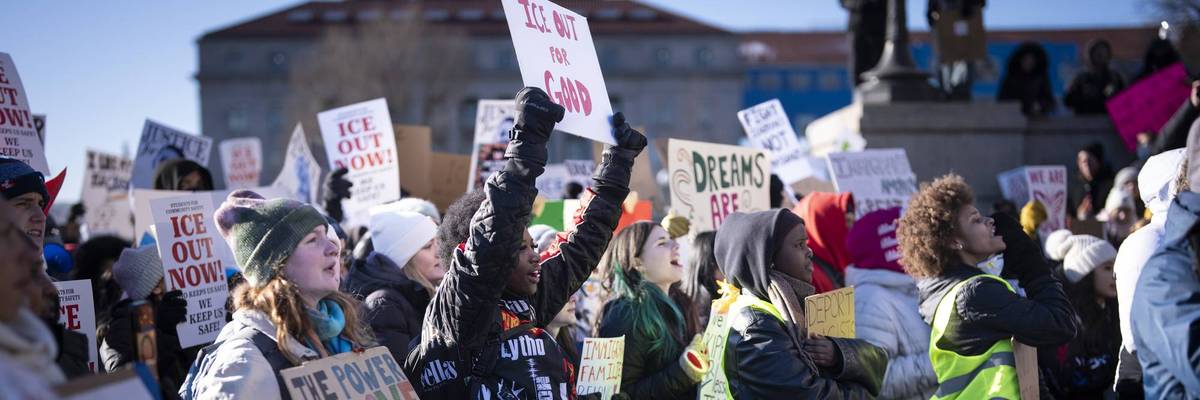
Students from St. Paul public schools protest at a massive walkout to the State Capitol in St. Paul, Minnesota, to protest Immigration and Custom Enforcement actions in Minnesota on Wednesday, January 14, 2026.
We must not rest and trust that a Democrat-majority Congress will lead positive change for immigrants; instead, we need to continue to grow the mass movement that has been organizing to defend immigrant communities.
Much was made of President Donald Trump’s apparent softening of his hard-line position on immigration during his interview on "60 Minutes" following the thumping Republicans received in the November midterms.
Speculation abounds: Could the president make an immigration deal with Democrats? Will children of undocumented people who were brought to the US when they were minors—the Dreamers—get permanent status? Or could our lawmakers pass legislation to provide relief in the form of work permits for the million or so farmworkers who do not have legal status?
If we lived in a normal political world, then we would expect some legislative movement on immigration, especially as the midterms sent a clear message that the American public is upset with the Trump administration, including with his handling of immigration.
What should provide hope is not the pundits speculating on the future of immigration reform, or Trump’s musings, but how grassroots groups have stood up for their neighbors.
But political normalcy doesn’t guide the Trump administration, as on immigration, Immigration and Customs Enforcement (ICE) agents continue their statewide surge operation throughout California and brutalize families at airports; the president promoted immigration hard-liner, Stephen Miller, to serve as White House chief of staff; and Border Czar Tom Homan recently boasted about the record number of immigrant arrests this year—the vast majority of whom have no criminal record—and how that number will increase next year.
Considering this reality, we should bear in mind the words of Reverand Fred Shuttlesworth. Describing his approach when advocating for civil rights, he said, “You can’t shame segregation… Rattlesnakes don’t commit suicide; ball teams don’t strike themselves out. You gotta put ’em out.”
Such clarity should guide immigrant rights groups and their allies in their advocacy work heading into the next Congress. More to the point, we must not rest and trust that a Democrat-majority Congress will lead positive change for immigrants. Instead, we need to continue to grow the mass movement that has been organizing to defend immigrant communities, building from actions in neighborhoods and states, as we force this Congress or the next to pass comprehensive changes to the immigration system.
It’s not that there is a shortage of immigration proposals floating around the halls of Congress.
For instance, there is the Farm Workforce Modernization Act, which has been introduced in multiple past Congresses, and that enjoys bipartisan support. This bill provides work permits to farmworkers and their family members, while also expanding the controversial E-Verify program to all farming operations.
There is also the American Dream and Promise Act, which grants a pathway to citizenship for young people who were under the age of 16 when they came to the United States, many of whom received renewable two-year work permits from the Obama-era DACA (Deferred Action for Childhood Arrivals) executive order.
Then there’s the Dignity Act. This bill provides permanent status for Dreamers, offers a way to legalize the undocumented spouses of US citizens who currently cannot fix their status if they have unauthorized entries into the country, and also makes it possible for everyone else who is undocumented to receive work permits.
This last portion of the bill has been particularly controversial, as the potential beneficiaries who are neither Dreamers nor married to US citizens would receive a renewable work permit that is good for seven years but doesn’t lead to permanent status, and must pay a yearly $1,000 fee while having 1% of their income taken from their paychecks.
All these bills would provide much needed relief for families who have undocumented members. The problem is that most of them deal with one particular group, leaving the others vulnerable to continuing state violence. It’s possible that group by group, different laws could be passed. But the legislative process is slow. If one initiative, say for Dreamers, gains momentum, it will take months or probably a year to get to the president’s desk, leaving little time in the legislative calendar for Congress to take up a bill for others.
There is also the question of who actually trusts the Trump administration to implement legislation if it were to pass. Are we to believe that undocumented people feel safe enough with this government to send it their pertinent documents? If this administration were to receive immigrants’ information, what assurances will there be that it will change people’s statuses instead of sending ICE to arrest them?
Still, I wouldn’t hold my breath waiting for Congress to act and Trump to move any legislation forward.
What makes the odds so low for decent immigration policy coming from the Trump administration, besides the presence of such figures as Homan and Miller, is how much money has been invested in repression.
Specifically, last year’s One Big Beautiful Bill Act, HR 1, dedicated $170 billion for immigration enforcement. ICE is now the highest-funded federal law enforcement agency, with an annual budget around $28 billion annually for the next four years, eclipsing the combined budgets of the FBI, Drug Enforcement Agency, ATF, and US Marshals. This is also more than the annual military budgets of Iran, Turkey, Spain, Mexico, Iran, and at least 23 countries in the list of the top 40 military spenders. A total of $45 billion is also for building new immigration detention centers, including for families. This last amount is a 400% increase when compared with 2025 and exceeds allocation for the entire federal prison system.
Moreover, this is direct handout to the corporations, Geo Group and CoreCivic, which together house approximately 90% of immigrants detained. Both corporations also donated directly to the Trump campaign, or to Trump-affiliated super-PACs.
This money has been locked into the budget and must be spent by 2029, so Democrats coming into Congress cannot defund ICE in upcoming budget debates.
Let’s be clear—taxpayers have paid for a deportation-industrial complex fueled by widespread misinformation that depicts all immigrants as violent criminals. If Miller’s promotion or Homan’s words don’t make you second guess the administration’s true priorities, then the billions dedicated to arresting and detaining undocumented people, regardless of their crimes, should make you aware of what to expect for the next couple years.
In this environment, change will not come from the “top,” but the “bottom,” that is, from the grassroots.
What should provide hope is not the pundits speculating on the future of immigration reform, or Trump’s musings, but how grassroots groups have stood up for their neighbors in neighborhood patrols. People around the country have attended ICE verification meetings with immigrant-led organizations. The city of Minneapolis amid "Operation Metro Surge" held a one-day general strike that shut down the city over how the immigrant community was being mistreated. People who are not immigrants, perhaps for the first time, are actually thinking about the issue and wanting to defend people who are being persecuted.
More mass action will be needed to push for real immigration reform, that is, comprehensive changes to the legal system that guarantee status to all undocumented people, while also creating pathways for future migrants to apply for status without unduly penalizing or persecuting them. We need a new national conversation, and not our current one that is based on overhyped security concerns. A place to start is with how immigrant rights are human rights, and that it’s immoral for native-born citizens, who literally have done nothing to receive their status other than being born here, to stand behind a system that unduly persecutes vulnerable people. We need protests at the scale and regularity of what we saw for months in 2006, when in opposition to HR 4437 (The Sensenbrenner Bill), thousands blocked that anti-immigration legislation from advancing.
Real change for immigrants could take place during this Congress, or the next. Regardless of when, the truth is that meaningful change, and not piecemeal, isolated initiatives, will come from mass political action calling for a system overhaul and a new national conversation on immigrant rights. The Trump administration has muddied the water when it comes to understanding the immigration issue. Immigrant rights groups and their allies best work together to toss it out, beginning with new proposals that do not discriminate, and that put us on solid moral ground.
This country and this world are at a monumental crossroads. US voters have an opportunity to beat back the forces of fascism and confront the billionaires who are rigging the economy, our media system, and our democracy, making it increasingly impossible for ordinary people to get by. We’re not just talking about the election. We’re talking about what must be done once these fascist elements are vanquished from power. We need a bolder set of solutions than what either major party has so far been willing to offer and a working-class movement ready to fight like hell for it. Trump didn't emerge from nowhere. The conditions that fueled MAGA authoritarianism were created by decades of radical neoliberal economic policies and a corrupt political system dominated by corporate interests. They slashed taxes on the super-rich, promising that the benefits would trickle down. They said giveaways to the corporate titans would make life more affordable for the rest of us. It was all bullshit. And when a bitter, betrayed populace searches for someone to blame, right-wing demagogues have little trouble finding scapegoats. People know when they're being lied to, but you won't hear any of this from the corporate media. Only independent journalism—powered and funded by people who believe in building a better world—can deliver truly trustworthy daily news. If you share our vision, please contribute whatever you can to sustain our work. |
Much was made of President Donald Trump’s apparent softening of his hard-line position on immigration during his interview on "60 Minutes" following the thumping Republicans received in the November midterms.
Speculation abounds: Could the president make an immigration deal with Democrats? Will children of undocumented people who were brought to the US when they were minors—the Dreamers—get permanent status? Or could our lawmakers pass legislation to provide relief in the form of work permits for the million or so farmworkers who do not have legal status?
If we lived in a normal political world, then we would expect some legislative movement on immigration, especially as the midterms sent a clear message that the American public is upset with the Trump administration, including with his handling of immigration.
What should provide hope is not the pundits speculating on the future of immigration reform, or Trump’s musings, but how grassroots groups have stood up for their neighbors.
But political normalcy doesn’t guide the Trump administration, as on immigration, Immigration and Customs Enforcement (ICE) agents continue their statewide surge operation throughout California and brutalize families at airports; the president promoted immigration hard-liner, Stephen Miller, to serve as White House chief of staff; and Border Czar Tom Homan recently boasted about the record number of immigrant arrests this year—the vast majority of whom have no criminal record—and how that number will increase next year.
Considering this reality, we should bear in mind the words of Reverand Fred Shuttlesworth. Describing his approach when advocating for civil rights, he said, “You can’t shame segregation… Rattlesnakes don’t commit suicide; ball teams don’t strike themselves out. You gotta put ’em out.”
Such clarity should guide immigrant rights groups and their allies in their advocacy work heading into the next Congress. More to the point, we must not rest and trust that a Democrat-majority Congress will lead positive change for immigrants. Instead, we need to continue to grow the mass movement that has been organizing to defend immigrant communities, building from actions in neighborhoods and states, as we force this Congress or the next to pass comprehensive changes to the immigration system.
It’s not that there is a shortage of immigration proposals floating around the halls of Congress.
For instance, there is the Farm Workforce Modernization Act, which has been introduced in multiple past Congresses, and that enjoys bipartisan support. This bill provides work permits to farmworkers and their family members, while also expanding the controversial E-Verify program to all farming operations.
There is also the American Dream and Promise Act, which grants a pathway to citizenship for young people who were under the age of 16 when they came to the United States, many of whom received renewable two-year work permits from the Obama-era DACA (Deferred Action for Childhood Arrivals) executive order.
Then there’s the Dignity Act. This bill provides permanent status for Dreamers, offers a way to legalize the undocumented spouses of US citizens who currently cannot fix their status if they have unauthorized entries into the country, and also makes it possible for everyone else who is undocumented to receive work permits.
This last portion of the bill has been particularly controversial, as the potential beneficiaries who are neither Dreamers nor married to US citizens would receive a renewable work permit that is good for seven years but doesn’t lead to permanent status, and must pay a yearly $1,000 fee while having 1% of their income taken from their paychecks.
All these bills would provide much needed relief for families who have undocumented members. The problem is that most of them deal with one particular group, leaving the others vulnerable to continuing state violence. It’s possible that group by group, different laws could be passed. But the legislative process is slow. If one initiative, say for Dreamers, gains momentum, it will take months or probably a year to get to the president’s desk, leaving little time in the legislative calendar for Congress to take up a bill for others.
There is also the question of who actually trusts the Trump administration to implement legislation if it were to pass. Are we to believe that undocumented people feel safe enough with this government to send it their pertinent documents? If this administration were to receive immigrants’ information, what assurances will there be that it will change people’s statuses instead of sending ICE to arrest them?
Still, I wouldn’t hold my breath waiting for Congress to act and Trump to move any legislation forward.
What makes the odds so low for decent immigration policy coming from the Trump administration, besides the presence of such figures as Homan and Miller, is how much money has been invested in repression.
Specifically, last year’s One Big Beautiful Bill Act, HR 1, dedicated $170 billion for immigration enforcement. ICE is now the highest-funded federal law enforcement agency, with an annual budget around $28 billion annually for the next four years, eclipsing the combined budgets of the FBI, Drug Enforcement Agency, ATF, and US Marshals. This is also more than the annual military budgets of Iran, Turkey, Spain, Mexico, Iran, and at least 23 countries in the list of the top 40 military spenders. A total of $45 billion is also for building new immigration detention centers, including for families. This last amount is a 400% increase when compared with 2025 and exceeds allocation for the entire federal prison system.
Moreover, this is direct handout to the corporations, Geo Group and CoreCivic, which together house approximately 90% of immigrants detained. Both corporations also donated directly to the Trump campaign, or to Trump-affiliated super-PACs.
This money has been locked into the budget and must be spent by 2029, so Democrats coming into Congress cannot defund ICE in upcoming budget debates.
Let’s be clear—taxpayers have paid for a deportation-industrial complex fueled by widespread misinformation that depicts all immigrants as violent criminals. If Miller’s promotion or Homan’s words don’t make you second guess the administration’s true priorities, then the billions dedicated to arresting and detaining undocumented people, regardless of their crimes, should make you aware of what to expect for the next couple years.
In this environment, change will not come from the “top,” but the “bottom,” that is, from the grassroots.
What should provide hope is not the pundits speculating on the future of immigration reform, or Trump’s musings, but how grassroots groups have stood up for their neighbors in neighborhood patrols. People around the country have attended ICE verification meetings with immigrant-led organizations. The city of Minneapolis amid "Operation Metro Surge" held a one-day general strike that shut down the city over how the immigrant community was being mistreated. People who are not immigrants, perhaps for the first time, are actually thinking about the issue and wanting to defend people who are being persecuted.
More mass action will be needed to push for real immigration reform, that is, comprehensive changes to the legal system that guarantee status to all undocumented people, while also creating pathways for future migrants to apply for status without unduly penalizing or persecuting them. We need a new national conversation, and not our current one that is based on overhyped security concerns. A place to start is with how immigrant rights are human rights, and that it’s immoral for native-born citizens, who literally have done nothing to receive their status other than being born here, to stand behind a system that unduly persecutes vulnerable people. We need protests at the scale and regularity of what we saw for months in 2006, when in opposition to HR 4437 (The Sensenbrenner Bill), thousands blocked that anti-immigration legislation from advancing.
Real change for immigrants could take place during this Congress, or the next. Regardless of when, the truth is that meaningful change, and not piecemeal, isolated initiatives, will come from mass political action calling for a system overhaul and a new national conversation on immigrant rights. The Trump administration has muddied the water when it comes to understanding the immigration issue. Immigrant rights groups and their allies best work together to toss it out, beginning with new proposals that do not discriminate, and that put us on solid moral ground.