SUBSCRIBE TO OUR FREE NEWSLETTER
Daily news & progressive opinion—funded by the people, not the corporations—delivered straight to your inbox.
5
#000000
#FFFFFF
To donate by check, phone, or other method, see our More Ways to Give page.
Daily news & progressive opinion—funded by the people, not the corporations—delivered straight to your inbox.
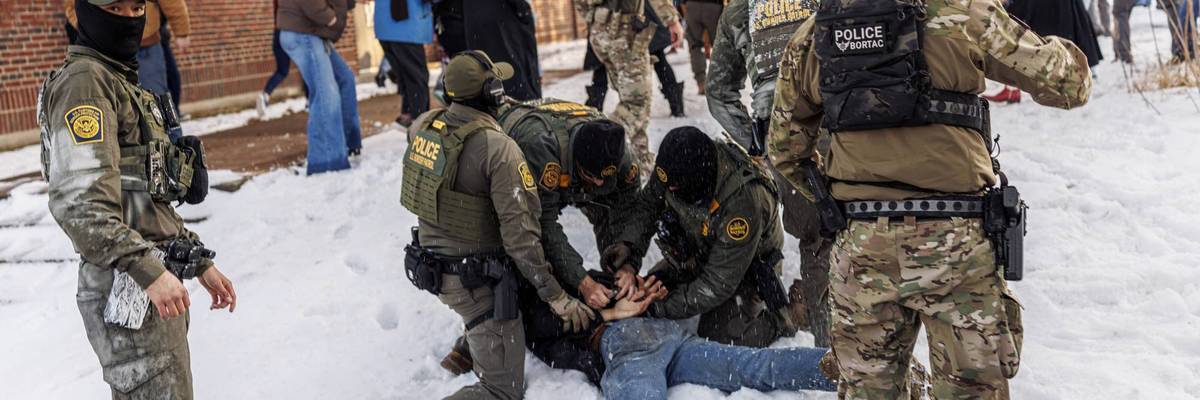
US Border Patrol agents detain a person near Roosevelt High School during dismissal time as federal immigration enforcement actions sparked protests in Minneapolis, Minnesota, on January 7, 2026.
Keeping ICE off school campuses is only the first step. School boards and state leaders must equip teachers with trauma-informed practices so children devastated by raids can keep learning.
Results of the November midterm elections brought relief to many immigrant communities, who saw voters in states like Texas push back against the aggressive immigration enforcement campaigns of President Donald Trump’s second term. Yet as immigrant rights advocates have warned, election results alone will not end Immigration and Custom Enforcement raids. ICE remains the highest funded US law enforcement agency with a remaining budget of $91 billion to fund more arrests, detentions, and deportations through September 2029. A Democratic Congress also cannot undo the acute psychological trauma that years of raids and family separations have already inflicted on school children. Inside classrooms all across the US, educators are confronting a wide range of trauma symptoms that disrupt learning.
The urgency of this need was made apparent to us a few weeks into the start of the school year, when a seasoned bilingual educator reached out to us in crisis after a fifth-grader’s parent was detained by ICE. She was at a loss as to how best to support the child, guide other teachers and staff, and reassure the broader student body. Even with resources and guidance on how to keep federal agents off school campuses, those protections are not enough when a fifth grader comes to class the morning after a parent is detained. She and her colleagues wanted to know what to do (and what not to do) so that students could continue to learn while coping with the distress of parental deportation and the ongoing threat of immigration enforcement in their community.
This teacher’s request for assistance in the immediate aftermath of a community member’s detention by ICE is now alarmingly common. We have been working with schools across the country for nearly two decades helping educators build strong home-school relationships, especially with immigrant families. Yet, educators’ concerns are markedly different now from what they were even two years ago. These unprecedented times call for new guidance, professional learning opportunities, resources, and supports for educators who are being asked to respond to crises that are devastating families and communities nationwide.
Protecting immigrant-origin students’ right to an education requires more than keeping ICE off school campuses. School boards, state education agencies, and teachers’ unions have the power and the obligation to make public schools safe for all students.
We led a workshop for teachers and support staff at the school, integrating expertise on the experiences of immigrant-origin youth with core trauma-informed principles. The workshop included baseline information about psychological responses to trauma and easy-to-implement self-regulation strategies for educators to use in their classrooms. We also heard about the issues that are most vexing for school personnel in the midst of a community crisis of this nature. We learned what educators wanted to know and what they found most helpful—lessons that should inform larger-scale efforts to develop and disseminate basic training for all adults working with young people in contexts affected by immigration enforcement.
First, we emphasized that the best and most protective thing classroom teachers can do for students whose family members have been detained or deported by ICE is to maintain normal classroom routines. Teachers are not expected to be experts in knowing how to manage the psychological consequences of a sudden, traumatic event like parental detention. However, they are experts in creating welcoming and routine learning environments; being a steady, positive presence in students’ lives; and teaching them academic and social skills to be successful in their school and in society.
Next, educators wanted help knowing developmentally appropriate ways to talk to students about their fears and answer their questions about immigration enforcement activity in their neighborhoods. We taught core principles from psychological first aid to help teachers respond effectively. This includes answering questions directly and honestly at an age-appropriate level while avoiding having students share in-depth trauma histories; letting students know that a variety of reactions are normal including sadness, anger, numbness, and distraction; helping students identify coping skills such as “hot chocolate” deep breathing; discussing what is being done by the school to keep students safe; and finding ways to help the classroom come together and support each other as a community.
In order to help teachers support an individual student displaying symptoms of trauma, we taught them the regulate, relate, reason sequence from the Neurosequential Model of Therapeutics. When a student experiences a trauma trigger, they can become dysregulated and therefore unable to learn. To help get them back on track, an adult must first work on their own regulation (“Put your oxygen mask on first”). Only then can they support the regulation of a student. Once a student is regulated, they need to “relate” to the teacher, which can be supported through open-ended comments and questions including reflective (e.g., “It sounds as if you are saying”), clarifying (e.g., “Tell me if I am wrong, but it sounds like…”), supportive (e.g., “No wonder you feel…”), and empowering (e.g., “What have you done in the past to help when things get difficult?”) strategies. Once the student feels supported and understood, they will be able to return to learning.
After the training, teachers and staff reported feeling better equipped with a set of strategies to use to support students impacted by immigration enforcement and more ready to respond to questions, fears, and atypical student behaviors that may accompany such destabilizing events.
Educators are on the front lines of a human rights and public health crisis for which few have been adequately trained. Yet, they remain among the most stabilizing adults in young people’s lives. Fortunately, trauma-informed practices do not require teachers to become therapists; they can be integrated directly into a teacher’s existing classroom toolkit, strengthening learning and emotional safety for everyone in the room.
Protecting immigrant-origin students’ right to an education requires more than keeping ICE off school campuses. School boards, state education agencies, and teachers’ unions have the power and the obligation to make public schools safe for all students. They must immediately dedicate professional development resources to equip every school staff member with trauma-informed crisis response skills before more classrooms are destabilized by federal raids.
This country and this world are at a monumental crossroads. US voters have an opportunity to beat back the forces of fascism and confront the billionaires who are rigging the economy, our media system, and our democracy, making it increasingly impossible for ordinary people to get by. We’re not just talking about the election. We’re talking about what must be done once these fascist elements are vanquished from power. We need a bolder set of solutions than what either major party has so far been willing to offer and a working-class movement ready to fight like hell for it. Trump didn't emerge from nowhere. The conditions that fueled MAGA authoritarianism were created by decades of radical neoliberal economic policies and a corrupt political system dominated by corporate interests. They slashed taxes on the super-rich, promising that the benefits would trickle down. They said giveaways to the corporate titans would make life more affordable for the rest of us. It was all bullshit. And when a bitter, betrayed populace searches for someone to blame, right-wing demagogues have little trouble finding scapegoats. People know when they're being lied to, but you won't hear any of this from the corporate media. Only independent journalism—powered and funded by people who believe in building a better world—can deliver truly trustworthy daily news. If you share our vision, please contribute whatever you can to sustain our work. |
Results of the November midterm elections brought relief to many immigrant communities, who saw voters in states like Texas push back against the aggressive immigration enforcement campaigns of President Donald Trump’s second term. Yet as immigrant rights advocates have warned, election results alone will not end Immigration and Custom Enforcement raids. ICE remains the highest funded US law enforcement agency with a remaining budget of $91 billion to fund more arrests, detentions, and deportations through September 2029. A Democratic Congress also cannot undo the acute psychological trauma that years of raids and family separations have already inflicted on school children. Inside classrooms all across the US, educators are confronting a wide range of trauma symptoms that disrupt learning.
The urgency of this need was made apparent to us a few weeks into the start of the school year, when a seasoned bilingual educator reached out to us in crisis after a fifth-grader’s parent was detained by ICE. She was at a loss as to how best to support the child, guide other teachers and staff, and reassure the broader student body. Even with resources and guidance on how to keep federal agents off school campuses, those protections are not enough when a fifth grader comes to class the morning after a parent is detained. She and her colleagues wanted to know what to do (and what not to do) so that students could continue to learn while coping with the distress of parental deportation and the ongoing threat of immigration enforcement in their community.
This teacher’s request for assistance in the immediate aftermath of a community member’s detention by ICE is now alarmingly common. We have been working with schools across the country for nearly two decades helping educators build strong home-school relationships, especially with immigrant families. Yet, educators’ concerns are markedly different now from what they were even two years ago. These unprecedented times call for new guidance, professional learning opportunities, resources, and supports for educators who are being asked to respond to crises that are devastating families and communities nationwide.
Protecting immigrant-origin students’ right to an education requires more than keeping ICE off school campuses. School boards, state education agencies, and teachers’ unions have the power and the obligation to make public schools safe for all students.
We led a workshop for teachers and support staff at the school, integrating expertise on the experiences of immigrant-origin youth with core trauma-informed principles. The workshop included baseline information about psychological responses to trauma and easy-to-implement self-regulation strategies for educators to use in their classrooms. We also heard about the issues that are most vexing for school personnel in the midst of a community crisis of this nature. We learned what educators wanted to know and what they found most helpful—lessons that should inform larger-scale efforts to develop and disseminate basic training for all adults working with young people in contexts affected by immigration enforcement.
First, we emphasized that the best and most protective thing classroom teachers can do for students whose family members have been detained or deported by ICE is to maintain normal classroom routines. Teachers are not expected to be experts in knowing how to manage the psychological consequences of a sudden, traumatic event like parental detention. However, they are experts in creating welcoming and routine learning environments; being a steady, positive presence in students’ lives; and teaching them academic and social skills to be successful in their school and in society.
Next, educators wanted help knowing developmentally appropriate ways to talk to students about their fears and answer their questions about immigration enforcement activity in their neighborhoods. We taught core principles from psychological first aid to help teachers respond effectively. This includes answering questions directly and honestly at an age-appropriate level while avoiding having students share in-depth trauma histories; letting students know that a variety of reactions are normal including sadness, anger, numbness, and distraction; helping students identify coping skills such as “hot chocolate” deep breathing; discussing what is being done by the school to keep students safe; and finding ways to help the classroom come together and support each other as a community.
In order to help teachers support an individual student displaying symptoms of trauma, we taught them the regulate, relate, reason sequence from the Neurosequential Model of Therapeutics. When a student experiences a trauma trigger, they can become dysregulated and therefore unable to learn. To help get them back on track, an adult must first work on their own regulation (“Put your oxygen mask on first”). Only then can they support the regulation of a student. Once a student is regulated, they need to “relate” to the teacher, which can be supported through open-ended comments and questions including reflective (e.g., “It sounds as if you are saying”), clarifying (e.g., “Tell me if I am wrong, but it sounds like…”), supportive (e.g., “No wonder you feel…”), and empowering (e.g., “What have you done in the past to help when things get difficult?”) strategies. Once the student feels supported and understood, they will be able to return to learning.
After the training, teachers and staff reported feeling better equipped with a set of strategies to use to support students impacted by immigration enforcement and more ready to respond to questions, fears, and atypical student behaviors that may accompany such destabilizing events.
Educators are on the front lines of a human rights and public health crisis for which few have been adequately trained. Yet, they remain among the most stabilizing adults in young people’s lives. Fortunately, trauma-informed practices do not require teachers to become therapists; they can be integrated directly into a teacher’s existing classroom toolkit, strengthening learning and emotional safety for everyone in the room.
Protecting immigrant-origin students’ right to an education requires more than keeping ICE off school campuses. School boards, state education agencies, and teachers’ unions have the power and the obligation to make public schools safe for all students. They must immediately dedicate professional development resources to equip every school staff member with trauma-informed crisis response skills before more classrooms are destabilized by federal raids.