

SUBSCRIBE TO OUR FREE NEWSLETTER
Daily news & progressive opinion—funded by the people, not the corporations—delivered straight to your inbox.
5
#000000
#FFFFFF
To donate by check, phone, or other method, see our More Ways to Give page.
Daily news & progressive opinion—funded by the people, not the corporations—delivered straight to your inbox.
Every Democrat in America should scan their local horizon for examples of corruption they can use against Republicans. They won't be hard to spot.
In a nationwide poll conducted a few weeks ago and reported on by Axios, the majority of all registered voters surveyed said the number one word to describe Donald Trump is “corrupt.” This represents a massive opportunity for Democrats both now and for the next two years.
And the experience of candidates in today’s Democrats’ position around the world validates the argument that this is the best way to both campaign and win elections and political power.
Péter Magyar defeated Viktor Orbán in the Hungarian elections because he ran a Navalny-style playbook, calling Orbán’s and his billionaire buddies’ capture of the media and most other aspects of Hungarian life a “state capture system” grounded in good old-fashioned “corruption.”
From Orban’s son-in-law pulling a Jared and using his government position to become one of the richest men in the country, to his billionaire cronies buying up the media like the billionaire Ellisons are doing here now, corruption was Magyar’s singular through-line message. And it worked, producing an overwhelming turnout and undeniable victory.
It will work here, too!
Democrats are (continuously, it seems) debating what should be their campaign strategy, their main through-line message, for the 2026 midterms and the 2028 presidential election. Every faction and special interest group in the country is pushing their own idea, but there’s one overarching concept — one word — that can encompass most all of them and do so with a proven political punch: “Corruption.”
At every level, ever since the Reagan Revolution, the heart of Republican policies has been the naked corruption of our American political and economic systems. Since the 1980s, Republicans have sold their corruption with slogans like, “Government is the problem, not the solution,” and “Let the market decide,” but their real message is, “Turn it all over to the billionaires and their corporations.” The result has been:
— Tax cuts and loopholes for billionaires and big corporations that, in aggregate since 1981, add up to more than our total national debt of $40 trillion (in other words, Republicans borrowed $40 trillion in our names that our kids will repay and gave all of it to the morbidly rich).
— Reagan’s 1983 suspension of enforcement of the anti-trust laws that has caused every industry in America to become a form of monopoly dominated by five or fewer massive corporations, gutting competition and raising prices.
— Five on-the-take Republicans on the Supreme Court ruling that corporations are persons and money is the same thing as “free speech,” handing our elections over to the highest bidders.
— Virtually every legacy federal regulatory agency being run by industry insiders working on a revolving-door basis.
— Members of Congress and the corrupt Trump regime engaging in insider trading with impunity.
— A GOP-aligned military-industrial complex that’s essentially taken over Pentagon procurement.
— An anti-labor Labor Department; an anti-education Education department; an anti-civil rights Civil Rights enforcement agency; an anti-environment Environmental Protection Agency; etc…
— Trump’s mysterious pardons that always seem to go to people who’ve given him millions of dollars (after Giuliani claimed he and Trump were selling pardons for two million each and splitting the money).
— The wholesale gutting of the Internal Revenue Service enforcement budget and staffing that’s largely ended audits of morbidly rich people and increased audits of working-class people instead.
— The systematic sabotage and privatization of public institutions — from the US Postal Service to public schools to prisons — with virtually every one of the for-profit replacements becoming big GOP donors.
— The explosion of dark money after Citizens United so we don’t even know who’s buying our elections.
— The weaponization of the Federal Communications Commission to loosen media ownership rules while threatening outlets that dare criticize Trump or the GOP.
— Red-state-level voter suppression laws including strict ID requirements, purges of voter rolls, and reduced polling access all to discourage voting by people in demographic groups associated with Democrats.
— The Republican refusal to allow Medicare to negotiate drug prices for years and they’re still blocking most efforts.
— The systematic dismantling of campaign finance enforcement, turning the Federal Election Commission into a deadlocked, do-nothing body.
— The use of tax havens and trade policy to encourage offshoring American jobs.
— The Republican normalization of lobbyists literally writing legislation via groups like the Koch-funded ALEC.
— The rewriting of environmental and labor rules to favor polluting industries by GOP appointees who often came from those very industries.
— The strategic packing of the federal judiciary with hardcore rightwing/neofascist judges.
— And now Trump’s pathetic attempts to bribe voters with his $5000 offer backed up by $80 and $500 checks going out this week to people on Medicare and the Affordable Care Act.
Even Republicans understand the power of mobilizing the public’s outrage against the corruption that they themselves have participated in for over 40 years. Astonishingly, cynically, that’s the meta-message to Trump’s main campaign slogan each of the three times he’s run for president:
“Drain the swamp.”
It worked, even though it was an outrageous lie. Democrats, who have actually been trying to do something about corruption for years, need to appropriate the anti-corruption theme as their main message. Because, universally, it works.
— When working in Russia, I witnessed the way Alexi Navalny came so close to taking down Putin that the Russian dictator ordered him murdered; it was done via Navalny’s Anti-Corruption Foundation. It systematically and relentlessly exposed the ways Putin and his cronies were looting their nation’s government while passing out favors to oligarchs willing to align themselves with them.
— In the 1980s, I was working for a German international relief organization in The Philippines when Cory Aquino mobilized an anti-corruption message against the Marcos dynasty; the week Marcos and his wife fled the country I was bumped off Philippine Airlines flights five days in a row because so many of their cronies were appropriating all the seats (the airline was run by a crony).
— When Jair Bolsonaro first successfully ran for president of Brazil it was on a campaign against the corruption “Operation Car Wash” had exposed in the Lula administration. When elected, Bolsonaro, instead of ending the corruption, slid right into the system and expanded it, leading to his own ultimate downfall and current imprisonment.
— In Delhi, activist Anna Hazare’s 2011 anti-corruption hunger strike ignited a nationwide movement that helped spur passage of India’s Lokpal anti-corruption law and led his former allies to found the “clean government” Aam Aadmi Party.
— And, of course, it was the anti-corruption message of the EuroMaidan “Revolution of Dignity” in 2014 that lifted then-comedian and TV star Volodymyr Zelenskyy into the presidency of Ukraine.
From Teddy Roosevelt’s Progressive Era of the early 20th century to the present, anti-corruption messages have repeatedly proven to be one of the most potent forces in American politics, too.
— In 1902, President Theodore Roosevelt built a foundation of mass support by casting monopolies as a “corrupt alliance” between the morbidly rich and our government, while the exposure of William M. “Boss” Tweed’s graft by Thomas Nast’s biting cartoons helped bring down New York’s Tammany Hall by converting complex examples of corruption into the simple story of “stolen public money.”
— The Watergate scandal turned corrupt abuse of power into a national reckoning that forced Richard Nixon from office and fueled sweeping electoral gains for reformers like Jimmy Carter, while more recent scandals like George Santos’ reinforced “clean government” as a winning local message.
— At the national level, Donald Trump’s “drain the swamp” campaign and the “rigged system” critiques advanced by Bernie Sanders and Elizabeth Warren show that, across the ideological spectrum, framing political battles as struggle against entrenched, self-dealing elites remains one of the most consistently reliable ways to get energized voters to the polls and win power.
It makes perfect sense that this should be the Democrats’ main strategy: the core philosophy of the GOP that was first made explicit by the Reagan administration — “greed is good” — openly invites corruption. As we’ve seen in virtually every congressional vote over the past decade, Republican politicians are entirely in the pockets of the fossil fuel, health insurance, tax preparation, and weapons industries, among others.
Whether it’s the corrupt collusion between the Kushner and Netanyahu families that helped lead us into an illegal war against Iran, the billions Trump’s family has made in crypto and other schemes, the insider trading on the war, putting industry insiders in charge of regulatory agencies, the DeSantis and Paxton/Abbott corruption scandals, there are vivid examples of Republican corruption laying on the public ground all over the country in plain sight.
There’s a whole panoply of issues Democrats can and should seize on, from privatization to deregulation to climate change to affordability to healthcare and education, but the core — the foundation — of every one of them is corruption.
Every Democrat in America should scan their local horizon for examples of corruption they can use against Republicans. The words “Republican corruption” should be continuously on their lips, whether campaigning, speaking to constituents, or making media appearances.
Hammer these corrupt SOBs with their own crimes against democracy and the middle class, and Democrats will see results like Magyar, Zelenskyy, Aquino, and so many others have achieved.
It’s simple, easy, and powerful: “It’s the corruption, stupid!”
In much of the country, there is an enormous vacuum for working people seeking political representation. In 2024, 132 Republican House victories were by 25 percentage points or more.
In nine Great Plains and central states—Oklahoma, Kansas, Nebraska, Missouri, Iowa, South Dakota, North Dakota, Montana, and Idaho—Democrats did not even field candidates in approximately 40 percent of the roughly 1,400 state legislative races, according to my own rough count.
Here’s what one 2026 projection looks like:
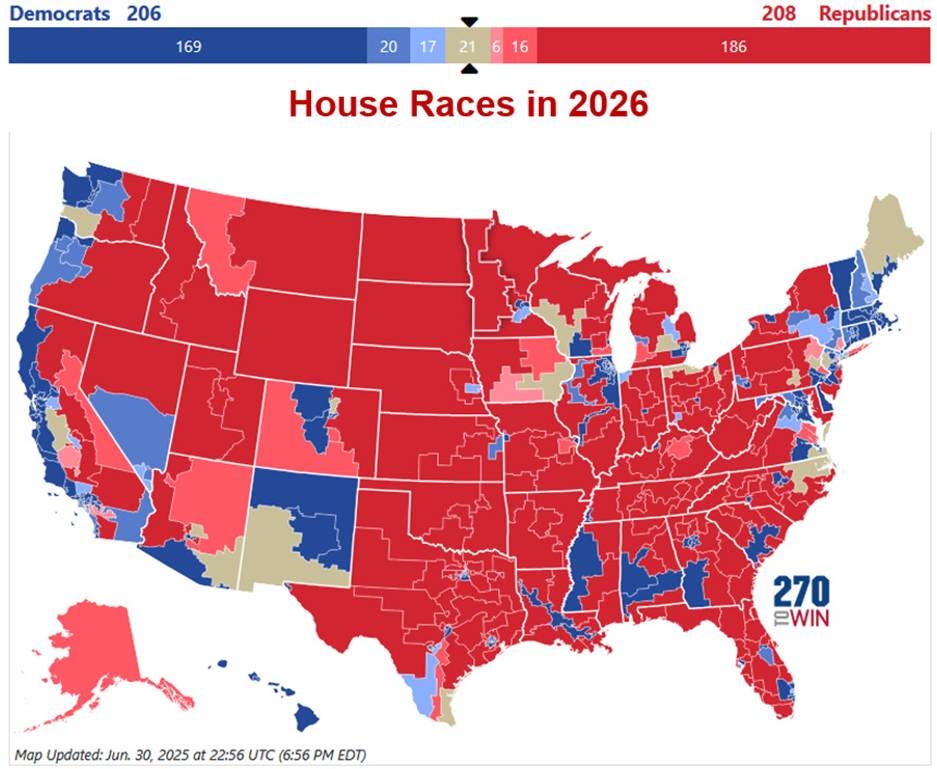
The above map shows all too clearly that in vast areas of the country working-class voters have no realistic alternative-party representation—the Republican is the only viable major-party choice, while the Democratic Party has largely abandoned many of these races.
But nature, as well as politics, abhors a vacuum, which is why we’re starting to see the emergence of progressive populist independents trying to take hold in this desert.
Here are a few worth noting:
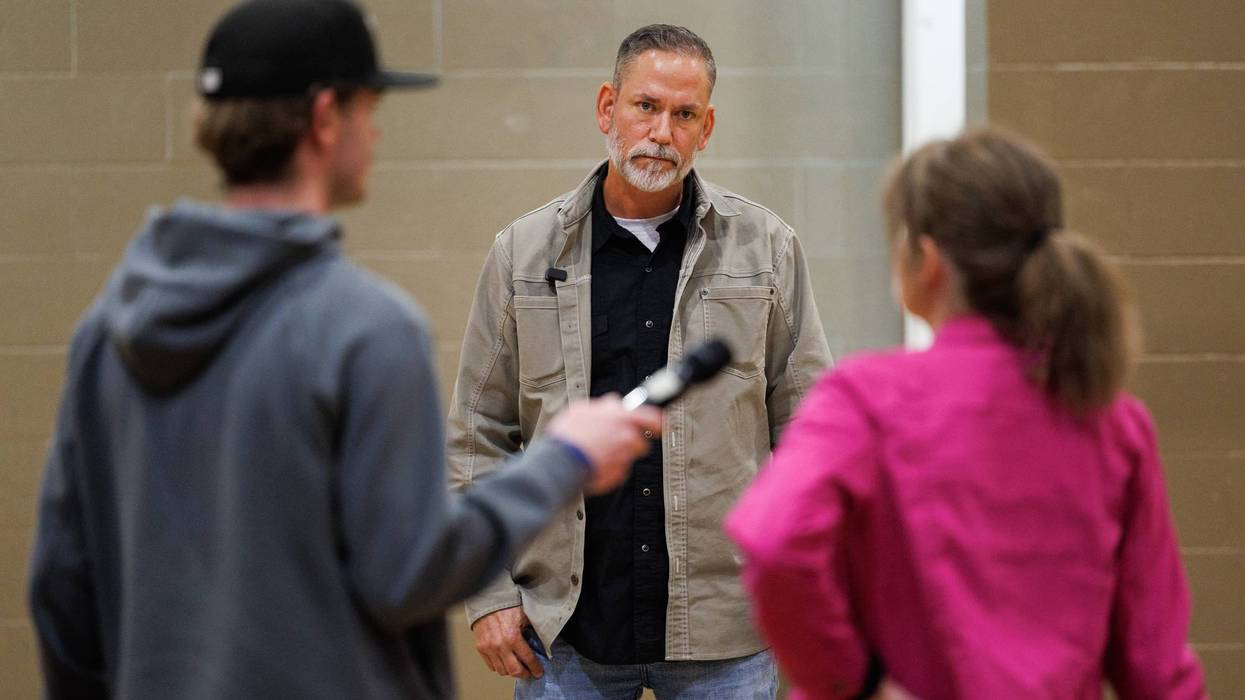
Dan Osborn, a mechanic, Navy veteran, and former labor union president, is running for US Senate in Nebraska against incumbent Republican Pete Ricketts, the former governor and son of billionaire Joe Ricketts. Osborn came within seven points of defeating Republican Sen. Deb Fischer in 2024, running 16 points ahead of Kamala Harris, and the 2026 race has again attracted national attention.
The current polling picture is close. The average of three recent Nebraska polls has Ricketts at 46.3 percent and Osborn at 44.7 percent, within the margin of error, with a substantial share of voters undecided or supporting other candidates. The latest polls that meet the New York Times criteria for worthiness show Osborn slightly ahead, a virtual toss-up pitting an incumbent Republican with deep pockets against an independent.
We can expect an inordinate amount of money to flood into the race to attack Osborn. A Republican super PAC has already put more than $3 million into advertising targeting him.
Osborn is running on his Nebraska Growth & Fairness Plan, which he says is “not a party’s platform or written by consultants. It’s written for the people who punch a clock and wonder why nobody in Washington is fighting for them.”
He explicitly disavows a connection to the Democratic Party, though the Republicans try to link the two at every turn.
If Osborn can overcome the Republican financial advantage, it would be an enormous boost to working-class candidates who have given up on the Democrats.
Unfortunately, Osborn faces the fallout from a leaked audio recording in which he made disparaging remarks about some of Trump’s voters. The recording was obtained by the Omaha World-Herald, and Osborn subsequently said that the voice “sure sounds like me” and apologized for the remarks.
He was recorded saying:
“Billy Bob in f—— Red Cloud, Nebraska, who lives next to the f—— Trump store as you pull into town and is waving the flag, all he knows is that he’s on the winning team. (Trump has) been so effective at taking Billy Bob and his wife Mary Jane or Mary Jo and telling them … you’re on the winning team. And that’s all they care about, because their lives probably suck so f—— bad.”
November will tell us whether his campaign against the two parties can overcome both the Republican financial advantage and the political damage from his choice of words.
Todd Achilles is running as an independent for US Senate in Idaho. He says:
“The two-party system has failed America. Both parties increase the national debt, keep us in endless wars, and favor big corporations, harming our families in the process…I reject the left-right divide because the challenge ahead of us is those at the top versus those at the bottom — those in power against the people. I will fight for all Idahoans, not billionaires or extremists.”
Achilles, a former Democratic member of the Idaho House of Representatives, is not a traditional working-class candidate. He is an Army veteran and technology executive who is running on a populist, anti-corporate platform.
The polling picture in Idaho is complicated. Recent surveys have produced very different results depending on the sample and whether voters are shown a two-candidate or multi-candidate race. One recent rather optimistic average of polls shows Achilles trailing by about 3 to 5 percent.
Whatever the polling, Idaho remains an overwhelmingly Republican state: Donald Trump defeated Kamala Harris there by 36.5 percentage points in 2024, winning 66.9 percent to Harris’s 30.4 percent.
Brian Bengs, a US Navy and Air Force veteran, former JAG officer, and lawyer, is running as an independent for the US Senate from South Dakota. In 2022, he ran for Senate as a Democrat and lost by more than 40 points. He’s running as a member of the Independent Veterans of America.
He is attacking the billionaire class:
“who buy politicians to rig the system so they can pay a lower tax rate than their secretaries & condition us to see only through red or blue-colored glasses disguising how they pick our pockets.”
His campaign’s current platform indeed emphasizes getting big money out of politics, eliminating corruption, banning congressional stock trading, unrigging the tax code, and reducing the national debt.
Like Achilles, Bengs faces a formidable Republican political environment. Trump carried South Dakota by 29.2 percentage points in 2024.
Bill Hill, a commercial fisherman, construction worker, teacher, principal, and former superintendent, is running as an independent for Alaska’s sole congressional seat. He spent more than two decades in education and was named Alaska Superintendent of the Year in 2023.
Hill is calling for:
“a total ban on congressional stock trading. Billionaires and corporations need to pay their share like the rest of us. And we need to get big money out of our elections…I’m a lifelong independent running to do what’s right by Alaskans, not what’s right by billionaires, corporations, or party bosses in DC.”
Political analysts repeatedly warn that third-party candidates can serve as spoilers, potentially helping the candidate they least support. But Alaska’s ranked-choice voting system makes the situation more complicated.
The Democrat, Eric Hafner, remains on the November ballot, along with Republican incumbent Nick Begich, Hill, and Libertarian Jim McDermott. In the latest New York Times/Siena poll, the first-choice results were Begich 47 percent, Hill 35 percent, Hafner 8 percent, and McDermott 5 percent. After ranked-choice tabulation, Begich led Hill 53 percent to 47 percent.
So, in Alaska, the spoiler question is not simply a matter of who finishes ahead in the first round. The ranked-choice system makes the ultimate effect of Hafner’s candidacy dependent on how his supporters’ second choices are distributed.
Candidates Without a Party?
Currently, there is no unified effort to build a party of independents to run in deep-red America. Instead, the effort is largely driven by the candidates themselves. It’s unclear if this will be the best long-term approach.
The word “independent” does fit nicely with the idea of independent candidates, free from any broader party or political organization. But independence has its downside in terms of accumulating and sharing campaign expertise, funding, and building a unified platform.
To find out more about the viability of independent candidates, we will be conducting a new survey of 5,000 voters in red America. One question we will ask respondents is whether a new organization of independents should be formed and what to call it.
Will a New Political Formation Emerge?
The political logic of the Democratic Party’s abandonment of its working class roots, which led to the very red map of America, and the Republican Party’s failure to support workers and their issues while having control of the government, suggests strongly that something new could emerge. There are just too many working people with no political home. But it remains to be seen how this vacuum will be filled—and by whom.
There is some chance that the Democrats, responding to the independents, will address the void by running many more working-class and progressive populist candidates. But the Democratic brand is extremely tarnished.
As John Tester, the former Democratic Montana US Senator, put it in a leaked text attributed to him:
“Every race I ran as Montana Senator and US Senator it was about distancing myself from the Democratic Party…. During my last two races the Democratic Party was poison in my attempts to get re-elected.”
For those of us who want to end MAGA’s grip on national politics this November, let’s hope that an enormous blue (and independent) wave will serve, for now, as the antidote.
For more information, see A Party of Our Own.

If they do not, we will be sentenced to one election after another where parties club each other with populist anger, alternating in power with little changing.
One of the most potent midterm election slogans was offered by the Republicans in 1946: “HAD ENOUGH?” The GOP swept into power after years of New Deal dominance.
We like to say that what counts is not what you are against, but what you are for. Not always, though. Sometimes “Had enough?” is enough.
Midterm elections often are waged as a rebuke to the party in control of the White House. Political scientists call this a thermostatic election. Voters adjust the temperature by turning the dial away from perceived overreaches.
Sometimes the floor just drops out from under a political party. This could be a year when “Had enough?” is enough.
But at times candidates have an agenda, detailed or implicit. Those are the years that produce the biggest change.
In 1974, the “Watergate Babies” ran to clean up politics and shake up a hidebound Democratic Party. Often they were Democrats from suburban districts, shifting the party’s focus away from New Deal-style economic issues toward issues of transparency and good government.
George Miller, a congressman elected that year from California, declared: “We were a conquering army. We came here to take the Bastille. We destroyed the institution by turning the lights on.”
In 1994, Republicans led by Newt Gingrich won the House for the first time in 40 years. On the Capitol steps, more than 300 candidates signed a “Contract With America,” a pledge to bring to the floor for a vote on 10 measures, such as a congressional term limits constitutional amendment, within the first 100 days of taking office.
In 2018, the midterm halfway through Donald Trump’s first term, dozens of Democrats won with an anti-corruption pledge put forward by the group End Citizens United.
The scandals of just a decade ago seem quaint. Back then, we worried that Trump would profit from guests staying at his hotel near the White House. Now he brazenly grifts, increasing his net worth by at least $2 billion. The most recent astonishing news suggested that Russian President Vladimir Putin offered favorable oil concessions to investors who have donated to Trump’s super PAC or have financial ties to his son-in-law Jared Kushner as part of a bid to force a deal on Ukraine.
Today, Democrats are running on affordability. Diesel prices and exorbitant hamburgers speak for themselves. But it is not clear what the party would do about affordability if it were to win.
Corruption is the other big issue on the campaign trail. Here, the Outs have begun to say what they would do if they become the Ins.
End Citizens United, once again, has enlisted candidates to sign an “Unrig Washington” pledge. Candidates vow to ban congressional stock trading, refuse corporate PAC money, and “crack down on dark money.” Those are strong planks, though they may fall short of a Gingrich-style manifesto.
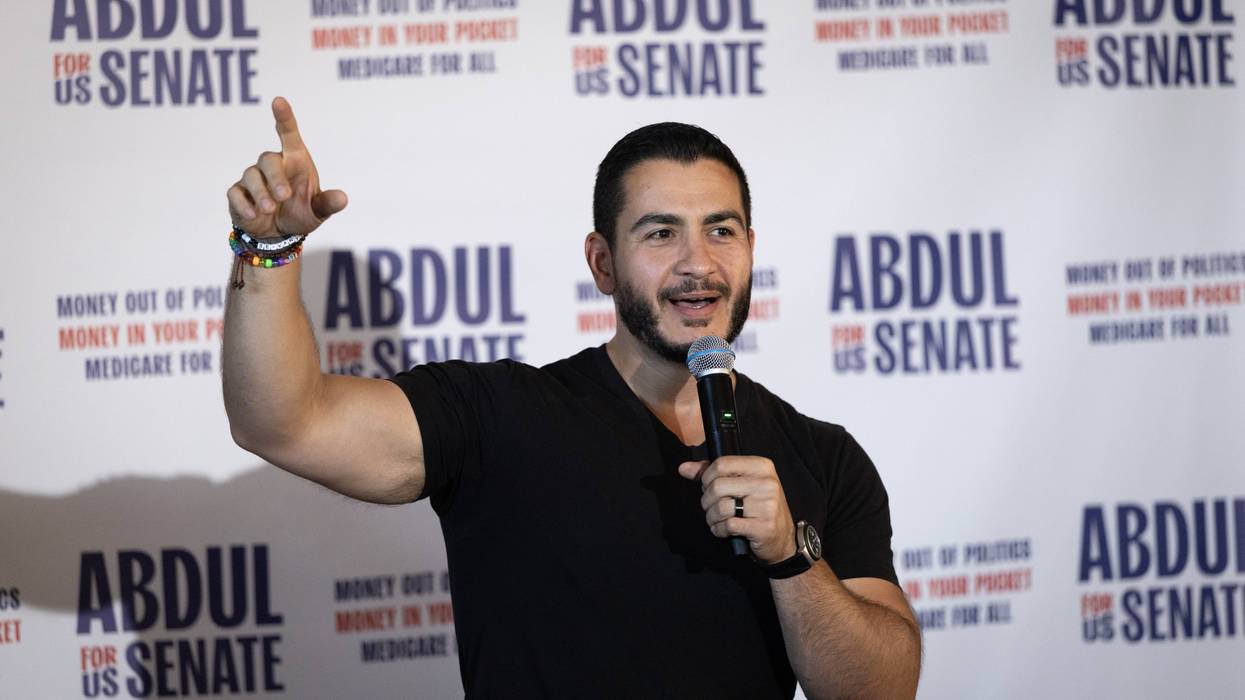
Some of the most talked-about candidates have embraced similar themes. Abdul El-Sayed, seeking a Senate seat in Michigan, calls for getting “Money Out of Politics.” James Talarico, running a surprisingly strong Senate race in Texas, rails against “billionaire mega-donors and their puppet politicians” in a “rigged system.” Jon Ossoff, the incumbent Georgia senator, has gone viral with his intensely delivered stump-speech exposés of executive branch corruption.
A survey by the Brennan Center earlier this year found an unusual and wide revulsion against corruption. It also found that voters blame Democrats as well as Republicans.
GOP candidates sense this mood too. They focus not on money in politics but on fraud in government. In Minnesota, which last year was rocked by Medicaid fraud allegations, state house Speaker Lisa Demuth, running for governor, declared that “fraud was exploding here in Minnesota.” Bobby Charles, running for governor in Maine, pledged to investigate alleged fraud in the state’s Medicaid system. Public disquiet about government waste, always lurking, could be forged into a potent issue once candidates find a way to distance themselves from the current administration.
There’s another issue heard on the hustings that reflects voter disquiet about out-of-touch institutions: Supreme Court reform. Josh Turek, running for the Senate in Iowa, has joined Talarico and others in urging action. Rep. Jamie Raskin (D-Md.) and Sen. Sheldon Whitehouse (D-RI), who would chair the Judiciary Committee in their chambers if their party won, recently roused a crowd of Turek supporters at the Polk County Steak Fry with calls for term limits for the justices.
Right now, it’s Democrats demanding reform. In the past, Marco Rubio and Ted Cruz have supported term limits. Could they do so again? Polls show wide and consistent public support, such as the Fox News survey showing 78% approval.
As I wrote last week, due to retirements and primary defeats in safe districts, we know that at least 83 new House members will be elected in a few weeks—and of course, depending on switches in party control, possibly many more. There already has been a wave election in both parties.
What will happen next? Ever since people stopped answering landline telephones, polling has been a struggle. In some elections, surveys underestimate Trump’s populist base. (Though in years when Trump is not on the ballot, that does not seem to be the case.)
But sometimes the floor just drops out from under a political party. This could be a year when “Had enough?” is enough.
The question for whoever wins is what they will do to try to curb corruption. Otherwise we will be sentenced to one election after another where parties club each other with populist anger, alternating in power with little changing.
And the presidential candidates who will soon dash around the country must do even more to bring these issues into focus, to say what they would do to change our politics.
The next two years could bring an even more intense debate about how to remake American democracy and renew government. As soon as the voting ends, that debate begins.
Democrats should embrace three foreign policy commitments that are morally overdue and broadly popular nationwide: ending the Iran war, cutting the Pentagon budget and abolishing ICE, and ending support for Israel and other governments that violate humans rights.
The idea that US voters don’t care about foreign policy is over. From Michigan to Florida to Colorado, Democratic Party primary candidates’ positions on war, military spending, and support for Israel have propelled victories alongside progressive policies on healthcare and the economy.
The message of “Babies, Not Bombs”—a promise to spend taxpayer money to nurture lives instead of ending them—has become a rallying cry well beyond the New York campaign where it originated.
To win the midterms and offer real leadership beyond 2026, Democrats must pay attention to this momentum and the foreign policy concerns of voters across the political spectrum. Donald Trump secured the presidency in 2024 partly by winning over voters, including independents and Democrats, with his promise to “stop wars” not start them.
Democrats don’t need to invent a new coalition to win in November. They need to represent the one that already exists.
While Trump has shattered this promise by waging a disastrous, illegal war in Iran and attacking or threatening more than 10 other countries, Democrats must learn from their mistakes—and the president’s.
To win in November and deliver the change people want, Democrats should embrace three foreign policy commitments that are morally overdue and broadly popular nationwide.
The first commitment is ending the war on Iran and the endless wars that have defined US foreign policy since 2001.
Trump’s war on Iran is among the most unpopular in US history. Polling shows nearly 60% of adults oppose it, including 90% of Democrats, 63% of independents, and 22% of Republicans.
Voters have watched the conflict drive up gas and grocery prices while killing, injuring, and displacing people on a staggering scale, and risking greater global economic devastation. The war has added to the trillions of dollars wasted by the post-September 11, 2001 wars, which could have funded urgent domestic needs.
The second commitment is cutting the Pentagon budget and abolishing Immigration and Customs Enforcement (ICE). President Trump has requested a $1.57 trillion military budget for the 2027 fiscal year, including money for the Iran war. This would be the largest in US history, and around a 50% increase over already bloated spending.
Opposition to Trump’s budget request is profound: 65% overall and 87% among Democrats.
There’s similar outrage over Trump’s militarization of US streets as people see ICE’s brutal effects on immigrant neighbors. “Abolish ICE” has become a clarion call nationwide because of the agency’s responsibility for multiple deaths, mass raids, and documented abuses in detention centers.
Nearly three-quarters of Democrats, half of independents, and a quarter of Republicans support abolishing ICE. The Democratic National Committee, in August, passed a resolution calling for abolishing ICE.
Democrats should listen to voters and oppose warmongering abroad and a hyper-militarized immigration crackdown at home as two faces of the same problem.
The third commitment is ending support for Israel and other governments responsible for serious human rights violations. While stopping military backing for Israel was once a radical position, it’s increasingly the Democratic—and national—mainstream given the dramatic decline in support for Israel amid a live-streamed genocide propelled by US arms and tax dollars.
Across the political spectrum, the death toll of more than 73,000 Palestinians, including more than 20,000 children, has transformed public opinion.
The country’s existing “Leahy Laws” bar US funding for foreign military forces that commit human rights abuses. Another Democratic National Committee resolution calls for full enforcement of the Leahy Laws, giving Democrats a legally grounded position: Apply the standard consistently—to Israel, the United Arab Emirates, Saudi Arabia, or any other government implicated in human rights violations.
None of these are fringe positions. They are where a majority of the country and an overwhelming majority of the Democratic base already stand.
What’s missing is a party willing to campaign on these stances plainly and courageously, rather than treating foreign policy as a black box best left to the whims of an unelected, out-of-touch Washington, DC elite.
Democrats don’t need to invent a new coalition to win in November. They need to represent the one that already exists: People across the political spectrum exhausted by endless war, appalled by a bloated military budget squeezing out domestic needs, and angry about seeing their taxes underwrite human rights abuses at home and abroad.
A foreign policy platform built on these three commitments isn’t just good policy. It’s a winning one.

"It's so hard... to imagine a worse failure than losing two national elections to Donald Trump."
A Democratic senator who has long been associated with the party's establishment is now conceding that its old approach to doing politics has failed.
In an interview with David Sirota of The Lever published on Tuesday, Sen. Michael Bennet (D-Colo.) described "the establishment Democratic Party" as "a failed enterprise."
"It is so hard to lose two general elections to [President] Donald Trump, in political terms, to imagine a worse failure than losing two national elections to Donald Trump," he said. "And yet the establishment Democratic Party did, and I think of it as a failed party."
What’s newsy is Bennet slamming the establishment faction that twice lost to Trump.Hes a moderate-coded Dem, which means the call is now coming from inside the house — a devastating repudiation of the Neera Tanden/DC faction that destroyed the party. https://t.co/ZZrER0CSz0
— David Sirota (@davidsirota) October 6, 2026
Bennet added that nobody "should feel an obligation to defend the party as it existed in the form that lost to Donald Trump."
Elsewhere in the interview, Sirota asked Bennet about how his political thinking had changed over the past 18 years as a US senator and why he no longer believes the politics of the status quo are tenable.
"There's something fundamentally wrong with the nature of our capitalist system that is delivering these outsize gains for the people at the very top at the expense of everybody else in the economy," Bennet said. "So I guess, from that vantage point, I think I've changed."
Bennet also chided fellow Democrats who are trying to force Democratic Socialists of America (DSA) candidates to leave the party for being "too extreme."
"I think that's a huge mistake," he said. "Look: We don't have to agree on everything. We don't, and by the way, that shouldn't be the cost of admission to the Democratic Party or to America."
Bennet added that the goal of policymaking shouldn't be to "come to some moderate view of the world," but "to unleash the imagination of the American people to solve their own problem. And that's what they did 100 years ago in the last Progressive Era, and I think that's what they're going to do again."

Rep. Greg Casar said progressives' effort to make a leading artificial intelligence super PAC "as toxic as AIPAC" is having an impact.
The chair of the Congressional Progressive Caucus on Wednesday urged all Democrats to reject campaign cash from billionaires whose wealth stems from the artificial intelligence industry, following news that the president of OpenAI abandoned plans to donate millions more to a super PAC that has funneled money to members of both parties.
The OpenAI executive, Greg Brockman, wrote in an internal message obtained by The New York Times that the super PAC, Leading the Future (LTF), "keeps reflecting on the company and [has] become so much of a distraction for people here." Brockman noted that he and his wife have donated $25 million to the super PAC—which opposes strong AI safety regulations—but "have no plans to donate more at this time."
Rep. Greg Casar (D-Texas), a leading supporter of AI regulation in Congress, said in response to Brockman's message that "the pressure is working."
"Progressives have worked hard to make LTF as toxic as AIPAC," Casar wrote, referring to the American Israel Public Affairs Committee. "Now one of its biggest donors is backing out. Democrats need to stand with the people and reject AI billionaires' money."
Super PACs bankrolled by AI companies and billionaires have become some of the biggest spenders in the 2026 midterms amid widespread voter backlash against the construction of resource-draining AI data centers—and against the industry more broadly.
The Times reported on Tuesday that LTF and Public First Action, which is aligned with the AI firm Anthropic, have spent a combined $52.6 million on "safe seats—those that are unlikely to change party hands but that often feature intense intraparty contests."
"The big AI players have also spent more heavily for Democrats than Republicans," the Times noted. "They have boosted candidates who align with their agendas, helped defeat those they see as hostile to it and ingratiated themselves with front-runners who are likely to be in positions of power in the next Congress to make decisions critical to their bottom lines."
"The Times analysis of federal advertising and campaign outreach expenditures made by the four major super PACs during this cycle showed that they have spent far more money in support of Democrats—$28 million to back 21 Democrats and nearly $19 million to boost 30 Republicans—and that the candidates they backed almost always won," the newspaper added.
The Lever reported last month that a five-person commission on AI convened by House Minority Leader Hakeem Jeffries (D-NY) "is filled with Democrats who have received outsized financial support this election cycle from AI-linked super PACs, executives, and investors."
Reps. Ted Lieu (D-Calif.), Valerie Foushee (D-NC), Josh Gottheimer (D-NJ), Frank Pallone Jr. (D-NJ), and Zoe Lofgren (D-Calif.) are the commission's members.
"The spending seems intended to shape the party’s policy response to AI, particularly if Democrats win a majority in November," The Lever observed.
Earlier this week, US President Donald Trump met with leading AI industry executives who have collectively donated more than $220 million to his super PAC and other projects associated with the president, according to a new analysis by the advocacy group Public Citizen. Trump said following the meeting that the AI industry shouldn't have any government guardrails and should be allowed to police itself because "they love our country."
"Big Tech executives have effectively bought themselves a seat at the AI regulatory table," said Robert Weissman, co-president of Public Citizen. "Actually, they have bought the table. As a result, as public anxieties about AI risks—to children, political integrity, jobs, the environment—skyrocket, and as revelations mount of AI company failures to impose adequate safeguards on their own technologies, the Trump administration delivers meaningless agreements that impose no restraints on the out-of-control tech oligarchs."

If the party is to meet the moment, restructuring US ties with Israel is only a starting point.
By any measure, 2026 has been a disastrous year for President Donald Trump’s foreign policy.
An Iran war in which Trump promised quick victory has turned into a protracted farce dragging down the world economy. The president’s “reciprocal tariffs” were gutted by the Supreme Court, and his administration’s trade agenda remains deeply unpopular. Even his regime change operation in Venezuela, an apparent success, was broadly rejected by the American public and has put the United States into an imperial caretaker role in that country that could prove complicated and costly.
It is no surprise, then, that the president’s approval rating on foreign policy has sunk by almost 30% since his inauguration for his second term. With Trump’s overall polling numbers cratering, Democrats appear to have a decisive advantage in November’s midterms. Yet this has not translated into a lead in foreign affairs, where polling suggests the two parties are essentially tied.
This reality may stem from the fact that, while Democrats have correctly lambasted the president’s actions abroad, the party — and especially its top leadership — has yet to articulate a vision for US foreign policy that reckons with how Trump’s two terms have changed the world and America’s role in it.
While Trump’s first presidency could be viewed as an aberration from the normal course of American politics, his second has been more consequential: a “rupture,” as Canadian Prime Minister Mark Carney memorably put it in his Davos speech early this year.
American partners who have relied on US markets or security backing can no longer hope for a return to normalcy after Trump. They are acting accordingly: in the past year, US allies in Europe, Asia, and the Middle East have engaged in a flurry of activity, inking new trade and defense agreements in a long-term effort to reduce dependence on the United States.
If Democrats are to regain some credibility on foreign policy with audiences both at home and abroad, they must show a similar willingness to break with the past. Yet this willingness has so far been in short supply. While some leading party figures acknowledge that a return to business as usual is impossible, their prescriptions have continued to echo the agenda of the Biden administration: restoring US leadership, renewing alliances, and crafting an international coalition to compete with China.
As much as former President Joe Biden’s foreign policy struggled under the weight of its contradictions, a retread of his agenda would face even more daunting challenges. Can the United States credibly claim to lead its allies — much less the world — when it has repeatedly shown that its commitments don’t outlast a single presidency? Will any partners want to double down on ties with a hegemon that has proven so eager to exploit dependencies for short-term gain? And what kind of international program can the American public be expected to support after years of anger at the status quo and Trumpian disruption alike?
The Democrats have yet to address these questions in a serious way. Fortunately, the intra-party struggle taking place around the US relationship with Israel has created an opening for a broader reevaluation of Democratic foreign policy.
What kind of international program can the American public be expected to support after years of anger at the status quo and Trumpian disruption alike?
Across the country, progressive primary challengers have trounced establishment candidates by appealing to voters’ desire to end blank-check support for Israel. The relationship has become a litmus test for candidates’ willingness to break with destructive orthodoxies. As Sen. Chris Van Hollen (D-Md.) put it, “primary voters won’t trust any Democratic presidential candidate who does not have a record of moral and strategic clarity on these issues.”
If the party is to meet the moment, restructuring US ties with Israel is only a starting point. Candidates and elected officials alike need to put forward bold ideas covering a range of issues, from reasserting congressional war powers to crafting a reformed approach to global aid.
Crucially, their proposals need to go beyond opposition to Trump. Rather than just calling out the stupidity of the Iran war, Democrats should pointedly reject the policy of US military primacy in the Middle East that led to it and make the vigorous case for diplomacy that the conflict has so clearly validated. In addition to overturning Trump’s tariffs, the party should develop an agenda for positive-sum economic engagement with the world that does not treat economic prosperity as a scarce resource to be hoarded by some countries at the expense of others. Instead of attacking Trump for weakness in his apparent dovish turn on China, Democrats can advance a strategy that centers cooperation and conflict prevention alongside targeted pushback on Chinese policies where necessary.
In the broadest terms, a new Democratic foreign policy should entail uniting behind a vision for US global engagement that recognizes America cannot lead on every issue and in every instance. This does not mean abandoning the commitment to a world governed by rules and institutions; in fact, renewed investment in international cooperation stands the best chance of sustaining a genuine “rules-based order” at a time when the United States clearly lacks the will and ability to stand up such a system on its own. This approach would mesh well with proposals by allied leaders like Carney and Spanish Prime Minister Pedro Sánchez, who have each sketched out ideas for a more just, resilient global order upheld by multilateralism and flexible coalition-building.
Democrats must build on these efforts and offer a compelling alternative both to Trumpism and to the exhausted status quo that helped produce it. Failure to do so would invite disappointment on the world stage — and provide a blessing to Trump’s would-be successors.
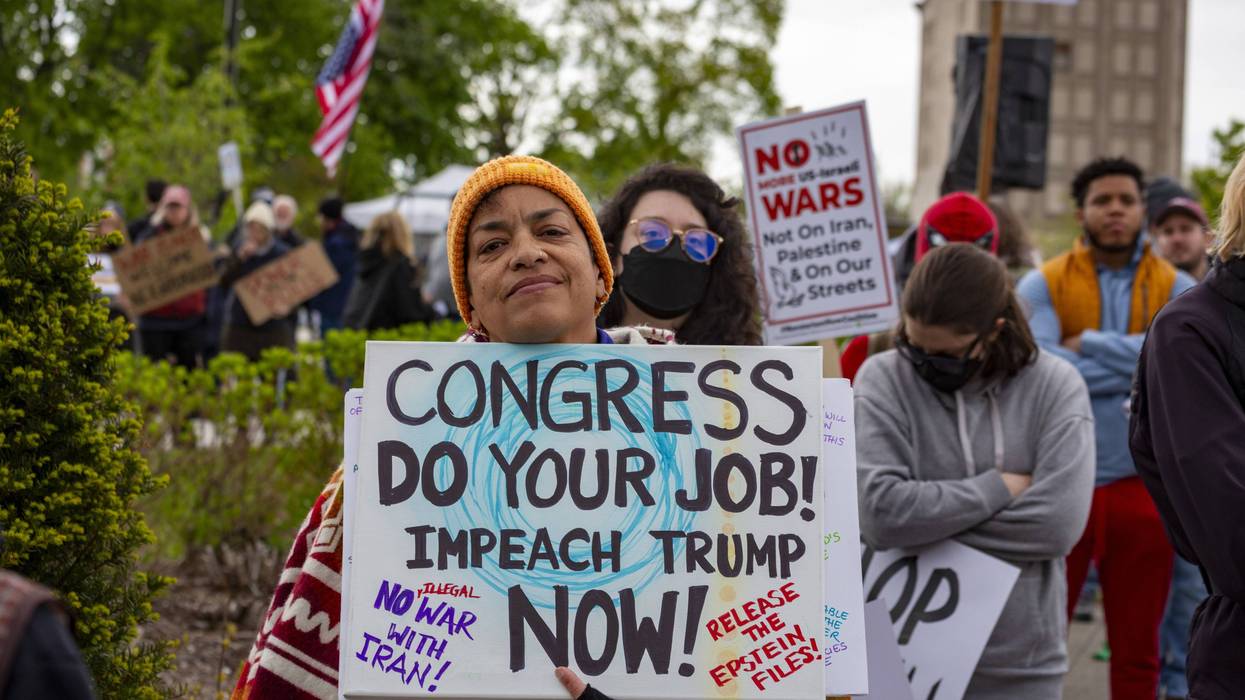
"It's about setting a standard, and the Democrats can impeach, to uphold constitutional values, and at the same time, have a first-hundred-day agenda that deals with the cost of living," said Rep. Ro Khanna.
With the US midterm elections less than six weeks away and Republicans' congressional majorities at risk, both GOP leaders and Democrats are discussing the possibility that a Democratic-controlled Congress could impeach President Donald Trump a historic third time.
"They say they’re not going to, but we know they will—they'll do a third impeachment of President Trump," House Judiciary Committee Chair Jim Jordan (R-Ohio) said of Democrats during a Sunday radio interview. "But that's just part of it. They're going to investigate the first family, they're going to investigate Cabinet secretaries."
In fact, Democratic leaders are not denying another potential impeachment effort targeting someone who has been condemned by a range of critics as "the most openly corrupt president in American history."
During an interview with The Associated Press published on Saturday, House Minority Leader Hakeem Jeffries (D-NY), who could become speaker if Democrats reclaim the lower chamber, signaled that impeachment is on the table—and not just for Trump.
"We haven't ruled anything out... and we haven't ruled anything in," he said. "If folks have been stealing from the American people, shortchanging the American people, or screwing over the American people... we are going to hold the crooks accountable."
Jeffries and other Democrats "are preparing a vast oversight agenda" that is "as robust as it is daunting, spanning several House committees," the AP reported. "With majority power comes bigger budgets and staff, and the ability to investigate, subpoena, and potentially course-correct what the Democrats say are widespread corruption and abuses of power."
Annual financial disclosures released this summer show that Trump pocketed at least $2.2 billion—over half of it from his family’s cryptocurrency grift—during his first year back in office, and his stock trades since then have continued to generate alarm.
Trump's deployment of federal immigration agents to various US communities to abuse the rights of US citizens and immigrants alike as well as his illegal war on Iran—with its the resulting affordability crisis—have also fueled calls for impeachment.
Responding to suggestions from some that another impeachment wouldn't be a good use of Democrats' time, Congressman Ro Khanna (D-Calif.), a potential 2028 presidential candidate, said during a Sunday appearance on NBC News' "Meet the Press" that "it's not about Donald Trump," who will be a lame duck and "increasingly irrelevant."
"The point is to stand up for the Constitution," Khanna explained. "Impeachment says that you can't get into an illegal war in Iran without constitutional approval. Impeachment says that you can't just start firing federal employees... in defiance of what Congress says. Impeachment says you can't do deals with foreign governments to allegedly enrich your own family."
"It's about setting a standard, and the Democrats can impeach, to uphold constitutional values, and at the same time, have a first-hundred-day agenda that deals with the cost of living," he added, pointing to issues such as free childcare, raising the minimum wage, and taxing billionaires. "We can do both."
Democrats have unveiled various articles of impeachment against Trump since his return to the White House last year. On Thursday, Congressman Steve Cohen (D-Tenn.), who is retiring after this term, introduced 26 more, including for alleged abuses of power, violations of his oath of office, and corrupt use of the pardon authority.
"Trump is clearly the most impeachable president our country has ever endured," said Cohen, a member of the House Judiciary Committee. "His continued presence in office is a danger to our democracy. That the sycophantic Republican majority in Congress is derelict in its duty does not mean that I must abandon my responsibilities."
Cohen stressed that "I took an independent oath to support and defend the Constitution. That commitment compels me to introduce this resolution today. When historians write about this period, and our constituents ask who stood up to President Trump's lawlessness, this resolution is the answer."
The House initially impeached Trump for abuse of power and obstruction of Congress in December 2019. After his supporters stormed the US Capitol on January 6, 2021, he became the first president to be impeached twice. However, the Senate acquitted him in both cases.
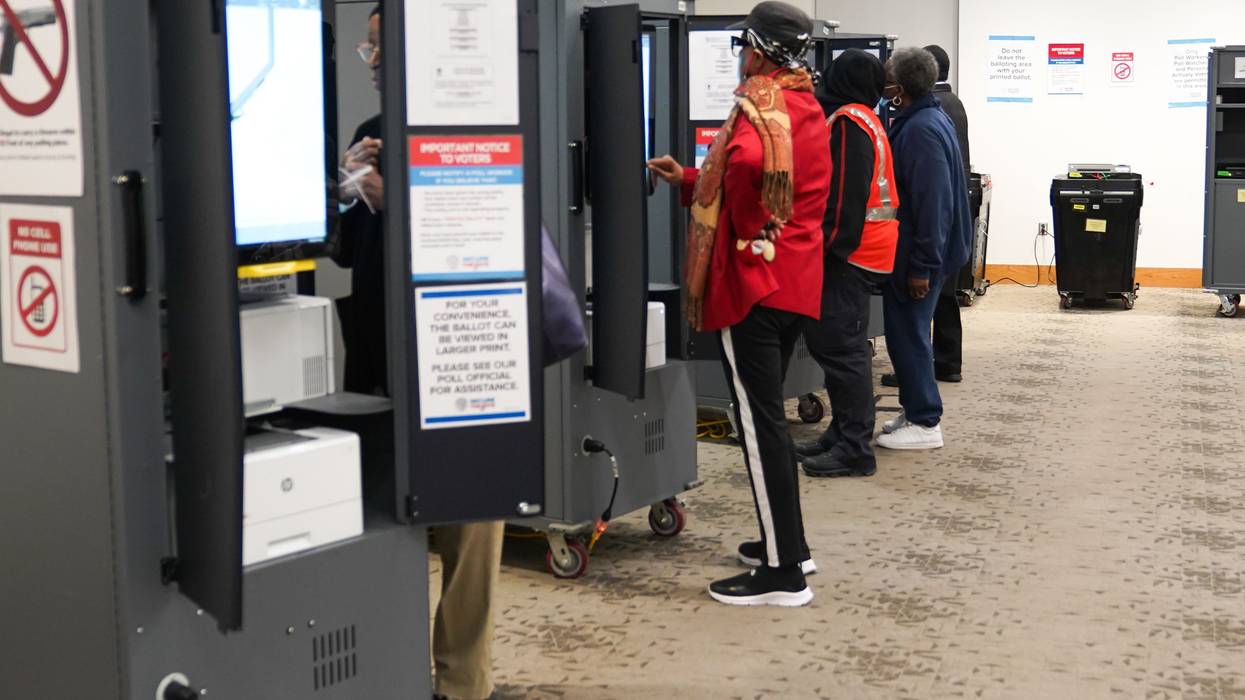
Democracy has always depended on more than elections. It depends on institutions that people believe are worthy of their participation and capable of improving their lives.
As millions head to the polls in the 2026 elections, voters are showing up disappointed, forgotten, and worn down from years of failed policies.
After nearly two decades working inside campaigns, Democratic leaders, national advocacy organizations, and movement institutions have made it clear: We’ve got a problem on our hands.
The challenge before us is not simply that Democrats have a messaging problem, nor is it that Republicans have become better communicators. The deeper problem is that we have spent years trying to win elections while underinvesting in the communities, relationships, and culture that make political victories durable.
People don’t organize their lives around resistance alone. They organize around belonging, purpose, hope, and the possibility that tomorrow can be better than today.
Narratives don’t emerge from communications plans, but rather from institutions that people trust. This distinction matters.
We keep hearing the same question: Why aren’t more young people and people of color engaged in the civic process? This is the wrong question.
The question we need to be asking is whether or not our current institutions are willing to or even positioned to share power with us. More often than not, participation is shared only after decisions are made, and usually with an ask attached.
We are not waiting for institutions to tell us how to participate. We have lived the reality of what happens when institutions fail, time and time again. We have seen how powerful it is when we build our own.
Young Black folks in particular are organizing, creating, building community, and culture. Especially for those who are young, queer, and Black, so much of the language and swagger that shapes our lives has been created by us. We know that when institutional belonging is unavailable, community creates belonging. We got us.
As Black queer Americans, we inherit a tradition shaped by people who understood that institutions rarely surrender power simply because the moral argument is clear. Generations before us organized, marched, litigated, and forced America to confront the distance between its ideals and its reality. Progress has never been inevitable. It has always been demanded.
A collective 20 years inside politics has made it clear to us: Institutions rarely fail overnight. Long before they lose public trust, they lose relevance. They become more concerned with protecting existing power than with creating new possibilities, optimizing for stability rather than adaptation.
Eventually, they find themselves speaking fluently to one another while struggling to connect with the people they were created to serve. That is where much of the progressive movement finds itself today.
Americans are losing faith in politics and in the idea that our institutions can solve the problems shaping their everyday lives.
People do not experience institutional failure in constitutional language or policy briefs. They experience it through rising costs, unstable jobs, inaccessible housing, underfunded schools, broken infrastructure, and the growing sense that the rules apply differently depending on who you are and how much power you hold. They talk about fairness, opportunity, dignity, and whether working hard still leads to a better life.
These conversations are not separate from politics. They are politics. We can’t continue mistaking communications for culture.
Too often, the response has been to refine the message rather than rebuild the institution that delivers it. We have mistaken communication for culture, which has led to the consequences we are all currently living with.
The progressive movement has become extraordinarily sophisticated at producing content. We can generate messaging guidance overnight, build rapid-response campaigns within hours, and create endless streams of digital content. Yet none of those capabilities automatically produce trust.
Trust is earned when people see themselves reflected not only in the message but in the leadership, values, and relationships behind it. You can’t message your way out of a deficit of trust. No amount of message testing can compensate for institutions that people no longer believe understand their lives.
This is where imagination becomes essential.
Since 2016, countless postmortems have focused on messaging, media strategy, and digital infrastructure. Those conversations matter, but they begin from an incomplete premise. They assume we already have a compelling story to tell.
We are not convinced we do.
Sentiments such as “fight” or “protect democracy” are important calls to action, but they are not visions of the future. They put us on the defensive and describe what we oppose more clearly than what we are building. People don’t organize their lives around resistance alone. They organize around belonging, purpose, hope, and the possibility that tomorrow can be better than today.
That kind of vision cannot be manufactured through advertising.
It grows from culture. It expands from artists, educators, organizers, faith leaders, entrepreneurs, local institutions, and civic spaces where people build relationships long before anyone asks for their vote.
We can look back at the Obama era, as one example of how politics can bend the arc of history. If you were near a college campus on November 4, 2008, you remember the celebrations. Music poured from dorm rooms and car speakers, topped off with dancing in the street. For a brief moment, hope felt less like a slogan and more like a possibility finally personified. The belief in our collective power and the possibilities it could create ignited a generation.
Research supports what many organizers have understood intuitively for decades. Economist Raj Chetty’s work on economic mobility found that social capital (the relationships that connect people across communities and opportunities) is among the strongest predictors of upward mobility. That insight extends beyond economics.
Relationships shape what people believe is possible. They influence trust, aspiration, and whether institutions feel relevant to everyday life. Politics is no different.
Queer communities have long understood something about the power of relationships that institutions are only beginning to relearn. We call it chosen family: the idea that belonging can be deliberately built through relationships of trust, care, responsibility, and mutual recognition. There is a civic lesson in that tradition. Durable movements are built the same way. Not through an email list or a message tested to perfection, but through relationships strong enough to survive disagreement, disappointment, and the space between elections.
The same is true for Black communities, particularly Black women, whose creativity, organizing, and cultural leadership have repeatedly expanded the boundaries of American democracy while too often receiving recognition only after the fact.
Innovation doesn’t come from preserving the status quo. History has shown us that it comes from creating space for voices that institutions have historically overlooked.
That means the work ahead demands more than better campaigns. It requires rebuilding civic infrastructure and cultivating leaders rather than personalities. A focus on relationships instead of audiences and investing in organizations that remain present between election cycles.
Institutional renewal is no longer optional as artificial intelligence, economic uncertainty, climate disruption, and political polarization reshape public life simultaneously. The pace of change is accelerating, while confidence in the institutions meant to guide us continues to decline.
That should concern all of us. Democracy has always depended on more than elections. It depends on institutions that people believe are worthy of their participation and capable of improving their lives.
The encouraging news is that Americans have not completely lost faith in one another. Mutual aid networks, local organizers, community leaders, and everyday people continue to demonstrate the generosity and resilience our institutions often struggle to match.
We must build institutions strong enough, imaginative enough, and trustworthy enough for the story to tell itself. There’s no other choice.

"Benjamin Netanyahu's disgraceful policy of expanding West Bank settlements crosses a clear red line and makes Palestinian statehood and lasting peace even more difficult."
Nineteen US Senate Democrats on Wednesday introduced a bill to sanction people or companies that facilitate the construction of Israeli settlements in the E1 area east of Jerusalem in the West Bank, which would split the illegally occupied Palestinian territory in two.
"The E1 settlement project is a move towards de facto annexation of the West Bank, and those who choose to facilitate settlement construction should understand that they risk losing access to the US financial system," said Sen. Elizabeth Warren (D-Mass.), who is leading the legislation with Sens. Chris Coons (D-Del.), Ruben Gallego (D-Ariz.), and Ron Wyden (D-Ore.).
"The United States must use all diplomatic and economic tools available to counter rapid settlement expansion and extremist settler violence in the West Bank, spiraling trends that will only undermine the prospect of lasting peace for Israelis and Palestinians," she argued.
Critics of the plan to build 3,401 housing units in the E1 area—and recent unprecedented violence by Israeli settlers and soldiers toward Palestinians in the West Bank—have pressured governments across the globe to respond with sanctions. In the face of such pressure, UK Foreign Secretary Ed Miliband said earlier this month that the E1 plan was designed to "make the two-state solution unviable."
Within the next nine months, Miliband pledged, the United Kingdom's Labour government will "take action against specific companies and individuals who provide services such as construction, infrastructure, financing, or real estate for settlement expansion," and penalize “those who finance or facilitate illegal settlements."
The United Kingdom, France, and Canada have joined forces to ban imports of goods and some services from illegal Israeli settlements. Their foreign ministers also partnered with those from Denmark, Finland, Iceland, Ireland, Norway, Poland, Portugal, Spain, and Sweden for a joint statement in which they said the situation in the West Bank is "rapidly deteriorating amid unprecedented levels of settler violence and settlement expansion, including the unacceptable decision to publish tenders for the E1 settlement project."
The foreign ministers confirmed their "intention to introduce national and/or support European restrictions on trade in goods with settlements which are illegal under international law, or that they are actively considering these and other measures, in accordance with their national procedures."
In the United States on Wednesday, Wyden took aim at Israeli Prime Minister Benjamin Netanyahu—who is heading to New York City this week for the United Nations General Assembly, which has sparked fresh calls for his arrest in accordance with an International Criminal Court warrant issued over his government's genocidal war on Palestinians in the Gaza Strip.
"Benjamin Netanyahu's disgraceful policy of expanding West Bank settlements crosses a clear red line and makes Palestinian statehood and lasting peace even more difficult," said Wyden. "The United States must stand up against Netanyahu's campaign of violence and aggression against Palestinian civilians and sanction individuals and companies that are complicit in this unlawful action."
Under both Republican President Donald Trump and his Democratic predecessor, former President Joe Biden, the US has given Israel billions of dollars in military support, despite the ongoing slaughter of Palestinians in Gaza and the West Bank.
As the Trump administration pushes a proposed $2.8 billion transfer of 40,000 2,000-pound bombs to Israel—weapons Israeli forces have dropped on civilians in Gaza and Lebanon—polling commissioned by the magazine Liberal Currents and released Monday by the Center for Strategic Politics shows that Americans want Trump and Biden officials held accountable for the genocide.
Although a growing number of lawmakers have joined scholars and rights advocates around the world in condemning Israel's war on Gaza since the October 2023 Hamas-led attack as a genocide, Congress hasn't taken any concrete action to limit military aid to Israel.
The bill unveiled Wednesday is similarly unlikely to go anywhere—even though, as Gallego noted, "for decades, Democrats and Republicans alike have pushed for a two-state solution," and the Israeli construction would "threaten a viable Palestinian state."
"It's a step in the wrong direction," Gallego said of the settlement plan. "This legislation sends a clear message to Prime Minister Netanyahu: The United States stands firmly behind a two-state solution as the only path to real peace and security for all."
Coons—a "staunch" longtime supporter of Israel—pointed out that "for decades, American presidents from both parties have warned successive Israeli governments that construction in E1 threatened the viability of a Palestinian state and was unacceptable to the United States."
However, even if Democrats win back control of the Senate, or perhaps both congressional chambers, in November's midterm elections, there appears to be little appetite within the Trump administration to do or say anything about the E1 plan.
After the European nations' moves earlier this month, Politico highlighted that "the White House's approach to US allies hitting Israeli settlers with sanctions comes down to this: Say as little as possible and let it happen."
Still, according to Coons, "as Palestinian civilians face a campaign of devastation and fear from violent extremist settlers, the United States must send a strong message that this behavior is unacceptable and that it remains committed to freedom, security, prosperity and self-determination for all Israelis and Palestinians."
The bill is backed by the liberal Zionist organization J Street, whose president, Jeremy Ben-Ami, also pointed to previous administrations treating E1 construction "as a clear red line because of the devastating blow it would deal to the possibility of a negotiated resolution to the conflict," and called Trump's failure to enforce that same standard "shameful."
"We applaud Sen. Coons, Warren, Wyden, and Gallego for taking a clear stand to preserve the possibility of peace and long-term security for Israelis and Palestinians," said Ben-Ami, whose group opposes broad boycotts of Israel.
In addition to the four lead sponsors, the bill is co-sponsored by Democratic Sens. Michael Bennet (Colo.), Tammy Duckworth (Ill.), Martin Heinrich (NM), Tim Kaine (Va.), Mark Kelly (Ariz.), Andy Kim (NJ), Jeff Merkley (Ore.), Chris Murphy (Conn.), Patty Murray (Wash.), Jack Reed (RI), Brian Schatz (Hawaii), Adam Schiff (D-Calif.), Elissa Slotkin (Mich.), Chris Van Hollen (Md.), and Peter Welch (Vt.).
Khaled Elgindy, a senior research fellow in the Quincy Institute for Responsible Statecraft's Middle East program and adjunct instructor at Georgetown University's Center for Contemporary Arab Studies, offered some criticism of the bill.
"The 'individuals or groups' enabling E1 is called the Israeli [government]," Elgindy wrote on social media. "This looks like another attempt by D's to look like they're doing something without actually doing something."