
SUBSCRIBE TO OUR FREE NEWSLETTER
Daily news & progressive opinion—funded by the people, not the corporations—delivered straight to your inbox.
5
#000000
#FFFFFF
To donate by check, phone, or other method, see our More Ways to Give page.


Daily news & progressive opinion—funded by the people, not the corporations—delivered straight to your inbox.
"Get out of the way of the expansion of renewable energy," one clean power advocate told the Trump administration.
Clean energy advocates have scored at least a temporary victory after a federal judge on Monday threw out President Donald Trump's executive order that banned new wind power projects in the US.
As reported by CNBC, Judge Patti Saris of the US District Court for the District of Massachusetts tossed Trump's executive order in its entirety after finding it "arbitrary and capricious and contrary to law," and arguing that the federal government did not provide a reasoned explanation for enacting such a policy.
The executive order, which Trump signed in January, halted all permits and leases for both offshore and onshore wind power projects.
A group of 17 states, led by New York Attorney General Letitia James, sued the Trump administration earlier this year to overturn the executive order, which they labeled "an existential threat to the wind industry" in the US.
In a social media post, James hailed the judge's ruling and called the decision "a big victory in our fight to keep tackling the climate crisis and protect one of our best sources of clean, reliable, and affordable energy."
Nancy Pyne, senior adviser for Sierra Club, declared the ruling "a victory for everyone who pays an electricity bill, is part of the clean energy workforce, and breathes air."
"Americans need cheaper and more reliable energy that does not come at the expense of our health and futures," Pyne added. "We are glad to see this illegal order get vacated, and we will continue to advocate for more wind energy projects across the country to lower the cost of energy and create stable, union jobs in our communities."
Kit Kennedy, managing director for power at Natural Resources Defense Council, also emphasized the benefits to US consumers of allowing more wind-power projects to move forward.
"From the beginning of its time in office, the Trump administration put a halt to the wind energy projects that are needed to keep utility bills in check and the grid reliable," Kennedy said. "In the months since, this action has been a devastating blow to workers, electricity customers, and the reliability of the power grid."
Kennedy added that the Trump administration should accept the judge's verdict and "get out of the way of the expansion of renewable energy."
The Trump administration has the option to appeal the judge's order, although it did not respond to questions from the New York Times on Monday about whether it had plans to do so.
Trump's war against wind power comes at a time when rising electric bills, caused in large part by increased demand from energy-devouring artificial intelligence data centers, have become a hot-button political issue.
A recent report from researchers at The Century Foundation and financial abuse watchdog Protect Borrowers found that the average overdue balance on utility bills has surged by 32% over the last three years, going from $597 in 2022 to $789 in 2025. The report also estimated that roughly 1 out of every 20 US households has utility debt that is “so severe it was sent to collections or in arrears."
"In one stroke, Trump is worsening three of our nation’s most vexing problems," said one critic.
President Donald Trump's administration drew criticism from climate advocates on Wednesday for taking a hatchet to fuel efficiency standards aimed at reducing US gas consumption and mitigating the damage done by human-made climate change.
The National Highway Traffic Safety Administration (NHTSA) has proposed slashing former President Joe Biden's fuel economy requirements for new cars down from 50.4 miles per gallon down to just 34.5 miles per gallon on average by 2031.
NHTSA claims that the change in fuel-efficiency standards would slash up-front costs to cars by roughly $900, although it acknowledges that this would also increase US gasoline consumption, which could mean higher prices at the gas pump.
The move has the support of America's major automobile manufacturers, who said the new rules would give them more flexibility. Ford CEO Jim Farley, for instance, told the Washington Post that the rule change means that the auto industry "can make real progress on carbon emissions and energy efficiency while still giving customers choice and affordability."
Many environmental advocates were quick to hammer Trump for making what they described as a shortsighted policy decision that cost Americans more over the long run in terms of both higher gas prices and carbon emissions.
Kathy Harris, director of clean vehicles at the Natural Resources Defense Council, said that Trump is "sticking drivers with higher costs at the pump, all to benefit the oil industry" and predicted that "drivers will be paying hundreds of dollars more at the pump every year if these rules are put in place."
The rule change also drew a scathing review from Dan Becker, director of the Center for Biological Diversity's Safe Climate Transport Campaign, who said that the Trump administration's actions were self-destructive on a number of levels.
"In one stroke, Trump is worsening three of our nation’s most vexing problems: the thirst for oil, high gas pump costs, and global warming," he said. "Trump’s action will feed America’s destructive use of oil, while hamstringing us in the green tech race against Chinese and other foreign carmakers. The auto industry will use this rule to drive itself back into a familiar ditch, failing to compete."
The move on fuel-efficiency standards wasn't the only climate-related policy move the administration made this week, as Bloomberg reported on Tuesday that the US Department of Energy also began unwinding a Biden-era program aimed at decarbonizing the building sector by allowing for the certification of "zero emissions" buildings.
Amneh Minkara, deputy director of Sierra Club's Clean Heat Campaign, said that repealing this program was particularly nonsensical since it was a voluntary standard that "did not place any additional burden on builders or owners," and instead represented "a clear way to meet consumer demand for pollution-free buildings."
"Defining what makes a building ‘zero emissions’ gives consumers certainty that when builders or sellers say a building is clean that it actually meets a specific set of criteria," Minkara emphasized. "It also would reduce energy waste, at a time when energy demand is at an all-time high, and lead to lower utility bills."
"The explosion of LNG exports in recent years has already generated massive profits for the fossil fuel industry, while consumers and local communities pay the price," said one climate campaigner.
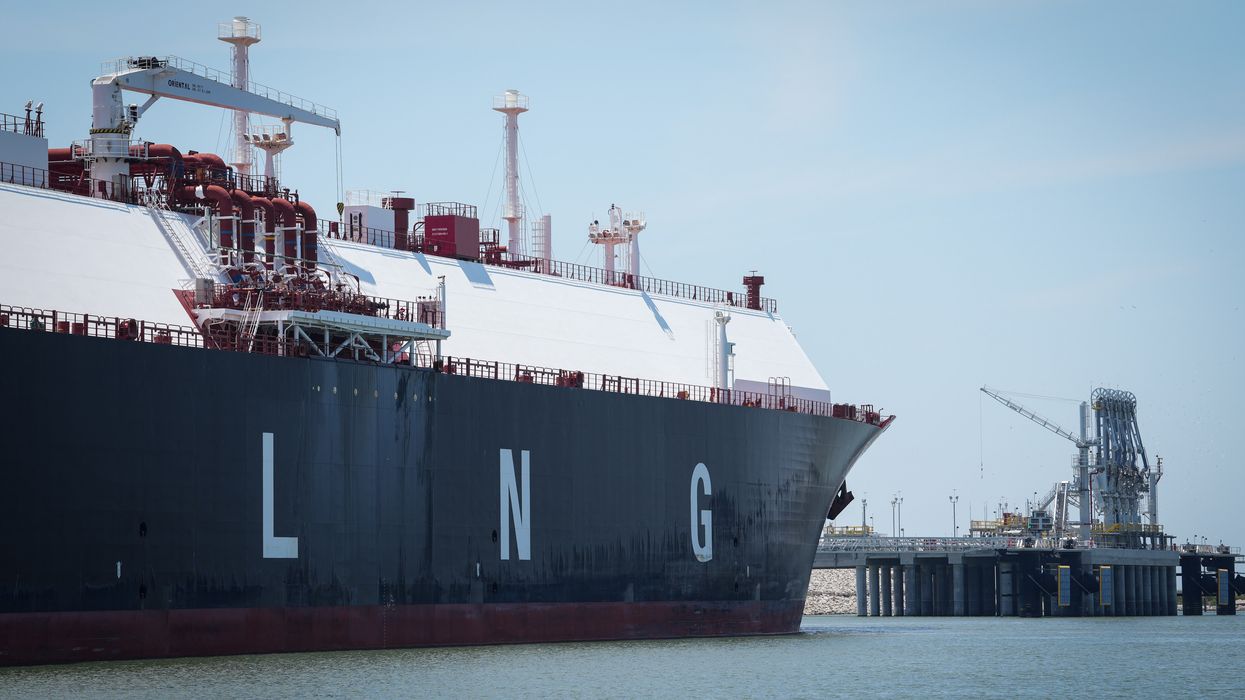
As government leaders from around the world met in Brazil to discuss solutions to the fossil fuel-driven climate emergency, the GOP-controlled US House of Representatives on Thursday advanced a bill that would lift restrictions on liquefied natural gas.
Eleven Democrats joined all Republicans present in voting for GOP Texas Congressman August Pfluger's Unlocking our Domestic LNG Potential Act, which would also grant the Federal Energy Regulatory Commission sole authority over applications for import and export facilities. It's now up to the Senate whether the bill will reach President Donald Trump.
As E&E News reported: "Pfluger and Republican leadership previously championed the bill in response to President Joe Biden's LNG pause, in which the Department of Energy paused new terminal approvals to evaluate whether they were in the public interest. It passed the House last year, but never received Senate consideration."
While Pfluger, House Speaker Mike Johnson (R-La.), and Sen. Tim Scott (R-SC), the upper chamber sponsor, celebrated Thursday's vote, climate campaigners blasted the bill—just one part of a sweeping GOP effort to boost the planet-heating fossil fuel industry during Trump's second term.
"The explosion of LNG exports in recent years has already generated massive profits for the fossil fuel industry, while consumers and local communities pay the price," Sierra Club director of beyond fossil fuels policy Mahyar Sorour said in a statement after the vote. "The last thing we need is even less oversight over these costly, polluting export projects."
"House Republicans should be focused on making investments in a clean economy and reducing energy costs for our families, not further padding the pockets of Big Oil and Gas executives," Sorour added. "The Senate should reject this dirty bill."
Energy prices are going up everywhere and Republicans just made it worse ⬇️
[image or embed]
— Energy and Commerce Democrats (@energycommerce.bsky.social) November 20, 2025 at 6:03 PM
Tyson Slocum, director of Public Citizen's Energy Program, highlighted that "President Trump explicitly promised during the campaign that he would lower Americans' utility bills by half within 12 months. Not only has Trump obviously failed on that promise, but this legislation would exacerbate the energy affordability crisis."
Slocum pointed to his group's estimates that "natural gas prices for American households have increased by $10.3 billion from January through August 2025 compared to the same time period a year earlier—a 20% increase."
"Eight LNG export terminals now consume more natural gas than all American households combined," he continued. "The US Department of Energy's Energy Information Administration's November 2025 Short Term Energy Outlook concludes that Americans face sharply higher natural gas prices 'primarily due to increased liquefied natural gas (LNG) exports.'"
"This radical and reckless deregulatory proposal eliminates the requirement that gas exports comply with the public interest, allowing fossil fuel companies to enjoy unregulated exports at the expense of affordable energy here at home," Slocum stressed. "The move by Congress to allow bypassing these safeguards could have catastrophic impacts on the consumers in the US, sending energy prices soaring, while allowing climate change to get far worse."
"Despite Trump promising he would cut Americans' energy bills, Congress is set to put consumers at risk of paying more, raising major questions about Trump's close allegiance with dirty energy executives who want to ship more fuel overseas," he added. "Creating more capacity to export US fossil fuels abroad will only accelerate the climate crisis and hurt US consumers."
Americans are already being crushed by the skyrocketing cost of living, and now the House GOP is passing legislation that will drive up monthly power bills even further by sending UNLIMITED amounts of our natural gas abroad.
[image or embed]
— Rep. Frank Pallone (@pallone.house.gov) November 20, 2025 at 4:26 PM
The vote happened on the same day that Doug Burgum, the billionaire fossil fuel industry ally whom Trump appointed to lead the US Department of the Interior, ordered the termination of the Biden administration's 2024-29 National Outer Continental Shelf Oil and Gas Leasing Program and the development of a "new, more expansive" plan "as soon as possible."
Responding to the order in a statement, Sierra Club executive director Loren Blackford said that "Donald Trump and Doug Burgum are once again trying to sell out our coastal communities and our public waters in favor of corporate polluters' bottom line."