5
#000000
#FFFFFF
To donate by check, phone, or other method, see our More Ways to Give page.
Daily news & progressive opinion—funded by the people, not the corporations—delivered straight to your inbox.
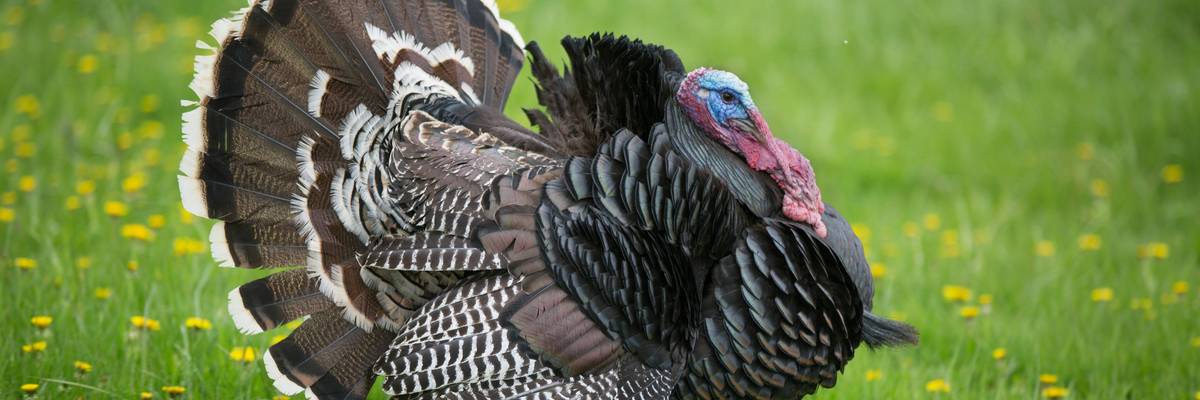
A turkey is seen on grass.
Being raised for food does not mean an animal’s life and their pain, stress, joy, or comfort matter any less.
As Thanksgiving nears, households across the country are making their preparations, asking questions like how big of a turkey should we get this year? How should we cook it? What brand would be best?
But what is rarely questioned is how the turkey lived.
Turkeys are inquisitive birds who spend their days exploring, foraging, and investigating their surroundings with their flock. Yet intensive farming gives them few opportunities to do those things. Thousands of birds can be housed together in enclosed sheds, where limited space and barren surroundings severely restrict their behavior.
Retailers need to do better for turkeys by adopting stronger sourcing standards, explaining their requirements clearly to shoppers, and reporting progress toward their animal welfare goals.
The problems begin long before housing. Commercial turkeys have been selectively bred for fast growth to develop large breast muscles. Their resulting body weights can contribute to painful leg and joint problems. Turkey bred to produce more meat often struggle to even take a few steps or right themselves if they fall over.
Cruel conditions inside the barn can compound those difficulties. Wet litter soaked in their droppings can damage birds’ feet, while poor air quality and overcrowding create further welfare risks, including burning irritation and wounds on their legs, throats, chests, and eyes. Food and water alone cannot make up for an unhealthy environment that undermines an animal’s health and ability to behave naturally.
These concerns are well established. In a scientific assessment published this year, the European Food Safety Authority identified overcrowding, wet litter, lack of enrichment, poor air quality, extremely fast growth, and painful mutilations, like beak trimming, among the factors that increase the risk of poor turkey welfare. It recommended more space, suitable bedding, opportunities to explore and forage, and breeding that prioritizes welfare over rapid growth and high body weight.
Better conditions are possible. Slower-growing birds grown with ample outdoor access to explore and appropriate shelter can support a better quality of life. Indoors, dry bedding, sufficient space, and complex spaces, including perches for roosting and plentiful forage for pecking and scratching, can also make meaningful differences to the turkeys’ lives.
But shoppers should not have to become animal welfare researchers to understand what they are buying.
A pastoral picture on a package cannot tell us whether a bird could walk comfortably. “Natural” describes processing and ingredients, not the animal’s living conditions. “No added hormones” is another meaningless claim as federal law prohibits all poultry in the USA from receiving hormones. Even welfare certifications differ in what they require.
For people buying turkey, meaningful independent certification provides more useful information than a reassuring image. Compassion in World Farming USA recommends looking for turkey certified by Animal Welfare Approved by A Greener World, Certified Animal Welfare by Global Animal Partnership (GAP) Step 4 or higher, or local farmers raising small flocks of pasture raised turkeys.
If those options are not available to you, look for Certified Humane + free range, GAP Step 3, or US Department of Agriculture organic turkeys. Reliable brands that are available nationwide include Mary’s Turkey free range varieties, Koch’s organic and heirloom lines, and Diestel Family Ranch’s pasture raised, organic, and heirloom turkeys. Alternatively, turkeys certified at GAP Steps 1 & 2 or Certified Humane do have no outdoor access, but better indoor conditions than turkeys on standard factory farms.
Individual choice only goes so far, and shoppers are limited by what is available at their local grocery stores. Retailers need to do better for turkeys by adopting stronger sourcing standards, explaining their requirements clearly to shoppers, and reporting progress toward their animal welfare goals. Retailers can support small, independent US farmers by making these changes and make higher-welfare options easier for shoppers to identify and obtain. Those expectations should not be limited to Thanksgiving, but apply throughout the year.
People can also choose a plant-based centerpiece or make vegetables, beans, grains, and other plant-based dishes a larger part of their Thanksgiving meal.
Whatever is served, the idea that farming an animal for food makes its experience irrelevant should be squashed. Being raised for food does not mean an animal’s life and their pain, stress, joy, or comfort matter any less. This Thanksgiving, let the season’s spirit of care, generosity, and gratitude extend beyond our loved ones to the turkey on our table.
This country and this world are at a monumental crossroads. US voters have an opportunity to beat back the forces of fascism and confront the billionaires who are rigging the economy, our media system, and our democracy, making it increasingly impossible for ordinary people to get by. We’re not just talking about the election. We’re talking about what must be done once these fascist elements are vanquished from power. We need a bolder set of solutions than what either major party has so far been willing to offer and a working-class movement ready to fight like hell for it. Trump didn't emerge from nowhere. The conditions that fueled MAGA authoritarianism were created by decades of radical neoliberal economic policies and a corrupt political system dominated by corporate interests. They slashed taxes on the super-rich, promising that the benefits would trickle down. They said giveaways to the corporate titans would make life more affordable for the rest of us. It was all bullshit. And when a bitter, betrayed populace searches for someone to blame, right-wing demagogues have little trouble finding scapegoats. People know when they're being lied to, but you won't hear any of this from the corporate media. Only independent journalism—powered and funded by people who believe in building a better world—can deliver truly trustworthy daily news. If you share our vision, please contribute whatever you can to sustain our work. |
As Thanksgiving nears, households across the country are making their preparations, asking questions like how big of a turkey should we get this year? How should we cook it? What brand would be best?
But what is rarely questioned is how the turkey lived.
Turkeys are inquisitive birds who spend their days exploring, foraging, and investigating their surroundings with their flock. Yet intensive farming gives them few opportunities to do those things. Thousands of birds can be housed together in enclosed sheds, where limited space and barren surroundings severely restrict their behavior.
Retailers need to do better for turkeys by adopting stronger sourcing standards, explaining their requirements clearly to shoppers, and reporting progress toward their animal welfare goals.
The problems begin long before housing. Commercial turkeys have been selectively bred for fast growth to develop large breast muscles. Their resulting body weights can contribute to painful leg and joint problems. Turkey bred to produce more meat often struggle to even take a few steps or right themselves if they fall over.
Cruel conditions inside the barn can compound those difficulties. Wet litter soaked in their droppings can damage birds’ feet, while poor air quality and overcrowding create further welfare risks, including burning irritation and wounds on their legs, throats, chests, and eyes. Food and water alone cannot make up for an unhealthy environment that undermines an animal’s health and ability to behave naturally.
These concerns are well established. In a scientific assessment published this year, the European Food Safety Authority identified overcrowding, wet litter, lack of enrichment, poor air quality, extremely fast growth, and painful mutilations, like beak trimming, among the factors that increase the risk of poor turkey welfare. It recommended more space, suitable bedding, opportunities to explore and forage, and breeding that prioritizes welfare over rapid growth and high body weight.
Better conditions are possible. Slower-growing birds grown with ample outdoor access to explore and appropriate shelter can support a better quality of life. Indoors, dry bedding, sufficient space, and complex spaces, including perches for roosting and plentiful forage for pecking and scratching, can also make meaningful differences to the turkeys’ lives.
But shoppers should not have to become animal welfare researchers to understand what they are buying.
A pastoral picture on a package cannot tell us whether a bird could walk comfortably. “Natural” describes processing and ingredients, not the animal’s living conditions. “No added hormones” is another meaningless claim as federal law prohibits all poultry in the USA from receiving hormones. Even welfare certifications differ in what they require.
For people buying turkey, meaningful independent certification provides more useful information than a reassuring image. Compassion in World Farming USA recommends looking for turkey certified by Animal Welfare Approved by A Greener World, Certified Animal Welfare by Global Animal Partnership (GAP) Step 4 or higher, or local farmers raising small flocks of pasture raised turkeys.
If those options are not available to you, look for Certified Humane + free range, GAP Step 3, or US Department of Agriculture organic turkeys. Reliable brands that are available nationwide include Mary’s Turkey free range varieties, Koch’s organic and heirloom lines, and Diestel Family Ranch’s pasture raised, organic, and heirloom turkeys. Alternatively, turkeys certified at GAP Steps 1 & 2 or Certified Humane do have no outdoor access, but better indoor conditions than turkeys on standard factory farms.
Individual choice only goes so far, and shoppers are limited by what is available at their local grocery stores. Retailers need to do better for turkeys by adopting stronger sourcing standards, explaining their requirements clearly to shoppers, and reporting progress toward their animal welfare goals. Retailers can support small, independent US farmers by making these changes and make higher-welfare options easier for shoppers to identify and obtain. Those expectations should not be limited to Thanksgiving, but apply throughout the year.
People can also choose a plant-based centerpiece or make vegetables, beans, grains, and other plant-based dishes a larger part of their Thanksgiving meal.
Whatever is served, the idea that farming an animal for food makes its experience irrelevant should be squashed. Being raised for food does not mean an animal’s life and their pain, stress, joy, or comfort matter any less. This Thanksgiving, let the season’s spirit of care, generosity, and gratitude extend beyond our loved ones to the turkey on our table.