

SUBSCRIBE TO OUR FREE NEWSLETTER
Daily news & progressive opinion—funded by the people, not the corporations—delivered straight to your inbox.
5
#000000
#FFFFFF
To donate by check, phone, or other method, see our More Ways to Give page.
Daily news & progressive opinion—funded by the people, not the corporations—delivered straight to your inbox.

The U.S. is suffering from numerous biological and human plagues. Trump is an autocrat whose role models are Putin, Bolsonaro, and Duterte. He is now doing everything in his power to obstruct a free and fair election in November, and there is great danger that he will refuse to leave office through constitutionally prescribed means.
It is likely that the election will generate many court challenges and political contestation involving governors, state legislatures and Congress. We may also see civil violence fomented by Trump's far-right supporters, many of whom are armed and dangerous and have already shown their willingness to brandish their weapons in public.
It is thus also likely that citizens who care about democracy will be called upon to defend it through their own direct action.
Two commentaries published in recent days warrant special attention.
The central point of Frances Fox Piven and Deepak Bhargava's "What if Trump Won't Leave?" is encapsulated in this subtitle: "We must lay the groundwork now for the kind of mass action that defends democracy and evicts this despicable, racist, wannabe authoritarian from the White House." This piece neatly outlines the kinds of challenges such preparations will involve and the reasons why they are necessary.
"' . . . All Enemies Foreign and Domestic': An Open Letter to Gen. Milley," co-authored by John Nagl and Paul Yingling--two highly respected retired U.S. Army Officers closely associated with the "Petraeus Brain Trust" during the Iraq war--is a very important piece that deserves wide circulation. No doubt speaking for many retired and current U.S. military officers, Nagl and Yingling outline the dangers that Trump poses to democracy, and then call on Milley, chairman of the Joint Chiefs of Staff, to defend the Constitution in the event that Trump refuses to leave office as required by law, and instead seeks to encourage his supporters to defend him, even by force of arms:
"As the senior military officer of the United States, the choice between these two options lies with you. In the Constitutional crisis described above, your duty is to give unambiguous orders directing U.S. military forces to support the Constitutional transfer of power. Should you remain silent, you will be complicit in a coup d'etat. You were rightly criticized for your prior active complicity in the president's use of force against peaceful protesters in Lafayette Square. Your passive complicity in an extralegal seizure of political power would be far worse. "
It is striking and indeed horrifying that such an open letter would need to be published, now, just as it is striking that retired General James Mattis and retired Admiral Mike Mullen only recently published similar warnings. We are at a moment of great peril, and whether the coercive power of the state will be deployed in constitutionally democratic ways is genuinely in question.
Nagl and Yingling's letter is the perfect complement to Piven and Bhargava's powerful call, from the left, for preparations for mass street protest.
Piven and Bhargava present their strategy as a rebuke to establishment forces: "The professional communicators, technocrats, and lawyers in much of the mainstream Democratic Party and some in the media will be horrified by this call for a mass nonviolent uprising in response to the theft of an election." I think the extraordinary BLM protests of this summer have "normalized" protest for many. I also think they exaggerate the radicalism of their proposal, which is essentially a strategy of demonstrating through nonviolent protest that Trump must be "evicted." Their very nuanced piece does not call for the seizing of the White House. It envisions the use of protest and direct citizen action as a way of enforcing the law. This means convincing the state and its police and military forces to uphold the law and not to use violence against citizens in defense of a dictator.
No serious person imagines that we are on the cusp of a genuinely "revolutionary situation," which would be an utter disaster along every imaginable dimension--including the fact that the "masses" who are armed and organized are right-wing militias not likely to support radical democracy. The point of taking to the streets, if this becomes necessary, is to work in tandem--a complex and agonistic collaboration to be sure--with professional politicians, communicators, lawyers, bureaucrats, and police and military officers to defend the rule of law.
And "in the last instance," this means that the people at the top of the military command do exactly as Nagl and Yingling entreat them to do: say "no" to Trump, evict him and his miserable ilk from the White House, and tell his angry mobs of supporters to obey the law and go home.
We thus need to prepare to defend the November election by all legal means necessary.
But first, we must do everything in our power to win it.
Trump must go. And then the real work of democratic politics can continue.

In the summer of 1995, when I was 18, I started visiting Tent City, a temporary encampment in an abandoned lot in northeast Philadelphia. About 40 families had taken up residence in tents, shacks, and other makeshift structures. Among them were people of various races, ages, and sexual orientations, all homeless and fighting for the right to live.
Tent City was set up by the Kensington Welfare Rights Union (KWRU), a grassroots organization of poor and homeless people and a chapter of the National Welfare Rights Union. As in so many other areas of the country, homelessness in Philadelphia, a city battered by decades of deindustrialization, job loss, and affordable housing cuts, had become endemic. Although they were still living in what had once been the center of the northeast industrial corridor, many in Philly, especially the residents of Kensington, had been reduced to two main sources of income: welfare and drugs. A teenager might have stood better odds of going to jail or being shot than graduating from Kensington High. More than 40% of the population in the area had to break the law simply to survive. Police brutality was rampant.
Federal and municipal welfare systems were being stripped of funds being funneled into the private sector. City officials assured those of us who protested that there was simply too much need and not enough resources. Even the local paper accused us of engaging in "homeless hype"--being too disruptive in our public demonstrations and acts of mutual solidarity--when the people of Kensington really needed peace and quiet, law and order. At that time, however, there were an estimated 27,000 homeless people in the city and 39,000 abandoned houses.
In that small Tent City lot, poor people were exposing the city's claim of scarcity as a myth. Families who moved there with close to nothing were quick to discover American abundance. Residents shared their food stamps, while individuals, community groups, and religious congregations all made donations. Soon, the abundance was such that hundreds of hungry families started turning out every week to be fed with the surplus food.
Tent City became more than another encampment on the margins of American life. It was a center of political life for Philadelphia's poor, as well as a strategic organizing base for sustenance and protest. In the winter, as rats the size of cats arrived, the encampment moved to an abandoned Catholic church, a project the KWRU labeled "the new Underground Railroad." Just as enslaved people once had to break the law to bust out of the system of slavery, poor and homeless people needed a growing civil disobedience movement to survive.
I think about Tent City often in these pandemic days of spiraling poverty and inequality, as protesters in cities across the country question the legitimacy of a system that devalues life, especially black lives, native lives, immigrant lives, and the lives of the poor. Unemployment is now at 41 million and so at Great Depression levels; the shantytowns that spread across the country in the worst years of the 1930s should remind us that mass homelessness exists just on the other side of mass unemployment.
Last week, for instance, Covid-19 moratoriums on eviction began to expire and, in my childhood hometown, Milwaukee, Wisconsin, upward of 40,000 eviction notices are poised to be sent out. Meanwhile, the government has blundered through a string of "relief" packages that have injected trillions of dollars into Wall Street while excluding millions of people from even the most basic stop-gap protections. In the midst of federal incompetence and outright abandonment, staggering numbers of Americans, children included, are desperate for support and real relief.
This society has long suffered from a kind of Stockholm syndrome: we look to the rich for answers to the very problems they are often responsible for creating and from which they benefit.
This society has long suffered from a kind of Stockholm syndrome: we look to the rich for answers to the very problems they are often responsible for creating and from which they benefit. The wreckage of this pandemic moment is a bitter reminder of this affliction, as well as a signpost suggesting how we must emerge from this crisis a just and more equitable nation. With a possible depression ahead and more social unrest on the rise, isn't it time to stop vindicating the wealthiest people in this country and look instead to leadership from those who were living in a depression before Covid-19 even hit and already organizing and protesting?
The Poor Organizing the Poor
Here's a story from a long-ago moment that's still relevant. Two months before his assassination in 1968, Dr. Martin Luther King, Jr., travelled to Chicago, to enlist the women of the National Welfare Rights Organization (NWRO)--the predecessor to the National Union of my day--into the Poor People's Campaign. As he walked into a conference room at a downtown Chicago YMCA, Dr. King encountered more than 30 welfare rights leaders seated strategically on the other side of an exceedingly large table. One of his advisers later noted that the women's reception of the southern civil rights leader was a "grand piece of psychological warfare."
Representing more than 30,000 welfare-receiving, dues-paying members, they had not come to passively listen to the famed leader. They wanted to know his position on the recent passage of anti-welfare legislation and quickly made that clear, pelting him with questions. Dr. King felt out of his element. Eventually, Johnnie Tillmon, the national chairwoman of the NWRO, stepped in. "You know, Dr. King," she said, "if you don't know about these questions, you should just say you don't know and then we could go on with this meeting."
To this, Dr. King replied, "We don't know anything about welfare. We are here to learn."
That day, Dr. King would learn much about the long struggle those women had waged for dignity in the workplace and the home. They taught him that programs of social uplift should be a permanent right and that the welfare system of the mid-twentieth century, much like our own, was structured as a public charity that callously differentiated between the "deserving" and "undeserving" poor. They introduced him to policy proposals that were generations ahead of their time, including a demand for a Guaranteed Adequate Annual Income, or what many now call a Universal Basic Income (UBI).
Four months into the Covid-19 crisis, with this country already afloat on a sea of inequality that would have been unimaginable even to those women in 1968, a sea change in public opinion may be underway when it comes to what's necessary and possible. Ideas that only a few years ago would have been considered unimaginable like universal healthcare, guaranteed affordable housing, and debt relief are now breaking into the mainstream. Don't think, however, that such policy positions, like the idea of a UBI, have materialized on Capitol Hill and in beltway think tanks out of thin air. They are, at least in part, the result of long-term agitating, educating, and organizing led by the poor themselves.
Those of us in the welfare rights movement always saw our work as the kindling for a wildfire of organizing by the poor and dispossessed. Our projects of survival, like Tent City, were not just about housing and feeding people. They were also about securing the lives of those committed to building the kind of movement necessary to transform society. Projects organized around immediate needs also became bases of operation for policy analysis and future plans.
Such projects, however, were beachheads meant to rally the larger society, as the ranks of the poor grew around us, to create lasting change for them. Perhaps it should be no surprise, then, that this novel pandemic has already galvanized bold collective action on the part of the poor and the precarious. For every sparsely attended reopen protest at a state capital by armed members of Donald Trump's base, hundreds of new mutual-aid networks, ad-hoc tenant associations, and wildcat strike funds have been organized for those at the base of this society. Meanwhile, thousands of protestors have taken over streets in cities all across the country resisting racism and inequality.
Entire communities that are out of work and losing income are taking life-saving action that is also at times, and by necessity, in contradiction to the law. Despite recent media images of vandalism, today's protest movement features countless acts that add up to projects for survival.
In April and May, millions did not pay rent, echoing that most basic of economic principles: those who can't pay won't pay. Indeed, such rent strikes and other protests speak to an essential demand for temporary relief in the midst of a crisis of unparalleled proportions, but they also signal potential new directions for millions of people who, if offered a political home that articulates their desperate needs and demands, might, against great odds, begin to find common cause.
The Rich Organizing the Rich
If this crisis is opening up new possibilities for organizing among the poor, however, the same is true for the rich. Since mid-March, the fortunes of the 600-plus billionaires in the United States have jumped by $434 billion, or 15%. In the CARES Act that Congress passed, legislators slipped in a tax break of $135 billion for 43,000 of the country's wealthiest business owners. (And, of course, you need to add this to the unprecedented redistribution of wealth from the poor to the very rich that happened via the $1.5 trillion Trump tax cut of 2017.)
This pandemic has already been very profitable for a very few. It should be seen as one benefit from a long-term organizing campaign of the rich that has included crushing the labor movement, consolidating industry, financializing the economy, and what one historian has dubbed a decades-long "tax strike." By now, of course, the story of widening inequality in this country has become a familiar one, but that doesn't make it any less shocking. In 1983, median household wealth in the United States was $84,000. Thirty-seven years of growing inequality later, it sits at $82,000. Meanwhile, as a point of comparison, the total wealth of the Forbes 400 was $92 billion in 1982. Now, it's $2.89 trillion.
Behind this staggering and rapid accumulation of wealth rests a deep and abiding belief in recent decades that the rich are the engine of the American economy and so the deepest source of societal wellbeing. In this Covid-19 crisis, evidence abounds that such a faith, which emerged fullblown during the presidency of Ronald Reagan in the 1980s, remains, for now, bipartisan and largely unshaken. The CARES Act caught its spirit exactly, managing to direct most of its money to Wall Street and hundreds of millions more to the police, while leaving millions of workers lacking paid sick leave and the uninsured, the homeless, undocumented immigrants, and many more in the lurch.
While the HEROES Act, recently passed by the Democratic majority in the House of Representatives, offers improvements on this, many of which are guaranteed not to make it through the Senate, there are once again striking windfalls for the rich embedded in the bill. Within its 2,000 pages is funding for lobbyists, mortgage servicers, and private insurance companies. It does nothing to prohibit the corporate mergers that have produced bigger and more powerful monopolies in other moments of crisis in the recent past. It extends COBRA, a federal program that enables workers to temporarily keep health coverage on their own dime after their employment ends, and again directs vast sums of money to the private insurance industry, instead of expanding Medicaid and guaranteeing healthcare during the most devastating public health crisis in a century.
Meanwhile, at the state and local level, politicians on both sides of the aisle have refused to touch the wealth of the rich, even as they have decried their budget shortfalls, while managing this crisis largely via the playbook of austerity and readying themselves for social unrest. New York State, for instance, passed a budget that will cut $300 million from public hospitals but increase funding for the police. Likewise, the Washington State legislature has been lauded for the bipartisanship it demonstrated recently in putting through deep budget cuts. In no case have legislators chosen to tax their wealthiest residents, nor let up on policing and other forms of control. And Washington is home to Bill Gates and Jeff Bezos, at present the two richest people on the face of the Earth.
Of course, the workers who are actually keeping the nation afloat will suffer the most from such cuts. They may now be called "essential," but they continue, as ever, to be treated as expendable appendages of the economy.
How to Revive American Society
I recently wrote a piece with the subtitle "How to Destroy American Society from the Top Down." The answer remains painfully simple: this country courts destruction as long as the rich are allowed to organize society around their lives and needs.
The answer remains painfully simple: this country courts destruction as long as the rich are allowed to organize society around their lives and needs.
From my first moments working at Tent City through my 25 years of grassroots organizing, I've come to see that inverting that subtitle in a positive fashion is crucial to our survival as a nation. Any true revival of American society depends on collective action by those most impacted by injustice and by the willingness of the rest of society to follow their lead. From the abolitionism of the pre-Civil War era to the labor movement of the 1930s and the Civil Rights Movement of the 1960s and beyond, people on the receiving end of injustice have done best when they didn't wait to be saved but, born out of necessity, took heroic action themselves.
When the Kensington Welfare Rights Union declared that we were building a "new Underground Railroad" in Philadelphia in the 1990s, we were doing more than just invoking a powerful chapter in the history of the abolition of slavery. We were implicitly challenging the dominant notion of who the agents of change in our society should be. We recognized, even then, that in the lessons Americans were taught about that history, enslaved people were often conspicuously missing in action from the story of abolition. We saw in that Underground Railroad a way for slaves to escape the grips of the system that was oppressing them, something far larger than just a physical pathway to freedom. We imagined it as a significant political project of the past exactly because it was one way the poor and enslaved of another era struck the first blows against a brutal and inhumane system.
Today, there is a freedom railroad rumbling underground, all around us. It has stops in the Amazon warehouses and the fast-food restaurants where low-wage workers are organizing for better wages and conditions; in immigrant communities that are protecting themselves against ICE raids in the midst of stay-at-home orders; in cities where people are winning moratoriums on water and utility shut-offs; in housing developments and hospitals where thousands are insisting that housing and healthcare are human rights.
You can hear it in the recent slogan--"stay in place, stay alive, organize, and don't believe the lies"--of the Poor People's Campaign that I co-chair, which has called for noncooperation with decisions to recklessly reopen states for business, putting the poor and sick most directly in harm's way. You can see it in the tens of thousands of people protesting across the country, refusing to be subdued by years of racism and police violence, people who are demanding full justice and the right for all of us, but especially repressed black lives, to survive and thrive.
In a moment from hell, there is only one meaningful way to revive American society: from the bottom up.

The New York Times' Thomas Edsall has an axe to grind, and the paper loves to let him grind it. Edsall is convinced that the Democrats need to move to the center, in ways that will offend much of the party, in order to appeal to the moderate white "swing" voters he believes are the key to a Democratic victory in 2020.
"Democrats will have to tackle issues that may alienate--and even give offense to--progressives, women, Latinos and African-Americans," Edsall preaches in his latest column (11/1/19). (Edsall repeatedly makes arguments like this, in which only cisgender, straight white men are never to be betrayed. See, for example, "What's a Non-Racist Way to Appeal to Working-Class Whites? NYT's Edsall Can't Think of Any," FAIR.org, 3/30/18, and "NYT Steers Dems Away From the Obvious Formula for Defeating Trump," FAIR.org, 8/29/19.)
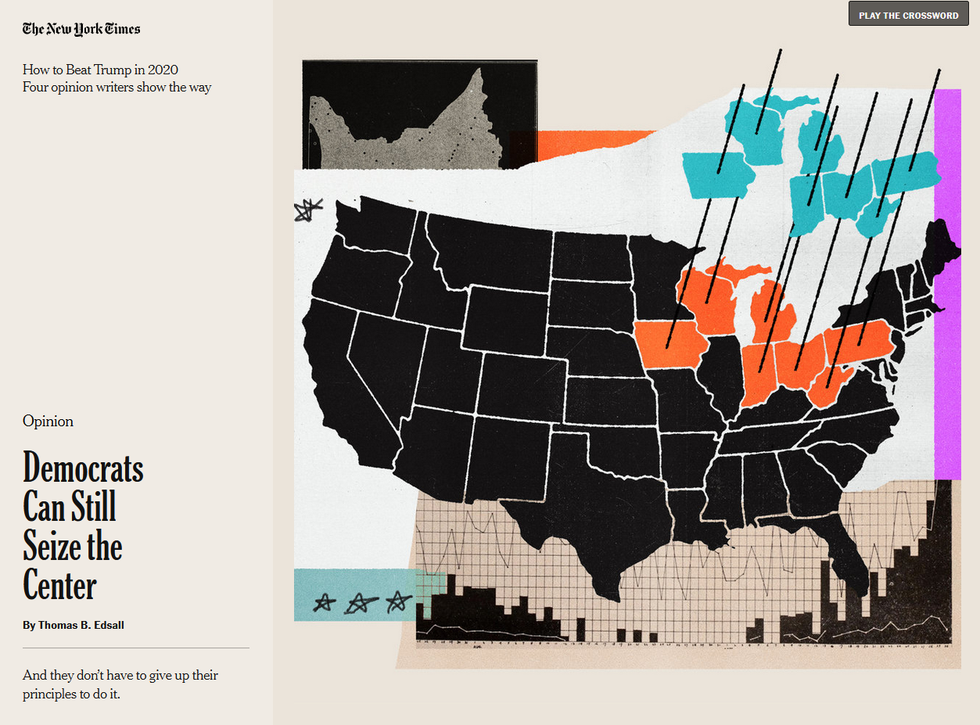
Why is Edsall so convinced of this strategy? Well, in this column, he looks at evidence that Trump won because of his "aversion to political correctness," and concludes that jumping on that train is how Democrats will win back the "swing electorate."
To help him interpret his data and figure out how to save the Democratic Party, Edsall turns to a real spectrum of experts: A "Republican lobbyist," a "Republican pollster," a "Republican consultant," another "Republican consultant," a "Republican Trump critic," and the editor of a "site that features many anti-Trump conservatives." Oh, and two professors to help balance things out--one of whom argues that "it would be utterly foolish for Democrats to...move the Democratic Party further leftward," the other of whom worked for Kenneth Starr's Whitewater investigation.
At least as problematic, though, are the questions Edsall is asking. He plies these right-wing "experts" with questions about "why immigration, identity politics and political correctness remain problematic for Democrats."
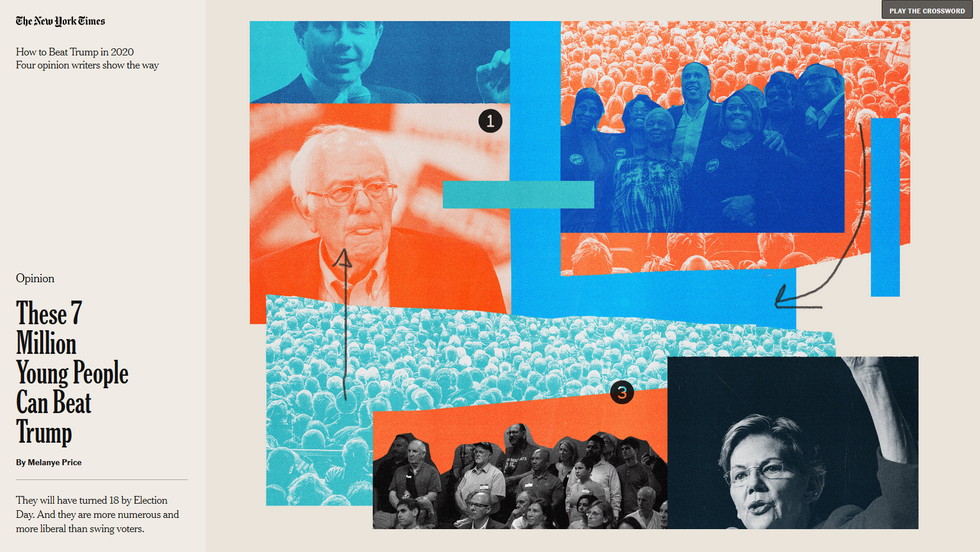
The problem here is twofold. First, persuading the "swing electorate" is not the only--or clearly best--way for Democrats to win, as the left always points out. The Times is not unaware of this, and in this instance they present Edsall's argument as part of a package; it's accompanied in part by a column by Melanye Price (11/1/19), who makes the case for focusing on turning out the youth vote, which is increasingly not white, and increasingly leans heavily Democrat. (It's worth noting that, while Price claims Elizabeth Warren and Julian Castro "seem most capable" of appealing to young people, Bernie Sanders has a much higher percentage of under-30 supporters--and supporters of color--than the other leading candidates.)
The demographic future of this country does not bode well for a party built on white supremacy, which is why the Republican Party is so intent on voter suppression--and why a massive get-out-the-vote strategy would virtually ensure Democratic victory. (Whether that's what the Democratic Party establishment wants is another question.) Edsall himself actually acknowledges the turn-out-the-base option, but dismisses it with a quote from his anonymous Republican pollster: "Democrats should focus on persuasion, because Trump will take care of mobilizing his opponents." If only it were so simple; ask Hillary Clinton about that one.
The demographic future of this country does not bode well for a party built on white supremacy, which is why the Republican Party is so intent on voter suppression--and why a massive get-out-the-vote strategy would virtually ensure Democratic victory.
But second--and not countered by an accompanying column: The "swing electorate" that cares only about immigration and identity politics is a myth. People's political opinions vary on a range of issues, so broad-brush labels like "liberal," "moderate" and "conservative" are only so helpful in predicting what positions they hold or which issues are most important to them. The politics of a person who could vote in one election for Barack Obama and the next for Donald Trump obviously can't be captured with such a label.
It's true that Trump, more than any politician in recent US history, turns out voters based on "conservative" identity politics. But he courted those same white working-class voters by bucking GOP orthodoxy with "liberal" economic positions--most notably trade protectionism, but also disingenuously attacking Wall Street and falsely promising to defend Social Security, Medicare and Medicaid. Meanwhile, the Democratic Party, which since the New Deal has been the party of labor, has long been shifting to the right on economic policy, abandoning one of its core constituencies.
Never mind that a wealth tax, proposed by both Sanders and Warren, is wildly popular among general election voters. Never mind that Medicare for All is also very popular--although recent polls (including one cited by Edsall) indicate that support may be weakening under the massive coordinated attacks on the plan from the deep-pocketed health industry and their lackeys from both parties and the corporate media (FAIR.org, 4/29/19, 10/2/19).
Edsall wants Democratic candidates to appeal to those white working-class voters, not by offering them real economic succor, but by throwing the rest of the party under the bus. Of course that's what all the Inexplicable Republican Best Friends consulted by Edsall advise (many of whom are explicitly anti-Trump)--because doing so would essentially turn those candidates into models of the pre-Trump Republican Party.
And by "balancing" Edsall's column with three other columns that make no mention of economics, class, wealth, poverty or inequality, the Times seems to be happily going along with the centrist smoke and mirrors.
Many Americans remain deeply concerned about reports of Russian interference with the 2016 election. Meanwhile, relations between the United States and Russia are at their lowest and most dangerous point in several decades. For the sake of democracy at home and true national security, we must reach common ground to safeguard common interests--taking steps to protect the nation's elections and to prevent war between the world's two nuclear superpowers.
Whatever the truth of varied charges that Russia interfered with the election, there should be no doubt that America's digital-age infrastructure for the electoral process is in urgent need of protection. The overarching fact remains that the system is vulnerable to would-be hackers based anywhere. Solutions will require a much higher level of security for everything from voter-registration records to tabulation of ballots with verifiable paper trails. As a nation, we must fortify our election system against unlawful intrusions as well as official policies of voter suppression.
"As a nation, we must fortify our election system against unlawful intrusions as well as official policies of voter suppression."
At the same time, the U.S. and Russian governments show numerous signs of being on a collision course. Diplomacy has given way to hostility and reciprocal consular expulsions, along with dozens of near-miss military encounters in Syria and in skies above Europe. Both sides are plunging ahead with major new weapons development programs. In contrast to prior eras, there is now an alarming lack of standard procedures to keep the armed forces of both countries in sufficient communication to prevent an escalation that could lead to conventional or even nuclear attack. These tensions are festering between two nations with large quantities of nuclear weapons on virtual hair-trigger alert; yet the current partisan fixations in Washington are ignoring the dangers to global stability and, ultimately, human survival.
The United States should implement a pronounced shift in approach toward Russia. No political advantage, real or imagined, could possibly compensate for the consequences if even a fraction of U.S. and Russian arsenals were to be utilized in a thermonuclear exchange. The tacit pretense that the worsening of U.S.-Russian relations does not worsen the odds of survival for the next generations is profoundly false. Concrete steps can and must be taken to ease tensions between the nuclear superpowers.
Signed,
Andrew Bacevich, Professor Emeritus, Boston University
Phyllis Bennis, Fellow, Institute for Policy Studies
Noam Chomsky, Professor, Author, and Activist
Stephen F. Cohen, Professor Emeritus of Russian Studies and Politics, NYU and Princeton University, and Board Member, American Committee for East-West Accord
John Dean, Former Nixon White House Counsel
Phil Donahue, Journalist and Talk-Show Pioneer
Thomas Drake, Former NSA Senior Executive and Whistle-blower
Daniel Ellsberg, Activist, "Pentagon Papers" Whistle-blower, and Author of The Doomsday Machine: Confessions of a Nuclear War Planner
Jack Matlock, Former US Ambassador to the USSR and Board Member, American Committee for East-West Accord
Walter Mosley, Writer and Screenwriter
Viet Thanh Nguyen, Pulitzer Prize-Winning Novelist
Frances Fox Piven, Distinguished Professor Emeritus, CUNY Graduate School
Valerie Plame, Former Covert CIA Operations Officer and Author
Adolph Reed Jr., Professor of Political Science, University of Pennsylvania
Bill Richardson, Former Governor of New Mexico
Patricia Schroeder, Former Congresswoman
Norman Solomon, National Coordinator, RootsAction.org
Gloria Steinem, Writer and Feminist Organizer
Adlai Stevenson III, Former US Senator and Chairman, Adlai Stevenson Center on Democracy
Katrina vanden Heuvel, Editor and Publisher, The Nation
Alice Walker, Writer, Poet, and Activist
Jody Williams, Professor and Nobel Peace Prize Laureate
James Zogby, President, Arab American Institute
Signers have endorsed this Open Letter as individuals and not on behalf of any organization.
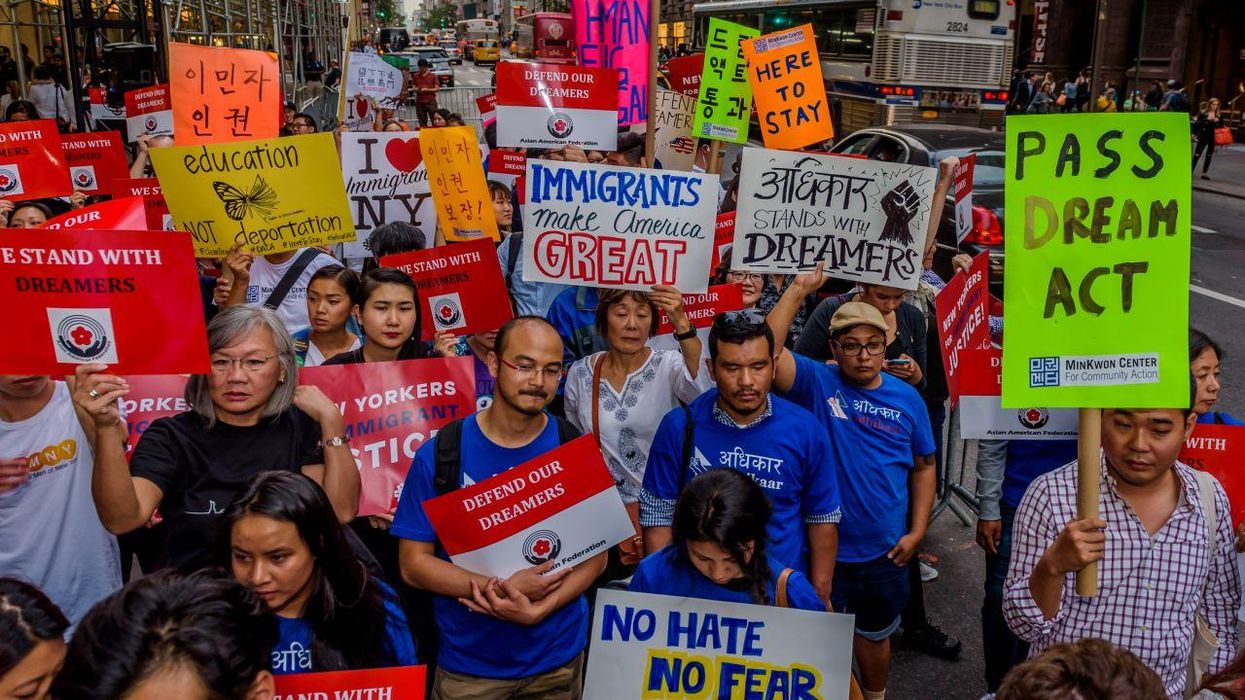
A striking feature of the current political moment is that many activists on the left are flocking to the Democratic Party. At first glance, this makes sense simply as a reaction to the narrow and disputed electoral victory of the bizarre and dangerous Donald Trump.
But the Democrats are not merely gaining voters. They are gaining activists, people who are committing not only to pull the party lever in the voting booth, but who are determined to rejuvenate and transform the party, beginning at the local level. This development is encouraging, and not only because it could make a difference in the 2018 midterms and the next presidential election.
Until the shock and fear of a Trump-led government took center stage, some on the left viewed elections and movement building as separate, even irreconcilable, paths to reform. While their skepticism about the Democratic Party was not misplaced, we argue that movements also depend on electoral politics. The growth, morale and effectiveness of today's movements will depend on the success of the current surge of enthusiasm for Democratic Party activism.
Why Some on the Left are Turning to the Democratic Party
Compared to the Obama years and the noisy 2016 election itself, the enthusiasm for Democratic Party activism welling up on the broad left today is startling. It already overshadows the usual Democratic Party electoral ground game of enlisting labor and other grass-roots constituencies to knock on doors, distribute literature and make phone calls to prime voters. Hundreds of groups at the national and local levels have organized to recruit new Democratic candidates and work on campaigns. Long-standing organizations that support Democratic candidates, such as Emily's List, are seeing unprecedented growth, and movement organizations, from the Democratic Socialists of America to the Movement for Black Lives, are getting involved in local and state races.
While fear of Trump has galvanized even centrist liberals, much of the new energy and organizing know-how is coming from left-leaning activists. Though surprising, it is not hard to explain the sudden enthusiasm for electoral action. The dangers of Donald Trump in the White House and a right-wing Republican Party in control of Congress, the Supreme Court and more than half of the states are glaring.
The path toward this new electoral activism was paved by the Bernie Sanders campaign, which made credible the prospect of engaging in a fight within the Democratic Party for a more radical and democratic economic program, for racial and social justice and for peace. As historian Max Elbaum has observed, the polarization of the country grew during the 2016 election. But the sectors of the left that grew the most were those energized by the Sanders campaign. Our Revolution, an organization inspired by that campaign, now claims some 400 local chapters that are trying to shift the Democratic Party to the left, in part by backing progressive local and state candidates.
The path to victory will be difficult. In the House, if the Democrats can hold on to the seats they already have, they still need to win an additional 24 seats. In the Senate, the prospects are more daunting: The Democrats must defend three times as many seats as the Republicans, 10 in states won by Trump, half of those by double digits.
It will take time, then, to oust the Republicans from their commanding position at the national level. That is why so much left energy has been focused on down-ballot elections. Victories on the local level can matter. Not only do they boost the morale of electoral and movement activists alike, but in our federal system, localities often have significant policy authority
An astonishing number of state and local elected offices go uncontested. One study found that, between 1992 and 2010, a third of all state legislative incumbents did not face a challenger in the primary and general elections. Another study found that, in six states, half of all mayoral candidates ran unopposed.
In Virginia, for example, where all statewide offices are held by Democrats and Clinton defeated Trump by 5 points, the lower House of Delegates has long been dominated by Republicans. Forty of the Republicans' 66 seats were uncontested by Democratic challengers in 2015. While it still might be a long shot, with the election of Trump and the new energy for electoral politics on the left, in 2017 the GOP could lose the 17 Republican House of Delegates seats that voted for Clinton in 2016.
Such a victory would be unprecedented, but the challenge is being embraced by a new grass-roots political action committee, Activate Virginia, founded by Josh Stanfield, a 30-year-old Sanders delegate to the Democratic National Convention, and two other activists.
Virginia's example, which points to a key weakness of the Democratic Party, also offers an opportunity to strengthen the influence of the left. The two major political parties are not parties in the sense of disciplined, unified, hierarchical membership organizations. Rather, they are loose and conflict-ridden confederations of separate leadership groups whose overall structure reflects the complex constitutional and institutional arrangements of the US federal system.
The point, however, is not to belabor the weakness of fractious and institutionally hamstrung political parties, but rather to note that the institutional fragmentation of the Democratic Party makes it susceptible to takeover. As an example of how centrists have exploited this political reality, consider the creation of the Democratic Leadership Council (DLC) in 1985. The so-called Third Way was designed to stymie the progressive, pro-labor party activism stimulated by Jesse Jackson's presidential campaigns in 1984 and 1988, and other efforts to move the party to the left. And it succeeded -- until the recent Sanders challenge loosened the grip that centrists had on the party for the past 30 years.
This kind of synergy between electoral and movement politics may be emerging in the area of health care. On the one side, Trump and the right-wing majority in Congress have put forward a series of Draconian legislative proposals to dismantle the Affordable Care Act, and especially the provisions that underwrite health care for the poor. On the other side, the political furor over these efforts has given a big bump to the Sanders-backed Medicare for All Act, with 16 Democratic senators now signed on. The legislative drama, in turn, is likely to boost the morale and increase the energy of the longer-term movement for a publicly funded health care system.
Why Movements Need Electoral Politics
The two major parties also matter because they play a very large role in shaping the life course of movements. This dynamic is often overlooked because the fundamental dynamics of movements and electoral campaigns are different. Movement activists work to raise the issues that divide and anger constituencies, while electoral operatives tend to smooth over the divisions that inhibit the building of the winning majority that elections require. In these respects, movement and electoral dynamics are antagonistic. But that is by no means the whole of it.
Movements also depend on elected leaders who are susceptible to or embrace the challenges that movements generate. They thrive when they get the rhetorical support of the elected leaders who worry about defections from movement-influenced constituencies. Moreover, the policy victories that movements score are ultimately fashioned by elected politicians.
As an example, consider the recent fortunes of the environmental movement. The same year Barack Obama was first elected president, a Canadian firm, TransCanada, had applied for a permit to build a 1,200-mile pipeline across the American Midwest to connect Canadian tar sands oil with Gulf Coast oil refineries. The company and the oil lobby misleadingly claimed that the project would create 140,000 jobs and billions in economic benefits; the Canadian government pressured a newly elected President Obama to approve the project. In April 2010, the US State Department concluded the pipeline would have a limited effect on the environment. Political strategists inside the White House convinced the president to stop using the term "climate change" and to focus on "clean energy jobs" and a "clean energy economy" to avoid drawing fire from the fossil-fuel industry and conservatives. Meanwhile, oil lobbyists used propaganda to successfully shift public opinion on climate change. In 2008, acceptance that its causes were human-made was 72 percent. Two years later, only 52 percent agreed.
Environmental activists rejected their insider tactics and began to build a coalition of grassroots groups that went well beyond normal lobbying and interest group politics, bringing together ranchers and land rights advocates in red states like Nebraska and Native tribes whose land would be violated and water threatened by the project.
At the time, Bill McKibben, a leader of the movement, wrote, "Now we know what we didn't before. Making nice doesn't work ... we may need to get arrested." In late August 2011, protestors mounted a two-week campaign in front of the White House, joined by some of the large environmental groups that are not usually associated with civil disobedience and more than 1,200 people got arrested. On Nov. 6, 2011, thousands of protesters surrounded the White House in what they called a "solidarity hug" to urge Obama to veto the pipeline. Under intense pressure from the Republican-controlled Congress to move the project forward, in 2015, Obama exercised his veto power for only the third time.
The re-energized environmental movement did its work in the streets. But the crucial point is that friendly Democrats ultimately conceded to the demand. The delays won by a broad and inclusive coalition of opposition groups to the pipeline using direct action, civil disobedience and mass arrests exerted political pressure on a wobbly president.
The great and transformational movements of the past -- the radical Democrats of the Revolutionary War era, or the abolitionists of the 19th century, or the 20th-century labor movement, or the black freedom movement, or the women's movement, or the movements for personal rights included under the LBGTQ acronym -- all scored their successes because they activated the elementary and fundamental power of ordinary people. The essence of that power is the refusal to cooperate in the basic institutional arrangements of a society. That is what movement power is: The power of the strike writ large, encompassing not only refusal in the workplace but in civil society itself.
Refusal isn't easy, and that is an important reason why movements depend on electoral politics. All of the influences of the institutions that mold daily life collaborate to make the exercise of movement power difficult, as do the immediate threats and punishments that the dominant society imposes on movements. Most of the time, electoral politics legitimizes those threats and punishments, giving the authority of tradition and legal procedure to the threat of force that usually suppresses rebellion. But sometimes, when electoral calculations lead politicians to recognize that they need voter support from among emerging movement constituencies, mass discontent is sufficient to lead at least some political leaders to rhetorically side with the discontented. By doing so, they of course give courage and moral support to emerging movements, as Roosevelt's campaign rhetoric gave courage to an emerging labor movement, or Kennedy's rhetoric nourished the black freedom movement, or Obama's sympathy for Trayvon Martin encouraged the Movement for Black Lives. The importance of this encouragement cannot be overstated.
Electoral context matters for another reason. The disruption that ensues from movement leverage can cleave the electoral base of a governing party, compelling political elites to respond with ameliorating reform. When that happens, it is elected politicians who fashion the policy measures that respond to movement demands and disorder. We need politicians in charge of that process who lean toward the left and its movements. Even when movement leverage succeeds in forcing action on policy reform, the movement itself is only one of the influences in crafting the policy change. We want the thumbs of legislators like Elizabeth Warren and Bernie Sanders on the scale in legislative deliberations. And that means movements need a rejuvenated Democratic Party.
The incredible outpouring of protest against Trump's presidency and policies, from the amazing global women's marches to organizational responses to all of his egregious executive orders, portends a diverse and enormous mass movement. With the most recent executive order banning Muslims from seven countries with Muslim majorities, the rapid mobilization of opposition from a variety of constituencies, even some within the Justice Department and Republican Party, augurs a spreading dissidence.
The incredible outpouring of protest against Trump's presidency and policies, from the amazing global women's marches to organizational responses to all of his egregious executive orders, portends a diverse and enormous mass movement. With the most recent executive order banning Muslims from seven countries with Muslim majorities, the rapid mobilization of opposition from a variety of constituencies, even some within the Justice Department and Republican Party, augurs a spreading dissidence.
Already some are calling this vast movement the "resistance." Whether this label is warranted will depend on the degree to which these demonstrations actually challenge repressive power structures not only with public dissent but active disobedience.
For those of us who are veterans of the draft resistance movement of the 1960's, our actions were aimed at delegitimitizing a system that provided the military with compliant agents for its class-based war machine. While limited in numbers, this resistance spread throughout the society and into the military. As young draftees in Vietnam refused orders and even attacked their officers, the Nixon Administration was forced to end the draft and to begin to bring the troops home.
The draft resistance movement of this period also encouraged acts of solidarity and defiance from adult supporters, like Dr. Spock, and sympathizers, like Daniel Ellsberg. When such supporters and sympathizers were charged with criminal offenses, their court cases were successfully resolved because of constitutional protections under the First Amendment. Nonetheless, whatever the level of activism, it was clear that risks were taken which entailed possible and, in some cases, actual incarceration.
While I hesitate to encourage today's resisters to court jail sentences, the need to develop creative civil disobedience must be considered if, indeed, authentic resistance is to spread and deepen. Already those political officials and university presidents who have committed themselves, their cities, and their campuses to defying Trump's crackdown on immigrants provide a clear example of one form of resistance. Of course, the real showdown is yet to come. Whether these sanctuary spaces can withstand federal repression will determine the realization of this resistance and the degree to which it reflects that of the Central American solidarity networks of the 1980's and the pre-Civil War abolitionist struggles.
Given the direction of Trump's executive orders and the Republican marching orders, there are numerous actions that already constitute resistance responses. Among these is the continuing native protest at Standing Rock, one that still requires additional ally support. The battles against the DAPL and Keystone XL will necessitate the revival of groups like 350.org and their civil disobedience campaign.
On the other hand, rallying against the proponents of fossil fuel and environmental exploitation might have to look to a whole range of activities from switching to renewables to boycotting the corporations and banks that promote such ecocide policies. This is already underway in efforts to divest from financial institutions and corporations that enable the DAPL. I would also propose using either Earth Day or May Day as a day of a fossil fuel strike. This would mean not relying on any machine that consumes oil or gas.
The escalation of such tactics to a strike obviously may cause hardship, especially to those who have no choice but to work on that day and to take fossil fuel based transportation. However, in a variation on the Montgomery Bus Boycott where civil rights protestors created a fleet of automobiles to keep African-American domestic workers, in particular, off the busses, so caravans of electric or alternative fuel vehicles could be assembled for those in dire employment situations.
Such a turn towards self-reliance and solidarity in the resistance could be undertaken in other arenas of struggle. For example, as Trump and his misogynist and fundamentalist minions attempt to curtail abortion services, a new underground railroad could be constructed to move vulnerable women in rural areas to nearby cities with family planning clinics that offer abortion services. Doctors and nurses committed to the resistance may even consider locating free clinics in more remote areas with ample supplies of the Plan B drug.
Resistance movements will obviously require certain levels of sacrifice, but ones that, at the same time, should prefigure the kind of society where common goods and services are readily available to all. Without replicating the free stores and coops of the 60's, there are other options that new technologies, like 3D printers and such, may make possible, facilitating in the process communities of resistance.
Certainly, resistance movements will face a decidedly antagonistic reaction from Trump and his majority Republican government. However, as Frances Fox Piven, recently wrote in The Nation: "In the face of an unrelenting hostile regime...resistance movements, by blocking or sabotaging the policy initiatives of the regime, can create or deepen elite and electoral cleavages." Beyond this kind of political contestation, resistance movements may also harbor the hopes and practices of an alternative America where new forms of solidarity and self-determination will become the beacon for fundamental change.
From Sen. Elizabeth Warren (D-Mass.) backing unqualified Housing and Urban Development nominee Ben Carson, to 14 Senate Democrats voting to confirm torture supporter Mike Pompeo as CIA chief, to the looming possibility that any Democrat might support Sen. Jeff Sessions for attorney general, progressives have reason to fear that Democratic opposition to the Trump administration is weaker than it needs to be--even in the face of a fervent and growing resistance movement.
"Resistance means resisting," Daily Kos founder and publisher Markos Moulitsas wrote Thursday in response to Warren's committee vote on Carson. "All those people in the streets last Saturday didn't march for Democrats to make nice with the GOP. They marched to resist--whether it's Trump, or his acolytes like Carson. And if even progressive champions like Warren can't figure that out, we really are in trouble."
Republicans learned this lesson in 2009, Huffington Post reporters Jennifer Bendery and Ryan Grim wrote this week, referring to the "wave of populist protests [that] swept across the country" and essentially forced GOP leaders to adopt an obstructionist agenda.
"Elected Democrats are now facing the same challenge, as a fired-up progressive base is marching far ahead of the party leadership," said Bendery and Grim. "Democrats are scrambling to keep up."
Referring to the Women's March on Washington and global solidarity actions, they noted: "This newfound energy is driving throngs of people into the political process--and it's quickly being turned against Democratic politicians for being soft on [President Donald] Trump, whether it's by approving his cabinet nominees or signaling a willingness to work with him."
But senators "appear unwilling to do what their base is asking," according to the Washington Post, which pointed to this week's committee and full Senate votes on Carson; Pompeo; Nikki Haley, Trump's nominee to be ambassador to the United Nations; Wilbur Ross to serve as commerce secretary; and Elaine Chao to lead the Transportation Department; as well as last week's votes on Defense Secretary James Mattis and Homeland Security Secretary John F. Kelly.
"Senate Dems' response to millions taking to the streets is beyond disappointing," Shaunna Thomas, co-founder of the online advocacy group UltraViolet, told HuffPost. "It is outright shameful."
Furthermore, it's also not what the party needs, Sarah Jones argued Tuesday at the New Republic:
It's not enough for Democrats to call themselves The Resistance. They must also explain what it is they're resisting. Is it simply Trump? Or is it the ideology that helped put Trump in power?
Here, Democrats should take a lesson from the left. "Movements can mobilize people to refuse, to disobey, in effect to strike," Frances Fox Piven recently wrote in The Nation. "[P]eople in motion, in movements, can throw sand in the gears of the institutions that depend on their cooperation." Fight for 15, Occupy, Black Lives Matter: They point the way forward. So, too, did last Saturday's Women's March. In each instance, people rallied around a cause, not a person or a party. They did not turn out for politicians, they were not attracted by celebrities. They turned out because they wished to identify themselves with a specific values statement. Their actions teach us what it means to do politics--and warn us against defining politics in electoral terms alone.
The Democratic Party will continue to fail unless it understands this. The victims of its failure won't be Hillary Clinton or David Brock but vulnerable Americans whose survival depends on the party's ability to oppose Trumpism. Its left-wing critics have no choice but to reject its calls for unity. The stakes are too high to do anything else.
And while some Democrats cite 2018 re-election concerns as justification for caving to the Trump agenda, that knife cuts both ways.
As Charles Pierce wrote Thursday at Esquire, "Any Democratic senator who votes to confirm Jefferson Beauregard Sessions as Attorney General should immediately be rendered dead to the party and to every Democratic voter in the country."
"[R]esistance to the Sessions nomination is a bright line in the sand beyond which should be found nothing but exile," Pierce declared.
As someone once said, a lie can travel halfway around the world before the truth puts its boots on. In the 2016 presidential election, right-wing billionaire Donald Trump's lies may have carried him as far as the White House, but with this past weekend's global Women's March on Washington the truth put its marching boots on.
As someone once said, a lie can travel halfway around the world before the truth puts its boots on. In the 2016 presidential election, right-wing billionaire Donald Trump's lies may have carried him as far as the White House, but with this past weekend's global Women's March on Washington the truth put its marching boots on.
The mass outpouring of opposition to the Trump presidency was a remarkable and unprecedented global event. Certainly the liberal gloom prevailing in the United States since Trump's victory was given a much-needed jolt of spiritual fortitude. From Washington, D.C. to Chicago, Los Angeles, Seattle, New York City, Portland, and across Europe, Australia and elsewhere millions of women and men sent the message that the reactionary, authoritarian dreams of an ultra-wealthy capitalist and his cabinet of generals and billionaires will be resisted. The message of January 21 was clear, loud, and uncompromising: women's rights and human rights will be defended.
"The moment cries out for new political leadership, for grassroots working-class activism, and for a way out of the stagnant swamp of the corporate two-party system."
There is deep popular opposition to the legitimacy of a presidency occupied by this toxic, twittering human smokestack of polluted right-wing demagoguery. Indeed, Trump faces widespread antipathy for his racist border wall plan, proposed Muslim registry, and planned attacks on health care rights. His history of demeaning women as some sort of patriarchal birthright, coupled with an entitled silver spoon mentality that he thinks gives him free rein to insult, threaten, and bully anyone who challenges him, evoke for many only public revulsion. For many Trump is now perceived as the ultimate concierge of corrupt capitalism, a man whose economic orientation in office will translate into angling for every possible "deal" to further enrich the super-wealthy corporate class.
Unlike former president Obama or candidate Clinton, many tens of millions of ordinary Americans are not asking everyone to give Trump a chance or wishing him "success." They're not talking about how as Americans we're "all on the same team." Nor are they clamoring to assist Trump's advisory Strategic and Policy Forum on economic issues, as many of Clinton's most influential corporate supporters are doing.
We have to "throw sand in the gears of everything," instead declares Frances Fox Piven in a recent Nation essay. Good idea. That means escalating the defiance, escalating the resistance, stoking the fires of mass protest everywhere they smolder. The moment cries out for new political leadership, for grassroots working-class activism, and for a way out of the stagnant swamp of the corporate two-party system.
Night of the Living Election Cycle
If there is one positive consequence of the Trump presidency, it is that it signals the birth of a new era of grassroots activism and mass social protest. Where it will go remains to be seen, but when masses of people are in motion everything is possible. But what is also possible is that the very same Democratic Party "opposition" that set the stage for Trump's victory will limit the Anti-Trump Resistance to the goal of merely reinstalling the same-old, same-old Obama-Clinton brand of neoliberal corporate politics in the next elections.
That is indeed the thinking at the top of the Democratic Party. "I don't think people want a new direction," declared newly selected House minority leader Nancy Pelosi (D-CA) after the election. As she explained, "When President Clinton was elected, Republicans came in big in the next election. When President Bush was president, we came in big in the subsequent election. When President Obama became president, the Republicans came in big in the next election."
"The gates to right-wing authoritarianism are now thrust wide open with Trump's election."
Talk about Night of the Living Election Cycle! What an exhaustingly lifeless view of the dynamics of social and political change. This is a vision that reduces American politics to an eternal tug of war between elite Republicans and Democrats, that can't see beyond the glare of Beltway politics, and stands mute before society's historic challenges. But what should we expect from a Democratic National Committee (DNC) that apparently feared Vermont Senator's Bernie Sanders reformist version of "socialism" more than Trump, who were more interested in anointing Clinton party nominee than even allowing a fair primary in their own party?
This DNC scenario for opposing Trump could signal short-term victories for the Democrats, in two or four years, but also a longer-term slide into even more threatening versions of right-wing "populist" authoritarianism. The problem now for the clueless Pelosi and company is this: Without political leadership that can genuinely challenge all the attendant evils of neoliberal capitalism, some far right-wing "strongman" of one kind or another could very likely dominate, define, or otherwise play a major role in U.S. politics for the indeterminate future. For the gates to right-wing authoritarianism are now thrust wide open with Trump's election. They will be hard to close if the only alternative is one version or another of corporate neoliberal politics in power.
The larger question that lingers over the political landscape is why exactly the worst major party candidate in years--a vulgar, chauvinistic, thin-skinned, impulsive, lying right-wing incompetent (there's more!)--had even the most remote chance of winning the presidency? Obviously, Clinton's tepid center-right politics offered little to inspire American voters. Even more Clinton was seen by many voters as the tired continuation of a quarter century of the Democratic Party's contribution to deteriorating working-class living standards.
The more astute among Clinton's supporters understand this. In a column just prior to the election, former Secretary of Labor Robert Reich reminds us that Democratic presidents have been in power for 16 of the last 24 years, controlling both houses of the U.S. Congress for four of those years. These were years characterized by political accommodation to a growing concentration of corporate power and wealth in the United States. Indeed, as Reich notes, both presidents Clinton and Obama failed in any meaningful way to halt the long-term decline in working-class jobs, wages, and benefits. Instead they promoted free trade agreements that accelerated the loss of manufacturing jobs, while offering displaced blue-collar workers, who once earned union wages, little in return. Nor did either do much of anything to protect the democratic right to unionize, under assault, despite campaign propaganda to the contrary. Consequently, union membership dropped from 22 percent of all workers in the early years of the Clinton administration to less than 12 percent today.
As for all those celebratory Facebook memes liberals like to post about how unemployment declined under Obama, Reich acknowledges in a Facebook commentary (Dec. 2) that the current official 4.6% unemployment rate is essentially meaningless. "Counting everyone who would prefer to work, a more accurate measure would be closer to 10 percent real unemployment," he says. Here's something else to note. The overwhelming bulk of the new jobs created in the last decade fall under the category of what a recent Harvard-Princeton study describes as "alternative work arrangements," a euphemism for temp workers, part-time employees, and contractors (without benefits). These have been invariably low or modest-paying jobs.
Tellingly, early in his first term Obama rejected advisory proposals for a far more ambitious economic stimulus initiative, lest he fail to appease right-wing Congressional Republicans. "Obama's cautiousness, however, proved to be his undoing," observed Walden Bello, analyst for Focus on the Global South, back in 2012. "The $787 stimulus compromise created what would become Obama's 'Bridge too Far': it was enough to prevent the situation from getting worse but not enough to trigger a healthy recovery."
Despite the great political capital Obama rode into office, with majority Democratic support in Congress in his first two years, there would be no confrontation with Wall Street or their Republican defenders. There would be no attempt to emulate even the limited jobs programs of the New Deal era. Nor would much be done to adequately rescue foreclosed homeowners. The nation's first Black president would prove himself in the end to be just another compromising politician content to play around the edges of the status quo. He was the man who kept Wall Street from the people's pitchforks, as he himself once admitted, but finally couldn't keep a racist billionaire from storming the gates of power to plant his upper-class boots on the desk in the oval office.
What to make of all this? "The unsurprising result has been to shift political and economic power to big corporations and the wealthy, and to shaft the working class," concludes Reich of Clinton and Obama's impotence before the historic trend of advancing corporate power. "That created an opening for demagoguery, in the form of Trump. Donald Trump has poisoned America, but he didn't do it alone. He had help from opportunists in the GOP, the media and at the highest reaches of the Democratic Party."
Of course, Democratic administrations were not entirely responsible for the quarter-century decline of working-class living standards. Give credit also to the Republicans under George W. Bush's two-term presidency. But that's the point. The relentless corporate neoliberal assault on the living standards of American workers is the result of bipartisan policies. No matter which major party is in power, the concentration of growing corporate wealth and wealth inequality continues its dystopian march forward.
The circumscribed nature of bipartisan politics, feet planted firmly in the slop and muck of the status quo, has a way of dulling the social imagination, making it difficult for many to even imagine what significant or even revolutionary social progress might look like.
"The relentless corporate neoliberal assault on the living standards of American workers is the result of bipartisan policies."
Imagine if Obama as president had used his political power to fight for a vision of a new, single-payer public health system to guarantee every person's right to health care? If such a system were now in place, with free public access at the point of care, how many ordinary Americans would have rushed to support a Republican know-nothing's "plan" to return to a full-out for-profit system that turns human health into just another exploitable commodity? How many now would be complaining about the injustice of removing private insurance companies and investors from the health care system? Or, for that matter, complaining about rising premiums under the complicated mess of the Affordable Care Act?
Imagine if the president had in 2009 declared his intent to create a new federal jobs program to put many tens of millions of unemployed Americans to work, rebuilding the nation's infrastructure at union wages? Or if the nation's leader had actually walked picket lines with workers under siege, such as in Madison, Wisconsin in 2011, as Obama once promised to do during his first presidential bid? Imagine if he had provided decisive financial relief to the millions of distressed homeowners at risk of losing their homes because of unfair banking mortgage practices? Or if the president had pledged to fight for a federal minimum wage of $15 an hour, using his White House pulpit to encourage grass-roots organizing for higher wages among all private sector workers?
What if the president had used the power of his office to resist a political climate where private corporations can routinely threaten to move to cheaper labor markets if they don't get every damn tax break they want from state and local legislators? Imagine if Obama had used his office to educate and mobilize mass public resistance to this sociopathic example of the "cost of doing business" under capitalism?
Imagine also instead of bombing seven countries, organizing global military drone assassinations, and vigorously persecuting whistleblowers who expose war crimes, the president had declared his intention to close U.S. military bases across the world, to end the era of U.S. imperial global military power, and to earmark military expenditures for expanded social programs to benefit working people?
Such vision might sound like pie in the sky, but at this historic juncture isn't it even more utopian to believe peace, social justice, and democracy is possible within the narrow limits of pro-capitalist politics? Of course, no individual president alone could implement such far-reaching social change simply by taking office. It will take independent social and political action, rooted in popular mass struggles, to ever decisively defeat Wall Street capitalism.
Utopian? Maybe. But is it less utopian to imagine Sanders and his progressive supporters taking over a thoroughly corporatized Democratic Party, revamping the party along the lines of the Senator's more or less social democratic platform? More to the point: Is it less utopian to imagine a just, democratic society under a reformed, kinder and gentler version of capitalism, as Sanders envisions?
Considering that the Democratic Party has never actually been a working-class party (except in rhetoric), coupled with the entrenched, stagnant force of the corporatized party leadership, Sanders' Our Revolution organization faces a decidedly uphill and most likely impossible battle. Admittedly, it's long been hard for many to even imagine a mass third party--a labor or socialist party--emerging in the United Sates. But is there another option that offers a way forward? Isn't it time now to initiate a wide-ranging popular discussion of these issues among the grassroots anti-Trump resistance?
Resist the Darkness
Writing for the Links International Journal of Socialist Renewal (affiliated with Green Left Weekly) in Australia, U.S. socialist Barry Sheppard describes Trump as a "would be Bonaparte," a cunning manipulator whose political power left unchecked threatens to move into outright authoritarian rule. This is a distinct possibility. Yet, paradoxically, there would have been no justice or progress either in Clinton's election. The latter conclusion speaks to the stone-hard reality that U.S. democracy is now more form than content, a wobbly propped-up facade hiding class contradictions, social inequality, and dominant corporate power. This is capitalism in the modern age. The rights of people will never be secure as long as these contradictions remain unresolved and the power of capital unabated.
"Trump is the barbarian who is now no longer at the gate."
As for Trump, if he were a fictional film character created by Orson Welles or Oliver Stone to satirize modern politics, the critics would probably say he was too crude a caricature, too broadly drawn, a vulgar, cartoonish exaggeration of the modern political personality. But Trump is all too real. He is the barbarian who is now no longer at the gate. Not that barbarism is anything new in this world of ours. But in the United States it is coming home to roost now in a new way.
"The lights are going out and the time to wake up from this nightmare is today," declared scholar Henry Giroux in the days following the election. "Forget depression, look ahead, get energized, read, build alternative public spheres, become guerrilla fighters. There are no guarantees in politics, but there is no politics that matters without hope, that is, educated hope." There are indeed grounds for such hope, educated and resilient and determined to fight on. We saw such hope in brilliant display this past weekend on the world's streets, led by determined, visionary women.
Think about it. Eight billionaires (five of them U.S. citizens) own as much wealth as half the world. Is that a social system that makes sense, or serves democracy? The overwhelming majority of the people are not capitalists or elitists. They are not privileged. They are ordinary people and they work for a living. Yet they are also extraordinary. Because they are the majority. They have no intrinsic interest in taking over the world or starting wars, exploiting others or using violence to protect their privileges. They also hold the key to the survival of human society, if it is to survive.
As the Rev. Martin Luther King, Jr. said in his 1967 Riverside Church speech opposing the Vietnam War, "When machines and computers, profit motives and property rights are considered more important than people, the giant triplets of racism, materialism, and militarism are incapable of being conquered." In that speech King also called his own government "the greatest purveyor of violence in the world." It was an assessment that remains essentially as true today as it was 50 years ago.
In a sense, the global Women's March on Washington represents an almost primal assertion of the people's democratic spirit, rising from roots deeply planted in the culture and psyche of millions. The weekend protests were a profound reminder that there is one thing the world's elites can never take away--the power of the majority to change the world. If you think this is just some Pollyannaish stab at optimism in a dark time, you are welcome to your cynicism. But history is made by those who refuse to accept social oppression and injustice, who resist adversity at all costs, and who keep fighting for justice until they've swept away every obstacle to the realization of the age-old dream of a world without war, economic exploitation, and social classes.
On Thursday, the day before President-elect Donald Trump is sworn in amid global protests and boycotts, his opponents are looking beyond inauguration day actions to create long-term strategies to resist the incoming right-wing agenda.
In an op-ed published in the Los Angeles Times, rights advocates and former Capitol Hill staffers Gonzalo Martinez de Vedia, Jeremy Haile, and Sarah Dohl issue the critical reminder that "ordinary Americans have the power to resist."
The authors are part of a team of former congressional staffers under President Barack Obama who witnessed the rise of the Tea Party in 2009 and are now aiming to use the conservative movement's tactics against them. The staffers recently published a manual known as the Indivisible Guide that instructs groups and individuals how to organize against Trump using the same opposition playbook that Republicans used under Obama.
That included organizing locally and pressuring their representatives to oppose Obama's "every move" through legislation, letters, public statements, and interviews.
It also meant refusing to compromise. Rather than introducing their own legislation, which would have exposed their unified front to intra-party conflict, Republicans simply stood together and opposed Democrats' plans, rather than putting forward their own.
"We pledge to create a resistance movement that makes Trump unable to govern our oppression."
--Ungovernable 2017
"Americans against Trump are in the majority," the activists write. "If we want to resist his agenda, we have to do it together, and we have to start now."
Similar action plans are cropping up throughout the progressive sphere.
Sarah Van Gelder, co-founder and editor of YES! Magazine, published a "to-do list for lasting change" that calls on people to "reconnect to your human and ecological community," "resist hate, exclusion, and policies that impoverish your community," and "revitalize your community and reclaim power," detailing steps to accomplish each goal.
In a piece titled "Throw Sand in the Gears of Everything," political science and sociology professor Frances Fox Piven similarly called for "defiant collective action against what seem formidable odds," even at risk of "tough reprisals."
And Ira Chernus, a professor of religious studies at the University of Colorado at Boulder, wrote about the importance of moving "beyond" resistance and building a political force with a positive focus, which, he says, is a way for activists to "move the political center toward them."
Anti-Trump collectives and campaigns are growing throughout the country at the local and national levels.
One of the latest to form, Ungovernable 2017, writes of their mission, "We pledge to create a resistance movement that makes Trump unable to govern our oppression; unable to deceive the people, to make the people accept his reign of hatred. We refuse to give hatred a chance to govern, a chance to roll back civil and human rights, a chance to deport millions of people, a chance to create camps and registries for Muslims, a chance to expand the prison industrial complex, a chance to expand its drone wars, or a chance to turn back the gains won by our struggles."
"Let's start now," they write. "Let's make the so-called inauguration day a day to resist a day to be ungovernable and plan for a new future and new way."
A s many are saying, we woke from a nightmare to find it was our new reality. A gaggle of inflated far-right self-promoters and operatives, big businessmen and their toadies, and homegrown fascists will control the presidency and determine the Supreme Court majority, maybe for a generation or more. The Congress is firmly in Republican hands, save for the uncertain possibility that Senate Democrats will muster the gumption to filibuster. And that possibility could also evaporate with the 2018 midterm elections, when as many as 20 or more Democrats will have to defend their seats. No wonder that everyone I speak with searches for someone to blame--Clinton or Comey or white women or the white working class or the Bernie troops--and then asks plaintively: What do we do now?
There are lots of answers floating about. State governments should band together to pass laws that bind their representatives in the Electoral College to support the winner of the popular vote. Or we should begin the hard work of reconstructing the Democratic Party, finally purging the influence of the Democratic Leadership Council and its Wall Street allies, so that it speaks more convincingly to the aspirations of working people and minorities. Or we should push for the reforms that will somehow prevent gerrymandered districts after the 2020 Census. Or we should restore the Voting Rights Act and push for automatic voter registration. And of course--again, somehow--we should restrict the role of big money in elections.
I support all of these efforts, needless to say, and I sign the petitions and respond to the fund-raising appeals that their advocates generate. But I am not very hopeful that any of them can succeed, at least not in the limited time we have to protect the planet from global warming or nuclear catastrophe or both.
There is another impulse evident in the spontaneous reactions that followed Trump's election in the streets of New York City, Los Angeles, San Francisco, Oakland, Baltimore, Kansas City, Milwaukee, Miami, Portland, and elsewhere. Lots of people--especially young people--gathered, made speeches, marched, shouted, and held up signs and banners. All of us who participated can report the lift to our morale the experience offered. We were performing the elementary rites of a social movement, rites that the influential historian Charles Tilly labeled "WUNC"--meaning that people gather together to demonstrate their worthiness, unity, numbers, and commitment.
Chanting crowds are the familiar insignia of movements. And I think movement politics may even make resistance to a Trump regime possible. But while the great movements of American history were the crucial determinant of our most important democratic reforms--from the basic electoral elements of representative democracy, to Emancipation, to labor rights, to women's and LGBTQ rights--none of these movements achieved their successes simply through the gathering of people to show their commitment. People gathered, of course, but what makes movements a force--when they are a force--is the deployment of a distinctive power that arises from the ability of angry and indignant people to at times defy the rules that usually ensure their cooperation and quiescence. Movements can mobilize people to refuse, to disobey, in effect to strike. In other words, people in motion, in movements, can throw sand in the gears of the institutions that depend on their cooperation. It therefore follows that movements need numbers, but they also need a strategy that maps the impact of their defiance and the ensuing disruptions on the authority of decision-makers.
The repercussions of such mass refusals can be far-reaching, simply because social life depends on systems of intricate cooperation. So does our system of governance. Perhaps the US government, with its famous separation of powers on the national level and its decentralized federal structure, is especially vulnerable to collective defiance. To be sure, the right wing has now taken over many of the veto points in the national government, and it dominates half of the state governments as well (although that could change in 2018, when many hard-right Republican governors will be defending their seats). But the big cities, where a majority of the population lives, have not been captured. Center-left mayors preside over cities like New York, Los Angeles, Boston, Seattle, and San Francisco, for example. And that fact can nourish urban resistance movements.
People don't easily break the rules of institutional life, and especially not collectively and publicly, if only because of the punishments that can be visited on rule-breakers. Think of the possible responses of a Trump administration! And, in fact, movements from the lower reaches of society--whose members are often the most marginalized and vulnerable--usually don't emerge if people think they'll have no influence over the regime in power. People are much likelier to risk defiant collective action if leading politicians appear accountable to movement constituencies. The great strike movement among industrial workers arose under Franklin Roosevelt, who promised to speak for "the forgotten man" in the midst of the Great Depression. The civil-rights movement escalated at least partly because of the reluctant encouragement of Democratic presidents newly concerned about the loyalty of urban black voters, and it triumphed under a president who felt it strategic to echo the words of the civil-rights anthem "We Shall Overcome."
A Trump administration is unlikely to give people at the bottom any reason for confidence that their demands will be heard by responsive authorities. But political leaders in big cities are beginning to provide just that sort of electoral resonance and encouragement. We can see what may be the beginnings of a movement to resist mass deportations in the emergence of sanctuary cities, churches, and universities. The mayors of New York, Chicago, Los Angeles, Seattle, and Denver have all publicly promised to protect vulnerable populations. However, this will be a contest: Because Trump is already hedging on some of his campaign promises, he will need to give at least the appearance of acting on his inflammatory boasts about ridding the nation of undocumented immigrants. Maybe he will try to build a "beautiful" wall, giving the contracts to his cronies, but the Mexican government certainly won't pay for it. Flashy raids and roundups and registries would be cheaper and easier, but they can only be accomplished if local institutions and local people cooperate. All three depend on city records, on local police forces, and on institutions like schools and churches that are at least beginning to proclaim their resistance.
* * *
There's a slogan among organizers to the effect that all organizing is local, meaning that people come together in local workplaces and communities to articulate their grievances and their hopes, and to develop the muscle to act. Local organizing against Trump's initiatives will be bolstered by the support of local politicians, and movement organizing in turn can stiffen the backs of local politicians when the Trump administration threatens to cut funding to city governments. There would be many opportunities to play a role: Even ordinary householders can take in and shield immigrants. And all of us can render registries useless by insisting on registering ourselves as Muslims or Mexicans or Moldovians. A sanctuary movement gives lots of people a role that matters. Most important, in our complex federal system, where the policies of the national government depend on cooperation by state and local authorities, these local movements have the potential to block initiatives by the incoming Trump regime.
If movements are to become an important force in the politics of the Trump era, they will have to be movements of a somewhat different kind from the labor, civil-rights, and LGBTQ activism of the recent past that we usually celebrate. Those were movements focused on progress, on winning measures that would remedy long-standing injustices, and they were movements that some elites also endorsed. Now the protests will have to aim not at winning, but at halting or foiling initiatives that threaten harm--either by redistributing wealth to the very top (the Trump tax and energy plans), or by eliminating existing political rights (the cancellation of DACA, the Obama executive order that protected undocumented-immigrant children, known as Dreamers), or by jeopardizing established protections and benefits (the looming prospect of privatizing Social Security, Medicare, and Medicaid, or the threat to turn funding for public education into a system of vouchers for charter schools). So how do resistance movements win--if they win--in the face of an unrelentingly hostile regime? The answer, I think, is that by blocking or sabotaging the policy initiatives of the regime, resistance movements can create or deepen elite and electoral cleavages.
* * *
Indeed, there have been resistance movements in the American past, and they have had a considerable impact on the nation's development. The abolitionist movement is a good example: It was a resistance movement against the slaveholding South and its great influence in national politics. It was also a resistance movement against the politicians, merchants, and bankers of the North who were committed to preserving the Union and preserving the slave-based cotton economy. The more radical abolitionists saw slavery as embedded in the Constitution itself, a document that William Lloyd Garrison famously burned before an audience of thousands in Framingham, Massachusetts. It was the abolitionists' agitation over slavery that threw the ruling cross-party coalition into disarray, provoking deep divisions in the large Protestant denominations and national political parties. This paved the way for the creation of the Republican Party in 1856 and Lincoln's election in 1860, followed by the secession of the slaveholding states and the eruption of the Civil War. The abolitionist resistance continued to play a critical role in the war itself: Hundreds of thousands of slaves in the South took up their own cause by running away and joining the Union troops or by simply refusing to work and striking against plantation labor, thus weakening the Southern economy and hugely contributing to the Union victory. As is well known, the costs in blood and property were horrific, but with war's end and the passage of the 13th, 14th, and 15th Amendments, a resistance movement had won at least a partial victory.
Antiwar movements also illustrate the formidable opposition that resistance efforts can confront. Because they emerge at moments of mass patriotic zeal, they have a hard time evoking sympathetic responses from political leaders. War and the patriotic fervor it incites isolate and demonize antiwar causes, so that, at least at first, they are denied the resonance and encouragement that come from the electoral echo chamber. Think only of the movement against the Iraq War, whose worldwide participants are often estimated at 10 million, but whose existence did not prevent the United States from launching what has turned out to be endless war. The anti-Vietnam War movement also had a difficult path: Years of marches and demonstrations and chants of "Hey, hey, LBJ, how many kids did you kill today?" may have influenced the tactics of the war party in Washington, but the war continued and even escalated.
The solution turned out to lie in the expansion of the anti-Vietnam War movement--and the escalation of its defiance. The war only wound down when resistance spread from the civilian population to the armed forces, the very instrument of warmaking and imperial power. Rank-and-file troops began to refuse orders, to sabotage military discipline, and even to shoot their own officers. The prospect of an army in disarray prompted military leaders to join the search for a way to wind down the war, in effect allying with the antiwar movement and ensuring its success, at least for a time.
Resistance movements are hard: They must mobilize defiant collective action against what seem formidable odds, and they risk triggering tough reprisals. Moreover, they often operate in the dark, not knowing the weak points of the regime they confront or the strains among its allies. This describes our own situation: We don't really know much about the potential fissures among the parade of groups and individuals that Trump is inviting into the national government. Can the alt-right co-exist with the Koch brothers' network? Will traditional Republicans continue to stomach the flamboyant improprieties of Trump's allies and of Trump himself? Will the voters who wanted to shake things up continue to be satisfied with rhetoric and bluster?
We don't know. But we do know something about the political dangers of a Trump administration that is allowed to move forward without mass resistance.