

SUBSCRIBE TO OUR FREE NEWSLETTER
Daily news & progressive opinion—funded by the people, not the corporations—delivered straight to your inbox.
5
#000000
#FFFFFF
To donate by check, phone, or other method, see our More Ways to Give page.
Daily news & progressive opinion—funded by the people, not the corporations—delivered straight to your inbox.
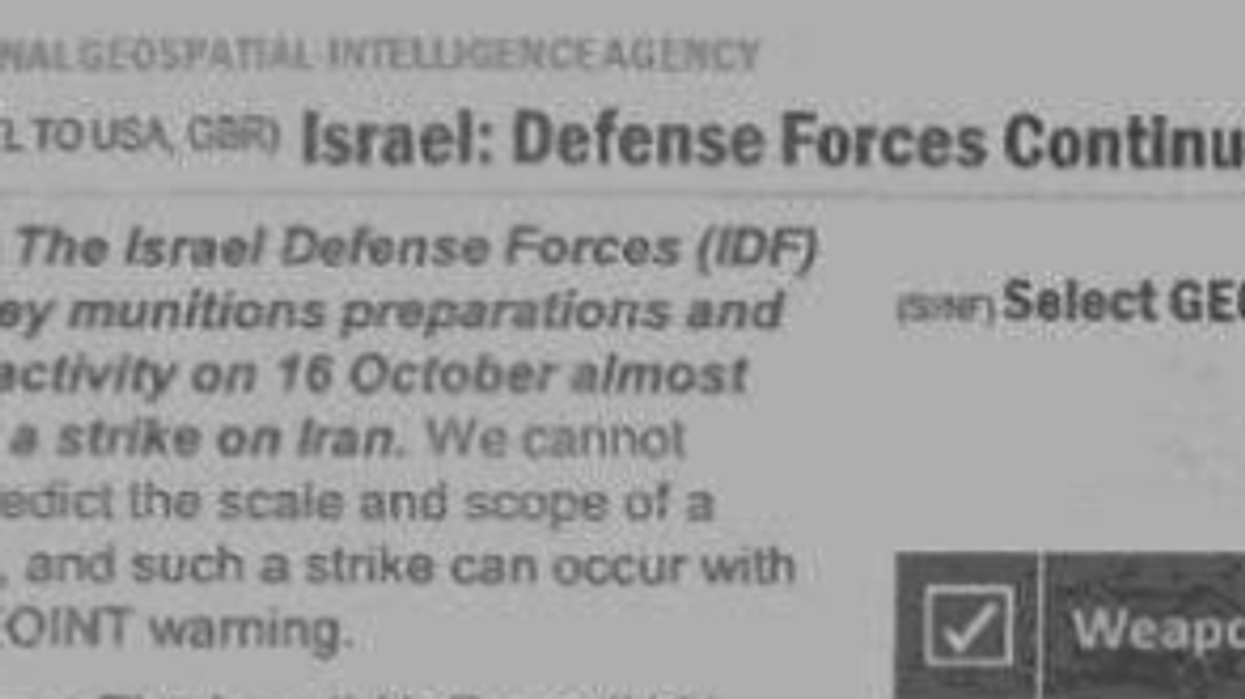
Another of the alleged documents, which multiple outlets have been told appear authentic, confirm U.S. spying on Israeli military forces and shows "a strike on Iran" is "almost certainly" coming.
"We have not observed indications that Israel intends to use a nuclear weapon."
That sentence is the concluding line from an allegedly leaked (or hacked) U.S. intelligence document posted online this week and later reported on by Axios, CNN, and other outlets.
As Axios reported on Saturday, "U.S. officials are extremely concerned about a potentially major security breach after two alleged U.S. intelligence documents about Israel's preparations for an attack on Iran were published by a Telegram account affiliated with Iran."
The Associated Press and independent investigative journalist Ken Klippenstein both cited government sources who said the documents appeared to be authentic. While U.S. officials have yet to comment publicly on the material, reporting confirmed an investigation into their authenticity and how they came to be in the public domain was underway.
Since a barrage of missile strikes aimed at military targets in Israel by Iran on Oct 1, a retaliatory strike in response to Israel's assassination of Hezbollah leader Hassan Nasrallah and other attacks, the world has been waiting for Israel's promised military response.
Assuming the documents are authentic, what they show is that U.S. intelligence—as is well known and despite being close allies—keeps a close and clandestine eye on Israeli military operations.
CNN cited an unnamed U.S. official who called the documents being made public "deeply concerning," though the outlet did not publish the documents in full. The documents, according to CNN,
are marked top secret and have markings indicating they are meant to be seen only by the US and its "Five Eyes" allies — Australia, Canada, New Zealand and the United Kingdom.
They describe preparations Israel appears to be making for a strike against Iran. One of the documents, which says it was compiled by the National Geospatial-Intelligence Agency, says the plans involve Israel moving munitions around.
Another document says it is sourced to the National Security Agency and outlines Israeli air force exercises involving air-to-surface missiles, also believed to be in preparation for a strike on Iran. CNN is not quoting directly from or showing the documents.
It has long been known that Israel has a nuclear weapons program and maintains a nuclear arsenal, but it remains both Israeli and U.S. government policy never to acknowledge or confirm the existence of either. In one of the documents, the U.S. specifically references Israel's ability to deploy a nuclear weapon, though it categorizes the threat of doing so in this case as low.
Independent journalist Ken Klippenstein, recently banned from X for posting an internal opposition research dossier that the Trump campaign had compiled on JD Vance, posted images of both documents to his substack page, as he excoriated major outlets for refusing to do.
"As with the J.D. Vance Dossier, which the entire media knew about but refused to publish, it appears the media has once again lost its nerve – and its sense of what's news," Klippenstein wrote.
According to Klippenstein's assessment:
The intelligence report includes a rundown of the various aspects of Israeli military activities that the U.S. is monitoring to inform its judgments and conclusions: weapons handling, air defense, ground forces, Navy, Air, Special Forces, and even Israel’s Nuclear Forces. But even then, only the weapons handling and special forces categories are identified as having a “medium” predictive ability in regards to determining Israel’s action; the rest are designated “low” predictive ability.
The second intelligence report is titled “Israel: Air Force Continues Preparations for Strike on Iran and Conducts a Second Large-Force Employment Exercise.” The document details Israeli activities during an evident “mission rehearsal” (in U.S. lingo) that could be indicative of how Israel will strike Iran. Citing imagery analysis and other sources, the NGA report notes that the Israeli Air Force is already conducting covert drone operations over Iran (evidently doing its own spying), and how, as part of Israeli Air Force activity, has been handling air-launched ballistic missiles and other weapons.
Defending release of the full documents, he explained that both provide "insight of enormous public interest as we stand at the precipice of a broader conflict" and contained "information that directly bears upon U.S. obligations and actions. It is for that reason that I've decided to publish the basic documents."
"This threat is emerging the day before a vote on reauthorizing vast domestic spying capabilities?" wrote one journalist. "What are the chances!"
The House Republican leadership on Wednesday abruptly canceled planned floor votes on mass surveillance reforms shortly after unnamed U.S. intelligence officials told multiple news outlets that Russia has made alarming progress on a space-based nuclear weapon purportedly designed to target American satellites.
The timing of the intelligence leak raised suspicions among journalists and lawmakers who support reforms to Section 702 of the Foreign Intelligence Surveillance Act (FISA), authority that allows U.S. agencies to spy on non-citizens located outside of the country.
The Federal Bureau of Investigation and National Security Agency have regularly abused Section 702 to collect the data of American journalists, activists, and even members of Congress without a warrant—abuses that have spurred the latest push for reforms.
"Very interested to learn about this threat," said Sen. Mike Lee (R-Utah), who is part of the ideologically diverse coalition that wants substantive FISA changes. "Also very interested to know why the spy guys are raising mysterious alarms right before we're about to reform illegal domestic surveillance under FISA."
Lee's comment came in response to a vaguely menacing statement from Rep. Mike Turner (R-Ohio), chair of the House Permanent Select Committee on Intelligence.
Turner said Wednesday morning that the committee provided all members of Congress with "information concerning a serious national security threat," without providing any specific details.
"I am requesting that President [Joe] Biden declassify all information related to this threat so that Congress, the administration, and our allies can openly discuss the actions necessary to respond to this threat," added Turner, an outspoken supporter of upholding federal agencies' mass spying authority under Section 702.
The Intercept's Ken Klippenstein noted that Turner "has tweeted out support for 702 at least a dozen times in the past year alone."
"I wonder if that has anything to do with his decision to apprise us of this ominous threat!" Klippenstein wrote in his newsletter.
Klippenstein's colleague at The Intercept, Daniel Boguslaw, had a similar reaction to Turner's statement.
Wow. This threat is emerging the day before a vote on reauthorizing vast domestic spying capabilities? And the head of the house intel wants to declassify it? What are the chances! https://t.co/2sKCn3P3nY
— Daniel Boguslaw (@DRBoguslaw) February 14, 2024
Reporting by The New York Times, ABC News, and other prominent outlets soon made clear that the secret information Turner referenced was related to Russian anti-satellite weaponry, which Moscow has been working on for years.
But officials and lawmakers privy to the intelligence, which was reportedly obtained under Section 702 authority, were quick to stress that the "serious national security threat" that Turner invoked was in no way imminent.
"It is a serious national security issue in the medium-to-long term that the Congress and the administration need to focus on," said Rep. Jim Himes (D-Conn.), the top Democrat on the House Intelligence Committee. "But no need to buy gold."
Which begs the question: If the supposed threat to U.S. national security isn't urgent, why did Turner choose to raise the issue a day before the House was set to vote on whether to reform and reauthorize Section 702?
Citing one unnamed U.S. official, The Washington Post reported that Turner "appears to want to use the information about the adversary capability to convince skeptical colleagues that 702 is an indispensable intelligence tool."
"Lawmakers in the House and Senate have been in possession of the raw intelligence concerning the foreign capability for several weeks and were preparing to learn how the administration might respond," the Post added. "Turner's disclosure could make that response more difficult if it revealed information about how the intelligence was obtained in the first place."
In the wake of the flurry of news stories on the U.S. intelligence, Raj Shah, a spokesperson for House Speaker Mike Johnson (R-La.), announced on social media that the GOP leadership has decided to postpone a vote on Section 702 reform and reauthorization indefinitely "to allow Congress more time to reach consensus."
Without congressional action, Section 702 will expire on April 19.
"The FBI's boosters on the Intelligence Committee are afraid to vote on key reforms—but these votes are long overdue and something the American people deserve."
Elizabeth Goitein, co-director of the Liberty and National Security program at the Brennan Center for Justice, called Johnson's decision to cancel Thursday's votes "jaw-dropping" and accused members of the House Intelligence Committee of "waging a propaganda campaign" to tank popular, bipartisan reform efforts.
Last month, the House Judiciary Committee overwhelmingly passed legislation that would require "all intelligence agencies and the FBI to obtain a warrant from the Foreign Intelligence Surveillance Court (FISC) before conducting any query of a U.S. person," along with other reforms.
The House Permanent Select Committee on Intelligence passed its own bill that Goitein argued is "designed to look like reform while doing nothing at all," allowing the FBI to "continue abusing Section 702."
Because the House judiciary panel has jurisdiction over surveillance matters, Johnson should have run with its bipartisan bill, Goitein wrote.
"Instead, Johnson orchestrated a new bill, framed as a 'compromise' but in fact closely tracking HPSCI's bill," Goitein wrote, alluding to the Reforming Intelligence and Securing America Act.
Let’s review. The Chair of HPSCI made a public statement that frightened the American people, may have compromised intelligence sources, and was wholly unnecessary given the absence of any urgent threat, in order to gin up a new (bogus) argument against Section 702 reform. 12/13
— Elizabeth Goitein (@LizaGoitein) February 15, 2024
Sensing broad support for reform, Section 702 supporters on Wednesday gummed up the works during a House Rules Committee hearing on the new legislation. Johnson then yanked the bill, which reform advocates were trying to amend to include greater privacy protections.
Jake Laperruque, deputy director on surveillance at the Center for Democracy and Technology, said in a statement that "privacy advocates and Judiciary Committee leadership made clear this week that we are ready and eager to vote on FISA, and the surveillance loopholes that are misused to evade warrant rules."
"The FBI's boosters on the Intelligence Committee are afraid to vote on key reforms—but these votes are long overdue and something the American people deserve," Laperruque added. "It's time to stop punting and bring the debate over warrantless FISA surveillance to the House floor."
"We trusted the government not to screw us," said Edward Snowden. "But they did. We trusted the tech companies not to take advantage of us. But they did. That is going to happen again, because that is the nature of power."
With this week marking 10 years since whistleblower Edward Snowden disclosed information to journalists about widespread government spying by United States and British agencies, the former National Security Agency contractor on Thursday joined other advocates in warning that the fight for privacy rights, while making several inroads in the past decade, has grown harder due to major changes in technology.
"If we think about what we saw in 2013 and the capabilities of governments today," Snowden told The Guardian, "2013 seems like child's play."
Snowden said that the advent of commercially available surveillance products such as Ring cameras, Pegasus spyware, and facial recognition technology has posed new dangers.
As Common Dreams has reported, the home security company Ring has faced legal challenges due to security concerns and its products' vulnerability to hacking, and has faced criticism from rights groups for partnering with more than 1,000 police departments—including some with histories of police violence—and leaving community members vulnerable to harassment or wrongful arrests.
Law enforcement agencies have also begun using facial recognition technology to identify crime suspects despite the fact that the software is known to frequently misidentify people of color—leading to the wrongful arrest and detention earlier this year of Randal Reid in Georgia, among other cases.
"Despite calls over the last few years for federal legislation to rein in Big Tech companies, we've seen nothing significant in limiting tech companies' ability to collect data."
Last month, journalists and civil society groups called for a global moratorium on the sale and transfer of spyware like Pegasus, which has been used to target dozens of journalists in at least 10 countries.
Protecting the public from surveillance "is an ongoing process," Snowden told The Guardian on Thursday. "And we will have to be working at it for the rest of our lives and our children's lives and beyond."
In 2013, Snowden revealed that the U.S. government was broadly monitoring the communications of citizens, sparking a debate over surveillance as well as sustained privacy rights campaigns from groups like Electronic Frontier Foundation (EFF) and Fight for the Future.
"Technology has grown to be enormously influential," Snowden told The Guardian on Thursday. "We trusted the government not to screw us. But they did. We trusted the tech companies not to take advantage of us. But they did. That is going to happen again, because that is the nature of power."
Last month ahead of the anniversary of Snowden's revelations, EFF noted that some improvements to privacy rights have been made in the past decade, including:
"Despite calls over the last few years for federal legislation to rein in Big Tech companies, we've seen nothing significant in limiting tech companies' ability to collect data... or regulate biometric surveillance, or close the backdoor that allows the government to buy personal information rather than get a warrant, much less create a new Church Committee to investigate the intelligence community's overreaches," wrote EFF senior policy analyst Matthew Guariglia, executive director Cindy Cohn, and assistant director Andrew Crocker. "It's why so many cities and states have had to take it upon themselves to ban face recognition or predictive policing, or pass laws to protect consumer privacy and stop biometric data collection without consent."
"It's been 10 years since the Snowden revelations," they added, "and Congress needs to wake up and finally pass some legislation that actually protects our privacy, from companies as well as from the NSA directly."

American whistleblower Edward Snowden was among 72 foreign-born individuals granted Russian citizenship on Monday in a decree signed by President Vladimir Putin, just over seven months into Russia's war on Ukraine.
"After two years of waiting and nearly 10 years of exile, a little stability will make a difference for my family."
Snowden--who exposed the mass surveillance practices of the U.S. National Security Agency (NSA)--has lived in Russia since the summer of 2013, when the United States revoked his passport while he was attempting to travel from Hong Kong to Ecuador.
Shortly after Russia granted him permanent residency rights, Snowden announced in November 2020 that he and his wife, Lindsay Mills--who gave birth to their first son that year, and a second son earlier this year--were seeking dual citizenship.
"After years of separation from our parents, my wife and I have no desire to be separated from our son," Snowden explained. "That's why, in this era of pandemics and closed borders, we're applying for dual U.S.-Russian citizenship."
"Lindsay and I will remain Americans, raising our son with all the values of the America we love--including the freedom to speak his mind. And I look forward to the day I can return to the states, so the whole family can be reunited," he added. "Our greatest wish is that, wherever our son lives, he feels at home."
In a tweet noting that statement and sharing a family photo, the 39-year-old said Monday that "after years of separation from our parents, my wife and I have no desire to be separated from our SONS. After two years of waiting and nearly 10 years of exile, a little stability will make a difference for my family. I pray for privacy for them--and for us all."
Snowden attorney Anatoly Kucherena told Russian state-owned RIA Novosti on Monday that Mills is seeking citizenship. The lawyer also said that Snowden will not be forced to participate in the recently announced "partial mobilization" to send troops to Ukraine, as he has not served in Russia's army.
Not long before Russia invaded Ukraine in late February, Snowden accused the global news media of "pushing for war." Since the invasion, he has faced some criticism for his lack of comment on the conflict.
Just after the war began, he said that "I'm not suspended from the ceiling above a barrel of acid by a rope that burns a little faster every time I tweet, you concern-trolling ghouls. I've just lost any confidence I had that sharing my thinking on this particular topic continues to be useful, because I called it wrong."
In response to the citizenship news on Monday, Evan Greer, director of the U.S.-based digital rights group Fight for the Future, tweeted that "if the Biden administration dropped the charges against Snowden, Putin wouldn't be able to use him for a PR stunt, just sayin'."
Shadowproof managing editor Kevin Gosztola said: "Let's be clear. Snowden sought citizenship in Russia because his government will not let him return to his home country without putting him on trial exposing mass surveillance that systematically violated the privacy rights of millions and even spurred modest reform."
Snowden--who potentially faces decades in U.S. prison for theft and Espionage Act charges--has previously said that he would return to the United States if he believed he would receive a fair trial.
A federal appeals court ruled two years ago that the NSA's warrantless surveillance of U.S. phone records--which Snowden exposed--was illegal. Snowden has continued to criticize years of impunity for the agency's violation of Americans' civil liberties.
"Our position has not changed. Mr. Snowden should return to the United States where he should face justice as any other American citizen would," Ned Price, a spokesperson for the U.S. State Department, said Monday, also suggesting that the exile may be required to fight in Russia's war against Ukraine, despite his attorney's comments on the matter.
The Washington Post reported that White House Press Secretary Karine Jean-Pierre declined to comment, only saying that "since I believe there have been criminal charges brought against him, we would point you to the Department of Justice for any specifics on this."
Meanwhile, in Russia, when asked if Putin will meet with Snowden, presidential spokesperson Dmitry Peskov reportedly said that "there are no such plans."

Exiled U.S. whistleblower and former National Security Agency contractor Edward Snowden on Tuesday called out years of impunity for the NSA violating Americans' civil liberties and privacy rights.
Snowden's tweet came in response to CNN reporting that the NSA "failed to follow both court-approved and internal procedures designed to prevent officials from using a controversial foreign surveillance law to inappropriately monitor Americans' communications."
The revelations related to Section 702 of the Foreign Intelligence Surveillance Act (FISA) came in a new semi-annual government watchdog report to Congress. Snowden highlighted that such failures at the NSA are part of a long trend of abuse.
"This has happened year after year since the program began," said Snowden, who has lived in Russia since exposing U.S. government mass surveillance in 2013. Asked by one Twitter user about the penalties for the agency's conduct, he added that "there aren't any."
The controversial law, which enables the U.S. government to collect communications of foreigners located outside the United States without warrants, "broadly prohibits the intelligence community and law enforcement from targeting U.S. persons," CNN explained. However, a loophole allows for warrantless searches of "702-gathered information for Americans' records if 'a query is reasonably likely to return foreign intelligence information.'"
Privacy advocates have long called on Congress to close this "backdoor search" loophole. More than two dozen groups wrote to lawmakers last summer that "ending this unconstitutional practice is imperative to ensure that foreign intelligence surveillance does not swallow Americans' privacy rights."
As the unclassified version of the new NSA report details, the agency's Office of the Inspector General (OIG) found that U.S. person (USP) queries "performed against FISA Section 702 data did not always follow NSA procedural and policy requirements."
The OIG also found that "some selector information in an NSA tool's FISA Section 702 USP query module was not documented with consistency" and "an NSA query tool did not prevent certain queries containing known USP selectors from processing."
"The OIG made 13 recommendations to assist NSA in addressing these issues," the report notes. "Seven recommendations were closed prior to report issuance, and the actions planned by management meet the intent of the other recommendations."
An NSA spokesperson told CNN that the agency "remains fully committed to the rigorous and independent oversight provided by the NSA inspector general's office."
"NSA continues to employ measures to assist analysts in conducting their work compliantly with civil liberties and privacies protections," the spokesperson added. "As the OIG included in its report, the agency has in place multiple processes to aid in ensuring query compliance."
However, critics of the NSA continued to express doubt that much will change at the agency.
Noting the OIG report, Shadowproof managing editor Kevin Gosztola tweeted Tuesday that "it's almost like the NSA doesn't give a shit about procedures because there's no risk of consequences and politicians in Congress really don't care about accountability for abuses."

Is the phone in your pocket spying on you? As cell phones have become ubiquitous, government intelligence agencies have poured vast resources into hacking them, remotely stripping people of their privacy in the name of national security. Now, a burgeoning industry has emerged, generating huge profits for shadowy corporations that specialize in developing ever-more innovative ways to secretly infect digital devices with spyware. Activists, journalists, human rights defenders and dissidents the world over have been surveilled and in a number of cases arrested, tortured or killed. This week, Citizen Lab, a cybersecurity research organization based at the University of Toronto, revealed the existence of a "zero-click" exploit that exposed 1.65 billion Apple iPhone and other Apple devices to a complete and almost undetectable takeover by the spyware known as Pegasus, produced by NSO Group, a private company.
Pegasus spyware grants unlimited access to all of an infected device's content, from chat messages to emails to phone calls, allows control of the phone's microphone and camera, and shares the phone's location in real time.
"If you don't do anything to stop the sale of this technology, it's not just going to be 50,000 targets. It's going to be 50 million targets," NSA whistleblower Edward Snowden told the Guardian last month.
"NSO Group is a mercenary surveillance company based in Israel," Ronald Deibert, director of Citizen Lab, said on the Democracy Now! news hour. "NSO Group first came on our radar back in 2016, when we discovered it was being used by the United Arab Emirates to target a human rights defender named Ahmed Mansoor. Since then, we and others have documented extensive abuses of this company's technology."
If you believe NSO Group's founders, the software is only legally deployed to catch criminals, terrorists, pedophiles and the like. Not convinced, Amnesty International and 155 other civil society organizations and technology experts issued a joint letter calling for an immediate moratorium on the sale, transfer and use of surveillance technology: "NSO Group's spyware has been used to facilitate human rights violations around the world on a massive scale," the letter states. "It has become clear that its technology facilitates systemic abuse...if the recent allegations about the use of Pegasus are even partly true, then that red line has been crossed again and again with total impunity."
Among the cases cited by Amnesty is that of Cecilio Pineda Birto, a Mexican journalist shot dead on March 2nd, 2017. He had been receiving death threats, and just that morning announced a forthcoming report on corrupt local officials colluding with organized crime figures. In 2021, Pineda's phone number appeared on a leaked list of about 50,000 cell phone numbers from all over the world, said to be targets of the Pegasus software. Scores of journalists from the Forbidden Stories collaboration and Citizen Lab reported on the leaked list, which included hundreds of journalists and activists as well as many world leaders.
"If you don't do anything to stop the sale of this technology, it's not just going to be 50,000 targets. It's going to be 50 million targets," NSA whistleblower Edward Snowden told the Guardian last month. "And it's going to happen much more quickly than any of us expect. The way we do that is to halt the trade of this technology."
Pegasus was used to target phones owned by family members of Jamal Kashoggi, the Saudi dissident and Washington Post journalist, both before and after his brutal murder by a Saudi kill team inside the Saudi consulate in Istanbul on October 2nd, 2018.
Another victim of the NSO Group's spyware is Omar Radi, an independent journalist in Morocco who has long reported on corruption, land expropriation and human rights abuses by the Moroccan government. In 2020, Amnesty International issued a report with proof that Radi's iPhone had been infected by Pegasus spyware.
"Pegasus is a silent program. You don't feel it," Omar Radi told us on Democracy Now! in July, 2020, just two weeks before he was arrested by Moroccan police. "It can use your microphone, it can use your keyboard, it can use your screen, and get any information that is stored in your phone. I don't know the amount of information they've stolen from my phone." Omar Radi was recently sentenced to six years in prison.
"NSO Group is merely one among many mercenary spyware companies that exist globally," Citizen Lab's Ron Deibert said. "Governments that have deep pockets can simply go and purchase this type of despotism as a service off the shelf. We've never seen anything like that historically, the privatization of this type of digital espionage."
Apple issued a software update that supposedly fixed this problem. But hackers will certainly find more holes in these digital device operating systems. Without a ban on Pegasus and spyware like it, human rights defenders, journalists and others will continue to be targeted, spied on, beaten, arrested and killed.

Denmark helped the United States spy on senior European officials including German Chancellor Angela Merkel, European media reported Sunday.
Danish state broadcaster DR reported that nine unnamed sources viewed an internal classified report from the Danish Defence Intelligence Service (FE) on its 2015 investigation into its relationship with the National Security Agency. The report covered 2012-2014, when Joe Biden was vice president in the Obama administration.
Disclosures from NSA whistleblower Edward Snowden in 2013 revealed that the NSA was spying on world leaders including Merkel. The Sunday reporting, a collaboration that included Swedish public broadcaster SVT, Norwegian public broadcaster NRK, Germany's Suddeutsche Zeitung, NDR, WDR, and France's Le Monde, reveals Denmark's abetting of the surveillance.
Other German targets of the surveillance included then-chancellor candidate Peer Steinbruck and former German Foreign Minister Frank-Walter Steinmeier.
"The media reports describe a system of Danish-American cooperation used to surveil and stock data from underwater internet cables. DR reports that a data center was even built for that purpose at a Danish intelligence facility on the island of Amager, south of Copenhagen," Politico EU reported.
"Through targeted retrievals and the use of NSA-developed analysis software known as Xkeyscore," Reuters added, "NSA intercepted both calls, texts, and chat messages to and from telephones of officials in the neighboring countries, sources told DR."
Responding to the revelations, Steinbruck told ARD it was "grotesque that friendly intelligence services are indeed intercepting and spying on top representatives" of other countries.
According to Snowden, President Joe "Biden is well-prepared to answer for this when he soon visits Europe since, of course, he was deeply involved in this scandal the first time around."
"There should be an explicit requirement for full public disclosure not only from Denmark, but their senior partner as well," Snowden tweeted.
Snowden is facing charges of violating the Espionage Act--the charges were brought by Obama's Justice Department--and has been living in Russia.
Previous reporting showed that Denmark had approved a U.S. request for a rendition plane to land in Copenhagen in June 2013 to nab Snowden, who had fled Hong Kong.
Reuters also reported in 2013 that Biden had a call with then-Ecuadorean President Rafael Correa asking him not to grant asylum to Snowden, who had sought the protection from the Latin American country.

While the dramatic arrest of dissident journalist Roman Protasevich by the Belarusian government over the weekend was fiercely condemned worldwide, press freedom advocates on Monday not only called for the reporter's release but also highlighted how the actions taken by Belarus were eerily similar to an effort in 2013 by the U.S. and other Western governments to capture NSA whistleblower Edward Snowden.
"Downing aircraft to pursue the arrest of dissidents has always been outrageous... and should be opposed no matter the flag under which it occurs."
--Edward Snowden
Protasevich, a well-known critic of Belarus' authoritarian President Alexander Lukashenko, was taken into custody after the plane that he and 122 other passengers were traveling on--en route from Athens, Greece to Vilnius, Lithuania, where Protasevich lives in exile--was forced to land.
Although they readily admitted that Lukashenko's government had violated international treaties governing airspace and was deserving of condemnation, critics of the corporate media and U.S. foreign policy were eager to point out that Belarus' behavior was not unprecedented; in fact, they said, some of the same Western officials denouncing Belarus' arrest of Protasevich were complicit in the 2013 plot to intercept Snowden.
"For anyone shocked at the Belarus plane grounding, remember, the U.S. did the same thing to the president of Bolivia in an attempt to kidnap Edward Snowden," journalist Alan MacLeod said Monday.
In 2013, the plane carrying then-Bolivian President Evo Morales from Russia was rerouted to and stuck in Vienna for 13 hours at the suspected behest of the U.S., which believed that Morales, who was returning to Bolivia following a summit in Moscow, had clandestinely helped Snowden, then stranded at the city's international airport, on board.
The whistleblower--who has lived in Russia for almost eight years since being granted temporary asylum, followed by permanent residency last October--was not found on the flight.
Snowden on Monday weighed in on the parallels between the repressive scheme that the U.S. and key European Union states used in their failed attempt to capture him and Belarus' recent hunt for Protasevich, arguing that "downing aircraft to pursue the arrest of dissidents has always been outrageous... and should be opposed no matter the flag under which it occurs."
The hypocrisy of Western officials--including Jen Psaki, now the White House press secretary but in 2013 the spokesperson for the Obama State Department who admitted that the U.S. had been in contact with multiple countries in an effort to track down Snowden--was the subject of an essay published Monday by journalist Glenn Greenwald, who famously reported on materials leaked to him by Snowden and shed light on the Obama administration's persecution of the whistleblower.
"News accounts in the West which are depicting [Belarus' arrest of Protasevich] as some sort of unprecedented assault on legal conventions governing air travel and basic decency observed by law-abiding nations are whitewashing history," Greenwald wrote.
"No journalist, especially Western ones, should be publishing articles or broadcasting stories falsely depicting Sunday's incident as an unprecedented assault that could be perpetrated only by a Russian-allied autocrat," he added. "The tactic was pioneered by the very countries who today are most vocally condemning what happened."
Greenwald continued:
Illustrating how little the U.S. cares about even pretending to abide by the standards it imposes on others, the Biden administration on Monday sent out Psaki herself to condemn Belarus' conduct as "a shocking act" and "a brazen affront to international freedom and peace and security by the regime." It would not even occur to Biden officials--just for the sake of appearances if nothing else--to try to find someone to do this other than the same person who, in 2013, obfuscated and defended the actions of the U.S. and E.U. in doing the same thing to Bolivia's presidential plane. U.S. officials simply do not believe that they are bound by the same standards to which its adversaries must be subjected.
[...]
The only two differences between these situations that one can locate are factors against the Western nations responsible for the downing of Morales' plane. Unlike what Belarus did, the U.S. and its European allies obviously had no confirmation of Snowden's presence on the plane. They forced it to land based on a guess, on rumor, on speculation, which turned out to be utterly false. The second difference is that there are obviously additional international and diplomatic implications from forcing the plane of a democratically elected president to land as opposed to a standard passenger jet: that is, at the very least, a profound attack on the sovereignty of that country. Again, there are no valid justifications for what Belarus did, but to the extent one wants to distinguish its actions from what U.S./E.U. nations did in 2013, those are the only identifiable differences.
Others chimed in to draw attention to British and U.S. complicity in the plight of WikiLeaks founder Julian Assange and demand that he be released in addition to Protasevich.
In his essay, Greenwald wrote that "the blatant double standards the U.S. and Europe have endlessly tried to impose upon the world--whereby they are freely permitted to do exactly what they condemn when done by others--is not just a matter of standard lawlessness and hypocrisy."
"In Western media discourse, only Bad Countries are capable of bad acts; the U.S. and its allies are capable, at worst, only of well-intentioned mistakes," Greenwald continued.
"When the U.S. media helps to perpetuate this narrative, it deceives and misleads the audience they purportedly inform by concealing the bad acts of the U.S. and implying if not stating that such acts are the sole province of the Bad Countries who are adverse to the U.S.," he added. "Doing so both enables rogue nation behavior by Western powers and implants jingoistic propaganda."

Since Donald Trump's presidency ended with a violent insurrection at the US Capitol that left five people dead, the country and its leadership have focused on how to address the "new" threat of "terrorism." Bipartisan efforts backed by President Joe Biden seek to further escalate an already out-of-control US Intelligence apparatus.
Supporters of civil liberties and defenders of Black, immigrant, and Muslim communities have urged caution against such measures. Nonetheless, we are told by some opponents of the far-right that supporters of equality and civil liberties should not be worried about expansions of US surveillance and counterterrorism capabilities.
They are wrong. A new report published by Project South, a movement-building organisation rooted in the Black radical tradition, describes the lengthy history, practices, and law behind the US surveillance state and its systematic targeting of Black, immigrant, and/or Muslim communities, with a particular focus on the US South. Spying on the Margins: The History, Law, and Practice of U.S. Surveillance Against Muslim, Black, and Immigrant Communities and Contemporary Strategies of Resistance is intended as a useful guide and tool for community organisers, lawyers, activists, and all those concerned about the practical effects of the massive growth of the US surveillance state.
Many associate systematic state surveillance practices against Muslims in the US with the 9/11 attacks and the "war on terror" that followed. But the reality is that Black and immigrant Muslim communities were subjected to discriminatory and abusive surveillance practices long before that.
After the first world war, an increasingly nativist US government subjected diverse Muslim communities to surveillance and deportation when they began to engage in political organising. For example, as the US government passed overtly xenophobic laws such as the National Origins Act of 1924, restricting non-white and non-Christian immigration, the FBI began to aim its surveillance at pan-Islamic and Islamic-influenced Black and pan-African movements that opposed white supremacy. During the second world war, the US government spied on Black Muslim organisations, alleging without basis that they might be allied with the Japanese government. And following the war, Black, Indigenous, and immigrant movement leaders, Black Muslims and Arab leftists were among many activists and civil rights groups targeted by the FBI's infamous domestic political spying programme, COINTELPRO.
A Senate Select Committee that investigated COINTELPRO in the 1970s, known as the Church Committee, found that a combination of factors led "law enforcers to become lawbreakers". The Church Committee's exposure of the COINTELPRO abuses led to a series of reforms, including laws designed to regulate government surveillance and internal guidelines that limited the FBI's investigative authority and spelled out the rules that govern law enforcement operations.
These nominal reforms, however, did not stop the expansion of the US surveillance state for too long. In the aftermath of the 1993 World Trade Center bombing and the climate of fear prompted by the Oklahoma City bombing, the federal government aggressively rolled back existing limits on the government's ability to surveil and deport people, often from Muslim majority countries. In 1996, the Antiterrorism Effective Death Penalty Act (AEDPA) was signed into law, which substantially limited prisoners' ability to challenge unlawful convictions.
The surveillance state was further strengthened following the 9/11 attacks and the consequent "war on terror." The exposure of the state's myriad rights abuses under the guise of combatting "terror", from mass surveillance and profiling of Muslims to torture of people detained at Guantanamo and CIA black sites, resulted in a series of cosmetic reforms. Nevertheless, most of the statutory authorities invoked to surveil, criminalise, and brutalise Muslims and others in the aftermath of 9/11 remains on the books to this day.
Acts of charity and kindness towards Muslim-majority communities, such as Palestinians living under Israeli occupation, have been reduced to material support for "terrorism". The political views of Muslim youth are invoked in court to suggest they are predisposed to committing acts of "terrorism". Hundreds of Black and/or immigrant Muslims, many with personal vulnerabilities that were exploited by informants, have been ensnared into FBI sting operations that rival Hollywood thrillers in their absurdity.
And the expansion of surveillance authorities under the Foreign Intelligence Surveillance Act (FISA) continues to allow federal agents to circumvent the rules of criminal procedure when targeting people suspected of "terrorism".
Since the aftermath of the COINTELPRO scandal, courts, Congress, and the executive branch have always maintained some limited authority to carry out surveillance beyond the traditional limits of the Fourth Amendment where the surveillance was "primarily" for gathering foreign intelligence rather than for the purpose of criminal prosecution. Under the Foreign Intelligence Surveillance Act, the government had to prove to a federal judge that the target of surveillance was an agent of a foreign power where it was aimed at a US citizen or resident or took place on US soil. This authority had always been subject to some abuse but was still generally limited.
But after 9/11, all branches of the US government radically reinterpreted and eventually changed FISA to enable mass surveillance. The law was changed to permit "foreign intelligence gathering" even if it was not the primary purpose of the surveillance. Congress passed Section 215 of the USA PATRIOT Act, which enabled the mass gathering of telephone calling data and the gathering of other previously confidential business and financial records. And after revelations of mass data-gathering involving US communications providers by the executive branch, Congress reacted not by restricting the President but by passing the FISA Amendments Act of 2007. This change permitted the executive branch to obtain FISA court approval for mass surveillance throughout the world, including the collection of intimate photos, text messages, emails, and even email/password combinations to be stored by the NSA.
In the haze of secrecy created by FISA, secret court rulings permitted multiple mass surveillance programmes that logged the phone metadata and email communications of millions of Americans and others - alongside spying programmes that captured private communications of civilians and officials alike in other countries. Multiple state and federal initiatives log and store collections of data that have no apparent connection to criminal activity.
Throughout the US South, Black and/or Muslim communities have faced significant consequences as a result of this expansive surveillance state. In Florida, Black Muslims associated with the Moorish Science Temple were ensnared into fake "terrorist" plots, including one to blow up the Sears Tower in Chicago, whose absurdity was mocked even by their sentencing judge, while a Palestinian American professor was tried for "terrorism" offences - with the jury eventually acquitting him or deadlocking on every charge - almost entirely on the basis of his political speech. In Georgia, Muslim teenagers were subjected to relentless prosecution, eventual conviction for terrorism, and incarceration based on their online political speech and travel to their ancestral homelands. In North Carolina, Muslim youth who expressed their strong political opposition to the US and Israel ended up serving decades-long sentences for terrorism-related convictions in which the prosecution was able to use FISA surveillance for reasons that have never been disclosed. And states throughout the South, like much of the country, have set up large data-mining enterprises designed to share surveillance information with federal agencies alongside creating legal loopholes that permit discriminatory surveillance practices.
These predatory surveillance practices continued well beyond the Bush presidency into both the Obama and Trump administrations. Among other outrages, the Trump administration explicitly sought to use the FBI's counterterrorism authorities to target Black protesters during the George Floyd demonstrations. One would expect most of these practices to be unlawful in a democracy. But, as the Project South report shows, the law of the US surveillance state targets Black, immigrant, and Muslim communities, precisely because federal intelligence agencies already have broad, sweeping discretion.
From the Supreme Court's ruling in Laird vs Tatum (1972) holding that surveillance of public activities, in and of itself, is not a violation of the First Amendment, to loopholes like the so-called Third Party Doctrine, permitting surveillance of information disclosed to third parties - including telecommunications companies - to the expansive interpretation of FISA, the government has managed to use the law to ensure both widespread surveillance and to avoid facing meaningful consequences even when the law is violated.
Just as the existing surveillance authorities have been used to target those who are directly impacted by state repression, measures touted by the Democratic Party to target the Trump insurrectionists will inevitably worsen the problem.
But in spite of the fealty of the Democratic Party to the intelligence apparatus, Black, Muslim, and/or immigrant communities throughout the country have put forward strategies to resist.
In Los Angeles, community organisers shut down in 2018 efforts by the city council to fund one of several "Countering Violent Extremism" (CVE) programmes - these are nominally designed to deter violence but practically designed to surveil and criminalise teenagers from mostly Muslim backgrounds. In the San Francisco Bay Area, community groups were able to force local police departments to cut ties with the FBI's "Joint Terrorism Task Force" in 2017. In Georgia, a coalition of immigrants' rights organisers shut down a state measure that would have facilitated the sharing of student data with state and federal intelligence agencies in 2019. And in some places, Muslims were able to send a blow to the FBI's intelligence-gathering efforts simply by refusing to participate in them.
The Democratic Party establishment should bow to the lead of these grassroots organisers. But even if they do not, community groups throughout the country should be prepared to address further threats from the surveillance state.

America has a serious infrastructure problem.
Maybe when I say that what comes to mind are all the potholes on your street. Or the dismal state of public transportation in your city. Or crumbling bridges all over the country. But that's so twentieth century of you.
America's most urgent infrastructure vulnerability is largely invisible and unlikely to be fixed by the Biden administration's $2 trillion American Jobs Plan.
I'm thinking about vulnerabilities that lurk in your garage (your car), your house (your computer), and even your pocket (your phone). Like those devices of yours, all connected to the Internet and so hackable, American businesses, hospitals, and public utilities can also be hijacked from a distance thanks to the software that helps run their systems. And don't think that the U.S. military and even cybersecurity agencies and firms aren't seriously at risk, too.
Such vulnerabilities stem from bugs in the programs--and sometimes even the hardware--that run our increasingly wired society. Beware "zero-day" exploits--so named because you have zero days to fix them once they're discovered--that can attract top-dollar investments from corporations, governments, and even black-market operators. Zero days allow backdoor access to iPhones, personal email programs, corporate personnel files, even the computers that run dams, voting systems, and nuclear power plants.
It's as if all of America were now protected by nothing but a few old padlocks, the keys to which have been made available to anyone with enough money to buy them (or enough ingenuity to make a set for themselves). And as if that weren't bad enough, it was America that inadvertently made these keys available to allies, adversaries, and potential blackmailers alike.
The recent SolarWinds hack of federal agencies, as well as companies like Microsoft, for which the Biden administration recently sanctioned Russia and expelled several of its embassy staff, is only the latest example of how other countries have been able to hack basic U.S. infrastructure. Such intrusions, which actually date back to the early 2000s, are often still little more than tests, ways of getting a sense of how easy it might be to break into that infrastructure in more serious ways later. Occasionally, however, the intruders do damage by vacuuming up data or wiping out systems, especially if the targets fail to pay cyber-ransoms. More insidiously, hackers can also plant "timebombs" capable of going off at some future moment.
Russia, China, North Korea, and Iran have all hacked into this country's infrastructure to steal corporate secrets, pilfer personal information, embarrass federal agencies, make money, or influence elections. For its part, the American government is anything but an innocent victim of such acts. In fact, it was an early pioneer in the field and continues to lead the way in cyberoperations overseas.
This country has a long history of making weapons that have later been used against it. When allies suddenly turn into adversaries like the Iranian government after the Shah was ousted in the 1979 revolution or the mujahideen in Afghanistan after their war against the Red Army ended in 1989, the weapons switch sides, too. In other cases, like the atomic bomb or unmanned aerial vehicles, the know-how behind the latest technological advances inevitably leaks out, triggering an arms race.
In all these years, however, none of those weapons has been used with such devastating effect against the U.S. homeland as the technology of cyberwarfare.
The Worm That Turned
In 2009, the centrifuges capable of refining Iranian uranium to weapons-grade level began to malfunction. At first, the engineers there didn't pay much attention to the problem. Notoriously finicky, such high-speed centrifuges were subject to frequent breakdowns. The Iranians regularly had to replace as many as one of every 10 of them. This time, however, the number of malfunctions began to multiply and then multiply again, while the computers that controlled the centrifuges started to behave strangely, too.
It was deep into 2010, however, before computer security specialists from Belarus examined the Iranian computers and discovered the explanation for all the malfunctioning. The culprit responsible was a virus, a worm that had managed to burrow deep into the innards of those computers through an astonishing series of zero-day exploits.
That worm, nicknamed Stuxnet, was the first of its kind. Admittedly, computer viruses had been creating havoc almost since the dawn of the information age, but this was something different. Stuxnet could damage not only computers but the machines that they controlled, in this case destroying about 1,000 centrifuges. Developed by U.S. intelligence agencies in cooperation with their Israeli counterparts, Stuxnet would prove to be but the first salvo in a cyberwar that continues to this day.
It didn't take long before other countries developed their own versions of Stuxnet to exploit the same kind of zero-day vulnerabilities. In her book This Is How They Tell Me the World Ends, New York Times reporter Nicole Perlroth describes in horrifying detail how the new cyber arms race has escalated. It took Iran only three years to retaliate for Stuxnet by introducing malware into Aramco, the Saudi oil company, destroying 30,000 of its computers. In 2014, North Korea executed a similar attack against Sony Pictures in response to a film that imagined the assassination of that country's leader, Kim Jong-un. Meanwhile, Pelroth reports, Chinese hackers have targeted U.S. firms to harvest intellectual property, ranging from laser technology and high-efficiency gas turbines to the plans for "the next F-35 fighter" and "the formulas for Coca-Cola and Benjamin Moore paint."
Over the years, Russia has become especially adept at the new technology. Kremlin-directed hackers interfered in Ukraine's presidential election in 2014 in an effort to advance a far-right fringe candidate. The next year, they shut down Ukraine's power grid for six hours. In the freezing cold of December 2016, they turned off the heat and power in Kyiv, that country's capital. And it wasn't just Ukraine either. Russian hackers paralyzed Estonia, interfered in England's Brexit referendum, and nearly shut down the safety controls of a Saudi oil company.
Then Russia started to apply everything it learned from these efforts to the task of penetrating U.S. networks. In the lead-up to the 2016 elections, Russian hackers weaponized information stolen from Democratic Party operative John Podesta and wormed their way into state-level electoral systems. Later, they launched ransomware attacks against U.S. towns and cities, hacked into American hospitals, and even got inside the Wolf Creek nuclear power plant in Kansas. "The Russians," Pelroth writes, "were mapping out the plant's networks for a future attack."
The United States did not sit idly by watching such incursions. The National Security Agency (NSA) broke into Chinese companies like Huawei, as well as their customers in countries like Cuba and Syria. With a plan nicknamed Nitro Zeus, the U.S. was prepared to take down key elements of Iran's infrastructure if the negotiations around a nuclear deal failed. In response to the Sony hack, Washington orchestrated a 10-hour Internet outage in North Korea.
As the leaks from whistleblower Edward Snowden revealed in 2013, the NSA had set up full-spectrum surveillance through various communications networks, even hacking into the private phones of leaders around the world like Germany's Angela Merkel. By 2019, having boosted its annual budget to nearly $10 billion and created 133 Cyber Mission teams with a staff of 6,000, the Pentagon's Cyber Command was planting malware in Russia's energy grid and plotting other mischief.
Unbeknownst to Snowden or anyone else at the time, the NSA was also stockpiling a treasure trove of zero-day exploits for potential use against a range of targets. At first glance, this might seem like the cyber-equivalent of setting up a network of silos filled with ICBMs to maintain a rough system of deterrence. The best defense, according to the hawk's catechism, is always an arsenal of offensive weapons.
But then the NSA got hacked.
In 2017, an outfit called the Shadow Brokers leaked 20 of the agency's most powerful zero-day exploits. That May, WannaCry ransomware attacks suddenly began to strike targets as varied as British hospitals, Indian airlines, Chinese gas stations, and electrical utilities around the United States. The perpetrators were likely North Korean, but the code, as it happened, originated with the NSA, and the bill for the damages came to $4 billion.
Not to be outdone, Russian hackers turned two of the NSA zero-day exploits into a virus called NotPetya, which caused even more damage. Initially intended to devastate Ukraine, that malware spread quickly around the world, causing at least $10 billion in damages by briefly shutting down companies like Merck, Maersk, FedEx, and in an example of second-order blowback, the Russian oil giant Rosneft as well.
Sadly enough, in 2021, as Kim Zetter has written in Countdown to Zero Day, "[C]yberweapons can be easily obtained on underground markets or, depending on the complexity of the system being targeted, custom-built from scratch by a skilled teenage coder." Such weapons then ricochet around the world before, more often than not, they return to sender.
Sooner or later, cyber-chickens always come home to roost.
Trump Makes Things Worse
Donald Trump notoriously dismissed Russian interference in the 2016 elections. His aides didn't even bother bringing up additional examples of Russian cyber-meddling because the president just wasn't interested. In 2018, he even eliminated the position of national cybersecurity coordinator, which helped National Security Advisor John Bolton consolidate his own power within the administration. Later, Trump would fire Christopher Krebs, who was in charge of protecting elections from cyberattacks, for validating the integrity of the 2020 presidential elections.
The SolarWinds attack at the end of last year highlighted the continued weakness of this country's cybersecurity policy and Trump's own denialism. Confronted with evidence from his intelligence agencies of Russian involvement, the president continued to insist that the perpetrators were Chinese.
The far right, for partisan reasons, abetted his denialism. Strangely enough, commentators on the left similarly attempted to debunk the idea that Russians were involved in the Podesta hack, 2016 election interference, and other intrusions, despite overwhelming evidence presented in the Mueller report, the Senate Intelligence Committee findings, and even from Russian sources.
But this denialism of the right and the left obscures a more important Trump administration failure. It made no attempt to work with Russia and China to orchestrate a truce in escalating global cyber-tensions.
Chastened by the original Stuxnet attack on Iran, the Putin government had actually proposed on several occasions that the international community should draw up a treaty to ban computer warfare and that Moscow and Washington should also sort out something similar bilaterally. The Obama administration ignored such overtures, not wanting to constrain the national security state's ability to launch offensive cyber-operations, which the Pentagon euphemistically likes to label a "defend forward" strategy.
In the Trump years, even as he was pulling the U.S. out of one arms control deal after another with the Russians, The Donald was emphasizing his superb rapport with Putin. Instead of repeatedly covering for the Russian president--whatever his mix of personal, financial, and political reasons for doing so--Trump could have deployed his over-hyped art-of-the-deal skills to revive Putin's own proposals for a cyber-truce.
With China, the Trump administration committed a more serious error.
Stung by a series of Chinese cyber-thefts, not just of intellectual property but of millions of the security-clearance files of federal employees, the Obama administration reached an agreement with Beijing in 2015 to stop mutual espionage in cyberspace. "We have agreed that neither the U.S. [n]or the Chinese government will conduct or knowingly support cyber-enabled theft of intellectual property, including trade secrets or other confidential business information for commercial advantage," Obama said then. "We'll work together and with other nations to promote other rules of the road."
In the wake of that agreement, Chinese intrusions in U.S. infrastructure dropped by an astonishing 90%. Then Trump took office and began to impose tariffs on Chinese goods. That trade war with Beijing would devastate American farmers and manufacturers, while padding the bills of American consumers, even as the president made it ever more difficult for Chinese firms to buy American products and technology. Not surprisingly, China once again turned to its hackers to acquire the know-how it could no longer get legitimately. In 2017, those hackers also siphoned off the personal information of nearly half of all Americans through a breach in the Equifax credit reporting agency.
As part of his determination to destroy everything that Obama achieved, of course, Trump completely ignored that administration's 2015 agreement with Beijing.
Head for the Bunkers?
Larry Hall once worked for the Defense Department. Now, he's selling luxury apartments in a former nuclear missile silo in the middle of Kansas. It burrows 15 stories into the ground and he calls it Survival Condo. The smallest units go for $1.5 million and the complex features a gym, swimming pool, and shooting range in its deep underground communal space.
When asked why he'd built Survival Condo, Hall replied, "You don't want to know."
Perhaps he was worried about a future nuclear exchange, another even more devastating pandemic, or the steady ratcheting up of the climate crisis. Those, however, are well-known doomsday scenarios and he was evidently alluding to a threat to which most Americans remain oblivious. What the Survival Condo website emphasizes is living through five years "completely off-grid," suggesting a fear that the whole U.S. infrastructure could be taken down via a massive hack.
And it's true that modern life as most of us know it has become increasingly tied up with the so-called Internet of Things, or IoT. By 2023, it's estimated that every person on Earth will have, on average, 3.6 networked devices. Short of moving to a big hole in the ground in Kansas and living completely off the grid, it will be difficult indeed to extricate yourself from the consequences of a truly coordinated attack on such an IoT.
A mixture of short-sighted government action--as well as inaction--and a laissez-faire approach to markets have led to the present impasse. The U.S. government has refused to put anything but the most minimal controls on the development of spyware, has done little to engage the rest of the world in regulating hostile activities in cyberspace, and continues to believe that its "defend forward" strategy will be capable of protecting U.S. assets. (Dream on, national security state!)
Plugging the holes in the IoT dike is guaranteed to be an inadequate solution. Building a better dike might be a marginally better approach, but a truly more sensible option would be to address the underlying problem of the surging threat. Like the current efforts to control the spread of nuclear material, a non-proliferation approach to cyberweapons requires international cooperation across ideological lines.
It's not too late. But to prevent a rush to the bunkers will take a concerted effort by the major players--the United States, Russia, and China--to recognize that cyberwar would, at best, produce the most pyrrhic of victories. If they don't work together to protect the cyber-commons, the digital highway will, at the very least, continue to be plagued by potholes, broken guardrails, and improvised explosive devices whose detonations threaten to disrupt all our lives.