

SUBSCRIBE TO OUR FREE NEWSLETTER
Daily news & progressive opinion—funded by the people, not the corporations—delivered straight to your inbox.
5
#000000
#FFFFFF
To donate by check, phone, or other method, see our More Ways to Give page.
Daily news & progressive opinion—funded by the people, not the corporations—delivered straight to your inbox.
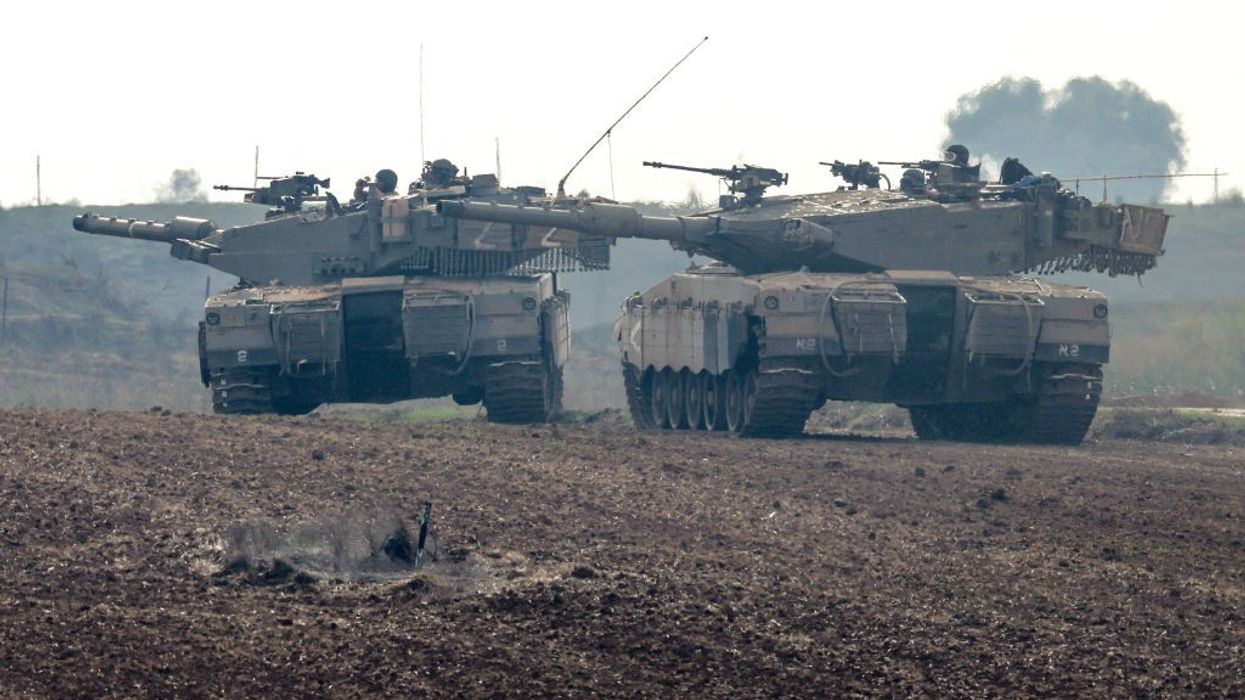
In the wake of the atrocities committed on October 7th and Washington’s tacit acquiescence in Israel’s maximalist war aims, the dubious notion that vital American interests are still at stake in the Greater Middle East has taken on new life.
One way of understanding the ongoing bloodbath pitting Israel against Hamas is to see it as just the latest chapter in an existential struggle dating back to the founding of the Jewish state in 1948. While the appalling scope, destructiveness, and duration of the fighting in Gaza may outstrip previous episodes, this latest go-around serves chiefly to reaffirm the remarkable intractability of the underlying Arab-Israeli conflict.
Although the shape of that war has changed over time, certain constants remain. Neither side, for instance, seems capable of achieving its ultimate political goals through violence. And each side adamantly refuses to concede to the core demands of its adversary. In truth, while the actual fighting may ebb and flow, pause and resume, the Holy Land has become the site of what is effectively permanent conflict.
For several decades, the United States sought to keep its distance from that war by casting itself in the role of regional arbiter. While providing Israel with arms and diplomatic cover, successive administrations have simultaneously sought to position the U.S. as an “honest broker,” committed to advancing the larger cause of Middle Eastern peace and stability. Of course, a generous dose of cynicism has always informed this “peace process.”
On that score, however, the present moment has let the cat fully out of the bag. The Biden administration responded to the gruesome terrorist attack on October 7th by unequivocally endorsing and underwriting Israeli efforts to annihilate Hamas, with Gazans thereby subjected to a World War II-style obliteration bombing campaign. Meanwhile, ignoring tepid Biden administration protests, Israeli settlers continue to expel Palestinians from parts of the West Bank where they have lived for generations. If Hamas’s October assault was a tragedy, proponents of a Greater Israel also saw it as a unique opportunity that they’ve seized with alacrity. As for the peace process, already on life support, it now seems altogether defunct. Prospects of reviving it anytime soon appear remote.
Deepening the Pentagon’s involvement in the Greater Middle East will only compound the failures to which the Carter Doctrine has already subjected this nation, while scrambling U.S. strategic priorities in ways sure to prove counterproductive.
More or less offstage, the fighting is having this ancillary effect: as Israeli Defense Forces (IDF) employ U.S.-provided weapons and munitions to turn Gaza into rubble, the “rules-based international order” touted by the Biden administration as the latest organizing principle of American statecraft has forfeited whatever slight credibility it might have possessed. Russia’s assault on Ukraine appears almost measured and humane by comparison.
As if to emphasize Washington’s own limited fealty to that rules-based order, President Biden’s immediate response to the events of October 7th focused on unilateral military action, bolstering U.S. naval and air forces in the Middle East while shoveling even more weapons to Israel. Ostensibly tasked with checking any further spread of violence, American forces in the region have instead been steadily edging toward becoming full-fledged combatants.
In recent weeks, U.S. forces have sustained dozens of casualty-producing attacks, primarily from rockets and armed drones. Attributing those attacks to “Iran-affiliated groups,” the U.S. has responded with air strikes targeting warehouses, training facilities, and command posts in Syria and Iraq.
According to a Pentagon spokesman, the overall purpose of American military action in the region is “to message very strongly to Iran and their affiliated groups to stop.” Thus far, the impact of such messaging has been ambiguous at best. Certainly, U.S. retaliatory efforts haven’t dissuaded Iran from pursuing its proxy war against American military outposts in the region. On the other hand, the scale of those Iran-supported attacks remains modest. Notably, no U.S. troops have been killed — yet.
For the moment at least, that fact may well be the administration’s operative definition of success. As long as no flag-draped coffins show up at Dover Air Force Base in Delaware, Joe Biden may find it perfectly tolerable for the U.S.-Iran subset of the Israel-Hamas war to simmer indefinitely on the back burner.
This pattern of tit-for-tat violence has received, at best, sporadic public attention. Where (if anywhere) it will lead remains uncertain. Even so, the U.S. is at risk of effectively opening up a new front in what used to be called the Global War on Terror. That war is now nearly dormant, or at least hidden from public view. The very real possibility of either side misinterpreting or willfully ignoring the other’s “messaging” could reignite it, with an expanded war that directly pits the U.S. against Iran making the Israel-Gaza war look like a petty squabble.
Then there are the potential domestic implications. No doubt President Biden’s political advisers are alive to the possibility of a major war affecting the outcome of the 2024 elections (and not necessarily to the incumbent’s benefit either). One can easily imagine Donald Trump seizing on even a handful of U.S. military fatalities in Middle East skirmishing as definitive proof of presidential ineptitude, akin to the bungled withdrawal from Kabul, Afghanistan, during Biden’s first year in office.
Two Wars Converge
Understanding the larger implications of these developments requires putting them in a broader context. In Gaza in the last two months, two protracted meta-conflicts that had unfolded on parallel tracks for decades have finally converged. That is likely to have profound implications for basic U.S. national security policy, even if few in Washington appear aware of the potential implications.
On the one track, dating from 1948 (although its preliminaries occurred decades earlier) is the Arab-Israeli conflict. Enshrined among Israelis as the War for Independence, for Arabs the events of 1948 are seen as the Nakba, or “Catastrophe.” Subsequent eruptions of violence have ensued from time to time, as Arab nations vented their anger at the Jewish state and Israel pursued opportunities to create a strategically more coherent and more economically viable, not to mention biblically endorsed, “Greater Israel.”
Initially intent on steering clear of the Arab-Israeli conflict — occasionally even denouncing Israeli misbehavior — American officials allowed themselves over time to be incrementally drawn into becoming Israel’s closest ally. Yet under the terms of the relationship as it evolved, the Israeli leaders insisted on retaining a large measure of strategic autonomy. Over Washington’s vociferous objections, for example, it acquired a robust nuclear arsenal. To guarantee their security, Israelis placed paramount emphasis on their own military capabilities, not those of the United States.
Meanwhile, on the other track, dating from the promulgation of President Jimmy Carter’s Carter Doctrine in 1980, U.S. forces have had their hands full in the region. With Israel exacerbating or fending off threats to its own security, successive American administrations undertook a series of new military commitments, interventions, and occupations across the Greater Middle East that had little or nothing to do with protecting Israel.
In the Persian Gulf, the Levant, the Horn of Africa, the Balkans, and Central Asia, the Pentagon dealt with problems of its own as those regions became venues for hosting American forces engaged in operations intended to protect, punish, or even “liberate.” Such military exertions and the presence of U.S. forces became commonplace throughout the Middle East — except in Israel. In the wake of the 9/11 attacks, Washington’s military actions reached their apotheosis when President George W. Bush embarked on a global campaign with the aim of eliminating evil.
Meanwhile, the various engagements undertaken by Israeli forces from the 1950s into the present century achieved mixed results. On the one hand, the Jewish state persists and has even expanded — a minimalist definition of “success.” On the other hand, recent events affirm that threats to Israel’s existence also persist.
In comparison, the U.S.-led Global War on Terror proved an outright failure, even if strikingly few ordinary Americans (and even fewer members of the political establishment) appear willing to acknowledge that fact.
Once the U.S.-supported regime in Kabul collapsed in 2021, it appeared American military misadventures in the Greater Middle East might be petering out. The humiliating result of Operation Enduring Freedom in Afghanistan in the wake of the disappointing outcome of Operation Iraqi Freedom had seemingly exhausted Washington’s appetite for remaking the region. Besides, there was Russia to tend to — and China. Strategic priorities seemed to be shifting.
Alarm Bells, American-Style
Now, however, in the wake of the atrocities committed on October 7th and Washington’s tacit acquiescence in Israel’s maximalist war aims, the dubious notion that vital American interests are still at stake in the Greater Middle East has taken on new life. Dating from the 1980s, Washington had cycled through a variety of arguments for why that part of the world was worthy of spending American blood and treasure: the threat of Soviet aggression, U.S. reliance on foreign oil, radical Arab dictators, Islamic jihadism, weapons of mass destruction falling into hostile hands, potential ethnic cleansing and genocide. All of those were pressed into service at one time or another to justify continuing to treat the Middle East as a strategic U.S. priority.
In truth, though, none of them has stood the test of time. Each has proven to be fallacious. Indeed, efforts to cure the sources of dysfunction afflicting the region proved to be a fool’s errand that has cost the United States dearly in money and lives while yielding little of value.
For that reason, allowing Israel’s conflict with Hamas to draw the United States into a new Middle Eastern crusade would be the height of folly. In fact, however, with little public attention and even less congressional oversight, that is precisely what may be happening. The Global War on Terror seems on the verge of absorbing the Gaza War into its current configuration.
In recent years, a shift in Pentagon priorities to the Indo-Pacific and to a future face-off with China has left only about 2,500 U.S. troops in Iraq and 900 more in Syria. The nominal mission of such modestly sized garrisons is to carry on the fight against the remnants of ISIS.
White House officials have, however, never gone out of their way to explain what those troops are really doing there. In practice, they have effectively become inviting stationary targets. As a consequence and not for the first time, “protecting the troops” has emerged as a convenient pretext for mounting a broader punitive response.
With Congress accepting claims that the Authorization for Use of Military Force (AUMF) enacted in response to 9/11 suffices to cover whatever U.S. forces in the region may be up to 22 years later, the Biden administration functionally has a free hand to act as it wishes. The course it has chosen is to use Israel’s war in Gaza as a rationale for reversing course in the Middle East and once again making violence and threats of violence the basis of U.S. policy there. On that score, the fact that some American forces are now covertly operating in Israel itself should set off alarm bells.
The Gaza War will change Israel in ways that may be difficult to foresee. The failure of its vaunted military and intelligence establishments to anticipate and thwart the worst terrorist attack in that country’s history leaves Jewish Israelis with a sense of unprecedented vulnerability. It will hardly be surprising if they look to Washington for protection, in which case Israel’s survival could become an American responsibility.
The invitation is one that the United States would do well to refuse. Accepting it will confront Americans with challenges they are ill-equipped to meet and with obligations they can ill afford. Deepening the Pentagon’s involvement in the Greater Middle East will only compound the failures to which the Carter Doctrine has already subjected this nation, while scrambling U.S. strategic priorities in ways sure to prove counterproductive.
In 1796, George Washington warned his countrymen of the dangers of allowing a “passionate attachment” to another nation to affect policy. That warning remains relevant today. The Gaza War is not and should not become America’s war.

There is blood in the water and frenzied sharks are closing in for the kill. Or so they think.
From the time of Donald Trump's election, American elites have hungered for this moment. At long last, they have the 45th president of the United States cornered. In typically ham-handed fashion, Trump has given his adversaries the very means to destroy him politically. They will not waste the opportunity. Impeachment now--finally, some will say--qualifies as a virtual certainty.
No doubt many surprises lie ahead. Yet the Democrats controlling the House of Representatives have passed the point of no return. The time for prudential judgments--the Republican-controlled Senate will never convict, so why bother?--is gone for good. To back down now would expose the president's pursuers as spineless cowards. The New York Times, the Washington Post, CNN, and MSNBC would not soon forgive such craven behavior.
So, as President Woodrow Wilson, speaking in 1919 put it, "The stage is set, the destiny disclosed. It has come about by no plan of our conceiving, but by the hand of God."Of course, the issue back then was a notably weighty one: whether to ratify the Versailles Treaty. That it now concerns a "Mafia-like shakedown"orchestrated by one of Wilson's successors tells us something about the trajectory of American politics over the course of the last century and it has not been a story of ascent.
The effort to boot the president from office is certain to yield a memorable spectacle. The rancor and contempt that have clogged American politics like a backed-up sewer since the day of Donald Trump's election will now find release. Watergate will pale by comparison. The uproar triggered by Bill Clinton's "sexual relations"will be nothing by comparison. A de facto collaboration between Trump, those who despise him, and those who despise his critics all but guarantees that this story will dominate the news, undoubtedly for months to come.
As this process unspools, what politicians like to call "the people's business"will go essentially unattended. So while Congress considers whether or not to remove Trump from office, gun-control legislation will languish, the deterioration of the nation's infrastructure will proceed apace, needed healthcare reforms will be tabled, the military-industrial complex will waste yet more billions, and the national debt, already at $22 trillion--larger, that is, than the entire economy--will continue to surge. The looming threat posed by climate change, much talked about of late, will proceed all but unchecked. For those of us preoccupied with America's role in the world, the obsolete assumptions and habits undergirding what's still called "national security"will continue to evade examination. Our endless wars will remain endless and pointless.
By way of compensation, we might wonder what benefits impeachment is likely to yield. Answering that question requires examining four scenarios that describe the range of possibilities awaiting the nation.
The first and most to be desired (but least likely) is that Trump will tire of being a public pinata and just quit. With the thrill of flying in Air Force One having worn off, being president can't be as much fun these days. Why put up with further grief? How much more entertaining for Trump to retire to the political sidelines where he can tweet up a storm and indulge his penchant for name-calling. And think of the "deals"an ex-president could make in countries like Israel, North Korea, Poland, and Saudi Arabia on which he's bestowed favors. Cha-ching! As of yet, however, the president shows no signs of taking the easy (and lucrative) way out.
The second possible outcome sounds almost as good but is no less implausible: a sufficient number of Republican senators rediscover their moral compass and "do the right thing,"joining with Democrats to create the two-thirds majority needed to convict Trump and send him packing. In the Washington of that classic twentieth-century film director Frank Capra, with Jimmy Stewart holding forth on the Senate floor and a moist-eyed Jean Arthur cheering him on from the gallery, this might have happened. In the real Washington of "Moscow Mitch"McConnell, think again.
The third somewhat seamier outcome might seem a tad more likely. It postulates that McConnell and various GOP senators facing reelection in 2020 or 2022 will calculate that turning on Trump just might offer the best way of saving their own skins. The president's loyalty to just about anyone, wives included, has always been highly contingent, the people streaming out of his administration routinely making the point. So why should senatorial loyalty to the president be any different? At the moment, however, indications that Trump loyalists out in the hinterlands will reward such turncoats are just about nonexistent. Unless that base were to flip, don't expect Republican senators to do anything but flop.
That leaves outcome number four, easily the most probable: while the House will impeach, the Senate will decline to convict. Trump will therefore stay right where he is, with the matter of his fitness for office effectively deferred to the November 2020 elections. Except as a source of sadomasochistic diversion, the entire agonizing experience will, therefore, prove to be a colossal waste of time and blather.
Furthermore, Donald Trump might well emerge from this national ordeal with his reelection chances enhanced. Such a prospect is belatedly insinuating itself into public discourse. For that reason, certain anti-Trump pundits are already showing signs of going wobbly, suggesting, for instance, that censure rather than outright impeachment might suffice as punishment for the president's various offenses. Yet censuring Trump while allowing him to stay in office would be the equivalent of letting Harvey Weinstein off with a good tongue-lashing so that he can get back to making movies. Censure is for wimps.
Besides, as Trump campaigns for a second term, he would almost surely wear censure like a badge of honor. Keep in mind that Congress's approval ratings are considerably worse than his. To more than a few members of the public, a black mark awarded by Congress might look like a gold star.
Not Removal But Restoration
So if Trump finds himself backed into a corner, Democrats aren't necessarily in a more favorable position. And that ain't the half of it. Let me suggest that, while Trump is being pursued, it's you, my fellow Americans, who are really being played. The unspoken purpose of impeachment is not removal, but restoration. The overarching aim is not to replace Trump with Mike Pence--the equivalent of exchanging Groucho for Harpo. No, the object of the exercise is to return power to those who created the conditions that enabled Trump to win the White House in the first place.
Just recently, for instance, Hillary Clinton declared Trump to be an "illegitimate president."Implicit in her charge is the conviction--no doubt sincere--that people like Donald Trump are not supposed to be president. People like Hillary Clinton--people possessing credentials like hers and sharing her values--should be the chosen ones. Here we glimpse the true meaning of legitimacy in this context. Whatever the vote in the Electoral College, Trump doesn't deserve to be president and never did.
For many of the main participants in this melodrama, the actual but unstated purpose of impeachment is to correct this great wrong and thereby restore history to its anointed path.
In a recent column in the Guardian, Professor Samuel Moyn makes the essential point: Removing from office a vulgar, dishonest, and utterly incompetent president comes nowhere close to capturing what's going on here. To the elites most intent on ousting Trump, far more important than anything he may say or do is what he signifies. He is a walking, talking repudiation of everything they believe and, by extension, of a future they had come to see as foreordained.
Moyn styles these anti-Trump elites as "centrists,"members of the post-Cold War political mainstream that allowed ample room for nominally conservative Bushes and nominally liberal Clintons, while leaving just enough space for Barack Obama's promise of hope-and-(not-too-much) change.
These centrists share a common worldview. They believe in the universality of freedom as defined and practiced within the United States. They believe in corporate capitalism operating on a planetary scale. They believe in American primacy, with the United States presiding over a global order as the sole superpower. They believe in "American global leadership,"which they define as primarily a military enterprise. And perhaps most of all, while collecting degrees from Georgetown, Harvard, Oxford, Wellesley, the University of Chicago, and Yale, they came to believe in a so-called meritocracy as the preferred mechanism for allocating wealth, power, and privilege. All of these together comprise the sacred scripture of contemporary American political elites. And if Donald Trump's antagonists have their way, his removal will restore that sacred scripture to its proper place as the basis of policy.
"For all their appeals to enduring moral values,"Moyn writes, "the centrists are deploying a transparent strategy to return to power."Destruction of the Trump presidency is a necessary precondition for achieving that goal. "Centrists simply want to return to the status quo interrupted by Trump, their reputations laundered by their courageous opposition to his mercurial reign, and their policies restored to credibility."Precisely.
High Crimes and Misdemeanors
For such a scheme to succeed, however, laundering reputations alone will not suffice. Equally important will be to bury any recollection of the catastrophes that paved the way for an uber-qualified centrist to lose to an indisputably unqualified and unprincipled political novice in 2016.
Holding promised security assistance hostage unless a foreign leader agrees to do you political favors is obviously and indisputably wrong. Trump's antics regarding Ukraine may even meet some definition of criminal. Still, how does such misconduct compare to the calamities engineered by the "centrists"who preceded him? Consider, in particular, the George W. Bush administration's decision to invade Iraq in 2003 (along with the spin-off wars that followed). Consider, too, the reckless economic policies that produced the Great Recession of 2007-2008. As measured by the harm inflicted on the American people (and others), the offenses for which Trump is being impeached qualify as mere misdemeanors.
Honest people may differ on whether to attribute the Iraq War to outright lies or monumental hubris. When it comes to tallying up the consequences, however, the intentions of those who sold the war don't particularly matter. The results include thousands of Americans killed; tens of thousands wounded, many grievously, or left to struggle with the effects of PTSD; hundreds of thousands of non-Americans killed or injured; millions displaced; trillions of dollars expended; radical groups like ISIS empowered (and in its case even formed inside a U.S. prison in Iraq); and the Persian Gulf region plunged into turmoil from which it has yet to recover. How do Trump's crimes stack up against these?
The Great Recession stemmed directly from economic policies implemented during the administration of President Bill Clinton and continued by his successor. Deregulating the banking sector was projected to produce a bonanza in which all would share. Yet, as a direct result of the ensuing chicanery, nearly nine million Americans lost their jobs, while overall unemployment shot up to 10%. Roughly four million Americans lost their homes to foreclosure. The stock market cratered and millions saw their life savings evaporate. Again, the question must be asked: How do these results compare to Trump's dubious dealings with Ukraine?
Trump's critics speak with one voice in demanding accountability. Yet virtually no one has been held accountable for the pain, suffering, and loss inflicted by the architects of the Iraq War and the Great Recession. Why is that? As another presidential election approaches, the question not only goes unanswered, but unasked.
To win reelection, Trump, a corrupt con man (who jumped ship on his own bankrupt casinos, money in hand, leaving others holding the bag) will cheat and lie. Yet, in the politics of the last half-century, these do not qualify as novelties. (Indeed, apart from being the son of a sitting U.S. vice president, what made Hunter Biden worth $50Gs per month to a gas company owned by a Ukrainian oligarch? I'm curious.) That the president and his associates are engaging in a cover-up is doubtless the case. Yet another cover-up proceeds in broad daylight on a vastly larger scale. "Trump's shambolic presidency somehow seems less unsavory,"Moyn writes, when considering the fact that his critics refuse "to admit how massively his election signified the failure of their policies, from endless war to economic inequality."Just so.
What are the real crimes? Who are the real criminals? No matter what happens in the coming months, don't expect the Trump impeachment proceedings to come within a country mile of addressing such questions.
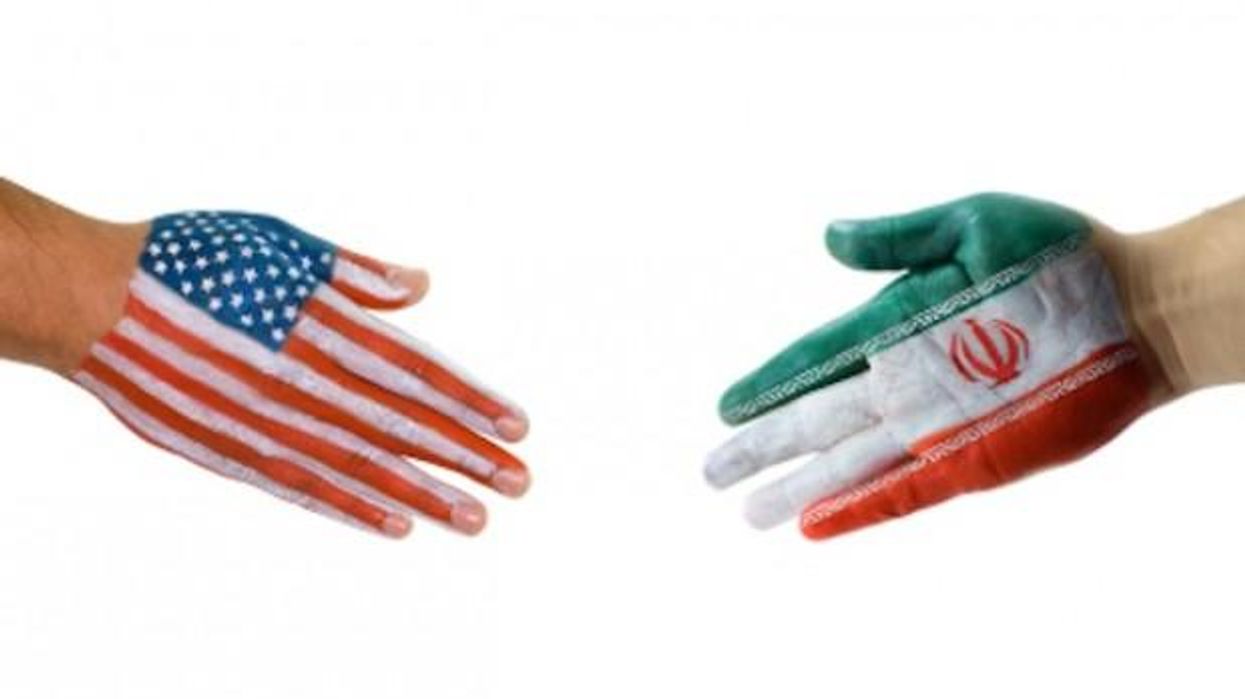
Editor's note: The National Iranian-American Council has released a letter, signed by 30 foreign policy practitioners, calling on the U.S., Europe, and Iran to take steps to reduce tensions in the Persian Gulf.
July 30, 2019
As foreign-policy practitioners with decades of collective experience in national security and diplomacy, we write to warn that U.S.-Iran tensions have entered a dangerous new phase that has put us on the brink of a disastrous and avoidable war. The administration's decision to violate the Iran nuclear agreement in pursuit of a so-called maximum pressure strategy is damaging the accord and U.S. interests in ways that could be difficult to reverse. There remains a narrow path for the U.S. and Iran to avoid military conflict and resolve ongoing disputes through negotiations. Doing so, however, will require bold action and constructive steps from all sides, as outlined below.
The U.S. Should Suspend Recent Sanctions to Provide Space for Diplomacy
Iran Should Return to Full Compliance with the Nuclear Accord
The U.S. and Iran Should Pursue a Prisoner Swap
Europe Must Take More Serious Steps to Address Challenges in Meeting Its Sanctions Relief Obligations
The U.S. and Iran Must Reestablish Communication Channels
The U.S. Should Appoint a Credible and Empowered Iran Envoy
Pursue an Agreement to Avoid Confrontations in the Persian Gulf
U.S. Congress Should Pass Legislation to Prevent War
Signatories:
Jamal Abdi, President, National Iranian Amerian Council
Arshin Adib-Moghaddam, Professor in Global Thought and Comparative Philosophies at SOAS, University of London and Fellow of Hughes Hall, University of Cambridge
Sanam Naraghi Anderlini, Founder and CEO, International Civil Society Action Network (ICAN)
Andrew Bacevich, Co-founder, Quincy Institute for Responsible Statecraft
Juan Cole, Richard P. Mitchell Collegiate Professor of History at the University of Michigan
Michael C. Desch, Packey J. Dee Professor of International Relations, University of Notre Dame
Dina Esfandiary, Fellow, International Security Program, Belfer Center for Science and Security Studies, Harvard University; Fellow, The Century Foundation
John L. Esposito, Professor of Religion & International Affairs and Islamic Studies at Georgetown University
Farideh Farhi, Affiliate Graduate Faculty of Political Science, University of Hawai'i at Manoa
Nancy W. Gallagher, Director, Center for International and Security Studies at Maryland and Research Professor of Public Policy, University of Maryland
Mark Gasiorowski, Professor, Department of Political Science, Tulane University
Kevan Harris, Assistant Professor of Sociology studying development and social change in the global South, UCLA
Rula Jebreal, Professor, American University of Rome
Peter Jenkins, Former UK Ambassador to the IAEA
Bijan Khajehpour, Managing partner at Vienna-based Eurasian Nexus Partners, a strategy consulting firm focused on the Eurasian region
Lawrence Korb, Senior Fellow at the Center for American Progress, former Assistant Secretary of Defense (1981-1985)
Peter Kuznick, Professor of History and Director, Nuclear Studies Institute, American University
Joshua Landis, Sandra Mackey Professor of Middle East Studies and Director of the Center for Middle East Studies at the University of Oklahoma
Daniel Larison, Senior Editor, The American Conservative
John J. Mearsheimer, R. Wendell Harrison Distinguished Service Professor of Political Science, University of Chicago
Francois Nicoullaud, Former French Ambassador to Iran
Rouzbeh Parsi, Visiting Research Scholar, Sharmin and Bijan Mossavar-Rahmani Center for Iran and Persian Gulf Studies, Princeton University; Head of the Middle East and North Africa Programme at the Swedish Institute of International Affairs-Stockholm; Senior Lecturer, Human Rights Studies, Lund University
Trita Parsi, Co-founder, Quincy Institute for Responsible Statecraft; Adjunct Associate Professor, Georgetown University
Thomas R. Pickering, former Under Secretary of State and Ambassador to Russia, India, the United Nations and Israel
Paul Pillar, Nonresident Senior Fellow at the Center for Security Studies at Georgetown University and Nonresident Senior Fellow in Foreign Policy at the Brookings Institution
Edward Price, Director of Policy and Communications, National Security Action; former National Security Council Spokesperson; Former Special Assistant to President Obama for National Security Affairs
Barbara Slavin
John F. Tierney, former Member of Congress and Executive Director of Center for Arms Control and Non-Proliferation and of Council for a Livable World
Stephen Walt, Robert and Renee Belfer Professor of International Affairs, Harvard Kennedy School
Lawrence Wilkerson, Visiting Professor of Government and Public Policy at the College of William & Mary and former chief of staff to Secretary of State Colin Powell

[Editorial note: This remnant of a manuscript, discovered in a vault near the coastal town of Walpole, Massachusetts, appears to have been part of a larger project, probably envisioned as an interpretive history of theUnited States since the year 2000. Only a single chapter, probably written near the midpoint of the twenty-first century, has survived. Whether the remainder of the manuscript has been lost or the author abandoned it before its completion is unknown.]
Chapter 1
The Launch
From our present vantage point, it seems clear that, by 2019, the United States had passed a point of no return. In retrospect, this was the moment when indications of things gone fundamentally awry should have become unmistakable. Although at the time much remained hidden in shadows, the historic pivot now commonly referred to as the Great Reckoning had commenced.
Even today, it remains difficult to understand why, given mounting evidence of a grave crisis, passivity persisted for so long across most sectors of society. An epidemic of anomie affected a large swath of the population. Faced with a blizzard of troubling developments, large and small, Americans found it difficult to put things into anything approximating useful perspective. Few even bothered to try. Fewer succeeded. As with predictions of cataclysmic earthquakes or volcanic eruptions, a not-in-my-lifetime mood generally prevailed.
During what was then misleadingly known as the Age of Trump, the political classes dithered. While the antics of President Donald Trump provoked intense interest -- the word "intense" hardly covers the attention paid to him -- they also provided a convenient excuse for letting partisan bickering take precedence over actual governance or problem solving of any sort. Meanwhile, "thought leaders" (a term then commonly used to describe pontificating windbags) indulged themselves with various pet projects.
In the midst of what commentators were pleased to call the Information Age, most ordinary Americans showed a pronounced affinity for trivia over matters of substance. A staggering number of citizens willingly traded freedom and privacy for convenience, bowing to the dictates of an ever-expanding array of personalized gadgetry. What was then called a "smartphone" functioned as a talisman of sorts, the electronic equivalent of a rosary or prayer beads. Especially among the young, separation from one's "phone" for more than a few minutes could cause acute anxiety and distress. The novelty of "social media" had not yet worn off, with its most insidious implications just being discovered.
Divided, distracted, and desperately trying to keep up: these emerged then as the abiding traits of life in contemporary America. Craft beer, small-batch bourbon, and dining at the latest farm-to-table restaurant often seemed to matter more than the fate of the nation or, for that matter, the planet as a whole. But all that was about to change.
Scholars will undoubtedly locate the origins of the Great Reckoning well before 2019. Perhaps they will trace its source to the aftermath of the Cold War when American elites succumbed to a remarkable bout of imperial hubris, while ignoring (thanks in part to the efforts of Big Energy companies) the already growing body of information on the human-induced alteration of the planet, which came to be called "climate change" or "global warming." While, generally speaking, the collective story of humankind unfolds along a continuum, by 2019 conditions conducive to disruptive change were forming. History was about to zig sharply off its expected course.
This disruption occurred, of course, within a specific context. During the first two decades of the twenty-first century, American society absorbed a series of punishing blows. First came the contested election of 2000, the president of the United States installed in office by a 5-4 vote of a politicized Supreme Court, which thereby effectively usurped the role of the electorate. And that was just for starters. Following in short order came the terrorist attacks of September 11, 2001, which the world's (self-proclaimed) premier intelligence services failed to anticipate and the world's preeminent military establishment failed to avert.
Less than two years later, the administration of George W. Bush, operating under the delusion that the ongoing war in Afghanistan was essentially won, ordered U.S. forces to invade Iraq, a nation that had played no part in the events of 9/11. The result of this patently illegal war of aggression would not be victory, despite the president's almost instant "mission accomplished" declaration, but a painful replay of the quagmire that U.S. troops had experienced decades before in Vietnam. Expectations of Iraq's "liberation" paving the way for a broader Freedom Agenda that would democratize the Islamic world came to naught. The Iraq War and other armed interventions initiated during the first two decades of the century ended up costing trillions of taxpayer dollars, while sowing the seeds of instability across much of the Greater Middle East and later Africa.
Then, in August 2005, Hurricane Katrina smashed into the Gulf Coast, killing nearly 2,000 Americans. U.S. government agencies responded with breathtaking ineptitude, a sign of things to come, as nature itself was turning increasingly unruly. Other natural disasters of unnatural magnitude followed. In 2007, to cite but one example, more than 9,000 wildfires in California swept through more than a million acres. Like swarms of locusts, fires now became an annual (and worsening) plague ravaging the Golden State and the rest of the West Coast. If this weren't enough of a harbinger of approaching environmental catastrophe, the populations of honeybees, vital to American agriculture, began to collapse in these very same years.
Americans were, as it turned out, largely indifferent to the fate of honeybees. They paid far greater attention to the economy, however, which experienced its own form of collapse in 2008. The ensuing Great Recession saw millions thrown out of work and millions more lose their homes as a result of fraudulent mortgage practices. None of the perpetrators were punished. The administration of President Barack Obama chose instead to bail out offending banks and large corporations. Record federal deficits resulted, as the government abandoned once and for all even the pretense of trying to balance the budget. And, of course, the nation's multiple wars dragged on and on and on.
Through all these trials, the American people more or less persevered. If not altogether stoic, they remained largely compliant. As a result, few members of the nation's political, economic, intellectual, or cultural elites showed any awareness that something fundamental might be amiss. The two established parties retained their monopoly on national politics. As late as 2016, the status quo appeared firmly intact. Only with that year's presidential election did large numbers of citizens signal that they had had enough: wearing red MAGA caps rather than wielding pitchforks, they joined Donald Trump's assault on that elite and, thumbing their noses at Washington, installed a reality TV star in the White House.
To the legions who had found the previous status quo agreeable, Trump's ascent to the apex of American politics amounted to an unbearable affront. They might tolerate purposeless, endless wars, raise more or less any set of funds for the military that was so unsuccessfully fighting them, and turn a blind eye to economic arrangements that fostered inequality on a staggering scale. They might respond to the accelerating threat posed by climate change with lip service and, at best, quarter-measures. But Donald Trump in the Oval Office? That they could not abide.
As a result, from the moment of his election, Trump dominated the American scene. Yet the outrage that he provoked, day in and day out, had this unfortunate side effect: it obscured developments that would in time prove to be of far more importance than the 45th American president himself. Like the "noise" masking signals that, if detected and correctly interpreted, might have averted Pearl Harbor in December 1941 or, for that matter, 9/11, obsessing about Trump caused observers to regularly overlook or discount matters far transcending in significance the daily ration of presidential shenanigans.
Here, then, is a very partial listing of some of the most important of those signals then readily available to anyone bothering to pay attention. On the eve of the Great Reckoning, however, they were generally treated as mere curiosities or matters of limited urgency -- problems to be deferred to a later, more congenial moment.
Item: The reality of climate change was now indisputable. All that remained in question was how rapidly it would occur and the extent (and again rapidity) of the devastation that it would ultimately inflict.
Item: Despite everything that was then known about the dangers of further carbon emissions, the major atmospheric contributor to global warming, they only continued to increase, despite the myriad conferences and agreements intended to curb them. (U.S. carbon emissions, in particular, were still rising then, and global emissions were expected to rise by record or near-record amounts as 2019 began.)
Item: The polar icecap was disappearing, with scientists reporting that it had melted more in just 20 years than in the previous 10,000. This, in turn, meant that sea levels would continue to rise at record rates, posing an increasing threat to coastal cities.
Item: Deforestation and desertification were occurring at an alarming rate.
Item: Approximately eight million metric tons of plastic were seeping into the world's oceans each year, from the ingestion of which vast numbers of seabirds, fish, and marine mammals were dying annually. Payback would come in the form of microplastics contained in seafood consumed by humans.
Item: With China and other Asian countries increasingly refusing to accept American recyclables, municipalities in the United States found themselves overwhelmed by accumulations of discarded glass, plastic, metal, cardboard, and paper. That year, the complete breakdown of the global recycling system already loomed as a possibility.
Item: Worldwide bird and insect populations were plummeting. In other words, the Sixth Mass Extinction had begun.
All of these fall into the category of what we recognize today as planetary issues of existential importance. But even in 2019 there were other matters of less than planetary significance that ought to have functioned as a wake-up call. Among them were:
Item: With the federal government demonstrably unable to secure U.S. borders, immigration authorities were seizing hundreds of thousands of migrants annually. By 2019, the Trump administration was confining significant numbers of those migrants, including small children, in what were, in effect, concentration camps.
Item: Cybercrime had become a major growth industry, on track to rake in $6 trillion annually by 2021. Hackers were already demonstrating the ability to hold large American cities hostage and the authorities proved incapable of catching up.
Item: With the three richest Americans -- Jeff Bezos, Bill Gates, and Warren Buffet -- controlling more wealth than the bottom 50% of the entire population, the United States had become a full-fledged oligarchy. While politicians occasionally expressed their dismay about this reality, prior to 2019 it was widely tolerated.
Item: As measured by roads, bridges, dams, or public transportation systems, the nation's infrastructure was strikingly inferior to what it had been a half-century earlier. (By 2019, China, for instance, had built more than 19,000 miles of high-speed rail; the U.S., not one.) Agreement that this was a problem that needed fixing was universal; corrective action (and government financing), however, was not forthcoming.
Item: Military spending in constant dollars exceeded what it had been at the height of the Cold War when the country's main adversary, the Soviet Union, had a large army with up-to-date equipment and an arsenal of nuclear weapons. In 2019, Iran, the country's most likely adversary, had a modest army and no nuclear weapons.
Item: Incivility, rudeness, bullying, and general nastiness had become rampant, while the White House, once the site of solemn ceremony, deliberation, and decision, played host to politically divisive shouting matches and verbal brawls.
To say that Americans were oblivious to such matters would be inaccurate. Some were, for instance, considering a ban on plastic straws. Yet taken as a whole, the many indications of systemic and even planetary dysfunction received infinitely less popular attention than the pregnancies of British royals, the antics of the justifiably forgotten Kardashian clan, or fantasy football, a briefly popular early twenty-first century fad.
Of course, decades later, viewed with the benefit of hindsight, the implications of these various trends and data points seem painfully clear: the dominant ideological abstraction of late postmodernity -- liberal democratic capitalism -- was rapidly failing or had simply become irrelevant to the challenges facing the United States and the human species as a whole. To employ another then-popular phrase, liberal democratic capitalism had become an expression of "fake news," a scam sold to the many for the benefit of the privileged few.
"Toward the end of an age," historian John Lukacs (1924-2019) once observed, "more and more people lose faith in their institutions and finally they abandon their belief that these institutions might still be reformed from within." Lukacs wrote those words in 1970, but they aptly described the situation that had come to exist in that turning-point year of 2019. Basic American institutions -- the overworked U.S. military being a singular exception -- no longer commanded popular respect.
In essence, the postmodern age was ending, though few seemed to know it -- with elites, in particular, largely oblivious to what was occurring. What would replace postmodernity in a planet heading for ruin remained to be seen.
Only when...
[Editor's note: Here the account breaks off.]
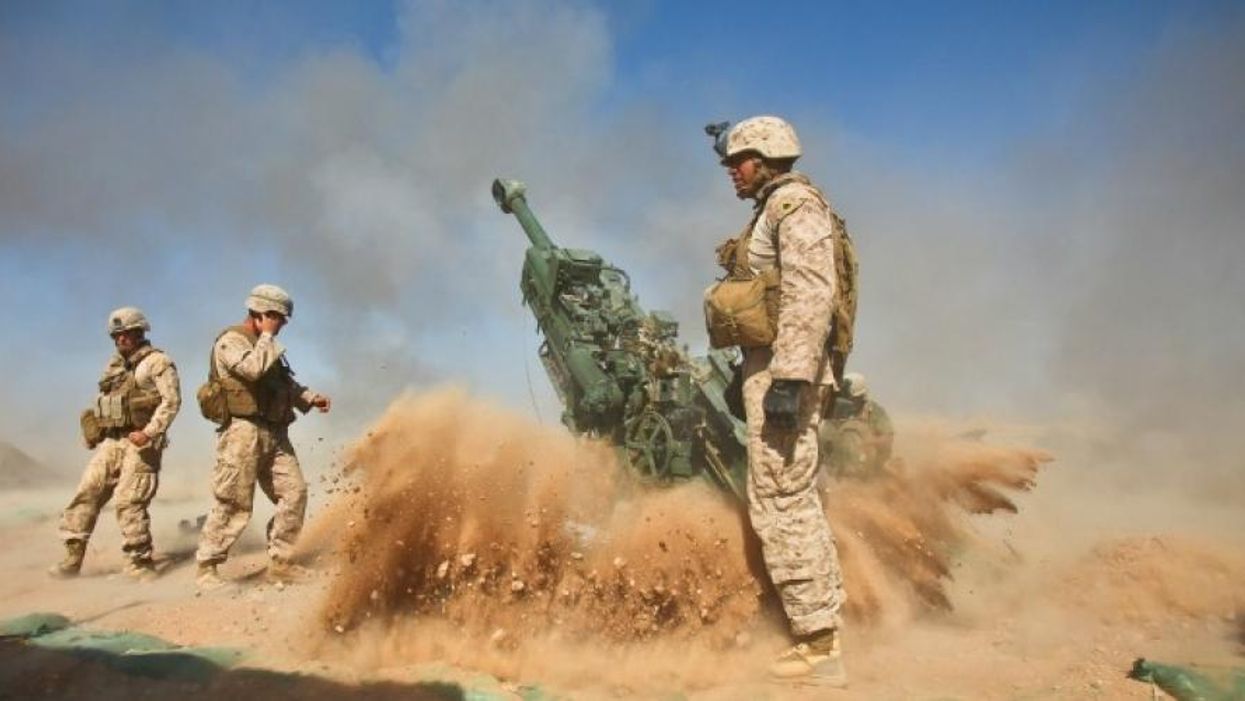
When Donald Trump entered the Oval Office in January 2017, Americans took to the streets all across the country to protest their instantly endangered rights. Conspicuously absent from the newfound civic engagement, despite more than a decade and a half of this country's fruitless, destructive wars across the Greater Middle East and northern Africa, was antiwar sentiment, much less an actual movement.
Those like me working against America's seemingly endless wars wondered why the subject merited so little discussion, attention, or protest. Was it because the still-spreading war on terror remained shrouded in government secrecy? Was the lack of media coverage about what America was doing overseas to blame? Or was it simply that most Americans didn't care about what was happening past the water's edge? If you had asked me two years ago, I would have chosen "all of the above." Now, I'm not so sure.
After the enormous demonstrations against the invasion of Iraq in 2003, the antiwar movement disappeared almost as suddenly as it began, with some even openly declaring it dead.
After the enormous demonstrations against the invasion of Iraq in 2003, the antiwar movement disappeared almost as suddenly as it began, with some even openly declaring it dead. Critics noted the long-term absence of significant protests against those wars, a lack of political will in Congress to deal with them, and ultimately, apathy on matters of war and peace when compared to issues like health care, gun control, or recently even climate change.
The pessimists have been right to point out that none of the plethora of marches on Washington since Donald Trump was elected have had even a secondary focus on America's fruitless wars. They're certainly right to question why Congress, with the constitutional duty to declare war, has until recently allowed both presidents Barack Obama and Donald Trump to wage war as they wished without even consulting them. They're right to feel nervous when a national poll shows that more Americans think we're fighting a war in Iran (we're not) than a war in Somalia (we are).
But here's what I've been wondering recently: What if there's an antiwar movement growing right under our noses and we just haven't noticed? What if we don't see it, in part, because it doesn't look like any antiwar movement we've even imagined?
If a movement is only a movement when people fill the streets, then maybe the critics are right. It might also be fair to say, however, that protest marches do not always a movement make. Movements are defined by their ability to challenge the status quo and, right now, that's what might be beginning to happen when it comes to America's wars.
What if it's Parkland students condemning American imperialism or groups fighting the Muslim Ban that are also fighting the war on terror? It's veterans not only trying to take on the wars they fought in, but putting themselves on the front lines of the gun control, climate change, and police brutality debates. It's Congress passing the first War Powers Resolution in almost 50 years. It's Democratic presidential candidates signing a pledge to end America's endless wars.
For the last decade and a half, Americans--and their elected representatives--looked at our endless wars and essentially shrugged. In 2019, however, an antiwar movement seems to be brewing. It just doesn't look like the ones that some remember from the Vietnam era and others from the pre-invasion-of-Iraq moment. Instead, it's a movement that's being woven into just about every other issue that Americans are fighting for right now--which is exactly why it might actually work.
A Veteran's Antiwar Movement in the Making?
During the Vietnam War of the 1960s and early 1970s, protests began with religious groups and peace organizations morally opposed to war. As that conflict intensified, however, students began to join the movement, then civil rights leaders like Martin Luther King, Jr. got involved, then war veterans who had witnessed the horror firsthand stepped in--until, with a seemingly constant storm of protest in the streets, Washington eventually withdrew from Indochina.
You might look at the lack of public outrage now, or perhaps the exhaustion of having been outraged and nothing changing, and think an antiwar movement doesn't exist. Certainly, there's nothing like the active one that fought against America's involvement in Vietnam for so long and so persistently. Yet it's important to notice that, among some of the very same groups (like veterans, students, and even politicians) that fought against that war, a healthy skepticism about America's twenty-first-century wars, the Pentagon, the military industrial complex, and even the very idea of American exceptionalism is finally on the rise--or so the polls tell us.
Right after the midterms last year, an organization named Foundation for Liberty and American Greatness reported mournfully that younger Americans were "turning on the country and forgetting its ideals," with nearly half believing that this country isn't "great" and many eyeing the U.S. flag as "a sign of intolerance and hatred." With millennials and Generation Z rapidly becoming the largest voting bloc in America for the next 20 years, their priorities are taking center stage. When it comes to foreign policy and war, as it happens, they're quite different from the generations that preceded them. According to the Chicago Council of Global Affairs,
"Each successor generation is less likely than the previous to prioritize maintaining superior military power worldwide as a goal of U.S. foreign policy, to see U.S. military superiority as a very effective way of achieving U.S. foreign policy goals, and to support expanding defense spending. At the same time, support for international cooperation and free trade remains high across the generations. In fact, younger Americans are more inclined to support cooperative approaches to U.S. foreign policy and more likely to feel favorably towards trade and globalization."
Although marches are the most public way to protest, another striking but understated way is simply not to engage with the systems one doesn't agree with. For instance, the vast majority of today's teenagers aren't at all interested in joining the all-volunteer military. Last year, for the first time since the height of the Iraq war 13 years ago, the Army fell thousands of troops short of its recruiting goals. That trend was emphasized in a 2017 Department of Defense poll that found only 14% of respondents ages 16 to 24 said it was likely they'd serve in the military in the coming years. This has the Army so worried that it has been refocusing its recruitment efforts on creating an entirely new strategy aimed specifically at Generation Z.
In addition, we're finally seeing what happens when soldiers from America's post-9/11 wars come home infused with a sense of hopelessness in relation to those conflicts. These days, significant numbers of young veterans have been returning disillusioned and ready to lobby Congress against wars they once, however unknowingly, bought into. Look no farther than a new left-right alliance between two influential veterans groups, VoteVets and Concerned Veterans for America, to stop those forever wars. Their campaign, aimed specifically at getting Congress to weigh in on issues of war and peace, is emblematic of what may be a diverse potential movement coming together to oppose America's conflicts. Another veterans group, Common Defense, is similarly asking politicians to sign a pledge to end those wars. In just a couple of months, they've gotten on board 10 congressional sponsors, including freshmen heavyweights in the House of Representatives Alexandria Ocasio-Cortez and Ilhan Omar.
Sooner or later fighting climate change will mean taking on the Pentagon's global footprint, too.
And this may just be the tip of a growing antiwar iceberg. A misconception about movement-building is that everyone is there for the same reason, however broadly defined. That's often not the case and sometimes it's possible that you're in a movement and don't even know it. If, for instance, I asked a room full of climate-change activists whether they also considered themselves part of an antiwar movement, I can imagine the denials I'd get. And yet, whether they know it or not, sooner or later fighting climate change will mean taking on the Pentagon's global footprint, too.
Think about it: not only is the U.S. military the world's largest institutional consumer of fossil fuels but, according to a new report from Brown University's Costs of War Project, between 2001 and 2017, it released more than 1.2 billion metric tons of greenhouse gases into the atmosphere (400 million of which were related to the waron terror). That's equivalent to the emissions of 257 million passenger cars, more than double the number currently on the road in the U.S.
A Growing Antiwar Movement in Congress
One way to sense the growth of antiwar sentiment in this country is to look not at the empty streets or even at veterans organizations or recruitment polls, but at Congress. After all, one indicator of a successful movement, however incipient, is its power to influence and change those making the decisions in Washington. Since Donald Trump was elected, the most visible evidence of growing antiwar sentiment is the way America's congressional policymakers have increasingly become engaged with issues of war and peace. Politicians, after all, tend to follow the voters and, right now, growing numbers of them seem to be following rising antiwar sentiment back home into an expanding set of debates about war and peace in the age of Trump.
In campaign season 2016, in an op-ed in the Washington Post, political scientist Elizabeth Saunders wondered whether foreign policy would play a significant role in the presidential election. "Not likely," she concluded. "Voters do not pay much attention to foreign policy." And at the time, she was on to something. For instance, Senator Bernie Sanders, then competing for the Democratic presidential nomination against Hillary Clinton, didn't even prepare stock answers to basic national security questions, choosing instead, if asked at all, to quickly pivot back to more familiar topics. In a debate with Clinton, for instance, he was asked whether he would keep troops in Afghanistan to deal with the growing success of the Taliban. In his answer, he skipped Afghanistan entirely, while warning only vaguely against a "quagmire" in Iraq and Syria.
Heading for 2020, Sanders is once again competing for the nomination, but instead of shying away from foreign policy, starting in 2017, he became the face of what could be a new American way of thinking when it comes to how we see our role in the world.
In February 2018, Sanders also became the first senator to risk introducing a war powers resolution to end American support for the brutal Saudi-led war in Yemen. In April 2019, with the sponsorship of other senators added to his, the bill ultimately passed the House and the Senate in an extremely rare showing of bipartisanship, only to be vetoed by President Trump. That such a bill might pass the House, no less a still-Republican Senate, even if not by a veto-proof majority, would have been unthinkable in 2016. So much has changed since the last election that support for the Yemen resolution has now become what Tara Golshan at Vox termed "a litmus test of the Democratic Party's progressive shift on foreign policy."
Nor, strikingly enough, is Sanders the only Democratic presidential candidate now running on what is essentially an antiwar platform. One of the main aspects of Elizabeth Warren's foreign policy plan, for instance, is to "seriously review the country's military commitments overseas, and that includes bringing U.S. troops home from Afghanistan and Iraq." Entrepreneur Andrew Yang and former Alaska Senator Mike Gravel have joined Sanders and Warren in signing a pledge to end America's forever wars if elected. Beto O'Rourke has called for the repeal of Congress's 2001 Authorization to Use Military Force that presidents have cited ever since whenever they've sent American forces into battle. Marianne Williamson, one of the many (unlikely) Democratic candidates seeking the nomination, has even proposed a plan to transform America's "wartime economy into a peace-time economy, repurposing the tremendous talents and infrastructure of [America's] military industrial complex... to the work of promoting life instead of death."
And for the first time ever, three veterans of America's post-9/11 wars--Seth Moulton and Tulsi Gabbard of the House of Representatives, and South Bend Mayor Pete Buttigieg--are running for president, bringing their skepticism about American interventionism with them. The very inclusion of such viewpoints in the presidential race is bound to change the conversation, putting a spotlight on America's wars in the months to come.
Get on Board or Get Out of the Way
When trying to create a movement, there are three likely outcomes: you will be accepted by the establishment, or rejected for your efforts, or the establishment will be replaced, in part or in whole, by those who agree with you. That last point is exactly what we've been seeing, at least among Democrats, in the Trump years. While 2020 Democratic candidates for president, some of whom have been in the political arena for decades, are gradually hopping on the end-the-endless-wars bandwagon, the real antiwar momentum in Washington has begun to come from new members of Congress like Alexandria Ocasio-Cortez (AOC) and Ilhan Omar who are unwilling to accept business as usual when it comes to either the Pentagon or the country's forever wars. In doing so, moreover, they are responding to what their constituents actually want.
Somewhere just under the surface of American life lurks a genuine, diverse antiwar movement that appears to be coalescing around a common goal: getting Washington politicians to believe that antiwar policies are supportable, even potentially popular.
As far back as 2014, when a University of Texas-Austin Energy Poll asked people where the U.S. government should spend their tax dollars, only 7% of respondents under 35 said it should go toward military and defense spending. Instead, in a "pretty significant political shift" at the time, they overwhelmingly opted for their tax dollars to go toward job creation and education. Such a trend has only become more apparent as those calling for free public college, Medicare-for-all, or a Green New Deal have come to realize that they could pay for such ideas if America would stop pouring trillions of dollars into wars that never should have been launched.
The new members of the House of Representatives, in particular, part of the youngest, most diverse crew to date, have begun to replace the old guard and are increasingly signalling their readiness to throw out policies that don't work for the American people, especially those reinforcing the American war machine. They understand that by ending the wars and beginning to scale back the military-industrial complex, this country could once again have the resources it needs to fix so many other problems.
In May, for instance, Omar tweeted, "We have to recognize that foreign policy IS domestic policy. We can't invest in health care, climate resilience, or education if we continue to spend more than half of discretionary spending on endless wars and Pentagon contracts. When I say we need something equivalent to the Green New Deal for foreign policy, it's this."
A few days before that, at a House Committee on Oversight and Reform hearing, Ocasio-Cortez confronted executives from military contractor TransDigm about the way they were price-gouging the American taxpayer by selling a $32 "non-vehicular clutch disc" to the Department of Defense for $1,443 per disc. "A pair of jeans can cost $32; imagine paying over $1,000 for that," she said. "Are you aware of how many doses of insulin we could get for that margin? I could've gotten over 1,500 people insulin for the cost of the margin of your price gouging for these vehicular discs alone."
And while such ridiculous waste isn't news to those of us who follow Pentagon spending closely, this was undoubtedly something many of her millions of supporters hadn't thought about before. After the hearing, Teen Vogue created a list of the "5 most ridiculous things the United States military has spent money on," comedian Sarah Silverman tweeted out the AOC hearing clip to her 12.6 million followers, Will and Grace actress Debra Messing publicly expressed her gratitude to AOC, and according to Crowdtangle, a social media analytics tool, the NowThis clip of her in that congressional hearing garnered more than 20 million impressions.
Not only are members of Congress beginning to call attention to such undercovered issues, but perhaps they're even starting to accomplish something. Just two weeks after that contentious hearing, TransDigm agreed to return $16.1 million in excess profits to the Department of Defense. "We saved more money today for the American people than our committee's entire budget for the year," said House Oversight Committee Chair Elijah Cummings.
Of course, antiwar demonstrators have yet to pour into the streets, even though the wars we're already involved in continue to drag on and a possible new one with Iran looms on the horizon. Still, there seems to be a notable trend in antiwar opinion and activism. Somewhere just under the surface of American life lurks a genuine, diverse antiwar movement that appears to be coalescing around a common goal: getting Washington politicians to believe that antiwar policies are supportable, even potentially popular. Call me an eternal optimist, but someday I can imagine such a movement helping end those disastrous wars.

How best to describe the recently completed allied commemoration of the 75th anniversary of the D-Day invasion of France? Two words come immediately to mind: heartfelt and poignant. The aged D-Day veterans gathering for what was probably the last time richly deserved every bit of praise bestowed on them. Yet one particular refrain that has become commonplace in this age of Donald Trump was absent from the proceedings. I'm referring to"fake news." In a curious collaboration, Trump and the media, their normal relationship one of mutual loathing, combined forces to falsify the history of World War II. Allow me to explain.
In a stirring presentation, Donald Trump--amazingly--rose to the occasion and captured the spirit of the moment, one of gratitude, respect, even awe. Ever so briefly, the president sounded presidential. In place of his usual taunts and insults, he managed a fair imitation of Ronald Reagan's legendary"Boys of Pointe Du Hoc" speech of 1984."We are gathered here on Freedom's Altar," Trump began--not exactly his standard introductory gambit.
Then, in a rare display of generosity toward people who were neither Republicans nor members of his immediate family, Trump acknowledged the contributions of those who had fought alongside the G.I.s at Normandy, singling out Brits, Canadians, Poles, Norwegians, Australians, and members of the French resistance for favorable mention. He related moving stories of great heroism and paid tribute to the dwindling number of D-Day veterans present. And as previous presidents had done on similar occasions marking D-Day anniversaries, he placed the events of that day in a reassuringly familiar historical context:
"The blood that they spilled, the tears that they shed, the lives that they gave, the sacrifice that they made, did not just win a battle. It did not just win a war. Those who fought here won a future for our nation. They won the survival of our civilization. And they showed us the way to love, cherish, and defend our way of life for many centuries to come."
Nor was that all."Today, as we stand together upon this sacred Earth," Trump concluded,
"We pledge that our nations will forever be strong and united. We will forever be together. Our people will forever be bold. Our hearts will forever be loyal. And our children, and their children, will forever and always be free."
Strong and united, together, bold, loyal, and free... forever.
It was, in its way, an astonishing performance, all the more so because it was entirely out of character. It was as if Secretary of State Mike Pompeo had published a book of sonnets or National Security Advisor John Bolton had performed a serviceable rendition of"Nessun dorma" on the steps of the Lincoln Memorial--wonderful in its way, but given the source startling as well.
Selective Remembering and Convenient Forgetting
If the purpose of Trump's speech was to make his listeners feel good, he delivered. Yet in doing so, he also relieved them of any responsibility for thinking too deeply about the event being commemorated.
Now, let me just say that I hold no brief for Josef Stalin or the Soviet Union, or Marxism-Leninism. Yet you don't need to be an apologist for Communism to acknowledge that the Normandy invasion would never have succeeded had it not been for the efforts of Marshal Stalin's Red Army. For three full years before the first wave of G.I.s splashed ashore at Omaha Beach, Russian troops had been waging a titanic struggle along a vast front in their own devastated land against the cream of the German military machine.
One data point alone summarizes the critical nature of the Soviet contribution: in May 1944, there were some 160 German divisions tied up on the Eastern Front. That represented more than two-thirds of the armed might of the Third Reich, 160 combat divisions that were therefore unavailable for commitment against the Anglo-American forces desperately trying to establish a foothold in Normandy.
As has been the custom for quite some time now the German chancellor, representing the defeated enemy, attended the D-Day anniversary festivities as an honored guest. Angela Merkel's inclusion testifies to an admirable capacity to forgive without forgetting.
Russian President Vladimir Putin did not, however, make the guest list. In liberal circles, Putin has, of course, made himself persona non grata. Yet excluding him obviated any need for Trump and other dignitaries in attendance to acknowledge, even indirectly, the Soviet role in winning World War II. Although the Red Army was never known for finesse or artfulness, it did kill an estimated four million of Merkel's countrymen, who were thereby not on hand to have a go at killing Donald Trump's countrymen.
If war is ultimately about mayhem and murder, then the Soviet Union did more than any other belligerent to bring about the final victory against Nazi Germany. Without for a second slighting the courage and contributions of our Canadian, Polish, Norwegian, and Australian comrades--bless them all--it was the Red Army that kept General Dwight Eisenhower's expeditionary command from being pushed back into the Channel. In other words, thank God for the godless communists.
So, however heartfelt and poignant, the 75th anniversary of the D-Day landings was an exercise in selective remembering and convenient forgetting. It was, in other words, propaganda or, in contemporary parlance, fake news. The deception--for that's what it was--did not escape the notice of Russian commentators. Yet members of the American media, otherwise ever alert to Trump's sundry half-truths and outright deceptions, chose to ignore or more accurately endorse this whopper.
Time to Get Over the Hangover?
How much does such selective remembering and convenient forgetting matter? A lot, in my estimation. Distorting the past distorts the present and sows confusion about the problems we actually face.
For a small illustration of the implications of this particular elision of history we need look no further than the D-Day anniversary-inspired ruminations of New York Times columnist Bret Stephens. The purpose of his column, which appeared on June 7th, was to spin the spin. Stephens was intent on reinforcing Trump's carefully edited interpretation of World War II in order to further his own version of a crusading and militarized American foreign policy agenda.
Now, the war against Adolf Hitler occurred a considerable time ago. The war against Iraqi autocrat Saddam Hussein is a far more recent memory. Which should have greater relevance for U.S. policy today? On that score, Stephens is quite clear: it's the"lessons" of World War II, not of the reckless invasion of Iraq, that must pertain, not only today but in perpetuity. Sure, the Iraq War turned out to be a bit of a headache."But how long," Stephens asks,"should the hangover last?" Time to take an Alka-Seltzer and get back to smiting evildoers, thereby keeping alive the ostensible tradition of the Greatest Generation.
"If we really wanted to honor the sacrifices of D-Day," Stephens writes,"we would do well to learn again what it is the Allies really fought for." According to him, they fought"not to save the United States or even Britain," but to liberate all of Europe; not to defeat Nazi Germany,"but to eradicate a despicable ideology"; and"not to subsume our values under our interests but to define our interests according to our values."
Now, only someone oblivious to the actual experience of war could subscribe to such a noble list of"what the Allies really fought for." Perhaps more to the point, in expounding on what inspired the Allied war effort, Stephens chose to overlook the fact that the ranks of those Allies included the Soviet Union. Winston Churchill, Franklin Roosevelt, and their generals would not have considered this a casual omission. They thanked their lucky stars for the Soviet Union's participation.
Furthermore, Soviet leaders from Josef Stalin on down entertained their own distinct ideas about the war's purposes. They adhered to and were intent on exporting an ideology hardly less despicable than that of the Nazis. Their purpose was not to liberate Europe, but to absorb large chunks of it into an expanded Soviet sphere of influence. And while correlating interests with values might have appealed to the Soviet dictator, the values to which he subscribed excluded just about every item in the American Bill of Rights. So if we are serious about identifying common war aims,"what the Allies really fought for" focused on one thing only: destroying the Third Reich.
Just like Trump, however, Stephens airbrushes the Soviet Union out of the picture. In doing so, he sanitizes the past. His motive is anything but innocent. Having concocted his own spurious version of"what the Allies really fought for," Stephens pivots to the present moment and discovers--wouldn't you know it--that we are right back in those terrible days of the 1930s when the Western democracies hesitated to confront the rising threat posed by Adolf Hitler.
Seventy years after D-Day, the world is in disarray. And the West, Stephens charges, is sitting on its hands. Syria is a mess. So is Venezuela. Kim Jong-Un,"the world's most sinister dictator," still rules North Korea. In Cuba, China, Saudi Arabia, and Iran, dissidents languish behind bars. Nobody"other than a few journalists and activists" seems to care. Everywhere indifference prevails.
And we've seen this movie before, he insists:
"This is the West almost as it looked in the 1930s: internally divided and inward looking, hesitant in the face of aggression, incanting political pieties in which it no longer believed--and so determined not to repeat the mistakes of the last war that it sleepwalked its way into the next."
Now, in those circles where neoconservatives congregate and call for the United States to embark upon some new crusade, this analysis undoubtedly finds favor. But as a description of actually existing reality, it's about as accurate as Trump's own periodic blathering about the state of the world.
Is the West today"inward looking"? Then how do we explain the presence of Western forces in Afghanistan, of all places, for nigh onto 20 years? Is the West "hesitant in the face of aggression"? How does that charge square with actions taken by the United States and its allies in Iraq, Libya, Somalia, Yemen, and elsewhere? When it comes to war, some might suggest that our problem of late has not been hesitancy, but unending hubris and the absence of even minimal due diligence. More often than not, when it comes to aggressive behavior, we're the ones spoiling for a fight. Take General Kenneth McKenzie, the latest bellicose head of U.S. Central Command, for example, who is now plugging for"a return to a larger U.S. military presence in the Middle East" with Iran in mind. Don't accuse him of hesitance.
The prescription that Stephens offers reduces to this: just as in June 1944, brave men with guns, preferably speaking English, will put things right and enable freedom and democracy to prevail. We need only gird our loins and make the effort.
It's all very inspiring really. Yet Stephens leaves out something important: this time we won't be able to count on some other nation with a large and willing army to do most of the fighting and dying on our behalf.

Don't try to deny it! The political temperature of this country is rising fast. Call it Trump change or Trump warming, if you want, but grasp one thing: increasingly, you're in a different land and, whatever happens to Donald Trump, the results down the line are likely to be ever less pretty. Trump change isn't just an American phenomenon, it's distinctly global. After all, from Australia to India, the Philippines to Hungary, Donald Trumps and their supporters keep getting elected or reelected and, according to a recent CNN poll, a majority of Americans think Trump himself will win again in 2020 (though, at the moment, battleground-state polls look grim for him).
Still, whether or not he gets a second term in the White House, he only seems like the problem, partially because no president, no politician, no one in history has ever gotten such 24/7 media coverage of every twitch, tweet, bizarre statement, falsehood, or fantasy he expresses (or even the clothes he wears). Think of it this way: we're in a moment in which the only thing the media can't imagine saying about Donald Trump is: "You're fired!" And believe me, that's just one sign of a media -- and a country -- with a temperature that's anything but 98.6.
Since you-know-who is always there, always being discussed, always @(un)realdonaldtrump, it's easy enough to imagine that everything that's going wrong -- or, if you happen to be part of his famed base, right (even if that right isn't so damned hot for you) -- is due to him. When we're gripped by such thinking and the temperature's rising, it hardly matters that just about everything he's "done" actually preceded him. That includes favoring the 1%, deporting record numbers of illegal immigrants, and making war (unsuccessfully) or threatening to do so across significant parts of the planet.
Here, then, is the question of the day, the sort you'd ask about any patient with a rising temperature: If Donald Trump is only the symptom, what's the disease?
Blowback Central
Let me say that the late Chalmers Johnson would have understood President Trump perfectly. The Donald clearly arrived on the scene as blowback -- the CIA term of tradecraft Johnson first put into our everyday vocabulary -- from at least two things: an American imperium gone wrong with its never-ending wars, ever-rising military budgets, and ever-expanding national security state, and a new "gilded age" in which three men (Bill Gates, Jeff Bezos, and Warren Buffett) have more wealth than the bottom half of society and the .01% have one of their own, a billionaire, in the Oval Office. (If you want to add a third blowback factor, try a media turned upside down by new ways of communicating and increasingly desperate to glue eyes to screens as ad revenues, budgets, and staffs shrank and the talking heads of cable news multiplied.)
Now, I don't mean to sell Donald Trump short in any way. Give that former reality TV star credit. Unlike either Hillary Clinton or any of his Republican opponents in the 2016 election campaign, he sensed that there were voters in profusion in the American heartland who felt that things were not going well and were eager for a candidate just like the one he was ready to become. (There were, of course, other natural audiences for a disruptive, self-promoting billionaire as well, including various millionaires and billionaires ready to support him, the Russians, the Saudis... well, you know the list). His skill, however, never lay in what he could actually do (mainly, in these years, cut taxes for the wealthy, impose tariffs, and tweet his head off). It lay in his ability to catch the blowback mood of that moment in a single slogan -- Make America Great Again, or MAGA -- that he trademarked in November 2012, only days after Mitt Romney lost his bid for the presidency to Barack Obama.
Yes, four years later in the 2016 election, others began to notice the impact of that slogan. You couldn't miss the multiplying MAGA hats, after all. Hillary Clinton's advisers even briefly came up with the lamest response imaginable to it: Make America Whole Again, or MAWA. But what few at the time really noted was the crucial word in that phrase: "again." Politically speaking, that single blowback word might then have been the most daring in the English language. In 2016, Donald Trump functionally said what no other candidate or politician of any significance in America dared to say: that the United States was no longer the greatest, most indispensable, most exceptionable nation or superpower or hyper-power ever to exist on Planet Earth.
That represented a groundbreaking recognition of reality. At the time, it didn't matter whether you were Barack Obama, Hillary Clinton, or Marco Rubio, you had to acknowledge some version of that formula of exceptionalism. Trump didn't and, believe me, that rang a bell in the American heartland, where lots of people had felt, however indirectly, the blowback from all those years of taxpayer-funded fruitless war, while not benefitting from infrastructure building or much of anything else. They experienced blowback from a country in which new billionaires were constantly being created, while the financial distance between CEO salaries and those of workers grew exponentially vaster by the year, and the financing of the political system became a 1% affair.
With that slogan, The Donald caught the spirit of a moment in which both imperial and economic decline, however unacknowledged by the Washington political elite, had indeed begun. In the process, as I wrote at that time, he crossed a psychologically taboo line and became America's first declinist candidate for president. MAGA captured a feeling already at large that tomorrow would be worse than today, which was already worse than yesterday. As it turned out, it mattered not at all that the billionaire conman spouting that trademarked phrase had long been part of the problem, not the solution.
He caught the essence of the moment, in other words, but certainly didn't faintly cause it in the years when he financed Trump Tower, watched his five Atlantic City casinos go bankrupt, and hosted The Apprentice. In that election campaign, he captured a previously forbidden reality of the twenty-first century. For example, I was already writing this in June 2016, five months before he was elected president:
"In its halcyon days, Washington could overthrow governments, install Shahs or other rulers, do more or less what it wanted across significant parts of the globe and reap rewards, while (as in the case of Iran) not paying any price, blowback-style, for decades, if at all. That was imperial power in the blaze of the noonday sun. These days, in case you hadn't noticed, blowback for our imperial actions seems to arrive as if by high-speed rail (of which by the way, the greatest power on the planet has yet to build a single mile, if you want a quick measure of decline).
"Despite having a more massive, technologically advanced, and better funded military than any other power or even group of powers on the planet, in the last decade and a half of constant war across the Greater Middle East and parts of Africa, the U.S. has won nothing, nada, zilch. Its unending wars have, in fact, led nowhere in a world growing more chaotic by the second."
Mind you, three years later the United States remains a staggeringly powerful imperial force, with hundreds of military bases still scattered across the globe, while its economic clout -- its corporations control about half the planet's wealth -- similarly remains beyond compare. Yet, even in 2016, it shouldn't have been hard to see that the American Century was indeed ending well before its 100 years were up. It shouldn't have been hard to grasp, as Donald Trump intuitively did, that this country, however powerful, was already both a declining empire -- thank you, George W. Bush for invading Iraq! Mission Accomplished! -- and a declining economic system (both of which still looked great indeed, if you happened to be profiting from them). That intuition and that slogan gave Trump his moment in... well, dare I call it "the afternoon sun"? They made him president.
MTPGA
In a sense, all of this should have been expectable enough. Despite the oddity of Donald Trump himself, there was little new in it, even for the imperial power that its enthusiasts once thought stood at "the end of history." You don't need to look far, after all, for evidence of the decline of empires. You don't even have to think back to the implosion of the Soviet Union in 1991, almost three decades ago in what now seems like the Stone Age. (Admittedly, Russian President Vladimir Putin, a brilliant imagineer, has brought back a facsimile of the old Soviet Union, even if, in reality, Russia is now a rickety, fraying petro-state.)
Just take a glance across the Atlantic at Great Britain at this moment. And imagine that three-quarters of a century ago, that modest-sized island nation still controlled all of India, colonies across the planet, and an impressive military and colonial service. Go back even further and you'll find yourself in a time when it was the true superpower of planet Earth. What a force it was -- industrially, militarily, colonially -- until, of course, it wasn't.
If you happen to be looking for imperial lessons, you could perhaps say that some empires end not with a bang but with a Brexit. Despite all the pomp and circumstance (tweeting and insults) during the visit of the Trump royal family (Donald, Melania, Ivanka, Jared, Donald Jr., Eric, and Tiffany) to the British royals, led by a queen who, at 93, can remember better days, here's something hard to deny: with Brexit (no matter how it turns out), the Earth's former superpower has landed in the sub-basement of history. Great Britain? Obviously that adjective has to change.
In the meantime, across the planet, China, another once great imperial power, perhaps the greatest in the long history of this planet, is clearly on the rise again from another kind of sub-basement. That, in turn, is deeply worrying the leadership, civilian and military, of the planet's "lone superpower." Its president, in response, is wielding his weapon of choice -- tariffs -- while the U.S. military prepares for an almost unimaginable future war with that upstart nation, possibly starting in the South China Sea.
Meanwhile, the still-dominant power on the planet is, however incrementally, heading down. It's nowhere near that sub-basement, of course -- anything but. It's still a rich, immensely powerful land. Its unsuccessful wars, however, go on without surcease, the political temperature rises, and democratic institutions continue to fray -- all of which began well before Donald Trump entered the Oval Office and, in fact, helped ensure that he would make it there in the first place.
And yet none of this, not even imperial decline itself, quite captures the "disease" of which The Donald is now such an obvious symptom. After all, while the rise and fall of imperial powers has been an essential part of history, the planetary context for that process is now changing in an unprecedented way. And that's not just because, since the 1945 atomic bombings of Hiroshima and Nagasaki, growing numbers of countries have come to possess the power to take the planet down in a cataclysm of fire and ice (as in nuclear winter). It's also because history, as we've known it, including the rise and fall of empires, is now, in a sense, melting away.
Trump change, the rising political temperature stirred by the growing populist right, is taking place in the context of (and, worse yet, aiding and abetting) record global temperatures, the melting of ice across the planet, the rise of sea levels and the future drowning of coastlines (and cities), the creation of yet more refugees, the increasing fierceness of fires and droughts, and the intensification of storms. In the midst of it all, an almost unimaginable wave of extinctions is occurring, with a possible million plant and animal species, some crucial to human existence, already on the verge of departure.
Never before in history has the rise and decline of imperial powers taken place in the context of the decline of the planet itself. Try, for instance, to imagine what a "risen" China will look like in an age in which one of its most populous regions, the north China plain, may by century's end be next to uninhabitable, given the killing heat waves of the future.
In the context of both Trump change and climate change, we're obviously still awaiting our true transformative president, the one who is not a symptom of decline, but a factor in trying to right this country and the Earth before it's too late. You know, the one who will take as his or her slogan, MTPGA (Make The Planet Great Again).
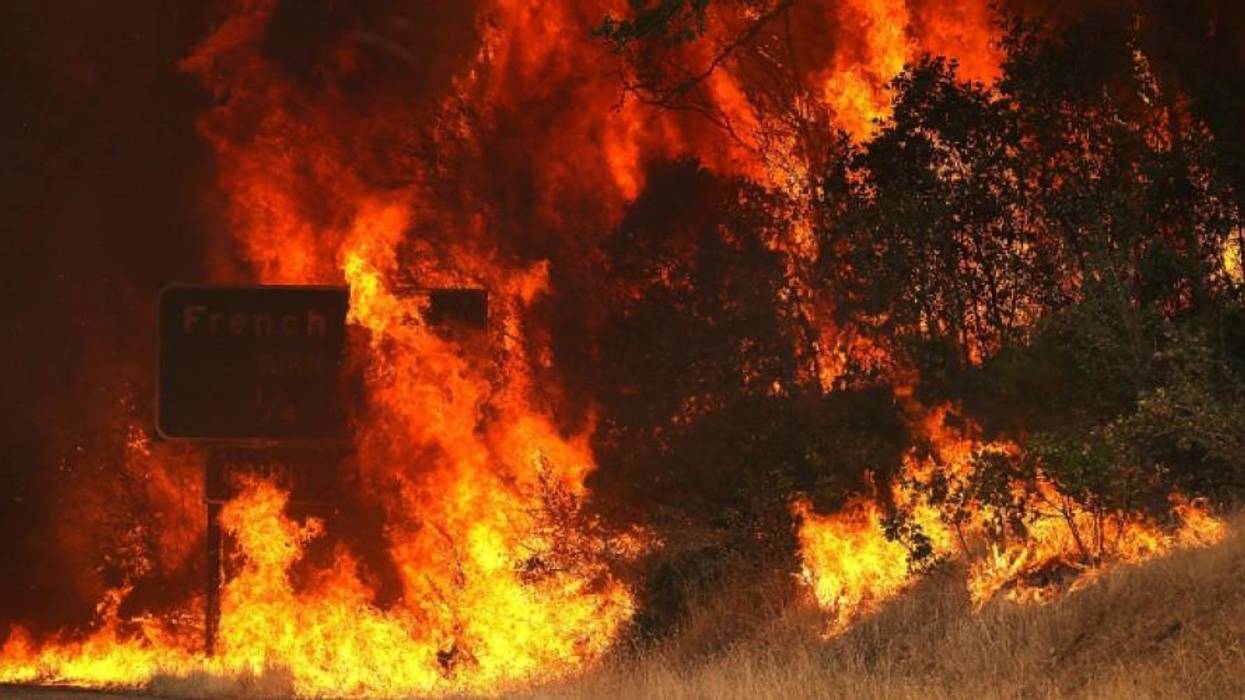
More and more, we look into our screens and gizmos. And this helps us--almost as if they were made for that purpose--not to think about the weather outside. Kept busy "curating" our own lives, we are regularly spared evidence of the coming catastrophe.
Long ago, in a memorable poem, Robert Frost guessed that there was a human need to bring the moods of the world into conformity with our moods:
"Tree at my window, window tree,
My sash is lowered when night comes on;
But let there never be curtain drawn
Between you and me."
He says he has seen the "head" of the tree "taken and tossed" in rough weather, as his own head was "taken and swept" by a dream. This resemblance between the world and himself somehow added to his interest in life:
"That day she put our heads together,
Fate had her imagination about her,
Your head so much concerned with outer,
Mine with inner, weather."
This sense of the human place in the fabric of nature--that there may be a deep connection between inner and outer weather--is starting to seem a thing of the past.
Can we still have inner weather when the outer weather changes so regularly and drastically? When 500 tornadoes rip through the country from Kansas to Pennsylvania in a matter of weeks? Or when 875,000 California acres burn down in the course of a summer? Rather than hear the message, we look into our smartphones or at our computer screens whose backgrounds may include breathtakingly lovely pictures of the planet--photos that show how beautiful a place it has been. As if we could have this Earth forever in reach, as if we could preserve it with a password or, by logging off, exchange it for another as lovely
There will be wars as a result of climate change; there will be mass migrations; there will be environmental destruction almost beyond imagining; and there will be increased inequality from all of those causes.
What Benjamin Franklin is rumored to have said about the American Republic is now true of the planet as well: we have a world, if we can keep it. But so much of our interest is directed elsewhere--to the work of "renaming," for example. There are scholars who think that by christening our age the Anthropocene, they are putting the fires and floods under a microscope. But does this human-centered word do much more than carve a new channel for pride? ("Just look around! It's all us!") The world, it seems, has become but one more link in the cyber-human chain by which we exit our natural bodies and turn into something rich and strange.
Greenhouse effect, global warming, climate change, climate disruption. Think of the succession of words we've used to describe the gradual onset of catastrophe and you see at once how inadequate words can be. In our time, corporate lingo has even rendered "disruptive" an admiring adjective for tech innovations on a par with "transformative." Think back to the way "creative destruction" was used in an age of trickle-down economics--the message was that the economic damage to so many people signaled a corporate creativity that would make the crooked places straight. Never mind the "destruction" part--the victims would find their recompense at a higher level.
The destruction always seems to be happening elsewhere. Of course we know better. The issue that should dwarf everything in sight today is planetary climate destruction. It's happening in plain sight and all around us, and most of us clearly can't bear to think about it. Why not? Because we are creatures of habit and immediacy, because the imagination can't fix for long on a distant and unbearable future. Habit disposes us to normalize the abnormal. It's a human propensity as natural as the protective mechanism that helps us not get stopped in our tracks by the painful things we did or suffered.
Lurking under the exhaustion, the unraveling, even the obliteration of nature is our awareness of another danger we have long grown used to denying. For there is a second way that organized society could be brought to an end: nuclear weapons, which require a kind of international control we haven't begun to imagine. To make much headway there, the world's sole remaining superpower would have to change its focus and drop all those other wars we're in. Few people can remember how we got into them, and even fewer (National Security Advisor John Bolton, Secretary of State Mike Pompeo, various Washington warriors and think-tank adepts) want them to continue, but these wars too have become a habit, a kind of addiction. Evidently we'll keep on fighting them unless something very big stops us.
War Parties and Other Distractions
In another remarkable poem, Robert Frost wondered whether the world would end in fire or ice. Destruction by fire, the poem suggests, may be the offspring of desire--the desire, above all, for power of a sort that keeps nations on the uneasy brink of war. However, as the poem goes on to say, cold indifference or hate could also bring an end to life on this planet:
"But if it had to perish twice
I think I know enough of hate
To say that for destruction ice
Is also great
And would suffice."
There could hardly be a surer allegory of our moment. The fire of the poem can stand in for our multiple wars and the shadow of nuclear cataclysm. And ice? Arctic sea ice is melting more rapidly than expected, as are the Antarctic ice sheets and glaciers everywhere. As they do, the sea level rises. Think of the ice as a premonition of the flood. And yet (naturally enough) these matters are off limits in polite conversation. We are kept on a steady course of avoidance by a wish for things to be normal. Perverse as it sounds, nothing is more normal than the next round of daily news about a bad man who is also big and crazy and (confess it) bizarrely fun to watch. The race to fetch and carry news about you-know-who helps us cling to a present that resembles the cartoons and comic books of the past.
Everyday politics is filled with distractions. On March 26th, for example, The Hill reported that Mitch McConnell had affirmed climate change is a human-caused phenomenon. Did he really believe that? "I do," he insisted, but the problem ought to be attacked in a reasonable state of mind: "The way to do this consistent with American values and American capitalism is through technology and innovation." So the Republican senate majority leader offered a Republican "solution" to global warming. Let the vested interests--Big Banks, Big Energy, Silicon Valley--join forces and solve it together. These things always get done eventually, don't they? As if on cue, from the minority leader of the Senate, there emerged a classic Democratic solution. Chuck Schumer said that the Senate ought to form a committee and investigate.
Another day, another distraction: the chairman of the Joint Chiefs of Staff, General Joseph Dunford, reported last month that Iran was engaged in an unprecedented "campaign" against the United States, a campaign revealed by his scrutiny of "multiple threat streams that were all perhaps coming together in time." The evidence on which his estimates were based appeared to be of Israeli provenance--a source that (on this subject particularly) many Americans have learned to distrust. About the same time, former Boeing executive Patrick Shanahan, who for the last half-year has served as acting secretary of defense, suggested that the president "doesn't want a war with Iran." Yet statements by Secretary of State Pompeo and National Security Advisor Bolton can hardly be said to bear out that claim. In a 2017 speech to MEK, the Iranian insurgent-terrorist group, John Bolton confidently predicted that "regime change" in Iran was imminent. Last month, he promised a similar insurrection in Cuba. Bolton's past behavior shows a consistent preference for war over other possible methods of undermining and destroying a foreign government.
Occasionally, a more hopeful distraction appears on the horizon. Just the other day, the Democratic presidential candidate Kirsten Gillibrand tweeted: "Our future is female. Intersectional. Powered by our belief in one another. And we're just getting started." In America, however, that prophesy is open to various interpretations. When it comes to the future and female leaders, consider the curriculum vitae of Condoleezza Rice, who served as national security advisor and later secretary of state for President George W. Bush and has since emerged as the leading name in the strategic consultancy firm RiceHadleyGates. It's an upmarket outfit, all of whose partners had a role in creating, widening, or protracting the never-ending war on terror and none of whom has been chastened by her or his experience of disaster. RiceHadleyGates's online bumpf assures you that the firm:
"works with senior executives of major companies to develop and implement their strategic plans and help companies expand in major emerging markets, including Asia, the Middle East, and the Americas. In addition, we assist companies dealing with the national security and foreign policy challenges associated with offering sophisticated technologies, products, and services in these overseas markets."
So the apostles of destruction by fire, female or otherwise, continue to reap their reward in status as well as hard cash.
And they have plenty of company. In the age of Trump, the war party of 2003-2006 has been resurrected behind the scenes. It can claim both a neoconservative and a neoliberal wing. Though in different tones of voice, both promote a return to American world leadership by force of--the polite word is "democracy" but the reality is, of course, ever-advancing strategic and tactical weapons systems in a Washington where the Pentagon budget grows more swollen every year. The neoconservative wing of that party, the Alliance for Securing Democracy, has on its board former Secretary of Homeland Security Michael Chertoff, former Republican congressman and chairman of the Select Committee on Intelligence Mike Rogers, and the neoconservative editor and columnist Bill Kristol. The neoliberal think tank, National Security Action, includes Barack Obama's speechwriter Ben Rhodes, along with Obama's national security advisors Tom Donilon and Susan Rice and the intervention strategist Anne-Marie Slaughter. Jake Sullivan, who was in line to be Hillary Clinton's national security advisor, sits on the advisory council of the first group and serves as co-chair of the second.
All of these people are pushing for a full-scale global renewal of liberal hegemony, supervised by the United States. The neoconservatives may look for regimes to topple, the neoliberals may prefer trade deals, but count on one thing: former officials and retired generals have already created a fresh environment in which they can safely mingle, brainstorm, and divvy up the world.
These people are the spiritual descendants of Alden Pyle, the "innocent" protagonist and title character of Graham Greene's 1955 Vietnam War novel, The Quiet American. "I hope to God you know what you are doing there," the English narrator Thomas Fowler says to Pyle. "Oh, I know your motives are good; they always are. I wish sometimes you had a few bad motives; you might understand a little more about human beings. And that applies to your country too, Pyle." After a plastic explosive goes off in a public place and kills the wrong people, Pyle says of the dead civilians: "They were only war casualties. It was a pity, but you can't always hit your target. Anyway, they died in the right cause." A little later he adds, "In a way you could say they died for democracy." Fowler replies: "I wouldn't know how to translate that into Vietnamese."
From our continuing failures, we can always be distracted by the memory of past glory--even when we know that the memory is largely counterfeit. George Packer's recent biography of the American diplomat Richard Holbrooke, Our Man, offers a proof of the method. Holbrooke was the finest flower of the U.S. foreign policy elite in the late twentieth century. He worked on the pacification program in Vietnam for the Agency for International Development, served as assistant secretary of state under Jimmy Carter--where, among his other duties, he facilitated the Indonesian occupation of East Timor--broadened his credentials for a decade on Wall Street, returned to public service as the Clinton administration's Balkan envoy and U.N. ambassador, and became at last a venerated but powerless authority on "global reach" as President Obama's special representative for Afghanistan and Pakistan.
Vietnam, Iraq, Afghanistan: Holbrooke supported all three of those disastrous wars in public, while reserving any guilty doubts for his private conversations and his diary. In non-diplomatic language, he was a careerist and a serial dissimulator, but Our Man contrives to elevate and almost pardon him because he did it in an idealistic cause, while seeking to preserve the facade of benevolent motives on which the reputation of his country depended. And he had to his credit one celebrated achievement: the Dayton Accords of 1995, which temporarily settled the conflict between Serbia and Croatia. This led to the 11-week-long bombing of Yugoslavia in 1999, which was said to have reasserted the "international norms" that NATO and the West stood for. The success of that mission would later be held up as a model for the anticipated success of the bombing, invasion, and occupation of Iraq.
Holbrooke politicked hard to get a Nobel Prize that never came his way for the Dayton Accords. As it turned out, the most lasting consequences of his actions in 1995 and his advice in 1999 have been the dismantling of Yugoslavia and the creation of Kosovo as a drug-warlord state. His biographer tells us that he was a charmer to some, an obnoxious self-promoter in the eyes of others. Even so, "our man" is praised in this account (with a touch of elegiac pathos) as one of the "almost great" American figures we ought to remember with respect and affection--the hero of a lost world of big ambitions and good intentions.
As Packer sees it (and many foreign-service and combat journalists would agree), America's faults have only been Holbrooke's faults, writ large. "After all," he writes,
"we Americans have never been good at managing the internal business of other countries. We're lousy imperialists. We're too chaotic and distracted--too democratic. We don't have the knowledge, the staying power, the public support, the class of elites with the desire and ability to run an empire. And we rarely have the moral standing we imagine."
The last sentence is careful to guard the author against any imputation of nostalgia for American hegemony, but in a sense the caution is unnecessary: in this account, the evil that we wrought came from incompetence, not malignity.
Still, look at the words again: "we rarely have the moral standing we imagine." It is the mildest of rebukes. Go to the back of the class, it says; get things right the next time. To see what is missing from such a judgment, compare the uninflected plainness of a sentence in John Mearsheimer's book The Great Delusion on the consequences of U.S. actions in Afghanistan, Iraq, Egypt, Libya, and Syria. "Not only has the United States failed to protect human rights and promote liberal democracy in those countries," Mearsheimer writes, "it has played a major role in spreading death and disorder across the greater Middle East." Count Vietnam and Iraq alone and the death toll inflicted by U.S. militarism is upward of two million abroad in the years since the Second World War. No other country comes close. And none of those engagements in Southeast Asia and later across the Greater Middle East and northern Africa can be claimed as a war of self-defense. All were wars of choice. How much should it matter that we only wanted to help?
There is a thought that never enters the mind of well-meaning liberals like Holbrooke and his biographer. The reason we can't teach others how to live is not that there is a good way of being an imperialist and Americans haven't learned it. No, we can't teach them because we don't understand ourselves well enough to know what we would teach. Yet Packer is drawn to admire Holbrooke by the nagging thought that "he believed that power brought responsibilities, and if we failed to face them the world's suffering would worsen, and eventually other people's problems would be ours, and if we didn't act no one else would... He was that rare American in the treetops who actually gave a shit about the dark places of the earth."
Notice the familiar and hackneyed warning that if we didn't venture out onto those distant battlefields of the planet, "other people's problems would be ours." In short, we must go to meet the enemy or he will come here. This has been the essential justification for every American war from Vietnam to the war on terror and the invasion of Iraq. That we could cause far worse problems by going to meet "the enemy" is the possibility invariably omitted under a haze of self-love and handsome regrets.
An Anything But Great World
When, in his essay "Perpetual Peace," Immanuel Kant spoke for an enlightened understanding of justice and called the apologists for war and empire "sorry comforters," he meant that they took the patterns of individual pride and fear as a collective rule for nations, and by doing so propagated a false idea of what action and suffering on a global scale could mean. Inseparably mixed with the cult of national self-love is the yearning to join the big boys who have made history. But where the fate of the world is at stake, the idea of "making history" through a struggle of great powers has been exposed as a cheat and a swindle.
Greatness in modern politics, in fact, has usually meant decisions that bring death to a great many unsuspecting people, most of whom have no connection to any problem the decisions were meant to solve. And yet this idea of greatness--or indispensability or exceptionalism--has so rooted itself in American electoral politics that a refusal to speak the comforting words may cause astonishment.
Senator Bernie Sanders was recently asked, "Do you feel you would be capable of using nuclear weapons in defense of the country?" He answered with bitter sarcasm, "Oh, yeah, anytime!"--and to make the meaning of "greatness" clear, he added: "Am I capable of blowing up the world?" The interviewer responded that he believed whether or not a politician would order a nuclear strike was "a great moral question." To this Sanders responded, "It's a great immoral question."
There are questions that should never be answered, because they degrade anyone involved in answering or even listening to them. The overriding legitimate question for governments today is this: Will the world end in fire or in flood--in nuclear catastrophe or climate catastrophe? With the exception of scientists, a few politicians, and increasing numbers of school-age children, most citizens and most of our leaders are looking away from the flood while greeting the fire with cliches as familiar as lullabies.
And now for the name you haven't heard but must somehow have expected, the subject of our favorite angry lullabies: Donald Trump. To mainstream journalists, he has become an object of unlimited enchantment and fascination. They treat him as if he were still the gonzo real-estate mogul and reality TV host it was impossible not to put on the front page because, in this age of social media, we're all writing for tabloids, aren't we? The symptomatic traits of a tabloid are no longer confined to journals like the National Enquirer. They encompass the New York Times, the Washington Post, CNN, MSNBC, and the major networks, not to mention the rest of us when the internet surf is up.
The reporters who build up Donald Trump as president--something they do with every smirk and gasp meant to show how much they want to take him down--surely believe in the reality of climate change (even if they seldom mention it) and they surely accept the dangers of a possible nuclear conflagration (though they mention it not at all). But the 24/7 journalism of the age of Trump has unfitted them to respond to the real dangers of this planet whose names are not Trump. To bring their reporting into line with the reality of climate change and the possibility that all our small wars could someday erupt into a world war, mainstream journalism would simply have to take him off the front page for weeks at a time.
Let us be optimists and suppose our luck holds out for another generation. Suppose we are spared destruction by fire. Climate change remains and its effects will be devastating, even though those effects are regularly dealt with as if they belonged to separate categories: immigration, inequality, environmental destruction, and war. There will be wars as a result of climate change; there will be mass migrations; there will be environmental destruction almost beyond imagining; and there will be increased inequality from all of those causes. Meeting the disruption that is already upon us will require kinds of planning and international arrangements that are foreign to our habits as the last superpower. Individuals, however powerful, however capricious, however destructive, in this context are never more than paltry symptoms. Paltry--that is to say, meager, sorry, anything but great.

Call it strange, but call it something. After all, never in history had there been such active opposition to a war before it began. I'm thinking, of course, about the antiwar surge that, in the winter and early spring of 2003, preceded the U.S. invasion of Iraq. Starting in the autumn of 2002, in fact, the top officials of President George W. Bush's administration couldn't have signaled more clearly that such an attack was coming. They had been ready to do so even earlier but, as White House Chief of Staff Andrew Card so classically put it, "From a marketing point of view, you don't introduce new products in August."
In the months that followed, one of those "new products" would turn out to be an antiwar movement. Outraged citizens took to the streets globally by the millions and, in this country, in small towns and large cities in staggering numbers carrying handmade signs saying things like "Contain Saddam--and Bush," "Remember when presidents were smart and bombs were dumb?," and "How did USA's oil get under Iraq's sand?" It was an unprecedented planetary movement of protest. More than a decade after the Soviet Union imploded, Patrick Tyler of the New York Times even suggested that those demonstrators might represent a second superpower. ("There may still be two superpowers on the planet: the United States and world public opinion.") And then, despite such opposition, the Bush administration launched its mission-accomplished invasion and, though in the years that followed disaster ensued, the marches died away and that antiwar movement seemed to evaporate.
Ever since, as the U.S. military intervened again and again--from Iraq to Yemen, Libya to Syria--throwing away literally trillions of dollars in the process, bombing, killing, uprooting, destroying, but never actually winning, next to no one would take to the streets in protest, no handmade signs would be made, no attention would seemingly be paid. Washington would continue to fight its endless sinkhole wars across the Greater Middle East and parts of Africa, unsettling whole swathes of the planet, with nary a peep at home.
Consider it one of the mysteries of our moment. Congress (until recently) remained supine when it came to those conflicts, while Americans basically looked the other way and went about their business as their tax dollars were squandered on a set of wars from hell. It's in this context--and that of a president who claimed he would get us out of our forever wars but only seems to keep getting us in further--that former Boston Globe columnist James Carroll, an antiwar activist (as I was) in the Vietnam era, looks back on that distant moment with a strange sense of regret (one that I deeply understand).
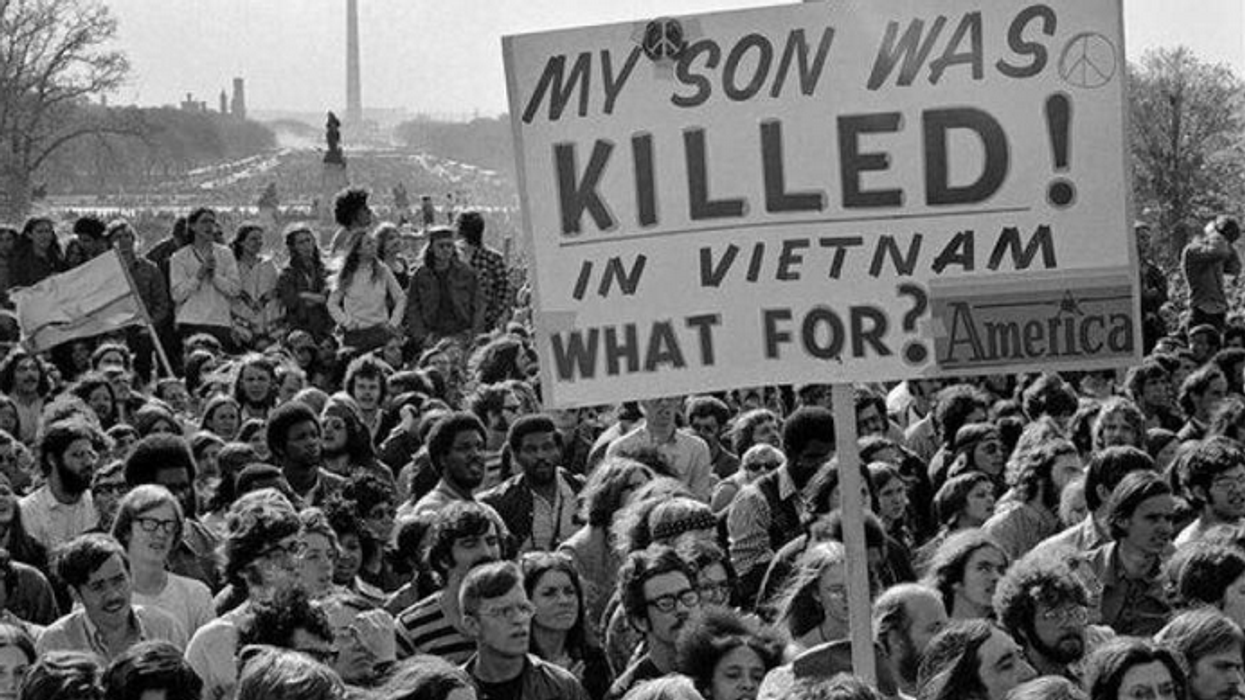
Earlier this month, the USS Abraham Lincoln carrier strike group -- the massive aircraft carrier itself with its dozens of warplanes and thousands of sailors and marines, a guided missile cruiser, and four destroyers -- suddenly began to make its way from the Mediterranean Sea into the Persian Gulf, heading for the waters off Iran. Pentagon sources spoke of ominous but unspecified threats. The U.S. military moved into a showy state of readiness, with reports that a force of up to 120,000 troops might be mobilized and sent to the Middle East for a possible future war with Iran.
In the Trump era, such American saber rattling, especially by hyper-hawkish National Security Advisor John Bolton, feels so unnervingly routine that it might not have even made me sit up. Then I read that the latest Middle East deployment included a task force of -- god save us from memory! -- B-52s, the massive strategic bombers dating from the 1950s that wreaked such havoc in the first great war of my adulthood: Vietnam.
Even as that now-ancient national trauma popped back into my mind, I chastised myself. Not every provocative U.S. naval deployment in sketchy waters off some distant coast is a set-up for a replay of the Gulf of Tonkin, that war-igniting North Vietnamese "attack" on U.S. destroyers that never was. I reminded myself as well that just because Bolton is sounding the alarm doesn't mean his counterparts in Tehran are harmless or that Donald Trump, who years ago warned against a president launching an attack on Iran to win a future election, would be willing to go there. Why, oh why, I kept asking myself, won't that antiwar trick knee of mine stop jerking?
The Ghost Bomber Flies Again, or 12 Drummers Drumming
But B-52s? I just couldn't get them out of my mind. How could those aged monsters with their massive swept-wings, eight pylon-mounted engines, and 70,000-pound payloads of bombs still be flying?
B-52s were brought into service in the 1950s as the emissaries of an orgasmic, potentially civilization-destroying nuclear assault against hundreds of cities in the Soviet Union and communist China. Thank god, it never came to that, but then the B-52 was reconfigured as the ultimate instrument of carpet-bombing in Vietnam, leveling vast numbers of mile-square "target boxes" across that land. Its crowning performance, however, didn't come until near that war's end: the "Christmas bombing" of 1972. From December 13th to December 29th, over the mythic 12 days of Christmas, like so many drummers drumming, wave after wave of those strategic bombers were sent against previously off-limit targets in and around the North Vietnamese cities of Hanoi and Haiphong. It would prove to be the biggest heavy bomber assault since World War II.
Then an antiwar activist and a priest, I was among those who, as soon as we heard about the bombing campaign, assumed our country was engaged in a war crime of the first order -- a modern Guernica, as the French newspaper Le Monde put it. Events would prove us right and, yes, the B-52 has haunted me ever since. That's why the news of its latest provocative deployment against Iran takes me back across the years to a set of as-yet-unreckoned-with mistakes -- ones that are distinctly the property of the Pentagon, but also, given the U.S. wars that followed, the American people. That's why, as recent events began to unfold, I found myself returning to what I still consider my own mistake rooted in the absurdity of that distant moment almost half a century ago, one that I suddenly felt a need to revisit.
The 12 Days of Christmas
The story begins with that Christmas bombing. Here's my best recollection of what happened. Less than two months before it began, just ahead of the presidential election of 1972, Richard Nixon's secretary of state, Henry Kissinger, announced that, when it came to the Vietnam War, "peace is at hand." In that way, he gave his president, if not a partridge in a pear tree, then at least the means to smother Democratic antiwar presidential candidate George McGovern that November. And a Washington-Hanoi peace accord had indeed been agreed to in Paris in October only to break down in December. At that time, the reelected president ordered the most savage bombing campaign of an already savage war, dispatching more than 100 B-52s to drop high explosives on, among so much else, the Bach Mai Hospital in the North Vietnamese capital, Hanoi. Once again, civilians were being killed by American flyers.
At that point in the war, as a member of the Catholic wing of the peace movement, I had been an organizer of numerous antiwar demonstrations and a participant in a handful of civil disobedience "actions," but something in me snapped on first hearing news of that barbarous burst of yuletide violence. I experienced a jolting urge to escalate myself and immediately thought of a good friend in Washington, another Catholic antiwar organizer and priest, as firmly committed to nonviolence as I was but less in the grip of timidity. He, too, was enraged by the Christmas bombing. "Let's do something about it,"he said.
The week before Christmas, I travelled from Boston to Washington to join him in shaping a response. By the time I got there, he had already gathered a few other activists, most of whom I knew. I trusted them. We were all old hands at antiwar protests (with small-potato arrest records to show for it). None of us, however, had engaged in the serious kinds of law breaking that had sent other Catholic pacifist-protesters off for significant prison terms. Yet all of us were appalled by the ongoing Christmas bombing, which, for us, felt like a new kind of draft notice.
Our collective urge seemed clear enough: Stop the war! Shut down the Pentagon! The question was: How? Inspired by a plain-spoken fellowwhose father had been a teamster and who had himself been a trucker, we were soon hunched over maps of the roadways ringing the Pentagon. A patchwork of clover leafs and ramps brought traffic into its two massive parking lots that accommodated almost all of the 20,000 workers who daily filed into the largest office building in the world. Its five sides enclosed five concentric rings, 17 miles of corridors. Because one of its sides fronted on Arlington National Cemetery and another on the Potomac River, automobile traffic generally flowed in from just two main arteries. Most of those thousands of vehicles passed, morning and night, through a single complex interchange, "the mixing bowl." A pair of Y-shaped crossings then funneled vehicles into the parking lots, each with its own choke point.
Shut down the Pentagon? Here perhaps was a way to do it: somehow block the traffic at one or more of those congestion points at the height of the morning rush hour and so stop its workforce, however briefly, from showing up to run the American war machine.
A Plunge into the Absurd, or 10 Lords A-Leaping
I recall feeling like I'd been dropped into another reality as I listened to my co-conspirators improvise strategies for blocking those critical roadways, grand designs that seemed so much less cockamamie once our trucker chum took charge. He had determined that I-95, the highway adjacent to the Pentagon, was under construction. Large trucks were already ubiquitous in the area. His idea: we would join them and who would even notice? In short order, we had a plan. He still possessed his "CDL" -- a commercial driver's license -- which would allow him to rent a set of dump trucks with which we could then deposit something on the highway, shutting things down in the most literal way possible.
It tells you everything about that moment that his plan left us effervescent, even though in any other time it would have seemed imprudent at best and lacking even a modicum of common sense at worst. I then returned to Boston where, within hours, the fantastic unreality, the folly of that plan seemed, to my relief, obvious. No way would it go forward.
As the days passed though and the bombing continued, my Washington-based conspirators began working all too seriously to make it real. Soon, a half-dozen rental dump trucks had indeed been lined up; a demolition contractor, happy to avoid landfill fees, had agreed to load them with concrete debris; and a date had already been set -- the last week of January -- for six teams of us to do practice runs. January 30th was then settled on as D (for "Dump") Day.
The plan: six dump trucks, each manned by a pair of protesters wearing hard hats and safety vests, would simultaneously roar up to pre-arranged sites. At a synchronized stroke of the clock, the "flag man" would leap out to halt oncoming vehicles at a safe distance, while the driver would flip the tailgate release, raise the bed, and offload several tons of concrete chunks and rubble onto the two key choke-points of the mixing bowl -- enough, that is, to block the entrance ramps to those immense Pentagon parking lots. We would then leap back in the trucks and speed away.
After making a beeline back to the rental lot and leaving the trucks, we would rendezvous at the Jefferson Memorial. There, we would await the police. A friendly lawyer had already warned us that we could be charged with anything from a misdemeanor civil infraction -- blockage of a public passageway -- to (gulp) criminal conspiracy to commit sabotage in a time of war. The police would know to come for us because we would have scattered copies of our manifesto around the rubble piles and it would include the time and place of our projected surrender. A call would also be made to the Washington Post, explaining that we were the ones who had created the massive traffic jam then spreading across northern Virginia. The manifesto was to be headlined "Stop the Bombing!" All well and good until, that December 29th, the Christmas bombing stopped. But that didn't stop us: we would simply headline the manifesto, "Stop the war!"
By the time I was briefed on the latest iteration of the plan by phone, 11 others had already agreed to take part. I swallowed hard, took a deep breath, cleared my calendar for the last week of January, and said I was in.
Peace with Honor?
But events outran us. By mid-January, peace talks had resumed in Paris between Kissinger and North Vietnam's Le Duc Tho. On January 23rd, President Nixon went on television to announce that a peace deal had been agreed to. A ceasefire was to take effect at once and U.S. combat operations halted. North Vietnam recognized the legitimacy of the South Vietnamese government in Saigon. That government, in turn, accepted zones of communist control in the south. American prisoners were to be released. The Nixon administration claimed the Christmas bombing -- those days of drummers drumming -- had forced the North Vietnamese back to the negotiating table, a case of ends justifying means if ever there was one.
In fact, however, that ceasefire would not hold. Savage fighting would continue for two more years until the Communists finally overran Saigon in April 1975. Still, the U.S. would no longer be a direct combatant. Vietnamese suffering would, of course, continue. For Americans, however, it would prove to be the ultimate not-with-a-bang-but-a-whimper ending. Still, an ending it was.
I recall that moment not as one of joy but of profound relief that the American war was finally over. But I must admit as well that, for me, there was also a sense of deliverance from the coming action at the Pentagon. Only with this turn in the story could I acknowledge to myself the depth of dread into which the prospect of our quixotic plan of faux-sabotage had plunged me.
After watching Nixon's peace announcement on television, I called my buddy in Washington and he promptly shocked me to the core. He assured me that the president was, as ever, obviously lying. The deal would never hold. The U.S. would soon gin up its war machine again. "Don't be a sucker, Jim," he insisted. And, of course, our dump-demo at the Pentagon was to take place as planned. In fact, the dummy runs with the trucks were about to start. Nonplussed, I pushed back. "Our demand," I insisted, "is to stop the war. How can we go through with this when that's exactly what they've done?"
But he wasn't having it and promptly put his ace on the table. "You signed up, Jim!" he said.
In the end, only three of the original dozen plotters, including that one-time trucker, saw the thing through. The rest of us dropped out and, though concrete rubble was indeed dumped on an access road to the Pentagon, there was but one measly truckload of it left at a potential chokepoint around 7:30 that D-Day morning, a pile far too small to block even that one road. Other drivers simply swung around it, hurling curses at what they took to be an incompetent construction crew. The few manifesto-flyers strewn about were quickly lost in the wind.
When, having returned the truck to the rental lot, the three would-be saboteurs called the Washington Post and showed up at the Jefferson Memorial ready to be arrested (or interviewed), neither police nor reporters appeared. Not even the morning radio traffic report mentioned anything out of the ordinary around the Pentagon. When my friend went back to the scene of the crime that afternoon, as he later told me, all evidence had already been swept away.
To my surprise, I was left feeling guilty and sad -- and so finally acknowledged the obvious to myself, though not to him: the entire project had been ridiculous from the get-go, Mahatma Gandhi meets the Keystone Kops. And doing it after the American war ended would only have emphasized the absurdity of it all (had anyone noticed). That such a mad action was conceived during the penultimate madness of those grim Christmas bombing days laid bare the madness with which, by then, that war had infected us all.
The War That Began With a Lie Ended With a Lie
In reality, the terms Hanoi agreed to that January were identical to those it had accepted in Paris in October (except for certain sticking points on which the Americans, not the North Vietnamese, gave way). As American negotiator John Negroponte later reportedly put it, we bombed them "into accepting our concessions."
If the Christmas bombing had any purpose at all, it was, by means of such a brutal display, to pressure U.S. ally and South Vietnamese leader Nguyen Van Thieu into accepting a peace treaty he had not been party to. In other words, the American war in Vietnam, which had begun with a lie, was now ending with a lie. President Nixon had promised "peace with honor." Now, the Paris agreement was going to deliver a final betrayal of the country's South Vietnamese allies, who would soon enough be crushed.
In the end, however, the Christmas bombing's true purpose wasn't to change the North or even convince Thieu to sanction the deal. It was simply to deliver 12 days of unprecedented violence, a pure spasm of hate and vengeance, a summary act of mass murder directed at an enemy that had refused to be defeated -- simply because it refused to be defeated.
As I recall all of this now, so many decades later, feelings of guilt and sadness swamp me once again, especially as, in the wake of that Christmas-tide spasm of bombing, my friendship with my Washington buddy would never be the same again.
The Last Antiwar Action, a la Doonesbury
If the Christmas bombing was the last direct American military action of the Vietnam War, it is likely that the overlooked single rubble-dump on that road near the Pentagon was the final antiwar protest of that era. And if its memory haunts me, it's undoubtedly because I can finally see that I was wrong not to join that foolish act of fake sabotage. After so many years of mass antiwar actions that were truly meaningful, even those six dump trucks -- those six geese a-laying their concrete debris on those access roads that morning -- would undoubtedly have had little more impact than that one pathetic dump did. Had the Christmas bombings been ongoing, the Pentagon engine of violence, generally on a kind of autopilot in those years, would surely have continued to purr along. The last anti-war action, if noticed at all, would, at best, have been laughed at. If the Washington Post had taken notice, it would have been in Doonesbury.
During these last 18 years of forever war across significant parts of the planet, such detachment has, in fact, been a striking mark of American life, while policies conceived in, and pursued from, the Pentagon have again and again unleashed havoc.
The difference would have been in me. I would have actively refused to accept at face value the Vietnam War's last lie: that those B-52s had brought home a victory of any kind.If I feel differently now, it's because of the nearly 50 years that have passed since that moment, the equivalent of a cumulative song whose lyrics would have been one lie a-laying after another: that, even with the Soviet Union gone, the U.S. still needed a hair-trigger nuclear arsenal; that NATO must expand, encroaching on Russia; that the threat of terror after 9/11 was existential and endless; that Iraq had weapons of mass destruction (or even a program to produce them); that there's no alternative to a new Cold War with China; and most recently, that the Iranians, thanks to their threatening actions, are bringing us to the edge of another incipient conflict.
To engage in a futile act of war protest, as my friend did then, was still to have refused to be fooled. It was to have done something. As he steered a lumbering dump truck into that Pentagon mixing bowl, I and countless others like me, whether out of hope, fear, or mere exhaustion, were busy detaching ourselves from an unfinished business, an unfinished duty: to actively resist the unjust violence being perpetrated or threatened in our names (and not just in Vietnam either).
During these last 18 years of forever war across significant parts of the planet, such detachment has, in fact, been a striking mark of American life, while policies conceived in, and pursued from, the Pentagon have again and again unleashed havoc -- both in an increasingly rubble-strewnGreater Middle East (and North Africa) and in a Europe increasingly overrun by the desperate refugees from our wars. As American military leaders have failedeven to come close to winning those wars (mission accomplished!), our politicians, right to left, have similarly failed to stop them -- have, in fact, often only encouraged them -- even as the wicked futility of such eternal violence has become ever plainer.
Yes, many Americans have come to disapprove of those forever wars, but what have we citizens actually done about them? Have we been waiting all this time for a mode of prudent protest to emerge? Looking for a reasonable way to object, for a realistic method of civic dissent to miraculously appear? Or have we merely been so many swans a-swimming, not caring enough, paying enough attention, to have become half-crazed, as my old friend was so long ago by the ongoing madness of the acts of our government?
Now, those ancient, ghostly B-52s are threatening to fly in yet another possible war in the Middle East, even as the Pentagon's lies keep coming. Yes, that building has five rings, but they're hardly golden (as that Christmas song has it). The U.S. war machine keeps chugging along, spitting lead. What can stop it? I ask this, regretting the day I had a chance, however laughable, to lend a hand in putting an obstacle -- if only a bit of rubble, if only for an hour -- in its way.
My three friends -- those three French hens of that Christmas moment -- acted. I declined to do so when still a young man, because it seemed too absurd to me at time. Here's something far more absurd, so many years later when I've become an old man: America's unending crimes of war have come to feel utterly routine. In our moment, John Bolton's bloody mischief continues to unfold and even a peep of actual public protest is missing in action.
My foolish friend died long ago. Otherwise, I would call my former fellow turtle dove this very moment and assure him that he was right, that I was wrong, and I would fervently apologize.