

SUBSCRIBE TO OUR FREE NEWSLETTER
Daily news & progressive opinion—funded by the people, not the corporations—delivered straight to your inbox.
5
#000000
#FFFFFF
To donate by check, phone, or other method, see our More Ways to Give page.
Daily news & progressive opinion—funded by the people, not the corporations—delivered straight to your inbox.
All of a sudden, MoveOn wants to help "national security" whistleblowers.
Well, some of them, anyway.
After many years of carefully refusing to launch a single campaign in support of brave whistleblowers who faced vicious prosecution during the Obama administration--including Army whistleblower Chelsea Manning, NSA whistleblowers Thomas Drake and Edward Snowden, and CIA whistleblowers John Kiriakou and Jeffrey Sterling--MoveOn.org has just cherrypicked a whistleblowing hero it can support.
"What about Manning, Drake, Snowden, Kiriakou, and Sterling, who also took great personal risks on behalf of democracy? With its digital finger to the wind, MoveOn refused to engage in a campaign to help any of them."
"The stakes could not be higher for the whistleblower, who took a great personal risk to defend our democracy," MoveOn declared in a mass email Sunday afternoon, referring to the intelligence official who went through channels to blow the whistle on Donald Trump's phone call with Ukraine's president. "We need to have the whistleblower's back."
I agree wholeheartedly.
But what about Manning, Drake, Snowden, Kiriakou, and Sterling, who also took great personal risks on behalf of democracy? With its digital finger to the wind, MoveOn refused to engage in a campaign to help any of them. Manning, Kiriakou, and Sterling were railroaded into prison and remained there for years; Snowden has been forced to stay in exile; and Drake endured years of persecution under threat of decades behind bars.
I experienced MoveOn's refusal firsthand when, in December 2015, I wrote to the group's campaign director with a request. After a sham trial, Sterling had gone to prison six months earlier for allegedly providing information to New York Times reporter James Risen that he included in a book. "Is there a way that MoveOn could use a bit of its list to promote this petition in support of Jeffrey Sterling?" I asked.
The answer that I received was disappointing--merely a suggestion that the petition be put on MoveOn's do-it-yourself platform, where it would not be supported with distribution to any of MoveOn's email list. After pressing further, I got an explanation from MoveOn that had a marketing sound: "It looks like we have definitely done a lot of testing on Snowden and Manning in the past, but unfortunately nothing quite reached the level of member support where we were able to send it out."
That approach has endured. In the last decade, MoveOn--which says it has an email list of 8 million "members"--has refused to do any campaigns to help Manning, Drake, Snowden, Kiriakou, or Sterling.
(Full disclosure: The organization where I'm national coordinator, RootsAction.org, has campaigned in support of all five of the above-named whistleblowers, with petitions, news conferences,protests, and fundraising.)
Now, the whistleblower initiative that MoveOn has started might seem like a welcome change of direction. But it's actually worse than problematic.
The organization that MoveOn just teamed up with--Whistleblower Aid--explicitly does not support people like Snowden, Drake, Kiriakou, Sterling, and Manning, or the more recent whistleblower Reality Winner. The founding legal partner at Whistleblower Aid, Mark Zaid, has maintained a vehement position against unauthorized release of classified information for many years.
"As a matter of law, no one who leaks classified information to the media (instead of to an appropriate governmental authority) is a whistleblower entitled to legal protection," Zaid wrote in a Washington Post op-ed piece in 2017. "That applies to Winner, Snowden, and Chelsea Manning, no matter what one thinks of their actions. The law appropriately protects only those who follow it. Anyone who acts contrary does so at their own peril."
According to Zaid and his organization--which MoveOn is now avidly promoting and helping to subsidize--if the White House whistleblower's memo had been bottled up via official channels and then had been leaked to a news organization, the whistleblower leaking the memo would not be, and should not be, "entitled to legal protection."
But, as Snowden has often emphasized, the official scenario of going through channels is a dangerous myth for "national security" whistleblowers. The reason Snowden didn't go through channels is that he saw what happened to whistleblowers who did--like Drake, who was targeted, harassed, and then prosecuted on numerous felony counts. Snowden clearly understood that going through channels would achieve nothing except punishment, which is why he wisely decided to go directly to journalists.
MoveOn has not only refused to support courageous whistleblowers like Snowden, Drake, Manning, Kiriakou, and Sterling--who've informed the world about systematic war crimes, wholesale shredding of the Fourth Amendment with mass surveillance, officially sanctioned torture, and dangerously flawed intelligence operations.
Now, MoveOn is partnering with a legal outfit that actually contends such brave souls don't deserve any protections as whistleblowers. Despite its assertion that "protecting whistleblowers is critical for a healthy democracy," MoveOn is now splitting donations with an organization that supports the absence of legal protections for many of them.
The U.S. government, determined to extradite and try Julian Assange for espionage, must find a way to separate what Assange and WikiLeaks did in publishing classified material leaked to them by Chelsea Manning from what The New York Times and The Washington Post did in publishing the same material. There is no federal law that prohibits the press from publishing government secrets. It is a crime, however, to steal them. The long persecution of Manning, who on March 8 was sent back to jail for refusing to testify before a grand jury, is about this issue.
If Manning, a former Army private, admits she was instructed by WikiLeaks and Assange in how to obtain and pass on the leaked material, which exposed U.S. war crimes in Afghanistan and Iraq, the publisher could be tried for the theft of classified documents. The prosecution of government whistleblowers was accelerated during the Obama administration, which under the Espionage Act charged eight people with leaking to the media--Thomas Drake, Shamai Leibowitz, Stephen Kim, Manning, Donald Sachtleben, Jeffrey Sterling, John Kiriakou and Edward Snowden. By the time Donald Trump took office, the vital connection between investigative reporters and sources inside the government had been severed.
Manning, who worked as an Army intelligence analyst in Iraq in 2009, provided WikiLeaks with over 500,000 documents copied from military and government archives, including the "Collateral Murder" video footage of an Army helicopter gunning down a group of unarmed civilians that included two Reuters journalists. She was arrested in 2010 and found guilty in 2013.
The campaign to criminalize whistleblowing has, by default, left the exposure of government lies, fraud and crimes to those who have the skills or access, as Manning and Edward Snowden did, needed to hack into or otherwise obtain government electronic documents. This is why hackers, and those who publish their material such as Assange and WikiLeaks, are being relentlessly persecuted. The goal of the corporate state is to shroud in total secrecy the inner workings of power, especially those activities that violate the law. Movement toward this goal is very far advanced. The failure of news organizations such as The New York Times and The Washington Post to vigorously defend Manning and Assange will soon come back to haunt them. The corporate state hardly intends to stop with Manning and Assange. The target is the press itself.
"If we actually had a functioning judicial system and an independent press, Manning would have been a witness for the prosecution against the war criminals he helped expose," I wrote after I and Cornel West attended Manning's sentencing in 2013 at Fort Meade, Md. "He would not have been headed, bound and shackled, to the military prison at Fort Leavenworth, Kan. His testimony would have ensured that those who waged illegal war, tortured, lied to the public, monitored our electronic communications and ordered the gunning down of unarmed civilians in Iraq, Afghanistan, Pakistan and Yemen were sent to Fort Leavenworth's cells. If we had a functioning judiciary the hundreds of rapes and murders Manning made public would be investigated. The officials and generals who lied to us when they said they did not keep a record of civilian dead would be held to account for the 109,032 'violent deaths' in Iraq, including those of 66,081 civilians. The pilots in the 'Collateral Murder' video, which showed the helicopter attack on unarmed civilians in Baghdad that left nine dead, including two Reuters journalists, would be court-martialed."
Manning has always insisted her leak of the classified documents and videos was prompted solely by her own conscience. She has refused to implicate Assange and WikiLeaks. Earlier this month, although President Barack Obama in 2010 commuted her 35-year sentence after she served seven years, she was jailed again for refusing to answer questions before a secret grand jury investigating Assange and WikiLeaks. While incarcerated previously, Manning endured long periods in solitary confinement and torture. She twice attempted to commit suicide in prison. She knows from painful experience the myriad ways the system can break you psychologically and physically. And yet she has steadfastly refused to give false testimony in court on behalf of the government. Her moral probity and courage are perhaps the last thin line of defense for WikiLeaks and its publisher, whose health is deteriorating in the Ecuadorian Embassy in London, where he has been holed up since 2012.
Manning--who was known as Bradley Manning in the Army--has undergone gender reassignment surgery and needs frequent medical monitoring. Judge Claude M. Hilton, however, dismissed a request by her lawyers for house arrest. Manning was granted immunity by prosecutors of the Eastern District of Virginia, and because she had immunity she was unable to invoke the Fifth Amendment protection against self-incrimination or to have her attorney present. The judge found her in contempt of court and sent her to a federal facility in Alexandria, Va. Hilton, who has long been a handmaiden of the military and intelligence organs, has vowed to hold her there until she agrees to testify or until the grand jury is disbanded, which could mean 18 months or longer behind bars. Manning said any questioning of her by the grand jury is a violation of First, Fourth and Sixth Amendment rights. She said she will not cooperate with the grand jury.
"All of the substantive questions pertained to my disclosures of information to the public in 2010--answers I provided in extensive testimony, during my court-martial in 2013," she said on March 7, the day before she was jailed.
"I will not comply with this, or any other grand jury," she said later in a statement issued from jail. "Imprisoning me for my refusal to answer questions only subjects me to additional punishment for my repeatedly-stated ethical objections to the grand jury system."
"The grand jury's questions pertained to disclosures from nine years ago and took place six years after an in-depth computer forensics case, in which I testified for almost a full day about these events," she went on. "I stand by my previous public testimony."
Manning reiterated that she "will not participate in a secret process that I morally object to, particularly one that has been historically used to entrap and persecute activists for protected political speech."
The New York Times, Britain's The Guardian, Spain's El Pais, France's Le Monde and Germany's Der Spiegel all published the WikiLeaks files provided by Manning. How could they not? WikiLeaks had shamed them into doing their jobs. But once they took the incendiary material from Manning and Assange, these organizations callously abandoned them. No doubt they assume that by joining the lynch mob organized against the two they will be spared. They must not read history. What is taking place is a series of incremental steps designed to strangle the press and cement into place an American version of China's totalitarian capitalism. President Trump has often proclaimed his deep animus for news outlets such as The New York Times and The Washington Post, referring to them as the "enemy of the people." Any legal tools given to the administration to shut down these news outlets, or at least hollow them of content, will be used eagerly by the president.
The prosecutions of government whistleblowers under the Espionage Act, warrantless wiretapping, monitoring of the communications of Americans and the persecution of Manning and Assange are parts of an interconnected process of preventing any of us from peering at the machinery of state. The resulting secrecy is vital for totalitarian systems. The global elites, their ruling ideology of neoliberalism exposed as a con, have had enough of us examining and questioning their abuses, pillage and crimes.
"The national security state can try to reduce our activity," Assange told me during one of our meetings at the embassy in London. "It can close the neck a little tighter. But there are three forces working against it. The first is the massive surveillance required to protect its communication, including the nature of its cryptology. In the military everyone now has an ID card with a little chip on it, so you know who is logged into what. A system this vast is prone to deterioration and breakdown. Secondly, there is widespread knowledge not only of how to leak, but how to leak and not be caught, how to even avoid suspicion that you are leaking. The military and intelligence systems collect a vast amount of information and move it around quickly. This means you can also get it out quickly. There will always be people within the system that have an agenda to defy authority. Yes, there are general deterrents, such as when the DOJ [Department of Justice] prosecutes and indicts someone. They can discourage people from engaging in this behavior. But the opposite is also true. When that behavior is successful it is an example. It encourages others. This is why they want to eliminate all who provide this encouragement."
"The medium-term perspective is very good," he said. "The education of young people takes place on the internet. You cannot hire anyone who is skilled in any field without them having been educated on the internet. The military, the CIA, the FBI, all have no choice but to hire from a pool of people that have been educated on the internet. This means they are hiring our moles in vast numbers. And this means that these organizations will see their capacity to control information diminish as more and more people with our values are hired."
The long term is not so sanguine. Assange, along with three co-authors--Jacob Appelbaum, Andy Muller-Maguhn and Jeremie Zimmermann--wrote a book titled "Cypherpunks: Freedom and the Future of the Internet." It warns that we are "galloping into a new transnational dystopia." The internet has become not only a tool to educate, they write, but the mechanism to create a "Postmodern Surveillance Dystopia" that is supranational and dominated by global corporate power. This new system of global control will "merge global humanity into one giant grid of mass surveillance and mass control."
"All communications will be surveilled, permanently recorded, permanently tracked, each individual in all their interactions permanently identified as that individual to this new Establishment, from birth to death," Assange says in the book. "I think that can only produce a very controlling atmosphere."
"How can a normal person be free within that system?" he asks. "[He or she] simply cannot, it's impossible."
It is only through encryption that we can protect ourselves, the authors argue, and only by breaking through the digital walls of secrecy erected by the power elite can we expose the abuses of power. But ultimately, they say, as the tools of the state become more sophisticated, even these mechanisms of opposition will be difficult and perhaps impossible to use.
"The internet, our greatest tool of emancipation," Assange writes, "has been transformed into the most dangerous facilitator of totalitarianism we have ever seen."
That is where we are headed. A few resist. Assange and Manning are two. Those who stand by passively as they are persecuted will be next.

The investigative reporter Seymour Hersh, in his memoir "Reporter," describes a moment when as a young reporter he overheard a Chicago cop admit to murdering an African-American man. The murdered man had been falsely described by police as a robbery suspect who had been shot while trying to avoid arrest. Hersh frantically called his editor to ask what to do.
"The editor urged me to do nothing," he writes. "It would be my word versus that of all the cops involved, and all would accuse me of lying. The message was clear: I did not have a story. But of course I did." He describes himself as "full of despair at my weakness and the weakness of a profession that dealt so easily with compromise and self-censorship."
Hersh, the greatest investigative reporter of his generation, uncovered the U.S. military's chemical weapons program, which used thousands of soldiers and volunteers, including pacifists from the Seventh-day Adventist Church, as unwitting human guinea pigs to measure the impact of biological agents including tularemia, yellow fever, Rift Valley fever and the plague. He broke the story of the My Lai massacre. He exposed Henry Kissinger's wiretapping of his closest aides at the National Security Council (NSC) and journalists, the CIA's funding of violent extremist groups to overthrow the Chilean President Salvador Allende, the CIA's spying on domestic dissidents within the United States, the sadistic torture practices at the Abu Ghraib prison in Iraq by American soldiers and contractors and the lies told by the Obama administration about the raid that killed Osama bin Laden. Yet he begins his memoir by the candid admission, familiar to any reporter, that there are crimes and events committed by the powerful you never write about, at least if you want to keep your job. One of his laments in the book is his decision not to follow up on a report he received that disgraced President Richard Nixon had hit his wife, Pat, and she had ended up in an emergency room in California.
Reporters embedded with military units in Iraq and Afghanistan routinely witness atrocities and often war crimes committed by the U.S. military, yet they know that access is dependent on keeping quiet. This collusion between the press and the powerful is a fundamental feature of journalism, one that even someone as courageous as Hersh, at least a few times, was forced to accept. And yet, there comes a time when reporters, at least the good ones, decide to sacrifice their careers to tell the truth. Hersh, relentlessly chronicling the crimes of the late empire, including the widespread use of torture, indiscriminate military strikes on civilian targets and targeted assassinations, has for this reason been virtually blacklisted in the American media. And the loss of his voice--he used to work for The New York Times and later The New Yorker--is evidence that the press, always flawed, has now been neutered by corporate power. Hersh's memoir is as much about his remarkable career as it is about the death of investigative journalism and the transformation of news into a national reality television show that subsists on gossip, invective, officially approved narratives and leaks and entertainment.
Investigative journalism depends not only on reporters such as Hersh, but as importantly on men and women inside the systems of power who have the moral courage to expose lies and make public crimes. Writing off any institution, no matter how nefarious the activity, as filled with the irredeemable is a mistake. "There are many officers, including generals and admirals, who understood that the oath of office they took was a commitment to uphold and defend the Constitution and not the President, or an immediate superior," he writes. "They deserve my respect and got it. Want to be a good military reporter? Find those officers." One of the heroes in Hersh's book is Ron Ridenhour, who served in a combat unit in Vietnam and who initiated the army's investigation into the My Lai massacre and generously helped Hersh track down eyewitnesses and participants.
The government's wholesale surveillance, however, has crippled the ability of those with a conscience, such as Chelsea Manning or Edward Snowden, to expose the crimes of state and remain undetected. The Obama administration charged eight people under the Espionage Act of leaking to the media--Thomas Drake, Shamai Leibowitz, Stephen Kim, Chelsea Manning, Donald Sachtleben, Jeffrey Sterling, John Kiriakou and Edward Snowden--effectively ending the vital connection between investigative reporters and sources inside the government.
This government persecution has, by default, left the exposure of government lies, fraud and crimes to hackers. And this is the reason hackers, and those who publish their material such as Julian Assange at WikiLeaks, are relentlessly persecuted. The goal of the corporate state is to hermetically seal their activities, especially those that violate the law, from outside oversight or observation. And this goal is very far advanced.
Hersh notes throughout his memoir that, like all good reporters, he constantly battled his editors and fellow reporters as much as he did the government or corporations. There is a species of reporter you can see on most cable news programs and on the floor of the newsrooms at papers such as The New York Times who make their living as courtiers to the powerful. They will, at times, critique the excesses of power but never the virtues of the systems of power, including corporate capitalism or the motivations of the ruling elites. They detest reporters, like Hersh, whose reporting exposes their collusion.
The Bertrand Russell War Crimes Tribunal was held in 1967 in Europe during the Vietnam War. It included the testimony of three American soldiers who spoke of watching soldiers and Marines routinely pump indiscriminate rounds of ammunition into villages with no regard for civilian casualties. Most of the American press dismissed the findings of the tribunal. The Times foreign affairs columnist, C.L. Sulzberger, launched a venomous attack against the Noble Prize-winning philosopher and mathematician, who was then 94 years old. Sulzberger, a member of the family that owned the paper, wrote that Russell had "outlived his own conscious idea and become clay in unscrupulous hands." The tribunal, Sulzberger went on, "cannot fairly be laid at the door of the wasted peer whose bodily endurance outpaced his brain."
Hersh, however, tipped off by the testimony at the tribunal, eventually uncovered the My Lai massacre. But no publication would touch it. Magazines such as Life and Look turned down the story. "I was devastated, and frightened by the extent of self-censorship I was encountering in my profession," Hersh writes. He finally published the story with the obscure, anti-war Dispatch News Service. Major publications, including The New York Times, along with Newsweek and Time, ignored the report. Hersh kept digging. More lurid facts about the massacre came to light. It became too big to dismiss, as hard as the mainstream media initially tried, and Hersh was awarded the 1970 Pulitzer Prize for International Reporting. The only officer convicted of the war crime, which left 106 men, women and children dead, was Lt. William Calley, who spent three months and 13 days in prison.
Papers like the New York Times pride themselves on their special access to the powerful, even if that access turns them into a public relations arm of the elites. This desire for access--which news organizations feel gives them prestige and an inside seat, although the information they are fed is usually lies or half-truths--pits conscientious reporters like Hersh against most editors and reporters in the newsroom. Hersh, who at the time was working for the Times, describes sitting across from another reporter, Bernard Gwertzman, who was covering Henry Kissinger and the NSC.
"There was a near-daily ritual involving Bernie that stunned me," Hersh writes. "On far too many afternoons around 5:00, Max Frankel's secretary would approach Bernie and tell him that Max [the Times' bureau chief in Washington] was at that moment on the phone with 'Henry' and the call would soon he switched to him. Sure enough, in a few moments Bernie would avidly begin scratching notes as he listened to Kissinger--he listened far more than he talked--and the result was a foreign policy story that invariably led the paper the next morning, with quotes from an unnamed senior government official. After a week or two of observing the process, I asked the always affable and straightforward Bernie if he ever checked what Henry was telling him with Bill Rogers, the secretary of state, or Mel Laird at the Pentagon. "Oh no,' he said. 'If I did that, Henry wouldn't speak to us.'"
The Washington Post broke the Watergate story, in which operatives for the Nixon White House in June 1972 broke into the Democratic National Committee headquarters in the Watergate office complex in Washington while Hersh was at the Times. Kissinger's assurances--Hersh writes that Kissinger "lied the way most people breathed"--that it was not an event of consequence saw the top editors at The New York Times initially ignore it. The paper, however, finally embarrassed by the revelations in The Washington Post, threw Hersh onto the story, although the paper's executive editor, Abe Rosenthal, called Hersh with a mixture of affection and wariness "my little commie."
Hersh left the paper after a massive expose he and Jeff Gerth wrote about the corporation Gulf and Western, which carried out fraud, abuse, tax avoidance and had connections with the mob, was rewritten by cautious and timid editors. Charles Bluhdorn, the CEO of Gulf and Western, socialized with the publisher Arthur "Punch" Sulzberger. Bluhdorn used his connections at the paper to discredit Hersh and Gerth, as well as bombard the paper with accusatory letters and menacing phone calls. When Hersh filed his 15,000-word expose, the business editor, John Lee, and "his ass-kissing coterie of moronic editors," perhaps fearful of being sued, neutered it. It was one thing, Hersh found, to go up against a public institution. It was something else to take on a private institution. He would never again work regularly for a newspaper.
"The experience was frustrating and enervating," he writes. "Writing about corporate America had sapped my energy, disappointed the editors, and unnerved me. There would be no check on corporate America, I feared: Greed had won out. The ugly fight with Gulf and Western had rattled the publisher and the editors to the point that the editors who ran the business pages had been allowed to vitiate and undercut the good work Jeff and I had done. ... The courage the Times had shown in confronting the wrath of a president and an attorney general in the crisis over the Pentagon Papers in 1971 was nowhere to be seen when confronted by a gaggle of corporate con men. ..."
His reporting, however, continued to relentlessly expose the falsifications in official narratives. The Navy intelligence official, Jonathan Pollard, for example, had been caught spying for Israel in 1985 and given a life sentence. Hersh found that Pollard primarily stole documents on how the United States spied on the Soviet Union. The Israeli government, Hersh suspected, "was trading Pollard's information to Moscow in exchange for the emigration of Soviet Jews with skills and expertise needed by Israel." Pollard was released, after heavy Israeli pressure, in 2015 and now lives in Israel.
The later part of Hersh's career is the most distressing. He was writing for The New Yorker when Barack Obama was elected president. David Remnick, the magazine's editor, socialized with Obama and was apparently wary of offending the president. When Hersh exposed the fictitious narrative spun out by the Obama administration about the killing of Bin Laden, the magazine killed the story, running instead a report about the raid, provided by the administration, from the point of view of one of the SEALs who was on the mission. Hersh resigned. He published the account of the raid in the London Review of Books, the beginning of his current exile to foreign publications. When we most urgently need Hersh and good investigative reporters like him, they have largely disappeared. A democracy, at best, tolerates them. A failed democracy, like ours, banishes them, and when it does, it kills its press.
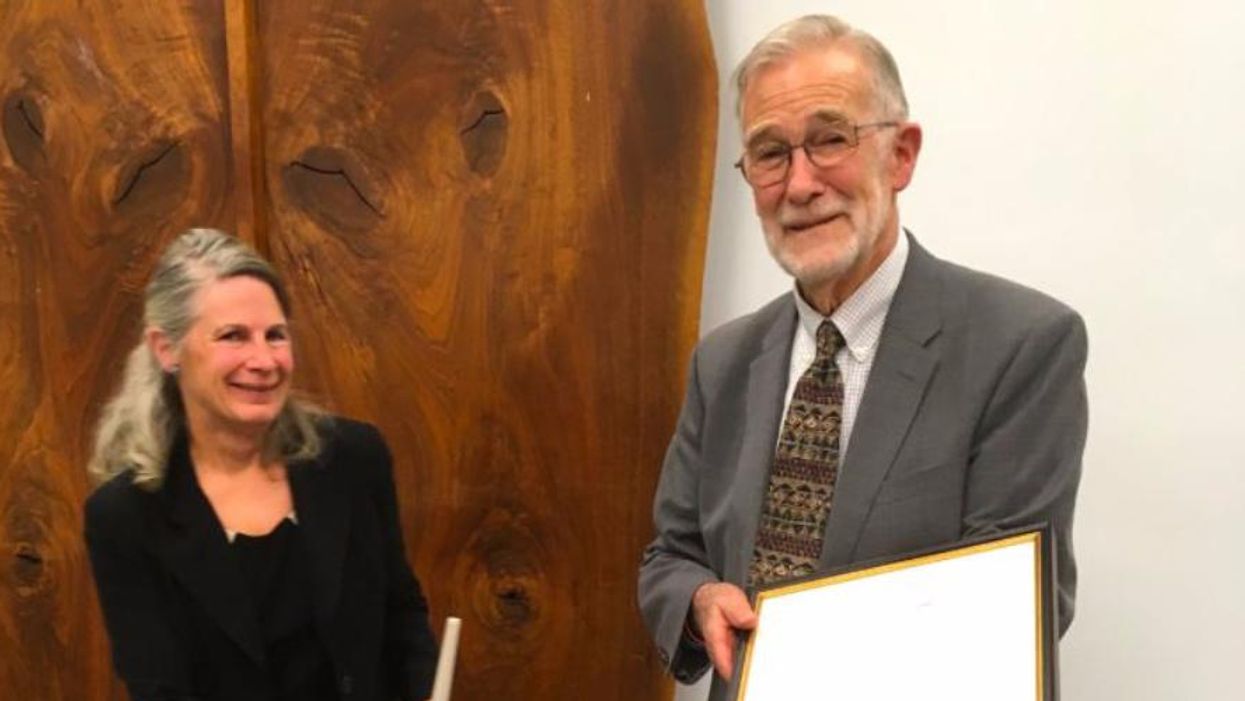
Here is Karen Kwiatowski's acceptance speech for the 2018 Sam Adams Award at a ceremony in Washington on Saturday night, preceded by the citation, that was read by former CIA analyst Ray McGovern.
Know all ye by these presents that Karen Kwiatkowski is hereby honored with the traditional Sam Adams Corner-Brightener Candlestick Holder, in symbolic recognition of her courage in shining light into dark places.
"If you see something, say something," we so often hear. Karen Kwiatkowski took that saying to heart.
She saw her Pentagon superiors acting as eager accomplices to the Cheney/Bush administration's deceit in launching a war of aggression on Iraq. And she said something--and helped Knight Ridder reporters Warren Strobel and Jonathan Landay see beneath the official lies and get the sordid story right before the war.
Karen's courage brings to mind the clarion call of Rabbi Abraham Heschel against the perpetrators of an earlier war--Vietnam. "Few are guilty," he said, "but all are responsible. Indifference to evil is more insidious than evil itself." Karen would not be indifferent to evil.
Ed Snowden, Sam Adams awardee in 2013, noted that we tend to ignore some degree of evil in our daily life, but, as Ed put it, "We also have a breaking point and when people find that, they act." As did Karen. As did 16 of Karen's predecessors honored with this award.
With all the gloom and doom enveloping us, we tend to wonder whether people with the conscience and courage of Ed or Karen still exist in and outside our national security establishment. Our country is in dire need of new patriots of this kind.
Meanwhile, we call to mind the courageous example not only of Karen and Ed, but also of Coleen Rowley and Elizabeth Gun, our first two awardees, who took great risks in trying to head off the attack on Iraq. And we again honor Chelsea Manning and Julian Assange who is now isolated in what the U.N. has called "arbitrary detention," for exposing the war crimes resulting from that war.
Karen Kwiatkowski has made her own unique contribution to this company of conscience and courage, and Sam Adams Associates are pleased to honor her.
Presented this 8th day of December 2018 in Washington by admirers of the example set by the late CIA analyst, Sam Adams.
'Thoughts on the Sam Adams Award': Remarks by Lt. Col. Karen Kwiatowski
I am honored beyond belief to be the 2018 recipient of the Sam Adams Award, and I thank Ray McGovern and the Sam Adams Associates for Integrity in Intelligence, Veteran Intelligence Professionals for Sanity, Warren Strobel, and Jonathan Landay of Knight Ridder during the run up to the second invasion of Iraq, and Rob Reiner for putting together a great movie that was so consistently truthful, that for me, it looked almost like a documentary. I want to also thank the late David Hackworth, a man I never met who published my first anonymous essays from the Pentagon, and of course, Lew Rockwell, who has published so many of my essays examining and trying to understand our government and our offensive policies over the past 15 years.
It is in our country's interest--as security professionals, as intelligence professionals, as soldiers and citizens, as writers and newsmakers--to be sensitive to the lawlessness, the immorality, and the wrongdoing of the bureaucracies and the leaders of the organizations we are a part of.
There have been many American patriots and truth-tellers who have received the honor you have given me tonight--and I am going to name them here because I stand in awe of all of them:
Coleen Rowley of the FBI; Katharine Gun of British Intelligence; Sibel Edmonds of the FBI; Craig Murray, former U.K. ambassador to Uzbekistan; Sam Provance, former U.S. Army Sgt; Maj. Frank Grevil of Danish Army Intelligence; Larry Wilkerson, Col., U.S. Army (ret.), former chief of staff to Colin Powell at State; Julian Assange, of WikiLeaks: Thomas Drake, of NSA; Jesselyn Radack, formerly of Dept. of Justice and now National Security Director of Government Accountability Project; Thomas Fingar, former Deputy Director of National Intelligence and Director, National Intelligence Council, and Edward Snowden, former contractor for the National Security Agency; Chelsea Manning, U.S. Army Private who exposed (via WikiLeaks) key information on Afghanistan and Iraq, as well as State Department activities; and to retired National Security Agency official William Binney, who challenged decisions to ignore the Fourth Amendment in the government's massive--and wasteful--collection of electronic data.
Again, I am very humbled and almost speechless tonight.
But not entirely speechless. My backstory is pretty well-known to most people here, and to anyone who was interested in understanding U.S. war policy in the early 2000s. I had a small role to play, in concert with a number of other truth-tellers in media and in the national security bureaucracy. For every one of us, there were probably 20 to 50 people working beside us and around us, who understood a lot about what was happening, and who probably got a funny feeling about being in an organization where we all swore to uphold the Constitution, but in fact were engaged in promulgating lies of both omission and commission, mistruths and misdirection, aimed not at our enemies abroad but against the American people. We were lying, with the help of a compliant and war-supportive media, to patriots young and old. Millions of Americans were eager to enlist, to fight, to sacrifice their life and health--for a made-up government fairy tale.
A sense of unease, I believe, was shared by many, many people who never blew a whistle, and never said a word. To their credit, some of these people passively resisted within their organizations, and tried to set things straight where they could. Some of these people simply called their assignments guy and got orders out of the Pentagon, others were removed if they resisted too much. There is always a cost when you seriously question the directions or actions of the bureaucracy that employs you.
It is in our country's interest--as security professionals, as intelligence professionals, as soldiers and citizens, as writers and newsmakers--to be sensitive to the lawlessness, the immorality, and the wrongdoing of the bureaucracies and the leaders of the organizations we are a part of. That is the first thing we must cultivate and encourage--a sensitivity to and an awareness of something as simple as right and wrong. This is fundamental. From knowing right and wrong, we move to the factor that motivates so many whistleblowers, something that we all share as human beings, and that is an idea of justice.
The truth-tellers who have been honored with Sam Adams Award, and thousands of others we may not be aware of around the world, share a concept of justice. For those who try to correct our U.S. government, particularly in its initiation and exercise of war, state-sanctioned murder, and physical devastation of whole societies, we as American have tools that many others around the world don't have. We have a Constitution that many of us swore to uphold. Americans tend to have a good grounding in the fundamentals of right and wrong, derived from religion or tradition, or both. We live in something that calls itself a republic, and it is a fine form of government, with a solid set of rules.
But how do we get from a certain moral discomfort, from seeing something going on around us that is wrong, to trying to do something about it? How do we decide if we want to leave the room, turn our backs, put our head down, or instead take some sort of action that will put us on a collision course with very powerful people? What if we, as truth-tellers, are like blind men describing an elephant--we see only one part of a larger story? How do we decide that our faith in our leadership is misplaced, and that more is at stake then just our jobs?
When you look at the experiences of people who made the dangerous and difficult decision to act, like Daniel Ellsberg, and Sam Adams, and Sibel Edwards, Jesselyn Raddick, Colleen Rowley, Thomas Drake, Ed Snowden, Julian Assange, and many others, you realize that speaking up and doing the right thing had a primary impact. That impact wasn't improved transparency, a more informed democracy, a more aware and alert citizenry, and better government decisions by our elected leaders. Those were all secondary impacts, and in many cases tenuous, as the improved level of national understanding seems to last for less than a single generation. No, the primary impact was the unimaginable wrath of the state aimed at the life, livelihood, reputation, family, character, and credibility of the truth-teller. In several cases, this included physical and psychological abuse, prison time, gag orders, and even more devious programs. The rage of the state against these truth-tellers is not impulsive and short-lived--it is a forever project funded by tax dollars, and fueled by very profitable agendas.
Knowing all of this, can we really expect to see a healthy and growing flow of truth tellers, whistleblowers, and simply bold honest people speaking out about government lies?
I think we can, and I am optimistic about the possibilities of better government through honest, bold, and forthright people working in and around this government.
To start with, as I mentioned, we as government employees and uniformed service-members need to have a solid sense of right and wrong. We need to cultivate a sense of justice. In a wonderful way, our younger generations are well prepared for this, at least in terms of cultivating a sense of justice. The young people we see portrayed, often disparagingly, as young socialists may not completely understand the nature of government or the state, but they do cherish ideas of justice.
The more of us--specifically those working with and inside the U.S. government today--who tell the truth, the less likely that government embarrassment will result in harm to a whistleblower, and the less likely in the long run that we will see whistleblowers as we tend to see them today.
We also need people in government service who are sensitive to what is going on in their organizations, and how people are feeling and behaving around them. It is not coincidence that many of the people who have been honored by this award are women, who may be paying closer attention to the mood and morality of their organizations. There's a country song that has a line in it about "Old men talking about the weather, and old women talking about old men." We need both in our organizations, to be in tune with what is happening, and who is leading us.
We need people in government service who are willing to walk away from a job, and to say or even broadcast why they are leaving, without worrying about the next job, without worrying about being blacklisted, without worrying that they can't make their next house payment or college tuition payment, or the alimony or child support payment. We need people in government who travel light, so to speak, and do their job because they love what they are doing and what it stands for. This grounding and lack of rigid self-identification with their employing bureaucracy is extremely important. Thanks to technology and societal evolution, the younger generations of Americans are very likely to walk away from a job that they believe to be immoral, to act to correct what they see as wrong or unjust, and incidentally, are less likely to own a home, and more likely to define themselves by what they believe and stand for, not where they work, and how many promotions they had planned for themselves in that organization.
But even with our younger generations coming into government service--with a good sense of justice, a strong sense of self, and a willingness to speak openly about what they believe and know--there is risk when someone questions the collective government story.
There is risk in the act of challenging authority and one's peer group, risk of being wrong and suffering loss of credibility. There is the rational and real risk of incurring the rage of the state, and being jailed, harmed, ruined and even killed on the whispers of an incensed or threatened agency.
There is another risk that we really don't talk about much. I think most concerning for many people is the risk that you are actually right, that you have discovered something damning and dark in your country, in your government, in your organization. Once this happens, if it happens, your life is irreversibly changed, and nothing is ever going to be the same. Understanding how your government actually works, in particular how it works to create and provoke war and murder, how it works to extract the wealth of the nation and use this blessing to commit Constitutional crimes and untold evil, in your name--for many this understanding is not a gift, but a curse. I estimate at least 10 percent of our country, 20-30 million Americans, many of them veterans the U.S. Empire's global adventures in the past 50 years, feel this curse, and many of them deal with it by turning away from the dark side of Washington D.C., and not talking, writing, or speaking about what they know.
If anyone has followed the case of former Marine Sergeant Brandon Raub a few years ago, you realize that the government keeps a close and paranoid eye on what veterans are doing and saying. Given how things work today, they may be wise to turn away silently from the truth they know.
I think this is why it is often hard for us to demand more truth-tellers come forward, especially in the defense and security and intelligence arena, when we should be shouting it from the rooftops.
Some years ago, I did an online radio program where I would interview interesting people, like Ray McGovern and Sam Provance and Sibel Edmonds, among many others. One person, in our conversation, expressed surprise that I was a short (formerly) brown haired woman, when he thought I would be a tall blonde. I was reminded of this when watching Shock and Awe, because Rob Reiner and the writers did not know who I was, and they portrayed me as a tall light-haired woman, a modern day Viking of sorts. Notwithstanding that this is a popular and attractive stereotype, I think there is something to be learned here. We want to believe that anyone who stands up to authority, who knows his or her own mind, who is willing to enter into a battle of wills with the state, and to take a risk is somehow taller, stronger, bolder, and braver than the rest of us.
But it isn't true. There is something remarkably childlike and simple in being honest, in observing without fear what is happening around you, and reporting this to the person who pays the bills. In the case of the national security arena, the bill payer is the American people. To tell the truth is simple, honorable, and good for the health of the republic. The fact that it drives the security apparatus and the government crazy is just icing on the cake. Granted, we all need jobs, and our mental health, and we don't want to be imprisoned, tortured, or killed. But the more of us--specifically those working with and inside the U.S. government today--who tell the truth, the less likely that government embarrassment will result in harm to a whistleblower, and the less likely in the long run that we will see whistleblowers as we tend to see them today. In a world of that values honesty, they would be receiving the public commendation of a proud Congress, a grateful media and President, and a contented population.
We--average Americans--are increasingly controlled, spied on, monitored, tracked, threatened, boxed in, and shut down by tools that were first used and tested on some contrived wartime enemy.
I'm not a Pollyanna, and I'm worried about the role the U.S. government is playing at home and abroad. The kind of devastation that the U.S. tolerates, supports and initiates around the world--Afghanistan, Iraq, Libya, Syria, of course Yemen comes to mind, the horrendous situation that Julian Assange is still facing as we speak--is not limited to "overseas." The industrial warfare state is as dangerous to Americans as it is to Iraqis, Syrians, and Yemenis. The arts of the warfare state are already being practiced here, against Americans. We--average Americans--are increasingly controlled, spied on, monitored, tracked, threatened, boxed in, and shut down by tools that were first used and tested on some contrived wartime enemy.
You don't need me to tell you this, it's in every newspaper every day, on every page. It is our modern reality. Truth and transparency are its only antidote, and truth and transparency needs all of us. To live in a society, to be a citizen, to love your country -- you cannot sleepwalk through it.
People who value wisdom, people who value common sense, people who value justice and people who believe that being woke is a good thing--congratulations! You are the majority! You are alive, you are in charge of this country, and you can choose. America is worth preserving, healing, and saving - and if she is to be saved we will do it by first learning the difference between the truth and a lie, and then speaking the truth loudly, boldly, to anyone who will listen, over and over and over again.
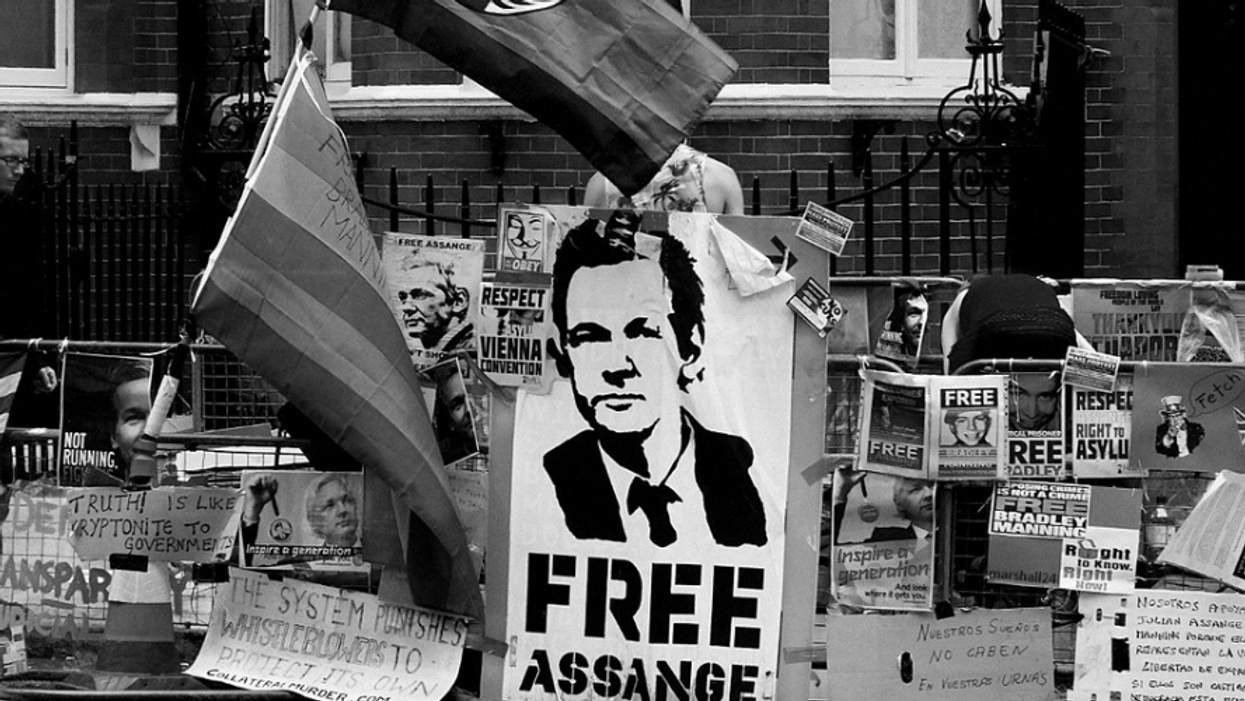
WikiLeaks founder Julian Assange remains arbitrarily detained in the Ecuadorian embassy in London. As he is in a critical situation under a special protocol imposing prison-like surveillance, news emerged that shed light on the grave danger he has been facing. Last week, the Washington Post reported that the US Justice Department, in what appeared to be an error of cut and paste in their court filing, inadvertently disclosed criminal charges against Assange exist under seal.
Assange's lawyer Jennifer Robinson responded to the revelation of a secret US government's prosecution against the publisher, by noting that it confirms what Assange and his legal team have been suspecting. She pointed out how a criminal investigation into WikiLeaks started in 2010 in relation to disclosures made by WikiLeaks in partnership with other major newspapers revealing the evidence of US war crimes. She made it clear that this risk of his extradition to the US has been the reason why Assange sought and was granted asylum by Ecuador in 2012.
This public confirmation of a US indictment sent a huge alarm to civil liberty groups in the US. The ACLU issued a statement, noting how this sealed indictment violates the Constitution and prosecuting journalists for publishing classified documents would set a dangerous precedent for press freedom. Now that this sealed indictment is out in the open, validating Assange's fear of leaving the embassy, the public is given an opportunity to see the true nature of his plight for freedom. What is now being revealed is the war on the First Amendment waged by the US government, targeting the Western journalist who has published materials in the public interest at a scale that has never been seen before.
The war on the First Amendment
The spark for this war was quietly lit in 2008 with US intelligence's plan to destroy WikiLeaks, viewing the website as an information security threat to the US army. It got inflamed in 2010 shortly after the whistleblowing site published the trove of US classified military records of the Afghan war, revealing around 20,000 deaths by assassination, massacre and night raids, and the Iraq War Logs, that informed people in Iraq and the international community about 15,000 civilian casualties previously unreported.
As the White House downplayed the significance of these disclosures, US Joint Chiefs of Staff Mike Mullen called WikiLeaks publications "reckless" and "irresponsible". While there is not a single shred of evidence that any of these disclosures caused anyone harm, the Pentagon deflected its own crimes and aggressively tried to attack the messenger with a bombastic line of "they have blood on their hands".
Assange as a spokesperson of this new multi-national media organization came under attack with an intense campaign of character assassination. The preliminary investigation of his alleged sexual misconduct involving two women in Sweden who explicitly denied the accusation of rape was turned into a full blown legal battle trapping him in London where the local press criminalized him as a rapist.
Right after WikiLeaks' publication of the US diplomatic cables, the vilification of Assange intensified by high profile US political figures. The former Vice President Joe Biden branded Assange as a high-tech terrorist, while a former Republican Speaker of the House, Newt Gingrich calling him an "enemy combatant", who deserves to be executed.
WikiLeaks also has faced massive coordinated political retaliation. On November 29, 2010, the US Attorney General publicly confirmed the existence of a secret grand jury investigation into disclosures of classified information made by WikiLeaks. In December 2010, Amazon removed WikiLeaks from their server after being pressured by US officials. Then, signaled by the US State Department, private paying processing companies such as VISA, MasterCard, PayPal, Bank of America and Western Union engaged in extrajudicial financial blockade against WikiLeaks, reportedly destroying over 95 % of their revenue. Meanwhile, WikiLeaks associates were repeatedly harassed at borders.
Whistleblowers as casualty of war
This attack on WikiLeaks is an escalation of Obama's war on whistleblowers. Before Snowden's revelations, former National Security Agency analysts, Thomas Drake, William Binney, J. Kirk Wiebe and Edward Loomis were alarmed by widespread government surveillance and decided to speak out.
Thomas Drake, former NSA senior executive who blew the whistle on secret mass surveillance programs, spoke about how he came to witness his own government actively violating the privacy and freedom of its citizens in the name of national security and decided not to remain silent. He said, "I took an oath to defend the constitution. Here I am finding myself defending the constitution against my own government, a government that I did not recognise, an alien form of government. I had to stand up to it."
Drake, who faced 35 years in prison before the government charges against him were unexpectedly dropped, also alerted the public about the government's war on whistleblowers:
"We are seeing an unprecedented campaign against whistleblowers and truthtellers: it's now criminal to expose the crimes of the state. Under this relentless assault by the Obama administration, I am the only person who has held them off and preserved his freedom. All the other whistleblowers I know have served time in jail, are facing jail or are already incarcerated or in prison."
John Kiriakou became the first CIA officer to confirm the use of torture and to face jail time for challenging the legality of the US torture program. Before going to jail, he spoke of his decision:
"I took my oath seriously. My oath was to the Constitution. On my first day in the CIA, I put my right hand up, and I swore to uphold the Constitution. And to me, torture is unconstitutional, and it's something that we should not be in the business of doing ... If you see waste, fraud, abuse or illegality, shout it from the rooftops, whether it's internally or to Congress."
While Obama was relentlessly prosecuted whistleblowers more than all other previous administrations combined, corporate media effectively kept the battlefield out of public sight. These whistleblowers who fought to hold the ground for truth became an invisible casualty of this war on the First Amendment, who were made to quietly endure suffering.
Frontline of the battle
As the unchecked power of the national security state grew, expanding its territory in cyberspace with increasing surveillance and censorship, a new stream of dissidents emerged on the Internet. WikiLeaks courageously entered into a frontline of the battle in defense of the First Amendment. With unprecedented technical infrastructure that enables anonymous submission of documents, it provided an avenue for a new generation of whistleblowers to exercise free speech that has been stifled in traditional channels.
The former US Army intelligence analyst Chelsea Manning, the source behind WikiLeaks major publications including the raw footage of a US airstrike killing innocent civilians in Iraq, first reached out to the established media outlets such as the New York Times and the Washington Post, but was not taken seriously by editors. When the mainstream press turned away, she chose to put her trust in the non-profit media organization that was little known at that time.
Manning's act of courage became contagious, creating a wave of whistleblowers. By following the step of his forerunner, political activist Jeremy Hammond exposed the inner workings of the pervasive surveillance state. At the sentencing hearing, he explained how he perfectly understood the consequences of his action and that it was against the law, yet he felt a duty to confront injustice. Then came Edward Snowden who revealed the NSA mass surveillance. In one of the addresses he made, Snowden also described his act as a public service and connected it with non-violent civil disobedience that Dr. King, a leader of civil rights movement employed to challenge the racist laws
As disclosures of government corruption began to challenge the legitimacy of authorities, the war on whistleblowers has escalated to a new level. Recent public confirmation of the US government's secret charges on Assange has shown the empire's expansion of a combat zone, to include journalists and publishers as its target. Although there is no clarity as to what charges are filed against Assange, the data that Google handed over to the US government in order to assist the prosecution of WikiLeaks' staff indicated that alleged offenses include espionage.
The Espionage Act of 1917 is a US federal law, created after World War I for wartime prosecutions. This outdated law does not allow a public interest defense and prevents whistleblowers from having their motivations considered in court, making it impossible for them to defend their acts and receive a fair trial. Manning was convicted and Snowden charged under the Espionage Act by President Obama.
Now this law that was used to imprison whistleblowers is weaponized to punish those who report on government crimes. Commenting on imminent withdrawal of asylum for Assange by the Moreno government and his risk of prosecution in the US, Glenn Greenwald, journalist at The Intercept noted how Obama's Justice Department was eager to prosecute Assange and WikiLeaks for the crime of publishing classified documents, but chose not to do so, due to concerns that it would set a precedent which could strip away the First Amendment protection for the press. Yet he contended that the Trump administration made it clear that they have no such reservation.
Tradition of civil disobedience
The possibility of the US government charging Assange who is not American, and didn't publish in the US under its laws, probably for 'espionage' is extremely alarming. What is this crime of 'aiding the enemy' that the US government is eager to convict this transnational journalistic organization for? WikiLeaks, the organization that claimed to derive its source of inspiration from American founding ideas, with cryptography as a non-violent democratic weapon, helped American people to engage in the tradition of civil disobedience. By doing so, Assange, an Australian citizen, enabled the vital function of American democracy.
The idea of civil disobedience was presented by American philosopher Henry David Thoreau, as a critical component of checks and balances of governmental power. Thoreau, who believed that "government is best which governs least" (1957, p. 235), put forward the idea of civil disobedience, reminding the moral responsibility of ordinary people to defy the illegitimate authority of the state and restrict its power.
Thoreau engaged in the act of civil disobedience, to oppose slavery and went to a prison for refusing to pay a poll tax that supported the US war against Mexico. For him, the method of civil disobedience offered a way for people to create laws that reflect the true values of society and improve democracy that was inherited from the forebears.
He posed the questions:
"Is a democracy, such is we know it, the last improvement possible in government? Is it not possible to take a step further towards recognizing and organizing the rights of man? There will never be a really free and enlightened State until the State comes to recognize the individual as a higher and independent power, from which all its own power and authority are derived, and treats him accordingly." (1957, p. 256)
This father of civil disobedience asked, "... Must the citizen ever for a moment, or in the least degree, resign his conscience to the legislator? Why has every man a conscience, then?" (p. 236). He aimed to institute a new form of government that places conscience as the highest law, allowing each individual to freely explore what is right in their hearts with obligation to act out of their own knowing. He noted, "Unjust laws exist: Shall we be content to obey them, or shall we endeavor to amend them, and obey them until we have succeeded, or shall we transgress them at once?" (p. 242). Through his own act of civil disobedience, he has shown how only by each person's adamant refusal to obey the dictates of unjust laws can we bring real accountability of the government and enshrine ideals into laws.
Conscience of America
Contrary to the ideals of equality and liberty at its foundation, from the onset of the US constitutional republic, unaccounted power has always existed, manifested in the founders' internal contradiction over slavery, genocide of natives and oppression of minority rights. The Declaration of Independence was said to be the promise and the Constitution was its fulfillment. What bridges between the ideals in the original document and laws were ordinary people who are capable of developing their own moral conscience and bearing true faith and allegiance to it.
As WikiLeaks pushed the boundaries of free speech, the world has seen the rise of the power of ordinary people. The late attorney and President Emeritus of the Center for Constitutional Rights, Michael Ratner, who witnessed Manning read her prepared statement at the military court facility in Fort Meade, Maryland, recognized her as the conscience of America.
Through its scientific journalism, publishing primary source material in its full archives, WikiLeaks gave this conscience of America the maximum political impact for it to inform the public, in order to redeem the nation that has lost its own course. In this war of a tyrannical state on the First Amendment, Assange became a lightning rod to take all the heat, so ordinary people can uphold these ideals that are inscribed in their hearts, defending them against all enemies, foreign and domestic.
As the invisible beast inside the US government devours the hearts of these brave young patriots, WikiLeaks acted as a shield. This was demonstrated in their extraordinary source protection. After Snowden identified himself as the source behind the NSA files, aggressive prosecution quickly rolled out from Washington. As Snowden was stranded in Hong Kong, it was then the investigations editor at WikiLeaks and journalist Sarah Harrison who risked her life to secure his asylum.
Call for duty
Just as the Founding Fathers of the United States, by revolting against the autocratic rule of King George were regarded as traitors, by aiding ordinary people expose and defy unjust secret law, WikiLeaks too has been branded as an enemy of the state. Trump's Secretary of State and the former CIA director, Mike Pompeo calls WikiLeaks a non-state hostile intelligence agency, claiming that the organization threatens American values and needs to be shut down. Members of the US Congress urged the Ecuadorian President to persecute Assange, calling him a "dangerous criminal" and a "threat to global security". While all these vicious verbal attacks are thrown at him, Assange remains in confinement, over the past months, being completely shut out from the outside, being continually deprived of fresh air, access to medical care and sunlight by the UK government in violation of UN rulings.
All wars start and are fueled by lies and propaganda. Once it was the Vietnam War, where under the command of the US President Lyndon B. Johnson, the Gulf of Tonkin lies unleashed military forces into Southeast Asia. Then came the invasion of Iraq with the former Secretary of State Colin Powell's speech at the UN, falsely claiming Iraq had 'Weapons of Mass Destruction'. This battle against free speech is another secret war of this empire. It now has become a fog of war, where with the hype of Russia Gate that was created out of thin air, the public was prevented from seeing who the real enemies are.
As Trump's administration now carries on Obama's legacy, vowing to destroy WikiLeaks for engaging in publishing activities that are protected under the First Amendment, American people are slowly coming to see their own government's dirty war that has been waged in their name.
By trying to prosecute Julian Assange, America is betraying its own ideals. As this government that proclaims to be the greatest nation on the earth now heads toward its own destruction, each of us are called to respond to the duty of civil disobedience. Can we the people break silence to end this war and defend those who fought for the ideals that founded this nation? Solidarity across political lines can create the greatest anti-war movement that this country has ever seen. Outcome of this battle matters not only for the freedom of Assange, but for the liberation of America and realization of its own ideals that this country once stood for the world.

Wikileaks founder Julian Assange has been secretly indicted by the Trump administration's Justice Department, "a drastic escalation" of the feds' efforts against him, the New York Times reported. Secretary of State Mike Pompeo has denounced Wikileaks as a "non-state hostile intelligence service" and labeled Assange a "fraud," "coward," and "enemy." But rather than a federal indictment, Assange deserves a tweaked version of one of Washington's hottest honorifics.
Wikileaks has been in the federal crosshairs since it released scores of thousands of documents exposing lies and atrocities regarding the Afghan and Iraq wars, thanks to leaks from Army corporal Bradley (now Chelsea) Manning. During the 2016 presidential campaign, Wikileaks released emails from the Democratic National Committee showing that its nominating process was rigged to favor Hillary Clinton. During the final month of the campaign, Wikileaks disclosed emails from Clinton campaign chief John Podesta.
In the final month of the presidential campaign, Donald Trump declared, "I love WikiLeaks" and mentioned it more than a hundred times. However, since Trump took office, he is following Washington protocols and viewing whistleblowers as public enemies.
The Assange indictment is far more threatening than Trump tweets snarling at CNN. The ACLU warns that prosecuting Assange for Wikileaks' publishing operations would be "unconstitutional" and sets a "dangerous precedent for U.S. journalists, who routinely violate foreign secrecy laws to deliver information vital to the public's interest." Trevor Timm of the Freedom of the Press Foundation declared: "Any charges brought against WikiLeaks for their publishing activities pose a profound and incredibly dangerous threat to press freedom."
It is difficult to appreciate Wikileaks without recognizing how federal secrecy has become far more pervasive and dangerous since 9/11. If someone had massively leaked U.S. government documents on Iraq in January 2003, the Bush administration campaign for war might have been thwarted. The federal government made almost 50 million decisions to classify information last year. Politicians and federal agencies have long recognized that "what people don't know won't hurt the government."
"Truth will out" is the biggest fairy tale in Washington. U.S. troops are now fighting in 14 foreign nations: will the Pentagon tell us all about it? The National Security Agency illegally tracked every citizen's phone calls: no federal official disclosed the system that a federal judge castigated as an "almost Orwellian" surveillance scheme. And what are the betting odds of Americans seeing the dirt on the U.S. government's long-term collusion with the Saudi regime (despite its atrocities at home and abroad)?
On the same day the Assange indictment scored headlines, Trump awarded seven Presidential Medals of Freedom. No controversy greeted posthumous awards to Babe Ruth and Elvis Presley -- unlike the ruckus regarding Miriam Adelson, wife of Republican super-donor Sheldon Adelson. Public Citizen, a liberal nonprofit, howled that the Adelson award "is just the latest sign of [Trump's] ability to corrupt and corrode all aspects of the government." New York Times columnist Paul Krugman caterwauled that it was "ludicrous" and "and an insult to people who received the medal for genuine service."
In reality, Presidential Medals of Freedom have routinely been exploited to buttress the political establishment, with bevies of awards for political operators, members of Congress, and pliable foreign leaders. President Lyndon Johnson distributed a bushel of Medals of Freedom to his Vietnam War architects and enablers, perhaps as consolation prizes for losing the war. (The medal awarded to Defense Secretary Robert McNamara, whose lies about the war making progress cost thousands of Americans and Vietnamese their lives, fetched $40,625 at an auction a few years ago.) President George W. Bush conferred Medals of Freedom on his Iraq war team, including CIA chief George "Slam Dunk" Tenet, Iraq viceroy Paul Bremer, and ambassador Ryan Crocker, whom Bush called "America's Lawrence of Arabia." Some of the biggest fabulists of the modern era -- including Henry Kissinger and Dick Cheney -- also pocketed the award.
The controversies over Assange and Adelson provide a serendipitous opportunity to update the freedom awards. Because few things are more perilous to democracy than permitting politicians to coverup crimes, there should be a new Medal of Freedom category commending individuals who have done the most to expose official lies. This particular award could be differentiated by including a little steam whistle atop the medal -- vivifying how leaks can prevent a political system from overheating or exploding.
Assange would deserve such a medal -- as would Thomas Drake and Edward Snowden (who revealed NSA's abuses), John Kiriakou (who revealed CIA torture), and Daniel Ellsberg (who leaked the Pentagon Papers). Admittedly, there may be no way to stop presidents from giving steam whistle freedom awards to political donors' wives.
Organizations like Wikileaks are among the best hopes for rescuing democracy from Leviathan. Unless we presume politicians have a divine right to deceive the governed, America should honor individuals who expose federal crimes. Whistleblowers should be especially welcome by anyone riled up over Trump's lies.
Many Americans remain deeply concerned about reports of Russian interference with the 2016 election. Meanwhile, relations between the United States and Russia are at their lowest and most dangerous point in several decades. For the sake of democracy at home and true national security, we must reach common ground to safeguard common interests--taking steps to protect the nation's elections and to prevent war between the world's two nuclear superpowers.
Whatever the truth of varied charges that Russia interfered with the election, there should be no doubt that America's digital-age infrastructure for the electoral process is in urgent need of protection. The overarching fact remains that the system is vulnerable to would-be hackers based anywhere. Solutions will require a much higher level of security for everything from voter-registration records to tabulation of ballots with verifiable paper trails. As a nation, we must fortify our election system against unlawful intrusions as well as official policies of voter suppression.
"As a nation, we must fortify our election system against unlawful intrusions as well as official policies of voter suppression."
At the same time, the U.S. and Russian governments show numerous signs of being on a collision course. Diplomacy has given way to hostility and reciprocal consular expulsions, along with dozens of near-miss military encounters in Syria and in skies above Europe. Both sides are plunging ahead with major new weapons development programs. In contrast to prior eras, there is now an alarming lack of standard procedures to keep the armed forces of both countries in sufficient communication to prevent an escalation that could lead to conventional or even nuclear attack. These tensions are festering between two nations with large quantities of nuclear weapons on virtual hair-trigger alert; yet the current partisan fixations in Washington are ignoring the dangers to global stability and, ultimately, human survival.
The United States should implement a pronounced shift in approach toward Russia. No political advantage, real or imagined, could possibly compensate for the consequences if even a fraction of U.S. and Russian arsenals were to be utilized in a thermonuclear exchange. The tacit pretense that the worsening of U.S.-Russian relations does not worsen the odds of survival for the next generations is profoundly false. Concrete steps can and must be taken to ease tensions between the nuclear superpowers.
Signed,
Andrew Bacevich, Professor Emeritus, Boston University
Phyllis Bennis, Fellow, Institute for Policy Studies
Noam Chomsky, Professor, Author, and Activist
Stephen F. Cohen, Professor Emeritus of Russian Studies and Politics, NYU and Princeton University, and Board Member, American Committee for East-West Accord
John Dean, Former Nixon White House Counsel
Phil Donahue, Journalist and Talk-Show Pioneer
Thomas Drake, Former NSA Senior Executive and Whistle-blower
Daniel Ellsberg, Activist, "Pentagon Papers" Whistle-blower, and Author of The Doomsday Machine: Confessions of a Nuclear War Planner
Jack Matlock, Former US Ambassador to the USSR and Board Member, American Committee for East-West Accord
Walter Mosley, Writer and Screenwriter
Viet Thanh Nguyen, Pulitzer Prize-Winning Novelist
Frances Fox Piven, Distinguished Professor Emeritus, CUNY Graduate School
Valerie Plame, Former Covert CIA Operations Officer and Author
Adolph Reed Jr., Professor of Political Science, University of Pennsylvania
Bill Richardson, Former Governor of New Mexico
Patricia Schroeder, Former Congresswoman
Norman Solomon, National Coordinator, RootsAction.org
Gloria Steinem, Writer and Feminist Organizer
Adlai Stevenson III, Former US Senator and Chairman, Adlai Stevenson Center on Democracy
Katrina vanden Heuvel, Editor and Publisher, The Nation
Alice Walker, Writer, Poet, and Activist
Jody Williams, Professor and Nobel Peace Prize Laureate
James Zogby, President, Arab American Institute
Signers have endorsed this Open Letter as individuals and not on behalf of any organization.

Daniel Ellsberg has a message that managers of the warfare state don't want people to hear.
"If you have information that bears on deception or illegality in pursuing wrongful policies or an aggressive war," he said in a statement released last week, "don't wait to put that out and think about it, consider acting in a timely way at whatever cost to yourself.... Do what Katharine Gun did."
If you don't know what Katharine Gun did, chalk that up to the media power of the war system.
Ellsberg's video statement went public as this month began, just before the 15th anniversary of when a British newspaper, the Observer, revealed a secret NSA memo -- thanks to Katharine Gun. At the UK's intelligence agency GCHQ, about 100 people received the same email memo from the National Security Agency on the last day of January 2003, seven weeks before the invasion of Iraq got underway. Only Katharine Gun, at great personal risk, decided to leak the document.
If more people had taken such risks in early 2003, the Iraq War might have been prevented. If more people were willing to take such risks in 2018, the current military slaughter in several nations, mainly funded by U.S. taxpayers, might be curtailed if not stopped. Blockage of information about past whistleblowing deprives the public of inspiring role models.
That's the kind of reality George Orwell was referring to when he wrote: "Who controls the past controls the future; who controls the present controls the past."
Fifteen years ago, "I find myself reading on my computer from the Observer the most extraordinary leak, or unauthorized disclosure, of classified information that I'd ever seen," Ellsberg recalled, "and that definitely included and surpassed my own disclosure of top-secret information, a history of U.S. decision-making in Vietnam years earlier." The Pentagon Papers whistleblower instantly recognized that, in the Observer article, "I was looking at something that was clearly classified much higher than top secret.... It was an operational cable having to do with how to conduct communications intelligence."
What Ellsberg read in the newspaper story "was a cable from the NSA asking GCHQ to help in the intercepting of communications, and that implied both office and home communications, of every member of the Security Council of the UN. Now, why would NSA need GCHQ to do that? Because a condition of having the UN headquarters and the Security Council in the U.S. in New York was that the U.S. intelligence agencies promised or were required not to conduct intelligence on members of the UN. Well, of course they want that. So, they rely on their allies, the buddies, in the British to commit these criminal acts for them. And with this clearly I thought someone very high in access in Britain intelligence services must dissent from what was already clear the path to an illegal war."
But actually, the leak didn't come from "someone very high" in GCHQ. The whistleblower turned out to be a 28-year-old linguist and analyst at the agency, Katharine Gun, who had chosen to intervene against the march to war.
As Gun has recounted, she and other GCHQ employees "received an email from a senior official at the National Security Agency. It said the agency was 'mounting a surge particularly directed at the UN Security Council members,' and that it wanted 'the whole gamut of information that could give U.S. policymakers an edge in obtaining results favorable to U.S. goals or to head off surprises.'"
In other words, the U.S. and British governments wanted to eavesdrop on key UN delegations and then manipulate or even blackmail them into voting for war.
Katharine Gun took action: "I was furious when I read that email and leaked it. Soon afterwards, when the Observer ran a front-page story--'U.S. dirty tricks to win vote on Iraq war'--I confessed to the leak and was arrested on suspicion of the breach of section 1 of the Official Secrets Act."
The whistleblowing occurred in real time. "This was not history," as Ellsberg put it. "This was a current cable, I could see immediately from the date, and it was before the war had actually started against Iraq. And the clear purpose of it was to induce the support of the Security Council members to support a new UN resolution for the invasion of Iraq."
The eavesdropping was aimed at gaining a second--and this time unequivocal--Security Council resolution in support of an invasion. "British involvement in this would be illegal without a second resolution," Ellsberg said. "How are they going to get that? Obviously essentially by blackmail and intimidation, by knowing the private wants and embarrassments, possible embarrassments, of people on the Security Council, or their aides, and so forth. The idea was, in effect, to coerce their vote."
Katharine Gun foiled that plan. While scarcely reported in the U.S. media (despite cutting-edge news releases produced by my colleagues at the Institute for Public Accuracy beginning in early March of 2003), the revelations published by the Observer caused huge media coverage across much of the globe-- and sparked outrage in several countries with seats on the Security Council.
"In the rest of the world there was great interest in the fact that American intelligence agencies were interfering with their policies of their representatives in the Security Council," Ellsberg noted. A result was that for some governments on the Security Council at the time, the leak "made it impossible for their representatives to support the U.S. wish to legitimize this clear case of aggression against Iraq. So, the U.S. had to give up its plan to get a supporting vote in the UN." The U.S. and British governments "went ahead anyway, but without the legitimating precedent of an aggressive war that would have had, I think, many consequences later."
Ellsberg said: "What was most striking then and still to me about this disclosure was that the young woman who looked at this cable coming across her computer in GCHQ acted almost immediately on what she saw was the pursuit of an illegal war by illegal means.... I've often been asked, is there anything about the release of the Pentagon Papers on Vietnam that you regret. And my answer is yes, very much. I regret that I didn't put out the top-secret documents available to me in the Pentagon in 1964, years before I actually gave them to the Senate and then to the newspapers. Years of war and years of bombing. It wasn't that I was considering that all that time. I didn't have a precedent to instruct me on that at that point. But in any case, I could have been much more effective in averting that war if I'd acted much sooner."
Katharine Gun "was not dealing only with historical material," Ellsberg emphasizes, she "was acting in a timely fashion very quickly on her right judgement that what she was being asked to participate in was wrong. I salute her. She's my hero. I think she's a model for other whistleblowers. And for a long time I've said to people in her position or my old position in the government: Don't do what I did. Don't wait till the bombs are falling or thousands more have died."
By making her choice, Gun risked two years of imprisonment. In Ellsberg's words, she seemed to be facing "a sure conviction--except that the government was not willing to have the legality of that war discussed in a courtroom, and in the end dropped the charges."
As this month began, Katharine Gun spoke at a London news conference, co-sponsored by ExposeFacts and RootsAction.org (organizations I'm part of) and hosted by the National Union of Journalists. Speaking alongside her were three other whistleblowers--Thomas Drake, Matthew Hoh and Jesselyn Radack--who have emerged as eloquent American truth tellers from the NSA, State Department and Justice Department. The presentations by the four are stunning to watch.
Their initiatives, taken at great personal risk, underscore how we can seize the time to make use of opportunities for forthright actions of conscience. This truth is far from confined to what we call whistleblowing. It's about possibilities in a world where silence is so often consent to what's wrong, and disruption of injustice is imperative for creating a more humane future.

The Trump administration has declared a war on media leaks and called for the U.S. federal workforce and contractors to receive "anti-leak" training. The centerpiece of Trump's anti-leak campaign, aside from early morning tweet-storms railing against leakers and media, is the National Insider Threat Taskforce.
The Insider Threat Program is not Trump-era creation. In then-secret testimony to Congress in 2012, Directorate of National Intelligence official Robert Litt touted the original Insider Threat Program as a highlight in administrative efforts to "sanction and deter" leaks. In the past, Insider Threat Program training has improperly included "WANTED"-style images of whistleblowers pictured alongside actual spies and mass murderers.
As recently as last month, DOD has developed training courses, toolkits, templates, posters, and videos, all aimed toward silencing and deterring anyone who would disclose to the press or the public information the government wants kept secret for no legitimate reason and that the public has an interest in knowing. It is not only federal employees who receive these trainings, but tens of thousands of government contractors as well. Companies with any classified access are required to implement an "Insider Threat Program," an insidious presumption that employees cannot be trusted.
Part of the "Unauthorized Disclosure" training includes watching a Fox News clip on the crackdown on leaks and Attorney General Jeff Sessions' statement announcing an increase in criminal leak investigations. A student guide from the Insider Threat Awareness training includes the McCarthyesque request that employees report on each other for "general suspicious behaviors," including "Questionable national loyalty" such as "Displaying questionable loyalty to U.S. government or company" or "Making anti-U.S. comments." Never mind that the only oath government employees take is to the U.S. Constitution, not to any government official or the U.S. government itself and certainly not to a private company.
The many secrecy trainings come with promotional posters with unsophisticated rhyming slogans cringe-worthy to First Amendment advocates and marketing professionals alike, such as "There no delete when you tweet" or "Tweets sink fleets." The poster with the slogan "Every Leak makes us weak" is accompanied by a melting American flag info-graphic. Then there's the most anti-press poster, a mock newspaper website with the slogan "Think before you click," complete with a red, Trumpian-style, all caps "IT'S A CRIME" at the bottom. The messaging is so heavy-handed it would be funny if the consequences weren't the freedoms of speech and the press. Finally, there's the laughably inaccurate and awkward slogan "Free speech doesn't mean careless talk." Actually, it does. Free speech does not mean screaming "FIRE" in a crowded theater, but there is no Supreme Court ruling holding that "careless speech" is somehow exempt from First Amendment protections, lest our President's Twitter feed be censorable.
There is an "unauthorized disclosures" video training from September 2017 billed as "compliant with White House and Secretary of Defense Memoranda" that condemns leaks, points out punishment for leakers, and warns apocalyptically that when there are unauthorized leaks, "we all risk losing our way of life."
Another informational video includes a fictionalized news story about Americans dying in a terrorist attack because of a release of classified information. Such a story has never appeared in the actual news media because it has never happened. In Chelsea Manning's criminal case - worth mentioning since her leaks are consistently singled out in the videos - the government was unable to provide a finalized damage assessment, even though the leaks occurred years prior. (Curiously, Edward Snowden's even more-well known leaks are not mentioned by name in the videos.)
The trainings include little or no mention of whistleblowing, except to say that leaking to the media is not whistleblowing, and the First Amendment offers no protection to whistleblowers. This is chilling, but not accurate. The Supreme Court has recognized that the media is a legitimate outlet for whistleblowers. And, information that has been classified to cover up government wrongdoing or prevent embarrassment is not properly classified. In fact, whistleblowers leaking to the media is a time-honored tradition dating back, at least, to Daniel Ellsberg's leaking of the Pentagon Papers.
The Insider Threat Program trainings do not send a simple message against leaking properly classified information, such as nuclear launch codes or covert identities. Rather, the trainings send much more destructive messages against all leaks and speech the government does not like: do not criticize the government or you will be reported as an insider threat and keep all government secrets, even when the government breaks the law. These are messages contrary to a free and open democratic society, especially one where the First Amendment protects freedoms of speech, association, and the press.
The training videos go beyond simply urging employees to keep quiet. Employees are instructed not to access or share information already in the public sphere. Considering that every major newspaper includes almost daily leaks of classified information, such an instruction is impossible to comply with, and will almost certainly be used, as it has in the past, to retaliate against whistleblowers. After all, the biggest leaker of classified information is the U.S. government itself.

President Donald Trump's administration is in the throes of a crisis of legitimacy and leadership, with federal government employees concerned and unwilling to stay quiet about chaos, incompetence, and questionable acts unfolding within institutions. To respond to an increase in leaks to the press, the Justice Department pledged to escalate its policy of targeting leakers for prosecution.
Attorney General Jeff Sessions, an aggressive supporter of anti-leaks policies, indicated the insider threat task force within the government would refine policies to promote tighter control over government information. Intelligence agencies would refer more cases to the Justice Department, and the Justice Department would investigate more leaks.
"This nation must end this culture of leaks. We will investigate and seek to bring criminals to justice. We will not allow rogue anonymous sources with security clearances to sell out our country. These cases, to investigate and prosecute, are never easy. But cases will be made, and leakers will be held accountable," Sessions proclaimed.
He argued, "Just yesterday, we saw reports in the media about conversations the president had with foreign leaders. No one is entitled to surreptitiously fight to advance battles in the media by revealing sensitive government information. No government can be effective when it's leaders cannot discuss sensitive matters in confidence or talk freely in confidence with foreign leaders."
According to Sessions, the Justice Department has received "nearly as many criminal referrals involving unauthorized disclosures" as were "received in the previous three years combined."
A new "counterintelligence unit" was created to manage cases. The Justice Department is also reviewing policies that affect media subpoenas.
Sessions suggested media should be respected but that "respect is not unlimited. [The media] cannot place lives at risk with impunity."
Dan Coats, who is the director of national intelligence, joined Sessions to publicly condemn the "culture of leaking."
"If you improperly disclose classified information, we will find you. We will investigate you. We will prosecute you to the fullest extent of the law, and you will not be happy with the result," Coats declared.
Yet, few specific examples of "dangerous" leaks were given in statements filled with chest-thumping banalities that are all too common when it comes to government pledges to hunt down leakers and bring them to justice.
Former CIA officer John Kiriakou, who was prosecuted for a leak and jailed by President Obama's administration, reacted, "These are not national security leaks. These are leaks that are embarrassing to the president personally, but they have nothing to do with national security. It's not intelligence-related if the president has an argument with the prime minister of Australia and then rudely terminates his phone call."
"There's no intelligence-related fallout from something like that. It's just an embarrassment to the president," Kiriakou said.
On one level, this may be viewed as a pledge to sharply escalate a crackdown on leaks. But there is also ample evidence to argue this merely continues a policy wholly embraced by the Obama administration.
Kiriakou noted Attorney General Eric Holder demanded New York Times reporter James Risen testify in the Espionage Act prosecution against CIA officer Jeffrey Sterling, who is currently serving a sentence in prison.
"Risen went all the way to the Supreme Court, and the Supreme Court ruled in favor of the Justice Department. Still, Risen refused to testify. I view this as a beginning of a war on the First Amendment, on freedom of the press, on freedom of speech," Kiriakou said.
There were a record number of leak prosecutions under the Obama administration, particularly under the Espionage Act, a World War I-era law the government has used to prosecute leakers as if they are spies.
In 2012, it was Director of National Intelligence James Clapper, who proposed using polygraph exams to force intelligence agency employees to "answer a direct question" about "whether they have disclosed information to reporters."
The same year, general counsel for the director of national intelligence, Robert Litt, testified in a closed session by the Senate Select Committee on Intelligence. He said "robust programs" were designed as part of the insider threat program to monitor and track employees' online activities. The "intelligence community" studied and developed "automated systems" to identify "classified information published on the internet."
Military whistleblower Chelsea Manning uncovered records through a Freedom of Information Act request that showed the Insider Threat Task Force produced "psychological profiles on potential leakers and whistleblowers."
"The program alleges that I am 'disgruntled' based on my perceived sexual orientation and gender identity, questioning my 'self-image as a man' while acknowledging that 'he [sic] wanted to be an openly accepted female,'" Manning wrote. "It describes me as 'an advocate for homosexuals openly serving' in the military, and my concern and advocacy of queer and trans rights as being expressed 'obsessively.'"
The files show the "intelligence community" viewed people struggling with issues of gender identity or sexual orientation as someone, who should be monitored through total surveillance of their activities, even though there is no correlation between these issues and leaking.
The "insider threat" program adopted by Obama to respond to Manning's disclosures to WikiLeaks was unprecedented. Marisa Taylor and Jonathan Landay of McClatchy Newspapers detailed how it extended "beyond the U.S. national security bureaucracies to most federal departments and agencies nationwide, including the Peace Corps, the Social Security Administration, and the Education and Agriculture departments. It emphasize[d] leaks of classified material but catchall definitions of 'insider threat' give agencies latitude to pursue and penalize a range of other conduct."
"Millions of federal employees and contractors," Taylor and Landay reported, "must watch for 'high-risk persons or behaviors' among co-workers and could face penalties, including criminal charges, for failing to report them." And, "Leaks to the media [were] equated with espionage." One Defense Department strategy document from June 1, 2012, stated, "Leaking [was] tantamount to aiding the enemies of the United States."
"Experts and current and former officials" that Taylor and Landay spoke to for the story suggested this program would likely "make it easier for the government to stifle the flow of unclassified and potentially vital information to the public, while creating toxic work environments poisoned by unfounded suspicions and spurious investigations of loyal Americans."
The Trump administration's recommitment to crack down on leaks, possibly to a greater degree than Obama, will make the work environment in government even more toxic. It may breed distrust in offices and make the administration even more dysfunctional--and that will lead to more leaks.
"In the not-too-distant past, these issues of leaks were settled administratively," Kiriakou recalled.
"When I was at the CIA, I worked with a woman who was having an affair with a CNN commentator, and she leaked classified information to him. She was investigated. She admitted what she had done, but there was no Espionage Act case. She was suspended without pay for six weeks. She was barred from promotion for three years, and she had a security violation memo put in her personnel folder."
"That's how you deal with leaks, not with task forces and Espionage Act cases," Kiriakou argued.
Coats suggested if employees with access to classified material have "legitimate concerns" there are "multiple ways for them to put forward a complaint."
"The [intelligence community] offers avenues for whistleblowers and protections for those individuals for them to report concerns without fear of reprisal. And there are other legal options available outside those channels including notifying the congressional intelligence committees or even their own congressional representative or senator in Congress," Coat maintained.
This is propaganda. Whistleblowers may be protected from reprisal, including prosecution, if the information at issue does not involve policies or programs the government wishes to defend. Or, to put it another way, whistleblowers may be retaliated against, even with proper channels available, if officials--including those implicated--do not believe there is any misconduct or wrongdoing at the center of whistleblowers' claims.
For example, Bill Binney, Thomas Drake, Ed Loomis, and Kirk Wiebe were National Security Agency employees, who filed complaints with the inspector general's office. These whistleblowers went through proper channels around a decade ago. Their names were provided to the Justice Department for investigation, and eventually, Drake was targeted with an Espionage Act prosecution.
Once a federal employee or contractor is charged with violating the Espionage Act, there is no public interest defense. It is a strict liability offense. The mere fact that an employee signed a non-disclosure agreement is used to argue a whistleblower or leaker engaged in conduct that helped adversaries or endangered national security.
It does not matter whether the whistleblower or leaker intended to do harm or not. The courts accept this as as constitutional and appropriate within the boundaries of law, and the government is able to win just about any leak case that goes to trial.