

SUBSCRIBE TO OUR FREE NEWSLETTER
Daily news & progressive opinion—funded by the people, not the corporations—delivered straight to your inbox.
5
#000000
#FFFFFF
To donate by check, phone, or other method, see our More Ways to Give page.
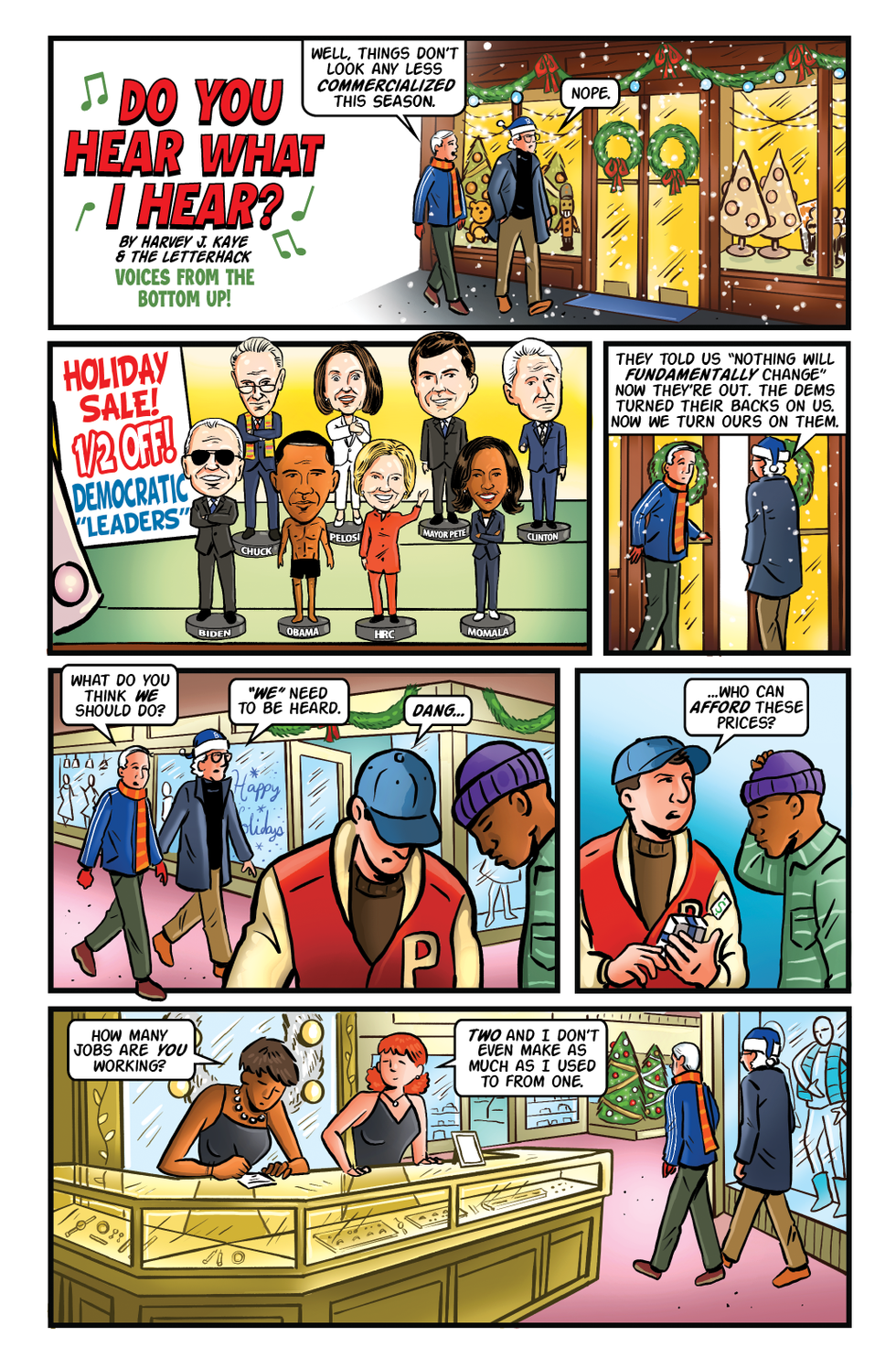
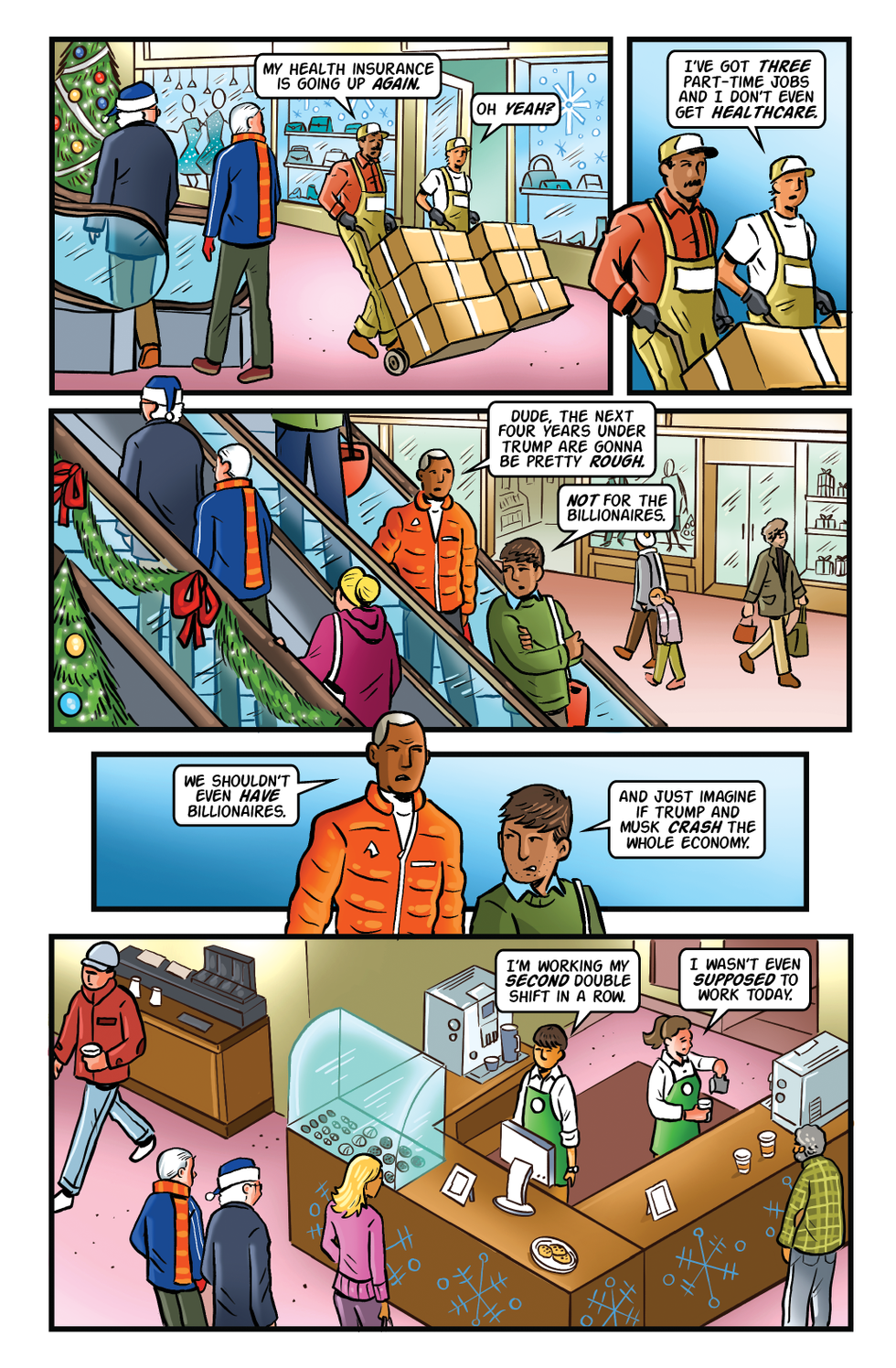
In fact, even as workers began to organize anew and started demanding better deals from their bosses, the Democrats failed to act seriously to bolster their initiatives. Then, truly proving they had not been listening, they ran a 2024 presidential campaign that avoided calling out the billionaire bosses whose billions are growing ever greater and made little of the voiced needs and wants of the working class.
Situating our new comic in the Holiday season, we seek not only to remind liberals, progressives, radicals, and socialists to listen to and empower the voices of working people, but also to push the Democrats to do so as they/we work to rebuild the party in favor of taking back and democratically transforming America.
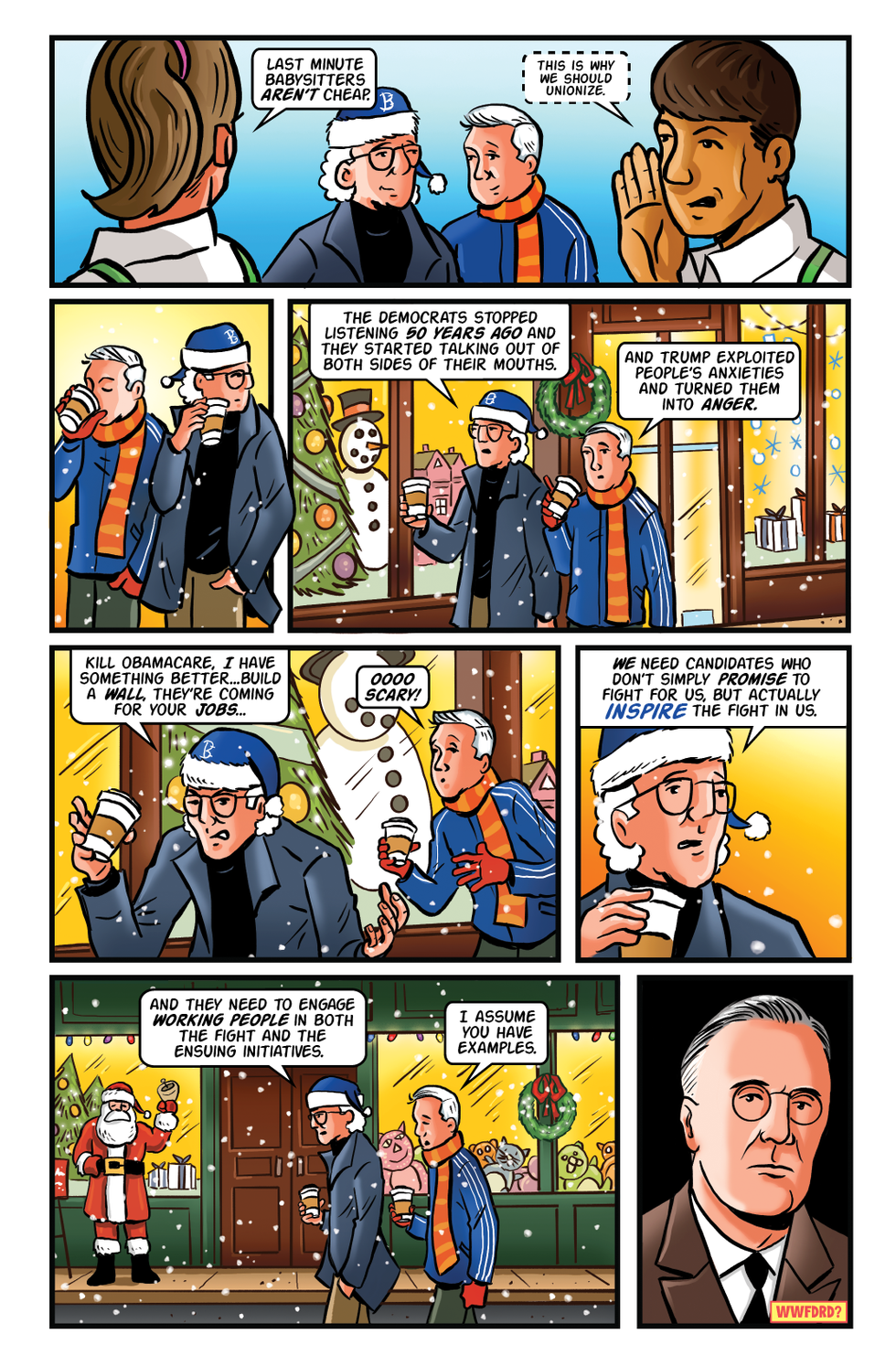
We close this installment of our comic-strip series with a portrait of FDR, the Democratic President who—for all of his tragic faults and failings—not only listened to and actually heard working people, but also encouraged them to progressively push him further than he might otherwise have gone and determinedly engaged their labors and energies to dramatically transform the nation and radically enhance freedom, equality, and democracy.
In upcoming comics for Common Dreams we intend to recount that history in hopes of inspiring and propelling Democrats and working people alike to take action.
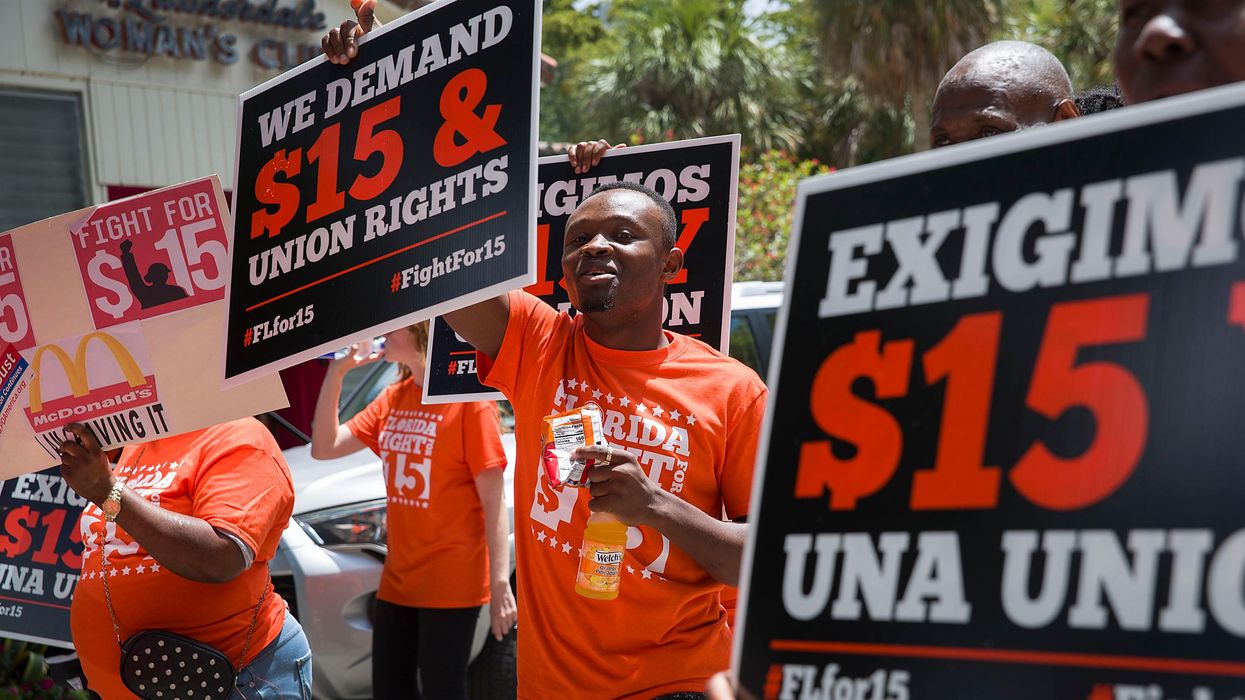


The U.S. Office of Personnel Management (OPM) issued new guidance to the heads of all executive departments and agencies instructing them to implement the new wage by January 30. Nearly 70,000 federal workers are expected to receive a raise as a result of the new policy, which was first reported by Axios.
OPM Director Kiran Ahuja said in a statement that "as the largest employer in the country, how the federal government treats its workforce has real impact. Raising pay rates across the federal government to a minimum of $15 per hour reflects our appreciation for the federal workforce and our values as a nation."
Everett Kelley, president of the American Federation of Government Employees--which represents 700,000 federal workers--called President Joe Biden's move "one of his most significant actions to date."
"For the tens of thousands of workers who will start seeing more money in their paychecks each week, this is a transformative policy choice that will improve their everyday lives," Kelley said in a statement. "Setting a new $15 per hour wage floor for federal government work will encourage employers across the country who are currently paying poverty wages to compete for labor and start paying fairer rates, lifting the wages of American workers across the country."
The administration's move follows a recommendation in an executive order signed by Biden during his first week in office. Last November, the U.S. Labor Department announced that all federal contract workers will be paid at least $15 per hour starting in January--a policy ordered by Biden in April--while asserting that all U.S. workers should receive at least that much.
Related Content

Reacting to the November announcement, Rep. Pramila Jayapal (D-Wash.), who chairs the Congressional Progressive Caucus, said, "Now, let's take this nationwide and give over 30 million workers a much-needed and well-deserved raise."
Correction: This article originally cited an SEIU press release claiming "nearly 700,000 federal workers are expected to receive a raise." The true number is nearly 70,000, according to OPM.

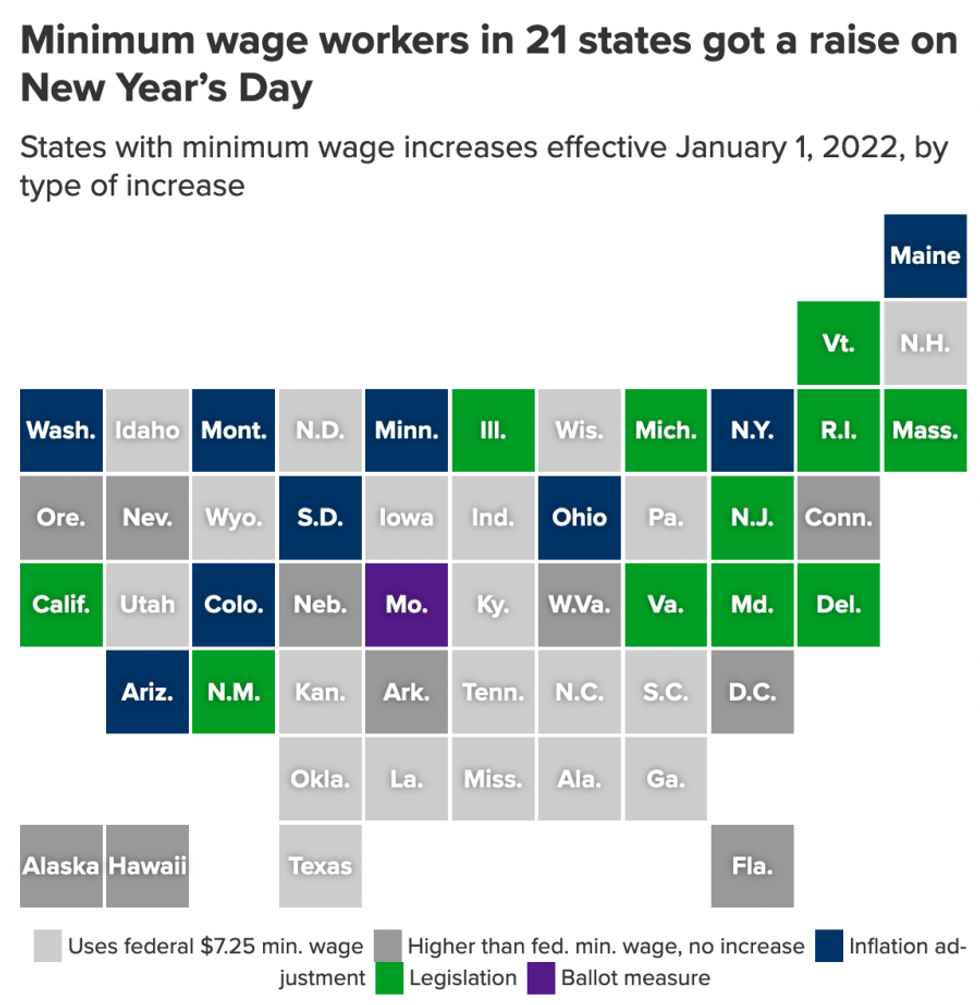
In an analysis published Thursday, David Cooper, Krista Faries, and Sebastian Martinez Hickey of the Economic Policy Institute (EPI) observed that the January 1 wage hikes in 21 states "range from a $0.22 inflation adjustment in Michigan to a $1.50 per hour raise in Virginia, the equivalent of an annual increase ranging from $458 to $3,120 for a full-time, full-year minimum wage worker."
"The January 1 increases in 11 states--California, Delaware, Illinois, Maryland, Massachusetts, Michigan, New Jersey, New Mexico, Rhode Island, Vermont, and Virginia--are the result of legislation passed by state lawmakers to raise their state's wage floors," the EPI experts wrote. "In nine states, the changes are the result of automatic annual inflation adjustments."
Other states are slated to raise their wages later in the new year. According to the National Employment Law Project, a record 81 U.S. jurisdictions will increase their minimum wages in 2022, and voters in several states could have the chance to vote on wage-related ballot initiatives during the midterms--a testament to the growing momentum of the worker-led Fight for $15 movement.
In California, a proposed ballot measure led by Los Angeles investor and activist Joe Sanberg seeks to gradually raise the state minimum wage to $18 an hour beginning in 2023.
Additionally, under an executive order that President Joe Biden signed back in April, the minimum wage for federal contract workers will rise to $15 an hour by January 30, 2022.
While data-collecting challenges stemming from the pandemic have made it difficult to estimate how many workers will benefit from the raises that took effect on January 1, the EPI researchers stressed in their new analysis that "minimum wage increases are as crucial as ever in the current context--to protect low-wage workers from exploitation and continue toward the goal of a living wage for all workers."
"From a macroeconomic perspective, it's smart policy," they added. "Low-wage households--who disproportionately benefit from increases to the minimum wage--are highly likely to quickly spend the extra dollars they receive, bolstering consumer demand as the economy continues to recover."
But despite the fresh wage hikes, the EPI experts emphasized that 20 states--half of which are in the South--still adhere to the federal minimum of $7.25 an hour, spotlighting the need for action at the federal level.
"As economic research continues to show that higher minimum wages work precisely as they're intended--lifting pay for low-wage workers with little, if any, impact on their job prospects--there is no excuse for lawmakers to let the federal minimum wage continue to languish," they argued.
Early last year, House Democrats passed a coronavirus relief package that included a $15 federal minimum wage provision, but Senate Democratic leaders later removed the measure to conform to the advice of the upper chamber's unelected parliamentarian.
Eight Senate Democrats then proceeded to join Republicans in voting down Sen. Bernie Sanders' (I-Vt.) attempt to overrule the parliamentarian and reinclude the provision.
In a tweet on Thursday, Sanders lamented that "the average worker, when adjusting for inflation, is making $44 a week LESS today than they made in the 1970s."
The recent, record-breaking surge in inflation--which has been caused by a number of factors, including pandemic-related supply chain disruptions and corporate profiteering--has eroded the modest wage growth that workers have seen over the past year, leading many employees to seek out higher pay and better benefits using the leverage conferred by a tight labor market.
The EPI's Cooper, Faries, and Hickey wrote Thursday that "with consumer prices rising substantially over the past year, the need for a higher federal minimum wage is more acute than ever--and the longer Congress waits to enact an increase, the larger that increase will need to be to establish an adequate wage floor."
"The Raise the Wage Act of 2021--a bill that would raise the federal minimum wage to $15 by 2025--would finally set the country's minimum wage on the path to a livable wage," they argued, "achieving a policy goal that economic and racial justice advocates have been demanding for over 50 years."