

SUBSCRIBE TO OUR FREE NEWSLETTER
Daily news & progressive opinion—funded by the people, not the corporations—delivered straight to your inbox.
5
#000000
#FFFFFF
To donate by check, phone, or other method, see our More Ways to Give page.
Daily news & progressive opinion—funded by the people, not the corporations—delivered straight to your inbox.

"A pioneer for women's rights, Rep. Schroeder spoke up for Colorado in D.C. for over two decades, defying odds and making her mark," said one lawmaker.
Progressive lawmakers were among those mourning the death of former U.S. Rep. Patricia Schroeder, who served in the House for 24 years and pushed for legislation to protect the jobs of parents, control military spending, and expand healthcare for low-income people. She died in Celebration, Florida on Monday at age 82.
Schroeder first ran for Congress in 1972, representing the Denver area and centering her grassroots campaign largely on her opposition to the U.S. war in Vietnam.
She was one of just 14 women in the House when she took office and was the first woman to serve on the House Armed Services Committee, on which she sat for her entire legislative career.
Upon being named to the committee, Schroeder recalled being ordered by Chairman F. Edward Hébert, a right-wing Democrat from Louisiana, to share a seat with African-American Rep. Ron Dellums (D-Calif.), saying that Hébert told the newly elected lawmakers that they were "only worth half the normal member."
She had previously been told by a dean at Harvard Law School, where she earned a law degree in 1964, that she and the other 14 women in her class had "taken this position from a man."
She was undaunted by the sexism she encountered, and used her position on the Armed Services Committee to regularly call for arms control and reduced military spending. Schroeder aimed to reform the committee that she said acted too frequently as the Pentagon's "lap dog."
The congresswoman was also well known for leading the fight for women's rights in the workplace, pushing for the passage of the 1978 Pregnancy Discrimination Act, which prohibited employers from firing women because they were pregnant. Fifteen years later, she helped pass the Family and Medical Leave Act of 1993 to ensure people wouldn't lose their jobs for taking time off work to care for a newborn or other family member.
Other legislation she played a crucial role in passing included the Violence Against Women Act of 1994; the National Child Protection Act of 1993, which established a background check system for childcare providers; and the Breast and Cervical Cancer Mortality Prevention Act of 1990, which provided screenings for lower-income women.
In 1995, Schroeder joined Bernie Sanders, then an Independent member of the House representing Vermont, in rising to oppose the comments of Rep. Duke Cunningham (R-Calif.). Cunningham uttered a slur as he attacked the two lawmakers for supporting gay Americans who served in the military and told Sanders, "Sit down, you socialist!"
Schroeder retorted with a "parliamentary inquiry," asking, "Do we have to call the gentleman a gentleman if he's not one?"
On Tuesday, Sanders tweeted that Schroeder "was not only a friend but an extraordinarily effective congresswoman who, in so many ways, led the way in opening up opportunities for women."
"Former Congresswoman Pat Schroeder was a fearless champion for women's rights," said Rep. Alexandria Ocasio-Cortez (D-N.Y.). "Her work has inspired countless women in politics and government, and we hope to continue to uphold her legacy."
Newly elected progressive Reps. Maxwell Alejandro Frost (D-Fla.) and Jasmine Crockett (D-Texas) also expressed appreciation for Schroeder's legacy.
"A pioneer for women's rights, Rep. Schroeder spoke up for Colorado in D.C. for over two decades, defying odds and making her mark," said Crockett. "Last night we lost a giant—but Pat Schroeder's legacy and work lives on!"
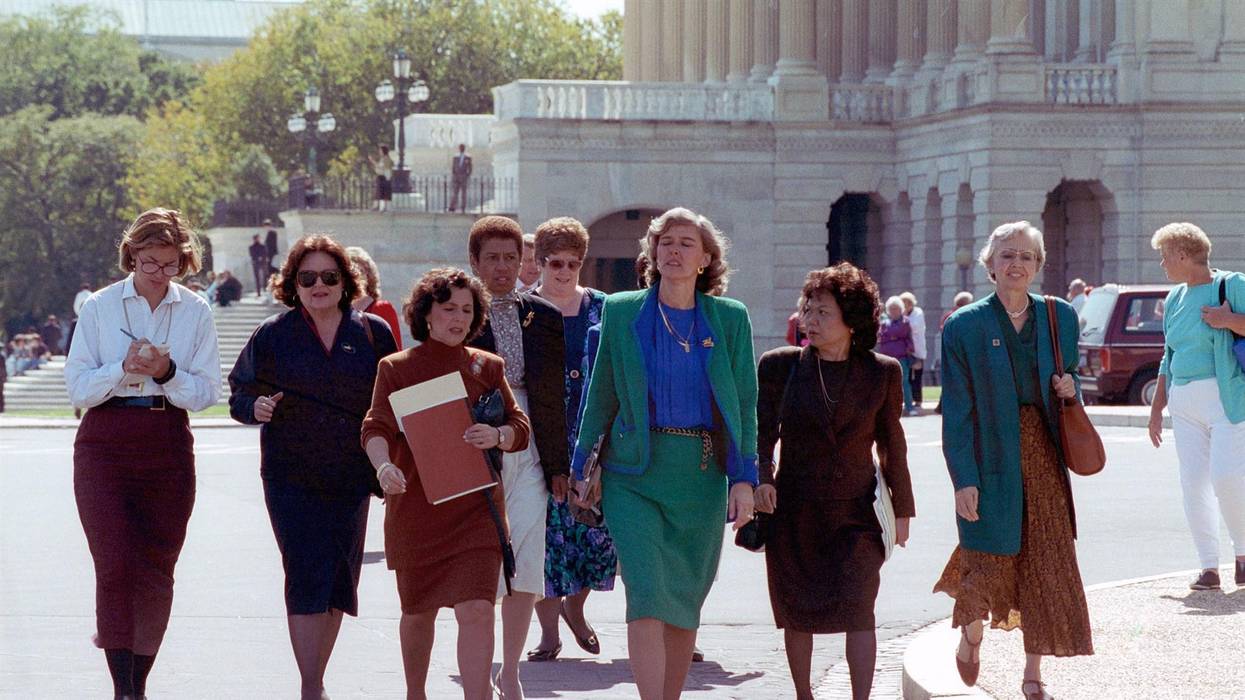
On October 8, 1991, six other female members of Congress and I stormed the steps of the U.S. Senate and interrupted the Democratic Senators' weekly caucus lunch, demanding that Professor Anita Hill be given an opportunity to testify during the confirmation hearings of Clarence Thomas about allegations of sexual misconduct.
You might think that a Democratic-controlled Senate and Judiciary Committee would not have required the intercession of six Democratic members of the House of Representatives to give a public airing to the outrageous actions of President George H.W. Bush's Supreme Court nominee. But to think that is a fundamental misunderstanding of the environment at the time.
There were, in 1991, no female members of the Senate Judiciary Committee on either side of the aisle. Thousands of American women -- including more than a few on Capitol Hill -- endured sexual discrimination and harassment at their workplaces in silence (in addition to unequal pay, which continues to this day). And there was a feeling among the men in charge that inappropriate personal or professional actions of a judicial nominee, even one for a lifetime appointment, shouldn't interfere with the progression of his illustrious career.
So here we are again, 27 years later. The similarities between the reactions to Professor Hill's accusations and those of Dr. Christine Blasey Ford, Deborah Ramirez and Julie Swetnick against Judge Brett Kavanaugh have been well documented. And the actions of the Senate leadership and the Senate Judiciary Committee leaders raise questions about exactly what, if anything, the Senate Judiciary Committee learned from its gross mistreatment of Professor Hill.
The answers will have profound implications far outside the nation's capital.
Just days after we marched up the Senate steps, Professor Hill swore to tell the truth and testified before the all-male, all-white Senate Judiciary Committee. I'll never forget watching the blank faces of the men questioning Professor Hill, casting doubt on her credibility and calling into question her motives. The hearings devolved into a shameful discourse that sought to embarrass and cast fault on the accuser. In reality, Professor Hill was on trial that day.
For many, it was captivating television, a real life political thriller. But for too many women in America, experiences like Professor Hill's were all too real.
In 1991, far fewer people, including U.S. Senators of both parties, took seriously the pervasiveness of sexual harassment and abuse of women in our society. Professor Hill's testimony marked a tipping point, changing how we talk about workplace sexual harassment, raising public awareness about its pervasiveness and spurring the "Year of the Woman," when then-record numbers of women ran for and were elected to Congress.
Decades later, it seems increasingly likely that the Senate Judiciary Committee will repeat its catastrophic failures from the Thomas hearings, reportedly hiring an outside prosecutor to conduct a legalistic interrogation of Kavanaugh's alleged victim instead of a Senate hearing.
It's not enough for the committee to prematurely hold a hearing for Judge Kavanaugh and Dr. Blasey Ford to testify in order to set the stage for a quick vote immediate afterwards. It must pause for a thorough FBI investigation of the allegations against Kavanaugh. Absent such an investigation, the nomination process must not proceed.
If the Republican Senate majority could stall on the last Supreme Court nomination for 293 days for political reasons, surely multiple sexual misconduct allegations are a good reason to delay a hearing and a vote on a lifetime appointment to the highest court in the land.
Senators must listen to Dr. Blasey Ford, Ms. Ramirez, Ms. Swetnick and any other women who comes forward without bias or malice, and treat them with the respect Professor Hill was not afforded. So far, they haven't. That is particularly disturbing given that several Republicans have served on the committee since the days of Professor Hill's testimony. For instance, Sen. Orrin Hatch, R-Utah, who accused Professor Hill of basing her testimony on "The Exorcist" and was one of the fiercest defenders of Justice Thomas, has now said that Dr. Blasey Ford may be "mixed up" and confusing Judge Kavanaugh with someone else.
Instead of showing deference or even compassion, Republican Senators on the Judiciary Committee have ignored Dr. Blasey Ford's request for the FBI to re-open its background check investigation of Judge Kavanaugh, and demanded her rushed participation in a Senate hearing to apparently be conducted by a sex crimes prosecutor. (Never mind that she received death threats and was forced to flee her home.) It's no wonder Dr. Blasey Ford apparently remains concerned about testifying on the Republicans' terms.
Only after reviewing the findings of a thorough investigation and hearing testimony from Kavanaugh's accusers should the committee members make a determination about the credibility of the nominee. Only then should the committee consider whether Kavanaugh's nomination should proceed based on his abilities, his judicial record and philosophy and his character.
I oppose Judge Kavanaugh's nomination for policy reasons, but such opposition should have no bearing on how this matter is handled. Whether you believe he would be a good addition to the Supreme Court or not, a full examination of these incidents and the judge's entire background is warranted.
The Senate erred gravely in proceeding with the Thomas nomination given the credible accusations against him, let alone with rushing through the hearings and refusing to hear testimony that supported Professor Hill's accusations. It should not make the same mistake again, thus perpetuating the mistreatment of another generation of women and girls.

Throughout the day before the summit in Helsinki, the lead story on the New York Times home page stayed the same: "Just by Meeting With Trump, Putin Comes Out Ahead." The Sunday headline was in harmony with the tone of U.S. news coverage overall. As for media commentary, the Washington Post was in the dominant groove as it editorialized that Russia's President Vladimir Putin is "an implacably hostile foreign adversary."
Contempt for diplomacy with Russia is now extreme. Mainline U.S. journalists and top Democrats often bait President Trump in zero-sum terms. No doubt Hillary Clinton thought she was sending out an applause line in her tweet Sunday night: "Question for President Trump as he meets Putin: Do you know which team you play for?"
A bellicose stance toward Russia has become so routine and widespread that we might not give it a second thought -- and that makes it all the more hazardous. After President George W. Bush declared "You're either with us or against us," many Americans gradually realized what was wrong with a Manichean view of the world. Such an outlook is even more dangerous today.
The Russiagate frenzy is largely about punching up contrasts between the United States (angelic and victimized) and Russia (sinister and victimizer).
Since early 2017, the U.S. mass media have laid it on thick with the rough political equivalent of a painting technique known as chiaroscuro - "the use of strong contrasts between light and dark, usually bold contrasts affecting a whole composition," in the words of Wikipedia. The Russiagate frenzy is largely about punching up contrasts between the United States (angelic and victimized) and Russia (sinister and victimizer).
Countless stories with selective facts are being told that way. But other selectively fact-based stories could also be told to portray the United States as a sinister victimizer and Russia as an angelic victim. Those governments and their conformist media outlets are relentless in telling it either way. As the great journalist I.F. Stone observed long ago, "All governments lie, and nothing they say should be believed." In other words: don't trust, verify.
Often the biggest lies involve what remains unsaid. For instance, U.S. media rarely mention such key matters as the promise-breaking huge expansion of NATO to Russia's borders since the fall of the Berlin Wall, or the brazen U.S. intervention in Russia's pivotal 1996 presidential election, or the U.S. government's 2002 withdrawal from the Anti-Ballistic Missile Treaty, or the more than 800 U.S. military bases overseas -- in contrast to Russia's nine.
For human survival on this planet, an overarching truth appears in an open letter published last week by The Nation magazine: "No political advantage, real or imagined, could possibly compensate for the consequences if even a fraction of U.S. and Russian arsenals were to be utilized in a thermonuclear exchange. The tacit pretense that the worsening of U.S.-Russian relations does not worsen the odds of survival for the next generations is profoundly false."
The initial 26 signers of the open letter - "Common Ground: For Secure Elections and True National Security" -- included Pentagon Papers whistleblower Daniel Ellsberg, writer and feminist organizer Gloria Steinem, former UN ambassador Gov. Bill Richardson, political analyst Noam Chomsky, former covert CIA operations officer Valerie Plame, activist leader Rev. Dr. William Barber II, filmmaker Michael Moore, former Nixon White House counsel John Dean, Russia scholar Stephen F. Cohen, former U.S. ambassador to the USSR Jack F. Matlock Jr., Pulitzer Prize-winning writers Alice Walker and Viet Thanh Nguyen, The Nation editor Katrina vanden Heuvel, former senator Adlai Stevenson III, and former longtime House Armed Services Committee member Patricia Schroeder. (I was also one of the initial signers.)
Since its release five days ago, the open letter has gained support from a petition already signed by 30,000 people. The petition campaign aims to amplify the call for protecting the digital infrastructure of the electoral process that is now "vulnerable to would-be hackers based anywhere" -- and for taking "concrete steps... to ease tensions between the nuclear superpowers."
We need a major shift in the U.S. approach toward Russia. Clearly the needed shift won't be initiated by the Republican or Democratic leaders in Congress; it must come from Americans who make their voices heard. The lives -- and even existence -- of future generations are at stake in the relationship between Washington and Moscow.
Many of the petition's grassroots signers have posted comments along with their names. Here are a few of my favorites:
Yet a wide array of media outlets, notably the "Russiagate"-obsessed network MSNBC, keeps egging on progressives to climb toward peaks of anti-Russian jingoism. The line of march is often in virtual lockstep with GOP hyper-hawks like Senators John McCain and Lindsey Graham. The incessant drumbeat is in sync with what Martin Luther King Jr. called "the madness of militarism."
Meanwhile, as Dr. King said, "We still have a choice today: nonviolent coexistence or violent coannihilation."
Many Americans remain deeply concerned about reports of Russian interference with the 2016 election. Meanwhile, relations between the United States and Russia are at their lowest and most dangerous point in several decades. For the sake of democracy at home and true national security, we must reach common ground to safeguard common interests--taking steps to protect the nation's elections and to prevent war between the world's two nuclear superpowers.
Whatever the truth of varied charges that Russia interfered with the election, there should be no doubt that America's digital-age infrastructure for the electoral process is in urgent need of protection. The overarching fact remains that the system is vulnerable to would-be hackers based anywhere. Solutions will require a much higher level of security for everything from voter-registration records to tabulation of ballots with verifiable paper trails. As a nation, we must fortify our election system against unlawful intrusions as well as official policies of voter suppression.
"As a nation, we must fortify our election system against unlawful intrusions as well as official policies of voter suppression."
At the same time, the U.S. and Russian governments show numerous signs of being on a collision course. Diplomacy has given way to hostility and reciprocal consular expulsions, along with dozens of near-miss military encounters in Syria and in skies above Europe. Both sides are plunging ahead with major new weapons development programs. In contrast to prior eras, there is now an alarming lack of standard procedures to keep the armed forces of both countries in sufficient communication to prevent an escalation that could lead to conventional or even nuclear attack. These tensions are festering between two nations with large quantities of nuclear weapons on virtual hair-trigger alert; yet the current partisan fixations in Washington are ignoring the dangers to global stability and, ultimately, human survival.
The United States should implement a pronounced shift in approach toward Russia. No political advantage, real or imagined, could possibly compensate for the consequences if even a fraction of U.S. and Russian arsenals were to be utilized in a thermonuclear exchange. The tacit pretense that the worsening of U.S.-Russian relations does not worsen the odds of survival for the next generations is profoundly false. Concrete steps can and must be taken to ease tensions between the nuclear superpowers.
Signed,
Andrew Bacevich, Professor Emeritus, Boston University
Phyllis Bennis, Fellow, Institute for Policy Studies
Noam Chomsky, Professor, Author, and Activist
Stephen F. Cohen, Professor Emeritus of Russian Studies and Politics, NYU and Princeton University, and Board Member, American Committee for East-West Accord
John Dean, Former Nixon White House Counsel
Phil Donahue, Journalist and Talk-Show Pioneer
Thomas Drake, Former NSA Senior Executive and Whistle-blower
Daniel Ellsberg, Activist, "Pentagon Papers" Whistle-blower, and Author of The Doomsday Machine: Confessions of a Nuclear War Planner
Jack Matlock, Former US Ambassador to the USSR and Board Member, American Committee for East-West Accord
Walter Mosley, Writer and Screenwriter
Viet Thanh Nguyen, Pulitzer Prize-Winning Novelist
Frances Fox Piven, Distinguished Professor Emeritus, CUNY Graduate School
Valerie Plame, Former Covert CIA Operations Officer and Author
Adolph Reed Jr., Professor of Political Science, University of Pennsylvania
Bill Richardson, Former Governor of New Mexico
Patricia Schroeder, Former Congresswoman
Norman Solomon, National Coordinator, RootsAction.org
Gloria Steinem, Writer and Feminist Organizer
Adlai Stevenson III, Former US Senator and Chairman, Adlai Stevenson Center on Democracy
Katrina vanden Heuvel, Editor and Publisher, The Nation
Alice Walker, Writer, Poet, and Activist
Jody Williams, Professor and Nobel Peace Prize Laureate
James Zogby, President, Arab American Institute
Signers have endorsed this Open Letter as individuals and not on behalf of any organization.

In a lengthy Washington Post interview with Anita Hill and five female Democratic lawmakers who supported her during the historic confirmation hearing for U.S. Supreme Court nominee Clarence Thomas in 1991, Hill criticized former Vice President Joe Biden's recent apology regarding how he and the U.S. Senate Judiciary Committee handled her allegations that Thomas sexually harassed her.
In her remarks, published late Wednesday, Hill said Biden's new mea culpas don't really take "ownership of his role in what happened." He and other lawmakers should have shown "leadership" at the time, she added, "And they did just the opposite."
Hill, who is now a professor of legal history and public policy at Brandeis University, testified in 1991--in front of a Judiciary Committee comprised of only white men--that Thomas sexually harassed her when he worked as her supervisor at both the U.S. Department of Education and the Equal Employment Opportunity Commission.
Biden--who has long been criticized by Hill and several others for how he handled the situation as then-chairman of the Judiciary Committee--declined to call three women who had been subpoenaed to provide testimonies about similar behavior by Thomas that they had experienced or witnessed.
At Glamour magazine's Women of the Year event last week, Biden was asked how he might have handled the situation differently, and what he wants to say to Hill about it now. He said, in part:
Anita Hill was victimized, there is no question in my mind, and every single solitary person on that committee who believed her voted no.... What I do feel badly about was the bad taste that got left in the mouth of some of the people around Anita Hill, and maybe even Anita, about whether or not the witnesses should have been called who weren't called etcetera. Maybe I could have handled that better, but I believed her from the beginning, I made her case from the floor, I made her case to the committee....
I am so sorry if she believed that [the process was unfair]. I am so sorry that she had to go through what she went through. Think of the courage it took for her to come forward.... I feel really badly that she didn't feel like the process worked, but I tell you what, I said something at the time that proved to be right. I said this is going to be the start of a fundamental change of what constitutes harassment in the workplace and people are going to begin to change.
"He said, 'I am sorry if she felt she didn't get a fair hearing.' That's sort of an 'I'm sorry if you were offended,'" Hill told the Post. She said that while "some part of it" was an admission that he could have done better, ultimately she wants to hear Biden fully take "responsibility" for his role in how it played out--Thomas was ultimately confirmed 52-48, and remains on the court today.
Hill continued:
I still don't think it takes ownership of his role in what happened. And he also doesn't understand that it wasn't just that I felt it was not fair. It was that women were looking to the Senate Judiciary Committee and his leadership to really open the way to have these kinds of hearings. They should have been using best practices to show leadership on this issue on behalf of women's equality. And they did just the opposite....
You cannot just bring people forward into a process where you know they're not going to be treated fairly. That's not being heard. That's something that we are struggling with right now. Women are coming in to make a complaint, and the process is unfair and employers are saying, "Well, we have a process." Well, that's not enough.
Hill and the five Democratic lawmakers interviewed by the Post--Nita M. Lowey (N.Y.), Barbara A. Mikulski (Md.), Eleanor Holmes Norton (D.C.), Pat Schroeder (Colo.), and Louise M. Slaughter (N.Y.)--spoke about the media coverage of Thomas' confirmation process, the wave of women elected in 1994 (often seen as a direct response to how Hill was treated by lawmakers during the hearing), and the national conversation that is taking place right now, in the wake of allegations levied against several high-profile public figures and as survivors of sexual harassment and assault use the hashtag #MeToo to share their stories on social media.
Watch:
Read the full interview with the Post here.
We have seen the future of electoral politics flashing across the screens of local TV stations from Iowa to New Hampshire to South Carolina. Despite all the excitement about Facebook and Twitter, the critical election battles of 2012 and for some time to come will be fought in the commercial breaks on local network affiliates. This year, according to a fresh report to investors from Needham and Company's industry analysts, television stations will reap as much as $5 billion--up from $2.8 billion in 2008--from a money-and-media election complex that plays a definitional role in our political discourse. As Obama campaign adviser David Axelrod says, the cacophony of broadcast commercials remains "the nuclear weapon" of American politics.
We've known for some time that the pattern, extent and impact of political advertising would be transformed and supercharged by the Supreme Court's January 2010 Citizens United ruling. But the changes, even at this early stage of the 2012 campaign, have proven to be more dramatic and unsettling than all but the most fretful analysts had imagined.
Citizens United's easing of restrictions on corporate and individual spending, especially by organizations not under the control of candidates, has led to the proliferation of "Super PACs." These shadowy groups do not have to abide by the $2,500 limit on donations to actual campaigns, and they can easily avoid rules for reporting sources of contributions. For instance, Super PACs have established nonprofit arms that are permitted to shield contributors' identities as long as they spend no more than 50 percent of their money on electoral politics. So the identity of many, possibly most, contributors will never be known to the public, even though they are already playing a decisive role in the 2012 election season. Former White House political czar Karl Rove's Crossroads complex, for example, operates both a Super PAC and a nonprofit. And Rove's operation is being replicated almost daily by new political operations aiming their money at presidential, Congressional, state and local elections. "In 2010, it was just training wheels, and those training wheels will come off in 2012," says Kenneth Goldstein, president of Kantar Media's Campaign Media Analysis Group. "There will be more, bigger groups spending, and not just on one side but on both sides."
The 2012 campaign has already confirmed that Super PACs are key players, more powerful in many ways than the campaigns waged by candidates and party committees. But don't expect commercial media outlets to shed much light on these secretive powers. Newsroom staffs have been cut, political reporting is down and local stations are too busy cashing in on what TV Technology magazine describes as "the political windfall." The Citizens United ruling and its Super PAC spawn have created a new revenue stream for media companies, and they are not about to turn the spigot off. "Voters are going to be inundated with more campaign advertising than ever," one investor service wrote in 2011. "While this may fray the already frazzled nerves of the American people, it is great news for media companies." Indeed, Super PAC ads allow stations to reap revenues from actual campaigns and from parallel "independent" campaigns targeting the same audience with different messages.
Here's what the next stage of American politics looks like on the screen: WHO, the NBC affiliate in Des Moines, was awash in political advertising the night before the Iowa caucuses. But some ads stood out. One of the most striking was a minute-long commercial featuring amber waves of grain fluttering in the summer breeze, children smiling and a fellow with great hair declaring, "The principles that have made this nation a great and powerful leader of the world have not lost their meaning. They never will." Then the guy with the great hair announced, "I'm Mitt Romney. I believe in America. And I am running for president of the United States."
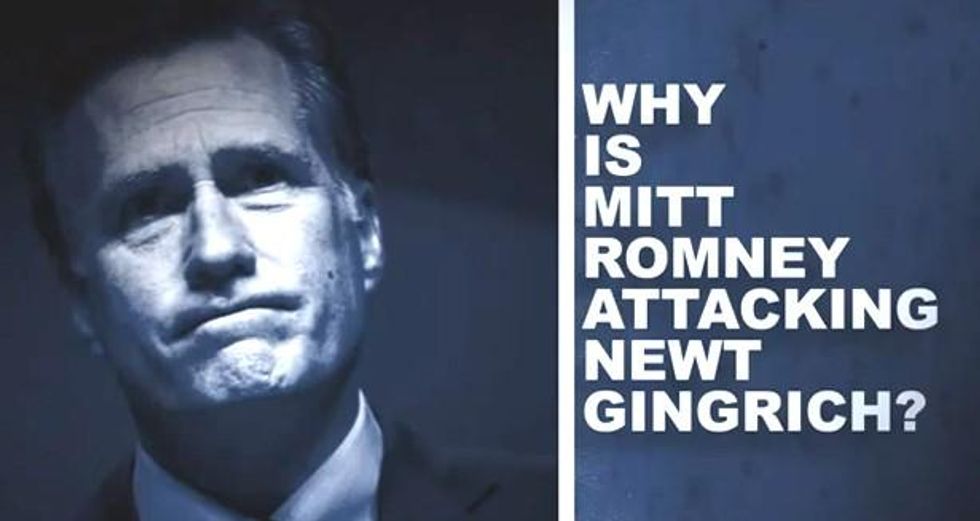
Then came another ad, darker and more threatening, with grainy production values, old black-and-white photos and a blistering assault on the Republican presidential contender who had briefly leapt ahead of Romney in the polling: former House Speaker Newt Gingrich. "Newt has more baggage than the airlines," the ad warned, before linking Gingrich to "China's brutal one-child policy," "taxpayer funding of some abortions," "ethics violations" and "half-baked and not especially conservative ideals." Quoting a National Review poke at Gingrich, the ad closed with the line: "He appears unable to transform, or even govern, himself."
The first commercial is an old-school "closing argument" ad, all optimism and light, along with the usual campaign-season balderdash--the empty banalities of a front-running contender appealing to "principles" and a belief in America. The second represents another archetype: the no-holds-barred takedown of an opposing candidate, which politicians and their consultants traditionally avoid running on the eve of a big vote for fear of muddying their own message and appearing too negative. Romney's campaign paid for the "amber waves of grain" ad. But who was responsible for the "Newt Gingrich: Too Much Baggage" ad? Restore Our Future, a Super PAC that collected $30 million for the 2012 campaign--more than the combined spending of Lyndon Johnson and Barry Goldwater on the 1964 presidential campaign. And when Gingrich shot to the top of the polls a month before the Iowa caucuses, the group steered $4 million into a TV ad campaign that knocked the former Speaker out of the lead and into a dismal fourth-place finish.
Who finished first in Iowa? And a week later in New Hampshire? The guy with the great hair and all the talk about "principles"--Mitt Romney. He also happened to be the guy who appeared before a dozen potential donors at the organizational meeting for Restore Our Future in July 2011. Romney's former chief campaign fundraiser moved over to Restore Our Future, as well as his former political director and other aides. Romney's old partner at Bain Capital helped Restore Our Future get off the ground with a $1 million check. Technically there can be no collaboration between Super PACs and the candidates they are supporting. But Timothy Egan of the New York Times stated the obvious: "This legalism of 'no coordination' is a filament-thin G-string. Everyone coordinates."
Gingrich complained about the presumably unethical and potentially illegal level of coordination between the "principled" Romney campaign and the thuggish Restore Our Future project. When Romney pled innocence and ignorance, Gingrich said: "He's not truthful about his PAC, which has his staff running it and his millionaire friends donating to it, although in secret. And the PAC itself is not truthful in its ads." But the griping didn't get him very far.
* * *
By the time the 2012 race formally began, on January 3, Super PACs had already logged $13.1 million in campaign spending in early caucus and primary states, most of it in Iowa and most of it negative. Romney, whose actual campaign spent only about one-third as much money on ads as did the Super PACs that supported him, emerged as the narrow winner. But he wasn't the only winner in Iowa or New Hampshire, where a similar scenario played out a week later. Local television stations like WHO in Des Moines and WMUR in Manchester cashed in, big-time, as would stations in later primary states. And station managers in battleground states across the country can hardly wait for the real rush, which will come when the Super PACs that have already been positioned to support the Republican nominee and Democrat Barack Obama spend their money in what is all but certain to be the first multibillion-dollar presidential race in history.
The total number of TV ads for House, Senate and gubernatorial candidates in 2010 was 2,870,000. This was a 250 percent increase over the number of TV ads aired in 2002, when the same mix of federal and state offices was up for grabs. Compared strictly with 2008, the amount spent on TV ads for House races in 2010 was up 54 percent, and the amount spent on Senate-race TV ads was up 71 percent. Even before this year's Iowa binge, it was clear that 2012 would see a quantum leap in spending from 2008, the greatest increase in American history, and most of this would go to TV ads. As Maribeth Papuga, who oversees local TV and radio purchases for the MediaVest Communications Group, says, "We're definitely going to see a big bump in spending in 2012."
It's not as if Americans haven't already seen big bumps on what is becoming the permanent campaign trail. Consider how politics has changed in the past four decades. In 1972, a little-known Colorado Democrat, Floyd Haskell, spent $81,000 (roughly $440,000 in 2010 dollars) on television advertising for a campaign that unseated incumbent Republican US Senator Gordon Allott. The figure was dramatic enough to merit note in a New York Times article on Haskell's upset win. Fast-forward to the 2010 Senate race, when incumbent Colorado Democrat Michael Bennet defeated Republican Ken Buck. The total spent on that campaign in 2010 (the bulk of which went to television ads) topped $40 million, more than $30 million of which was spent by Super PAC-type groups answering only to their donors. In the last month of the election, negative ads ran nearly every minute of every day. The difference in spending, factoring in inflation, approached 100 to 1. The 2010 Colorado Senate race is generally held up by insiders as the bellwether for 2012 and beyond. As Tim Egan puts it, "This is your democracy on meth--the post-Citizens United world."
* * *
Local TV stations across the country have come to rely on the booms in political advertising that come during critical election contests. In the '70s, political ads were an almost imperceptible part of total TV ad revenues. By 1996, according to the National Association of Broadcasters (NAB), they had edged up to 1.2 percent. A decade later political advertising was approaching 8-10 percent of total TV ad revenue. For many stations, political advertising in 2012 could account for more than 20 percent of ad revenues, and in some key states far more than that. As former New Jersey Senator Bill Bradley put it, election campaigns "function as collection agencies for broadcasters. You simply transfer money from contributors to television stations."
The 2010 election season saw record spending on broadcast advertising: as much as $2.8 billion. And that wasn't even a presidential election year. Wall Street stock analysts can barely contain themselves as they envision the growing cash flow. Eric Greenberg, a veteran broadcast-industry insider, says, "Political advertising and elections are to TV what Christmas is to retail."
Broadcasters aren't about to give away the present they have received from the Supreme Court. The NAB has a long history of lobbying to block any campaign finance reform that would decrease revenues for local television stations, such as the idea of compelling stations to provide free airtime to candidates as a public-service requirement. The NAB's prowess in Washington was summed up by former Colorado Representative Pat Schroeder, who said, "Their lobbying is so effective, they hardly have to flick an eyelash." After the Citizens United ruling, the NAB actively opposed key provisions of the DISCLOSE Act, a measure supported by Congressional Democrats and a handful of reform-minded Republicans to roll back elements of the decision. But that's not all. The group has even opposed steps toward the transparency that Supreme Court justices who backed the Citizens United ruling agree is vital but that might shame (or at least expose) the excesses of Super PACs.
In Iowa, where the race was delayed by wrangling over the caucus date, there were fears the money would not flow. But once the timeline was set, WHO, the NBC affiliate, along with another Des Moines station, took in nearly $3.5 million in the last weeks of 2011. A local station manager admitted he was prepared to interrupt his New Year's Eve dinner to upload new political ads. In all, more than $12.5 million worth of advertising was purchased in the Iowa race, and December 2011 revenues for WHO were up more than 50 percent from December 2010. The driver in the frenzy of last-minute TV advertising in Iowa and New Hampshire was the Super PACs.
Super PAC advertising is not like traditional campaign advertising. As the scenario that played out in Iowa illustrates, Super PACs allow allies of candidates with the right connections to the right CEOs and hedge-fund managers to pile up money that can then be used not to promote that candidate but to launch scorched-earth attacks on other candidates. The scenario is particularly well suited to negative advertising. This warps the process in a perverse way, creating a circumstance where a candidate who is not particularly appealing to voters but who is particularly appealing to a small group of 1 percenters can, with the help of well-funded friends, frame a campaign in his favor.
The threat to democracy plays out on a number of levels. Candidates without the right connections may prevail in traditional tests--as Gingrich did with strong debate performances and Rick Santorum did with grassroots organizing and a solid finish in Iowa. But they are eventually targeted and taken out by the Super PACs, and the candidate with the right connections, in this case Romney, enjoys smooth sailing. In Iowa, roughly 45 percent of all ads aired on local TV stations: thousands of commercials, one after another, attacking Gingrich.
Negative advertising can be effective even if it does not generate a single new voter for the candidate favored by the Super PAC placing the ad. If negative ads simply scare off potential backers of an opponent, that's a victory. Moreover, negative ads often force targeted candidates to respond to charges, no matter how spurious. And our lazy and underresourced news media allow the ads to set the agenda for coverage, thereby magnifying their importance and effect.
The most comprehensive research to date concludes that between 2000 and 2008 the overall percentage of political TV ads that were negative increased from 50 percent to 60 percent. And 2008 is already beginning to look like a tea party. The percentage and number of attack ads in 2010 were "unprecedented," and they are increasing sharply again in 2012.
"I just hate it, and there's so much of it," Sarah Hoffman complained to a reporter at a Gingrich event in the Iowa town of Shenandoah. "Anytime they do anything negative, I just turn it off." Gingrich emerged as a born-again reformer for about ninety-six hours during his Iowa free-fall, telling voters like Hoffman: "It will be interesting to see whether, in fact, the people of Iowa decide that they don't like the people who run negative ads, because you could send a tremendous signal to the country that the era of nasty and negative thirty-second campaigns is over."
If a signal was sent from Iowa, it was that many voters would rather switch off than try to sort out the attacks. With no competition on the Democratic side, and with conservatives supposedly all ginned up to choose a challenger for President Obama, Republicans confidently suggested that caucus turnout would rise from 119,000 in 2008 to as much as 150,000 in 2012. Instead, turnout was up only marginally, to around 122,000. If the maverick candidacy of Ron Paul had not attracted thousands of new voters to the caucuses--many of them antiwar and pro-civil liberties independents unlikely to vote Republican in the fall--the turnout would almost certainly have fallen to pre-2008 levels. "If all people hear are negatives, a lot of them are just going to ask, Why bother?" says Ed Fallon, a former Democratic legislator and local radio host in Des Moines who caucused this year as a Republican. "And they're even more frustrated by the fact that the money for the negative campaigning comes from all these unidentified sources on Wall Street."
The research of scholars Stephen Ansolabehere and Shanto Iyengar demonstrates that the main consequence of negative ads is that they demobilize citizens and turn them away from electoral politics. This fact is a "tacit assumption among political consultants," they explain, arguing that the trend is toward "a political implosion of apathy and withdrawal."
* * *
Were national and local broadcast media outlets to cover politics as anything more than a horse race and a clash of personalities, they might be able to undo much of the damage. But stations across the country--and the newspapers they often depend on for serious coverage--have eviscerated local reporting in recent years. Surveys suggest that news programs now devote far less time to political coverage than they did twenty or thirty years ago. To the extent that campaigns are covered, the focus is on personalities and the catfight character of the competition. So it was that when Gingrich complained about the battering he was taking from the Super PACs, the story was portrayed as a dust-up between a pair of candidates rather than as evidence of a structural crisis. In part, this is the fault of the candidates, who for the most part do not want to speak too broadly about Super PAC abuses in which they are engaging or in which they hope to engage.
Once it became clear that the media had no real interest in examining the problem, Gingrich quickly got with the program. Rather than make an issue out of campaign corruption, Gingrich's own Super PAC, Winning Our Future, corralled a $5 million donation from the spare-change drawer of Las Vegas casino mogul Sheldon Adelson (listed by Forbes as the eighth-wealthiest American, with a $21 billion fortune) just before the New Hampshire primary. The plan was to launch a blitzkrieg against Romney. Here we finally get the proper metaphor for post-Citizens United elections: mutually assured destruction, with citizens and the governing process the only certain casualties.
Unfortunately, the media outlets that could challenge this doomsday scenario tend to facilitate it. The elimination of campaign coverage is masked to a certain extent because the gutting of newsrooms also encourages what sociologist Herbert Gans describes as the conversion of political news into campaign coverage. As campaigns have become permanent, so has campaign coverage. Such coverage is cheap and easy to do, and lends itself to gossip and endless chatter, even as it sometimes provides the illusion that serious affairs of state are under scrutiny. To someone watching cable news channels, it might seem that presidential races have never been so thoroughly exhumed by reporters. But the coverage is as nutrition-free as a fast-food hamburger. After a panel of "experts" finish "making sense" of Rick Perry's debate performances, political ads don't look so bad.
With the little news coverage that remains focusing overwhelmingly on the presidential race, Congressional, statewide and local races get little attention nationally or even locally. Not surprisingly, research suggests that political TV advertising is even more effective further down the food chain. "In presidential campaigns, voters may be influenced by news coverage, debates or objective economic or international events," the Brookings Institution's Darrell West explained in 2010. "These other forces restrain the power of advertisements and empower a variety of alternative forces. In Congressional contests, some of these constraining factors are absent, making advertisements potentially more important. If candidates have the money to advertise in a Congressional contest, it can be a very powerful force for electoral success."
West's point is confirmed by a simple statistic from the 2010 races: of fifty-three competitive House districts where Rove and his compatriots backed Republicans with "independent" expenditures that easily exceeded similar expenditures made on behalf of Democrats--often by more than $1 million per district, according to Public Citizen--Republicans won fifty-one.
To the extent that media outlets cover campaigns, they highlight the "charge and countercharge" character of the fight as an asinine personality clash between candidates. But the real clash is between money and democracy. And the media outlets that continue to play a critical role in defining our discourse are not objecting. They are cashing in. Meanwhile, citizens are checking out.