

SUBSCRIBE TO OUR FREE NEWSLETTER
Daily news & progressive opinion—funded by the people, not the corporations—delivered straight to your inbox.
5
#000000
#FFFFFF
To donate by check, phone, or other method, see our More Ways to Give page.
Daily news & progressive opinion—funded by the people, not the corporations—delivered straight to your inbox.
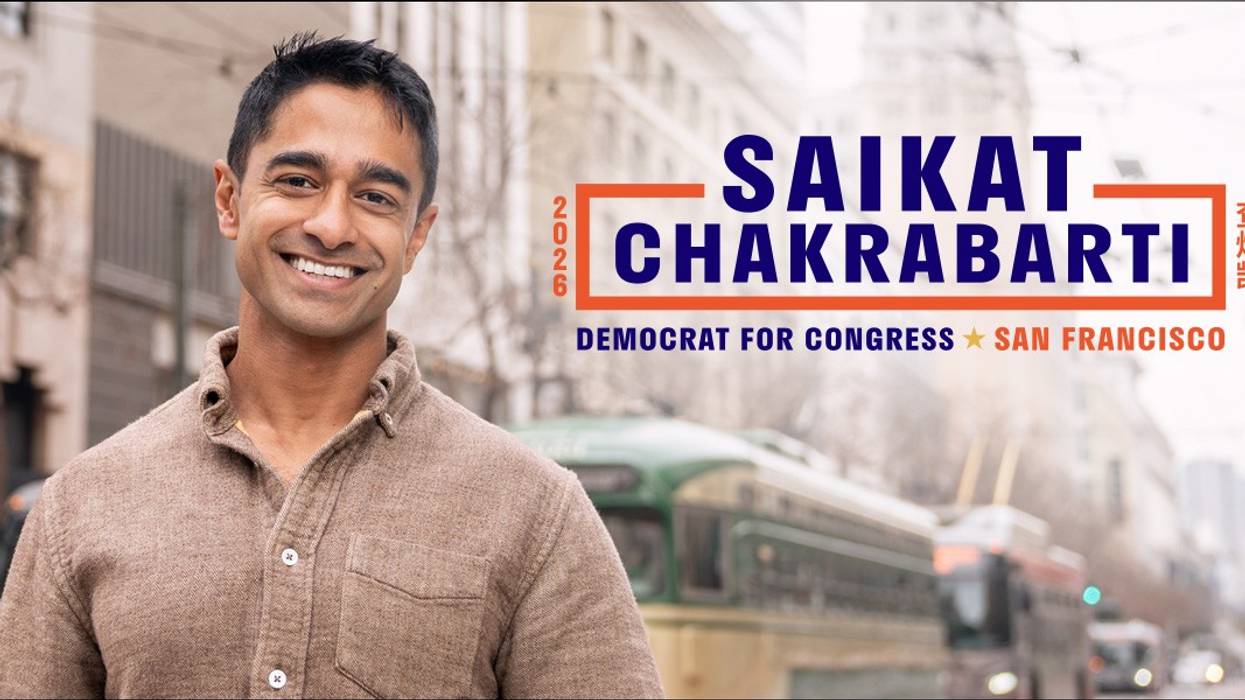
The campaign did not turn out as hoped for the individual who helped catapult Alexandria Ocasio-Cortez into Congress and co-founded Justice Democrats.
As those active in the field will often say, politics is a tough business – it ain’t for everyone. Saikat Chakrabarti, would-be successor to retiring San Francisco Representative and past Speaker of the House Nancy Pelosi, is a recent case in point: a candidate who seemed a perfect fit for the city’s political scene, yet failed to win one of the two slots in the November final. What is unusual about the Chakrabarti story is while we’re all too familiar with political figures who have mastered the art of winning and holding office at the expense of developing a clear vision of why they’re doing it, his problem has largely been the reverse.
Chakrabarti brought two major assets to the race: ideas and money. Some of his past ideas had been quite impactful. After significant involvement in Bernie Sanders’ seminal 2016 presidential campaign, he co-founded Brand New Congress to recruit new congressional candidates, one of whom was Alexandria Ocasio-Cortez. While Brand New Congress proved ephemeral, Justice Democrats, a subsequent organization he also co-founded, has proven to have staying power, continuing to promote Sanders-stripe candidates – with notable successes. Chakrabarti’s money derives from his role as a founding engineer of the then-start-up Stripe, a payments processing company. He is known to be a centimillionaire.
The connection with Ocasio-Cortez went on to became substantial, as he served as her campaign manager, chief of staff following her 2018 upset election to Congress, and a principal in the formulation of the Green New Deal legislation that she introduced in the House. Unfortunately, Chakrabarti himself did not fare so well within the walls of the House as he had without. He soon drew fire within the Democratic Caucus for sending out tweets criticizing other House members by name. Although he had previously shown great facility in dealing with both “big picture” political questions as well as the mechanics of campaigning, the curriculum doesn’t stop there. What he had apparently failed to understand was that while members of Congress may choose to criticize their colleagues by name, their staff are not expected to do so without the approval of the elected representative. Before her first year in office was out, he and Ocasio-Cortez would part ways. He went on to work on Green New Deal-type issues in an outside organization. Neither would subsequently speak in great detail about the parting. She did not endorse his congressional run.
In October 2025, Chakrabarti formally announced his candidacy for the San Francisco congressional seat. It was widely expected that the Speaker Emerita would not be running for re-election, but then she had surprised many by running for the term she was now serving after losing the speakership to the Republicans and stepping down from party leadership – and had made no statement regarding her 2026 intentions. Chakrabarti’s move forced the hand of State Senator Scott Wiener whose desire to succeed Pelosi was well known. (It had also previously been widely assumed that when Wiener did run he would ultimately get the nod of the Pelosi-Willie Brown establishment wing of the party, something that did not happen, presumably in part due to his announcing for the seat before Pelosi indicated her intention to leave it.)
To one unfamiliar with the details of San Francisco politics the Chakrabarti candidacy would likely have seemed a welcome development for the a left that has long been frustrated by city’s domination by what they considered the corporate-oriented wing of the Democratic Party – here was a big picture candidate with the capacity to run a high budget campaign. (Chakrabarti put in something like $10 million of his own money over the course of the campaign.) And he even seemed to recognize the fundamental truth that the wealthy will generally deny to their dying days – that all value comes from labor, telling supporters at his kick-off rally, “I ended up making a lot of money, and that was a profoundly weird and radicalizing experience,” but “I did not work harder than my teacher or a nurse or the people cleaning our offices ...I just won the startup lottery.”
But the campaign did not turn out as hoped. At the time of this writing the latest tally shows him at 17 percent, trailing Weiner at 41 percent and Supervisor Connie Chan at 29 percent. Chan, who much of the city’s left ultimately rallied around, might never have run if Chakrabarti had actually proved to be that hoped-for candidate. So what went wrong? Well, for one thing it wasn’t that his potential base refused to vote for a wealthy candidate who appeared to be trying to buy the office. Billionaire gubernatorial candidate Tom Steyer, who spent over $200 million on his race, carried San Francisco by a 38-25 percent margin over statewide frontrunner Xavier Becerra, the voters apparently deciding that he been putting his ill-gotten gains to good use.
A San Francisco Chronicle post mortem maintained that Chakrabarti’s problem was that he didn’t meet the right people. An article painting the city’s politics as special – which they are, just like every other city’s politics are special – described “San Francisco’s bare-knuckled political scene that is famously described as a ‘knife-fight in a phone booth’” to which “San Francisco Democratic Party Chair Nancy Tung added a telling detail ... ‘It’s a knife fight in a phone booth where you know everybody in the phone booth.’” The article goes on to say that, “Chakrabarti didn’t reach out to Tung,” and “More surprisingly, he didn’t reach out to [former Supervisor Aaron] Peskin, who is deeply wired into the city’s left.” Here the Chronicle ever so slightly touches on the real story, one that was covered by the city’s online publications, particularly 48 Hills and Mission Local.
Unmentioned in the Chronicle article is the fact that Peskin had been the candidate of the left in the city’s 2024 mayoral election and not only did Chakrabarti fail to meet Peskin, but he supported his opponent, the winner and current mayor Daniel Lurie (who has just successfully led the opposition to a ballot question proposing an increase to the rate and scope of the city’s Overpaid Executive Tax that is levied on companies with executives making more than 100 times the median employee compensation.) Perhaps even more importantly though, Chakrabarti also supported the candidate who supplanted Dean Preston on the city’s Board of Supervisors. Preston, a member of the Democratic Socialists of America, had been the city’s elected official most prominently championing the type of politics that Chakrabarti proclaimed that he was all about. And not just did he support Bilal Mahmood against Preston in 2024, but he donated to his campaign funds – plural because while contributions to supervisorial races are limited to $500, candidates can and often do simultaneously run campaigns for the Democratic County Central Committee, a race run without that contribution limit – the money spent on one race obviously redounding to the benefit of both. Chakrabarti contributed not only the maximum $500 to Mahmood’s supervisorial campaign, but also an additional $10,000 to his successful DCCC campaign in which he ran on what 48 Hills called “the right-wing corporate slate that took over the local Democratic Party” – ironically the same one that Party Chair Nancy Tung ran on.
It’s an unfortunate story really. The tangle of policy, principle, friendship, relationships, and future prospects that may go into endorsement decisions can be a thorny matter for anyone involved in politics, but in this case the opposition to Preston was really not a close question. For many it was simply disqualifying – after all, if he was off on this, what else might he be off on? Absent such egregious errors Chakrabarti might have been the candidate the San Francisco left was hoping for; he was talking a more radical talk than Chan does. Hopefully he’ll go on to make further useful policy contributions. Who knows maybe he’ll even try the electoral route again some time. But if he does, maybe he will have learned by then that there’s more to it than just knowing which way you’d vote on the big bills. Politics is a tough business – it ain’t for everyone.
Pelosi's progressive challenger called it the start of a "generational shift" in the Democratic Party.
Former House Speaker Nancy Pelosi is calling it quits after nearly four decades in Congress. On Thursday, the longtime Democratic leader announced that her 20th term in Congress will be her last and that she will not run for reelection in 2026.
"For decades, I've cherished the privilege of representing our magnificent city in the United States Congress," Pelosi (D-Calif.) said in a video tribute to her constituents in San Francisco. "That is why I want you, my fellow San Franciscans, to be the first to know I will not be seeking reelection to Congress. With a grateful heart, I look forward to my final year of service as your proud representative."
The departure of the 85-year-old Pelosi, the first and only woman to ever hold the speaker's gavel, comes at a critical crossroads for the Democratic Party, when the brand of corporate-friendly centrism she came to embody faces a crisis of credibility after failing to withstand the return of President Donald Trump, and an increasingly muscular progressive flank seeks to reshape the party in its image.
"Starting out as a progressive, Pelosi has steadily drifted to the center over the decades, coinciding with her rise up the party ranks, the gradual rise of her net worth, and even San Francisco’s transformation into an unaffordable playground for the rich," wrote Branko Marcetic in Jacobin when she stepped down from the role as the Democratic leader in 2022.
Once a proponent of universal healthcare, Pelosi will likely be remembered as one of the foremost obstacles to achieving Medicare for All, which she fought tooth and nail to block, with the support of the health insurance industry, during her final four years as speaker.
As the climate crisis grows more urgent and increasingly destructive, Pelosi will be remembered as the person who derided the nascent "Green New Deal" effort to transition America's economy toward renewables as "the green dream or whatever they call it."
As the Democratic Party's base reckons with its near-total shift against Israel following more than two years of genocide in Gaza, Pelosi—who previously backed funding for the Iraq War against the grassroots of her party—will be remembered as the person who, suggested that Democrats protesting for a ceasefire were spreading “[Russian President Vladimir] Putin’s message” and should be investigated by the FBI.
As Immigration and Customs Enforcement (ICE) rampages through American cities—including her beloved San Francisco—tormenting immigrants and citizens alike, Pelosi will be remembered for her role bending to Republican demands during the last government shutdown in 2019, to hand the agency more funding as part of a power play against the progressive "Squad" members who wanted to see the agency abolished or defunded.
And at a time when Americans struggle with a surging cost of living, Pelosi will be remembered as one of the people who profited most from her position at the heights of power. In 2024, she and her husband raked in more than $38 million from stock trading, more than any other member of Congress in either party, and remained a persistent defender of the humble elected representative's right to use their immense wealth of insider knowledge for personal gain.
Pelosi's retirement announcement comes at a moment when the Democratic establishment, particularly its congressional leaders—Senate Minority Leader Chuck Schumer (D-NY) and Pelosi's successor, House Minority Leader Hakeem Jeffries (D-NY)—face historic unpopularity with their own voters.
A survey published by Pew Research at the beginning of October found that 59% of self-identified Democrats disapprove of the job their leaders are doing. A previous poll from Reuters/Ipsos found that Democrats believe there was a large gulf between their governing priorities, like universal healthcare, affordable childcare, and higher taxes on the rich, and those of the party.
Pelosi's announcement comes just two days after the most significant triumph in decades for the progressive movement she tried to crush, with the democratic socialist state assemblyman Zohran Mamdani being comfortably elected as New York City's next mayor despite Pelosi's refusal to endorse.
"This is an appropriate response to Mamdani’s win," New Republic writer Indigo Oliver said of Pelosi's retirement on social media. "Chuck Schumer should follow Pelosi’s lead."
Even prior to her retirement becoming official, momentum was building behind a more progressive candidate to take Pelosi's seat as well: Saikat Chakrabarti, the former chief of staff for Rep. Alexandria Ocasio-Cortez (D-NY), who some have described as a "clone" of Mamdani, though he too has been met with criticism for his coziness with San Francisco's powerful tech sector.
"Pelosi’s retirement marks the end of an era in San Francisco politics and the beginning of a long-overdue generational shift," said an email from the Chakrabarti campaign.
"Voters have a right to know that their elected representatives are acting in the public's best interest and are not motivated by their personal financial interests," said the general counsel at the Campaign Legal Center.
The Senate Homeland Security and Governmental Affairs Committee on Wednesday narrowly voted in favor of advancing a bill that bars politicians at the federal level from trading stocks—with one highly notable exception.
As reported by Politico, Sen. Josh Hawley (R-Mo.) joined with all Democrats on the committee to advance a bill to ban stock trading by elected officials. However, to get Hawley's vote, Democrats had to agree to create a carveout for U.S. President Donald Trump and to apply the stock-trading ban only to future presidents.
Business Insider reported that, as written, the legislation "would ban members of members of Congress, the president, and the vice president from buying stocks immediately upon enactment, and would block them from selling stocks beginning 90 days after that."
"It would then require lawmakers to divest entirely from their stock holdings at the beginning of their next term, and it would require the president and vice president to do so beginning in 2029—after President Donald Trump's current term," the outlet explained.
Hawley took heat from fellow Republicans on the committee for advancing the legislation, including Sen. Rick Scott (R-Fla.), who accused his Missouri colleague of demonizing the wealthy.
"I don't know when in this country it became a negative to make money," said Scott. "How many of you don’t want to make money? Anybody want to be poor?"
Sen. Elissa Slotkin (D-Mich.) said that she wished that the law didn't have a carveout for Trump, but nonetheless supported advancing the bill and she described herself as "willing to make the good work instead of waiting for the perfect."
The bill's advancement out of committee earned plaudits from some government reform advocates. Craig Holman, a government affairs lobbyist with Public Citizen, encouraged the full U.S. Senate to take up a vote on the package while also explaining the proposed legislation's importance.
"Members of Congress frequently have access to nonpublic information about economic and business trends and are in a position of power to influence those trends," he said. "That is why the American public—Republicans, Democrats and Independents alike—has called for this type of legislation ever since a series of insider trading scandals erupted over the last several years."
Kedric Payne, the vice president and general counsel at the Campaign Legal Center (CLC), similarly praised the bill's advancement while also explaining why current transparency rules were no longer adequate.
"To prevent corruption and conflicts of interest, CLC has long called on Congress to update the STOCK Act, which merely requires members to disclose their transactions, and fully ban stock trading by sitting legislators," said Payne. "In the absence of these stronger rules, we've seen congressional stock trading proliferate. This has led to repeated examples of ethical violations and questionable financial activity, including during global health emergencies and times of great economic uncertainty."
Payne further emphasized that "voters have a right to know that their elected representatives are acting in the public's best interest and are not motivated by their personal financial interests."
The legislation advanced by Hawley and the Democrats was originally named after Rep. Nancy Pelosi (D-Calif.), the former speaker whose highly profitable stock trades have come under scrutiny in recent years.
Even though the bill has now made its way out of committee, it still faces an uncertain future in the full U.S. Senate where Republicans currently hold a 53-47 majority and where Democrats would need to win over some additional Republican converts on top of Hawley. And even should it pass the Senate, it's uncertain whether the legislation would be able to pass the Republican-controlled House of Representatives.

The striking of Iranian nuclear sites without congressional approval, said Rep. Alexandria Ocasio-Cortez, "is absolutely and clearly grounds for impeachment."
As U.S. President Donald Trump took to social media on Sunday night to express that regime change is on the table for Iran's government, the call from Democratic lawmakers and outside progressive voices for his impeachment continued to grow following the weekend bombing of Iranian nuclear sites.
"It's not politically correct to use the term, 'Regime Change,'" Trump posted on Sunday night on Truth Social, one day after the U.S. struck three sites in Iran overnight on Saturday. "But if the current Iranian Regime is unable to MAKE IRAN GREAT AGAIN, why wouldn't there be a Regime change??? MIGA!!!"
"So we DIDN'T destroy Fordo and we ARE doing regime change? How are there proponents of this anymore?" wrote Sen. Chris Murphy (D-Conn.) on Monday.
On Saturday, the United States dropped several 30,000-pound bunker buster bombs on Fordo, Iran's heavily fortified nuclear facility. Facilities at Natanz and Isfahan were also targeted.
Independent experts who viewed satellite imagery of the areas told NPR that the strike left Iran's nuclear program damaged but not destroyed.
In remarks on Monday, Rafael Grossi, Director General of the International Atomic Energy Agency (IAEA), said, "Given the explosive payload utilized, and the extreme vibration-sensitive nature of centrifuges, very significant damage is expected to have occurred." Speaking to the IAEA's board of governors, Grossi called for an immediate cease-fire between Israel and Iran so that inspectors could view and assess the damage to the targeted sites.
Prior to the attacks, U.S. intelligence agencies had assessed that Iran was not attempting to build a nuclear weapon.
Even before Trump made his comments about regime change on Sunday, multiple Democratic members of Congress took to social media to say that Trump's strikes on Iran constitute an impeachable offense.
"[Trump] has impulsively risked launching a war that may ensnare us for generations," Rep. Alexandria Ocasio-Cortez (D-N.Y.) wrote on X. "It is absolutely and clearly grounds for impeachment."
Meanwhile, Rep. Sean Casten (D-Ill.) wrote on Sunday: "This is not about the merits of Iran's nuclear program. No president has the authority to bomb another country that does not pose an imminent threat to the U.S. without the approval of Congress. This is an unambiguous impeachable offense."
Consumer advocate Ralph Nader wrote that Rep. Jamie Raskin (D-Md.), "the leading constitutional expert in Congress," should launch an impeachment push. Nader urged Raskin to file an article of impeachment against Trump for "engaging in a major war without a Congressional declaration."
"MAGA claimed to be anti-war when they voted for Trump. Well, he has betrayed you. Time to stand for your principles. Sign the War Powers Resolution and impeach Trump," wrote Saikat Chakrabarti, who is running for Rep. Nancy Pelosi's (D-Calif.) seat in Congress.
The journalist Scott Dworkin wrote "Congress must impeach and remove Trump. Period."
Reps. Thomas Massie (R-Ky.) and Ro Khanna (D-Calif.) introduced a war powers resolution in the U.S. House last week, asserting the constitutional requirement of congressional approval for any declaration of war. Sen. Tim Kaine (D-Va.) introduced one in the Senate.
Trump's comments about regime change came hours after Trump administration officials told the media earlier on Sunday that getting rid of Iran's leadership is not the administration's goal.
"This mission was not, and has not been, about regime change," Defense Secretary Pete Hegseth said in a press conference on Sunday morning. "The president authorized a precision operation to neutralize the threats to our national interests posed by the Iranian nuclear program."
Vice President J.D. Vance said on NBC News on Sunday morning: "Our view has been very clear that we don't want a regime change."
Don't count birthdays. Follow the money.
Sometimes a little procrastination can be a good thing. A recent case in point was this year’s California Democratic Party’s convention decision to postpone consideration of a resolution calling for a mandatory retirement age for state and local officials. By not acting on the measure the party has, at least for the moment, spared itself a diversion from the real question of just what message it wants to convey – regardless of the age of the messenger.
The resolution was offered by Eric Kingsbury, a member of a heavily tech-funded slate that succeeded in moving the San Francisco Democratic Central Committee dramatically to the right in the last election. Kingsbury was quick to state that this was “decidedly not about Nancy Pelosi. If every elected leader in this country were like Nancy Pelosi [the 85-year old San Francisco Representative who is a fellow Committee member] we wouldn’t have to have this conversation.” And yet SF Democratic Committee Chair Nancy Tung suggested a specific age cap of 70: “That’s the general thought. Though we are thinking that an exploration by the state party is the way to go. But 70 is an age that other jurisdictions have adopted for judges and the like.”
This all, of course, is a predictable reaction to Joe Biden’s inept debate performance widely believed to have cost the Democrats the White House. It is also something of what we might call a “best seller-list solution,” in this case a follow-up to the success of “Original Sin,” the account of the Biden decline in his White House years that immediately hit the top of the New York Times non-fiction list. This book comes close on the heels of “Abundance,” the best-seller pro-growth manifesto also touted by centrist members as the cure for what ails the Democrats. .
Perhaps the quickest refutation of the age-limit solution is Senator Bernie Sanders, currently traveling about the country conducting (often in the company of Rep. Alexandria Ocasio-Cortez) the largest anti-Trump Administration rallies to be found anywhere, while also sponsoring the (unfortunately unsuccessful) U.S. Senate resolutions to block weapons shipments for Israel’s use in further devastating Gaza. Sanders is 83, a year older than Joe Biden. Would we really want to silence the principal challenger to the Trump agenda in the currently trendy cause of fighting gerontocracy? Well, actually the people behind the convention resolution just might.
What is the new leadership of the San Francisco Democratic Party all about? As they say, just follow the money. In winning control of the Central Committee, the SF Democrats for Change slate raised over $2.2 million, more than tripling the amount raised in support of the Labor and Working Families slate of incumbent members and allies.
The source of that overwhelming financial edge was predominantly high tech capital. Backers included billionaire Chris Larsen of Ripple cryptocurrency, once estimated to be the fifth richest person in the world, now down to #407; Yelp CEO Jeremy Stoppelman; and Zack Rosen, CEO of the venture-backed software company Pantheon. But the group’s most prominent and infamous supporter is self described “centimillionaire” Garry Tan, CEO of startup incubator Y Combinator (I’ll leave you to do your own research on the exact meaning of that), and also an early employee of Palantir Technologies, the data analysis and technology firm that has received over $113 million in federal funding from the Trump administration for the implementation of the executive order for federal government cross-agency data sharing.
Tan, who is estimated to have spent something like $400,000 on SF politics in the past few years, achieved his moment of maximum fame with a wee hours X post directed at a majority of the then members of the San Francisco Board of Supervisors: “Fuck Chan Peskin Preston Walton Melgar Ronen Safai Chan as a label and motherfucking crew … And if you are down with Peskin Preston Walton Melgar Ronen Safai Chan as a crew fuck you too … Die slow motherfuckers.” When someone responded suggesting that he was drunk when he posted what was apparently a reference to a Tupac Shakur song, Tan responded, “You are right and motherfuck our enemies.” (The posts were subsequently deleted.) Tan describes himself as a “moderate.”
While all of the big bucks backers of SF Democrats for Change may not be as crude as Tan, one trait we can be certain that they do share is disinterest in any campaign to radically shift the status quo in America. Do they share their proteges’ interest in a political age cap? Who knows, but it’s nothing that’s going to make them start asking for their money back. Whereas, if they were to hear that the recipients of their campaign funding were calling for an end to the corporate domination of politics, we can be pretty sure they’d let us know what they thought about that.
That the party needs to find a way to recapture the hearts and minds of the working class has become a truism in Democratic circles. And that doing so will require advocating clawing back some of the wealth and power that the nation’s corporate elite have amassed in recent years is obvious to anyone who takes the time to think it through. But you ain’t going to keep the support of the people whose cash put SF Democrats for Change in power by talking that kind of talk.
This is a scenario we can expect to see repeated in every state over the next couple of years. Age limits! Deregulation! Strong defense! Cut bureaucracy! Patriotism! Less political correctness! It’ll all be rolled out as party “moderates” try to achieve the impossible status of being both the party of the working class and the party of billionaire and centimillionaire financiers. Beware!The Democratic Party, said AOC's former chief of staff, "needs a bold vision for how to raise living standards, quality of life, and security for all Americans."
"Twenty terms in Congress is enough."
That's according to the campaign website of Saikat Chakrabarti, the progressive political adviser who announced Wednesday that he plans to challenge 84-year-old former U.S. House Speaker Nancy Pelosi (D-Calif.) in the 2026 cycle.
Chakrabarti's website traces his journey from being born in Fort Worth, Texas, to immigrants from India, to moving to San Francisco after college to work as a software engineer, to his experiences in politics—supporting Sen. Bernie Sanders' (I-Vt.) 2016 presidential campaign, co-founding Justice Democrats, and serving as Rep. Alexandria Ocasio-Cortez's (D-N.Y.) campaign manager and chief of staff.
Watching U.S. President Donald Trump and billionaire Elon Musk "freely unleash chaos in their illegal seizure of government, it's become clear to me that the Democratic Party needs new leadership," Chakrabarti said in a long post on Musk's social media platform, X. "I don't understand how D.C.'s Democratic leaders are so paralyzed and unprepared for this moment after living through President Trump's first term—and after Trump and Elon warned us exactly what they planned to do."
"I respect what Nancy Pelosi has accomplished in her career, but we are living in a totally different America than the one she knew when she entered politics 45 years ago," he asserted, noting Pelosi's
reported role in recently thwarting Ocasio-Cortez's rise to ranking member of the House Committee on Oversight and Accountability.
"Now, the things that defined the American Dream—being able to afford healthcare, education, a home, and raise a family—are impossible for most people," said Chakrabarti. "And the Republican Party is overtly conspiratorial and anti-democracy. The Democratic Party needs to stop acting like it's competing against a normal political party that plays by the rules, and it needs a bold vision for how to raise living standards, quality of life, and security for all Americans."
After working for Ocasio-Cortez, "I returned to San Francisco where for five years I've led a policy think tank that develops comprehensive solutions to the problems that both America and San Francisco face," he said. "Now, I want to bring those solutions to Congress. I'm going to run a very different kind of campaign than most. Instead of spending hours each day doing 'call time' with big money donors—I'm going to spend every day talking with voters. I know! What a radical idea!"
"I'll be talking about the problems we need to solve for San Francisco, for America, and also about the future of the Democratic Party—and how it can provide an alternative vision of change from Trump and MAGA," Chakrabarti continued. "In addition to daily conversations with district residents, I'll also be holding weekly Zoom calls open to anyone to talk about national issues and the future of the Democratic Party."
Chakrabarti directed supporters to his campaign website, Saikat.us, where they can sign up to join a Zoom call, volunteer, or organize a house meeting in San Francisco—and he pledged to "never to share your data with anyone, or spam you with breathless pleas for money." The site highlights that he will not be accepting any corporate political action committee (PAC) money.
"I know it might seem it's a little early to start running. But the fact is, it's almost impossible to defeat incumbents in our system—even at a time when both Congress and the Democratic Party stand at record-low approval ratings," he said. "Winning this campaign will require months of organizing—online and on the street—to connect with every single voter in San Francisco."
Pelosi
filed a statement of candidacy with the Federal Election Commission for the 2026 midterms in November, just over a week after Democrats' devastating losses in the latest general elections. Although Pelosi was easily elected to her 20th term last year, Republicans retained the House and took control of the Senate and the White House.
"If Congress wants to wash itself of conflicts of interest it can start by passing a stock trading ban."
Dozens of U.S. lawmakers and their families bought or sold up to $113 million worth of shares in top Pentagon contractors this year, an analysis published on Wednesday revealed.
The Quincy Institute for Responsible Statecraft found that at least 37 members of Congress and their relatives traded between $24-113 million worth of stock in companies listed on Defense and Security Monitor's Top 100 Defense Contractors index.
As the Quincy Institute noted: "Eight of these members even simultaneously held positions on the Armed Services and Foreign Affairs Committees, the committees overseeing defense policy and foreign relations. Members of Congress that oversee the annual defense bill and are privy to intelligence briefings have an upper hand in predicting future stock prices."
The analysis found that one Democratic congressman accounted for the vast bulk of defense stock trading in 2024.
Rep. Josh Gottheimer of New Jersey traded at least $22 million and as much as $104 million worth of shares in companies on the index, including Microsoft, Northrop Grumman, and IBM. Gottheimer—who said his trades are handled by a third-party firm—sits on both the House Permanent Select Committee on Intelligence and the National Security subcommittee of the Committee on Financial Services.
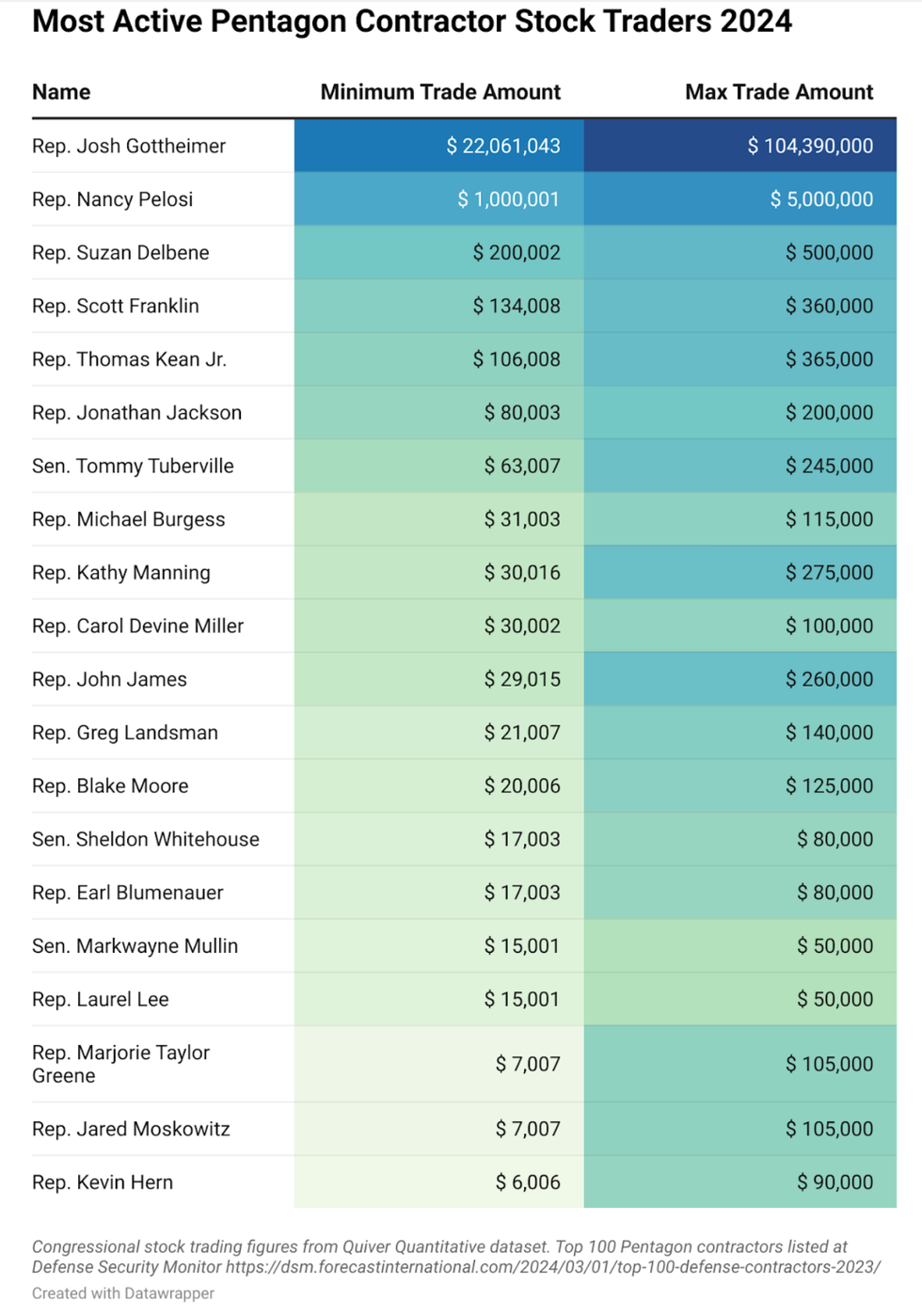 (Image: Quincy Institute for Responsible Statecraft/Datawrapper)
Next on the list in distant second place is former House Speaker Nancy Pelosi (D-Calif.), who has defended stock trading by lawmakers, and according to Quincy, "sold over $1 million worth of Microsoft stock in late July."
"The timing of Pelosi's Microsoft trades in the past have garnered attention, too; in March 2021, she bought Microsoft call options less than two weeks before the Army announced a $22 billion contract with the software company to supply augmented reality headsets," the analysis states.
"Pelosi had the most profitable 2024 of any lawmaker, netting an estimated $38.6 million from all stock trading activity, according to Quiver Quantitative," the report adds.
Pelosi was followed by Reps. Suzan DelBene (D-Wash.), Scott Franklin (R-Fla.), and Thomas Keane Jr. (R-N.J.).
The Quincy Institute asserted: "If Congress wants to wash itself of conflicts of interest it can start by passing a stock trading ban. The Ending Trading and Holdings in Congressional Stocks Act, or ETHICS Act, would prohibit members of Congress from trading individual stocks."
The ETHICS Act was approved by the Democrat-controlled Senate Committee on Homeland Security and Government Affairs in July. The full Senate—which will be GOP-controlled starting next month—has yet to vote on the bill.
Earlier this month, U.S. President Joe Bide n was applauded by progressive lawmakers for backing a ban on congressional stock trading and asserting that "nobody in the Congress should be able to make money in the stock market while they're in the Congress."
On Monday, Biden signed the $895 billion Servicemember Quality of Life Improvement and National Defense Authorization Act for Fiscal Year 2025. As Sen. Bernie Sanders (I-Vt.) has highlighted, "Of that nearly $1 trillion dollars... about half will go to a handful of hugely profitable defense contractors."
Congresswoman Rashida Tlaib (D-Mich.) decried both the enormity of the military budget, as well as the fact that some of her colleagues have profited from investments in the military-industrial complex.
Tlaib has introduced the Stop Politicians Profiting from War Act, which would ban members of Congress, their spouses, and their dependent children from trading defense stocks or having financial interests in companies that do business with the U.S. Department of Defense.
In 2012, Congress passed the Stop Trading on Congressional Knowledge (STOCK) Act, legislation that has been panned as
weak and ineffective.
"Sorry I couldn't pull it through everyone—we live to fight another day," Rep. Alexandria Ocasio-Cortez wrote on social media following the vote.
Update:
The House Democratic caucus on Tuesday chose Rep. Gerry Connolly over Rep. Alexandria Ocasio-Cortez for the ranking spot on the House Oversight Committee in the upcoming Congress.
The result of the secret-ballot vote, according to Axios, was 84 for Ocasio-Cortez (D-N.Y.) and 131 for Connolly (D-Va.).
"Tried my best," the New York progressive wrote on social media following the vote. "Sorry I couldn't pull it through everyone—we live to fight another day."
In a statement, Connolly thanked his colleagues "for their support and the confidence they've placed in me to lead House Democrats on the Oversight Committee," which will be under GOP control through at least 2026.
"We know what the Republican playbook will be. We have seen it before," said Connolly. "They have demonstrated that they are willing to traffic in debunked conspiracy theories and enable the worst abuses of the Trump administration. This will be trench warfare. Now is not the time to be timid."
"I promise the American people that our committee Democrats will be a beacon of truth and prepared from Day One to counter Republican gaslighting," he added. "We will be disciplined. We will be laser-focused on getting results on the kitchen table issues that affect the American people the most. We will stand up for our democracy and for truth. And we will protect the tremendous and historic progress we have made as House Democrats."
Earlier:
Rep. Gerry Connolly narrowly bested Rep. Alexandria Ocasio-Cortez in a secret-ballot vote Monday for the ranking spot on the House Oversight Committee in the upcoming Congress—but the New York progressive still has a shot to secure the role in a full Democratic caucus vote on Tuesday.
Connolly's (D-Va.) bid for the top Democratic slot on the House Committee on Oversight and Accountability—which could play a central role in investigating the incoming Trump administration in the coming years—is backed by former House Speaker Nancy Pelosi (D-Calif.), who has frequently clashed with Ocasio-Cortez (D-N.Y.) and other progressives on policy.
The House Democratic Steering and Policy Committee voted 34-27 behind closed doors on Monday to recommend Connolly over Ocasio-Cortez for the oversight role. While full caucus votes "typically align with the steering panel's recommendations," Politico noted, "two Democratic allies of Ocasio-Cortez... predicted the full caucus, composed of younger members who might be more likely to favor the 35-year old liberal compared to the steering panel, could sway in favor of the progressive New Yorker."
"Members said Connolly attracted staunch support from centrist Democrats after spending the last several weeks campaigning with key members," Politico reported. "He moved to lock down critical bases of support like the centrist New Democrat Coalition."
Ocasio-Cortez, for her part, is backed by the roughly 100-member Congressional Progressive Caucus as well as the Congressional Hispanic Caucus. The New York progressive also secured the backing of a majority of members on the House Oversight Committee, which is set to be controlled by Republicans through at least 2026.
Rep. Ro Khanna (D-Calif.) wrote on social media late Monday that "many" in the House Democratic caucus, including himself, will back Ocasio-Cortez in Tuesday's vote.
"AOC is objectively a more skilled communicator and narrative shaper than just about anyone in her party, and certainly more than Connolly."
Following Monday's steering panel vote, Ocasio-Cortez told reporters that she is "locked in" and "working hard."
"We are still in this," she wrote on social media. "This is the difficult business of hope and defying expectation. We do not give up. We run through the tape."
In private, Ocasio-Cortez—who won her seat in Congress by toppling a high-ranking Democrat—has "signaled" to her colleagues that she "might no longer back congressional primary challenges" against them, according to Politico, which cited three unnamed people familiar with her remarks.
The race between Connolly and Ocasio-Cortez is widely seen as a proxy fight between the younger, more progressive faction of the Democratic Party and the old guard, which appears bent on maintaining control. In recent days, Pelosi has reportedly been "actively working to tank" Ocasio-Cortez's chances of winning the oversight spot by making calls in support of Connolly.
Slate's Alexander Sammon wrote in a column Tuesday that "it's a bad move" for Pelosi and other leading establishment Democrats to back Connolly over Ocasio-Cortez, "one of the best-known progressives in the country" and also "one of the best-known Democrats period."
"With Trump in office, the role of Oversight will be extremely important, especially for a party that is begging voters to believe that they are well positioned to tackle corruption," Sammon wrote. "AOC is objectively a more skilled communicator and narrative shaper than just about anyone in her party, and certainly more than Connolly. Her ability as an explainer is top-notch, and her penchant for conveying outrage and injustice is sorely lacking in the party's upper echelons."
"Pelosi's penchant for backroom sabotage was easy to cheer when she was pushing fellow octogenarian and likely loser Joe Biden out of the presidential race; it's harder to justify when an eminently qualified rising star—who, whether Pelosi likes it personally or not, is widely known to be a cornerstone of the party's future—pushes for a simple promotion," Sammon added.

"It is so infantilizing to the House leadership to have a B team of octagenarians scheming behind their backs and aiming directly at their most promising young talent," said one progressive journalist.
Progressives on Thursday were frustrated by reports that former House Speaker Nancy Pelosi is using her considerable influence on Capitol Hill to undermine Rep. Alexandria Ocasio-Cortez's bid to become the top Democrat on the powerful committee that could launch investigations into the Trump White House in the coming years.
As Common Dreams reported last week, Pelosi (D-Calif.) has publicly indicated that she is supporting Rep. Gerry Connolly (D-Va.) to succeed Rep. Jamie Raskin (D-Md.) as ranking member on the House Committee on Oversight and Accountability when the 119th Congress begins in January.
But Punchbowl News reported Thursday that Pelosi—well-known for her relentless and often successful efforts to whip votes within the Democratic caucus—is also "making calls" to other Democratic lawmakers on behalf of Connolly.
The outlet reported that the former House speaker is "actively working to tank" the candidacy of Ocasio-Cortez (D-N.Y.), with whom she has had a rocky relationship at times as the progressive Democrat has pushed the party to embrace far-reaching reforms on climate, immigration, and other issues.
Both Connolly and Ocasio-Cortez believe they have the votes to win the ranking member position. Ocasio-Cortez is a close ally of Raskin, who named her vice ranking member in the current Congress, but the Maryland lawmaker, who is expected to succeed Rep. Jerrold Nadler (D-N.Y.) as ranking member of the House Judiciary Committee, has not publicly endorsed either candidate.
The Democratic Steering and Policy Committee, which has close ties to Minority Leader Hakeem Jeffries (D-N.Y.), is expected to make a recommendation for the ranking member role, after which the entire Democratic caucus will vote.
The centrist New Democrat Coalition endorsed Connolly on Friday, while a House Democrat told Axios that Ocasio-Cortez "has pretty much the entire [Oversight] Committee with her."
The Congressional Progressive Caucus announced its endorsement of Ocasio-Cortez on Friday, with Chair Pramila Jayapal (D-Wash.) and Chair-elect Greg Casar (D-Texas) arguing the congresswoman's "fearless advocacy leading the Oversight Committee will help ensure Democrats retake the House in 2026."
"Throughout her tenure on Oversight, Rep. Ocasio-Cortez has been a powerful voice for working people," said Jayapal and Casar. "She has wielded her seat on this committee to hold CEOs, Wall Street, and mega-corporations accountable to the American people. Her investigations that pressured Big Pharma to bring down the price of PrEP and other critical medications are just one example of her influential leadership and commitment to everyday people."
As Axios reported, several older longtime members are facing challenges for leadership roles from the party's younger generation. Ocasio-Cortez, 35, was the youngest woman ever elected to Congress when she won her election in 2018, and is an outspoken member of the progressive "Squad" which advocates for policies such as Medicare for All and has reportedly angered Pelosi in the past with its embrace of calls to "abolish" Immigration and Customs Enforcement (ICE).
"Many members are concerned about [the] precedent these races are setting," a senior House Democrat told Axios regarding the progressive contests with members like Connolly, who is 74.
Ryan Grim of Drop Site News said Pelosi's lobbying against Ocasio-Cortez "reeks of pettiness."
David Dayen, executive editor of The American Prospect, said the new reporting shows Pelosi attempting to act as a "puppet master."
"It is so infantilizing to the House leadership to have a B team of octagenarians scheming behind their backs and aiming directly at their most promising young talent," said Dayen.
Ocasio-Cortez wrote to colleagues last week to announce her bid for the ranking member position, highlighting her involvement in derailing Republican efforts to "weaponize the committee's investigatory power for partisan purposes" and pledging to balance the Oversight Committee's focus on President-elect Donald Trump's actions with fighting to better the lives of working Americans.
If Democrats win back control of the House in 2026, the committee would be empowered to launch investigations into the incoming Trump administration and would have subpoena power.
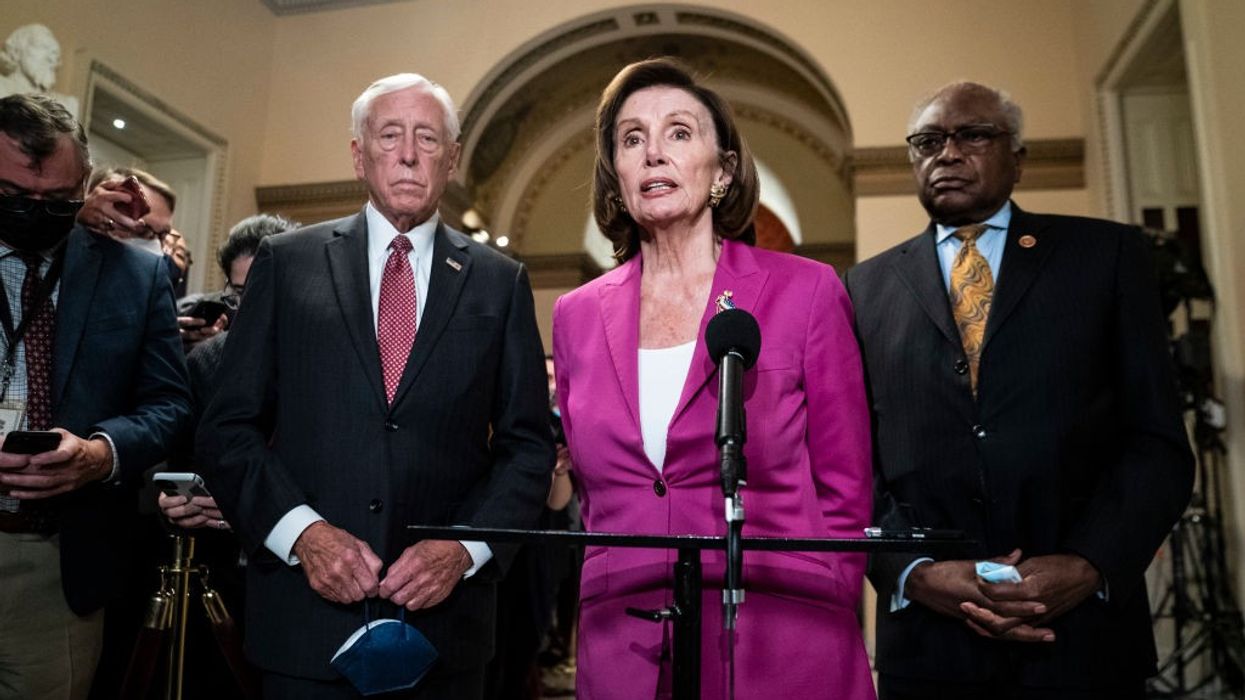
Energy counts, matters, and wins the political battles. There isn't even any adrenaline around the Dems' capillaries.
Over thirty years ago, Republican historian and political analyst, Kevin Phillips, remarked that the “Republicans go for the jugular while the Democrats go for the capillaries.” This serious disparity in political energy levels is rarely taken into account to explain election turnouts. The voluntary enfeebling of the Democratic Party started long ago. In 1970, writing in Harper’s Magazine, economist John Kenneth Galbraith, a co-founder of Americans for Democratic Action, wrote an article “Who Needs Democrats? And What It Takes to be Needed?” He argued that if the Democratic Party does not take on the corporate and political establishment, it has no purpose at all.
In 2001, long after the 1980 Reagan landslide of Jimmy Carter, Labor Secretary under Clinton, Robert Reich, wrote an op-ed for the Washington Post which declared, “…The Democratic Party. It’s Dead.”
In the following years, while the Democrats were accelerating their abandonment of half the country as “red states,” and became more out of touch with blue-collar workers and unions, whom they took for granted, the Republicans were becoming more energized by the year. Their mouthpieces dominating talk radio – e.g., Rush Limbaugh – were directly sowing unrebutted discord, day after day, among blue-collar workers against the Democrats. Why? It’s because the Democrats essentially gave up on Talk Radio and didn’t bother listening to how these corporatist radio bloviators were turning hard working listeners into Reagan Democrats.
While the GOP was eroding the core base of the Democratic Party and taking total control of red state legislatures, governorships, and courts, the Democrats, starting in 1979, were plunging into enticing and taking corporate PAC money, as urged by then Rep. Tony Coelho (D-CA). This reliance on corporate campaign money weakened the Party’s positions and actions on behalf of workers, consumers, the environment, and the need for an expanded social safety net for the populace. Western nations have provided their citizens superior health care, family support and education programs for decades.
The comparative energy levels were exhibited in the 2010 state gerrymandering drive. While the Democrats were snoozing, a laser beam effort in several states, like Pennsylvania, took the Dems to the cleaners. The result: majority GOP Congressional delegations for a decade even though the Democrats won the popular vote there. (See: Ratf**ked: The True Story Behind the Secret Plan to Steal America’s Democracy by David Daley.)
"The Dems had the popular New Deal agenda update in their grasp, but let it slip through their fingers."
Recall, in 2009 Obama had a large majority Democratic advantage in the House and Senate as a result of his win over John McCain in November 2008. Instead of going forward full throttle with this mandate, Obama chose extreme caution. He focused on Obamacare, after giving up right at the beginning the crucial “public option” allowing people to opt out of the corporate health insurance grip. He gave it up unilaterally before negotiations began with the obstructive GOP.
For the rest of his term, Obama appeared to be resting. He promised a $9.50 federal minimum wage in his 2008 campaign but didn’t lift a finger for it during his first term. It is still at a poverty wage of $7.25 per hour to this day. He didn’t really put up a grassroots fight for his stimulus bill following the Wall Street collapse and the great recession starting under George W. Bush, (the war criminal against the Iraqi people.) Obama even declined to prosecute the Wall Street crooks.
In the meantime, House Speaker Nancy Pelosi, managed to lose the House to a reactionary GOP in the 2010 elections, the 2012 elections, the 2014 elections and the 2016 elections, straightjacketing any possible Obama agenda in the Congress. The Dems had the popular New Deal agenda update in their grasp, but let it slip through their fingers while the GOP had a corporatist anti-worker, consumer, and women’s agenda and with ferocious energy blocked improvements supported by a majority of people in the US.
Even more inexplicable was the Democratic Party’s refusal to strongly support the galvanizing political civic movement to cancel the Electoral College (see NationalPopularVote.com). This organizing effort has led so far to the passage of state laws (California, New York, Illinois, etc.) handing the Electoral College vote to the presidential candidate who wins the national popular vote. The Democrats won the popular vote in 2000 (Al Gore) and 2016 (Hillary Clinton) but lost the Electoral College vote to G.W. Bush and the surprised Donald Trump. Still, the Democrats stay on the sidelines though this movement already has enabled state laws totaling 215 Electoral College votes, needing only to get to 270 to neutralize this anti-democratic vestige from the historic era of slavery.
Almost everywhere you look you see this huge disparity in energy levels. Compare the smaller Freedom Caucus in the House of Representatives with the Pelosi-toady Progressive Caucus. The difference is that between thunder and slumber over the years.
Compare the Tea Party’s slamming impact on the established GOP in Congress with the tepid attitude of most labor unions and the AFL-CIO deferring to the Democratic Party.
Compare the over-the-top corporate judges to the so-called liberal judges, as relating to federal cases against Trump.
Compare the comprehensive ghastly Heritage Foundation’s 900-page 2025 blueprint directed toward the GOP expansion of the corporate state and the stripping away of services to the people and their rights with the agenda advanced by the progressive citizen groups. No comparison. The media notices this difference in energy levels which is one reason it gives more coverage to the right-wing messianic bulldozers who show in every way that they are hungrier for taking power as they take no prisoners.
Partisan energy disparities even extend to the right-wing vs. left-wing media. The former has the brazen Fox News network. The left has nothing like that. Bill Moyers told me he urged mega-rich George Soros and allies to start a competing progressive network after Fox became quickly formidable. No way.
The right-wing magazines cover the actions of their right-wing allies, plus those gatherings and books. While the progressive media mostly ignores reviewing progressive books and what citizen groups are driving for against corporate power in Washington, DC, and at the state level. The Progressive media prefers publishing their opinions and exposé pieces. That’s one reason why there are more non-fiction right-wing corporatist books which become best sellers, while progressive tomes gather dust.
Further weakening the energy gap in favor of the GOP are the Democrats who look for scapegoats like the Greens to account for their disgraceful losses. They rarely look at themselves in the mirror. Democrats like Norman Solomon (See, Roots Action) issue “autopsy reports” following Party defeats. The 2017 report documented the Democratic Party’s arrogant, entrenched leadership which ignores the progressive base.
After the November 5th debacle, have you heard about mass resignations by Democrats responsible for this victory by the convicted felon, chronic liar, bigot, corrupt, phony promisor Trump? Well, the DNC chair, Jamie Harrison is resigning but that is pro forma. Other Democratic leaders are still on board at the state and federal level, in addition to, astonishingly enough, the failed corporate political/media consultants who enriched themselves while wasting away the biggest flood of campaign money in American history on the Kamala Harris campaign.
Younger Democrats who raise the need to displace the failed Democratic apparatchiks, and who want popular vigorous progressive agendas, as espoused by the naturally popular Senator Bernie Sanders, get ignored or worse pushed out of contention, visibility and, importantly, respect.
The Party’s losing elders have assured the absence of farm teams, of successors. Speaker Pelosi and her deputy Rep. Steny Hoyer are experts at this geriatric supremacy despite their track record of losing to the aggressive Republican plutocrats. Energy counts, matters and wins the political battles. There isn’t even any adrenaline around the Dems' capillaries.