
SUBSCRIBE TO OUR FREE NEWSLETTER
Daily news & progressive opinion—funded by the people, not the corporations—delivered straight to your inbox.
5
#000000
#FFFFFF
To donate by check, phone, or other method, see our More Ways to Give page.


Daily news & progressive opinion—funded by the people, not the corporations—delivered straight to your inbox.
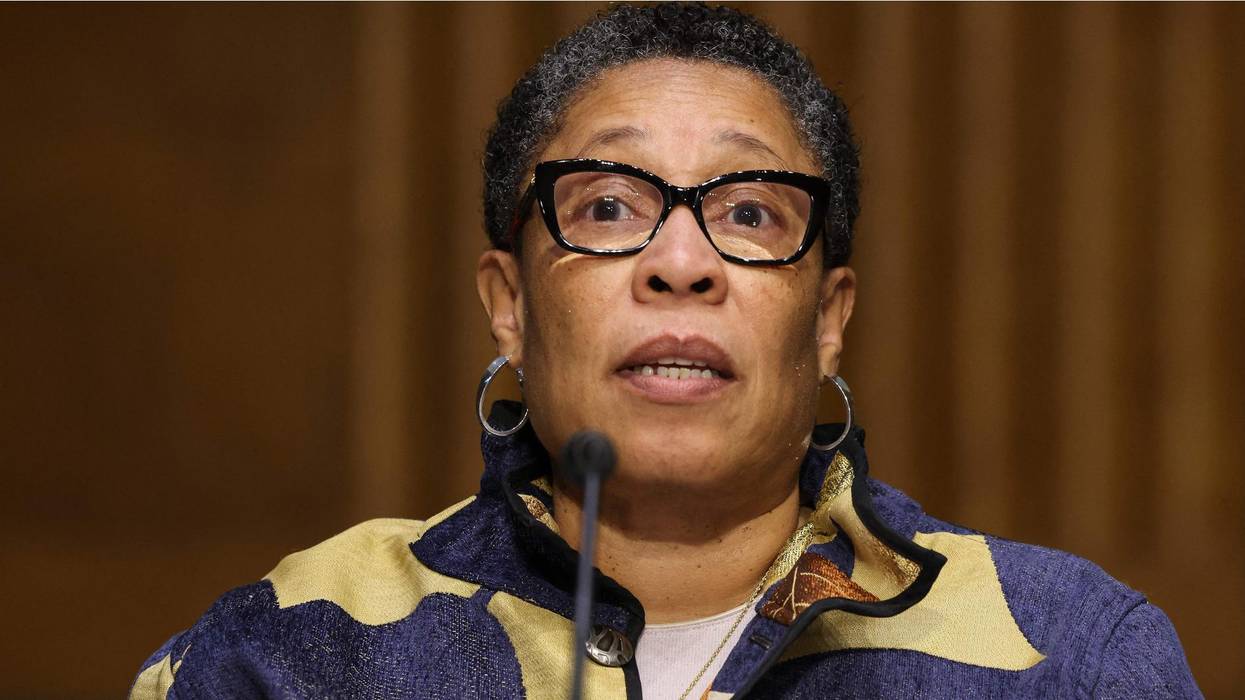
LGBTQ advocates on Thursday hailed a decision by the U.S. Department of Housing and Urban Development to withdraw a proposed Trump administration rule that would have allowed federally funded single-sex shelters to deny unhoused transgender people refuge in facilities matching their gender identity.
"Today, we are taking a critical step in affirming HUD's commitment that no person be denied access to housing or other critical services because of their gender identity. HUD is open for business for all."
--HUD Secretary Marcia Fudge
In a clear break with the previous administration's anti-transgender stance, HUD Secretary Marcia Fudge said in a statement that "access to safe, stable housing--and shelter--is a basic necessity."
"Unfortunately, transgender and gender-nonconforming people report more instances of housing instability and homelessness than cisgender people," she added. "Today, we are taking a critical step in affirming HUD's commitment that no person be denied access to housing or other critical services because of their gender identity. HUD is open for business for all."
In what was then condemned as "yet another dangerous and disgraceful attack on transgender people," the May 2019 proposal would have rolled back the Obama administration's Equal Access Rules, which aimed to provide everyone with access to safe and secure housing, "regardless of their sexual orientation, gender identity, or marital status."
While promoting the Trump administration's discriminatory policies during a September 2019 visit to the agency's San Francisco office, former HUD Secretary Ben Carson sparked outrage when he speculated that residents at shelters for unhoused women would be traumatized if "big, hairy men" were allowed to stay there.
The National Center for Transgender Equality called Thursday's move "a clear indication that Secretary Fudge and President [Joe] Biden are strongly committed to protecting transgender people from housing discrimination."
Center deputy executive director Rodrigo Heng-Lehtinen said in a statement that "the Biden administration is living up to its commitment to protect transgender people from discrimination."
"Today's announcement by Secretary Fudge is an important step in ensuring access to safe, affirming housing for transgender people," he added. "This is a decision that will save lives and help transgender people experiencing homelessness receive the assistance they need."
Dylan Waguespack, public policy and external affairs director at the LGBTQ youth advocacy group True Colors United, said that "by ending this discriminatory proposal for good, the department is righting a serious wrong."
"Whether it's homeless shelters, sports, or healthcare, supporting the safety and dignity of all young people is a central tenet to our society, regardless of who they are or who they love," asserted Waguespack. "We're thrilled to see that tenet wholeheartedly embraced by Secretary Fudge and leadership across the Biden administration."
HUD's decision is the latest move by an administration that has worked swiftly to reverse Trump's anti-LGBTQ policies.
On his first day in office, Biden signed what the Human Rights Campaign hailed as "the most substantive, wide-ranging executive order concerning sexual orientation and gender identity" in U.S. history, while the Department of Defense announced last month that the Trump-era prohibition on transgender troops would be lifted.
Two amendments introduced by Rep. Alexandria Ocasio-Cortez that would stop the White House's push to override regulations aimed at reducing segregation in U.S. housing are receiving renewed attention after the congresswoman fired back at President Donald Trump Wednesday for a pair of tweets she termed "racist, classist nonsense."
"We must hinder President Trump's efforts to segregate communities and to discriminate against Black and Brown homeowners and renters," Ocasio-Cortez told Bloomberg CityLab later Wednesday. "We cannot return to the days of redlining and white flight."
Trump and Housing and Urban Development (HUD) Secretary Ben Carson on July 23 introduced a rule meant to roll back Obama-era rules on enforcing a key provision of the 1968 Fair Housing Act, the Affirmatively Furthering Fair Housing mandate.
In order to thwart the administration's effort, Bloomberg explained:
The Bronx congresswoman has introduced a pair of amendments to an appropriations bill before Congress that would defund this rule as well as another rule before they can take effect. The legislation would prevent any federal funds from being used to implement or adopt the new rules proposed under Housing Secretary Ben Carson, effectively nullifying them.
If her amendments proceed, Ocasio-Cortez will deliver a setback to Trump, who has made housing segregation a plank in his campaign pitch to voters whom he identifies as the "Suburban Housewives of America."
As Common Dreams reported, Trump's tweets on the suburbs and fair housing Wednesday came in for substantial criticism, with critics decrying the implicit racism behind the comments.
"This is blatant racism from the President of the United States," tweeted Sen. Elizabeth Warren (D-Mass.). "And it's disgusting."
In a pair of tweets one advocacy group denounced as "racist, classist garbage," President Donald Trump on Wednesday boasted that he is working to prevent construction of low-income housing in the suburbs by repealing an Obama-era rule aimed at combating persistent racial segregation in those communities.
"I am happy to inform all of the people living their Suburban Lifestyle Dream that you will no longer be bothered or financially hurt by having low-income housing built in your neighborhood," Trump tweeted. "Your housing prices will go up based on the market, and crime will go down. I have rescinded the Obama-Biden AFFH Rule. Enjoy!"
"Words can't quite capture how outrageous and racist this is. Trump and Ben Carson have worked hand in glove to obstruct and destroy decades of work to promote fair housing in our country."
--Kristen Clarke, Lawyers' Committee for Civil Rights Under Law
Trump was referring to the 2015 Affirmatively Furthering Fair Housing (AFFH) rule, an addition to the 1968 Fair Housing Act that required cities and towns receiving federal funding to document and develop plans to redress racial housing segregation.
In 2018, Trump's Housing and Urban Development Secretary Ben Carson suspended the Obama-era rule. Last Thursday, HUD announced it is replacing the AFFH with a new regulatory framework (pdf) that would allow localities to monitor their own compliance with fair housing laws. The new rules are set to take effect next month.
"Words can't quite capture how outrageous and racist this is," Kristen Clarke, president and executive director of the Lawyers' Committee for Civil Rights Under Law, said in response to the president's tweets Wednesday. "Trump and Ben Carson have worked hand in glove to obstruct and destroy decades of work to promote fair housing in our country."
"On this latest move," Clarke added, "we will see the administration in court."
With the 2020 presidential election a mere three months away, critics like Sen. Elizabeth Warren (D-Mass.) characterized Trump's tweets as the president's most recent racist dog whistle aimed at white suburban voters he believes would be comforted by such messaging.
An NPR/PBS NewsHour/Marist poll last month showed Trump trailing presumptive Democratic nominee Joe Biden 35% to 60% among suburban voters.
The New York Times reported earlier this month that "Trump and his campaign team, already concerned about his weakness in battleground states, have become increasingly alarmed by internal polling showing a softening of support among suburban voters, especially women without college degrees."
"The Suburban Housewives of America must read this article," Trump tweeted last week, linking to a New York Post column by right-wing commentator Betsy McCaughey. "Biden will destroy your neighborhood and your American Dream. I will preserve it, and make it even better!"
Diane Yentel, president and CEO of the National Low Income Housing Coalition, said in a statement last week that Trump's rescission of the AFFH rule is an "abhorrent" attempt to "use a critical fair housing tool for election year race-baiting, particularly during a time of reckoning for racial injustices."
A group of progressive lawmakers including Sens. Elizabeth Warren and Bernie Sanders sent letters to the Department of Housing and Urban Development and private landlord associations on Wednesday demanding an immediate nationwide moratorium on evictions as individuals and families struggle with the massive financial impact of the coronavirus pandemic.
"Evicting families from their homes in the middle of a pandemic is cruel and dangerous," reads the letter (pdf) to Housing Secretary Ben Carson. "HUD must avoid the risk of exacerbating a public health emergency and protect the safety of renters."
Joining Warren and Sanders in signing the letter were Sen. Jeff Merkley (D-Ore.), Rep. Ayanna Pressley (D-Mass.), and Rep. Katie Porter (D-Calif.).
"Families already living on the margin are now facing the threat of increased economic vulnerability due to COVID-19 and may soon be in danger of missing a rent payment."
--Lawmakers' letter
The lawmakers called on Carson to move immediately to implement a "moratorium on evictions for individuals living in HUD-assisted rental housing, public housing, and for Housing Choice Voucher recipients."
More than 10 million people in the U.S. live in federally-assisted housing, and they are disproportionately older and lower-income--groups that are particularly vulnerable to COVID-19 and the economic fallout it is causing.
"Families already living on the margin are now facing the threat of increased economic vulnerability due to COVID-19 and may soon be in danger of missing a rent payment," the letter states. "Nearly a quarter of U.S. civilian workers have no access to paid sick leave, and may lack the ability to take days off without being fired."
In separate letters to the National Rental Home Council (pdf) and the American Apartment Owners Association (pdf), two of the nation's largest private landlord associations, the lawmakers called on the groups to work with their private-sector partners and implement "an immediate moratorium on all eviction proceedings in rental homes and offer deferred rent payment options with no late fees to tenants impacted by the COVID-19 outbreak."
"Evicting families puts their health at risk, imposes trauma on and disrupts the education of their children, and exacerbates the risk of outbreak in their communities," read the letters. "Even as government actors work to get the necessary resources to our neighbors experiencing homelessness, private sector partners should avoid exacerbating the problem by evicting tenants during a pandemic."
The letters come a week after Warren and Merkley called on (pdf) President Donald Trump to issue a nationwide moratorium on all evictions and foreclosures for properties owned or insured by Fannie Mae, Freddie Mac, the Federal Housing Administration, Veterans Affairs, or the Department of Agriculture's Rural Housing Service.
Read the full letter to HUD below:
Dear Secretary Carson:
We are writing to urge the Department of Housing and Urban Development to issue an immediate moratorium on evictions for individuals living in HUD-assisted rental housing, public housing, and for Housing Choice Voucher recipients. Evicting families from their homes in the middle of a pandemic is cruel and dangerous. HUD must avoid the risk of exacerbating a public health emergency and protect the safety of renters by issuing a moratorium on all eviction proceedings in facilities that receive HUD assistance until the public health emergency has passed and providing clear guidance to Public Housing Authorities (PHAs) regarding the availability of financial hardship exemptions for tenants and how they should educate residents about their options.
As of March 17, 2020,the Centers for Disease Control and Prevention has reported more than 4,600 confirmed COVID-19 cases in 49 states and the District of Columbia. A growing number of local and state jurisdictions are implementing social distancing and self-quarantine protocols that will likely continue to have a direct impact on businesses and employees across the country. Nearly every state has already declared a state of emergency.
Families already living on the margin are now facing the threat of increased economic vulnerability due to COVID-19 and may soon be in danger of missing a rent payment. Nearly a quarter of U.S. civilian workers have no access to paid sick leave, and may lack the ability to take days off work without being fired. Early reports indicate that the outbreak has already "prompt[ed] hundreds of layoffs over the past week alone." Many families do not have a safety net to withstand the potential economic shocks that could come with coronavirus--about forty percent of American families don't have sufficient savings to cover an unexpected expense of $400. And housing is already the largest expense for many families--more than one-third of Americans pay 30% or more of their income towards their housing, and 15% of Americans are paying more than half of their income towards housing. Given how squeezed these families' budgets are, for many, any interruption in income will likely translate into default on rent.
There is a clear and urgent public health need to stop evictions during this pandemic. More than 10 million Americans live in federally-assisted rental housing, and nearly one-fifth of those individuals are seniors, who are at higher risk of serious health complications from COVID-19. Having safe and stable housing ensures individuals have a place to self-quarantine, or to take care of family members who may be sick. In addition, evictions lead to negative health problems for individuals, and individuals experiencing homelessness "have higher rates of hospitalizations [...] than other populations." Evictions would add strain on hospitals at a moment when public health experts are expressing concern about medical facilities being overwhelmed.
Eviction may also lead to families becoming homeless, increasing their risk of contracting COVID-19 through community spread and exacerbating the possibility of outbreak in their community. Individuals experiencing homelessness are "at relatively high risk for a broad range of acute and chronic illnesses," and face barriers to care for "even the most routine medical treatment." Homeless individuals may also be unable to practice recommended social distancing in shelters or encampments, and lack access to running water to protect themselves from infection and prevent disease spread. HUD should be working urgently to connect individuals experiencing homelessness with shelter and basic necessities to slow the spread of COVID-19 while at the same time avoiding exacerbating the problem by evicting tenants during a pandemic.
HUD must also:
- Provide clear, immediate guidance to PHAs about COVID-19 protocols, including cleaning and tenant protections;
- Direct PHAs to proactively inform residents about requesting financial hardship exemptions; and
- Direct PHAs to allow residents to request these adjustments over the phone rather than in person and provide instructions to PHAs about how to educate their residents on their options if their income goes down.
HUD has provided support to homeowners following natural disasters, and should again now--but the agency must also protect renters from losing their homes during this pandemic, and protect the public from further spread of coronavirus. Municipalities across the country are suspending evictions to protect families and communities. Individuals living in federally-assisted rental housing and public housing need the certainty that they can take care of the health of themselves and their loved ones, and follow public health directives, without fear of losing their homes.
This week, the Department of Housing and Urban Development (HUD) published a proposed rule that would substantially limit enforcement of the 1968 Fair Housing Act, whose purpose is to provide for fair housing throughout the United States. The re-reading of the Fair Housing Act urged by the President and his Cabinet Secretary Ben Carson appears to eliminate the possibility of challenging systemic discrimination--which is often subtle and embedded in government and industry practices--and risks deepening patterns of segregation and racial wealth disparities.
The proposal would gut the core of the Act's disparate impact method of proof. This is despite the Supreme Court's affirmance of this approach in a 2015 decision authored by Justice Kennedy in Texas Dep't of Housing & Community Affairs v. Inclusive Communities Project (ICP). The disparate impact method of proof has been used to challenge loan practices that exclude or charge higher prices to minorities or target them for subprime loans; it has also been used to address practices that displace minority communities to further gentrification and to combat discriminatory zoning practices that exclude minorities from majority-white communities.
The proposal "risks deepening patterns of segregation and racial wealth disparities."An example of disparate impact involves a challenge to actions taken by St. Bernard Parish, Louisiana, a majority-white community outside of New Orleans, in the aftermath of Hurricane Katrina. The parish had adopted a number of measures to prevent blacks displaced by the Hurricane from relocating to the Parish. One such measure was a "blood relative ordinance," which prohibited rentals to those without blood ties to existing St. Bernard Parish residents. A court ruled that the Parish's actions violated the Fair Housing Act under intent and impact theories, and Justice Kennedy in ICP cited this case in making clear that the Act reached disparate impact claims.
The single question presented in ICP was whether the statute permits disparate impact claims. The Court therefore did not decide what standard should be used to analyze those claims. HUD's current disparate impact rule, adopted in 2013 by the Obama administration after an extensive regulatory process, formalizes the longstanding understanding that the Act prohibits policies and practices by the housing industry that cause segregation or adverse disparate effects on protected groups, and that lack sufficient justification. The 2013 rule applies the traditional three-step burden shifting approach for proving disparate impact claims, embodied in other civil rights statutes such as Title VII of the Civil Rights Act of 1964 (employment discrimination). The Title VII disparate impact standard was codified by statute in 1991, and the current HUD standard aligns closely with that. As in employment, HUD's 2013 rule made clear that a statistical disparity alone is not enough to prove disparate impact discrimination under the Fair Housing Act.
The Trump Administration's proposed rule would tear through that careful structure by piling on new requirements for plaintiffs and creating broad defenses for the housing industry.
First, HUD's proposal perverts the concept of a prima facie case by incorporating the defendant's rebuttal into the plaintiff's prima facie case. Traditionally, if the plaintiff establishes a prima facie case and the defendant fails to rebut, the plaintiff prevails. Under the new rule, in order to prevail, the plaintiff is expected to establish its affirmative case as well as prove the negative - that no rebuttal is possible. In other words, as part of the prima facie case, the plaintiff must prove that the defendant has no "valid interest or legitimate objective" in the challenged practice. These unusual standards are incorporated into the proposed rule's novel five-factor test for establishing a prima facie case. Not only does the defendant have no burden to prove a valid interest to rebut the prima facie case (although it can elect to submit evidence if it would like), it is afforded two entirely new, extremely broad defenses that shield it from liability.
The first of the two defenses operates almost like a preemption doctrine rather than how it is described in the preamble - as a rebuttal of plaintiff's causation requirement. The proposed rule gives the defendant a complete defense to a disparate impact claim if it can show its discretion is "materially limited" by federal, state or local law, or by a "binding or controlling court, arbitral, regulatory, administrative order, or administrative requirement." The Trump administration's "following orders" defense flies in the face of the core purpose of the Fair Housing Act - which is to dismantle segregation and eradicate barriers to equal housing opportunity - be they intentionally imposed or inadvertent yet unnecessary, and whether established at the local, state or federal level, or by private corporate interests.
The second defense to a prima facie case is available to defendants who use algorithms or other models in making their housing decisions; but it operates more like an exemption for most if not all of the financial services industry - namely mortgage banking and homeowners insurance. For instance, it makes disparate impact challenges to underwriting decisions unenforceable if the model is the industry standard, or if the model predicts for risk or some other valid objective and none of the factors in the model are intentionally discriminatory (i.e., are "substitutes or close proxies for" a protected group). The effect of this defense is to exempt from the Act those industries that denied or limited black access to the wealth generating capital available to many Americans, regardless of class. More recently in cities like Baltimore, banks sought out black and brown communities to provide them inferior loans. Nationally, black communities still have not recovered the wealth lost during the financial crises.
Between the unusually stringent and likely never to be satisfied prima facie case, and the two all-encompassing and easy to satisfy defenses, the proposed rule appears to use a belt and suspenders approach geared to ensure no effects case slips through. If the rule is finalized, it is likely to be challenged in court. It will then be to challengers to show a court that the Trump administration's interpretation distorts the meaning of the 1968 Fair Housing Act and undermines both congressional and judicial authority.
CNN is hosting the next Democratic primary debates on July 30 and 31. Three people have been selected to ask questions: CNN anchors Jake Tapper and Don Lemon, and CNN correspondent Dana Bash.
In the last presidential elections, the first Republican primary debate CNN hosted likewise featured three questioners: Tapper, Bash--and right-wing radio host Hugh Hewitt, of the conservative Christian Salem Radio Network.
Hewitt's presence wasn't a one-time thing, either. He asked questions alongside CNN journalists for each of the four GOP debates CNN hosted; Salem was its official media partner, as part of a deal brokered with the RNC. The conservative Washington Times' Stephen Dinan also made an appearance in the March 2016 CNN debate.
But--funny thing--when CNN hosted Democratic primary debates, it didn't partner with any left-wing media. Its partner for the first debate was tech giant Facebook--a current target of the Warren and Sanders campaigns--while NY1 joined for the third debate. (The second featured no media partner.) The Facebook partnership brought no additional moderator into the debate; instead, CNN read aloud some questions viewers had submitted via Facebook. For the third debate, held in New York City, local NY1 journalist Errol Louis participated.

As FAIR pointed out at the time, having questioners who make no pretenses about their objectivity changes the tenor of the debate. For example, Hewitt prodded Trump on whether "you still want to stay neutral when the Palestinian authority is inciting these [terrorist] attacks" (prompting Trump to protest that "there's nobody on this stage that's more pro-Israel than I am").
Telling the candidates, "I think all of you are more qualified than former Secretary of State Clinton," Hewitt asked whether or not they thought they should be attacking her more directly.
On the subject of the Supreme Court vacancy that the Republicans were holding unfilled under President Obama, Hewitt asked candidate Ted Cruz, "Do you trust Mr. Trump to nominate conservative justices?" He then pressed Trump:
Will you commit to voters tonight that religious liberty will be an absolute litmus test for anyone you appoint, not just to the Supreme Court, but to all courts?
Hewitt asked Ben Carson if, with his medical background, he could "order air strikes that would kill innocent children by not the scores, but the hundreds and the thousands?" After Carson's answer, Hewitt continued to prod:
So you are OK with the deaths of thousands of innocent children and civilians?... That is what war -- can you be as ruthless as Churchill was in prosecuting the war against the Nazis?
The CNN journalists tapped for this month's debate, in contrast, play it straight. Lemon, who has recently been outspoken about his opposition to Trump, has also delighted right-wing commentators in the past with his "pull up your pants" advice to black people to "fix our community" in the wake of the George Zimmerman verdict.
Neither Tapper nor Bash are conservative favorites, but neither are they journalists with a progressive worldview. Tapper devoted a segment (12/21/17) to defending Trump's move of the US embassy in Israel to Jerusalem, saying that some of the 128 nations that voted at the UN to condemn the move had "some questionable records of their own" (FAIR.org, 12/24/17).

Moderating a Democratic debate for the 2016 presidential race, Bash (Salon, 10/14/15) pressed Hillary Clinton to answer GOP candidate Carly Fiorina's charge that "if the government requires paid [maternity] leave, it will force small businesses to, quote, 'hire fewer people and create fewer jobs.'" Bash's follow-up question:
There are so many people who say, "Really? Another government program?" Is that what you're proposing? And at the expense of taxpayer money?
There are any number of progressive media outlets that could provide qualified journalists who would offer an avowedly left perspective; Democracy Now!, The Nation and the Intercept come to mind.
There's no excuse for CNN to partner with a right-wing outlet for Republican debates and not have any left-wing outlet involved in Democratic debates; please call on CNN to play fair and include a progressive journalist in its Democratic debates.
ACTION:
Please call on CNN to include a progressive journalist from an avowedly left media outlet as a moderator in its Democratic debates.
CONTACT:
Web: CNN Feedback
Phone: 404-827-1500
Twitter: @CNN
In 1968 -- just a week after Martin Luther King, Jr.'s assassination -- Congress passed the Fair Housing Act, or FHA.
The law secured everyone's right to housing regardless of race, national origin, disability, familial status, sex, or religion. The FHA protects people from discrimination when they're renting, getting a mortgage, or seeking housing assistance -- including applying for public housing or housing vouchers.
Now the Trump administration is going against that legacy, proposing a regulation that will target immigrant families living in government-subsidized housing.
They want to require every single family member in federally assisted housing to have their immigration status screened by the Department of Homeland Security. If just one resident is undocumented, the new policy will effectively block the entire household from receiving any housing benefits -- even for legally documented residents and citizens.
Undocumented people are already ineligible to apply for government benefits. Instead, the rule directly targets "mixed-status" families. In mixed-status families -- who all contain members who are legally eligible for public benefits -- subsidies are only provided to those eligible members. The family pays the prorated market rent for all non-eligible family members in the household.
So the proposed rule will obliterate affordable housing options for low-income Americans simply for having an immigrant family member who is currently ineligible (which doesn't necessarily mean they're undocumented either -- immigrants can have legal status and still not be eligible for public assistance programs).
In short, this rule will have an unprecedented discriminatory impact on families from other countries, regardless of their legal status -- a clear violation of the FHA's prohibition of discrimination based on national origin.
It's yet another attack from this administration again immigrants -- and a way to continue its separation of immigrant families. It would force a mother, who might be ineligible for benefits on her own, to face the impossible choice of separating from her child so they could keep their home, or forcing the entire family into homelessness.
The government's own analysis shows that more than 55,000 children -- who are U.S. citizens or otherwise eligible to receive housing benefits -- could face eviction under the proposed rule.
"This cruel and needless targeting of struggling immigrant families," members of the House Financial Services Committee wrote to Secretary Ben Carson, "only contributes to historic patterns of inequality, which ultimately hinder the U.S. housing market and American economy."
The families impacted the administration's cruelty will suffer a grave injustice even after doing everything right under U.S. law. They face being ripped apart simply because some of their family members were born somewhere else.
This is a sad reality for many immigrant Americans, and particularly for the Latino community, which appears to be a primary target of the Trump administration. The Trump administration cannot target these communities -- there is strength in numbers, and we will not allow them to prevail.
In the 1960s, at the very dawn of the New Right rebellion, William F. Buckley, Jr., declared that he would rather be governed by persons selected from the phone directory than the faculty of Harvard. Conservative egghead bashing has a long pedigree, and even Buckley, an aspiring patrician with one of the most laboriously affected accents ever heard, felt obliged to join in the populist trolling.
Over the succeeding five decades, the conservative movement and its chosen vehicle, the Republican Party, have substantially achieved the goal of systematically devaluing expertise, thereby accomplishing one of their most cherished ideological goals: to prove to the American people that government doesn't work.
As I have written before, the Republican push for non-expertise got a big boost during the Gingrich speakership. It continued its long march through institutions during the riotously incompetent planning and conduct of the Iraq war under George W. Bush, and has reached ghastly perfection with Donald Trump.
Just look at a few of the uniquely awful Trump personnel at the top tier: Mike Pompeo, John Bolton, Stephen Miller, Ben Carson, Betsy DeVos, departing Sarah Huckabee Sanders. Their unsuitability is matched by Trump appointees at lower levels.
The conclusion is inescapable: one could get better people for the jobs by recruiting candidates from the checkout line at a dollar store. Would such people be qualified for their positions? Probably not. But they might occasionally heed reasonable advice rather than reflexively doing the opposite, and they almost certainly would not unanimously possess the iron and unerring resolve of the current Trump team always to do the stupid, unethical or immoral thing.
Recently leaked vetting documents show what the Trump administration looks for in personnel. Despite warnings that former EPA administrator Scott Pruitt and former HHS Secretary Tom Price had considerable ethics and management problems, they were hired anyway. In their jobs, they proceeded to demonstrate just those same qualities the administration had been warned about.
Their downfall was less the result of their grifting and self-dealing than the fact that the capo in the White House was irritated by the conspicuous swaggering of these two arrogant underlings. They ought to have realized that such public flaunting of their bad-assery is reserved for the mob boss and his immediate family.
The vetting criteria for General David Petraeus, who was mooted for either secretary of state or national security adviser, are particularly telling. There were legitimate grounds for rejecting Petraeus: he was a major player in the Iraq debacle, a policy disaster that Trump roundly condemned during his campaign. The general's government career as CIA director ended abruptly when the FBI found he had been sharing code-word level classified information with his lover, who just happened not to be his wife. Petraeus compounded the damage by lying to the FBI.
But why was he rejected for a position in the Trump administration? Vetting personnel at the Republican National Committee "red flagged" Petraeus because he opposed torture - possibly the one unambiguously praiseworthy thing about the man.
As with personnel, so inevitably with policy. Flipping a coin before deciding among critical policy options would seem statistically to produce a better result than what we have seen in the Trump administration. By some strange reverse-Darwinian principle, Trump and his coat-holders invariably default to the worst conceivable option. Examples follow.
Let us imagine you are in charge and want to improve this country's terms of trade with China. Three broad options present themselves:
Of course, Trump picked option 3 because it was objectively the worst option.
Now, let's try tax cuts:
Naturally, Trump, with united assistance from the Republican Congress, chose option 3.
Now let us assume that for some reason you are dissatisfied with the Iran nuclear agreement (The Joint Comprehensive Plan of Action, or JCPOA) that your predecessor signed. Let us run though the options:
The answer to the Iran policy conundrum is of course now playing out in the news headlines.
Throughout American history, there has always been a strident minority opinion that aggressive and self-righteous stupidity is nobler and more virtuous in the sight of God than prudent and circumspect intelligence. This view now controls most of our government and is in a position to make its will the law of the land. Sooner or later, we shall see whether the higher laws of natural selection act to weed out stupidity in as spectacular and unpleasant a fashion as occurred with the Habsburg and Ottoman empires.
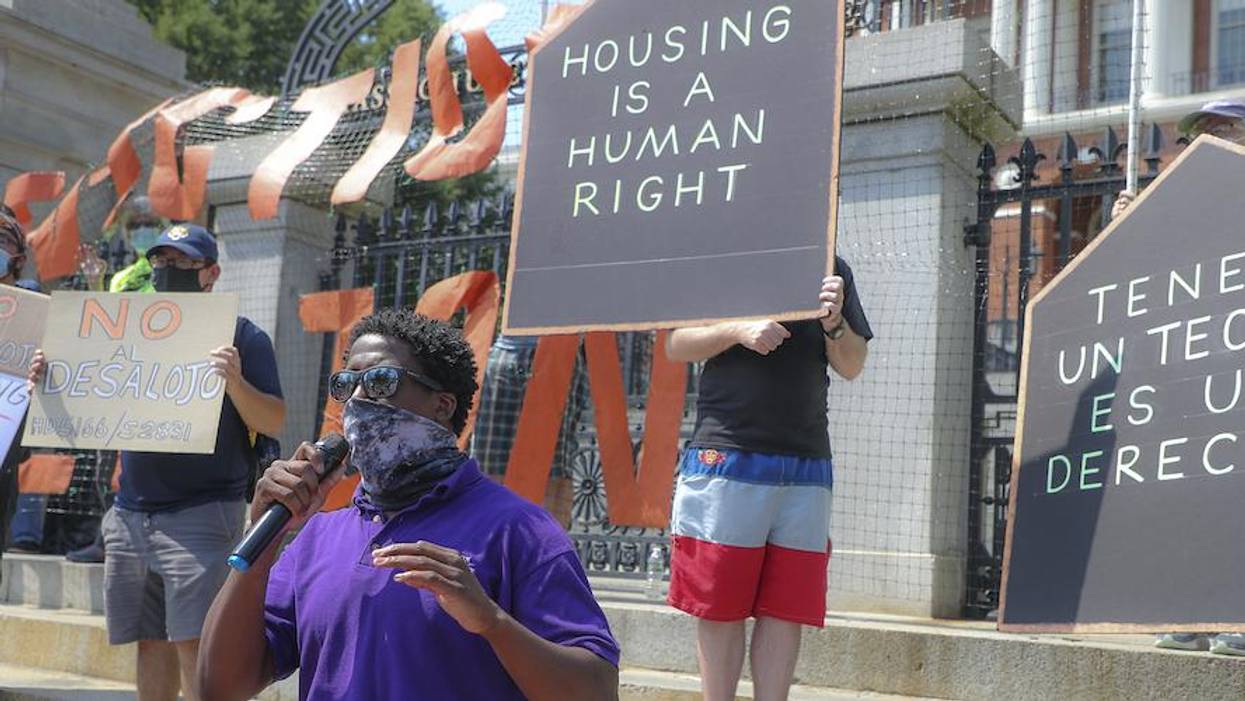
For a decade, U.S. lawmakers have kept the federal minimum wage at a level which increasingly leaves workers unable to afford housing.
That's according to a report from the National Low Income Housing Coalition (NLIHC). The group's 30th annual study of housing affordability found that a worker earning the federal minimum wage of $7.25--which is unchanged since 2009--cannot afford to rent a modest two-bedroom apartment in any state, metropolitan area, or county in the United States.
The report, entitled "Out of Reach," details how a worker would need to maintain three full-time jobs involving 127 hours of work per week to afford such a housing situation, without spending more than 30 percent of his or her income on housing.
"Our rental housing needs have worsened considerably over the past 30 years," wrote Diane Yentel, president and CEO of NLIHC, noting that housing assistance reaches fewer Americans than in 1989, when the group first compiled housing data. "Wage inequality has worsened between black and white workers at all wage levels, exacerbating the racial housing inequities that have long plagued the nation. Affordable rental housing for low-income people is significantly further out of reach now than in 1989, despite a massive increase in wealth for higher-income households."
Sen. Bernie Sanders (I-Vt.), who has worked alongside the national grassroots campaign Fight for $15 to push for a $15 minimum wage, called the report's findings "a national disgrace."
According to the Department of Housing and Urban Development's (HUD) own data, Americans who pay more than 30 percent of their income on rent or a mortgage payment are considered "cost-burdened," and those who pay more than 50 percent of their compensation on housing are "severely cost-burdened."
Yet while the federal government stipulates that households should pay no more than 30 percent on housing, another recent study by Harvard University found thatlawmakers have allowed the number of cost-burdened families to rise rapidly over the past two decades. From 2001 to 2016, 3.6 million more households spent more than half their income on housing.
"Despite clear and urgent needs, the Trump administration continues to starve communities of the resources needed to tackle this crisis. In the richest nation on earth, how is it that three out of every four families eligible for housing assistance are turned away?"
Rep. Ayanna Pressley (D-Mass.)"Seventy-one percent of extremely low-income renters are severely housing cost-burdened," reads the NLIHC's report, "which forces them to cut-back on other basic necessities like adequate food, healthcare, and transportation and also puts them at risk of housing instability."
The NLIHC found that even if a minimum-wage earner with a family were to squeeze his or her household into a one-bedroom apartment, that housing arrangement would hardly be more affordable than a slightly larger home. The worker would need to work 103 hours per week to afford the apartment without paying more than 30 percent of his or her income.
Corporations and lawmakers aligned with corporate interests have in recent years railed against proposals to raise the minimum wage to $15 per hour, which have gained momentum thanks to Fight for $15 and progressives in Congress including Sanders.
Yet NLIHC's report found that even this modest proposal would still leave many workers unable to afford a rental apartment in many parts of the country. A worker would need to earn an average of $22.96 to rent a modest two-bedroom apartment in the U.S. and more than $18 to rent a one-bedroom apartment.
Even in the most affordable states in the country, a minimum wage job leaves workers unable to rent a small apartment. In Arkansas, where the average rent for a two-bedroom apartment is $742, a renter would need to earn more than $14 per hour to afford it--putting those homes out of reach for workers who earn the state's minimum wage of $9.25.
The report also noted that rents are too high and wages are too low even for workers who earn more than the minimum wage.
"Nationally, the average renter's hourly wage is $17.57, which is $5.39 below the national two-bedroom Housing Wage and $1.08 below the national one-bedroom Housing Wage," the report reads.
In her preface to the report, Rep. Ayanna Pressley (D-Mass.) slammed the Trump administration for worsening the housing crisis through direct attacks on anti-segregation rules, subsidies for low-income Americans, and undocumented immigrants who live in public housing.
"Despite clear and urgent needs, the Trump administration continues to starve communities of the resources needed to tackle this crisis," wrote Pressley. "In the richest nation on earth, how is it that three out of every four families eligible for housing assistance are turned away? This administration's callous attempts to rollback funding for affordable housing and homelessness assistance programs has left more than half a million people without shelter on any given night."
In light of the Trump administration's neglect and exacerbation of housing access issues, Pressley called on Congress to pass legislation to invest in affordable housing, including the American Housing and Economic Mobility Act, which would pour resources into the National Housing Trust Fund and give special consideration to areas affected by redlining in the 20th century.
"This isn't just a devastating trend, but rather a national public health crisis," Pressley wrote. "So long as there is a national housing shortage, the American Dream remains largely deferred."
In what advocates for LGBTQ rights condemned as "yet another dangerous and disgraceful attack on transgender people from the Trump administration," the Department of Housing and Urban Development on Wednesday announced a proposal to allow taxpayer-funded homeless shelters to turn away trans individuals.
"When shelters are allowed to turn transgender people away--a policy that is sanctioned by a government that continues to push the lie that the mere existence of trans people threatens the privacy and safety of others--deadly violence against the trans community on the streets will rise."
--Ian Thompson, ACLU
"This is a heartless attack on some of the most vulnerable people in our society," Mara Keisling, executive director of the National Center for Transgender Equality (NCTE), said in a statement denouncing the plan.
HUD's new proposal would revise the Equal Access Rule, first published in 2012, that bars housing programs from discriminating against people on the basis of sexual orientation or gender identity.
If the revision takes effect, operators of federally funded sex-segregated shelters can consider factors such as "privacy, safety, practical concerns, religious beliefs" and sex designations on government documents when making a determination about a person's sex for housing purposes.
In a Twitter thread Wednesday, NCTE noted the high rates of trans individuals who experience homelessness in their lifetimes and the "disproportionate levels of discrimination" they face at shelters.
"Many transgender and non-binary people experience pervasive discrimination in the workplace and in housing, made even more heartbreaking by violence and rejection at home," Ian Thompson, senior legislative representative for the ACLU, said in a statement. "For transgender people, particularly trans youth of color and black trans women who experience homelessness at appallingly high rates, the crisis is especially dire, and has led to a devastating and largely unaddressed epidemic of violence and death."
Thompson warned that "when shelters are allowed to turn transgender people away--a policy that is sanctioned by a government that continues to push the lie that the mere existence of trans people threatens the privacy and safety of others--deadly violence against the trans community on the streets will rise."
The proposal came just a day after HUD Secretary Ben Carson told House lawmakers the Trump administration had no plans to change federal rules designed to protect LGTBQ people from housing discrimination.
Given Carson's comments Tuesday followed by the new proposal from the agency he runs, Keisling said, "Secretary Carson's actions are contrary to the mission of his Department and yet another example of tragic cruelty of this administration."