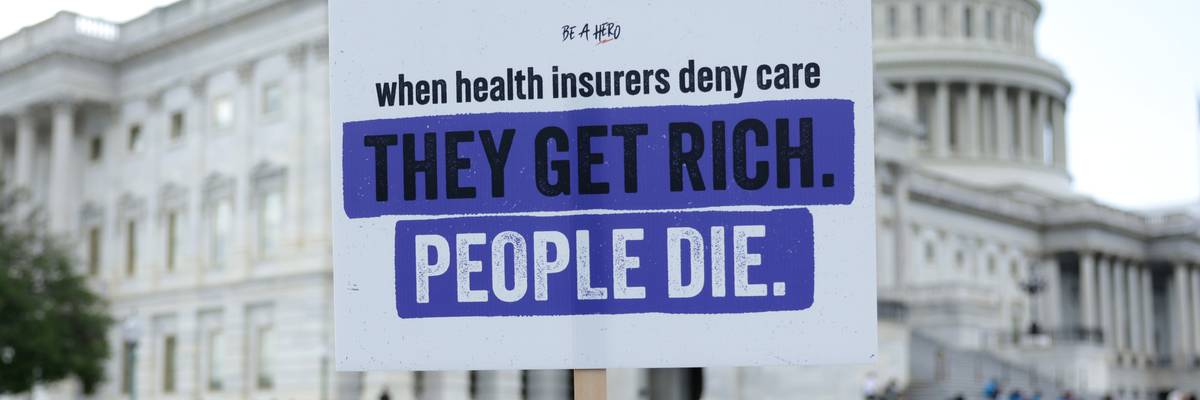
An advocate holds a sign during a news conference on Medicare Advantage on July 25, 2023 in Washington, DC.
To Boost Profits, Medicare Advantage Giants Move to Kick Over a Million Seniors Off Their Plans
Humana said it is exiting plans covering roughly 600,000 seniors to "drive the intended margin expansion."
Two of the largest Medicare Advantage insurers in the US, UnitedHealthcare and Humana, have signaled in recent days that they plan to exit certain "underperforming" markets and curb benefits in an effort to boost their bottom lines, a strategy that's expected to kick more than a million seniors from their coverage.
On Thursday, Axios cited an analyst note published earlier this week indicating that UnitedHealthcare "has dropped around 13% of plans offered across 18 states." Healthcare Dive reported that the company "expects to end 2026 with up to 1.1 million fewer MA members than it had last year."
"UnitedHealthcare—the largest MA insurer in the US—offered plans in one fewer state and 109 fewer counties this year, cut allowances for certain over-the-counter health and wellness items, and prioritized plan designs with more limited provider networks," Healthcare Dive noted. "The company also shifted commissions to brokers to incentivize enrollment in more profitable plans."
As for Humana, the company's chief financial officer said during an earnings call in late July that its exit from certain markets and dropping of specific plans would "impact approximately 600,000 members" as the firm implements "the changes necessary to drive the intended margin expansion."
Seniors who lose their MA plans in response to the insurance giants' moves will have to either find a new plan during open enrollment, which begins next month, or switch to traditional Medicare. MA plans currently cover more than half of all eligible Medicare beneficiaries.
Mark Meiselbach, a healthcare economist at Johns Hopkins University, has estimated that nearly 3 million people enrolled in MA will be forced to switch coverage this year due to insurers canceling their plans—which Meiselbach describes as "forced disenrollments."
“For most enrollees, they will likely be able to still find a comparable MA plan,” Meiselbach told Investopedia last week. “However, no two plans are exactly the same. They may still have access to their same primary care provider, but have to undergo new prior authorization for a medication or lose a supplemental benefit they relied on.”
The companies laid out their profit-boosting strategies months after the Trump administration provided a substantial payment increase to Medicare Advantage plans, which are run by private companies and funded by taxpayer dollars. MA companies are notorious for denying necessary care and overbilling the federal government through practices such as upcoding, whereby patients are made to appear sicker than they are to reap a larger federal payment.
"President Trump, Dr. Oz, and leaders in Congress have talked a big game for two years about reining in waste, fraud, and abuse, but instead they increased insurer payment by multiple times more than what the administration originally proposed," Anthony Wright, executive director of Families USA, said in response to the April payment hike.
During his remarks to the GOP midterm convention on Wednesday, President Donald Trump vowed to "stop all government payments to big insurance companies"—an apparently inadvertent call for the elimination of privately run Medicare Advantage plans, which received over $534 billion from the federal government last year.
We are at a crossroads
This country and this world are at a monumental crossroads. In a few short weeks, US voters will have an opportunity to beat back the forces of fascism and confront the billionaires who are rigging the economy, our media system, and our democracy, making it increasingly impossible for ordinary people to get by. We’re not just talking about the election. We’re talking about what must be done once these fascist elements are vanquished from power. We need a bolder set of solutions than what either major party has so far been willing to offer and a working-class movement ready to fight like hell for it. Trump didn't emerge from nowhere. The conditions that fueled MAGA authoritarianism were created by decades of radical neoliberal economic policies and a corrupt political system dominated by corporate interests. They slashed taxes on the super-rich, promising that the benefits would trickle down. They said giveaways to the corporate titans would make life more affordable for the rest of us. It was all bullshit. And when a bitter, betrayed populace searches for someone to blame, right-wing demagogues have little trouble finding scapegoats. People know when they're being lied to, but you won't hear any of this from the corporate media. Only independent journalism—powered and funded by people who believe in building a better world—can deliver truly trustworthy daily news. Our Fall Campaign is underway, and we need your help. To power our newsroom through the rest of the year, we need to raise $125,000 by midnight on October 31. So if you share our vision, please contribute whatever you can to sustain our work. |
Two of the largest Medicare Advantage insurers in the US, UnitedHealthcare and Humana, have signaled in recent days that they plan to exit certain "underperforming" markets and curb benefits in an effort to boost their bottom lines, a strategy that's expected to kick more than a million seniors from their coverage.
On Thursday, Axios cited an analyst note published earlier this week indicating that UnitedHealthcare "has dropped around 13% of plans offered across 18 states." Healthcare Dive reported that the company "expects to end 2026 with up to 1.1 million fewer MA members than it had last year."
"UnitedHealthcare—the largest MA insurer in the US—offered plans in one fewer state and 109 fewer counties this year, cut allowances for certain over-the-counter health and wellness items, and prioritized plan designs with more limited provider networks," Healthcare Dive noted. "The company also shifted commissions to brokers to incentivize enrollment in more profitable plans."
As for Humana, the company's chief financial officer said during an earnings call in late July that its exit from certain markets and dropping of specific plans would "impact approximately 600,000 members" as the firm implements "the changes necessary to drive the intended margin expansion."
Seniors who lose their MA plans in response to the insurance giants' moves will have to either find a new plan during open enrollment, which begins next month, or switch to traditional Medicare. MA plans currently cover more than half of all eligible Medicare beneficiaries.
Mark Meiselbach, a healthcare economist at Johns Hopkins University, has estimated that nearly 3 million people enrolled in MA will be forced to switch coverage this year due to insurers canceling their plans—which Meiselbach describes as "forced disenrollments."
“For most enrollees, they will likely be able to still find a comparable MA plan,” Meiselbach told Investopedia last week. “However, no two plans are exactly the same. They may still have access to their same primary care provider, but have to undergo new prior authorization for a medication or lose a supplemental benefit they relied on.”
The companies laid out their profit-boosting strategies months after the Trump administration provided a substantial payment increase to Medicare Advantage plans, which are run by private companies and funded by taxpayer dollars. MA companies are notorious for denying necessary care and overbilling the federal government through practices such as upcoding, whereby patients are made to appear sicker than they are to reap a larger federal payment.
"President Trump, Dr. Oz, and leaders in Congress have talked a big game for two years about reining in waste, fraud, and abuse, but instead they increased insurer payment by multiple times more than what the administration originally proposed," Anthony Wright, executive director of Families USA, said in response to the April payment hike.
During his remarks to the GOP midterm convention on Wednesday, President Donald Trump vowed to "stop all government payments to big insurance companies"—an apparently inadvertent call for the elimination of privately run Medicare Advantage plans, which received over $534 billion from the federal government last year.