

SUBSCRIBE TO OUR FREE NEWSLETTER
Daily news & progressive opinion—funded by the people, not the corporations—delivered straight to your inbox.
5
#000000
#FFFFFF
To donate by check, phone, or other method, see our More Ways to Give page.
Daily news & progressive opinion—funded by the people, not the corporations—delivered straight to your inbox.
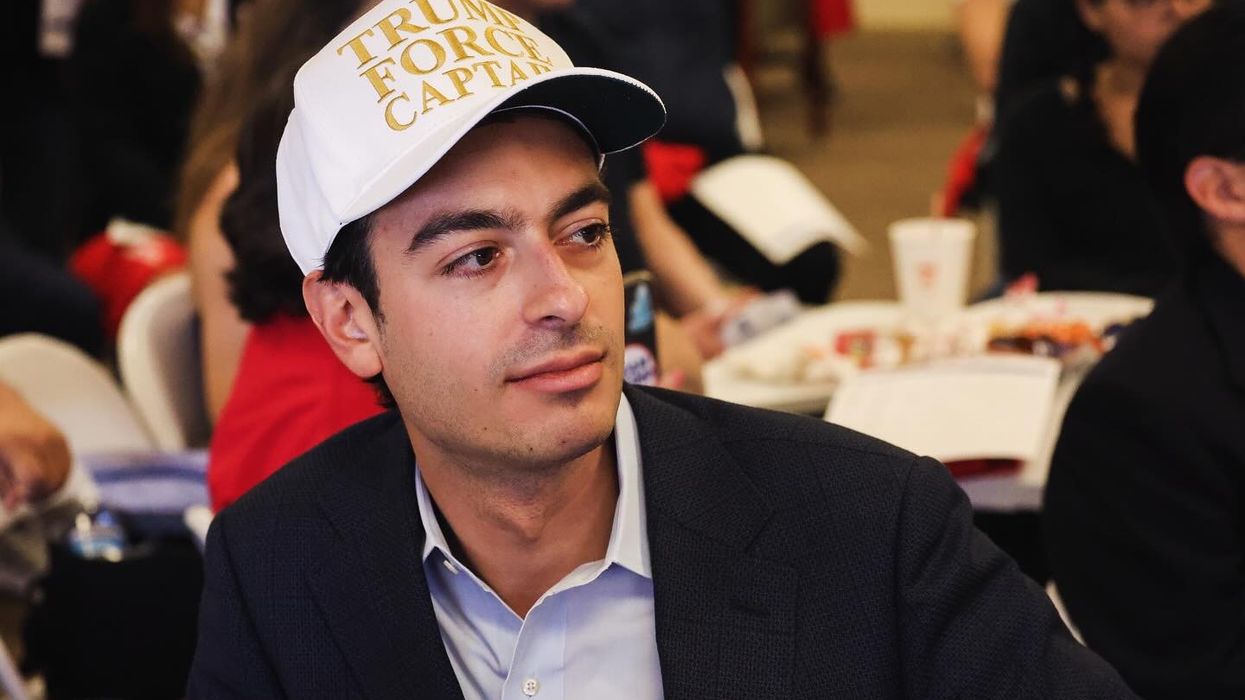
"Leading the Office of Special Counsel requires independence and experience," said one watchdog. "Paul Ingrassia seemingly has neither of these things."
U.S. President Donald Trump on Thursday nominated a far-right former podcast host with white supremacist views who called for martial law to keep Trump in power after his 2020 election loss to lead a key legal ethics office.
Trump tapped 30-year-old Paul Ingrassia—who is currently serving as the White House liaison to the Department of Homeland Security—to head the Office of Special Counsel, an independent investigative and prosecutorial agency tasked with enforcing ethics laws and protecting federal whistleblowers.
"Paul is a highly respected attorney, writer, and Constitutional Scholar, who has done a tremendous job serving as my White House Liaison for Homeland Security," Trump wrote Thursday on his Truth Social network. "Paul holds degrees from both Cornell Law School and Fordham University, where he majored in Mathematics and Economics, graduating near the top of his class."
Critics, however, had a different assessment of Ingrassia's qualifications.
Hampton Dellinger, the previous OSC chief, was initially fired by Trump in February but was temporarily reinstated via court order before being fired again after he began investigating the administration's mass layoffs of federal workers under the so-called Department of Government Efficiency. Dellinger dropped his legal challenge in March and announced that "my time as special counsel... is now over."
The OSC enforces the Hatch Act, which restricts the political activity of civilian executive branch employees. In 2021, the agency found that 13 senior Trump aides violated the law by campaigning for the president's failed 2020 reelection bid.
At that time, Ingrassia and his sister Olivia Ingrassia were hosting the "Right on Point" podcast. As Trump stoked the conspiracy theory that Democrats stole the election, Ingrassia amplified the president's "Big Lie" and called for authoritarian measures to keep him in the White House.
On December 12, 2020, the podcast's handle on its Twitter page was renamed "Stop the Steal HQ." The account reposted a tweet from prolific white supremacist and antisemite Nick Fuentes with the added message, "Time for @realDonaldTrump to declare martial law and secure his re-election!"
Ingrassia has expressed his own white supremacist views, including the assertion that "exceptional white men are not only the builders of Western civilization, but are the ones most capable of appreciating the fruits of our heritage." He also replied to a call for slavery reparations by demanding that the descendants of slaves "pay reparations to the descendants of slave owners" and advocated replacing the "treasonous" Ukrainian flag with the Confederate battle flag under penalty of "serious fines."
During the 2024 Republican presidential primaries, Trump boosted a false birther smear by Ingrassia that Nikki Haley—the former South Carolina governor and United Nations ambassador during the first Trump administration—was ineligible to run for president because her parents were not American citizens when she was born. Ingrassia posted several racist aspersions of Haley's Americanness, which have been archived by freelance journalist Jason Hart.
In March, Daily Dot's Amanda Moore revealed that Ingrassia misrepresented himself as an attorney for more than a year prior to his admission to the bar. During this time, he represented former professional kickboxer, self-described misogynist, and alleged rapist, sex trafficker, and money launderer Andrew Tate and his brother Tristan Tate in a civil suit. The Tates deny the charges.
As Moore reported:
As early as May 16, 2023, months before he took the bar exam, Ingrassia referred to himself as "an Associate Attorney at The McBride Law Firm, PLLC" on his personal Substack. But his bio on the site frequently changed. In a July 2023 piece on Tate, he described himself simply as an "associate" at the firm. In August, he referred to himself as a "law clerk." New York state records show that Ingrassia, a 2022 graduate of Cornell Law, took the bar on July 25-26, 2023, under his given name, Paolo Ingrassia. While Ingrassia received his results in October 2023, he was not admitted to the New York State Bar until July 30, 2024.
Responding to his nomination, Ingrassia wrote Thursday on X that "it's the highest honor to have been nominated to lead the Office of Special Counsel under President Trump!"
"As special counsel, my team and I will make every effort to restore competence and integrity to the Executive Branch—with priority on eliminating waste, fraud, and abuse in the federal workforce, and revitalize the rule of law and fairness in Hatch Act enforcement," he added.
"This is a pattern with the president's picks for watchdogs: partisan yeasayers whose willingness to stand up to the administration is questionable at best."
However, the Project on Government Oversight (POGO), a nonpartisan watchdog, said Friday: "Leading the Office of Special Counsel requires independence and experience. Paul Ingrassia seemingly has neither of these things."
"This is a pattern with the president's picks for watchdogs: partisan yeasayers whose willingness to stand up to the administration is questionable at best," POGO added.
Conservative writer Bobby Miller said on X that "the most insane thing about the Paul Ingrassia appointment is that he's been tapped to lead the Office of Special Counsel, an ethics watchdog tasked with enforcing laws that protect federal employees from abuse and safeguard the government from politicization."
"No one's even pretending that this Andrew Tate fanboy, Putin stooge, and martial law enthusiast would do anything even close to the job description," Miller added.
"Outside group spending this year is almost double the rate of any prior year," noted one critic. "Not a good thing."
Empowered by the U.S. Supreme Court's 2010 Citizens United v. Federal Election Commission ruling allowing unlimited independent financial contributions to support political campaigns, outside spending during the current election cycle has hit a record $1 billion, according to a report published Thursday by the watchdog group OpenSecrets.
"Super PACs and other outside groups that can raise and spend unlimited sums of money have poured about $1.1 billion into 2024 federal elections as of August 15—nearly twice what similar groups spent over the same period in the 2020 presidential election cycle when independent expenditures hit an all-time record," OpenSecrets said.
"More than half of all outside spending during the 2024 cycle—about $585.8 million—has gone into the presidential election, which saw an especially expensive Republican presidential nominating contest," the group added.
"The largest spender, by far, is former President Donald Trump's flagship super PAC, Make America Great Again Inc.," the report notes. "To date, MAGA Inc. has spent about $125.1 million boosting Trump in the presidential election, including nearly $33.2 million attacking his GOP rivals and more than $65.6 million opposing President Joe Biden."
"Future Forward and American Bridge 21st Century, the first and second-largest Democratic hybrid PACs, have spent a combined $74.7 million on the presidential race as of August 15," the publication adds. "Both super PACs pivoted to supporting Vice President Kamala Harris after Biden suspended his campaign last month."
Other key findings in the report include:
AIPAC—which vowed to spend $100 million on 2024 elections—played a key role in defeating Democratic Reps. Jamaal Bowman (N.Y.) and Cori Bush (Mo.) in recent primaries. The group has come under fire for attacking Black and brown members of Congress and for supporting Republicans who took part in Trump's attempt to overturn the 2020 presidential election results.
In an effort to curb the flood of dark money and other outside spending, House Democrats led by Reps. Adam Schiff (Calif.), Pramila Jayapal (Wash.), Dean Phillips (Minn.), and Jim McGovern (Mass.) last year
proposed a constitutional amendment to overturn Citizens United.
" Citizens United was one of the most egregious enablers of special interest money, but it was only the latest in a long line of Supreme Court cases that opened the floodgates," Schiff's office said at the time. "To truly rein in dark money, we must amend our Constitution."

On Sunday night, May 26, Ahmad became the symbol of the unspeakable horror of genocide in Gaza after Israel bombed his family tent in north Rafah.
Ahmad Al-Najjar was a happy one-year old child from Gaza. He loved trampolines, balls, and cats. Born as the youngest of his four siblings, his father liked to call him “bobba” or “baby.”
On Sunday night, May 26, Ahmad became the symbol of the unspeakable horror of genocide in Gaza after Israel bombed his family tent in north Rafah, killing him along with his mother, Faten, his sister, Houda, and his brother, Arkan. Though he was bombed beyond recognition, Ahmad was the most recognizable victim of the tents massacre in Rafah, which burned alive, beheaded, and killed at least 45 Palestinians, most of them women and children, and wounded hundreds others.
Rafah’s tents massacre was one of the most heinous assaults on Palestinian civilians in recent memory. International media and Palestinian sources reported that Israel blitzed the camp where displaced Palestinians were sheltering in tents with seven massive U.S. bombs weighing 2,000 pounds each. Meanwhile, weapons experts told CNN and The New York Times that they identified the remains of Boeing-made GBU-39s in the rubble.
The bombarded refugee tents had been designated by Israel as a “safe area” for civilians. Rafah was described by UNICEF officials as “a city of children, who have nowhere safe to go in Gaza.” It was believed to be Gaza’s last refuge, and the limit of the Biden administration’s “red line” in Gaza. This grim reality, however, did not prevent the Biden administration from shipping thousands of bombs and weapons to Israel, despite Israel’s repeated threats to invade Rafah. As Israeli forces were pounding Rafah’s refugee camps, U.S. presidential candidate Nikki Haley was in Israel signing “finish them” on the very U.S. bombs that were used to slaughter children in Gaza.
It is the children of Gaza who are forced to live the most unspeakable horrors while being denied the same outrage that Israel’s invented horrors have generated among U.S. and Western politicians
Widely circulated footage from the massacre showed a night of unspeakable horror: bodies burned to ashes, charred and blackened beyond recognition; beheaded children, decapitated and ripped apart by U.S. bombs; parents clutching their dead and burned children, screaming in horror; rescuers pulling people’s charred remains from the burning tents; wounded victims transferred to the hospital with horrific and gruesome injuries.
But the most horrifying footage from that night showed a man holding up what appeared to be the body of a small child who had been beheaded. It belonged to Baby Ahmad, who was wearing black pants and an orange shirt that night. His left leg was also severed in the blast. The family never found Ahmad’s head, and they buried him without it. He was put in the same body bag with his sister Houda. His mother and brother Arkan were buried in separate body bags.
His surviving brothers, Muhammad and Yamin, both saw the ravaged body of their little brother that night. In an interview with Al Jazeera, Ahmad’s father, Abdel Hafez, and two brothers, the only survivors of the family, speak up about the unspeakable horror they had to endure that night.
“I did not believed he was beheaded in the bombing until I saw it with my own eyes at the Tal As-Sultan clinic,” says Abdel Hafez. “His head was separated from his body.”
“It was horrific, very horrific, seeing a beheaded baby, my baby. He was buried without a head,” says the father. “I have been in a state of utter collapse, until this moment.”
The brothers look visibly traumatized. They can hardly invoke the sight of their little brother without trembling and bursting into tears. The family was staying at one of UNRWA’s shelters when Israeli forces pounded the camp. They had been displaced several times before they finally reached Rafah, where they settled in the Tal As-Sultan neighborhood after being forced to flee Khan Younis.
Battling his tears, brother Mohammad, aged 13, relates: “We were playing ball, before sunset. I came back to the shelters. They (Israelis) bombed the shelters, and I heard screams. Then I saw my brother Ahmad at the shelter’s door. His head was severed. His left leg was severed. He was wearing black pants and an orange shirt. I could not bear it, seeing my brother beheaded.”
Speaking through tears, Ahmad’s other brother, Yamin, aged eight, relates his first sight of Ahmad following the Israeli airstrike: “His face was soaked in blood, and his head severed. I wept. I love them so much.”
Standing by the graves of his family, and sharing photos of his slain children in their better and happier days, Ahmad’s father shares his fondest and last memory of his son: his nicknames, “bobba” and “baby,” and his baby word for “give me potato,” which is “baba tata,” and the way he pronounced shekel, the Israeli currency. “The last thing he asked for was a shekel, using his baby word for it: ‘tetel.’ I gave him the shekel, and he hugged me, and then left to buy something with it.”
“He loved playing with cats,” Muhammad recalls, bursting into bitter tears. “When I see his things, the trampoline and ball, and the things he played with, I feel sad and I miss him. I miss them all. I pray for them. I pray that God will have mercy on them, and grant them Heaven.”
Ahmad was one of 15,000 Gazan children murdered by Israel since October 7, a toll that would have been unimaginable without the bottomless supply of U.S. bombs. A new report by Euro-Med Human Rights Monitor shows that Israel dropped over 70,000 tons of U.S. bombs on Gaza in 200 days, which surpasses that of WWII and the bombings in Dresden, Hamburg, and London combined. It’s also 20 times more than the U.S. dropped on Iraq in six years of war.
Israel launched its genocidal war on Gaza by inventing its most outrageous lie, that Hamas fighters beheaded 40 Israeli babies on October 7. Despite being widely debunked, the lie has been repeatedly invoked by Israeli leaders to justify their genocide in Gaza. It has also served as a way to justify U.S. complicity in Israel’s war crimes in Gaza, with top U.S. officials, including Joe Biden, along with the mainstream media, echoing it recklessly.
Meanwhile, it is the children of Gaza who are forced to live the most unspeakable horrors while being denied the same outrage that Israel’s invented horrors have generated among U.S. and Western politicians. To cite Ahmad’s father: “They accuse us of beheading babies. But whose head was decapitated? My son, my one-and-a-half year old baby! They severed it completely.”
Update: This piece has been edited to provide more sourcing and accounts as to the types of U.S.-made bombs that Israel dropped on Rafah on May 26, 2024.

"Biden provided the shells, Republicans autograph them," said one progressive leader. "The U.S. political class is united in its complicity with this genocide."
Humanitarians reacted with outrage on Tuesday after former presidential U.S. candidate Nikki Haley wrote and signed an arguably genocidal message on an Israeli artillery shell while visiting an Israel Defense Forces post.
"Finish them! America [loves] Israel always," Haley wrote on the shell Tuesday, signing her name. She was accompanied by Danny Danon, a member of the Knesset, Israel's parliament, who posted photos from their tour on social media. Haley, who was the ambassador to the United Nations under then-President Donald Trump, has been an ardent supporter of Israel's war in Gaza and has ties to the American Israel Public Affairs Committee (AIPAC), a pro-Israel lobby group.
"Nothing to see here, just AIPAC's favorite politician, Nikki Haley, celebrating death and destruction in Gaza with an autographed missile," IfNotNow, a U.S. Jewish group that supports Palestinian rights, wrote on social media.
"Just disgusting," wrote Alon-Lee Green, director of the Jewish-Arab Movement for Peace, Equality & Social Justice in Israel. In the post, Green pleaded with Americans to take back their "filthy death-promoting politicians."
Alec Karakatsanis, an American civil rights lawyer, wrote that the Haley's message was "one of the most depraved things I have ever seen."
The timing of Haley's autograph of the weapon of war heightened the outrage. On Sunday night, Israel bombed the tents of displaced Palestinians in a "safe zone" of Rafah, killing at least 45 civilians, mostly women and children. Israeli Prime Minister Benjamin Netanyahu called the strike a "tragic mistake," but the Israeli military then killed at least another 21 Palestinian civilians in a similar attack on a refugee camp in the southern Gaza Strip on Tuesday.
Haley "spent Memorial Day not commemorating fallen American service members, but visiting Israel as it conducts a brutal massacre in Gaza," The New Republic's Hafiz Rashid reported, calling her autographed message "sick."
One commentator suggested that Haley's act encapsulated the attitude of America's leaders. The most powerful members of both major parties, including President Joe Biden, a Democrat, have supported Israel's war in spite of condemnation by the United Nations General Assembly, the International Criminal Court, and the International Court of Justice, which ordered Israel to "immediately halt its military offensive" in Rafah.
"Biden provided the shells, Republicans autograph them," Yanis Varoufakis, former Greek minister of finance and pro-Palestine public intellectual, wrote on social media. "The U.S. political class is united in its complicity with this genocide."
Nikki Hailey in Israel scribbling "FINISH THEM"on the shells that the IDF is about to fire into Rafah in defiance of the International Court of Justice. Biden provided the shells, Republicans autograph them. The US political class is united in its complicity with this genocide. pic.twitter.com/hejqVAjq8M
— Yanis Varoufakis (@yanisvaroufakis) May 28, 2024
Haley has spent recent days in Israel making unfounded claims about Russian, Chinese, and Iranian connections to the October 7 attack led by Hamas—and voicing her full support for the war effort, using rhetoric that wrongly indicates that she speaks for all Americans.
"America stands by Israel," Haley said during her tour with Danon, according to i24 News. "Israel is fighting the enemies of the U.S. today. Don't stop until you win."
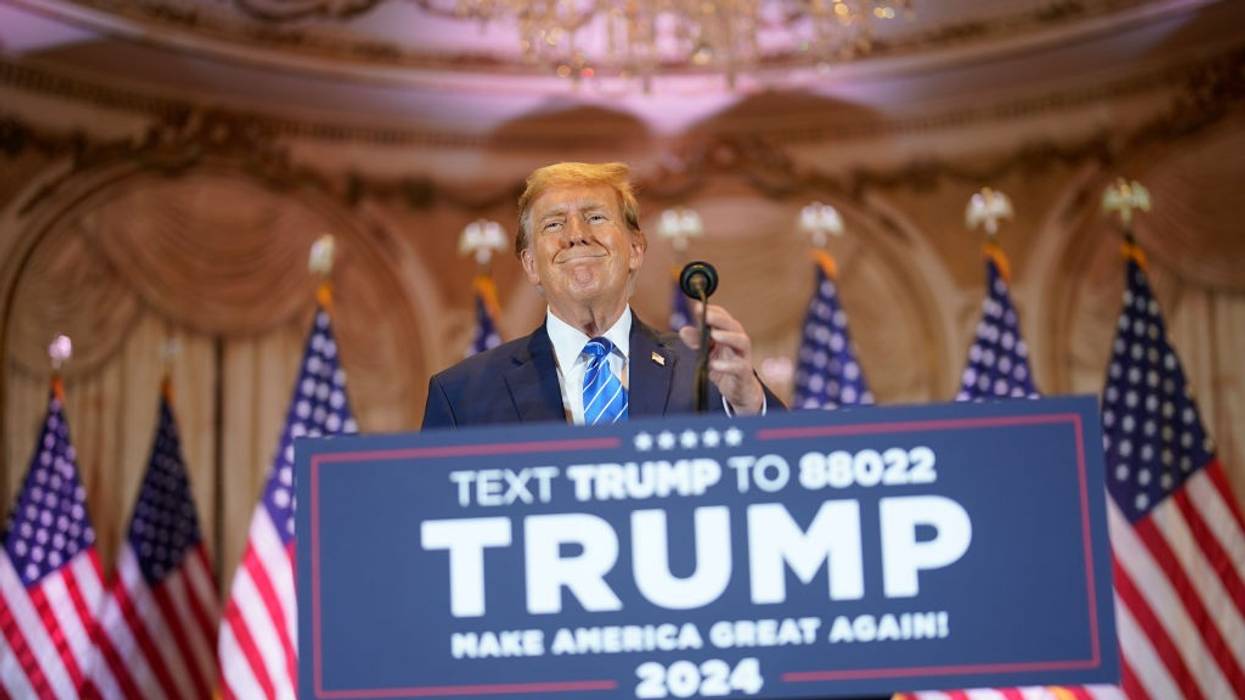
"Their decision to move forward with a dark-money, Trump donor-funded third-party fantasy bid is shameful and puts millions of Americans at risk," said one opponent.
With Democratic U.S. President Joe Biden expected to face former GOP President Donald Trump in the November election, No Labels on Friday confirmed it is pushing ahead with plans for a third-party "unity" ticket that critics fear could help the Republican return to the White House.
"The consequences of the next presidential election could not be more serious or more existential, and, despite this, No Labels has put their dangerous, reckless thought experiment ahead of the rights and freedoms of millions of Americans and the future of our democracy," declared MoveOn Political Action executive director Rahna Epting. "Their decision to move forward with a dark-money, Trump donor-funded third-party fantasy bid is shameful and puts millions of Americans at risk."
"Their own founder said they are 'not in it to win it,' and several current and past supporters of No Labels have implored them to stand down. And yet, they have decided to pump millions of dollars of dark money into a run that would swing the election to Donald Trump," she warned. "Any candidates who join the No Labels presidential ticket will be complicit in making it easier for Donald Trump and MAGA extremists to win a second term in the White House."
"Any candidates who join the No Labels presidential ticket will be complicit in making it easier for Donald Trump and MAGA extremists to win a second term."
Epting's comments came after No Labels national convention chair Mike Rawlings said in a statement that "earlier today, I led a discussion with the 800 No Labels delegates from all 50 states. These citizen leaders have spent months discussing with one another the kind of leadership they want to see in the White House in 2024. These are some of the most civic-minded, thoughtful, and patriotic Americans I have ever met. They take their responsibility seriously."
"Even though we met virtually, their emotion and desire to bring this divided nation back together came right through the screen. I wasn't sure exactly where No Labels delegates would land today but they sent an unequivocal message: Keep going," he added. "They voted near unanimously to continue our 2024 project and to move immediately to identify candidates to serve on the unity presidential ticket. Every one of our delegates had their own explanation for wanting to move ahead."
No Labels is a dark money group with secret far-right donors.
It’s not trying to find the so-called “middle ground.”
It’s trying to put Donald Trump back in the White House.
Be warned. pic.twitter.com/5cJgBTFGNj https://t.co/PCluXaWhBQ
— Robert Reich (@RBReich) March 8, 2024
While Rawlings provided some examples of delegates' statements from the call, so did journalists who obtained recordings of it. The New Republic's Greg Sargent—who got the audio from Matt Bennett, co-founder of the Democratic-centrist group Third Way—reported on concerns about a No Labels candidate being a spoiler for Trump:
For instance, a No Labels leader in Idaho said that while members are all for a run, they believe the ticket should "only" be offered to a candidate who has a "reasonable path to succeed and not be a spoiler." A leader in Iowa said the candidate must be "strong" and have "the ability to win."
Many others echoed these sentiments. At one point a party member from New Hampshire said: "We are in it to win it. But we also don't want to look like liars when we're telling people that we're not going to be a spoiler."
However, participants in the call expressed support for pursuing a unity ticket, according to Politico's Shia Kapos and Daniel Lippman, who also obtained a recording and reported that "delegates compared what No Labels was doing to Abraham Lincoln delivering the Gettysburg Address and the Founding Fathers during the American Revolution."
Third Way's Bennett said in a statement Friday: "What part of 'no' is so hard to understand? Time and again, voters, candidates, and election experts have told No Labels that a third-party presidential ticket can't win and would help Trump."
As Andrew Perez and Nikki McCann Ramírez detailed Friday for Rolling Stone:
Over the past year, the dark-money group has been leading a reported $70 million campaign to secure ballot access nationwide for a potential 2024 "unity" ticket. No Labels has refused to disclose who's funding this effort, claiming that this is to protect its donors from "agitators and partisan operatives." Thanks to a quirk in America's broken system of campaign finance laws, the group will never be required to disclose who funded its ballot access effort—and would only have to start reporting donors if it were to formally back candidates.
So far, No Labels has secured ballot access in 16 states, and is trying to do so in 17 other states. The group has given no concrete hints as to which two divide-spanning politicians might run on its unity ticket, or to what party they might belong.
Outgoing U.S. Sen. Joe Manchin (D-W.Va.)—a right-winger who weighed a run for president—suggested last week that a No Labels ticket would be a spoiler, saying that "right now, if you can't get on 50 states and you're going to basically hit in some of the battleground states that could be very detrimental to what the outcome would be."
During Biden's State of the Union speech on Thursday night, Trump said that it was "interesting" that Manchin and retiring Sen. Mitt Romney (R-Utah)—the 2012 GOP nominee—were sitting together, "and nobody wants to talk to them."
"I think they'd make a great No Labels team!" added Trump—whose only remaining primary challenger, former U.N. Ambassador Nikki Haley, dropped out earlier this week. She has also publicly opposed running with No Labels.
Sen. Kyrsten Sinema of Arizona, an Independent who ditched the Democratic Party shortly after the 2022 election, revealed this week that she is not seeking another term in November but she is also "not running for president."
Another potential No Labels candidate, former Republican Maryland Gov. Larry Hogan, recently resigned from the group's board in frustration and has decided to run for Senate. He remains opposed to both major candidates, saying Thursday that "I'm like 70% of the rest of people in America who do not want Joe Biden or Donald Trump to be president."
While No Labels searches for candidates, the group's critics continue to warn of the consequences of its potential ticket.
"There is no path to victory for No Labels. They will only ensure a second Trump presidency that serves the interests of their billionaire and corporate special interest backers," End Citizens United president Tiffany Muller said Friday. "It's why they've fought every effort to play by the rules and disclose their donors."
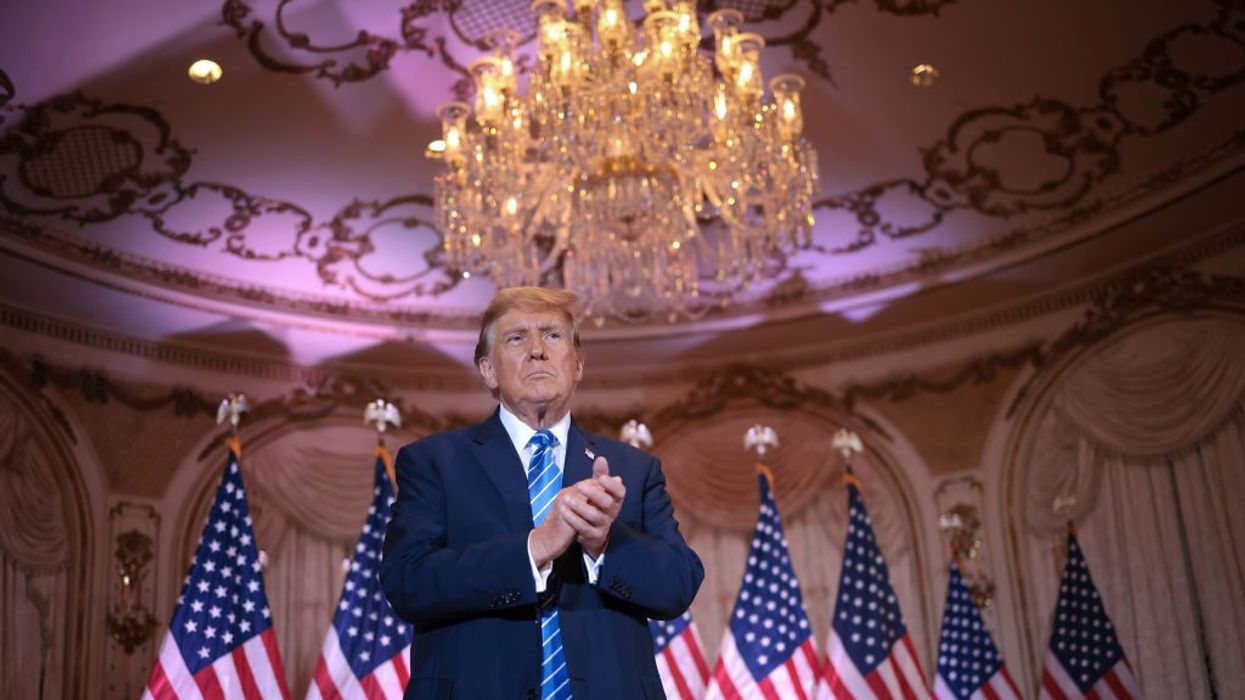
U.S. voters, said one campaigner, now have a choice "between an aspiring dictator who is running for office so that he can escape accountability and punish his political enemies, and a leader who will protect our democracy."
The Republican Party's lurch toward fascism appeared to accelerate Wednesday as former President Donald Trump notched two important political victories and fresh warnings emerged of the stark choice U.S. voters face with a 2020 rematch against President Joe Biden now all but certain.
Following a slew of Super Tuesday defeats and Monday's ruling by the U.S. Supreme Court—which includes three Trump appointees—to block states from barring the presumptive Republican nominee from the ballot for engaging in insurrection, Nikki Haley dropped out of the GOP presidential primary and outgoing Senate Minority Leader Mitch McConnell (R-Ky.) endorsed the 77-year-old former president.
Christina Harvey, executive director of the progressive advocacy group Stand Up America, emphasized the stakes of the upcoming election, saying that "Republicans have effectively chosen an aspiring dictator as their nominee for president."
"Trump's plans to undermine our freedoms and our democracy should be chilling to every American, including his pledges to abuse his power to seek revenge on political opponents, pardon his violent allies, and purge dissenters from the federal government," she said. "Voters will face a clear choice this fall, between an aspiring dictator who is running for office so that he can escape accountability and punish his political enemies, and a leader who will protect our democracy and fundamental freedoms."
Sen. Bernie Sanders (I-Vt.) also warned against Trump and suggested the choice could not be more clear.
"Another Trump presidency would be a disaster—not only for our country, but for the world," Sanders said. "We will lose the fight against climate change. Women will no longer have control over their own bodies. Billionaires will get richer and working people will suffer."
Sanders, who ran for president in both 2016 and 2020, also spoke about the threat Trump poses during a Tuesday night appearance with late-night host Stephen Colbert.
Another Trump presidency would be a disaster — not only for our country, but for the world.
We will lose the fight against climate change.
Women will no longer have control over their own bodies.
Billionaires will get richer and working people will suffer. pic.twitter.com/hkdUyGkwzU
— Bernie Sanders (@BernieSanders) March 6, 2024
Haley, who previously served as South Carolina's governor and Trump's ambassador to the United Nations, was the last Republican challenging him. She suspended her campaign after winning just the District of Columbia and Vermont.
"I have always been a conservative Republican and always supported the Republican nominee," she said. "It is now up to Donald Trump to earn the votes of those in our party and beyond it who did not support him and I hope he does that."
Responding to Haley's decision to exit the primary race, Biden said in a statement Wednesday that "Donald Trump made it clear he doesn't want Nikki Haley's supporters. I want to be clear: There is a place for them in my campaign."
"I know there is a lot we won't agree on," he acknowledged. "But on the fundamental issues of preserving American democracy, on standing up for the rule of law, on treating each other with decency and dignity and respect, on preserving NATO and standing up to America's adversaries, I hope and believe we can find common ground."
"We all know this is no ordinary election. And the stakes for America couldn't be higher," Biden stressed.
Democratic Legislative Campaign Committee (DLCC) president Heather Williams also warned of the threat posed by Trump and his committed far-right allies nationwide.
"As Donald Trump solidifies his control of the Republican Party, we can't lose sight of the hundreds of MAGA Trump loyalists serving in legislatures across the country who pose a direct threat to our communities and our democracy," she said. "These MAGA die-hards will stop at nothing to advance Trump's dangerous agenda, even as he careens more and more towards becoming a hardline dictator."
"From pushing for a nationwide abortion ban to destroying the foundation of our democracy, a Trump presidency would be supported and enacted by his allies in state legislatures," Williams warned. "The DLCC is sounding the alarm on the dangers of a united MAGA front at the national and state level, and we are laser-focused on defeating MAGA loyalists in state legislatures."
Although the U.S. Supreme Court last June ruled against the independent state legislature theory that Trump supporters used to justify their attempts to overturn the 2020 election results, CNN's Marshall Cohen noted at the time that "the somewhat limited ruling leaves plenty of avenues for future election-related challenges, regarding how districts are drawn, the deadlines for mail-in ballots, and other key questions."
Trump has been the GOP front-runner since formally launching his campaign in November 2022 and recent polling shows him having a slim lead over Biden in this year's anticipated rematch. This, despite the Republican being impeached twice during his first term and now facing four criminal cases—two related to his 2020 election interference.
Biden has faced criticism from many Democratic and younger voters for not being bold enough in tackling the climate emergency and for supporting Israel's ongoing assault on the Gaza Strip, which is being investigated at the International Court of Justice as genocide.
Congressman Dean Phillips (D-Minn.), a longshot Biden primary challenger, suspended his campaign on Wednesday and endorsed the president for reelection, saying that "in light of the stark reality we face, I ask you join me in mobilizing, energizing, and doing everything you can to help keep a man of decency and integrity in the White House. That's Joe Biden."
Speaking on MSNBC after McConnell's endorsement on Wednesday, Rep. Jamie Raskin (D-Md.) said that he believes American voters "know who Donald Trump is," but the real question for 2024 remains: "Who are we?"
"Are we going to stand with democracy and freedom or will we lapse into some other kind of theocratic or autocratic kind of government?" the congressman asked. "That's really the question for the American people."
Raskin—who led the historic second Trump impeachment following the January 6, 2021 insurrection—also called out the ex-president for continuing "to campaign almost exclusively on his Big Lie and the idea that he was somehow cheated out of an election."
"He wasn't. He lost the election in 2020," Raskin added of Trump. "He's going to lose the election in 2024 because the vast majority of the people reject what it is he's selling."
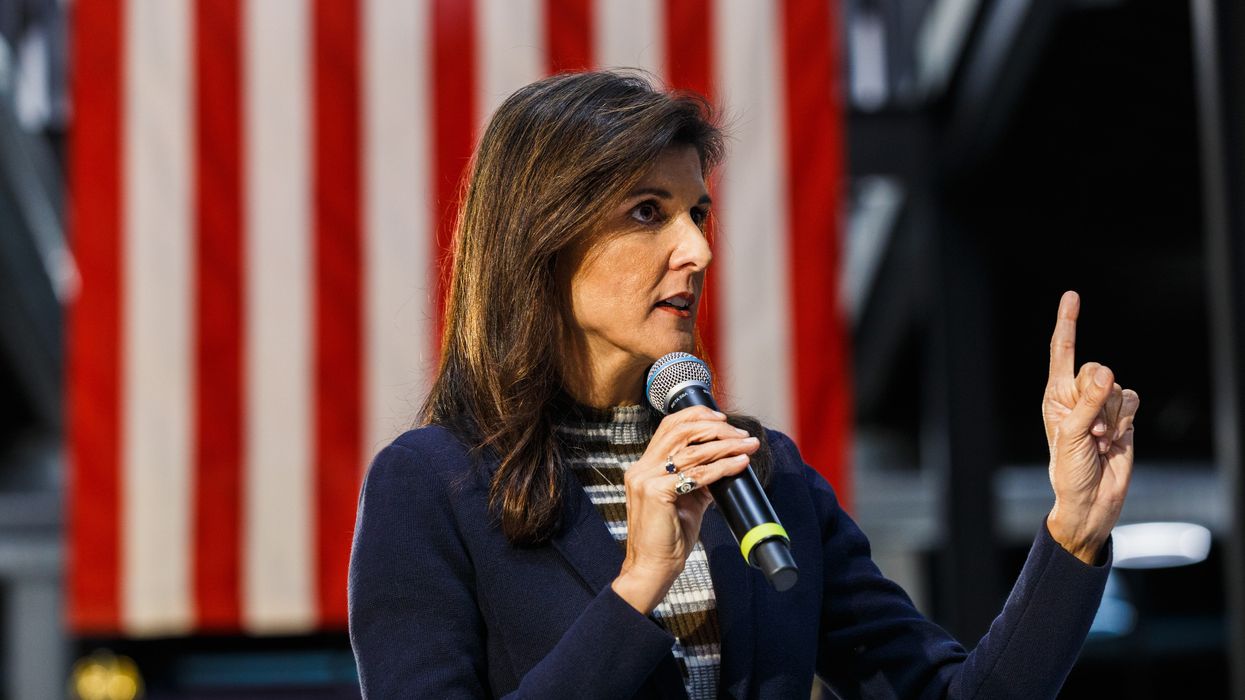
Fewer than 10% of anybody polled in the last four decades agreed with Nikki Haley that we spend too much on Social Security.
Nikki Haley wants to be president, which remains hypothetically possible… I guess. Donald Trump might, for example, be struck by a falling piano while walking down the sidewalk. Or his legal problems could intervene. But the wheels of justice don’t seem to be turning quickly enough to save Haley from a crushing primary defeat. She trails the former president by a
two-to-one margin in her home state and more than four to one among Republicans nationwide.
Among her many flaws, Haley wants to cut Social Security. Just last August, she said that a retirement age of 65 is “way too low” and should be raised “according to life expectancy.” That’s misdirection; the current retirement age for Social Security is 67, not 65, and United States life expectancy is falling, not rising.
Raising Social Security’s statutory retirement age by even a year is mathematically indistinguishable from a 6% to 7% across-the-board benefit cut. Because of the way Social Security’s benefits are calculated, that’s true regardless of when one claims benefits: at 62, 67, 70, or any other time. Raising the retirement age to 70 would worsen inequality and substantially cut benefits, especially for lower-income workers, as David Rosnick and Dean Baker found in 2010.
There’s a clean way to increase Social Security spending without “bankrupting” anything or overhauling our economic theories: by raising taxes on Dimon and the people who filled that November conference room. But you won’t hear Nikki Haley mention that.
Governor Haley, don’t lose this number: 64.3. That’s the average retirement age for countries that belong to the Organization for Economic Cooperation and Development (OECD).
In 2010, Social Security’s full retirement age was 66 years. If it had been linked to life expectancy then, it would have been reduced—to roughly the OECD average.
But fearmongering and facts don’t mix, and Haley’s gone into full-on fear mode over Social Security. She draws heavily on all the phony talking points and pie charts cooked up by billionaire-funded “think tanks” and astroturf groups.
Despite decades of propagandizing, voters aren’t buying it. A review of long-term polling on the subject found that most Democrats, Republicans, and Independents have consistently viewed Social Security “very favorably” for nearly 40 years. This positive opinion was essentially the same for younger and older people, and for both white and Hispanic voters. (Black voters were even more favorable.)
But then, Haley wasn’t speaking to voters—not yet. She was making her pitch to mega-donors like JPMorgan Chase CEO Jamie Dimon, who last November told a room filled with CEOs and Wall Street executives to get out their checkbooks for her. Other conference attendees were “just folks” types like Elon Musk, billionaire hedge funder Bill Ackman, and Disney head Bob Iger.
“Get a choice on the Republican side that might be better than Trump,” Dimon told the elite gathering—meaning, presumably, better for business. (That remark is likely to reappear in Trump’s campaign materials, as the huckster ex-president seeks to burnish his faux-populist credentials.)
Dimon’s remark was well-timed. As he praised the former governor, a group of CEOs was announcing a new pro-Haley Super PAC.
Who is Jamie Dimon? Members of the House Financial Services Committee cited his bank’s practice of “pinklining” (discriminatory lending toward women) and its role (at least, as of 2019) as “the number one funder of fossil fuels in the world.” Dimon’s bank looked the other way as Bernie Madoff bilked widows, orphans, and charities and earned some well-deserved notoriety for its extensive business ties to Jeffrey Epstein (a JPM exec visited Epstein in prison).
For at least two decades, JPMorgan Chasesystematically engaged in enough criminal activity to qualify it as the largest organized-crime syndicate in North America. It’s far worse than Enron, with crimes and violations that include foreclosure fraud, investor fraud, cheating customers, and market manipulation.
Before Dimon made his pitch for her, an “unnamed banking source” told Axios that Dimon and Haley had been having regular talks about the economy.
Like the saying goes: Game recognize game.
Haley’s billionaire-backed agenda, including her call for Social Security cuts, added to her New Hampshire loss. Political scientist Thomas Ferguson and his team found that Trump performed even better in parts of the state that had lower incomes and negative growth, concluding:
The... results testify how little many of the also ran’s favorite economic themes—the perils of the deficit, cutting Social Security, or crypto—moved Trump’s core constituency. Large numbers of Trump voters count on Social Security to get by...
Even if the improbable happens and Trump implodes, Haley would still have to face voters eventually. Here’s another number she shouldn’t lose: 10%. The historical polling data found that, for nearly four decades, “at no time did more than 10% (of those polled) state that too much was spent” on Social Security.
Fewer than 10% of Republicans thought it. Fewer than 10% of self-described conservatives thought it. Fewer than 10% of anybody, in fact, agreed with Nikki Haley that we spend too much on Social Security. Except for a brief period in the 1990s, an outright majority of Americans has said we spend too little.
They’re right. There’s a clean way to increase that spending without “bankrupting” anything or overhauling our economic theories: by raising taxes on Dimon and the people who filled that November conference room. But you won’t hear Nikki Haley mention that.
Here’s a number the rest of us shouldn’t lose: $8 million. That’s what Haley reportedly made cashing in on her government career—as a director for Boeing (of plane crash and exploding door fame); giving speeches to banks like Barclays and groups like the Center for Israel and Jewish Affairs, which “provided more money in a day than Haley had previously earned in a year”; and other sources.
She’ll be fine in retirement. It’s the rest of us who should worry—about Nikki Haley and her friends.
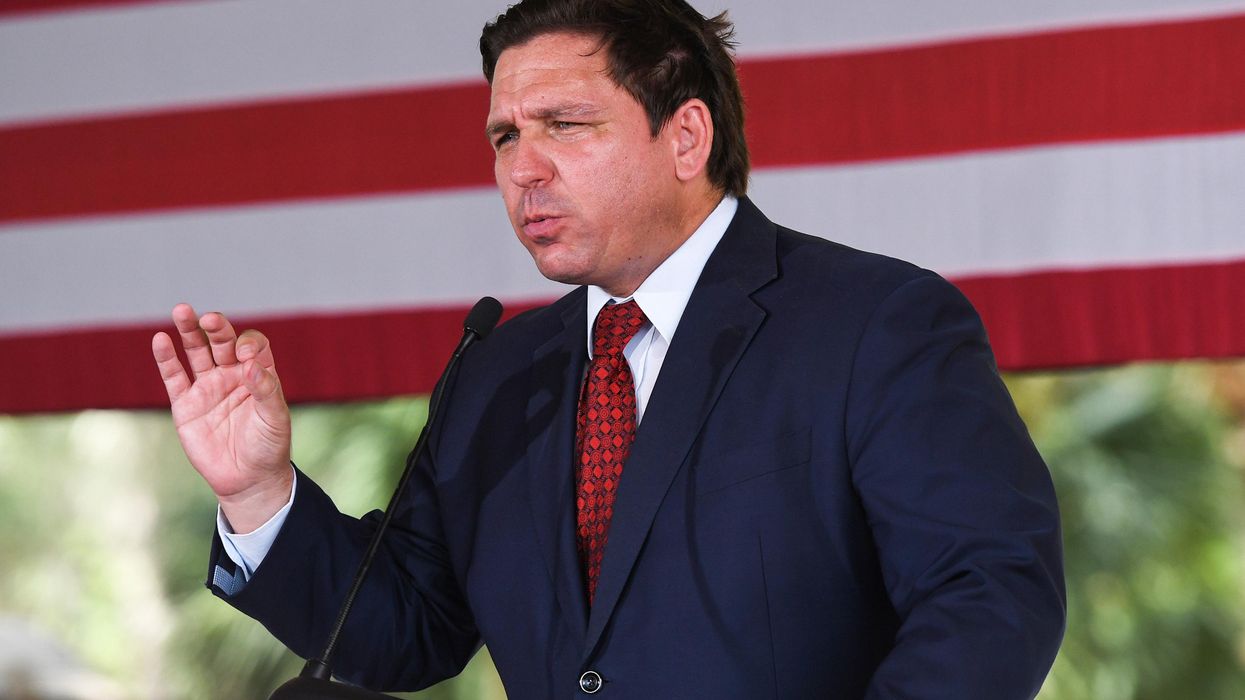
"As Floridians we will be stuck with him until 2026, so continue to hold him accountable and demand better for Florida," one state representative said.
Florida Governor Ron DeSantis announced on Sunday that he was suspending his presidential campaign ahead of Tuesday's New Hampshire primary and endorsing former President Donald Trump.
DeSantis broke the news in a video posted on social media nearly a week after he finished 30 percentage points behind Trump in the Iowa caucuses.
"Ron DeSantis, a man who built his entire campaign on attacking and demonizing already marginalized communities, has finally suspended his failing Presidential campaign," Florida Representative Anna V. Eskamani, a Democrat, posted on social media in response to the news. "As Floridians we will be stuck with him until 2026, so continue to hold him accountable and demand better for Florida."
"Ron DeSantis should be forced to carry his Presidential campaign to term."
In his video, DeSantis explained his decision.
"If there was anything I could do to produce a favorable outcome—more campaign stops, more interviews—I would do it," he said. "But I can't ask our supporters to volunteer their time and donate their resources if we don't have a clear path to victory. Accordingly, I am today suspending my campaign."
In responding to the news, activists and journalists highlighted DeSantis' far-right record on reproductive justice and LGBTQ+ rights. As Florida governor, he signed laws nearly banning abortion and prohibiting educators from discussing sexual orientation and gender identity with their K-12 students.
"Ron DeSantis should be forced to carry his Presidential campaign to term," Melanie D'Arrigo, the executive director of the Campaign for New York Health, posted on social medial.
Independent LGBTQ+ journalist Erin Reed wrote that DeSantis "is one of the most vile anti-LGBTQ+ politicians of the modern era. If he had his way, trans people would be eradicated from the Earth and queer people would have to go back into hiding."
"The end of his campaign is a moment we can all be thankful for," Reed said.
Equality California posted that the "real loss" of DeSantis' career was "the years of unnecessary struggles he imposed on LGBTQ+ youth."
"Their courage outshines his ambition," the advocacy group said.
DeSantis' departure sets up the rest of the Republican primary to be a contest between Trump and former United Nations Ambassador Nikki Haley.
"I want to say to Ron, he ran a great race. He's been a good governor, and we wish him well," Haley said in response to the news. "Having said that, it's now one fella and one lady left."
In his message, DeSantis chose to endorse Trump, despite the fact that pro-Trump super PAC MAGA Inc. funded more than $10-million worth of attacks against him before he even announced his presidential bid, as NBC News reported.
"It's clear to me that a majority of Republican primary voters want to give Donald Trump another chance," DeSantis said, adding that "we can't go back to the old Republican guard of yesteryear, a repackaged form of warmed-over corporatism that Nikki Haley represents."
Toward the end of his announcement, DeSantis repeated a quote he attributed to former British Prime Minister Winston Churchill: "Success is not final, failure is not fatal: It is the courage to continue that counts."
However, the International Churchill Society includes this quote on a list of quotations misattributed to Churchill, as journalist Dominic Pino pointed out.
The society listed the quote DeSantis used next to another about success and failure.
"We can find no attribution for either one of these, and you will find that they are broadly attributed to Winston Churchill," the society wrote. "They are found nowhere in his canon, however. An almost equal number of sources found online credit these sayings to Abraham Lincoln—but we have found none that provides any attribution in the Lincoln Archives."

"On Social Security, just as he does on so many other topics, Donald Trump is projecting his own desires onto his opponents," said one progressive defender of the program. "In this case, his accusations against Nikki Haley and Ron DeSantis happen to be true, but they are equally true about Trump himself."
Whichever Republican emerges victorious in the party's Iowa caucus on Monday and ultimately becomes the GOP nominee, defenders of Social Security want the voting public to know that not a single one of them can be trusted to defend what is considered the greatest anti-poverty program ever enacted in the United States.
While former president and GOP primary frontrunner Donald Trump in recent weeks has attacked his top rivals for comments they've made about the program, progressive advocates warn he is no better.
Last week, Trump released a new ad against former South Carolina governor Nikki Haley in New Hampshire that states: "Americans were promised a secure retirement. Nikki Haley’s plan ends that."
During a mid-week debate between Haley and Florida Gov. Ron DeSantis—though Trump skipped the event—the two second-tier GOP hopefuls sparred over their plans for Social Security as each said the other could not be trusted on the issue. While DeSantis said a "promise made is a promise" kept, Haley pointed out the governor voted three times to increase the retirement age when was in Congress.
Meanwhile, Haley repeated her promise to push for an increase of the retirement age for people now in their twenties and thirties if elected. In a subsequent public warning, however, the advocacy group Social Security Works made clear that neither DeSantis nor Haley—or Trump for that matter—deserve the public's trust.
Nancy Altman, president of Social Security Works, told Common Dreams over the weekend that while Trump's ads and recent statements correctly pinpoint why Nikki Haley and Ron DeSantis should never be trusted to protect Social Security, the former president has an expansive and consistent track record of attacking the program, including during his first term in office.
"On Social Security, just as he does on so many other topics," said Altman, "Donald Trump is projecting his own desires onto his opponents. In this case, his accusations against Nikki Haley and Ron DeSantis happen to be true, but they are equally true about Trump himself."
"Trump proposed serious cuts to Social Security as part of his budget every single year he was in office," she continued. "He surrounded himself with men like Mick Mulvaney and Mike Pence, who have long histories of trying to cut and privatize Social Security."
As Common Dreams reported during his presidency, including as he eyed reelection in 2020, Trump made repeated comments hostile to Social Security, Medicare, and Medicaid. In August of 2020, Trump bragged on national television that he would permanently halt the payroll tax that funds Social Security, comments that were seen by defenders of the program as a vow "to destroy" the program.
"Trump himself has supported privatization and raising the retirement age, along with slandering the program as a 'Ponzi scheme,'" warned Altman. "He can't be trusted to protect our earned benefits any more than DeSantis or Haley."

As Nikki Haley well knows, the Confederacy rose up not simply to preserve slavery and the Southern oligarchy, but to extend that oligarchy to the rest of the United States.
First, a curious person in her New Hampshire town hall this week asked Republican presidential candidate Nikki Haley, “What caused the Civil War?”
You could almost see the gears turning in her head, as she backs away from the questioner and takes a long pause, knowing that if she says “slavery” she’ll offend the white racist base of the GOP.
Ron DeSantis, after all, had to go so far as to change the curriculum in Florida’s public schools to assert that enslaved people “learned skills” that “could be applied for their personal benefit.”
Haley, of course, is no idiot. She was governor of South Carolina, the first state to secede from the union after Abe Lincoln was elected president in 1860. Her state’s December 20, 1860 Declaration of Secession lays it out clearly:
The right of property in slaves was recognized by giving to free persons distinct political rights, by giving them the right to represent, and burthening them with direct taxes for three-fifths of their slaves; by authorizing the importation of slaves for twenty years; and by stipulating for the rendition of fugitives from labor.
We affirm that these ends for which this government was instituted have been defeated, and the government itself has been made destructive of them by the action of the nonslaveholding states.
Those states have assume the right of deciding upon the propriety of our domestic institutions; and have denied the rights of property established in 15 of the states and recognized by the Constitution; they have denounced as sinful the institution of slavery; they have permitted open establishment among them of societies, whose avowed object is to disturb the peace and to eloign the property of the citizens of other states.
They have encouraged and assisted thousands of our slaves to leave their homes; and those who remain, have been incited by emissaries, books and pictures to servile insurrection.
So, lamely, Haley recites the ancient Southern excuse, that slavery was merely capitalism, that “freedom” means the freedom of white people to own other human beings:
I think the cause of the Civil War was basically how government was going to run—the freedoms and what people could and couldn’t do.
I think it always comes down to the role of government and what the rights of the people are. And I will always stand by the fact that I think government was intended to secure the rights and freedoms of the people. It was never meant to be all things to all people.
Government doesn’t need to tell you how to live your life. They don’t need to tell you what you can and can’t do. They don’t need to be a part of your life. They need to make sure that you have freedom. We need to have capitalism. We need to have economic freedom. We need to make sure that we do all things so that individuals have the liberties so that they can have freedom of speech, freedom of religion, freedom to do or be anything they want to be without government getting in the way.
When she was called out on it by the questioner, who said he was “astonished” that her answer didn’t mention slavery, she tried to be glib, asking rhetorically, “What do you want me to say about slavery?”
When the gaffe went viral, Haley tried to clean it up by saying that “of course” slavery was a cause of the Civil War, and, later, blaming the “gotcha” question on a “Democratic plant” who’d sneakily inserted himself into her town hall.
The simple reality is that the pro-slavery South is still very much with us, and is still—after 163 years—trying to make the case that democracy should be replaced with a strongman white supremacist oligarchy.
As I wrote in The Hidden History of American Oligarchy, the South had ceased to be a democracy by the 1830s and by the time of the Civil War was a full-blown police state run by a few thousand morbidly rich families who lived and acted like the feudal lords of ancient Europe.
And, most interesting, a disruptive new technology—the invention of the cotton gin—drove the process.
Just as the agricultural revolution birthed humanity’s first documented oligarchies, the invention of the cotton gin and its widespread use by 1820 birthed the first American oligarchy, one that eventually rose up and challenged democracy itself in a bloody Civil War.
The backstory is fascinating, and helps us understand Nikki Haley’s blithering. Today’s Republicans are using the new technology of social media to try to impose a 21st century version of the Confederate oligarchy and its exploitation of poor people.
From the century of the American Revolution until the early 1800s, the main sources of power that fueled America were twofold: wood and human labor.
In the North, that labor was often supplied by European convicts or indentured European immigrants who committed to a certain number of years of free labor in exchange for transportation from Europe, or simply by poor immigrants willing to do pretty much any job for very low pay.
As transatlantic commerce exploded through the late 1700s and early 1800s, the increasing numbers of ships brought with them a dramatic decrease in the cost of the trip for a new immigrant from Europe to America.
More and more people could avoid an indenture and simply pay their own way, so during this period, indentured servitude in the North pretty much faded away, replaced in some areas by prison labor but most often replaced by cheap immigrant labor.
In the South, these forms of labor existed, but on the plantations where the only way to pick and clean cotton was with fingers and hands, the labor was mostly supplied by enslaved people of African ancestry.
Then came a technological change that had as much impact on the South as Gutenberg’s printing press did on Europe centuries before and social media is having on us today.
It transformed the economics of the South from a hardscrabble existence into one of opulence and great wealth in a very few hands; changed the culture of the South from one that was apologetic for slavery and oligarchy into one that openly called both good things that should spread across the rest of the nation and around the world; and changed the politics of the South from a mostly democratic republic into an openly tyrannical autocracy.
Where Cotton Is King, Cotton Makes Kings
Cotton could be a reliably profitable crop for the Southern plantation owners; it was easy to grow, it could be stored for years if necessary, and there was worldwide demand for it. Its biggest problem was the seeds.
What we call cotton is a fibrous part of the “fruit” of the cotton plant. After the flower is pollinated, the seeds form and mature in a pod or boll along with a protective superstructure of thin fibers that we call cotton.
Picking cotton is work that in the period from the Revolutionary War to the Civil War was never automated, so it required a fair amount of human labor. Far more difficult, though, was the process of disentangling the cotton seeds from the cotton fibers that surrounded them. It could take an entire day for a person to clean a single pound of cotton by hand.
In 1794, Eli Whitney figured out how to make a drum into which raw cotton could be dumped, then spun with hundreds of tiny hooks that would pull the cotton fibers out through a mesh. The mesh was too fine for the seeds to pass through, so as the drum turned, the cotton accumulated outside it, leaving behind in the drum nothing but seeds.
Whitney wrote to his father:
One man and a horse will do more than fifty men with the old machines.... Tis generally said by those who know anything about it, that I shall make a Fortune by it.
His “cotton gin” (“gin” was short for “engine”) took the South by storm in the first two decades of the 1800s. Its biggest impact, though, was on the fate of democracy in the South.
Now that one machine could clean as much cotton as 50 people, every cotton plantation faced the possibility that it could produce 50 times as much cotton (and profit), if only it had 50 times as much land to grow the cotton on and 50 times as many people to pick it.
The wealthiest among the Southern plantation owners began to buy up small farms and plantations the way big agricultural corporations would later buy out American Midwestern farmers when Reagan stopped enforcing America’s anti-monopoly laws in the early 1980s.
The smaller farmers who couldn’t afford a cotton gin were faced with financial ruin from their giant competitors, and they didn’t have Willie Nelson to sing “Farm Aid” fundraising concerts to help them buy equipment to compete.
Like Midwestern farmers in the 1980s, the smaller Southern cotton farmers either sold out or were bankrupted and driven off their land; many became tenant farmers on what had previously been their own property.
Illinois’ Rep. John Farnsworth noted the trend in his 1864 speech on the floor of the U.S. House of Representatives:
[With t]he invention of the cotton gin, the cultivation made it profitable to raise men and women for the Southern market. The price of slaves was enhanced; from being worth $250 they went up to $1,200 and $1,300.
Then the greed for power took possession of the slaveholders, and the avarice of these men overleaped itself and they became clamorous for the extension of slavery. The bounds were too narrow for them. They became ambitious of a nation that should be founded upon ‘the cornerstone of slavery.’
Then it was, Mr. Speaker, that the slave power got the control of the Government, of the executive, legislative, and judicial departments. Then it was that they got possession of the high places of society. They took possession of the churches. They took possession of the lands. Then it became criminal for a man to open his lips in denunciation of the evil and sin of slaveholding.
Then followed... the attempt to expel John Quincy Adams; the throttling of the right to petition; suppressing the freedom of the press; the suppression of the freedom of the mails; all these things followed the taking possession of the Government and lands by the slave power, until we were the slaves of slaves, being chained to the car of this slave Juggernaut...
Then came the conventions of the rival political parties, in which they declared that the agitation of this vexed question should cease. But it would not cease, for the slave power was still clamoring for more, more, more!
Then came the [Dred Scott] decision of the Supreme Court. Why, sir, the spirit of slavery took possession of that court and instigated the palsied arm of a judge upon the brink of the grave to attempt to snatch the charter of human liberty from the throne of the Almighty.
The Southern oligarchs were on the rise.
The Oligarchs’ War
By the 1830s, with the recent death of nearly every member of the Founding generation and the rise of plantation oligarch Andrew Jackson’s vice president, John C. Calhoun, and his nullification crisis, the South was firmly in the economic, political, and social hands of a small number of uberwealthy plantation-based oligarchs made fabulously rich by the invention of the cotton gin.
In 1913, looking back on the 1787 Constitutional Convention, historian Henry Leffmann wrote:
Some of the members of the Convention doubtless believed that the question [of slavery] would settle itself thru the evolution of labor conditions. Ellsworth, of Connecticut, said, ‘Let us not intermeddle. As the population increases, poor laborers will be so plenty as to render slaves useless.’ This result might have been attained much earlier than it was if the cotton-gin had not been invented.
As Forrest A. Nabors wrote in his brilliant book From Oligarchy to Republicanism: The Great Task of Reconstruction:
A new generation of rulers reshaped the South around their new ruling principle... The development of Southern oligarchy portended the rupture of the union, regardless of the ties that bound them together, because no ties, physical, legal, or otherwise, can overcome the difference between fundamentally opposed types of political regimes.
And it was the technological revolution that Eli Whitney had birthed that gave them the wealth and power to try to pull it off.
Wisconsin Sen. Timothy Howe laid it out in an 1864 speech on the floor of the U.S. House of Representatives:
If the cotton gin had not been invented, slaveholding would not have been profitable. If slaveholding had not been profitable, slaveholders would not have been rich. If slaveholders had not been rich, they would not have been arrogant. If they had not been arrogant, four hundred thousand slaveholders would not have presumed to challenge dominion over 20 million freemen.
Slavery without the cotton gin would have been a monster wrong, but it would not have been dangerous to the republic. The cotton gin without slavery would have been of twice the value it has been and still would not have been dangerous to anyone. Together they have proved fatal to the peace of the nation.
On December 18, 1860, Tennessee Sen. Andrew Johnson (soon to be vice president and then president) said on the floor of the Senate, speaking in favor of the right of the Southern states to secede:
When the Union was formed, 12 of the 13 states were slaveholding; and if the cotton gin had not been invented, there would not probably today have been an African slave in North America.
Historian Forrest Nabors extensively cites (and informed me of) Rep. John Farnsworth of Illinois, as well as Sen. Timothy Howe of Wisconsin, who argued that the oligarchy in the South had become so strong that they weren’t just trying to be left alone in the lead-up to the Civil War—they actually wanted to dominate the North.
"Such, then, I find to be the cause and the purpose of the rebellion,” said Howe. “It was not to secure toleration for slavery within the seceding Slates, but to compel the adoption of slavery by the nation.”
In other words—as Nikki Haley well knows—the Confederacy rose up not simply to preserve slavery and the Southern oligarchy, but to extend that oligarchy to the rest of the United States.
The South has, since the 1830s, been the epicenter of an anti-democratic, anti-American plot to replace our representative government with rule by the morbidly rich.
And they’ve been doing it by creating a caste system in America and using new technologies to keep it in place so they can exploit the labor of non-white, imprisoned, and poor workers.
Which explains why Nikki Haley had such a struggle with the question, and the media largely dances around efforts to explain it: oligarchy is the ultimate work today’s Republican Party, relying heavily on the new technology of social media owned by rightwing billionaires.
Unless we stop them at the ballot box this coming November.