

SUBSCRIBE TO OUR FREE NEWSLETTER
Daily news & progressive opinion—funded by the people, not the corporations—delivered straight to your inbox.
5
#000000
#FFFFFF
To donate by check, phone, or other method, see our More Ways to Give page.
Daily news & progressive opinion—funded by the people, not the corporations—delivered straight to your inbox.
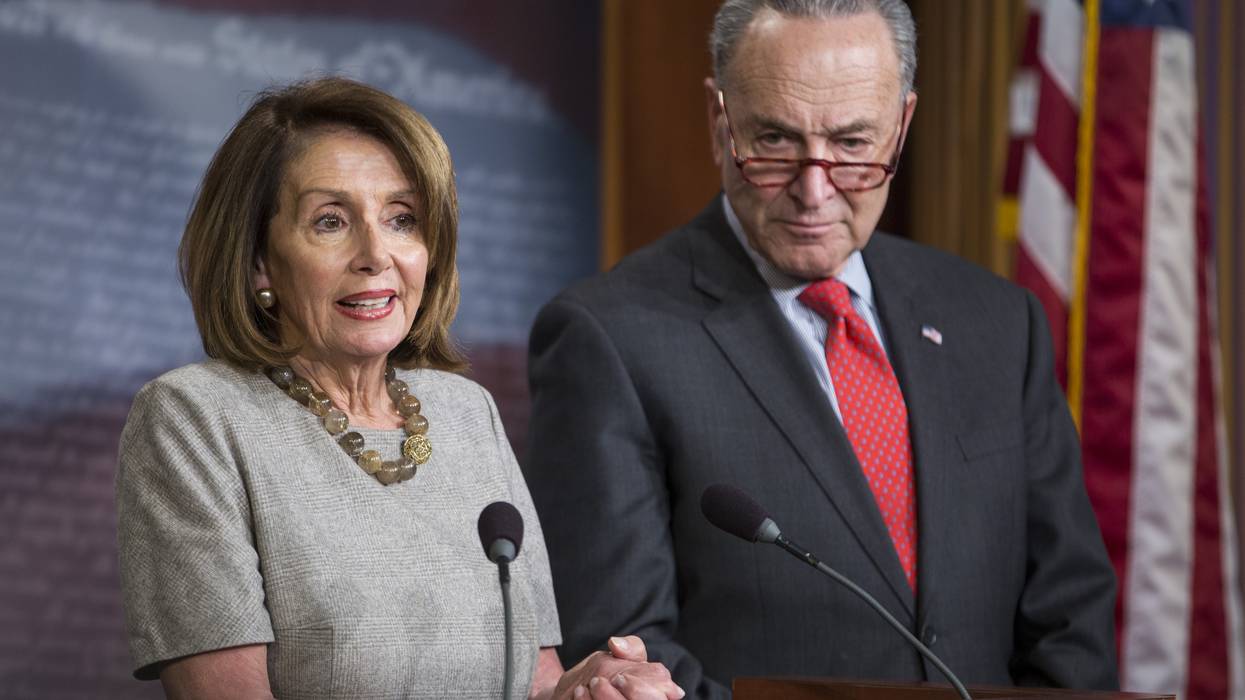
We must be willing to say out loud that the Democratic Party as currently led is a huge part of the problem. The people running it have failed. They have names. Saying so isn’t radical. It’s honest.
I’ve been hearing from a lot of candidates and campaigns lately. This one is for them.
In 2015, I sold my food trucks to volunteer for Bernie Sanders. That turned into co-founding Brand New Congress and Justice Democrats, then helping elect Alexandria Ocasio-Cortez to the US House of Representatives. I worked as her strategist and communications director for a few years after that. I’ve spent the better part of a decade pretty close to the center of the progressive movement. The following is what I learned.
Back in 2016, Hillary Clinton said Bernie Sanders’ policies were “fairy dust and rainbows.” The point wasn’t just that big things were hard. The point was that big things weren’t needed. The system was basically working. America was great. If you thought otherwise you weren’t serious, or you weren’t paying attention, or you were the kind of person who gets dismissed at Brookings as insufficiently realistic.
That was the consensus. Serious people. Credentialed people. New York Times columnists and think tank fellows and television regulars, all reading from the same hymnal. Don’t rock the boat. Take what the system offers. Be grateful.
That consensus didn’t protect us from Donald Trump. It elected him. Twice.
Because when someone came along and said the system is rigged and I’ll burn it down, 80 million people said, "Finally." They were wrong about the messenger. They were completely right about the problem. The “things are actually pretty good” position was the most destabilizing thing anyone could have said. That realism was actually radicalism. And we’re living in the results.
Progressive politics has the same capacity problem that the rest of the country does. We don’t have enough aligned people in power, and we can’t fix that one seat at a time any more than we can fix the housing crisis one subsidy at a time.
The market doesn’t work for the things people actually need to live. Not anymore. Maybe it once did. It doesn’t now and the evidence is everywhere.
We spend $6 trillion a year on healthcare. More than any country on earth, by a lot, and we rank last among wealthy nations in outcomes. Last. Tens of millions of people are one diagnosis away from financial ruin. Rural hospitals are closing. The market has had decades to fix this. It hasn’t fixed it. It has extracted wealth from it while delivering less.
Or consider the mRNA vaccines. The federal government funded the foundational research for 35 years. When COVID hit, the government paid Moderna and Pfizer billions more to finish the job and purchase the doses. Moderna and Pfizer then walked away with over $100 billion in combined revenue. The public got the bill twice, once as taxpayers funding the research, once as patients paying the prices, and the companies kept the patents.
The same pattern shows up in housing. We have been short on housing for decades. The market hasn’t built our way out of it. Cities that people actually want to live in are unaffordable. But so are the rural areas. I live in Lenoir City, Tennessee. Population about 11,000. Here a studio apartment runs you a thousand dollars a month.
And what did our nominee offer? Kamala Harris proposed a $25,000 grant for first-time home buyers. I understand the instinct. But the issue is supply. You pump $25,000 into a market that isn’t building enough homes then prices go up. The money flows straight through the buyer and into the seller or the landlord and the developer, and nothing new gets built. It’s the same story as healthcare. We keep pouring money into broken systems I assume because it seems like a logical solution. But it only makes the problem worse.
Too many people think of American problems as spending problems. But if I walked into my local grocery store and wanted 15,000 pounds of beef, it wouldn’t matter how much money I had. You can’t buy what doesn’t exist. We don’t have enough housing. We don’t have enough doctors. We don’t have enough childcare slots. Pumping money into markets that aren’t producing those things doesn’t produce them. It inflates the price of whatever scraps are left. You fix a capacity problem by building and training, not injecting more cash.
We built our way out of the Depression not just by writing checks but by doing it ourselves. The government built water and irrigation infrastructure that turned the Central Valley into the food supply for half the country. It strung electrical wire to farms and small towns across the rural South and Midwest that private utilities had written off as unprofitable. We built the industrial capacity that became the Arsenal of Democracy. That was public investment. That was us deciding some things are too important to leave to the market.
We don’t believe that anymore. Or rather, our leaders don’t. Those few that do get stopped before they can do anything about it.
AOC won. She scared people badly enough that they spent millions trying to destroy her. She had the right diagnosis. She had the right policies. She had the courage. The things she ran on didn’t happen. Not because she wasn’t good enough. Because she walked in alone. A seat won in isolation gets absorbed. The machinery of this system is designed to absorb individual attacks.
Progressive politics has the same capacity problem that the rest of the country does. We don’t have enough aligned people in power, and we can’t fix that one seat at a time any more than we can fix the housing crisis one subsidy at a time.
Which brings me to where we are. An American president is suggesting on a Tuesday night that Iran should cease to exist. Not metaphorically. And the people who are supposed to be the opposition are writing letters. That is where we end up when the people in charge have no affirmative vision, no plan to build anything, and no team capable of fighting for it even if they did.
So when people ask me about candidates, I’m not asking whether they have the right positions. Most of the good ones do. I’m asking whether they understand what those positions are actually up against. Whether they’re ready to fight it.
I’m looking for bold, specific, public policy positions. Not values. Policies. Medicare for All. Public ownership of AI infrastructure. A housing program that builds and owns, not just subsidizes. Drug pricing reform that takes back the patents on publicly-funded research so the public owns what the public paid for. You would be amazed how many candidates won’t put this out publicly.
We must be willing to say out loud that the Democratic Party as currently led is the problem. The people running it have failed. They have names. Saying so isn’t radical. It’s honest.
An understanding that our institutions have been captured. The FEC. The FDA. The SEC. The DOJ. The Supreme Court. Not neutral referees. A coordinated fifty-year project to make progressive governance legally impossible. A candidate who won’t say that isn’t ready for what’s coming.
I’m looking for bold, specific, public policy positions. Not values. Policies.
A willingness to take risks inside the party. Not fighting Republicans on television, which costs nothing. Backing primary challengers against Democratic incumbents who are blocking the agenda. Making it more dangerous to oppose you than to support you. Almost nobody will do this.
All of those are necessary. None of them are enough.
A commitment to building a team before they win. Not after. Campaigning alongside candidates in other states and districts. Endorsing across geographies. Treating their race as part of something bigger than their district. This has never been done at scale on our side. It’s the thing that would change everything.
People resist this one the most, so let me explain why it matters.
A candidate’s victory, whether it’s a House seat or a Senate seat, can only accomplish things within the framework of how big and powerful their team is, how aligned that team is, and whether they built it before they walked into the building. It has to happen before, not after, for two reasons. First, because building it before is what proves you’re willing to put skin in the game and take real risks. Anyone can talk about solidarity after they’ve won. Doing it before, when it costs you something, is what makes it mean anything. Second, because you cannot change who’s sitting at the table from inside the table. You have to build the power to change it from outside. That means committing to each other before any of you have a seat, when the only thing binding you together is the mission itself.
And it matters to voters. Candidates running on these ideas as individuals are just putting policies on a page. They’re giving speeches. When they show up with a team, when they’ve committed to each other before they’ve won anything, they’re showing voters they understand what’s standing in their way and they have a plan for taking it head on.
Nobody is coming to do this for us. It takes a team. People who said all of this out loud before they won.
Underneath all of it, public ownership as the mechanism. Not regulation. Not subsidy. Ownership. We did it before. We can do it again. When a technology has the power to transform society, it’s unwise to leave it in the hands of a tiny group of self-absorbed billionaires whose only goal is to maximize profit, who consistently show contempt for the rights and interests of their fellow Americans, and who aren’t accountable to anyone, especially with a federal government this weak. We don’t let private companies build nuclear weapons. We don’t let them decide when or how to use them. We don’t let them raise armies. We understand some things are too powerful to leave in private hands. AI is one of those things. It’s built off of thousands of years of human data and thought. It’s built off of major public investment. It’s built by us. It should be working for us. The only thing that’s got a single chance of ensuring that is if we own it. Just like Alaska gets dividends from its oil reserves, the American people should be getting dividends from their data and their investments.
Nobody is coming to do this for us. It takes a team. People who said all of this out loud before they won. Who committed to each other before they walked into Washington. Who understand that their victory only matters if the person running three states over wins too.
That team is what I’m building with A Fight Worth Having. Not candidates with good vibes. Candidates who’ve passed this filter. Who know what they’re up against. Who are ready to fight the right people, including the ones in their own party.
If you’ve been reading this and asking what do we do, this is what we do.
Go to AFightWorthHaving.com

Youth support for Palestine reflects a changing media landscape.
As unconditional support for Israel becomes more of a political liability and solidarity with Palestine establishes itself as a litmus test, former Secretary of State Hillary Clinton and her fellow status-quo defenders are blaming social media for the US public’s growing solidarity with Palestine.
In accusing young people of falling for fake news, they rely on an outdated assumption that equates social media with falsehoods—and equates legacy media with trustworthiness. What’s clear is that Clinton and her peers who partake in similar rhetoric fail to grasp the nuances of today’s media landscape, particularly as it has unraveled around Palestine.
More and more Americans have realized that Israel’s post-October 7 assault on Gaza is not only disproportionate but genocidal, and that in spite of the carnage, the US government continues to provide diplomatic cover and send billions in military aid. It’s no wonder that public sentiment has shifted considerably against Israel in the past two years, with young people in particular being increasingly supportive of Palestine. This sea change has made establishment politicians very nervous. In several recent speaking engagements, former Secretary of State Hillary Clinton has lamented that these pro-Palestine young people have the unfortunate habit of getting their news from social media; to her, that makes them uninformed and sorely misled.
“More than 50% of young people in America get their news from social media. Just pause on that for a second,” she said at an event for the newspaper Israel Hayom earlier this month. “They are seeing short-form videos, some of them totally made up, some of them not at all representing what they claim to be showing. And that’s where they get their information.”
The claim that social media is misleading and misinforming young people is simply an attempt not only to delegitimize pro-Palestine sentiment but to cast doubt on the devastation in Gaza itself.
Clinton’s framing is reminiscent of 2016-era misinformation discourse, back when the US public hadn’t fully figured out what to do with social media’s rapid acceleration and impact on politics. But that familiar rhetoric does not apply to the youth-driven political realignment on Palestine. When Clinton implies that pro-Palestine sentiment is a result of misinformation—a fraught umbrella diagnosis that often tries to encompass too much, and whose remedies can clash with the ideals of free speech—she attempts to place it within the context of Facebook fueling atrocities in Myanmar, Russian information campaigns working to influence the US election, and then-candidate Donald Trump labeling every media outlet “fake news,” forcing them to have tough conversations about when and how to fact-check his claims.
While the current media landscape and its relationship to politics is still bleak, Clinton’s accusation is much more about her fealty to Israel and the centrist-liberal order. The claim that social media is misleading and misinforming young people is simply an attempt not only to delegitimize pro-Palestine sentiment but to cast doubt on the devastation in Gaza itself.
The data point that half of Americans get (some of) their news from social media alarms most people—perhaps a valid instinct, given the current media landscape of local news in decline, billionaires taking over outlets, and profit-driven influencers peddling dubious wellness claims via vertical video. Social media did democratize information sharing without necessarily embedding any accountability mechanism for its quality and accuracy, resulting in a lot of low-quality content of dubious veracity.
But this doesn’t mean that social media users are only, primarily, or even significantly consuming fake news or slop. Pew Research Center reports that users, shockingly, do make assessments about what content they’re looking at. Not to mention that plenty of the content on social media is content from news outlets themselves.
According to Clinton, what’s most concerning is the fact that so many young people are getting their information from TikTok, given that the app is “governed by an algorithm—at least up til now—still largely manipulated by the Chinese Communist Party.” Her geopolitical paranoia echoes CNN commentator Van Jones, who in October placed blame on Iran and Qatar for running a “disinformation campaign” that flooded social media users with images of “dead Gaza baby, dead Gaza baby, dead Gaza baby.” Both try to convince audiences that concern for Palestine is just an information-operations campaign from our geopolitical enemies. Reports from earlier this year indicated that the legislation banning TikTok was, in part, ushered along by lawmakers’ worries about the prevalence of content critical of Israel on the platform.
Yet the most damning lesson here is not the growing reliance on getting information from social media, or even the fact that our collective outlook toward it should be more nuanced (it should!). Rather, it’s the collapse of trust in traditional legacy media that has accompanied young peoples’ shifting views on Palestine. The media industry utterly failed in its charge to report the news, and it failed to defend colleagues in Gaza as they were systematically murdered by the Israeli government. The New York Times in particular has been especially egregious, most infamously failing to retract their story “Screams Without Words” even after its credibility was seriously questioned.
Let’s say Clinton and her peers are only consuming these news sources (and even then, they’d have to be taking great lengths to avoid reading the quality reporting on Gaza that mainstream publications do often release, not to mention ignoring the numerous reports from human rights organizations and experts), then they’d be the ones who are uninformed—not the bogeyman of kids on social media.
The Lemkin Institute for Genocide Prevention and Human Security issued a statement last week on Clinton’s baseless accusations:
What truly seems to unsettle Secretary Clinton is not “misinformation,” but rather the fact that younger generations are no longer consuming a single, state-controlled narrative. They are accessing unfiltered images and testimonies that challenge decades of political messaging.
Clinton’s basic premise—denying the genocide in Gaza—is false. Young people know that they’re being gaslit. Yes, it is true that they’ve experienced “TikTok smashing their brains all day long with videos of carnage in Gaza.” They’ve seen Western media bend over backwards to diminish blame on Israel. And they’ve seen resilient Palestinian journalists like Bisan Owda showing Gaza through her own eyes.
At the Doha Forum, Clinton said it’s “a provable fact that most Americans... get their news from social media.” To echo Foreign Policy editor-in-chief Ravi Agrawal’s response: “Is that a bad thing?”
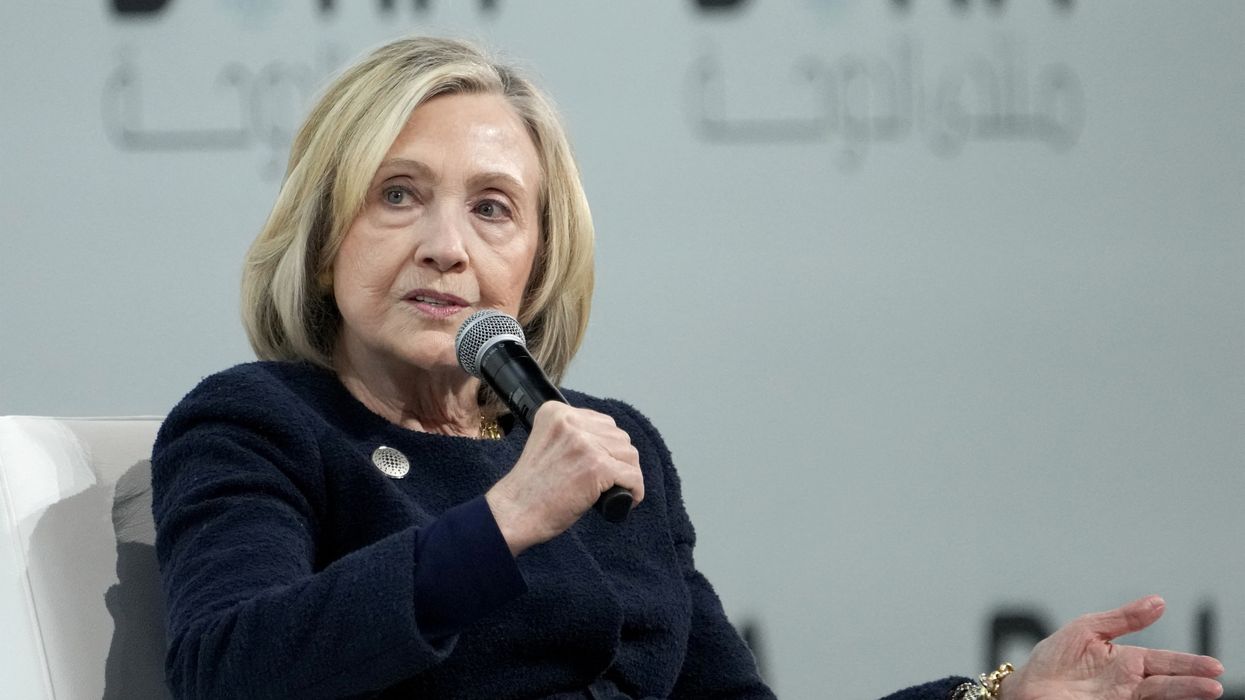
"Young people in the US are not stupid or gullible. They simply reject genocide—something the secretary might consider."
The world's leading genocide prevention group this week accused former US Secretary of State Hillary Clinton of "outright genocide denial" for comments last week attributing young Americans' opposition to Israel's US-backed genocide in Gaza on social media.
Speaking last week at the Israel Hayom Summit in New York, Clinton asserted that young people's support for Palestine stems from the fact that they are "getting their information from social media, particularly TikTok," adding that many younger Jewish Americans “don’t know the history and don’t understand" the Israel-Palestine issue.
On Monday, the Philadelphia-based Lemkin Institute for Genocide Prevention and Human Security—named for Raphael Lemkin, a lawyer and Holocaust survivor who coined the term genocide—published a statement arguing that "Secretary Clinton’s framing is not at all an accurate reflection of why Americans are growing more critical of Israel."
"Young Americans of all political stripes have not fallen prey to propaganda, though that is always a legitimate concern," the institute said. "Rather, they have consumed two years of videos depicting Israel’s genocide against Palestinians that have been uploaded by Palestinian journalists, ordinary people trying to survive in Gaza, [Israel Defense Forces] soldiers, and ordinary Israelis themselves."
"There has been no convincing refutation of the sheer amount of raw evidence of genocide coming out of Palestine," the institute contended. "Young people in the US are not stupid or gullible. They simply reject genocide—something the secretary might consider doing as well."
Wow: Lemkin Institute for Genocide Prevention (named for Holocaust survivor Raphael Lemkin, who coined term "genocide") calls Clinton's remarks "genocide denial.""Young people in the US are not stupid or gullible. They simply reject genocide – something the Secretary might consider doing as well."
[image or embed]
— Prem Thakker ツ (@premthakker.bsky.social) December 9, 2025 at 11:15 AM
LIGP continued:
Secretary Clinton appears not to be bothered by the reality of genocidal violence—in fact, she did not mention anything about it. Her concern is, rather, in her words, “the narrative”—the fact that these crimes are no longer hidden and are now being livestreamed and documented in real time, making it harder for her and others to control it. TikTok cannot be blamed for the fact that many members of Gen Z understand that Israel is committing genocide, since so many other people, including those who never look at TikTok, also hold that view. Apart from the Lemkin Institute, the vast majority of large, mainstream human rights organizations, the [United Nations], and many scholars as well as international legal bodies have denounced Israel’s actions in Gaza as genocide. Many carefully researched reports by international organizations have established that Israel’s crimes meet the international legal threshold for genocide. We encourage the former secretary to read them.
"The Lemkin Institute continues to support students and young people worldwide for having the courage to stand up for their convictions, to speak truth to power, and to fight against the scourge of genocide in Palestine and elsewhere," LIGP added. "Secretary Clinton’s remarks are not only inaccurate—they are also a shameful example of the lengths to which people complicit in genocide will go to to deny its existence."
The institute's rebuke of Clinton's comments came as the International Court of Justice in The Hague adjudicates a genocide case against Israel filed by South Africa and supported by around two dozen nations. Israeli Prime Minister Benjamin Netanyahu and former Defense Minister Yoav Gallant—who ordered the "complete siege" of Gaza that fueled famine and disease—are also wanted by the International Criminal Court, also located in the The Hague, for alleged war crimes and crimes against humanity including murder and forced starvation.
Lemkin's denunciation also comes amid a tenuous ceasefire between Israel and Hamas in Gaza, a truce Israeli forces have broken more than 500 times, according to officials in the Palestinian exclave. Israeli officials say Palestinian resistance fighters have violated the ceasefire more than 30 times.
Since the Hamas-led attack of October 7, 2023, Israel's annihilation and siege of Gaza have left more than 250,000 Palestinians dead, maimed, or missing and around 2 million more forcibly displaced, starved, or sickened. Israeli military data suggests that of the the more than 70,000 Palestinian deaths, over 8 in 10 were civilians.
Through it all, the United States has backed Israel with more than $21 billion worth of weaponry and diplomatic support including repeatedly vetoing United Nations Security Council ceasefire resolutions.
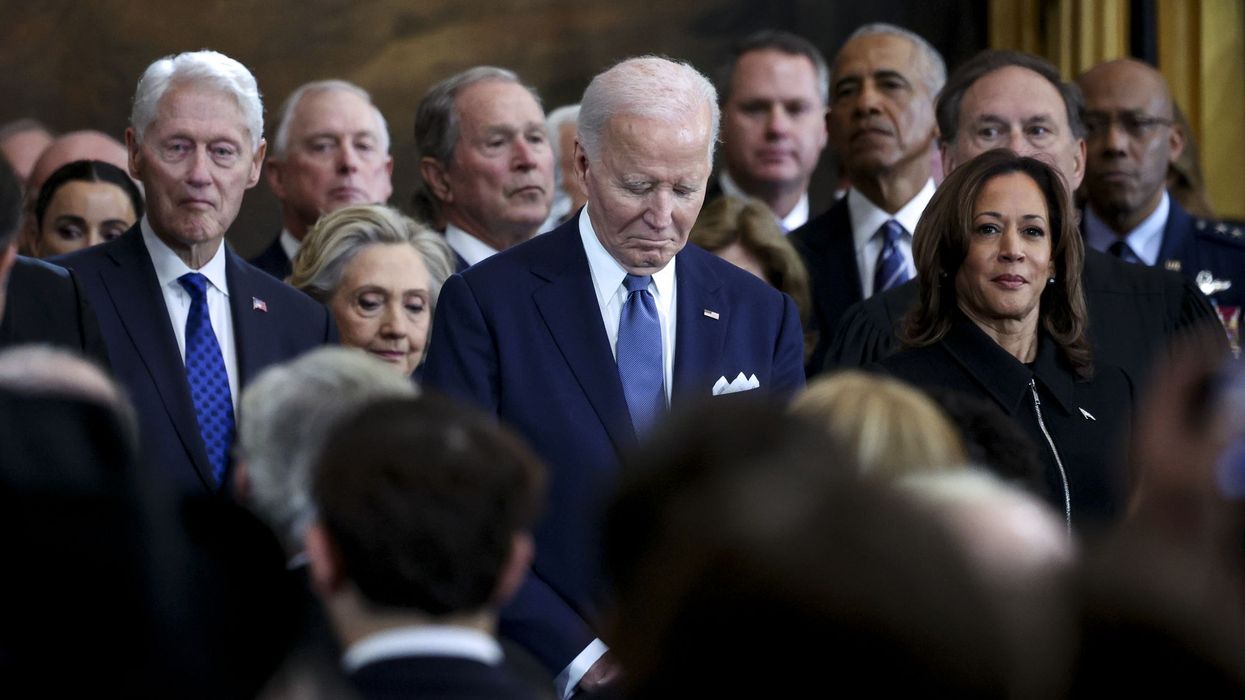
Saving the country from autocracy requires recognizing—and then overcoming—the chokehold that Democratic leaders have on the party.
Ten years after Donald Trump first ran for president, he stands at the helm of Titanic America. How did this happen?
No factors were more pivotal than the outlooks and actions of the Democratic Party leadership. Scrutinizing them now is vital not only for clarity about the past. It also makes possible a clear focus on ways to prevent further catastrophe.
Here’s the actual history that corporate Democrats pretend didn’t happen:
2016: Hillary Clinton offers more of the status quo. Her allies in the Democratic Party pull out all the stops so she can win the party’s presidential nomination. With a big assist from the Democratic National Committee, she prevails over the strong primary challenge from Bernie Sanders, but her campaign trail goes downhill from there. After rallying behind Sanders’s genuine progressive populism, many young people don’t trust the pseudo-populism of Clinton’s campaign. She has earned a millennial problem, and it prevents her from becoming president.
2017: Democratic Party leaders can hardly blame themselves or their nominee for the virtually unbelievable circumstance of the Trump presidency. A critical focus on Clinton’s coziness with Wall Street won’t do. Neither will critiquing her thinly veiled contempt for the progressive wing of the party. But blaming Trump’s victory on Russia becomes an obsessive theme.
2018: The Democratic leadership is mapping out a battle plan for the midterm elections in November. At the same time, a key priority is to thwart the inside threat posed by progressive forces. Establishment Democrats are keeping a watchful eye and political guns trained on Bernie Sanders.
2019: Democrats take control of the House, and a large cast of political characters is off and running for the party’s presidential nomination. Sanders and Senator Elizabeth Warren are at the left edge, while more than a dozen others jostle for media attention. For elites determined to retain undemocratic power, seeing either Sanders or Warren in the Oval Office would be the worst possible outcome.
2020: Early in the year, the economic populism of the Sanders campaign continues to catch fire, while many forces team up to function as fire extinguishers. The Democratic Party establishment acts to smother the grassroots blaze. After Joe Biden’s fifth-place finish in the New Hampshire primary puts his campaign on life-support, rescue comes eighteen days later from South Carolina, where Biden wins a landslide primary victory—and then several corporate-friendly contenders quickly drop out of the race and effusively endorse him. When Biden clinches the nomination, progressives largely close ranks behind him to defeat Trump. Biden squeaks through.
2021: President Biden’s first year includes backing and signing legislation with real benefits for tens of millions of Americans. But his resolve dissipates. Before the end of the year, he abandons Build Back Better legislation that would have been transformational. Notably, Biden withdraws all US troops from Afghanistan in late summer—but overall he opts to fuel militarism, with ever-higher Pentagon spending instead of devoting adequate resources to meet human needs and protect nature. The president goes full speed ahead with “modernization” plans for ever more dangerous nuclear weapons that already have a pre-overrun price tag of $1.7 trillion.
2022: Biden relapses into his customary “moderate” political mode, while his capacity to speak coherently weakens. Party discipline, internalized by Democrats in Congress, precludes independent-minded leadership as they begin to proclaim that Biden should run for re-election. Conformity of groupthink and fear of retribution from the White House keep people quiet.
2023: A real-life Shakespearean tragedy unfolds as Biden throws down a gauntlet to run for re-election even while his mental frailty becomes more evident. Enablers ignore the party’s base, with polls continuing to show that most Democrats don’t want him to be the next nominee (including 94 percent of Democrats under 30). A common canard—pushed by Biden’s coterie of sycophants—contends that because he defeated Trump once, he’s the best person to do it again; the claim ignores the fact that Trump 2020 represented an unpopular status quo, and Biden 2024 would represent an even more unpopular status quo, as “right track / wrong track” polling makes crystal clear. Soon after Hamas attacks Israel on October 7 and the Israeli military starts its siege of Gaza, Biden begins to further alienate many of his party’s usual voters by massively boosting US military aid as the slaughter of Palestinian civilians escalates.
2024: Among top Democrats, denial about Biden’s evident cognitive infirmity grows along with the infirmity itself. Even after Biden’s disastrous debate performance in late June, the political reflex of dissembling prevents him from bowing out for another 28 days. That leaves 107 days for the newly installed nominee Kamala Harris to pick up the pieces before Election Day. At first it seems that she might find ways to depart from coming across as Biden’s yes-woman, but there is no such departure. Nothing epitomizes the Harris campaign’s moral collapse more than her insistence on echoing the Biden line about Gaza while the US continues to arm Israel’s military as it methodically kills Palestinian civilians. In the process, Harris chooses to ignore both human decency and polls showing that far more voters would be likely to cast their ballots for her if she were to come out against sending more armaments to Israel. Electoral disaster ensues.
Last month, two events showed the huge contradiction between the potential for true progressive change and the dire reality of feckless Democratic Party leaders. When socialist Zohran Mamdani won election as mayor of New York after running as a Democrat, he said: “If there is any way to terrify a despot, it is by dismantling the very conditions that allowed him to accumulate power. This is not only how we stop Trump; it’s how we stop the next one.” A week later, eight members of the Senate’s Democratic caucus surrendered to Trump, betraying efforts to defend Obamacare and a healthcare status quo that still leaves tens of millions uninsured or underinsured. The capitulation meant that the nation’s healthcare crisis would get even worse.
Craven and conformist Democratic Party leadership—coloring inside corporate lines while enmeshed with rich backers—hardly offers a plausible way to defeat the Trump forces, much less advance a humane political agenda. Saving the country from autocracy requires recognizing and overcoming the chokehold that Democratic leaders have on the party.
The timeline above is drawn from my new book about the 10-year political descent into the current inferno, The Blue Road to Trump Hell, which is free as an e-book or PDF at BlueRoad.info.

"I guess Hillary Clinton also thinks that Amnesty International called what’s happening in Gaza a genocide because they saw some videos on TikTok and just 'did not know history,'" said one observer.
Since Israel began bombarding Gaza and starving its population of more than 2 million Palestinians in October 2023, the consensus that the Israeli government is committing genocide has steadily grown to include international and Israeli human rights groups, a United Nations panel, Holocaust scholars, and nearly 40% of Jewish Americans, according to one striking recent survey.
But in 10 words, former US Secretary of State Hillary Clinton on Tuesday waved away the findings of respected groups like Amnesty International and renowned experts like Brown University professor Omer Bartov, when she commented on why young Americans are expressing support for Palestinians.
"They were getting their information from social media, particularly TikTok," said Clinton.
Without pointing to any evidence, the former secretary of state said young people in the US are "seeing short-form videos, some of them totally made up, some of them not at all representing what they claim to be showing, and that’s where they get their information" about Israel's attacks on Gaza.
She added that "it’s not just the usual suspects"—without naming who those pro-Palestinian "suspects" are.
"It’s a lot of young Jewish Americans who don’t know the history and don’t understand," she said. "A lot of the challenge is with younger people."
Hillary Clinton blames TikTok and “totally made up” videos for young people’s views on Israel and Palestine.
She says social media influenced “not just the usual suspects” but also “young Jewish Americans who don’t know the history and don’t understand.” https://t.co/rUVXRqK2rK pic.twitter.com/hAwG7Gbhwf
— Prem Thakker (@prem_thakker) December 2, 2025
Her remarks echoed those of former Obama White House speechwriter Sarah Hurwitz, who spoke recently about the challenges Zionists are presented with when they try to defend Israel to young Jewish people who have seen widely available, credible images and news out of Gaza, where Israel has killed more than 70,000 Palestinians and is continuing to restrict humanitarian aid despite a ceasefire deal reached in October.
"Anything that we try to say to them, they’re hearing it through this wall of carnage," Hurwitz lamented last month, drawing condemnation.
Clinton was speaking at an event in New York City for Israel Hayom, the most widely read newspaper in Israel, which is run by billionaire Miriam Adelson, a megadonor to President Donald Trump. Adelson published an editorial in the Jewish Journal in November 2023 saying pro-Palestinian protesters "are dead to us," and her late husband, Republican donor Sheldon Adelson, said in 2014 that the Palestinians are "an invented people."
Jeremy Slevin, a senior adviser to Sen. Bernie Sanders (I-Vt.), pointed to the irony of Clinton attending an event associated with the Adelsons and then claiming that "the kids are being radicalized by anti-Israel propaganda."
Clinton has frequently claimed that pro-Palestinian Americans, particularly students who took part in nationwide campus protests last year as they urged the Biden administration to comply with US law and stop funding Israel's attacks on Gaza, are simply misinformed about Palestine and ignorant of history, particularly pointing to the 2000 Camp David Summit hosted by former President Bill Clinton.
The former secretary of state has repeated the claim that the Palestinians were offered a "generous deal" at the meeting and "walked away"—a "myth" that Camp David negotiator Robert Malley has debunked, warning it's been used by Clinton and others to "justify Israel's genocide."
Robert Malley on the myth of “Palestinians walked away” at Camp David (July 2000):
➤ Malley says the popular story pushed since 2000 – that Arafat rejected a “generous offer” – is contradicted by the actual record. Israeli PM Barak sidelined the Palestinians for a year,… pic.twitter.com/3vlf1Rl4qj
— Drop Site (@DropSiteNews) November 28, 2025
"She’s the one getting the history wrong," including at the Israel Hayom event, said Drop Site News on Tuesday.
A number of observers took issue with Clinton's suggestion that anti-Israel sentiment in the US is being driven solely by young people, with Just Security executive editor Adil Haque issuing a "periodic reminder that the biggest shift in attitudes toward Israel and Palestine has been among older Democrats."
In 2022, 43% Democratic voters ages 50 and up had an unfavorable view of Israel. That percentage has risen sharply since Israel began its onslaught in Gaza, with 66% of those voters reporting an unfavorable view in a Pew Research Center poll this year.
Meanwhile, 71% of Democrats ages 49 and under opposed Israel in the same poll, and 62% of them had expressed opposition in 2022, denoting a less extreme shift in opinion.
"Democrats get their news from CNN more than other mainstream sources," said Haque, pointing to the network's recent investigation about Palestinian aid-seekers who were killed by Israeli forces. "If you're a 60-year-old with grandkids and you read or watch CNN's Gaza reporting, you don't need TikTok to know that what's happening is very, very wrong."
Dylan Williams, vice president of government affairs at the Center for International Policy, also suggested Clinton has an inaccurate view of who opposes Israel's ongoing attacks on Palestinians.
"I’m nearly 50. I don’t use TikTok. I listen to NPR 'Morning Edition' and read the Financial Times daily," said Williams. "I’m a lawyer who has worked on Israel-Palestine issues for the last 20 years. The evidence I’ve seen that Israel committed atrocities including genocide in Gaza is overwhelming."
Author Jason Overstreet wondered how Clinton would explain the findings of human rights groups like Amnesty International and Israel-based B'Tselem, which pointed to testimonies by Israeli soldiers and the documented destruction of Gaza's food system when it concluded in a report in July that Israel is committing genocide in the exclave.
"I guess Hillary Clinton also thinks that Amnesty International called what’s happening in Gaza a genocide because they saw some videos on TikTok and just 'did not know history,'" said Overstreet. "Young people’s views on Israel are based on young people knowing that Israel has committed genocide."

"You want history books to not record you as an evil genocide supporter?" said one organizer. "You need to actually make an impact, NOW."
U.S. college students are still facing punishment for protesting Israel's U.S.-backed bombardment of Gaza and its starvation of more than 2 million Palestinians there, with Columbia University announcing this week the suspension and expulsion of dozens of students who spoke out over the past year.
But a number of observers have pointed to a shift in the rhetoric of some of the student organizers' biggest detractors in recent days, with former Secretary of State Hillary Clinton notably saying Thursday that "thousands of children in Gaza are at risk of starvation while trucks full of food sit waiting across the border" and calling for "the full flow of humanitarian assistance" to be restored.
Clinton didn't mention the Israeli blockade that has kept food from reaching Palestinians, more than 120 of whom have now died of starvation, or the at least $12.5 billion in military aid the U.S. has provided to Israel since the blockade first began in October 2023—in violation of U.S. laws prohibiting the government from giving military aid to countries that block humanitarian aid.
The former Democratic presidential nominee also didn't acknowledge the remarks she made in May 2024 about the campus protests that were spreading across the country, with students demanding that their schools divest from companies that work with the Israeli government and that the country end its support for the Israel Defense Forces (IDF).
At the time, Clinton said students who oppose Israel's policies in Gaza and the West Bank "don't know very much" about the conflict there. Clinton and other politicians from both the Democratic and Republican parties have repeated the familiar phrase, "Israel has a right to defend itself" as the IDF has attacked so-called "safe zones," hospitals, and refugee camps.
Some suggested her comments on Thursday appeared to be those of an influential political figure who's come to a realization about the situation that both the Biden and Trump administrations, with bipartisan support from Congress, have helped to bring about in Gaza.
"Seems mostly like all the recent photos of starving children are responsible for this shift, though humanitarian aid groups have been warning about this for months and months," said Washington Post reporter Jeff Stein.
One observer said Clinton and a number of European leaders are speaking out now because Israel has already "carried out their final solution."
As Common Dreams reported this week, Integrated Food Security Phase Classification has said that at least 244,000 people in Gaza are now in Phase 5 of famine, defined at "an extreme deprivation of food."
New York Times columnist Megan Stack said she welcomed anyone who is "[waking] up" to the reality of man-made mass starvation made possible by U.S. support, but called it "an absolute indictment of the center-left, such as it is, that it took pictures of dying, skeletal babies with trash bags for diapers to muster this pale response."
"Subtext: We can stomach mass bombings, but starvation is a bridge too far," said Stack.
The comments from Clinton coincided with a shift in the corporate media's coverage of Gaza, with major outlets focusing heavily on the impact of starvation.
Organizer and attorney Aaron Regunberg said that instead of simply doing "reputational damage control by speaking up in these very last moments," powerful political leaders must "shut shit down."
"You want history books to not record you as an evil genocide supporter?" said Regunberg. "One speech now—after countless speeches condemning those who have been speaking out—ain't gonna cut it... You need to go to Gaza. You need to actually make an impact, NOW."
Progressive organizer Lindsey Boylan wondered whether establishment leaders "will ever admit that smearing all protests to stop the genocide actually contributed to the genocide."
"Few people could have played a more pivotal role in shaping the democratic response to prevent genocide," said Boylan of Clinton's comments. "Now here we are. Watching mass death of kids."
On Friday, U.S. Sen. Bernie Sanders (I-Vt.), who has consistently demanded that the Biden and Trump administrations stop funding Israel's assault on Gaza and warned of the impact mass starvation would have, issued his latest call for U.S. support to end immediately.
"American taxpayer dollars are being used to starve children, bomb civilians, and support the cruelty of [Prime Minister Benjamin] Netanyahu and his criminal ministers," said Sanders. "Enough is enough. The White House and Congress must immediately act to end this war using the full scope of American influence. No more military aid to the Netanyahu government. History will condemn those who fail to act in the face of this horror."
This article has been corrected to state that 244,000 Palestinians in Gaza were in Phase 5 of starvation in May 2025. A previous version incorrectly stated that 85% of the population was in Phase 5.

Tens of millions of Americans voted for our past presidents. They are waiting for them to speak up, stand up, and mightily help lead the fight to stop Trump’s mayhem against the American people in red and blue states.
If there was ever a strong contemporary case for declaring that silence is complicity, consider the hush of Joe Biden, Barack Obama, Bill and Hillary Clinton, Al Gore, and even George W. Bush as they grind their teeth over the Donald Trump-Elon Musk wrecking of America. Trump is destroying freedom of speech and due process, abolishing democratic restraints, and establishing a criminal fascistic dictatorship.
Trump pounds Biden for the Trump administration’s blunders and failures an average of six times a day. These assaults go unrebutted by the Delaware recluse, nursing his political wounds.
The Clintons? Bill sticks to his private telephone wailings. While Hillary, who gave us Trump in 2016 with her smug, stupid campaign, penned a self-anthem op-ed in The New York Times on March 28, 2025. She writes: “Mr. Trump and Secretary of Defense Pete Hegseth (of group chat fame) are apparently more focused on performative fights over wokeness than preparing for real fights with America’s adversaries.” Trump is not belligerent enough for the war hawk Hillary Clinton who has been the pro-Iraq sociocider butcher of Libya and the ardent supporter behind provocative “force projection” of the Empire around the world.
What would all the GIs, who they caused to lose their lives in their presidential wars, think of their timidity?
Before turning to the excuses for essentially shutting themselves up during our country’s greatest political upheaval—unconstitutional and criminal to the core—here is what prominent former Democratic presidents and presidential candidates COULD do:
Don’t they know they have a trusteeship obligation to citizens, many of whom are voicing their demands for a comprehensive plan of offense against the GOP in town meetings and other forums?
The media, threatened daily by Trump, is eager to give former Democratic Party leaders coverage.
Even George W. Bush, known for causing the deaths of over 1 million Iraqis and the destruction of their country by his criminal war of aggression has a beef. His sole claim to being a “compassionate conservative”—the funding of life-saving AIDS medicines overseas—has gone down in flames with Trump’s illegal demolition of the U.S. Agency for International Development (USAID). Bush may be mumbling about this, but he’s staying in his corner painting landscapes.
All this abhorrent quietude in the face of what they all believe is a mortal attack on the Republic has the following excuses:
First, they don’t want to get into a pissing match with a slanderous ugly viper, who unleashes his hordes of haters on the internet. That’s quite a surrender of patriotic duty at a time of unprecedented peril. What would all the GIs, who they caused to lose their lives in their presidential wars, think of their timidity?
Second, it wouldn’t have much impact. America doesn’t listen to “has-beens.” Then why is Obama still the most popular retired politician in America with over 130 million followers on Twitter? That attitude is just convenient escapism.
Third, plunging into the raucous political arena with the Trumpsters and Musketeers is just too disruptive of a comfortable daily routine life by politicians who believe they have been there, done that, and deserve a respite. Self-diminishment gets you nowhere with tens of millions of people in distress who seek powerful amplifiers from well-known leaders behind the demand that Trump understands: YOU’RE FIRED, ringing throughout the nation from liberals and betrayed Trump voters hurting in the same ways. That mass demand is what pushes impeachment of the most visibly impeachable president in American history.
In the final analysis, it comes down to their absence of civic self-respect and cowardliness in confronting Der Fuhrer. Aristotle was right: “Courage is the first of human qualities because it is the quality which guarantees the others.”
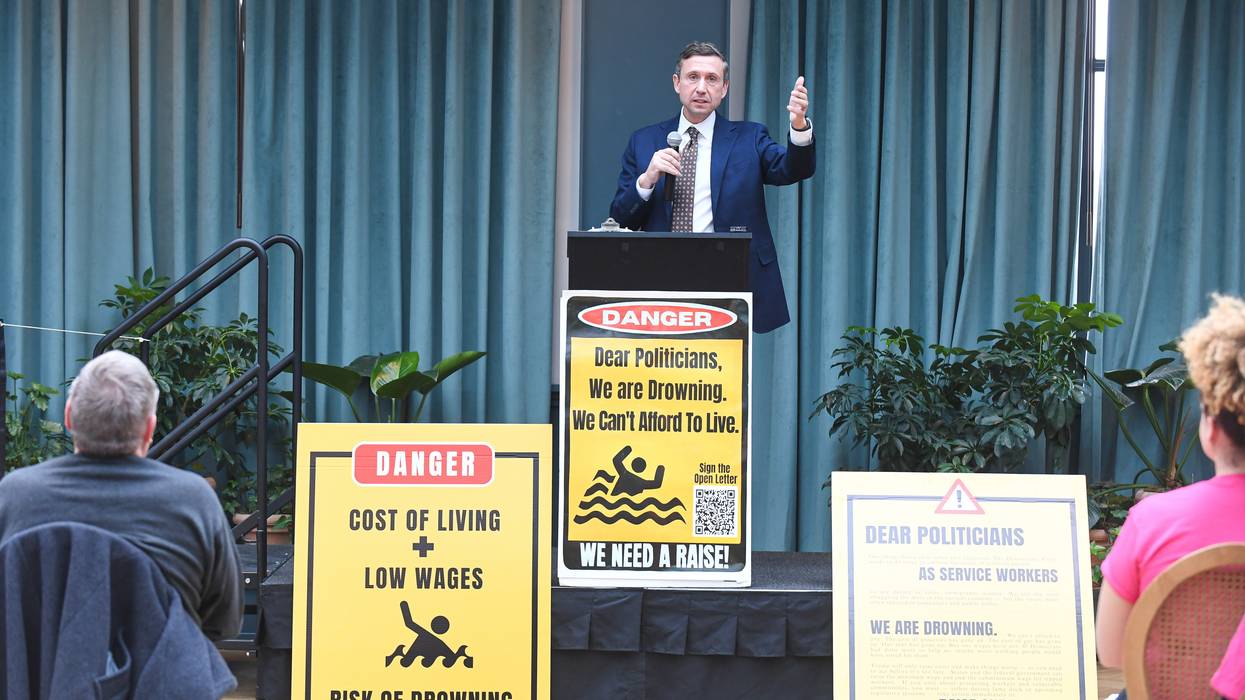
The recent race for DNC chair raises questions about how the progressive wing of the party can and should move forward toward 2028.
Just before starting to write my lament about what a dramatic step backward the recent campaign for Democratic National Committee chair had been, I opened an Our Revolution email that told me, “We beat back the party establishment at the DNC.”
Now Our Revolution being a direct organizational descendent of the 2020 Bernie Sanders presidential campaign, and me having been a 2016 Sanders convention delegate, I feel pretty confident that our ideas of who “we” means are pretty much the same. So what accounts for the widely divergent takes?
For those who haven’t been following this, Minnesota’s Democratic-Farmer-Labor Party Chair Ken Martin was just elected to lead the DNC for the next four years, defeating Wisconsin Democratic Party Chair Ben Wikler by a 246.5–134.5 vote margin. There was no contested election four years ago, because by tradition a just-elected president selects the new chair; contested elections generally follow defeats. In the last one, in 2017, former Obama administration Secretary of Labor Tom Perez won the job, beating Minnesota Rep. Keith Ellison in a second round of voting, 235--200.
At the moment there is no one obviously positioned to take up the Sanders’ mantle in the 2028 presidential campaign.
Ellison’s candidacy came in the wake of his having been just the second member of Congress to support Sanders in the prior year’s presidential primaries, and the fact that Sanders people harbored serious grievances with the DNC over its perceived favoritism for the ultimate nominee, Hillary Clinton, lent a distinct edge to the election, bringing it considerably more buzz than the one that just occurred. At the time, former Massachusetts Rep. Barney Frank, a vociferous opponent of Sanders’ run—who had once declared, “The most effective thing liberals and progressives can do to advance our public policy goals... is to help Clinton win our nomination early in the year”—now thought there was “a great deal to be said for putting an active Sanders supporter in there,” so as to clear the air “of suspicions and paranoia.” But Clinton and Barack Obama apparently didn’t think so, and Clinton’s past Obama cabinet colleague, Perez, took up the torch in a race that produced a level of grassroots involvement seldom if ever before seen in this contest.
Although the office is traditionally considered organizational rather than ideological and the 2017 candidates did run on those issues, the underlying political differences were obvious to all. This time around, the race was generally understood to involve little if any political disagreement on the issues. By way of explaining its support for new party chair Martin, Our Revolution characterized runner-up Wikler, as “an establishment candidate backed by Nancy Pelosi, Hakeem Jeffries, and Chuck Schumer, and bankrolled by the billionaire class.” We understand that election campaigns are about sharpening the perception of differences between the candidates, but still this seems a rather thin, flimsy basis for hailing the vote as an anti-establishment triumph, given that Martin has publicly stated that he doesn’t want the party to take money from "those bad billionaires" only from "good billionaires;”and one of the two billionaires who gave a quarter million dollars to Wikler’s campaign was George Soros—probably the DNC’s model “good billionaire.” Besides Musk/Bezos/Zuckerberg probably aren’t thinking of donating anyhow. Oh, and Chuck Schumer actually supported Ellison eight years ago.
Actually, “we” did have a horse in the race—2020 Sanders campaign manager Faiz Shakir. Shakir, who has been running a nonprofit news organization called More Perfect Union, dedicated to “building power for the working class,” argued that Democrats needed a pitch for building a pro-worker economy to go with their criticism of U.S. President Donald Trump’s policy proposals. His viewpoint presented a serious alternative to that of Martin, who told a candidates forum that “we’ve got the right message... What we need to do is connect it back with the voters,”—seemingly a tough position to maintain following an election in which NBC’s 20-state exit polling showed the majority of voters with annual household incomes under $100,000 voting Republican, while the majority of those from over-$100,000 households voted Democrat. But even though Shakir was a DNC member and thereby able to get the 40 signatures of committee members needed to run, he entered the race far too late to be taken for a serious contender and ultimately received but two votes.
Mind you, none of this critique comes as a criticism of the work of the two state party chairs who were the principal contenders. Martin touts the fact that Democrats have won every statewide election in Minnesota in the 14 years that he has chaired the party, and anyone who understands the effort that goes into political campaign work can only admire that achievement. Nor is Our Revolution to be criticized for taking the time to discern what they thought would be the best possible option in a not terribly exciting race that was nevertheless of some importance.
At the same time it’s hard not to regret the diminished DNC presence of the “we” that Our Revolution spoke of, after “we” legitimately contended for power in the last contested election. Certainly this lack of interest was in no small part a consequence of the extraordinary circumstances that produced a presidential nominee who had not gone before the voters in a single primary—for the first time since Hubert Humphrey in 1968.
More importantly, it raises a serious question for those of us who believe that the structure and history of the American political system require the left’s engagement in the Democratic Party—uncomfortable and unpleasant as that may be at times. As the social scientists like to say, politics abhors a vacuum, and absent a national Democratic Party presence for the perspective that motivated the Sanders campaigns, people seeking action on the big questions on the big stage may start to look elsewhere. And elsewhere always looms the possibility of the cul-de-sac of yet of another third party candidacy that holds interesting conventions and debates, but ultimately receives only a small share of the vote, but a large share of the blame for the election of a Republican president.
At the moment there is no one obviously positioned to take up the Sanders’ mantle in the 2028 presidential campaign. But we may have to make it our business to find one.

It's a mistake to dismiss the workers of this nation. And yet the elites within the Democratic Party have shown their disdain over and over and over again.
While some prominent Democrats are calling on party to reconnect with the working class by embracing economic populism, Fareed Zakaria, the host of a CNN news show and a Washington Post columnist, argues in a recent op-ed that it’s lost cause:
“[The Democrats] have a solid base of college-educated professionals, women and minorities. Many of the swing voters who have helped them win the popular vote in seven of the past nine presidential elections are registered independents and suburbanites. Perhaps they should lean into their new base and shape a policy agenda around them, rather than pining for the working-class Whites whom they lost decades ago.”
It's eerily reminiscent of what Senator Chuck Schumer infamously said eight years ago just before Hillary Clinton lost to Trump:
“For every blue-collar Democrat we lose in western Pennsylvania, we will pick up two moderate Republicans in the suburbs in Philadelphia, and you can repeat that in Ohio and Illinois and Wisconsin.”
Zakaria, however, claims that Biden didn’t follow Schumer’s advice and instead enacted massive infrastructure investments that were intended to please the entire working class. Biden, he writes, “presided over the creation of almost 17 million jobs with inflation nearing the Fed’s 2 percent target….wage inequality is down…and wage growth is outpacing inflation.”
To counter the blooming oligarchy which appears to have planted itself firmly in both parties, working people need a new political home, one of their own making.
But despite all this economic assistance, the working class increased its vote for Trump. For Zakaria, the Democrats’ electoral failure illustrates the futility of pandering to the working class.
We might better understand working-class alienation if we look at how Zakaria cherry picked his facts and ignored those that didn’t fit his story.
Zakaria loads the dice because he is sure that the White working-class cares more about race, immigration, gender, and sexual preference than it does about its own economic well-being. Hillary Clinton in 2016 ungracefully called half of the Trump voters “deplorables.” Zakaria means much the same when he writes that the Democratic Party “has been slowly losing the votes of the White working class, largely on issues related to race, identity and culture.”
The data from long-term voter surveys tell a different story. The White working-class has become more liberal, not more deplorable, on these issues. While researching my book, Wall Street’s War on Workers, I identified 23 controversial questions put to tens of thousands of White working-class voters over the last several decades. In no case did the White working-class become more illiberal. On thirteen of those controversial questions workers became more liberal. Here are five examples:
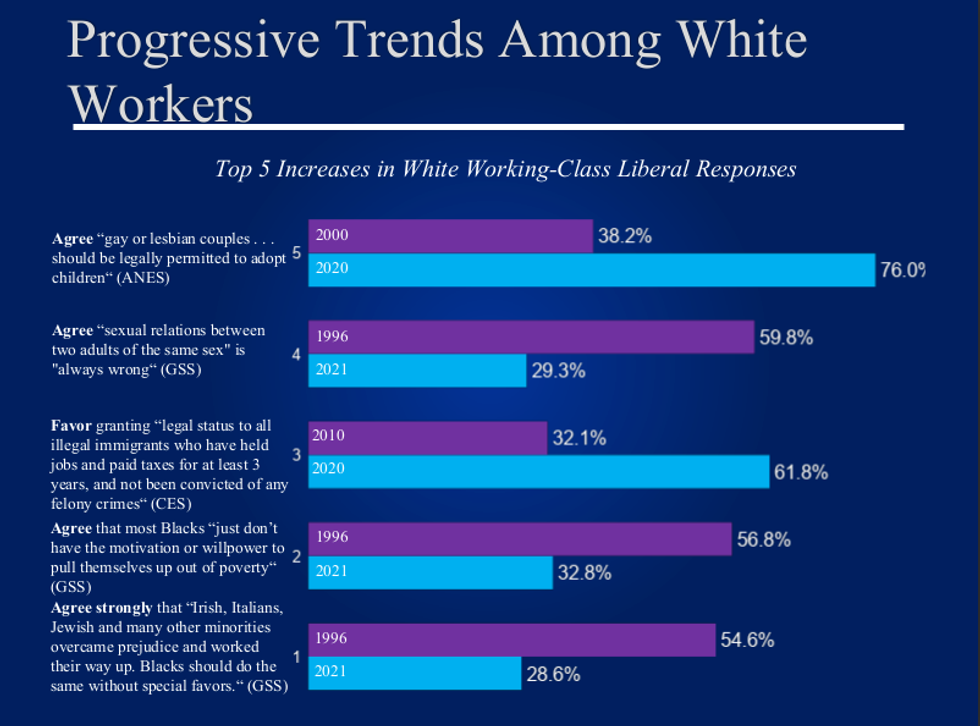
Zakaria’s laments the Democrats leftward shift, but the Democrats have not in recent years put forth a strong populist agenda. (See “Are You Still Wondering Why Workers Voted for Trump?”)
Zakaria, nevertheless, has no trouble pushing these alienated workers into the MAGA movement. No big loss. But such abandonment is a loss for members of the working class. The MAGA oligarchs did not become billionaires by protecting the economic needs and interests of working people.
To counter the blooming oligarchy which appears to have planted itself firmly in both parties, working people need a new political home, one of their own making. Although the process is extremely difficult in our two-party system, working people and labor unions may have no choice but to build a new political formation of and by working people, just like the Populists did at the end of the 19th century to battle the robber barons of that era.
Their party’s name is as appropriate today as it was then: The People’s Party.
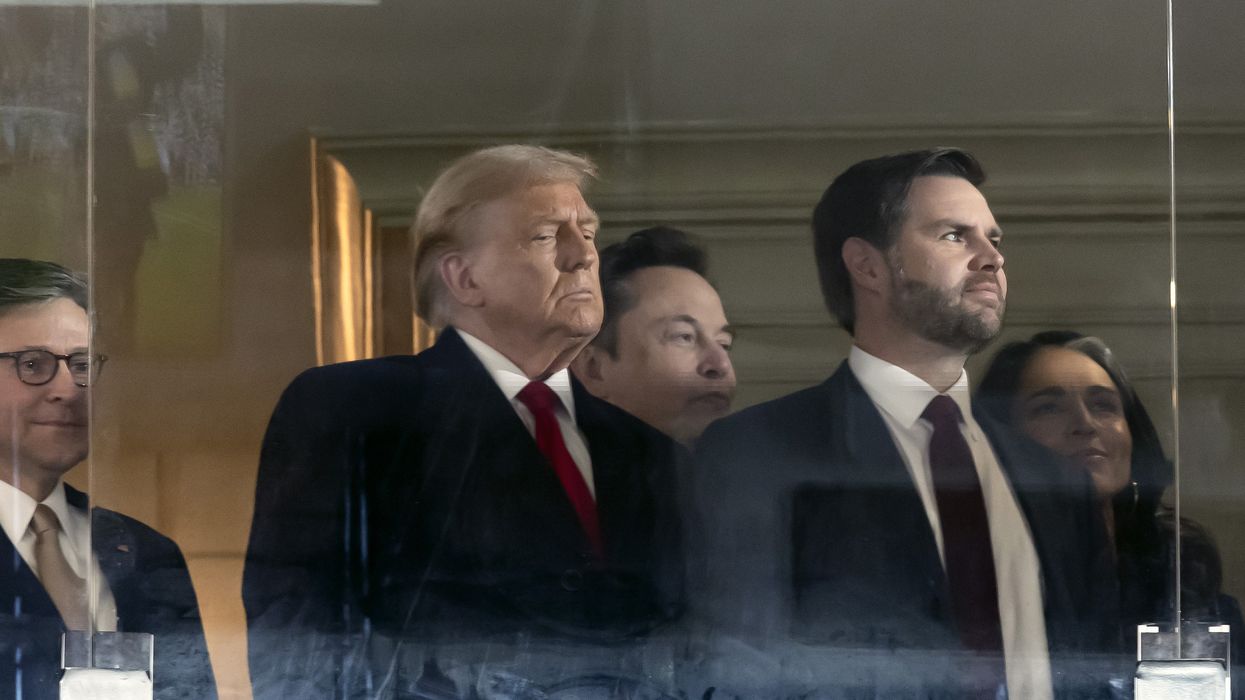
One watchdog noted the "rank hypocrisy of the entire Trump transition team operating in the shadows with private servers and emails even after Donald Trump screamed from the hilltops at the very idea in the past."
The watchdog group Accountable.US is sounding the alarm on reporting that President-elect Donald Trump's transition team is eschewing government issued email addresses and devices and instead conducting business using private emails—whipping up fears that sensitive government information could be exposed.
"Never mind the rank hypocrisy of the entire Trump transition team operating in the shadows with private servers and emails even after Donald Trump screamed from the hilltops at the very idea in the past," said Kayla Hancock, director of the Trump Accountability War Room for Accountable.US in a statement Thursday. "The real problem is how reckless and irresponsible the Trump team is treating serious national security risks so that they can conduct business and solicit donations without scrutiny."
Accountable.US also called the practice a "recipe for corruption."
Trump hammered then-presidential candidate Hillary Clinton on the campaign trail in 2016 over her use of a private email server when she was secretary of state.
New York Times opinion columnist Jamelle Bouie made a remark similar to that of Accountable.US, writing that "I recall a time when using a private email server was the single greatest scandal in American history."
Politico, which reported on the Trump team's use of private emails earlier this week, wrote that "the private emails have agency employees considering insisting on in-person meetings and document exchanges that they otherwise would have conducted electronically, according to two federal officials granted anonymity to discuss a sensitive situation."
Fears are high especially in light of recent hacking attempts from China and Iran that targeted Trump and other top officials, per Politico. Transition business is being handled using domains like "@transition47.com" and "@trumpvancetransition.com" as opposed to .gov accounts.
According to Politico, "this break with tradition stems from the Trump team forgoing federal funding and the ethics and transparency requirements that come with it."
The Trump transition team has declined to sign a memorandum of understanding with the General Services Administration that would provide federal funding for the transition in exchange for strict limits on donations. Without the agreement in place, "Trump can raise unlimited amounts of money from unknown donors to pay for the staff, travel and office space involved in preparing to take over the government," according to The New York Times.
The Trump transition team has signed other agreements that will help an already delayed transition process proceed—for example, an agreement to allow the Justice Department to conduct background checks on his nominees and appointees.
In their statement, Accountable.US also called out the transition team for not signing the agreement to cap donations.