
SUBSCRIBE TO OUR FREE NEWSLETTER
Daily news & progressive opinion—funded by the people, not the corporations—delivered straight to your inbox.
5
#000000
#FFFFFF
To donate by check, phone, or other method, see our More Ways to Give page.


Daily news & progressive opinion—funded by the people, not the corporations—delivered straight to your inbox.
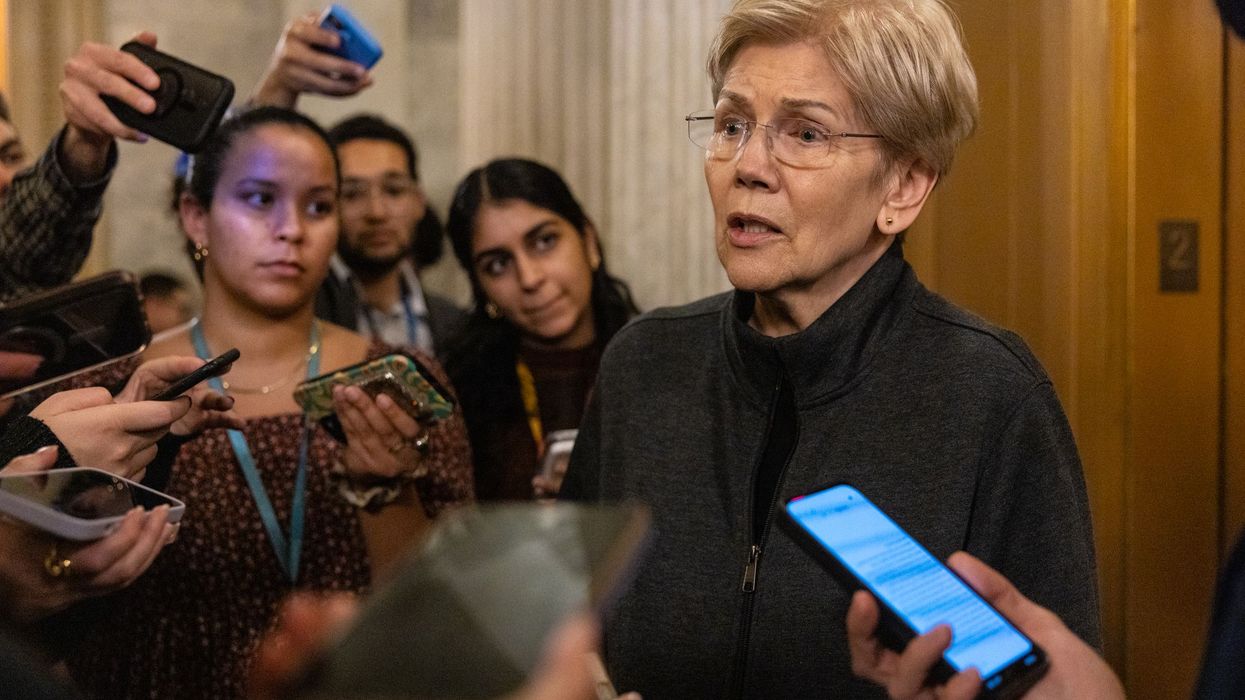
"If the CFPB is not there, people have nowhere to turn when they get cheated," said Sen. Elizabeth Warren.
President Donald Trump and his administration have been openly plotting to scrap the nation's top consumer protection watchdog, but a federal judge has at least temporarily put those plans on hold.
US District Judge Amy Berman Jackson ruled on Tuesday that the US Federal Reserve must continue providing funds to the Consumer Financial Protection Bureau (CFPB), rejecting the Trump administration's claims that the nation's central bank currently lacks the "combined earnings" to fund the bureau's operations.
The administration had argued that the Federal Reserve should not be making payments to the CFPB because it has been operating at a loss since 2022, when it began a series of aggressive interest rate hikes aimed at taming inflation.
However, Jackson rejected this reasoning and accused the administration of using it as a cover to defund an agency that the president and top officials such as Russell Vought, director of the Office of Management and Budget, had long expressed a desire to abolish.
"It appears that defendants’ new understanding of 'combined earnings' is an unsupported and transparent attempt to starve the CPFB of funding," the judge wrote.
The CFPB must now be funded at least until the DC Circuit of Appeals weighs in on an ongoing lawsuit brought by the National Treasury Employees Union (NTEU) against Vought over layoffs at the agency that is scheduled for hearings in February.
The NTEU took a victory lap in the wake of the ruling and taunted Vought for his defeat.
"Yet another loss for Rusty Vought," the union posted on Bluesky. "Wonder how much longer Donald is going to put up with this?"
While it will continue to receive funding for the time being, the CFPB has still seen its ability to fulfill its mission severely diminished during Trump's second term.
A Tuesday report from Reuters claimed that the CFPB is "on the brink of collapse" given that the Trump administration, congressional Republicans, and industry lawsuits have "undone a decade's worth of CFPB rules on matters ranging from medical debt and student loans to credit card late fees, overdraft charges and mortgage lending."
The report also noted that, during Trump's second term, the CFPB has "dropped or paused its probes and enforcement actions, and stopped supervising the consumer finance industries, leading to a string of resignations" at the agency.
Sen. Elizabeth Warren (D-Mass.), who first drew up plans to create the CFPB in the wake of the 2008 global financial crisis, explained the agency's importance in an interview with Reuters.
"I was stunned by the number of people in financial trouble who had lost a job or got sick but who had also been cheated by one or more of their creditors," she said. "For no agency was consumer protection a first priority, it was somewhere between fifth and 10th, which meant there was just no cop on the beat. If the CFPB is not there, people have nowhere to turn when they get cheated."
"By refusing to fund the CFPB, even when legal and appropriate funding mechanisms are available, the Trump administration has sharpened its message that it does not care about affordability."
A coalition of attorneys general from across the US sued White House budget chief Russell Vought on Monday over his effort to completely starve the Consumer Financial Protection Bureau of funding, a ploy that—if successful—would eliminate a key path of recourse for Americans harmed by corporate abuses.
The lawsuit was filed in a federal court in Portland, Oregon by the top law enforcement officials of 20 states—including New York, California, Maine, and Hawaii—and the District of Columbia. The suit notes that Vought, in his capacity as acting director of the consumer bureau, "has worked tirelessly to terminate the CFPB’s operations by any means necessary—denying plaintiffs access to CFPB resources to which they are statutorily entitled."
The attorneys general specifically challenge Vought's "unlawful" refusal to request CFPB funding from the Federal Reserve. Under the law that established the consumer bureau, the agency receives funding from the Fed rather than congressional appropriations.
Vought has advanced a tortured definition of "earnings" to argue the Fed lacks funds from which the CFPB can draw, leaving him with no choice but to allow the agency he and his far-right allies have long opposed to languish.
The new lawsuit argues that Vought's position violates the Administrative Procedure Act and the US Constitution. If allowed to stand, Vought's refusal to seek CFPB funds would "make it all but certain that the CFPB will run out of funding completely in January 2026."
California Attorney General Bonta said in a statement Monday that the Trump administration’s "latest effort to destroy the CFPB means that hundreds of thousands of consumer complaints will fall on deaf ears."
"By refusing to fund the CFPB, even when legal and appropriate funding mechanisms are available, the Trump administration has sharpened its message that it does not care about affordability, that it does not care to be on the side of families and working Americans," said Bonta.
The CFPB has been a target of big banks and other powerful corporations since its creation in the wake of the 2008 financial crisis. The agency's success—it has returned more than $21 billion to consumers since 2011—has only intensified efforts by corporate-friendly lawmakers and right-wing bureaucrats to gut it.
Since taking control of the CFPB earlier this year, Vought has effectively shut down bureau operations and signaled a lax approach to enforcement.
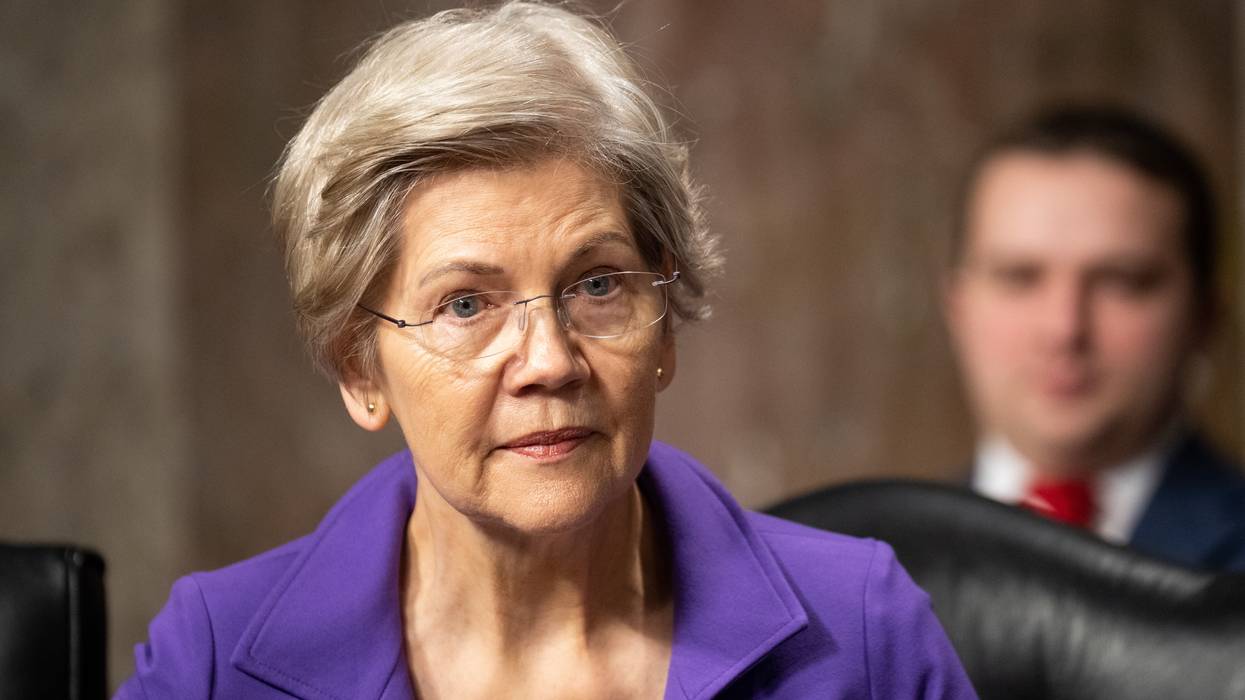
US Sen. Elizabeth Warren (D-Mass.), an architect of the CFPB, applauded the state attorneys general for taking legal action against Vought.
“The Trump administration’s latest illegal attempt to shut down the Consumer Financial Protection Bureau will hurt families in every state across the country—and now states are fighting back," said Warren. "Today’s new lawsuit underscores how illegally starving the agency of funding would turn off the consumer complaint database that has helped millions of Americans at the end of their rope after getting scammed."
"If courts uphold the law," she added, "they’ll reject this attempt to sideline the financial cop on the beat that has returned more than $21 billion directly to Americans cheated by big banks or giant corporations.”
"Never in modern US history has the office intersected so broadly and deeply with the financial interests of the commerce secretary’s own family," according to the New York Times.
A group of Democratic lawmakers has called for the Commerce Department to investigate whether its billionaire secretary, Howard Lutnick, is improperly boosting artificial intelligence data centers that "stand to enrich his entire family."
The group of 25 House and Senate Democrats, led by Sen. Elizabeth Warren (D-Mass.) and Rep. Madeleine Dean (D-Pa.), sent a letter on Thursday urging the department's acting inspector general, Duane Townsend, to review whether Lutnick violated any part of the ethics agreement he signed following his nomination.
That agreement required him to divest his stake in the financial services firm Cantor Fitzgerald, which he had owned and led for decades. Cantor owns the Newmark Group, a real estate broker that facilitates leases for AI data centers.
Lutnick stepped down from his position as CEO in February, handing his financial stake in the company to his adult sons, Brandon and Kyle.
Though the transfer of his stake was supposed to happen in May, records show he did not do so until October, after receiving an ethics waiver from the Trump administration that allowed him to continue working on matters that could affect the company.
The lawmakers described some of these potential conflicts in the letter, many of which were revealed by a New York Times investigation last month:
Multiple press reports indicate that, in his capacity as head of the Commerce Department, Secretary Lutnick has helped boost AI data centers in ways that will likely enrich his own family. He has made public appearances promoting data center projects—including at least one that his family's company has worked on.
Furthermore, Secretary Lutnick has reportedly pressured foreign governments to invest in the US data center industry. For example, as part of a recent AI chips export deal with the United Arab Emirates (UAE), Secretary Lutnick reportedly pushed the UAE to "build data centers in America,” in exchange for the United States loosening export control restrictions on certain advanced chips. The Trump administration ultimately approved this deal, under which the Lutnick-backed Newmark Group is primed to profit from that Emirati investment.
Similarly, as part of another trade deal, Secretary Lutnick reportedly pushed South Korea to invest hundreds of billions of dollars in the United States. One startup vying for some of South Korea's investment has paid the Lutnick family's companies millions in fees to help it secure financing and land for its new data center.
Though businesspeople have often occupied the role of Commerce Secretary, the Times reported last month that "never in modern US history has the office intersected so broadly and deeply with the financial interests of the commerce secretary’s own family, according to interviews with ethics lawyers and historians."
According to the company's most recent quarterly earnings report, Newmark has completed more than $25 billion in data center deals over the past 12 months, resulting in its most lucrative year in the firm's history.
Citing evidence that the construction of AI data centers considerably spikes energy costs for consumers, the lawmakers said, "There is substantial public interest in ensuring that Secretary Lutnick is not violating federal ethics law to propel data centers that will be profitable for his family while making life more expensive for working Americans."