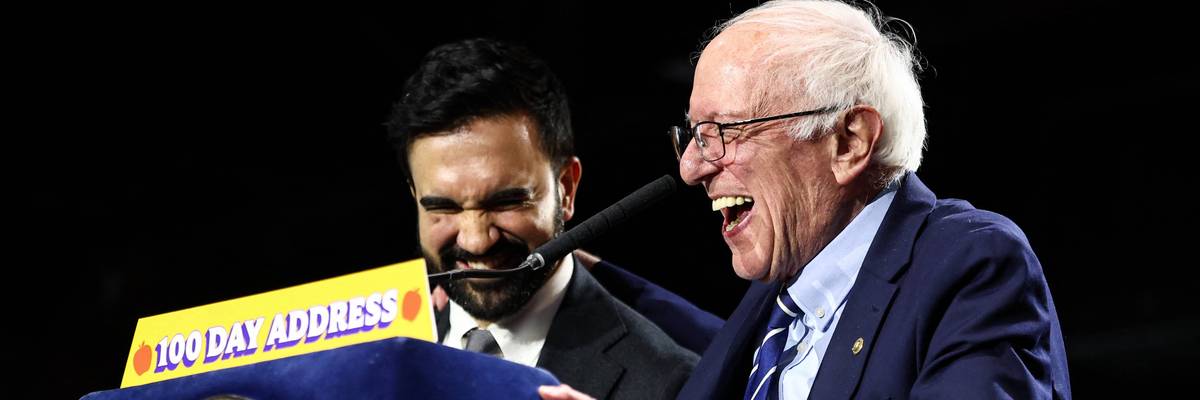
US Sen. Bernie Sanders (I-Vt.) shares a laugh with New York City Mayor Zohran Mamdani during Mamdani's 100 Day Address in Maspeth, New York on April 12, 2026.
Guess What Happened After New York Raised Taxes on the Rich? More Millionaires Moved In
"Tax flight is nothing more than a myth, and should be given as much credence as flat-earthers.”
The threats came in a steady stream last year from Fox News, hedge fund manager Bill Ackman, and Gristedes grocery chain CEO John Catsimatidis, who insisted that wealthy New York City residents were "panicking" at the possibility that then-state Rep. Zohran Mamdani, a democratic socialist, could become the mayor and ensure rich locals pay more in taxes to help fund crucial services.
"It only takes a handful of successful people to leave to decimate the city’s tax base," cautioned Ackman, while Catsimatidis suggested many rich New Yorkers would likely join him in fleeing to "the promised land": Florida, which has no state income tax.
But the progressive think tank Groundwork Collaborative said Thursday that new Internal Revenue Service (IRS) data should be "the final nail in the coffin" of the evidence-free, perennial claim that higher taxes cause wealthy residents to leave their cities and states.
The agency released its 2023 Statistics of Income (SOI) data, covering the period before Mamdani became mayor and introduced a tax on second homes, ranging from 0.8% to 1.3% for properties valued at $5 million or more, which he estimated will raise $500 million annually.
The data shows how the tax base was impacted after the state imposed a separate tax policy in 2022, raising its top tax rate on the highest earners.
Poking a giant hole in the persistent theory that wealthy people won't want to live in states that require more from them in taxes, the number of New Yorkers reporting more than $1 million in income grew by about 3% after the tax rate was raised, the SOI data shows.
"If there was any merit to the myth that tax increases on New York’s wealthy drive them away, the new IRS data should show it. It doesn’t."
The number of millionaires nationwide went down in 2023, but New York counted 2,000 more than it had the previous year. The number of tax filers earning between $500,000 and $1 million also grew by over 8,500—more than 7%.
The average adjusted gross income of New Yorkers who left the state from 2022-23 fell 15%, from over $125,000 to $106,900.
"If the past is prologue, the SOI data suggest few, if any, of the city’s wealthiest residents will leave as a result of a modest tax. Instead they are likely to remain rooted in the social, business, and economic networks that make New York uniquely valuable to them," said Groundwork Collaborative. "The New Yorkers actually at risk of leaving the city are the lower-income workers who power the economy."
Lindsay Owens, president and CEO of Groundwork Collaborative, said the new data makes clear that "tax flight is nothing more than a myth, and should be given as much credence as flat-earthers.”
"If there was any merit to the myth that tax increases on New York’s wealthy drive them away, the new IRS data should show it," said Owens. "It doesn’t—New York’s millionaire population kept climbing years after the state raised taxes on top earners."
Wealthy New Yorkers, said Groundwork, are shown by the data to be "a settled population that may squawk about a tax increase, but not pack up and leave."
We are at a crossroads
This country and this world are at a monumental crossroads. In a few short weeks, US voters will have an opportunity to beat back the forces of fascism and confront the billionaires who are rigging the economy, our media system, and our democracy, making it increasingly impossible for ordinary people to get by. We’re not just talking about the election. We’re talking about what must be done once these fascist elements are vanquished from power. We need a bolder set of solutions than what either major party has so far been willing to offer and a working-class movement ready to fight like hell for it. Trump didn't emerge from nowhere. The conditions that fueled MAGA authoritarianism were created by decades of radical neoliberal economic policies and a corrupt political system dominated by corporate interests. They slashed taxes on the super-rich, promising that the benefits would trickle down. They said giveaways to the corporate titans would make life more affordable for the rest of us. It was all bullshit. And when a bitter, betrayed populace searches for someone to blame, right-wing demagogues have little trouble finding scapegoats. People know when they're being lied to, but you won't hear any of this from the corporate media. Only independent journalism—powered and funded by people who believe in building a better world—can deliver truly trustworthy daily news. Our Fall Campaign is underway, and we need your help. To power our newsroom through the rest of the year, we need to raise $125,000 by midnight on October 31. So if you share our vision, please contribute whatever you can to sustain our work. |
The threats came in a steady stream last year from Fox News, hedge fund manager Bill Ackman, and Gristedes grocery chain CEO John Catsimatidis, who insisted that wealthy New York City residents were "panicking" at the possibility that then-state Rep. Zohran Mamdani, a democratic socialist, could become the mayor and ensure rich locals pay more in taxes to help fund crucial services.
"It only takes a handful of successful people to leave to decimate the city’s tax base," cautioned Ackman, while Catsimatidis suggested many rich New Yorkers would likely join him in fleeing to "the promised land": Florida, which has no state income tax.
But the progressive think tank Groundwork Collaborative said Thursday that new Internal Revenue Service (IRS) data should be "the final nail in the coffin" of the evidence-free, perennial claim that higher taxes cause wealthy residents to leave their cities and states.
The agency released its 2023 Statistics of Income (SOI) data, covering the period before Mamdani became mayor and introduced a tax on second homes, ranging from 0.8% to 1.3% for properties valued at $5 million or more, which he estimated will raise $500 million annually.
The data shows how the tax base was impacted after the state imposed a separate tax policy in 2022, raising its top tax rate on the highest earners.
Poking a giant hole in the persistent theory that wealthy people won't want to live in states that require more from them in taxes, the number of New Yorkers reporting more than $1 million in income grew by about 3% after the tax rate was raised, the SOI data shows.
"If there was any merit to the myth that tax increases on New York’s wealthy drive them away, the new IRS data should show it. It doesn’t."
The number of millionaires nationwide went down in 2023, but New York counted 2,000 more than it had the previous year. The number of tax filers earning between $500,000 and $1 million also grew by over 8,500—more than 7%.
The average adjusted gross income of New Yorkers who left the state from 2022-23 fell 15%, from over $125,000 to $106,900.
"If the past is prologue, the SOI data suggest few, if any, of the city’s wealthiest residents will leave as a result of a modest tax. Instead they are likely to remain rooted in the social, business, and economic networks that make New York uniquely valuable to them," said Groundwork Collaborative. "The New Yorkers actually at risk of leaving the city are the lower-income workers who power the economy."
Lindsay Owens, president and CEO of Groundwork Collaborative, said the new data makes clear that "tax flight is nothing more than a myth, and should be given as much credence as flat-earthers.”
"If there was any merit to the myth that tax increases on New York’s wealthy drive them away, the new IRS data should show it," said Owens. "It doesn’t—New York’s millionaire population kept climbing years after the state raised taxes on top earners."
Wealthy New Yorkers, said Groundwork, are shown by the data to be "a settled population that may squawk about a tax increase, but not pack up and leave."
The threats came in a steady stream last year from Fox News, hedge fund manager Bill Ackman, and Gristedes grocery chain CEO John Catsimatidis, who insisted that wealthy New York City residents were "panicking" at the possibility that then-state Rep. Zohran Mamdani, a democratic socialist, could become the mayor and ensure rich locals pay more in taxes to help fund crucial services.
"It only takes a handful of successful people to leave to decimate the city’s tax base," cautioned Ackman, while Catsimatidis suggested many rich New Yorkers would likely join him in fleeing to "the promised land": Florida, which has no state income tax.
But the progressive think tank Groundwork Collaborative said Thursday that new Internal Revenue Service (IRS) data should be "the final nail in the coffin" of the evidence-free, perennial claim that higher taxes cause wealthy residents to leave their cities and states.
The agency released its 2023 Statistics of Income (SOI) data, covering the period before Mamdani became mayor and introduced a tax on second homes, ranging from 0.8% to 1.3% for properties valued at $5 million or more, which he estimated will raise $500 million annually.
The data shows how the tax base was impacted after the state imposed a separate tax policy in 2022, raising its top tax rate on the highest earners.
Poking a giant hole in the persistent theory that wealthy people won't want to live in states that require more from them in taxes, the number of New Yorkers reporting more than $1 million in income grew by about 3% after the tax rate was raised, the SOI data shows.
"If there was any merit to the myth that tax increases on New York’s wealthy drive them away, the new IRS data should show it. It doesn’t."
The number of millionaires nationwide went down in 2023, but New York counted 2,000 more than it had the previous year. The number of tax filers earning between $500,000 and $1 million also grew by over 8,500—more than 7%.
The average adjusted gross income of New Yorkers who left the state from 2022-23 fell 15%, from over $125,000 to $106,900.
"If the past is prologue, the SOI data suggest few, if any, of the city’s wealthiest residents will leave as a result of a modest tax. Instead they are likely to remain rooted in the social, business, and economic networks that make New York uniquely valuable to them," said Groundwork Collaborative. "The New Yorkers actually at risk of leaving the city are the lower-income workers who power the economy."
Lindsay Owens, president and CEO of Groundwork Collaborative, said the new data makes clear that "tax flight is nothing more than a myth, and should be given as much credence as flat-earthers.”
"If there was any merit to the myth that tax increases on New York’s wealthy drive them away, the new IRS data should show it," said Owens. "It doesn’t—New York’s millionaire population kept climbing years after the state raised taxes on top earners."
Wealthy New Yorkers, said Groundwork, are shown by the data to be "a settled population that may squawk about a tax increase, but not pack up and leave."