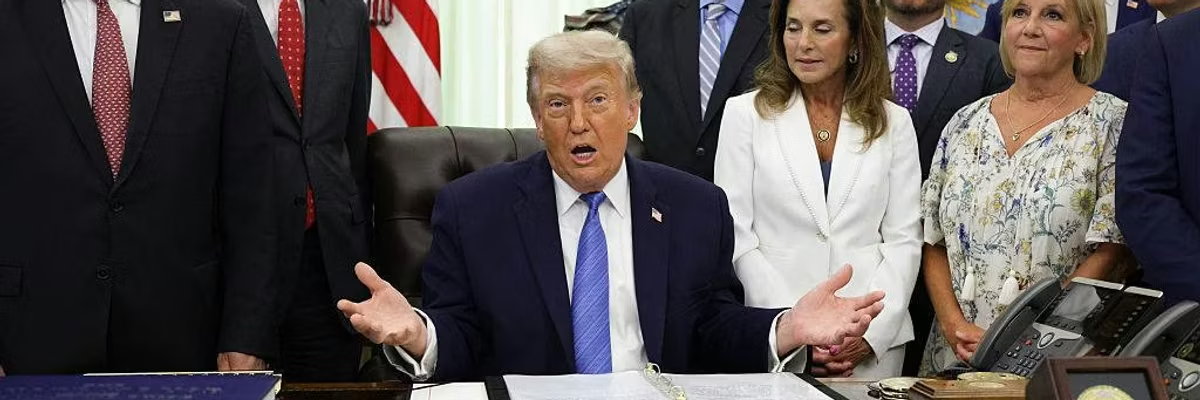
President Donald Trump speaks before signing the Secure America Act in the Oval Office of the White House on June 10, 2026 in Washington, DC.
Federal Court Blocks Trump's 'Loyalty Question' on Civil Service Job Applications
A union member testified that she was "afraid" answering the question about the president's executive orders honestly would "hurt her application."
A court's decision to block the Trump administration from including a "loyalty question" on federal job applications was a win not only for the nonpartisan civil service, but also for the communities public employees serve, said one labor leader whose union was among the plaintiffs in the case against the Office of Personnel Management.
Patrick Moran, president of the American Federation of State, County, and Municipal Employees (AFSCME) union, said Friday that the loyalty questions the OPM placed on job applications for public servants were a "blatantly illegal attempt to hire partisan cronies who would endanger our communities by putting politics before people, rather than dedicated, qualified public service workers."
The question was added to applications in response to one of President Donald Trump's first executive orders of his second term, titled “Reforming the Federal Hiring Process and Restoring Merit to Government Service." The OPM was directed to develop a “Federal Hiring Plan that brings to the Federal workforce only highly skilled Americans dedicated to the furtherance of American ideals, values, and interests."
Several essay questions were added to job applications for the civil service as a result, including one that asked: "How would you help advance the president’s executive orders and policy priorities in this role? Identify one or two relevant executive orders or policy initiatives that are significant to you, and explain how you would help implement them if hired."
Over 70,000 job postings have included the question, and the plaintiffs in the case—including AFSCME, the American Federation of Government Employees (AFGE), and the National Association of Government Employees (NAGE), argued that its inclusion compelled applicants to make political statements and chilled the speech of those who may not agree with Trump's executive orders.
The US District Court for the District of Massachusetts found that continuing to include the question would cause "irreparable harm" to workers applying for government jobs.
Judge George A. O’Toole Jr. said the plaintiffs' arguments that the OPM had violated applicants' First Amendment rights and the Administrative Procedure Act were likely to succeed in court.
A sworn declaration from an AFGE member figured prominently in the case. The employee said she "was afraid" that answering the loyalty question with an honest response about her personal views on Trump's executive orders would "hurt her application."
O'Toole wrote that the question's plain language "calls for the applicant’s personal views on a political topic, and directly links that personal view to the duties of the desired civil service job."
Everett Kelley, AFGE national president, said that "requiring federal job applicants to answer politically motivated questions goes against the very nature of the nonpartisan civil service, and we are pleased the judge has put an immediate stop to the administration’s loyalty questions. Federal employees should be hired based solely on their ability to perform the job—not their allegiance to any particular administration."
O'Toole denied the unions' request for a preliminary injunction blocking the government from incorporating answers that applicants have already provided into hiring decisions.
Still, Skye Perryman, president and CEO of Democracy Forward, which represented the plaintiffs, said the ruling "protects the Constitution, the civil service, and the people who depend on a professional, nonpartisan federal workforce.”
“For more than a century, civil servants have been hired based on their merits, not based on allegiance to a partisan political agenda,” said Perryman. “Today’s decision—stopping the Trump-Vance administration’s required loyalty question for public servants—reaffirms the importance of a nonpartisan civilian workforce that serves the American people."
We are at a crossroads
This country and this world are at a monumental crossroads. In a few short weeks, US voters will have an opportunity to beat back the forces of fascism and confront the billionaires who are rigging the economy, our media system, and our democracy, making it increasingly impossible for ordinary people to get by. We’re not just talking about the election. We’re talking about what must be done once these fascist elements are vanquished from power. We need a bolder set of solutions than what either major party has so far been willing to offer and a working-class movement ready to fight like hell for it. Trump didn't emerge from nowhere. The conditions that fueled MAGA authoritarianism were created by decades of radical neoliberal economic policies and a corrupt political system dominated by corporate interests. They slashed taxes on the super-rich, promising that the benefits would trickle down. They said giveaways to the corporate titans would make life more affordable for the rest of us. It was all bullshit. And when a bitter, betrayed populace searches for someone to blame, right-wing demagogues have little trouble finding scapegoats. People know when they're being lied to, but you won't hear any of this from the corporate media. Only independent journalism—powered and funded by people who believe in building a better world—can deliver truly trustworthy daily news. Our Fall Campaign is underway, and we need your help. To power our newsroom through the rest of the year, we need to raise $125,000 by midnight on October 31. So if you share our vision, please contribute whatever you can to sustain our work. |
A court's decision to block the Trump administration from including a "loyalty question" on federal job applications was a win not only for the nonpartisan civil service, but also for the communities public employees serve, said one labor leader whose union was among the plaintiffs in the case against the Office of Personnel Management.
Patrick Moran, president of the American Federation of State, County, and Municipal Employees (AFSCME) union, said Friday that the loyalty questions the OPM placed on job applications for public servants were a "blatantly illegal attempt to hire partisan cronies who would endanger our communities by putting politics before people, rather than dedicated, qualified public service workers."
The question was added to applications in response to one of President Donald Trump's first executive orders of his second term, titled “Reforming the Federal Hiring Process and Restoring Merit to Government Service." The OPM was directed to develop a “Federal Hiring Plan that brings to the Federal workforce only highly skilled Americans dedicated to the furtherance of American ideals, values, and interests."
Several essay questions were added to job applications for the civil service as a result, including one that asked: "How would you help advance the president’s executive orders and policy priorities in this role? Identify one or two relevant executive orders or policy initiatives that are significant to you, and explain how you would help implement them if hired."
Over 70,000 job postings have included the question, and the plaintiffs in the case—including AFSCME, the American Federation of Government Employees (AFGE), and the National Association of Government Employees (NAGE), argued that its inclusion compelled applicants to make political statements and chilled the speech of those who may not agree with Trump's executive orders.
The US District Court for the District of Massachusetts found that continuing to include the question would cause "irreparable harm" to workers applying for government jobs.
Judge George A. O’Toole Jr. said the plaintiffs' arguments that the OPM had violated applicants' First Amendment rights and the Administrative Procedure Act were likely to succeed in court.
A sworn declaration from an AFGE member figured prominently in the case. The employee said she "was afraid" that answering the loyalty question with an honest response about her personal views on Trump's executive orders would "hurt her application."
O'Toole wrote that the question's plain language "calls for the applicant’s personal views on a political topic, and directly links that personal view to the duties of the desired civil service job."
Everett Kelley, AFGE national president, said that "requiring federal job applicants to answer politically motivated questions goes against the very nature of the nonpartisan civil service, and we are pleased the judge has put an immediate stop to the administration’s loyalty questions. Federal employees should be hired based solely on their ability to perform the job—not their allegiance to any particular administration."
O'Toole denied the unions' request for a preliminary injunction blocking the government from incorporating answers that applicants have already provided into hiring decisions.
Still, Skye Perryman, president and CEO of Democracy Forward, which represented the plaintiffs, said the ruling "protects the Constitution, the civil service, and the people who depend on a professional, nonpartisan federal workforce.”
“For more than a century, civil servants have been hired based on their merits, not based on allegiance to a partisan political agenda,” said Perryman. “Today’s decision—stopping the Trump-Vance administration’s required loyalty question for public servants—reaffirms the importance of a nonpartisan civilian workforce that serves the American people."
A court's decision to block the Trump administration from including a "loyalty question" on federal job applications was a win not only for the nonpartisan civil service, but also for the communities public employees serve, said one labor leader whose union was among the plaintiffs in the case against the Office of Personnel Management.
Patrick Moran, president of the American Federation of State, County, and Municipal Employees (AFSCME) union, said Friday that the loyalty questions the OPM placed on job applications for public servants were a "blatantly illegal attempt to hire partisan cronies who would endanger our communities by putting politics before people, rather than dedicated, qualified public service workers."
The question was added to applications in response to one of President Donald Trump's first executive orders of his second term, titled “Reforming the Federal Hiring Process and Restoring Merit to Government Service." The OPM was directed to develop a “Federal Hiring Plan that brings to the Federal workforce only highly skilled Americans dedicated to the furtherance of American ideals, values, and interests."
Several essay questions were added to job applications for the civil service as a result, including one that asked: "How would you help advance the president’s executive orders and policy priorities in this role? Identify one or two relevant executive orders or policy initiatives that are significant to you, and explain how you would help implement them if hired."
Over 70,000 job postings have included the question, and the plaintiffs in the case—including AFSCME, the American Federation of Government Employees (AFGE), and the National Association of Government Employees (NAGE), argued that its inclusion compelled applicants to make political statements and chilled the speech of those who may not agree with Trump's executive orders.
The US District Court for the District of Massachusetts found that continuing to include the question would cause "irreparable harm" to workers applying for government jobs.
Judge George A. O’Toole Jr. said the plaintiffs' arguments that the OPM had violated applicants' First Amendment rights and the Administrative Procedure Act were likely to succeed in court.
A sworn declaration from an AFGE member figured prominently in the case. The employee said she "was afraid" that answering the loyalty question with an honest response about her personal views on Trump's executive orders would "hurt her application."
O'Toole wrote that the question's plain language "calls for the applicant’s personal views on a political topic, and directly links that personal view to the duties of the desired civil service job."
Everett Kelley, AFGE national president, said that "requiring federal job applicants to answer politically motivated questions goes against the very nature of the nonpartisan civil service, and we are pleased the judge has put an immediate stop to the administration’s loyalty questions. Federal employees should be hired based solely on their ability to perform the job—not their allegiance to any particular administration."
O'Toole denied the unions' request for a preliminary injunction blocking the government from incorporating answers that applicants have already provided into hiring decisions.
Still, Skye Perryman, president and CEO of Democracy Forward, which represented the plaintiffs, said the ruling "protects the Constitution, the civil service, and the people who depend on a professional, nonpartisan federal workforce.”
“For more than a century, civil servants have been hired based on their merits, not based on allegiance to a partisan political agenda,” said Perryman. “Today’s decision—stopping the Trump-Vance administration’s required loyalty question for public servants—reaffirms the importance of a nonpartisan civilian workforce that serves the American people."