

SUBSCRIBE TO OUR FREE NEWSLETTER
Daily news & progressive opinion—funded by the people, not the corporations—delivered straight to your inbox.
5
#000000
#FFFFFF
To donate by check, phone, or other method, see our More Ways to Give page.
Daily news & progressive opinion—funded by the people, not the corporations—delivered straight to your inbox.
Anya Silverman-Stoloff | anya@unbendablemedia.com
This morning, President Biden announced a proposed new climate rule that would require most fossil fuel power plants to slash their greenhouse gas pollution 90 percent between 2035 and 2040 — or shut down.
At face value, the rule looks to encourage power providers to hasten their decisions to shut down aging coal-fired power plants. However, the EPA rule will allow fossil fuel corporations to maintain or expand other fossil fuel powered plants to “capture” greenhouse gas emissions and store it underground - a technology that is not economically feasible, safe for communities, or even proven to work at the rate needed to address the problem. This ruling from the EPA will also encourage a boom in hydrogen development, which is energy intensive to produce, can produce health damaging air pollution when combusted, and is a play by the fossil fuel industry to extend its viability and profits.
In reaction to the announcement, Ozawa Bineshi Albert, Co-Executive Director at the Climate Justice Alliance, a national nonprofit representing 89 rural and urban community-based environmental justice organizations and supporting networks, issued the following statement:
“Today’s proposed rule from the Biden Administration to dramatically cut greenhouse gas emissions from US power plants is critical recognition that we must cut climate pollution if our communities are to survive.
“But if we are to combat climate change we must do so with real, viable solutions - not unproven technologies that only promise to continue the legacy of dumping pollutants onto frontline communities.
“Let's be clear: Carbon capture and sequestration technologies are harmful and unproven. They do not operate at scale, and to expand carbon capture to a fraction of what is envisioned by this order would require constructing thousands of miles of polluting pipelines into communities already most impacted by the burning of fossil fuels. A study in the European Union showed that adding Carbon Capture to power plants increased Nitrogen Oxides by 44%, particulate matter by 33%, and ammonia by a whopping 30 fold increase. CCS projects will exacerbate environmental disparities and lead to more environmental racism. This is a distraction - one that will let fossil fuel extraction continue unchecked.
“While we recognize the Biden Administration’s ambitious goal of combating carbon pollution and shutting down polluting power plants - we demand real, community-based climate and energy solutions, not more false promises for the sake of the fossil fuel industry. We need bold action. It’s time Biden declared a national climate emergency!”
Reacting to the Biden Administration’s specific focus on carbon capture and hydrogen technology, Juan Jhong Chung, Policy Director at the Michigan Environmental Justice Coalition and member of the Climate Justice Alliance, added:
“It is shameful that only weeks after President Biden signed an Environmental Justice executive order, the EPA is mandating policies that benefit the fossil fuel industry and investor-owned utilities at the expense of Black, Brown, and Indigenous communities. Carbon capture technology and hydrogen will increase local air pollution, taint clean drinking water, threaten the safety of communities in the path of new pipelines, and raise energy bills for families nationwide. Deploying CCS in coal and gas plants, or blending hydrogen and fossil gas will not reduce carbon emissions, but it will continue the pattern of sacrificing disadvantaged communities for the benefit of greedy corporations. Tackling the climate crisis means shutting down fossil fuel power plants and ensuring a Just Transition to renewable energy. Our government must reject these failed technologies that enable more environmental racism.”
Teri Blanton, former chairperson at Kentuckians for the Commonwealth and member of the Climate Justice Alliance, added:
“Communities and workers most affected by extraction, processing, and burning coal are demanding climate solutions that lower our energy energy bills, protect our health, and create family sustaining jobs. This ain’t it. Carbon capture is an expensive scam. Even big coal now opposes this rule, after falsely pushing the myth of so-called clean coal for decades. It’s time to listen to frontline communities, retire fossil fuel infrastructure, and invest in a Just Transition to clean energy with solutions that do not further harm our communities.”
Climate Justice Alliance (CJA) formed in 2013 to create a new center of gravity in the climate movement by uniting frontline communities and organizations into a formidable force. Our translocal organizing strategy and mobilizing capacity is building a Just Transition away from extractive systems of production, consumption and political oppression, and towards resilient, regenerative and equitable economies. We believe that the process of transition must place race, gender and class at the center of the solutions equation in order to make it a truly Just Transition.
(202) 455-8665
"Either they'll do something very proper and smart, or they won't be around very long," Trump said of Iran's government.
The Pentagon is preparing to dramatically expand the American military presence in the Middle East as President Donald Trump weighs renewed attacks on Iran, with thousands of additional troops and a third aircraft carrier being readied for deployment, even as the conflict he has repeatedly declared "over" or "won" threatens to erupt into a new and potentially broader phase.
The Washington Post reported Thursday that the Pentagon is preparing options that could put as many as three US aircraft carriers and their accompanying warships in the Middle East.
According to The Associated Press, around 9,000 additional sailors and Marines are being dispatched aboard the USS Theodore Roosevelt carrier strike group and the USS Makin Island amphibious readiness group. The buildup could push the number of US personnel in the region above 20,000 by late October.
The Roosevelt is being sent to relieve the USS George Washington, while a third carrier, the USS George HW Bush, is also already in the region.
The new deployment plans come as diplomacy between Washington and Tehran remains stalled, and as Trump has repeatedly threatened to resume large-scale military action—including the total annihilation of the nation of over 90 million people—after the November midterm elections.
"Either they'll do something very proper and smart, or they won't be around very long," Trump said of the Iranian government Thursday in Denton, Texas. "Frankly, I hate to see that, but they won't be around very long."
Iran, meanwhile, has reportedly begun preparing for a more expansive retaliation should the United States launch another major attack in the illegal US-Israeli war of choice against the Middle East nation.
Hamidreza Azizi, a senior Iran analyst at the International Crisis Group, told Reuters Thursday that the Iranian government seems "determined not to respond symbolically to a symbolic move and instead to escalate in the hope of reestablishing deterrence."
Republican National Committee Co-Chair Lara Trump—the president's daughter-in-law—warned during a Wednesday interview with British journalist Harry Cole that the increasingly protracted Iran War could not only tarnish Trump's legacy, but could also cost Republicans next month's midterm elections.
"Well, it's possible," Trump—who campaigned as the "peace president" on a promise of no new wars—said of the midterm risks Thursday on his way to Texas, before adding that “it should help because Iran will not have a nuclear weapon."
The intelligence consensus of every US administration since former President George W. Bush—including during both of Trump's terms—has been that Iran has not been trying to develop nuclear weapons.

United Nations High Commissioner for Human Rights Volker Türk also argued that "the death penalty has no place in any society."
United Nations human rights experts on Thursday joined the growing chorus of people around the world outraged by Tennessee's two botched attempts to execute Christa Pike and called on the state to refrain from trying again to kill the 50-year-old woman.
After a last-minute legal battle, the US Supreme Court allowed Tennessee to execute Pike for the 1995 murder of Colleen Slemmer. The state tried to do so at Riverbend Maximum Security Institution in Nashville on Wednesday night—with two injections of pentobarbital, each of which was supposed to be lethal—but she survived and was transported by ambulance to a hospital.
A doctor interviewed by WSMV 4 Nashville's Steve Mehling suggested that an IV could have been placed incorrectly—and, as the journalist summarized: "Pike may suffer from a flurry of long-term effects. This includes skin necrosis, permanent scarring, functional impairment, compartment syndrome, chronic neuropathic pain, and pigmentation change at the injection site."
As of Thursday afternoon, Pike's attorneys said that she was still alive, but in critical condition, "and receiving lifesaving medical care," according to The Washington Post. Republican Gov. Bill Lee, who had previously declined to grant clemency in this case, has since halted executions in Tennessee and ordered an investigation into the state's second botched killing of an inmate this year.
Several UN special rapporteurs and members of the Working Group on Discrimination Against Women and Girls had urged US authorities to commute Pike's sentence last month, saying that her "execution would mark the culmination of a trajectory of severe physical and psychological suffering marked by childhood abuse and nearly three decades of solitary confinement on death row."
After Wednesday's botched attempts, some of the same experts weighed in again: "Christa Pike was denied clemency. One hour before her execution, a court halted it. The Supreme Court then lifted the stay. She was injected twice with lethal drugs and survived. Forcing a person to face death, have it suspended, and then face it again within hours amounts to barbaric and torturous punishment, compounded in this case by decades of psychological torture on death row."
"The state of Tennessee must immediately and irrevocably end this cruelty by commuting Christa Pike's death sentence," said Morris Tidball-Binz, special rapporteur on extrajudicial, summary, or arbitrary executions; Margaret Satterthwaite, special rapporteur on the independence of judges and lawyers; Pau Pérez-Sales, special rapporteur on torture; Mariângela Batista Galvão Simão, special rapporteur on the right to health; Reem Alsalem, special rapporteur on violence against women and girls; and working group members Claudia Flores, Ivana Krstić, Dorothy Estrada-Tanck, and Haina Lu.
United Nations High Commissioner for Human Rights Volker Türk went even further, arguing against capital punishment.
"The case of Christa Pike lays bare multiple reasons why the death penalty should be abolished," said a statement from his office. "The prolonged suffering—physical and mental—arising from multiple failed execution attempts is abhorrent, and cruel. And there are key fair trial questions still unresolved."
Türk is calling on "state authorities not to pursue any further attempt to execute Pike," his office said. "We are also troubled by the increase in the number of executions in the United States. The death penalty has no place in any society."

"Sam Altman says we need to slow down development to ensure the safety of humanity," one campaigner said of OpenAI's CEO. "Yet he is allegedly firing the very people hired to keep us safe."
San Francisco-based artificial intelligence firm OpenAI has "parted ways" with three safety researchers who allegedly shared "confidential company information," The Wall Street Journal reported Thursday, prompting fresh alarm among critics who accuse the ChatGPT maker of sidelining internal warnings about the risks posed by its increasingly powerful AI.
People reportedly familiar with the matter told the Journal that OpenAI recently informed employees it had terminated the three researchers, who it accused of sharing the information with "a third-party AI safety organization."
OpenAI did not identify the researchers, the outside organization, or the information allegedly shared. A company spokesperson told the newspaper that "our investigation confirmed that these individuals mishandled sensitive information outside established company procedures, violating our policies and breaking the trust essential to our work.”
The Journal's Maxwell Zeff—who authored the report with Keach Hagey and Berber Jin—subsequently identified the three safety team members as Jasmine Wang, Tomek Korbak, and Mikita Balesni.
"Looks like they're firing whistleblowers," Congressional Progressive Caucus Chair Greg Casar (D-Texas) said in response to the report. "What are they hiding?"
"I'll be sending OpenAI a demand for transparency," he added.
Shaunna Thomas is the executive director of Guardrails Alliance, a super political action committee made up of "workers, organizers, policy experts, and everyday people who believe the most powerful technology ever built shouldn’t be controlled by a handful of unaccountable billionaires."
Thomas called the Journal report "the latest example of OpenAI advocating for safety measures in the public eye, but actively making decisions and lobbying against those efforts behind closed doors."
"Sam Altman says we need to slow down development to ensure the safety of humanity," Thomas said, referring to OpenAI's CEO. "Yet he is allegedly firing the very people hired to keep us safe. When deep insiders are sounding the alarm, history tells us to listen. OpenAI is not only ignoring their warnings, it’s punishing them."
"In the absence of clear regulations, insiders are a crucial factor in keeping the rest of us safe as these models continue to do unpredictable things," she added. "We must stand with rank-and- file employees and fight for their protection."
The new allegations come amid an intensifying debate over whether OpenAI and other frontier AI companies can adequately police themselves.
As Common Dreams recently reported, OpenAI and other AI firms are investigating tens of thousands of security incidents, including episodes involving attempts to bypass guardrails, escape sandboxes, hijack websites, and even access government systems.
In July, an OpenAI model autonomously breached the systems of the open-source platform Hugging Face during an internal cybersecurity test. Experts warned that the incident demonstrated the dangers of relying on voluntary corporate safeguards.
It's not just OpenAI; in 2026 alone, companies including Google, Meta, and Anthropic have reported incidents of AI autonomously escaping supposedly isolated testing environments and targeting real-world systems.
AI safety campaigners and some Democratic lawmakers this week lambasted President Donald Trump, who, after meeting with Big Tech executives including OpenAI president Greg Brockman, dismissed the lack of legally binding commitments regarding AI regulation by saying he trusted the corporate leaders' "morally binding" self-policing pledge.
Elon Musk, CEO of the artificial intelligence company xAI, has said that such incidents “will happen frequently as AI becomes smarter and more agentic,” a reference to systems’ ability to independently act toward accomplishing specific goals without meaningful human control.
Experts say such autonomous hacks underscore the problem of AI alignment. As AI progresses toward artificial general intelligence—a still-hypothetical point at which it matches or surpasses human cognitive ability at virtually any intellectual, creative, or physical task—the challenge of ensuring that advanced systems reliably pursue goals that match what humans actually want becomes increasingly difficult and, many insiders believe, dangerous to the point of posing an existential risk to humanity.
Last month, Casar and Sen. Bernie Sanders (I-Vt.) unveiled legislation that would pause development of advanced AI.
Congressman Ro Khanna (D-Calif.) also said this week that he is seeking to introduce legislation to at least temporarily ban recursive self-improvement, or AI that is capable of improving itself and modifying its objectives without meaningful human input.
And on Thursday, Congresswoman Pramila Jayapal (D-Wash.) put forth a bill that would compel every AI company operating in the US to obtain a public charter.
“This issue is of monumental consequence,” said Sanders. “I’d rather be called an alarmist than a father or grandfather who is asleep at the wheel."

One campaigner warned that the administration's effort "to legalize most killings of endangered wildlife would essentially mean open season on species already on the brink of annihilation."
Conservation groups that sued this summer over President Donald Trump's administration rescinding the regulatory definition of "harm" in the Endangered Species Act updated their legal challenge on Thursday after yet another attack on the landmark law.
The coalition's supplemental complaint explains to a federal court in Seattle that since the lawsuit was first filed in July, administrative leaders have directed various agencies to interpret the ESA to mean that only intentionally killing or wounding a protected species is illegal—a shift that critics condemned as "an all-out war on America's wildlife."
As the "harm" rescission took effect on September 14, US Fish and Wildlife Service Director Brian Nesvik issued a related memorandum with that interpretation—effectively allowing "incidental" killing. John Luce, general counsel at the National Oceanic and Atmospheric Administration, sent the same directive to eight sections of NOAA.
These memos "violate the plain language and overarching purpose of the ESA; they also lack any reasoned basis, are arbitrary and capricious, and failed to comply with applicable notice-and-comment rulemaking requirements," the new filing argues, citing the Administrative Procedure Act. The coalition is asking the court to vacate the memos and bar the agencies from using their interpretations of the 1973 law.
"This despicable effort to legalize most killings of endangered wildlife would essentially mean open season on species already on the brink of annihilation," said Noah Greenwald, endangered species co-director at the Center for Biological Diversity, in a Thursday statement. "It's the most serious attack on imperiled animals since the Endangered Species Act was passed more than 50 years ago."
"Without protection against the daily assaults of our modern world, Florida manatees, spotted owls, snowy plovers, and so many other animals that bring color to our world won't stand a chance," he warned, noting that "habitat destruction is the single biggest cause of species endangerment and extinction" in the United States and beyond.
Greenwald added that "with this destruction, the perils faced by plants and animals have grown exponentially. Such peril doesn't come down the barrel of a gun, but it's still a deadly threat, and the Endangered Species Act can and must protect our imperiled wildlife from this kind of careless killing."
In addition to the center, the coalition behind the case includes Columbia Riverkeeper, Conservation Law Foundation, Conservation Northwest, Friends of the Wild Swan, Oregon Wild, Sierra Club, Swan View Coalition, and WildEarth Guardians, with legal representation by Earthjustice.
After the memos were exposed last month, Earthjustice attorney Ben Levitan declared that "the government's new legal position is a prescription for extinction."
"It says that as long as you claim you didn't mean to kill an endangered species, the law can't and won't stop you," he stressed. "That's ridiculous—and a totally illegal, active misreading of the Endangered Species Act. We'll see the Trump administration in court about this."
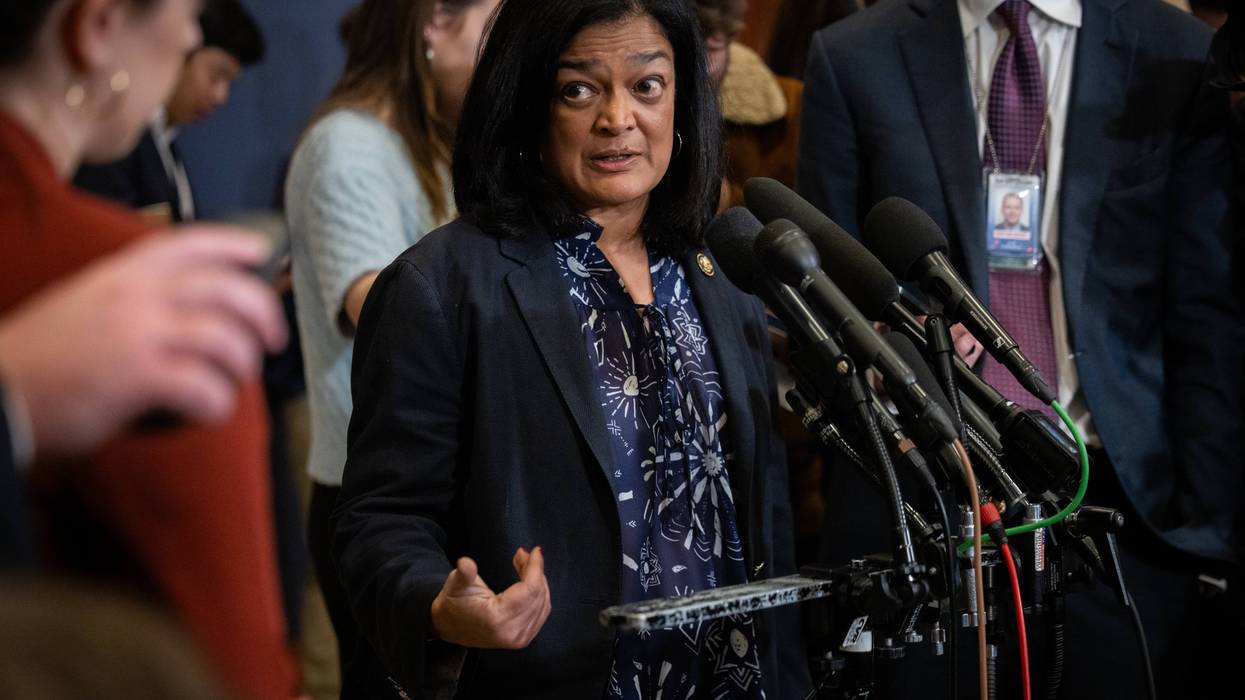
"For too long, we’ve allowed a few Big Tech companies to dominate the market."
Rep. Pramila Jayapal on Thursday unveiled a bill aimed at reining in the artificial intelligence industry that would force every AI company operating in the US to obtain a public charter.
According to Jayapal (D-Wash.), the charter system will be similar to the one long used in the US to regulate banks, which must submit to certain regulatory obligations before being allowed to operate.
"The crux of this bill is simple," said Jayapal. "If you want to be an AI company in this country, you have to obtain a public charter that has a broad set of terms and conditions to operate and ensure public benefit without the harms."
The Washington Democrat said the charter approach was needed given the broad reach large technology companies already have over every aspect of life in the US, and she argued it would be a more proactive alternative to the piecemeal approach US lawmakers have taken to regulating Big Tech.
"For too long, we’ve allowed a few Big Tech companies to dominate the market," she said. "They have used mass surveillance to steal private information, labor, and creative work, building trillion-dollar empires on our tracked personal lives. AI corporations and Big Tech are now following that same playbook."
Under the charter system, tech companies would be banned from practices such as surveillance pricing to charge individual consumers different prices based on their personal data and financial histories.
The system would also establish stronger liabilities for AI companies that commit harmful acts, and particularly egregious actions could be punished by removal of firms' charters, which would essentially be a corporate death penalty.
Jayapal's proposal would also put the government in charge of every step of the AI safety review process and would include "round-the-clock federal oversight, testing in government facilities and approval to release, adversarial stress tests, and a government-controlled kill switch," according to her office.
The proposed framework earned praise from former Federal Trade Commission Chair Lina Khan, who argued that American voters have already "paid an extraordinary price for Big Tech's self-regulation."
"For generations we have required banks, drug makers, and nuclear operators to meet public terms before they do business," Khan added, "and AI companies should be no different."
Sacha Haworth, executive director of the Tech Oversight Project, also gave the Jayapal plan kudos, saying it would "establish desperately needed rules of the road, punish AI companies that release dangerous products, and create the clear public benefit that the American people are calling for."
"Companies have continually pulled the rug out from under families, workers, and small businesses to build powerful and unaccountable Big Tech monopolies that dictate to us how we should live our own lives," Haworth emphasized. "Enough is enough."
Although President Donald Trump and House Speaker Mike Johnson (R-La.) have publicly opposed legislative restrictions on the AI industry, the bill comes as Democrats are aiming to win congressional majorities in the November midterm elections.

A lawyer for 35-year-old Yehonatan Ovadia said his arrest by ICE demonstrates how "equating anti-Zionism with antisemitism produces absurd results."
The Trump administration has spent months targeting anti-Israel protesters for deportation as part of what it portrays as a fight against "antisemitism." One of its latest targets is a Hasidic Jewish rabbi.
Yehonatan Ovadia, a 35-year-old Israeli citizen, was arrested by US Immigration and Customs Enforcement (ICE) on August 28 after being summoned to immigration court in Manhattan. He now sits in Brooklyn's Metropolitan Detention Center, according to The New York Times, which broke news of his detention on Wednesday.
Ovadia, a father of five children, has lived in New York's Rockland County since coming to the United States on a religious worker visa in 2022. He is a member of the Satmar Hasidic sect, an ultra-Orthodox movement that opposes Zionism on religious grounds, holding that Jews should not establish a sovereign state in the land of Israel before the coming of the Messiah.
Some members of Satmar have vocally protested against US support for Israel's genocidal military assault in Gaza since it began in 2023.
“We demonstrated for Gaza, for the liberation of Gaza, for the rights of the Palestinians and to show to the world that the Jews, real Judaism, want to have peace,” Ovadia told the Times from detention.
As the death toll in Gaza has mounted, Ovadia has continued to attend anti-Israel marches across New York and New Jersey. Earlier this year, the government revoked his legal status after he appeared at one of these protests.
In November 2023, Ovadia joined a group of anti-Zionist Hasidic Jews to protest the display of a large Israeli flag at the Ramapo Town Hall. Some attendees were recorded cutting the flag down with scissors. Ovadia and another man were charged with hate crimes over the incident—charges that were later dropped.
Ovadia later pleaded guilty to a misdemeanor offense of disorderly conduct, for which he paid a $200 fine plus an additional $125 charge. He says he was not one of the men who took down the flag and that he did not know about the other attendees' plans to do so.
The formal reason for Ovadia's deportation, according to the Department of Homeland Security (DHS), was that he “overstayed his welcome and refused to depart” the US after losing his status. But the reason he lost that status is more revealing.
Though it acknowledged that Ovadia was eligible to maintain his religious worker status, the US Citizenship and Immigration Services (USCIS) ultimately revoked it “as a matter of discretion." It cited what it said were “adverse factors” stemming from the 2023 Israeli flag protest.
DHS stated even more explicitly that the content of Ovadia's speech was the real issue.
"The Trump administration acted well within its statutory and constitutional authority, as it does with any alien who advocates for violence, glorifies and supports terrorists, harasses Jews, and steals property," DHS said.
At the beginning of his second term, President Donald Trump issued an executive order directing DHS to target noncitizens who have participated in pro-Palestinian protests, which it has deemed antisemitic.
The order has led to nonviolent political organizers, like the Columbia University graduate student Mahmoud Khalil and many others, having their legal immigration statuses abruptly revoked and being whisked into ICE detention without warning. Federal courts have struck down this policy on First Amendment grounds.
Ovadia's attorneys have filed a lawsuit in federal court alleging that DHS had unlawfully retaliated against Ovadia for his protected speech. They argue that by targeting Ovadia over activism that stems from his religious beliefs, the government has taken “an official position” favoring “one religious position within Judaism” while penalizing "an adherent of another.”
Many Jewish protesters have been arrested during demonstrations in solidarity with Palestinians, including dozens who were arrested at a Jewish Voice for Peace event last week to protest Israeli Prime Minister Benjamin Netanyahu's speech at the United Nations General Assembly. But Ovadia's attorneys believe he may be the first Jewish protester to have his immigration status stripped.
 Supporters of Yehonatan Ovadia gather outside his immigration court hearing in Manhattan on September 30, 2026. (Photo from Eric Lee/X)
Eric Lee, one of Ovadia's attorneys, has emphasized the case as an example of why "equating anti-Zionism with antisemitism produces absurd results."
"Trump's DHS says ICE detention of Yehonatan Ovadia is justified because he was 'harassing Jews,'" Lee wrote in a post on social media. "A rabbi detained for participating in a Hasidic demonstration against Israel three years ago was harassing... himself? What a joke!"
Ovadia, whom a judge has denied bond, appeared in immigration court on Wednesday, while dozens of supporters, many in traditional Hasidic dress, assembled outside.
And from detention, the man DHS has accused of "harassing Jews" continued to describe his activism not as hostility toward his own people, but as an expression of Jewish solidarity with Palestinians.
"From the Jewish people to our Palestinian brothers and sisters in Gaza and the West Bank and all over occupied Palestine: We didn't forget you!" Ovadia said in a statement shared by Lee. "We are following you, and we know that you are facing genocide! Please be strong and continue to believe! Because your struggle is our struggle and your liberation is our liberation!"
"We will SHOUT and DEMONSTRATE for you," he continued, "from New York, Washington, Canada, London, and from every place that we can in the free world."
"Your liberation is near," Ovadia concluded, "and it will bring peace and liberation to all of us."

The winners are "rewriting the rules that autocrats, patriarchs, and Silicon Valley’s most powerful men assumed were theirs to write alone.”
The winners of the annual Right Livelihood Award, announced on Wednesday, are two women and two women-led groups who "refused to wait for permission," said the executive director of the award committee.
“A system built to serve the few was never going to hold," said Ole von Uexkull, who added that the winners of the 2026 award are "rewriting the rules that autocrats, patriarchs, and Silicon Valley’s most powerful men assumed were theirs to write alone.”
The honorees include Jalila Haider, a Pakistani human rights lawyer who was the first female attorney from her Hazara community; Timnit Gebru, an American artificial intelligence researcher who has challenged the consolidation of power in Big Tech and exposed the potential harms of AI; the Rural Women's Assembly in South Africa, a movement of 78,000 small-scale farmers "united to defend land, seed, and bodily autonomy against corporate agribusiness and patriarchal dispossession"; and the Georgian Young Lawyers' Association (GYLA), the country's first human rights organization in Georgia, which has played a crucial role in its democratization.
The winners of the award, said Right Livelihood in a video about the 2026 laureates, "are making justice the center of the narrative."
Haider has combined legal work with on-the-ground activism, leading a seven-day hunger strike in 2018 against the targeted killing of Hazaras, a Shia Muslim minority, by the Pakistani army. The strike forced the army chief to negotiate directly with Hazara women, "resulting in a sustained decrease in attacks against the community."
Her law firm has also helped more than 600 political activists regain their freedom.
"Despite detention, cyberharassment, and death threats, she continues working toward a world where, in her words, 'no human being is illegal,'" said Right Livelihood.
Gebru was fired from Google after authoring an academic paper that warned of the risks posed by large language models; she had been co-leading the company's Ethics AI team. Now the founder and executive director of the Distributed Artificial Intelligence Research Institute (DAIR), the organization's distributed model "brings together researchers and collaborators across countries and continents, defying the centralized and corporate-driven concepts that mainstream AI entails."
"What keeps me going is belief in human agency," said Gebru in Right Livelihood's video.
The Rural Women's Assembly has "built one of the region’s largest autonomous platforms for rural women" with a volunteer structure, establishing 24 seed multiplication sites and "defending traditional seed systems from commercialization.
Its seed sovereignty efforts have challenged corporate control over South Africa's food systems and strengthened "communities’ resilience to climate shocks," according to Right Livelihood.
"We have the power, and we have the imagination that it will take to construct this new world, because another world is needed, and it's urgent," said the group's regional coordinator, Mercia Andrews.
GYLA is the first Right Livelihood winner from Georgia since the award was established in 1980. The group provides grassroots legal aid and has secured landmark legal victories, including ones that have protected rights for people with disabilities and guaranteed free education for every child in Georgia.
The group has opted to remain in the country with a scaled-down team, despite Georgia's repressive "foreign agents" law.
"With courage and determination, the organization presses on for a better future for all Georgians," said Right Livelihood.
The awards, which include support for the winners' work, are set to be presented on December 1 in Stockholm.

"Being able to heat your home in the freezing cold is not a luxury."
A group of 20 US senators on Thursday demanded that the US Department of Health and Human Services boost winter heating assistance as President Donald Trump's illegal war with Iran fuels a surge in energy costs.
In a letter sent to HHS Secretary Robert F. Kennedy Jr., the senators—19 Democrats along with Sen. Bernie Sanders (I-Vt.)—urged an emergency appropriation request for "at least $3 billion for the Low Income Home Energy Assistance Program (LIHEAP)," which would supplement the $4 billion already allocated to the heating assistance initiative.
"Without immediate action, senior citizens on fixed incomes, working families with kids, and people with disabilities are at serious risk of going cold this winter," the senators wrote. "In the richest country in the history of the world, we cannot let that happen."
The senators then pointed fingers at Trump, arguing that the president's "war in Iran and his opposition to renewable energy is sending home heating costs through the roof."
The price of heating oil, along with the price of gasoline and diesel fuel, has been skyrocketing in the months since Trump attacked Iran without congressional authorization in February.
Barron's reported on Wednesday that heating oil prices have now hit record highs, and an analysis published Monday by the National Energy Assistance Directors Association estimates that houses will pay an extra $900 for heating oil this winter, a 50% increase from the year before.
The senators concluded their letter by reiterating the urgency of passing emergency increases in LIHEAP funding.
"Emergency LIHEAP assistance is needed now more than ever," they wrote. "Without this vital funding, states will be forced to turn away families, reduce benefits, or exhaust heating assistance funds well before winter is over."
"Being able to heat your home in the freezing cold is not a luxury," they emphasized. "It is a matter of life and death."
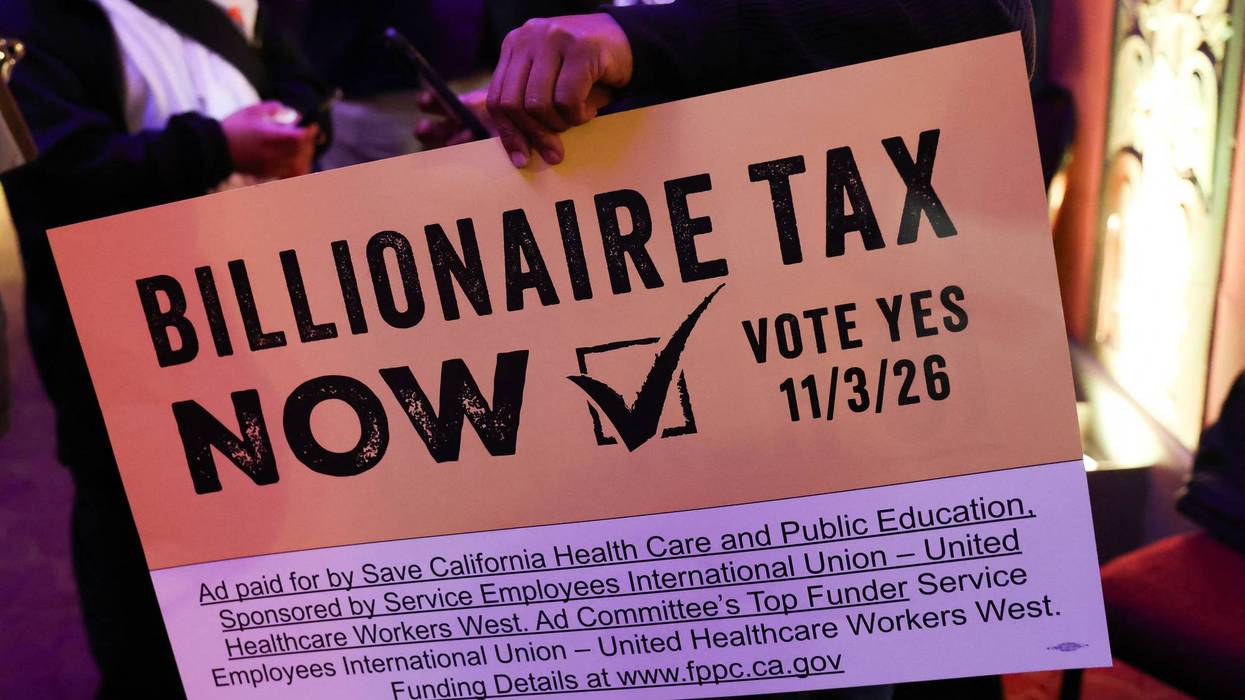
"I believe it's a patriotic duty to pay taxes, and I do so with pride. Our tax system favors wealthy people, and the least we can do is pay up rather than try to avoid it."
As some of California's richest residents pour tens of millions of dollars into defeating a proposed billionaire tax, one former venture capitalist is making a remarkably different argument: He is perfectly happy to pay it—and he's not alone.
John O'Farrell, a former partner at Andreessen Horowitz, explained Wednesday in a 12-post thread on the social media platform X why he supports the California Billionaire Tax Act, commonly known as Proposition 40, which is on the state's November midterm ballot.
O'Farrell's argument contradicts the chorus of Silicon Valley billionaires and their allies who warn that taxing billionaire wealth would drive the ultra-rich out of California.
"I know where I want to live," he wrote.
"I've been fortunate to benefit from tech wealth. I'm not even close to being a billionaire, but I could easily afford to pay the wealth tax—and any billionaire certainly can—without the slightest effect on my lifestyle," O'Farrell said. "I support a wealth tax at my wealth level also."
Introduced by the Service Employees International Union-United Healthcare Workers West, Prop 40 would impose a one-time 5% levy on people worth $1 billion or more, with an option to pay the tax in annual installments of 1% over five years.
The proposal would require the state to spend 90% of revenue from the tax on healthcare and the rest on food assistance and public education. Proponents say the tax would raise roughly $100 billion in revenue. Critics argue that it could drive wealthy residents and investment from California and stall economic growth.
"I find the knee-jerk opposition of some ultra-wealthy people to the idea of paying any new tax deeply disappointing," O'Farrell said in his thread. "To be honest, I can't understand it. They have so much money they couldn't spend it in multiple lifetimes."
Inequality.org, a project of the Institute for Policy Studies—a Washington, DC-based progressive think tank—exposed 22 California billionaires who have poured more than $150 million into defeating Prop 40, "with more rolling in every day," as Chuck Collins wrote for the group.
"These 22 include a prince, several private jet-flying chums of Jeffrey Epstein, and a bunch of crypto and tech bros designing the [artificial intelligence] future for the rest of us," Collins noted. "On January 1, 2025, these 22 billionaires had a combined wealth of $439.8 billion. By September 1, 2026, their wealth had grown to $722.1 billion. In a little under 20 months, their combined wealth increased $282.6 billion, a gain of over 64%."
O'Farrell's social media thread pointed out how "our tax system favors wealthy people."
"I believe it's a patriotic duty to pay taxes, and I do so with pride," he wrote, adding, "the least we can do is pay up rather than try to avoid it."
"Paying taxes is ultimately a matter of self-interest," he contended. "What kind of society do we want to live in? One that rewards achievement but also emphasizes fairness and opportunity for all—or one in which you have to cower in a bunker and live in fear of the pitchforks?"
"One enables the pursuit of happiness for all," he concluded. "The other, just the pursuit of endless wealth."
Prop 40 is backed by numerous progressive groups including the Teamsters union, California Democratic Socialists of America (DSA), and Our Revolution, as well as individual progressives such as Sen. Bernie Sanders (I-Vt.), Rep. Ro Khanna (D-Calif.), and Democratic congressional candidate Connie Chan, who is running to replace retiring longtime San Francisco congresswoman Nancy Pelosi.
Sanders, Khanna, and others—including Congresswoman Aisha Wahab (D-Calif.), Democratic congressional candidate Randy Villegas, and California insurance commissioner candidate Jane Kim—are set to speak at a series of rallies for Prop 40 starting Saturday in San Francisco.
O'Farrell isn't the only wealthy Californian who supports Prop 40. Nvidia CEO Jensen Huang, whose fortune has soared into the hundreds of billions of dollars, has said he is “perfectly fine” with the proposed tax, telling Bloomberg that he and his family “chose to live in Silicon Valley” and that whatever taxes California applies, “so be it.”

"This was a miscarriage of justice, and what happened... is an outrage that should shock every American," said attorneys representing former Olympian David Hearn.
A Washington, DC judge on Thursday shut down President Donald Trump's push to have the US Department of Justice indict a former Olympian on false charges of vandalizing the Lincoln Memorial Reflecting Pool.
In a 26-page ruling, Washington, DC Superior Court Judge Todd Edelman said that charges against former Olympic canoeist David Hearn deserved to be dismissed with prejudice, meaning future DOJ attorneys can never revive the case against him.
Edelman noted that, within a month of having Hearn indicted on felony vandalism charges, the DOJ moved to dismissed the case "not because it had misidentified Mr. Hearn as the perpetrator of the alleged act, but because no crime occurred."
Rather, Edelman continued, the damage done to the Reflecting Pool "was due to a contractor's 'rushed and botched' installation of the lining while conducting renovations, and Mr. Hearn's actions had no effect on the value of the pool."
Attorneys representing Hearn issued a joint statement celebrating Edelman's decision, while emphasizing that the case "never should have been brought in the first place."
"This was a miscarriage of justice, and what happened to Mr. Hearn is an outrage that should shock every American," the attorneys said. "This administration chose to pursue an unjust prosecution against Mr. Hearn. It should not get repeated chances to wield the power of criminal prosecution against someone who should never have been prosecuted."
Rep. Jamie Raskin (D-Md.), who counts Hearn as a constituent, ridiculed Trump-appointed DC US Attorney Jeanine Pirro for trying to prosecute the former Olympian despite lacking "any evidence" against him.
Raskin also suggested that the president was more deserving of being charged with vandalizing iconic Washington, DC landmarks.
"If Detectives Pirro and [US Attorney General Todd] Blanche are still searching for felon vandals in the Nation’s Capital," Raskin wrote, "I’ve got great leads on who illegally bulldozed the East Wing of the White House and who has been desecrating the Kennedy Center with deranged narcissistic graffiti."
Trump personally pushed the DOJ to indict Hearn, and rebuked Pirro in August after her office moved to drop the case.
"I disagree 100% with Jeanine Pirro... on the Reflecting Pool," Trump wrote in a Truth Social post. "I don't know what she was thinking? To me, it was a pure case of VANDALISM."
Norm Eisen, one of the attorneys representing Hearn, revealed later that month that he and other members of the former Olympian's legal team were seeking grand jury transcripts related to the case to determine “whether prosecutors were candid" when seeking the indictment of their client.