SUBSCRIBE TO OUR FREE NEWSLETTER
Daily news & progressive opinion—funded by the people, not the corporations—delivered straight to your inbox.
5
#000000
#FFFFFF
To donate by check, phone, or other method, see our More Ways to Give page.
Daily news & progressive opinion—funded by the people, not the corporations—delivered straight to your inbox.
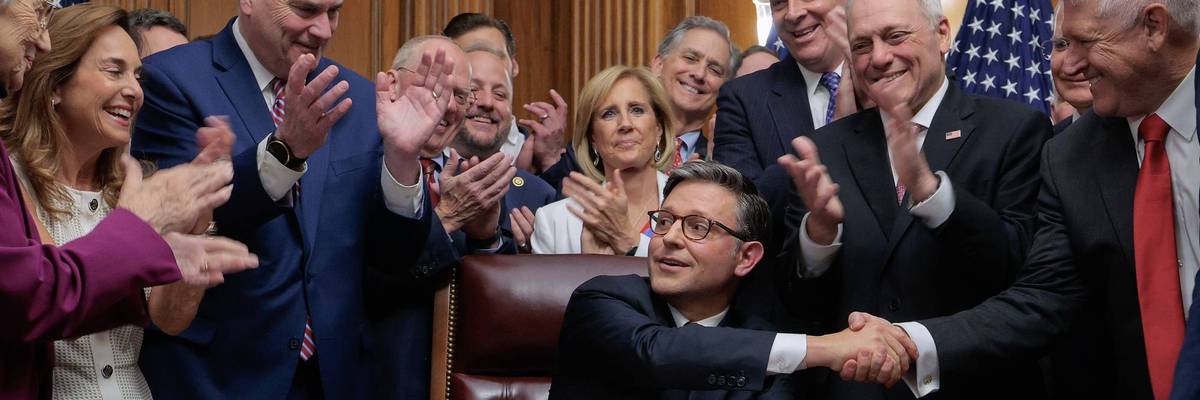
Speaker of the House Mike Johnson (R-La.) is congratulated by his fellow Republicans after signing the One Big Beautiful Bill Act during an enrollment ceremony in the Rayburn Room at the US Capitol on July 3, 2025, in Washington, DC.
The companies avoided more than $26.7 billion in income taxes last year, enough to give free school lunches to every child in America.
Dozens of America's most profitable corporations avoided paying any federal income taxes in 2025, according to an analysis out on Tuesday from the Institute on Taxation and Economic Policy.
The 88 companies—which include Tesla, Southwest Airlines, Live Nation, Palantir, Citigroup, and many others listed in the S&P 500—brought in a collective $105 billion in pretax income last year.
ITEP found that 2025 saw a spike in corporate tax avoidance, enabled in part by new loopholes created by the One Big Beautiful Bill Act signed by President Donald Trump and by his 2017 Tax Cuts and Jobs Act, which reduced the corporate tax rate to 21% from its previous 35%.
The One Big Beautiful Bill Act is expected to hand the wealthiest 1% of Americans $117 billion in tax cuts this year, while those in the bottom 95% are set to pay more in taxes while facing across-the-board cuts to social safety net programs like Medicaid and the Supplemental Nutrition Assistance Program.
It also allowed multimillion- and billion-dollar corporations to find new ways to avoid paying taxes. More than half of the tax-avoiders listed in the report used a provision in the new tax law allowing companies to immediately write off capital investments, reducing their collective taxes by $11.4 billion.
Pharmaceutical and tech companies, meanwhile, were able to take advantage of tax write-offs for research and development, exempting them from approximately another $4.4 billion.
In total, the corporate tax avoidance documented in 2025 by the researchers helped to rob the public coffers of yet another $26.7 billion, enough to give every public school student a free lunch for a year, according to a University of Missouri analysis of the National School Lunch Program.
The researchers said that the full scale of corporate tax avoidance remains unclear, since corporate tax returns are not publicly available. Some companies were also excluded because they are not part of the S&P 500 or have not yet reported their 2025 taxes.
“These findings are not isolated cases—they reflect systemic deficiencies in the corporate tax code,” said Amy Hanauer, the executive director for ITEP. “Without meaningful reform, profitable corporations will continue to pay less than their fair share.”
Dear Common Dreams reader, It’s been nearly 30 years since I co-founded Common Dreams with my late wife, Lina Newhouser. We had the radical notion that journalism should serve the public good, not corporate profits. It was clear to us from the outset what it would take to build such a project. No paid advertisements. No corporate sponsors. No millionaire publisher telling us what to think or do. Many people said we wouldn't last a year, but we proved those doubters wrong. Together with a tremendous team of journalists and dedicated staff, we built an independent media outlet free from the constraints of profits and corporate control. Our mission has always been simple: To inform. To inspire. To ignite change for the common good. Building Common Dreams was not easy. Our survival was never guaranteed. When you take on the most powerful forces—Wall Street greed, fossil fuel industry destruction, Big Tech lobbyists, and uber-rich oligarchs who have spent billions upon billions rigging the economy and democracy in their favor—the only bulwark you have is supporters who believe in your work. But here’s the urgent message from me today. It's never been this bad out there. And it's never been this hard to keep us going. At the very moment Common Dreams is most needed, the threats we face are intensifying. We need your support now more than ever. We don't accept corporate advertising and never will. We don't have a paywall because we don't think people should be blocked from critical news based on their ability to pay. Everything we do is funded by the donations of readers like you. When everyone does the little they can afford, we are strong. But if that support retreats or dries up, so do we. Will you donate now to make sure Common Dreams not only survives but thrives? —Craig Brown, Co-founder |
Dozens of America's most profitable corporations avoided paying any federal income taxes in 2025, according to an analysis out on Tuesday from the Institute on Taxation and Economic Policy.
The 88 companies—which include Tesla, Southwest Airlines, Live Nation, Palantir, Citigroup, and many others listed in the S&P 500—brought in a collective $105 billion in pretax income last year.
ITEP found that 2025 saw a spike in corporate tax avoidance, enabled in part by new loopholes created by the One Big Beautiful Bill Act signed by President Donald Trump and by his 2017 Tax Cuts and Jobs Act, which reduced the corporate tax rate to 21% from its previous 35%.
The One Big Beautiful Bill Act is expected to hand the wealthiest 1% of Americans $117 billion in tax cuts this year, while those in the bottom 95% are set to pay more in taxes while facing across-the-board cuts to social safety net programs like Medicaid and the Supplemental Nutrition Assistance Program.
It also allowed multimillion- and billion-dollar corporations to find new ways to avoid paying taxes. More than half of the tax-avoiders listed in the report used a provision in the new tax law allowing companies to immediately write off capital investments, reducing their collective taxes by $11.4 billion.
Pharmaceutical and tech companies, meanwhile, were able to take advantage of tax write-offs for research and development, exempting them from approximately another $4.4 billion.
In total, the corporate tax avoidance documented in 2025 by the researchers helped to rob the public coffers of yet another $26.7 billion, enough to give every public school student a free lunch for a year, according to a University of Missouri analysis of the National School Lunch Program.
The researchers said that the full scale of corporate tax avoidance remains unclear, since corporate tax returns are not publicly available. Some companies were also excluded because they are not part of the S&P 500 or have not yet reported their 2025 taxes.
“These findings are not isolated cases—they reflect systemic deficiencies in the corporate tax code,” said Amy Hanauer, the executive director for ITEP. “Without meaningful reform, profitable corporations will continue to pay less than their fair share.”
Dozens of America's most profitable corporations avoided paying any federal income taxes in 2025, according to an analysis out on Tuesday from the Institute on Taxation and Economic Policy.
The 88 companies—which include Tesla, Southwest Airlines, Live Nation, Palantir, Citigroup, and many others listed in the S&P 500—brought in a collective $105 billion in pretax income last year.
ITEP found that 2025 saw a spike in corporate tax avoidance, enabled in part by new loopholes created by the One Big Beautiful Bill Act signed by President Donald Trump and by his 2017 Tax Cuts and Jobs Act, which reduced the corporate tax rate to 21% from its previous 35%.
The One Big Beautiful Bill Act is expected to hand the wealthiest 1% of Americans $117 billion in tax cuts this year, while those in the bottom 95% are set to pay more in taxes while facing across-the-board cuts to social safety net programs like Medicaid and the Supplemental Nutrition Assistance Program.
It also allowed multimillion- and billion-dollar corporations to find new ways to avoid paying taxes. More than half of the tax-avoiders listed in the report used a provision in the new tax law allowing companies to immediately write off capital investments, reducing their collective taxes by $11.4 billion.
Pharmaceutical and tech companies, meanwhile, were able to take advantage of tax write-offs for research and development, exempting them from approximately another $4.4 billion.
In total, the corporate tax avoidance documented in 2025 by the researchers helped to rob the public coffers of yet another $26.7 billion, enough to give every public school student a free lunch for a year, according to a University of Missouri analysis of the National School Lunch Program.
The researchers said that the full scale of corporate tax avoidance remains unclear, since corporate tax returns are not publicly available. Some companies were also excluded because they are not part of the S&P 500 or have not yet reported their 2025 taxes.
“These findings are not isolated cases—they reflect systemic deficiencies in the corporate tax code,” said Amy Hanauer, the executive director for ITEP. “Without meaningful reform, profitable corporations will continue to pay less than their fair share.”