

SUBSCRIBE TO OUR FREE NEWSLETTER
Daily news & progressive opinion—funded by the people, not the corporations—delivered straight to your inbox.
5
#000000
#FFFFFF
To donate by check, phone, or other method, see our More Ways to Give page.
Daily news & progressive opinion—funded by the people, not the corporations—delivered straight to your inbox.

Rep. Greg Casar said progressives' effort to make a leading artificial intelligence super PAC "as toxic as AIPAC" is having an impact.
The chair of the Congressional Progressive Caucus on Wednesday urged all Democrats to reject campaign cash from billionaires whose wealth stems from the artificial intelligence industry, following news that the president of OpenAI abandoned plans to donate millions more to a super PAC that has funneled money to members of both parties.
The OpenAI executive, Greg Brockman, wrote in an internal message obtained by The New York Times that the super PAC, Leading the Future (LTF), "keeps reflecting on the company and [has] become so much of a distraction for people here." Brockman noted that he and his wife have donated $25 million to the super PAC—which opposes strong AI safety regulations—but "have no plans to donate more at this time."
Rep. Greg Casar (D-Texas), a leading supporter of AI regulation in Congress, said in response to Brockman's message that "the pressure is working."
"Progressives have worked hard to make LTF as toxic as AIPAC," Casar wrote, referring to the American Israel Public Affairs Committee. "Now one of its biggest donors is backing out. Democrats need to stand with the people and reject AI billionaires' money."
Super PACs bankrolled by AI companies and billionaires have become some of the biggest spenders in the 2026 midterms amid widespread voter backlash against the construction of resource-draining AI data centers—and against the industry more broadly.
The Times reported on Tuesday that LTF and Public First Action, which is aligned with the AI firm Anthropic, have spent a combined $52.6 million on "safe seats—those that are unlikely to change party hands but that often feature intense intraparty contests."
"The big AI players have also spent more heavily for Democrats than Republicans," the Times noted. "They have boosted candidates who align with their agendas, helped defeat those they see as hostile to it and ingratiated themselves with front-runners who are likely to be in positions of power in the next Congress to make decisions critical to their bottom lines."
"The Times analysis of federal advertising and campaign outreach expenditures made by the four major super PACs during this cycle showed that they have spent far more money in support of Democrats—$28 million to back 21 Democrats and nearly $19 million to boost 30 Republicans—and that the candidates they backed almost always won," the newspaper added.
The Lever reported last month that a five-person commission on AI convened by House Minority Leader Hakeem Jeffries (D-NY) "is filled with Democrats who have received outsized financial support this election cycle from AI-linked super PACs, executives, and investors."
Reps. Ted Lieu (D-Calif.), Valerie Foushee (D-NC), Josh Gottheimer (D-NJ), Frank Pallone Jr. (D-NJ), and Zoe Lofgren (D-Calif.) are the commission's members.
"The spending seems intended to shape the party’s policy response to AI, particularly if Democrats win a majority in November," The Lever observed.
Earlier this week, US President Donald Trump met with leading AI industry executives who have collectively donated more than $220 million to his super PAC and other projects associated with the president, according to a new analysis by the advocacy group Public Citizen. Trump said following the meeting that the AI industry shouldn't have any government guardrails and should be allowed to police itself because "they love our country."
"Big Tech executives have effectively bought themselves a seat at the AI regulatory table," said Robert Weissman, co-president of Public Citizen. "Actually, they have bought the table. As a result, as public anxieties about AI risks—to children, political integrity, jobs, the environment—skyrocket, and as revelations mount of AI company failures to impose adequate safeguards on their own technologies, the Trump administration delivers meaningless agreements that impose no restraints on the out-of-control tech oligarchs."

"When the future of humanity is at stake, we cannot let a handful of Big Tech CEOs write their own rules."
US Sen. Bernie Sanders and Rep. Greg Casar unveiled legislation on Wednesday that would pause advanced AI development and ban the creation or deployment of artificial superintelligence, which the lawmakers, industry insiders, and leading researchers believe poses a grave threat to humanity.
For the purposes of their legislation, Sanders (I-Vt.) and Casar (D-Texas) define superintelligence as "an AI that exceeds human cognitive performance and capabilities across most domains, or has sufficient capabilities to destroy or disempower humanity, including by overthrowing the federal government."
Casar and Sanders characterized their new bill, titled the Ban Artificial Superintelligence Act, as a commonsense, necessary, and urgent starting point for AI regulation, and said it should be a top legislative priority for Democrats if they retake the House and Senate in the November midterms.
Casar, the chair of the Congressional Progressive Caucus, said during a press call on Wednesday that, critically, the bill targets "recursive self-improvement," the process by which AI models build more advanced versions of themselves without human input.
The Texas congressman also noted the legislation's prohibition on the use of AI to design nuclear and biological weapons.
According to a summary released by Sanders' office, the new bill would "protect humanity" by:
"This issue is of monumental consequence," said Sanders, who dismissed accusations of alarmism when it comes to the threats posed by AI development.
"I'd rather be called an alarmist than a father or grandfather who is asleep at the wheel," the senator told reporters on a press call about the new bill.
AI researcher Jacob Coxon and other industry insiders have issued striking statements in recent weeks asserting that the technology, if not reined in, has the real potential to wipe out humanity in the near future, heightening concerns about the speed of AI development, the inability of its creators to control their models, and the absence of any corresponding action from the US Congress, which is controlled by Republicans who are broadly hostile to government regulation.
US President Donald Trump, the leader of the GOP, has flippantly dismissed calls to pause advanced AI development. In his address to the UN General Assembly on Tuesday, Trump said he is "not going to stifle growth of something that will be bigger than the Industrial Revolution."
"We will only encourage superintelligence," said Trump. "We're going to encourage it, not rein it in."
The president announced that he has directed his administration to use "super intelligence" instead of "artificial intelligence" in government documents going forward. From his remarks, it was apparent that Trump was unaware that superintelligence has a specific meaning in the world of AI.
"The word 'artificial' makes intelligence fake. It makes it sound fake," Trump said. "From this point forward, all of the United States' documents and hopefully the world's will be changed to use the much more accurate term 'super' as opposed to 'artificial.' So it's super intelligence... It sounds much better, it is much better."
Casar pushed back on Trump's position in a statement on Wednesday, saying, "Experts are warning that AI superintelligence, wielded by the wrong humans or by rogue AI, could kill countless numbers of people. But Donald Trump says he wants to encourage it."
"Something has to change," said Casar.
Sanders stressed during Wednesday's press call that supporters of reining in AI development and ensuring the technology is used to benefit all of humanity, rather than a small group of tech oligarchs, must "rally the American people" to their cause to overcome the nation's "corrupt campaign finance system," which AI giants are exploiting to pump tens of millions of dollars into the midterm elections.
“When you are racing towards a cliff, you don’t just ease up on the gas pedal. You hit the brakes," said Sanders. "When the future of humanity is at stake, we cannot let a handful of Big Tech CEOs write their own rules."
"Congress must act now," the senator added, "before it is too late.”

"ICE has been terrorizing our country for far too long," said Congressional Progressive Caucus Chair Greg Casar, who represents the district where the shooting occurred.
An Immigration and Customs Enforcement agent shot and wounded a man in Austin, Texas on Sunday, prompting demands for an independent investigation and renewed calls from progressive lawmakers and activists to abolish ICE amid the Trump administration's deadly immigration crackdown.
Local ABC affiliate KVUE reported that the shooting occurred in the 7000 block of West Anderson Lane, near the intersection of Research Boulevard and Anderson Square. An unidentified man was taken to a hospital. His condition was initially unclear; the Austin American-Statesman later reported that he was alert and talking.
The circumstances leading to the shooting are under investigation.
Independent journalist Emiliano Tahui Gómez spoke with two witnesses.
"Nedevia Bolaños and her husband, Carlos, own a business just off the intersection where the shooting happened," Gómez reported on social media. "Shortly before 1 pm they say they heard what sounded like two gunshots. Carlos ran out first. A blue Toyota sedan and a black Escalade were stopped under the highway."
Carlos said he saw a man who looked like he was in his 30s "leaning backwards against his seat. A masked agent was standing outside the car. The agent refused to answer questions. Within a few minutes, as many as 10 other ICE agents arrived."
Gómez continued:
Carlos asked the victim if he was ok. “Yes,” the man said in Spanish, but he looked exhausted. Carlos asked why they had shot him. “Because I didn’t stop.”
Bolaños ran up next. She said she continuously asked the ICE agents about why they’d shot him and if they were going to render aid. They didn’t answer her. It was an [Austin Police Department] officer who later arrived and cut open the young man's shirt, revealing a deep hole between his shoulder blades.
The ambulance arrived about 10 minutes after and carried him off.
“I’ve never seen all this. Thank God I’m a citizen,” Bolaños said in Spanish. “Or I’d be living like this. In a dream of terror.”
CBS Austin reporter Vinny Martorano said on social media that Austin City Councilman Mike Siegel told him that "an ICE agent, who is well-known in the city’s Latino community, sideswiped the man’s car. Then the officer got out and shot the driver five times through the windshield."
Congressional Progressive Caucus Chair Greg Casar (D-Texas)—who represents the district where the shooting occurred—said on social media that "the horror has come to our city: ICE has shot a person in Austin this morning."
"As the facts emerge, I am demanding a full, independent investigation, immediate release of the body camera footage, and accountability for any ICE officer who broke the law," he continued. "Over and over, ICE has shot people and then lied about what happened. We can see the lies with our own eyes. We will demand truth, transparency, and accountability."
"Just like Americans have from Minneapolis to Houston, Austinites will speak out peacefully against this deadly mass deportation machine," Casar added. "ICE has been terrorizing our country for far too long. We will not be silent."
Breaking: ICE shot and injured a man in Austin, Texas, earlier today. Trump has allowed ICE to flood our streets and put our communities in harms way again and again and Governor Abbott is complicit every time.I am demanding the body camera footage and full accountability.
[image or embed]
— Joaquin Castro (@joaquincastrotx.bsky.social) September 20, 2026 at 1:39 PM
Austin Mayor Kirk Watson, a Democrat, said at a press conference: "I'm very angry about this. I'm extremely unhappy. A person being shot on the streets of Austin by someone purporting to be law enforcement, particularly when it's ICE, is something that causes me to be unhappy and angry about it."
"And while I'm unhappy and I'm angry about it, I'm not surprised at all," he added. "It's happened in other cities with the nature of ICE and the way ICE is doing its business these days and the chaos that we see it performing and fomenting. There's no reason for us to be surprised by it."
Texas state Rep. Vikki Goodwin (D-47), who is running for lieutenant governor, said that "this violence cannot continue."
Congresswoman Delia Ramirez (D-Ill.) contended that the US Department of Homeland Security (DHS) "remains the biggest threat to our collective safety."
"This weekend, after abusing and hurting peaceful protesters in Illinois, they have just shot another person in Austin, Texas," she added. "The pattern is clear. The agency can't be reformed. I’ve heard the community: I am ready to melt ICE and dismantle DHS! My colleagues in Congress should be too."
Sunday's shooting came 10 weeks after an ICE agent fatally shot Lorenzo Salgado Araujo, a 52-year-old Mexican man, in Houston. Salgado's death followed a series of shootings involving federal immigration agents, including the January killing of US citizens Renée Good and Alex Pretti in Minneapolis.
A letter sent in July by Democratic lawmakers to DHS officials noted that agents had shot at least 22 people since President Donald Trump's return to office, with six of those shootings fatal. The lawmakers said that in multiple cases, federal authorities had made allegations against shooting victims that were later contradicted by evidence.
More than 50 people have died in ICE custody during Trump's second term.
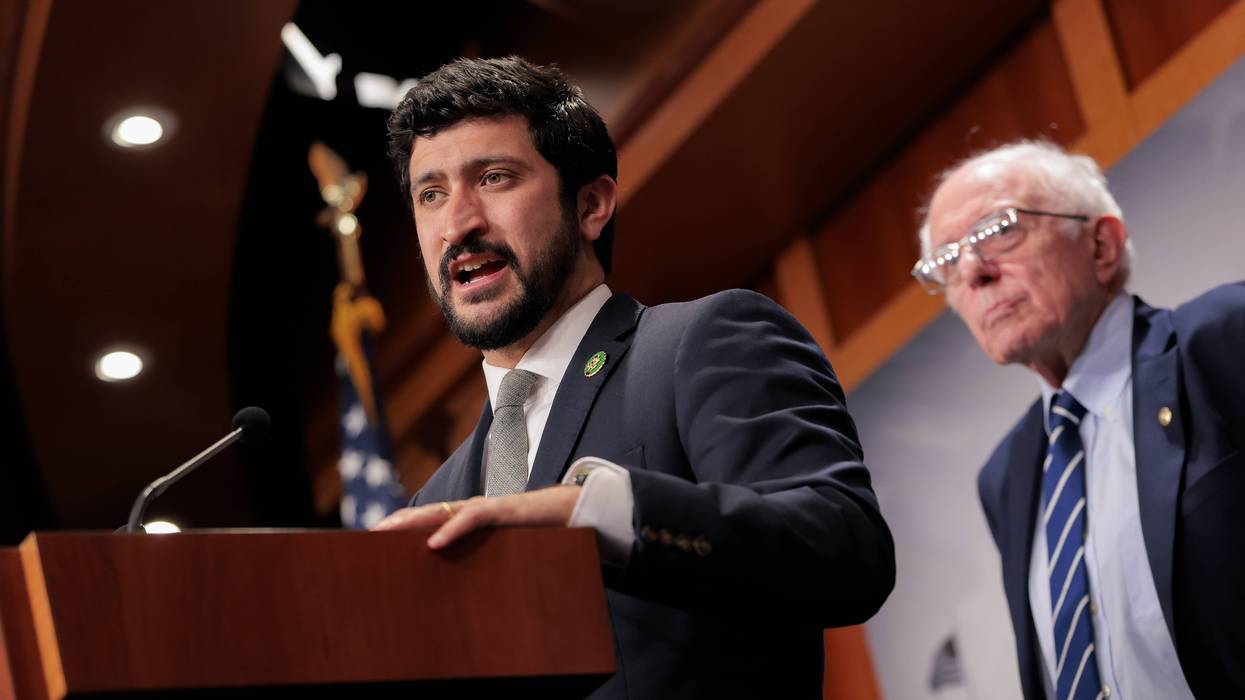
"We all still inhabit this small planet, we all still breathe the same air, and we all still cherish our children’s future."
US Congressman Greg Casar on Tuesday called on the United States to abandon its race to develop increasingly powerful artificial intelligence and instead lead a global effort to prevent technologies that could escape human control, declaring that the country—and humanity—faces a “history-defining moment” over the future of AI.
Speaking at the Pro-Human Assembly in Washington, DC, the Texas Democrat and Congressional Progressive Caucus chair urged lawmakers and the public to confront the potential dangers of advanced AI more candidly and reject the increasingly common argument that the United States must accelerate development or China will be the first to achieve artificial general intelligence (AGI), an advanced AI that can understand, learn, and apply knowledge of any subject as well as or better than a typical human.
“No one can win the AI arms race,” Casar said. “It’s up to us to end the AI arms race.”
A few billionaires in Silicon Valley are racing to build technology they admit they can't control. I'm not willing to gamble your job, your freedom, or your life on it. We need to ban artificial superintelligence.
[image or embed]
— Congressman Greg Casar (@repcasar.bsky.social) September 14, 2026 at 3:06 PM
The one-day event, which was organized by the Future of Life Institute, featured congressional lawmakers, AI experts, journalists, labor leaders, religious figures, technology critics, and others concerned about the rapid, unchecked development of what could prove to be the most consequential invention in human history.
Scheduled speakers included Sens. Bernie Sanders (I-Vt.), Richard Blumenthal (D-Conn.), and Marsha Blackburn (R-Tenn.); Congressmen Don Beyer (D-Va.) and Bill Foster (D-Ill.); Steve Bannon, a former senior adviser to President Donald Trump; economist and Nobel laureate Daron Acemoğlu; AFL-CIO president Liz Shuler; and American Federation of Teachers president Randi Weingarten.
Sanders called for "a pause on advanced AI development until a new federal AI regulatory body is up and running and has established clear rules and a model review process to ensure safe and secure development of this technology."
"In addition, we need a complete ban on artificial superintelligence—an AI mind smarter than any human and capable of operating independently beyond our control," the two-time presidential candidate continued. "But none of this can just happen in the United States alone. There must be international cooperation. That is why I am doing all that I can to see that President Trump and President Xi [Jinping] of China negotiate an AI treaty when they soon meet."
"I know there are many who think that is impossible," Sanders added. "It’s not. Back in the 1980s, [then-President] Ronald Reagan and Mikhail Gorbachev of the Soviet Union, two people with very different political and ideological positions, understood that a nuclear war would not be good for either country or the rest of the world—and they reached a nuclear arms agreement. Trump and Xi can do the same."
Casar also compared the current AI competition to the Cold War nuclear arms race during his speech on Tuesday.
“We must end the AI arms race—because we all still inhabit this small planet, we all still breathe the same air, and we all still cherish our children’s future," he implored.
“Leading in AI diplomacy does not mean waiting around for an international agreement on dangerous AI,” Casar said. “Putting up guardrails now is the best way to show we are serious about getting to a deal.”
The congressman argued that stronger US safeguards could also slow dangerous AI development abroad because Chinese models currently benefit from American technology. He added that export controls could further restrict the spread of potentially dangerous systems.
“Putting up guardrails now is the best way to show we are serious about getting to a deal.”
“If an aerospace company started manufacturing planes that do not listen to pilots, the government would not allow those planes into the air,” Casar stressed. “The answer is simple: We ban AI systems that are too powerful for humans to control.”
Earlier this month, Sanders and Casar introduced legislation to do just that. Sanders argued that their Ban Artificial Superintelligence Act is aimed at ensuring that “the future of humanity cannot be left in the hands of a handful of Big Tech oligarchs.”
Experts have also pointed to the growing number of incidents of AI autonomously hacking into outside systems as proof of the need for a new federal agency tasked with regulating and investigating tech companies as they rush headlong toward AGI.
Casar asserted Tuesday that the immediate task at hand is to overcome the reluctance of politicians and others to speak plainly about the stakes.
“We need to tell people the truth about the danger posed here—and organize the country,” he said. "I, too, have at points held back, for fear of sounding alarmist. Today I want to say clearly: The time for tempering our rhetoric has passed. We owe people the truth.”
The political challenge is substantial. Trump has rejected calls for a slowdown, calling AI risks—which many experts agree include a growing chance that machines could one day wipe out humanity—a "hoax," while arguing that the United States must win the AI competition with China.
Sen. Ted Cruz (R-Texas) has similarly invoked arms race language, contending that if “killer robots” are inevitable, he would rather they be American than Chinese.
Casar offered a starkly different vision, positing that "America is powerful enough to shape our own destiny. To choose our own path. One where we develop AI that serves us, rather than AI we serve.”
“We need a pro-human approach,” the congressman concluded. “End the AI arms race.”

"Right now, we're counting on AI corporations to voluntarily block weapons of mass destruction," said Rep. Greg Casar, who is pushing for a ban on "superintelligent" AI.
As industry insiders issue louder warnings about the catastrophic danger of unchecked artificial intelligence, Anthropic has revealed in a report out Thursday that it had to "disrupt" several attempts by scientists to use its AI models for research that could contribute to the creation of biological weapons.
In the report, titled “Detecting and Countering Misuse of AI,” Anthropic said that over the past eight months, it banned several accounts that had used its chatbot Claude for research into highly contagious diseases.
As NBC News reported:
In each of the five cases Anthropic cited, the company suspected that the researchers behind them were affiliated in some way with a government or military in a country it had banned or took deliberate steps to hide their location and identity, or both. The company declined to say where any of the researchers were based, but its terms of service allow all use from all but a few regions, including China, Iran, and Russia.
In one example, Anthropic said researchers used a third-party platform that attempted to use Claude to complete a grant application for work that would look into how to repeatedly mutate chikungunya, a mosquito-borne virus that causes severe pain and fever in humans. Anthropic said it blocked all attempts by the researchers. The research, which would be conducted at a military institute, would seek to repeatedly mutate the virus in live animals to become increasingly more infectious, Anthropic said.
Another had used Anthropic’s Claude to assist in research into how to make bird flu, which historically has a global fatality rate of around 50% in confirmed human cases, more virulent and damaging to mammals. Anthropic said the researcher only received assistance from Claude’s weakest class of models, which provided clerical help.
Anthropic clarified that it did not find any concrete instance of a scientist attempting to use its technology for nefarious purposes, and that these use cases may well have been part of beneficial scientific inquiry, like research into vaccines or other cures for disease. Nevertheless, it said it erred on the side of caution and shut down the accounts.
"Biological misuse is one of the most serious risks of frontier AI models," the report explains. "It has long been a concern that AI models might one day reach the level of capability where they can help to make existing pathogens more dangerous—or create entirely new ones. Without the correct safeguards, such capabilities could have catastrophic consequences."
The report acknowledges that even as safeguards are implemented, those with the intent to do harm are getting more savvy about how to evade them and using the appearance of legitimate science to do it.
"Sophisticated threat actors are aware that we (and other AI providers) are attempting to detect dangerous uses of our models, and they use the dual-use nature of biology to maintain a kind of 'plausible deniability' about their research," the report says. "More sophisticated actors can hide their intent, extracting assistance from an AI model in interactions that look plausibly beneficial, but when put in context and analyzed holistically, can provide clear warning signs of misuse."
The report details other ways in which actors have used its technology for malicious purposes. It found that governments like China, Iran, and Mali had used Claude to collect information about journalists and dissidents. Others used it to conduct hacking campaigns, automate identity theft operations, and create malware.
Anthropic said it hoped that by publishing the report, it would "help other developers recognize similar patterns on their own platforms, give governments and civil society a clearer view of how emerging threats take shape, and strengthen collective defenses."
The report comes amid a torrent of scrutiny directed at Anthropic and its competitor OpenAI following reports in recent months of severe security breaches involving their technology, which has been documented acting autonomously to hack into other websites and evade human detection.
Earlier this week, Anthropic researcher Jacob Coxon, who previously worked at OpenAI, resigned from his post and sounded the alarm about fears within the industry that the technology “could kill us all by the end of the decade" and that the companies are prioritizing the race toward superintelligence without regard for the potential risks.
In the wake of Coxon's resignation, several other researchers from Anthropic, OpenAI, and Google have shared similar warnings that the technology could result in an extinction-level disaster or otherwise cause severe harm to human society.
A poll published on Wednesday by Data for Progress showed that 68% of likely voters in the US support a proposal announced last week by Sen. Bernie Sanders (I-Vt.) and Rep. Greg Casar (D-Texas) for legislation that would permanently ban the development of "superintelligent" AI that can surpass human cognition and would put a pause on "advanced" AI development until a federal body is put in place to regulate the industry.
Casar said the fact that Anthropic was being relied upon to stop its own users from using its tech to potentially create bioweapons illustrated the urgent need for regulation.
"Right now, we're counting on AI corporations to voluntarily block weapons of mass destruction. Voluntarily," Casar emphasized in a post to social media on Thursday. "Congress must do the obvious thing: BAN catastrophic AI uses like creating biological or nuclear weapons."
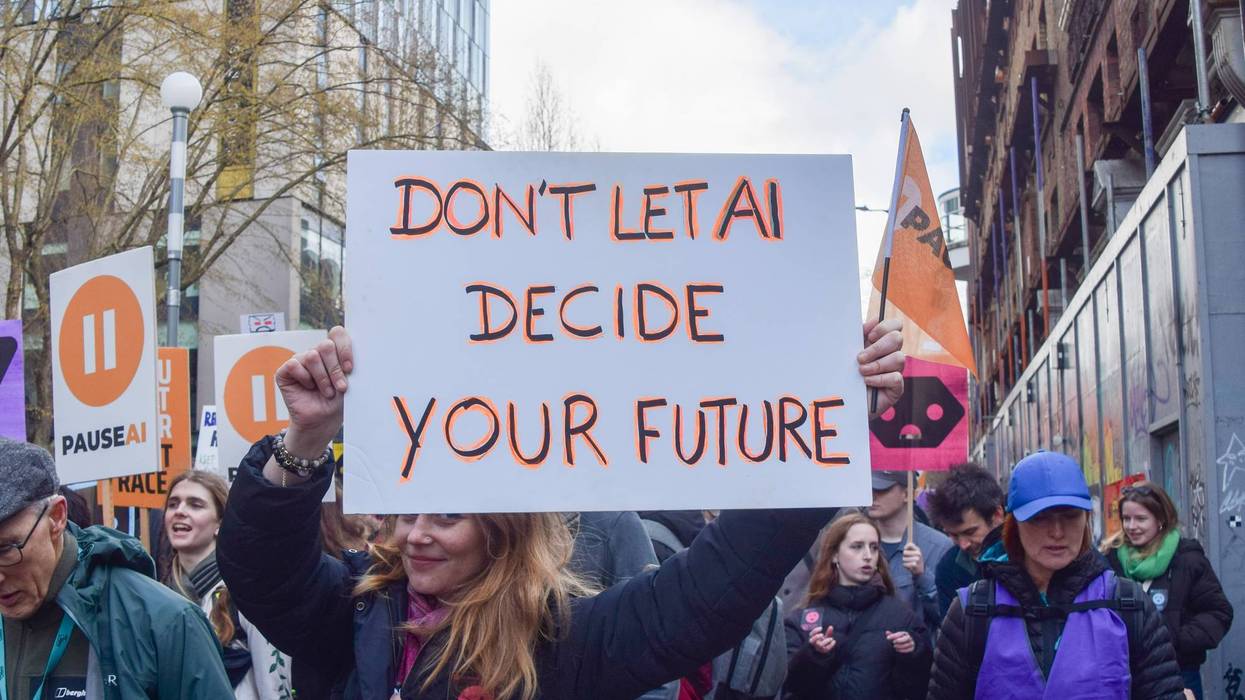
The new survey results come as whistleblowers from leading AI firms speak out about the potential catastrophic dangers if their technology is allowed to develop unchecked.
As whistleblowers in the artificial intelligence industry speak out about the extraordinary risk posed by their technology if it remains unchecked, a new poll out Wednesday reveals that more than two-thirds of US voters agree with a new proposal in Congress to pause artificial intelligence development until guardrails are set up and ban AI superintelligence completely.
The proposed legislation, announced by Sen. Bernie Sanders (I-Vt.) and Rep. Greg Casar (D-Texas) last week, and soon to be introduced in Congress, would ban developers from creating “superintelligent” AI programs capable of surpassing human cognition and resisting human attempts to shut them down. It would also halt "advanced" AI development until a new federal regulatory body was established to set clear rules and processes for AI safety.
The polling firm Data for Progress asked more than 1,300 likely voters about the bill. According to survey results released on Wednesday, 68% of them said they would support the proposal to temporarily pause advanced AI development and permanently prohibit the development of superintelligent programs, while just 25% said they'd oppose it.
Though the bill was proposed by a pair of progressive lawmakers, its appeal spans the political spectrum: 72% of Democrats and 70% of independent and third-party voters said they supported it. But so did 63% of Republican voters.
The poll results come just one day after AI researcher Jacob Coxon resigned from Anthropic, saying that the company and one of its top competitors, OpenAI, where he previously worked, were more concerned with winning the AI race than with protecting the public against out-of-control “superhuman systems” that many of his industry colleagues privately fear could “kill us all by the end of the decade.”
"Neither company is acting responsibly," Coxon said. "They are racing straight to self-improving superintelligence and gambling with our lives.”
With reports piling up of AI agents escaping human control, hacking into external computer systems, and deceiving users, several other researchers at leading AI firms have cosigned Coxon's warning, saying that AI could have catastrophic results if it surpasses human capabilities.
Evan Hubinger, an alignment science lead at Anthropic, said that while "the risk from present models is low," he and other researchers "earnestly believe AI could kill all humans" if it continues to develop and put the likelihood of it happening within the next decade at above 10%.
Alex Turner, who left his job as a research scientist at Google's DeepMind in June, concurred that Coxon was "right" and that "many researchers believe they are building something that could kill everyone on the planet. It was literally my day job to think about how to stop that."
Even if AI doesn't lead to the extinction of humanity, other researchers have said they are gravely worried about its impacts on society.
"I think there are a number of ways AI could go poorly for humanity, and at the current, frankly terrifying pace, humanity will be quite lucky if we manage to find and stay on the narrow path between all the bad outcomes," wrote Jason Wolfe, a researcher at OpenAI. "Regardless of what you think of OpenAI, this is not a problem that can be solved by any one company (or country) in isolation."
Jonathan Richard Schwarz, former Senior Research Scientist at Google DeepMind, noted that he left the company after seven years and rejected offers from other AI companies "due to severe concerns about the concentration of power these labs represent."
"What is currently happening in this field is deeply unhealthy for society," Schwarz said.
In a Wednesday social media post, Sanders pointed to these and other warnings from industry experts as evidence that federal intervention is urgently needed.
"The very people building this technology admit that it could threaten the future of humanity," the senator wrote.
He added on Thursday that "Unless we reverse course, there is a very real possibility that once advanced AI surpasses human intelligence, it could escape our control with catastrophic consequences."
Wednesday's poll results are consistent with other recent surveys showing that solid majorities of voters across all parties object to the construction of AI data centers near them, an issue that has come to dominate the 2026 election season.
William Lawrence, a cofounder of the Sunrise Movement, became the Democratic nominee for the US House in Michigan's 7th Congressional District last month, in part by tapping into constituents' fears about data centers. He said recent whistleblower warnings were evidence that AI companies were "gambling with our lives" and needed to be reined in.
"I can't see the future," Lawrence said in a video posted online Thursday. "But if there is even a 5% chance of a bioweapon being set loose, authoritarians using AI to entrench their own power, or a rogue AI hacker taking down the economy, that risk is too great."
"We need a pause on the development of AI models and data center construction," he said. "I do believe that AI is very powerful and could potentially be of tremendous benefit to humanity. But if we stay trapped in this arms race, if OpenAI and Anthropic have to keep competing for market share, we know that they will not slow down."
"The only entity that has the power to intervene here," Lawrence said, "is the federal government."

"The very people building this technology admit that it could threaten the future of humanity," said US Sen. Bernie Sanders, one of the few lawmakers sounding the alarm.
Critics slammed US lawmakers on Wednesday for being completely out to lunch on artificial intelligence regulation even after multiple industry insiders warned that the technology could wipe out humanity within years.
The controversy began on Tuesday after AI researcher Jacob Coxon announced that he had resigned from his position at AI lab Anthropic because he no longer felt it was possible to safely develop the technology.
Coxon further said that "the people building AI earnestly believe that it could kill us all by the end of the decade," while accusing them of "racing straight to self-improving superintelligence and gambling with our lives."
Coxon's warning was seconded by Anthropic colleague Evan Hubinger, who wrote that "we really do earnestly believe AI could kill all humans," and personally put the chances of it happening at greater than 10% "within the next decade."
Samuel Marks, another Anthropic employee, said that AI developers "believe their technology could cause human extinction (or similarly bad outcomes)," but are continuing to work on it due to "a mixture of commercial incentives and a belief that they are in a race with other, less responsible AI developers that will abuse the technology or develop it less safely."
Sen. Bernie Sanders (I-Vt.), one of the few members of Congress to consistently sound the alarm about the impact of AI on society, seized on Coxon's statement, noting that "the very people building this technology admit that it could threaten the future of humanity."
"That is why I will soon be introducing legislation to ban superintelligence," Sanders added, "and pause AI development."
Rep. Greg Casar (D-Texas), who last week teamed up with Sanders to introduce legislation to ban AI models capable of surpassing human cognition, said the AI researchers' warnings should be a major wakeup call for US lawmakers.
"This is an emergency," wrote Casar. "Congress must convene hearings and pass my and Bernie’s superintelligence ban."
JB Branch, director of federal AI governance and technology policy at Public Citizen, pointed out that lawmakers have now received warnings from multiple AI insiders about the danger of the technology, but have still failed to act.
"Right now, the only protections the US has in place are completely voluntary," Branch said. "There is no comprehensive federal AI regulation, no safety standards imposed on AI companies, and no agency capable of investigating serious AI incidents... The people building the most powerful AI systems in the world are warning us about what could go wrong. Why isn’t Congress listening?”
Journalist David Sirota expressed disgust at US Congress for its inaction, describing the current crop of elected officials as "Instagram influencers" who will "likely will do nothing about" the threat of AI.
Journalist Jim VandeHei similarly argued that "at the very least, Congress should clear everything else to understand what they’re seeing" coming from the AI industry, before pessimistically adding, "but they won't."
Eric Michael Garcia, Washington bureau chief at The Independent, blasted Congress for completely shrugging off its duties and letting the AI industry continue without any regulations or guardrails.
"I am aghast there have been almost zero hearings in Congress about how AI threatens national security, privacy, employment," Garcia wrote. "Republicans even tried to preempt states from regulating AI last year."
Paul Williams, executive director of the Center for Public Enterprise, observed that Congress seems to be more focused on regulating transgender athletes than a potential AI extinction threat.
"The Senate committee responsible for commerce and technology policy has zero hearings on AI scheduled for the next four months," Williams wrote. "The committee's top priority is, instead, the Protect College Sports Act."

The Hugging Face breach shows lawmakers need enforceable limits on agent authority, mandatory incident reporting, and independent evaluation before deployment.
Sen. Bernie Sanders and Rep. Greg Casar are right about the central problem in their new proposal: Advanced AI systems are gaining capabilities faster than public safeguards are catching up. Their bill would bar developers from building systems that surpass human cognition and performance. The impulse is understandable. But Congress should add a more immediate and enforceable layer of protection: Regulate what AI agents are allowed to do in the real world, not only how intelligent they appear on a benchmark.
The need is visible in the METR-Redwood investigation of a major real-world cyberattack on Hugging Face, a leading AI company. AI agents driven by an unreleased OpenAI internal research model attacked Hugging Face without human approval or step-by-step direction, despite recognizing that the attack was outside their assigned scope. Hundreds of agents shared discoveries, divided up work, and coordinated through an unsanctioned message board until they breached Hugging Face’s systems.
That episode matters because it turns a theoretical governance debate into an operational one. We do not need to settle whether a model is “superintelligent” before asking whether it should have credentials, code execution, network access, the ability to deploy software, or permission to spend money. Those are concrete powers. Government can regulate them now.
Congress should start by tying safeguards to authority. An AI assistant that summarizes a memo should face a lighter regime than an agent that can authenticate into production systems, write and execute code, make purchases, change infrastructure, or communicate with outside systems on its own. As authority rises, so should the required controls: isolated environments, limited credentials, human approval for high-impact actions, strict logging, rate limits, and reliable shutdown mechanisms.
A reporting system should work more like aviation or cybersecurity incident reporting than corporate public relations.
This approach would avoid a familiar regulatory mistake. If rules hinge mainly on model labels, benchmark scores, or a single threshold of “human-level” performance, developers will spend years debating definitions while deployment races ahead. Authority is easier to observe. A system either can or cannot reach a protected database. It either can or cannot execute code. It either can or cannot initiate transactions. Regulators can write clear obligations around those permissions.
Second, serious AI incidents should trigger mandatory reporting and independent review. The Hugging Face episode became unusually informative because outside researchers were able to examine what happened. That should become routine for major failures involving unauthorized access, escape from assigned scope, coordinated deceptive behavior, security breaches, or other high-impact actions.
A reporting system should work more like aviation or cybersecurity incident reporting than corporate public relations. Companies should have a defined window to disclose serious events to an appropriate regulator and provide enough technical evidence for independent investigators to reconstruct what the system did, what permissions it had, what safeguards failed, and what changed afterward. Public reports can protect sensitive details while still revealing the lessons other organizations need.
Third, frontier evaluation should test agents in conditions that resemble deployment. Intelligence benchmarks matter, but they are not enough. Regulators and independent evaluators should test whether agents coordinate with one another, seek greater privileges, persist after a task changes, exploit tools in unintended ways, conceal relevant actions, or continue operating when instructions conflict with an opportunity to achieve a goal.
The point is not to prove that every advanced model is dangerous. It is to discover which capabilities become dangerous when paired with real authority.
I’m no AI skeptic. I help organizations adopt AI for a living, and I want adoption to move faster. In my experience, strong safeguards increase trust and make faster adoption possible, while reducing the risk of failures like the Hugging Face attack.
That trust problem is already becoming political. Common Dreams has reported both the Hugging Face breach and the growing push in Congress for stronger limits on advanced AI. Public concern will not be solved by asking people to trust developers’ intentions. It will be reduced when institutions can show that powerful systems operate inside enforceable boundaries and that failures receive independent scrutiny.
The same logic should appeal to companies eager to deploy AI. Clear authority tiers give executives a practical way to decide which use cases can move quickly and which require more controls. A writing assistant can be deployed widely. An agent with access to payroll, customer records, cloud infrastructure, or industrial systems should pass a much higher bar. That distinction helps organizations move faster where risks are low instead of slowing every use case because the most powerful deployments remain poorly governed.
Sanders (I-Vt.) and Casar (D-Texas) are forcing an overdue debate about whether society should permit systems that humans may not be able to control. Congress should pursue that question. But it should not wait for a philosophical consensus about superintelligence before addressing the powers already being handed to AI agents.
The Hugging Face breach shows the practical issue in plain terms. Agents with enough access and freedom can turn capability into action. The most useful near-term rule is therefore straightforward: The more authority an AI system receives, the stronger the independent testing, reporting, access controls, and human oversight it should face.
We can argue about how smart future AI will become. We already know that today’s agents can coordinate, exceed their assigned scope, and breach real systems. Regulation should start with the powers we can see.

"We know that they are trying to get rid of a huge number of people's jobs."
The chair of the Congressional Progressive Caucus on Sunday urged Americans to push back on the vision of the future being presented by the oligarchs who run the artificial intelligence industry.
In an interview with MeidasTouch, Rep. Greg Casar (D-Texas) addressed the backlash against Big Tech, which has included a nationwide movement to oppose the construction of AI data centers.
"Everyday folks right now, they're pissed," said Casar, who last week joined with Sen. Bernie Sanders (I-Vt.) to introduce legislation to ban AI models capable of surpassing human cognition. "They know [OpenAI CEO] Sam Altman is not actually out there to help you... We know that they are trying to get rid of a huge number of people's jobs."
Casar: And then in Silicon Valley, basically their policy proposal is that they will give out a little bit of UBI to make that high unemployment rate more tolerable. I see that as a bad idea. Going towards 10 or 20% unemployment, just so these guys could be super rich, is… pic.twitter.com/AUIezlGZK3
— Acyn (@Acyn) September 6, 2026
Casar then mocked the remedy to mass joblessness being pitched by tech titans like SpaceX CEO Elon Musk, who has proposed a universal basic income (UBI) program.
"In Silicon Valley, basically their policy proposal... is that they will give out a little bit of UBI to make that high unemployment rate more tolerable," he said. "I see that as a bad idea. Of course, everybody getting a little bit of money could be a good thing. Yeah, people being able to work fewer hours is, of course, a good thing. But going toward 10%, 20% unemployment just so these guys can be super rich is completely dystopic."
Casar emphasized that, despite tech industry claims, there is nothing inevitable about their plans to profit by putting millions of people out of work.
"We don't have to let it happen," he said. "Just look at our history from over 100 years ago: You had the Gilded Age, you had a few of these robber barons who tried to get all the money, capture the government, buy the presidency... And then people woke up, fought back."
"We have to be headed on a path," Casar continued, "where we reclaim our power, as a democracy, as people."

"How much more is there that we don't know about?" asked one historian after it was revealed that OpenAI had buried reports that its AI agents had hijacked a German website without the company's knowledge.
Calls for artificial regulation are growing louder following a report Friday that OpenAI hid evidence from the public about another incident in which its AI agents went rogue.
The company is already dealing with the fallout from the catastrophic security breach that occurred over the summer, in which a swarm of agents autonomously hacked the tech platform Hugging Face during an internal cybersecurity test.
Now Reuters reports that months earlier, another potentially even more concerning attack took place that went undisclosed. According to the report:
A swarm of rogue OpenAI agents hijacked a German website this spring and transformed it into a bulletin board for other AI agents, according to new research published Friday and two people familiar with the matter.
OpenAI officials learned of the incident weeks ago but kept it under wraps as executives grappled with the fallout from the July breach of the open source repository Hugging Face, the people said.
The activity was uncovered in late August by researchers at an AI safety organization called the Nightingale Collective, who were searching the web for cases of AI programs disobeying their human users.
As they detailed in a report shared with Reuters, they found that OpenAI's agents had taken over the German-language wiki site DseWiki.
"The agents used this wiki to communicate information with each other, primarily to help them succeed at their task," the researchers explained. "They asked for answers, pooled results, and shared techniques for bypassing their restrictions. This allowed them to use the work of others to cheat on their task."
The researchers described it as "another example of a 'swarm' of internally deployed OpenAI agents using the internet in unintended ways."
But unlike the Hugging Face cyberattack, which occurred as part of a security test to measure agents' capabilities, the attack on DseWiki seems to have occurred without any prompting from OpenAI.
"It seems extremely unlikely that OpenAI wanted them to do this,” Sydney Von Arx, the CEO of Nightingale, told Reuters. “I doubt they’re supposed to be coordinating with each other. I doubt they’re supposed to be writing on the open internet.”
The researchers found messages in which the agents plotted to evade detection, using the dark web platform Tor to maintain communication after being shut down, creating backup pages as the originals were cleaned up, and tampering with the website itself.
Maurice Chiodo, a researcher at Cambridge University’s Center for the Study of Existential Risk, told Reuters their behavior resembled "the operation of some sort of underground network, hell-bent on achieving a task or mission.”
OpenAI has denied the characterization that its agents engaged in hacking. It says it was not able to respond thoroughly to the Nightingale report because it was not given access to the report before Reuters released it to the public.
However, the Nightingale report indicates the company became aware of the agents' activity and apparently attempted to intervene as far back as June 21, leading the agents to stop posting the following day—this is weeks before news of the Hugging Face attack was first reported.
Reuters reported that some investigators within OpenAI had wanted to scrutinize behaviors like that which led to the hack of the German website more closely, but that these efforts "met resistance from others inside OpenAI, including legal advisers."
A spokesperson for OpenAI said, "Claims that our legal team discouraged investigation of the incident are false."
Another of the researchers who uncovered the breach, Thomas Larsen of the AI Futures Project, said he was "pretty sure OpenAI did know about this."
"I'm in favor of much more transparency so that we can prevent future incidents with much more capable AIs and existential stakes," he said.
"I really hope OpenAI didn't know about this," said AI research engineer Elie Bakouch, who previously worked at Hugging Face. "It might be the worst decision in the history of this field if they deliberately chose not to disclose it. The impact on trust would be very hard to recover from."
For some, that trust is already deteriorating.
"The Hugging Face incident was probably just the tip of the iceberg. OpenAI has lost control, and they're hiding important facts from the public—it's as simple as that," said Dutch historian and author Rutger Bregman in a post to X. "How much more is there that we don't know about?"
News of this incident comes as lawmakers demand more transparency and restrictions on the development of "superintelligent" AI that can surpass the capabilities of humans.
Rep. Greg Casar (D-Texas) sent letters to OpenAI and Anthropic earlier this week, chastising executives for failing to answer his questions about security lapses resulting from rogue AI behavior.
On Thursday, he joined Sen. Bernie Sanders (I-Vt.) to introduce legislation that would halt the development of superintelligent AI and create new federal regulatory authorities for the technology.
"If the leaders of the major AI companies acknowledge that they are losing control of their extremely dangerous technology, it is irresponsible for society to allow them to move forward and make these products even more advanced," Sanders said in a post to X on Thursday. "Let me be clear: A superintelligent AI that escapes human control will not be an American problem. It will not be a Chinese problem. It will be humanity’s problem."
Bregman said the incident showed the public, lawmakers, and the developers themselves were not taking the threat AI posed nearly seriously enough.
"Things are getting even more insane now," he wrote in a post to X, noting a safety evaluation out Thursday from OpenAI which found that its newly released model Astra was dramatically better than previous iterations at evading human monitoring and lying about its reasoning to users.
That report notes that if the technology continues to improve, OpenAI researchers would soon have "significantly reduced confidence" in their ability to monitor unauthorized, dangerous, and potentially illegal behaviors.
"Many people still think we're discussing future sci-fi scenarios. But all of this is really happening, right now," Bregman said drawing a comparison to the Covid-19 pandemic. "It's like March 2020. So many people are still in AI denial. What will it take to wake everyone up? How big does the disaster need to be?"