

SUBSCRIBE TO OUR FREE NEWSLETTER
Daily news & progressive opinion—funded by the people, not the corporations—delivered straight to your inbox.
5
#000000
#FFFFFF
To donate by check, phone, or other method, see our More Ways to Give page.
Daily news & progressive opinion—funded by the people, not the corporations—delivered straight to your inbox.
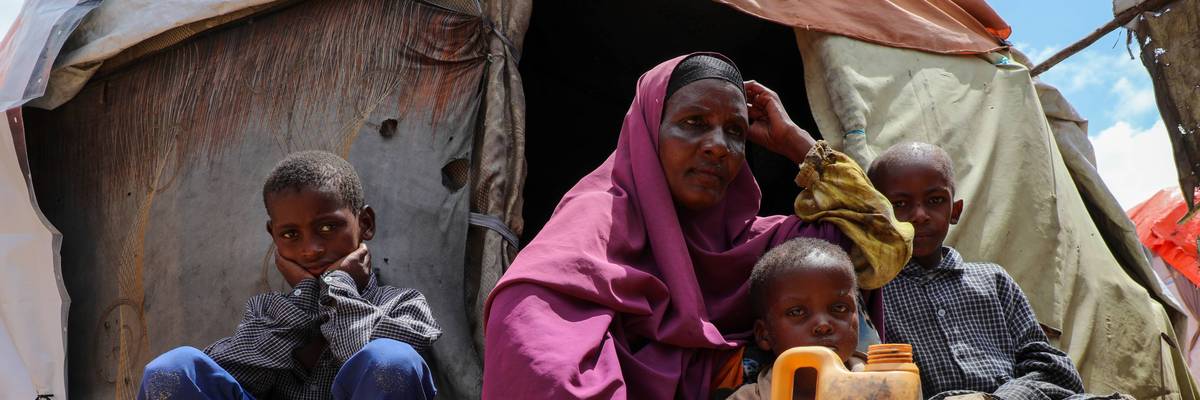
Residents of the Maacani Camp in Mogadishu, Somalia struggle to survive in tents on May 05, 2026.
"Without urgent action now, Somalia risks becoming one of the clearest examples of what happens when early warnings are ignored and humanitarian systems are allowed to erode."
A report released Thursday showing that Somalia is rapidly descending into famine underscored the harms done by the illegal dismantling of the US Agency for International Development, a department that President Donald Trump and billionaire Elon Musk targeted as part of a broader assault on the federal government.
New data from the Integrated Food Security Phase Classification (IPC) showed that more than six million people—around a third of Somalia's population—are facing acute hunger as drought and conflict combine with humanitarian aid cuts to create a devastating humanitarian emergency. Around 1.9 million children in Somalia "are now expected to require treatment for acute malnutrition in 2026," according to IPC, and regions of the country are at severe risk of famine.
"Humanitarian assistance remains a lifeline but is far from sufficient, reaching only 12% of people in Phase 3 or above," said IPC, a partnership of aid organizations and United Nations agencies. "A rapid and sustained scale‑up of multisectoral assistance—particularly in hotspot areas such as Burhakaba—is urgently needed to prevent further deterioration and loss of life."
Reuters noted that "global cuts to foreign aid, including by the United States, have substantially reduced support to Somalia." The outlet added that "impacts of the US-Israeli war on Iran are complicating efforts to respond to food shortages caused by multiple failed rain seasons and ongoing insecurity."
Mohamed Mohamud Hassan, Save the Children's Somalia director, said in a statement Thursday that the country is "in the grip of a deepening humanitarian catastrophe" and the "window to prevent famine... is closing fast."
"Children are dying from preventable causes—malnutrition, disease, displacement—while funding falls far short of what is urgently needed," said Hassan. "We call on the international community to act now, scale up lifesaving assistance, and ensure that no child dies because the world looked away."
"Somalia is once again standing at the edge of catastrophe. This is a crisis of access, affordability, and global political failure."
The US has historically been the largest contributor of humanitarian aid to Somalia, but the Trump administration's shuttering of USAID cut off much of the American food and medical aid that was flowing to the East African nation. The Trump administration's dismantling of USAID has also severely harmed Somalia's economy.
"Somalia is once again standing at the edge of catastrophe," Richard Crothers, Somalia country director at the International Rescue Committee, said Friday. "This is a crisis of access, affordability, and global political failure. Without urgent action now, Somalia risks becoming one of the clearest examples of what happens when early warnings are ignored and humanitarian systems are allowed to erode."
Experts say the closure of USAID last year is already responsible for hundreds of thousands of preventable deaths, and researchers have warned that millions more could die by 2030 if the aid is not restored.
In addition to sounding the alarm about Somalia, IPC released reports this week detailing increasingly dire hunger in the Democratic Republic of the Congo (DRC) and Sudan—countries that were also devastated by the gutting of USAID.
"USAID was the leading donor in the country and most aid agencies relied on its funding to help people survive and rebuild their lives," said Manenji Mangundu, Oxfam International's DRC country director. "Without it, agencies have been forced to make terrible triage decisions including who gets to live and who might needlessly die."
"The world cannot continue to look the other way—the situation is dire," Mangundu added.
Dear Common Dreams reader, It’s been nearly 30 years since I co-founded Common Dreams with my late wife, Lina Newhouser. We had the radical notion that journalism should serve the public good, not corporate profits. It was clear to us from the outset what it would take to build such a project. No paid advertisements. No corporate sponsors. No millionaire publisher telling us what to think or do. Many people said we wouldn't last a year, but we proved those doubters wrong. Together with a tremendous team of journalists and dedicated staff, we built an independent media outlet free from the constraints of profits and corporate control. Our mission has always been simple: To inform. To inspire. To ignite change for the common good. Building Common Dreams was not easy. Our survival was never guaranteed. When you take on the most powerful forces—Wall Street greed, fossil fuel industry destruction, Big Tech lobbyists, and uber-rich oligarchs who have spent billions upon billions rigging the economy and democracy in their favor—the only bulwark you have is supporters who believe in your work. But here’s the urgent message from me today. It's never been this bad out there. And it's never been this hard to keep us going. At the very moment Common Dreams is most needed, the threats we face are intensifying. We need your support now more than ever. We don't accept corporate advertising and never will. We don't have a paywall because we don't think people should be blocked from critical news based on their ability to pay. Everything we do is funded by the donations of readers like you. When everyone does the little they can afford, we are strong. But if that support retreats or dries up, so do we. Will you donate now to make sure Common Dreams not only survives but thrives? —Craig Brown, Co-founder |
A report released Thursday showing that Somalia is rapidly descending into famine underscored the harms done by the illegal dismantling of the US Agency for International Development, a department that President Donald Trump and billionaire Elon Musk targeted as part of a broader assault on the federal government.
New data from the Integrated Food Security Phase Classification (IPC) showed that more than six million people—around a third of Somalia's population—are facing acute hunger as drought and conflict combine with humanitarian aid cuts to create a devastating humanitarian emergency. Around 1.9 million children in Somalia "are now expected to require treatment for acute malnutrition in 2026," according to IPC, and regions of the country are at severe risk of famine.
"Humanitarian assistance remains a lifeline but is far from sufficient, reaching only 12% of people in Phase 3 or above," said IPC, a partnership of aid organizations and United Nations agencies. "A rapid and sustained scale‑up of multisectoral assistance—particularly in hotspot areas such as Burhakaba—is urgently needed to prevent further deterioration and loss of life."
Reuters noted that "global cuts to foreign aid, including by the United States, have substantially reduced support to Somalia." The outlet added that "impacts of the US-Israeli war on Iran are complicating efforts to respond to food shortages caused by multiple failed rain seasons and ongoing insecurity."
Mohamed Mohamud Hassan, Save the Children's Somalia director, said in a statement Thursday that the country is "in the grip of a deepening humanitarian catastrophe" and the "window to prevent famine... is closing fast."
"Children are dying from preventable causes—malnutrition, disease, displacement—while funding falls far short of what is urgently needed," said Hassan. "We call on the international community to act now, scale up lifesaving assistance, and ensure that no child dies because the world looked away."
"Somalia is once again standing at the edge of catastrophe. This is a crisis of access, affordability, and global political failure."
The US has historically been the largest contributor of humanitarian aid to Somalia, but the Trump administration's shuttering of USAID cut off much of the American food and medical aid that was flowing to the East African nation. The Trump administration's dismantling of USAID has also severely harmed Somalia's economy.
"Somalia is once again standing at the edge of catastrophe," Richard Crothers, Somalia country director at the International Rescue Committee, said Friday. "This is a crisis of access, affordability, and global political failure. Without urgent action now, Somalia risks becoming one of the clearest examples of what happens when early warnings are ignored and humanitarian systems are allowed to erode."
Experts say the closure of USAID last year is already responsible for hundreds of thousands of preventable deaths, and researchers have warned that millions more could die by 2030 if the aid is not restored.
In addition to sounding the alarm about Somalia, IPC released reports this week detailing increasingly dire hunger in the Democratic Republic of the Congo (DRC) and Sudan—countries that were also devastated by the gutting of USAID.
"USAID was the leading donor in the country and most aid agencies relied on its funding to help people survive and rebuild their lives," said Manenji Mangundu, Oxfam International's DRC country director. "Without it, agencies have been forced to make terrible triage decisions including who gets to live and who might needlessly die."
"The world cannot continue to look the other way—the situation is dire," Mangundu added.
A report released Thursday showing that Somalia is rapidly descending into famine underscored the harms done by the illegal dismantling of the US Agency for International Development, a department that President Donald Trump and billionaire Elon Musk targeted as part of a broader assault on the federal government.
New data from the Integrated Food Security Phase Classification (IPC) showed that more than six million people—around a third of Somalia's population—are facing acute hunger as drought and conflict combine with humanitarian aid cuts to create a devastating humanitarian emergency. Around 1.9 million children in Somalia "are now expected to require treatment for acute malnutrition in 2026," according to IPC, and regions of the country are at severe risk of famine.
"Humanitarian assistance remains a lifeline but is far from sufficient, reaching only 12% of people in Phase 3 or above," said IPC, a partnership of aid organizations and United Nations agencies. "A rapid and sustained scale‑up of multisectoral assistance—particularly in hotspot areas such as Burhakaba—is urgently needed to prevent further deterioration and loss of life."
Reuters noted that "global cuts to foreign aid, including by the United States, have substantially reduced support to Somalia." The outlet added that "impacts of the US-Israeli war on Iran are complicating efforts to respond to food shortages caused by multiple failed rain seasons and ongoing insecurity."
Mohamed Mohamud Hassan, Save the Children's Somalia director, said in a statement Thursday that the country is "in the grip of a deepening humanitarian catastrophe" and the "window to prevent famine... is closing fast."
"Children are dying from preventable causes—malnutrition, disease, displacement—while funding falls far short of what is urgently needed," said Hassan. "We call on the international community to act now, scale up lifesaving assistance, and ensure that no child dies because the world looked away."
"Somalia is once again standing at the edge of catastrophe. This is a crisis of access, affordability, and global political failure."
The US has historically been the largest contributor of humanitarian aid to Somalia, but the Trump administration's shuttering of USAID cut off much of the American food and medical aid that was flowing to the East African nation. The Trump administration's dismantling of USAID has also severely harmed Somalia's economy.
"Somalia is once again standing at the edge of catastrophe," Richard Crothers, Somalia country director at the International Rescue Committee, said Friday. "This is a crisis of access, affordability, and global political failure. Without urgent action now, Somalia risks becoming one of the clearest examples of what happens when early warnings are ignored and humanitarian systems are allowed to erode."
Experts say the closure of USAID last year is already responsible for hundreds of thousands of preventable deaths, and researchers have warned that millions more could die by 2030 if the aid is not restored.
In addition to sounding the alarm about Somalia, IPC released reports this week detailing increasingly dire hunger in the Democratic Republic of the Congo (DRC) and Sudan—countries that were also devastated by the gutting of USAID.
"USAID was the leading donor in the country and most aid agencies relied on its funding to help people survive and rebuild their lives," said Manenji Mangundu, Oxfam International's DRC country director. "Without it, agencies have been forced to make terrible triage decisions including who gets to live and who might needlessly die."
"The world cannot continue to look the other way—the situation is dire," Mangundu added.

