SUBSCRIBE TO OUR FREE NEWSLETTER
Daily news & progressive opinion—funded by the people, not the corporations—delivered straight to your inbox.
5
#000000
#FFFFFF
To donate by check, phone, or other method, see our More Ways to Give page.
Daily news & progressive opinion—funded by the people, not the corporations—delivered straight to your inbox.
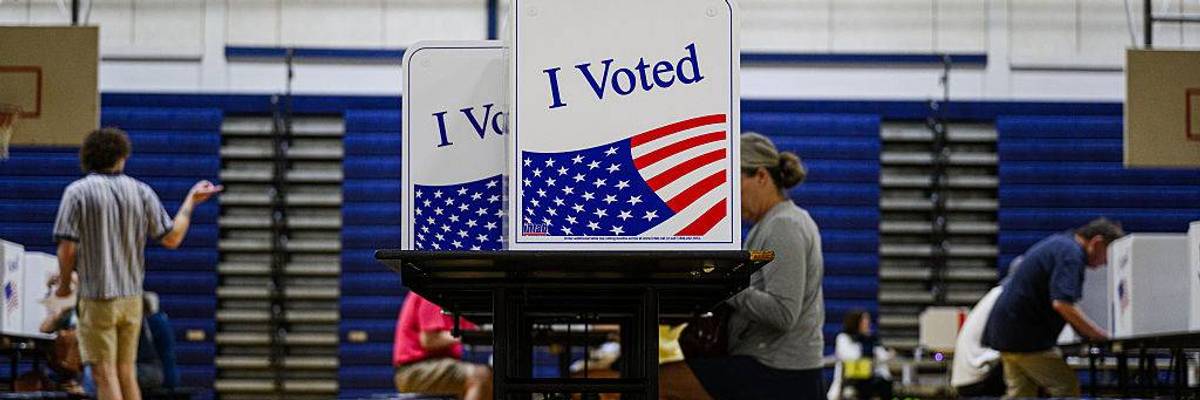
Voters cast their ballots at South Oldham Middle School on May 19, 2026 in Crestwood, Kentucky.
Trump is "trying to scare people into thinking he has more power than he has," said UCLA law professor Rick Hasen.
President Donald Trump raised eyebrows on Tuesday when he didn't rule out declaring a "national security emergency for elections" ahead of the 2026 midterms that would let him restrict the use of mail-in ballots and require voters to provide proof of citizenship.
Rick Hasen, a law professor at UCLA and an expert in election law, told The New Republic in an interview published Wednesday that simply declaring a national emergency related to election security wouldn't override states' voting laws.
"The United States Constitution does not give the president power over elections," Hasen explained. "We have a decentralized election system. Most of our election rules come from states, from state legislatures passing statutes."
Even though Trump cannot legally seize control of the country's elections systems, Hasen said, his "national emergency" declaration could be used as a tool to discredit Democratic victories in the midterms and also to more generally intimidate Democratic voters.
"He’s trying to scare people into thinking he has more power than he has," Hasen said. "That itself makes him powerful, because people are deterred by him. And maybe it deters people from showing up to vote in elections... We should not be complacent at all, even if Trump doesn’t have the power to actually do some of the stuff he’s threatened."
Hasen also speculated that Trump's executive order instructing the United States Postal Service to not deliver mail-in ballots to states that have not shared their voter data with the White House was also part of an intimidation operation.
"So everybody’s confidence in the elections goes down," Hasen said. "And it’s like, 'Why mail back my ballot if the post office isn’t going to deliver it? Why show up at the polling place if there’s going to be armed security there?' All of these things are, I think, scare tactics. And we shouldn’t give Trump the power—we shouldn’t give Trump room in our heads to panic over whether or not we're going to have free and fair elections."
In an analysis published Wednesday, progressive commentator Thom Hartmann described Trump as a "cornered rat" who will attempt any trick to maintain Republican majorities in Congress.
"It's going to be up to us and the individual states to make sure our voices are heard and our votes are properly counted," Hartmann wrote. "We should be thinking of this as an election continuity exercise that may not be necessary but, like wearing a seatbelt, could be essential if Trump tries to repeat 2020 in some way."
Hartmann also listed a number of recommendations for Democrats to combat Trump's election subversion attempts, including educating voters on the constitutional limits of the president's powers, being prepared to arrest any federal immigration enforcement officers who appear at polling locations, and encouraging early voting.
"For over a decade now, close races immediately produce Republican claims of fraud," Hartmann added. "Lawyers, election officials, and communications systems must be fully prepared to deal with lies and propaganda long before November."
Dear Common Dreams reader, It’s been nearly 30 years since I co-founded Common Dreams with my late wife, Lina Newhouser. We had the radical notion that journalism should serve the public good, not corporate profits. It was clear to us from the outset what it would take to build such a project. No paid advertisements. No corporate sponsors. No millionaire publisher telling us what to think or do. Many people said we wouldn't last a year, but we proved those doubters wrong. Together with a tremendous team of journalists and dedicated staff, we built an independent media outlet free from the constraints of profits and corporate control. Our mission has always been simple: To inform. To inspire. To ignite change for the common good. Building Common Dreams was not easy. Our survival was never guaranteed. When you take on the most powerful forces—Wall Street greed, fossil fuel industry destruction, Big Tech lobbyists, and uber-rich oligarchs who have spent billions upon billions rigging the economy and democracy in their favor—the only bulwark you have is supporters who believe in your work. But here’s the urgent message from me today. It's never been this bad out there. And it's never been this hard to keep us going. At the very moment Common Dreams is most needed, the threats we face are intensifying. We need your support now more than ever. We don't accept corporate advertising and never will. We don't have a paywall because we don't think people should be blocked from critical news based on their ability to pay. Everything we do is funded by the donations of readers like you. When everyone does the little they can afford, we are strong. But if that support retreats or dries up, so do we. Will you donate now to make sure Common Dreams not only survives but thrives? —Craig Brown, Co-founder |
President Donald Trump raised eyebrows on Tuesday when he didn't rule out declaring a "national security emergency for elections" ahead of the 2026 midterms that would let him restrict the use of mail-in ballots and require voters to provide proof of citizenship.
Rick Hasen, a law professor at UCLA and an expert in election law, told The New Republic in an interview published Wednesday that simply declaring a national emergency related to election security wouldn't override states' voting laws.
"The United States Constitution does not give the president power over elections," Hasen explained. "We have a decentralized election system. Most of our election rules come from states, from state legislatures passing statutes."
Even though Trump cannot legally seize control of the country's elections systems, Hasen said, his "national emergency" declaration could be used as a tool to discredit Democratic victories in the midterms and also to more generally intimidate Democratic voters.
"He’s trying to scare people into thinking he has more power than he has," Hasen said. "That itself makes him powerful, because people are deterred by him. And maybe it deters people from showing up to vote in elections... We should not be complacent at all, even if Trump doesn’t have the power to actually do some of the stuff he’s threatened."
Hasen also speculated that Trump's executive order instructing the United States Postal Service to not deliver mail-in ballots to states that have not shared their voter data with the White House was also part of an intimidation operation.
"So everybody’s confidence in the elections goes down," Hasen said. "And it’s like, 'Why mail back my ballot if the post office isn’t going to deliver it? Why show up at the polling place if there’s going to be armed security there?' All of these things are, I think, scare tactics. And we shouldn’t give Trump the power—we shouldn’t give Trump room in our heads to panic over whether or not we're going to have free and fair elections."
In an analysis published Wednesday, progressive commentator Thom Hartmann described Trump as a "cornered rat" who will attempt any trick to maintain Republican majorities in Congress.
"It's going to be up to us and the individual states to make sure our voices are heard and our votes are properly counted," Hartmann wrote. "We should be thinking of this as an election continuity exercise that may not be necessary but, like wearing a seatbelt, could be essential if Trump tries to repeat 2020 in some way."
Hartmann also listed a number of recommendations for Democrats to combat Trump's election subversion attempts, including educating voters on the constitutional limits of the president's powers, being prepared to arrest any federal immigration enforcement officers who appear at polling locations, and encouraging early voting.
"For over a decade now, close races immediately produce Republican claims of fraud," Hartmann added. "Lawyers, election officials, and communications systems must be fully prepared to deal with lies and propaganda long before November."
President Donald Trump raised eyebrows on Tuesday when he didn't rule out declaring a "national security emergency for elections" ahead of the 2026 midterms that would let him restrict the use of mail-in ballots and require voters to provide proof of citizenship.
Rick Hasen, a law professor at UCLA and an expert in election law, told The New Republic in an interview published Wednesday that simply declaring a national emergency related to election security wouldn't override states' voting laws.
"The United States Constitution does not give the president power over elections," Hasen explained. "We have a decentralized election system. Most of our election rules come from states, from state legislatures passing statutes."
Even though Trump cannot legally seize control of the country's elections systems, Hasen said, his "national emergency" declaration could be used as a tool to discredit Democratic victories in the midterms and also to more generally intimidate Democratic voters.
"He’s trying to scare people into thinking he has more power than he has," Hasen said. "That itself makes him powerful, because people are deterred by him. And maybe it deters people from showing up to vote in elections... We should not be complacent at all, even if Trump doesn’t have the power to actually do some of the stuff he’s threatened."
Hasen also speculated that Trump's executive order instructing the United States Postal Service to not deliver mail-in ballots to states that have not shared their voter data with the White House was also part of an intimidation operation.
"So everybody’s confidence in the elections goes down," Hasen said. "And it’s like, 'Why mail back my ballot if the post office isn’t going to deliver it? Why show up at the polling place if there’s going to be armed security there?' All of these things are, I think, scare tactics. And we shouldn’t give Trump the power—we shouldn’t give Trump room in our heads to panic over whether or not we're going to have free and fair elections."
In an analysis published Wednesday, progressive commentator Thom Hartmann described Trump as a "cornered rat" who will attempt any trick to maintain Republican majorities in Congress.
"It's going to be up to us and the individual states to make sure our voices are heard and our votes are properly counted," Hartmann wrote. "We should be thinking of this as an election continuity exercise that may not be necessary but, like wearing a seatbelt, could be essential if Trump tries to repeat 2020 in some way."
Hartmann also listed a number of recommendations for Democrats to combat Trump's election subversion attempts, including educating voters on the constitutional limits of the president's powers, being prepared to arrest any federal immigration enforcement officers who appear at polling locations, and encouraging early voting.
"For over a decade now, close races immediately produce Republican claims of fraud," Hartmann added. "Lawyers, election officials, and communications systems must be fully prepared to deal with lies and propaganda long before November."