

SUBSCRIBE TO OUR FREE NEWSLETTER
Daily news & progressive opinion—funded by the people, not the corporations—delivered straight to your inbox.
5
#000000
#FFFFFF
To donate by check, phone, or other method, see our More Ways to Give page.
Daily news & progressive opinion—funded by the people, not the corporations—delivered straight to your inbox.
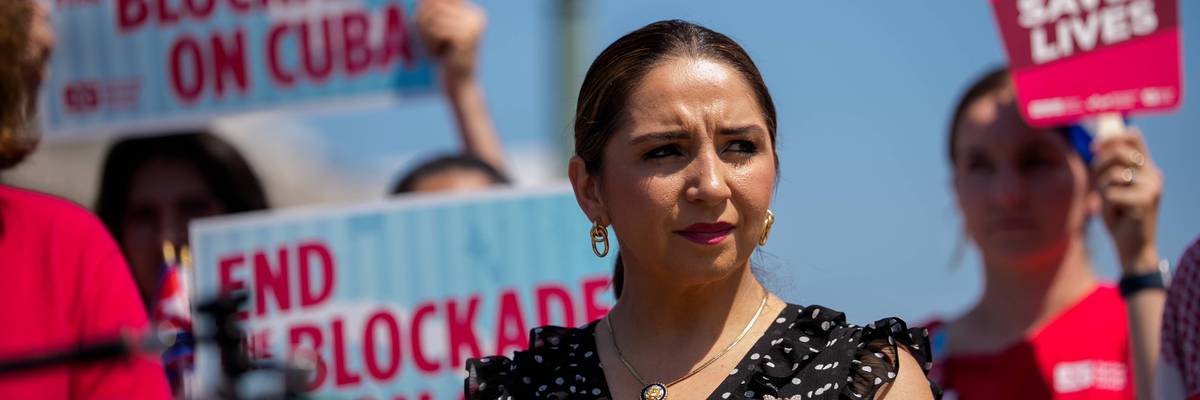
Congresswoman Delia Ramirez (D-Ill.) attends a news conference calling for the end to the US blockade against Cuba on Capitol Hill in Washington, DC on June 30, 2026.
"Despite what warmongers want you to believe, the Monroe Doctrine undermines the partnerships needed to confront our complex challenges," said Rep. Delia Ramirez. "We must change course."
A congresswoman whose parents immigrated to the United States during US-backed genocidal dictatorships in Guatemala on Tuesday excoriated a State Department video hailing the Monroe Doctrine, an imperialist policy used by Washington to declare the Western Hemisphere its exclusive sphere of influence while masking aggression as protection from outside powers.
The roughly five-minute State Department video presents the Monroe Doctrine as a continuous thread in US foreign policy from 1823 to today, culminating in January's abduction of Venezuelan President Nicolás Maduro. It starts with President James Monroe's warning that the Americas were no longer open to European colonization, then moves through the Spanish-American War—launched by President William McKinley on false pretenses—the Roosevelt Corollary, the Cold War and Cuban Missile Crisis, and finally to the Trump administration.
"American dominance in the Western Hemisphere will never be questioned again," the State Department said in a social media post promoting the video.
Responding to the clip, Congresswoman Delia Ramirez (D-Ill.) said: "What a cheap piece of imperialist propaganda. The Monroe Doctrine's legacy is political instability, deep poverty, extreme migration, and colonialism throughout Latin America and the Caribbean."
Declared in December 1823 by Monroe as Spanish colonies in the Americas won their independence, the doctrine states that European powers should not establish new colonies or interfere politically in the independent states of the Western Hemisphere. While it was partly a response to European attempts to restore colonial rule in Latin America, the Monroe Doctrine also asserted US hegemony over the Americas.
Over time, the Monroe Doctrine was transformed from a warning against European imperialism into a rationale for US imperial interventions and conquest, beginning with waging war on Mexico—again, under false pretenses, this time challenged by opponents including a young congressman named Abraham Lincoln—that resulted in the seizure of more than half of Mexican territory.
The US attempted to use the Monroe Doctrine to justify acquisition of a 10-mile zone around the Panama Canal via "gunboat diplomacy" and, after the 1904 Roosevelt Corollary, the right to intervene in Latin American and Caribbean countries when it judged their governments unstable, indebted, hostile, or vulnerable to foreign influence. Invasions and occupations of Cuba, Haiti, the Dominican Republic, and Nicaragua followed.
During the Cold War, successive US administrations used the largely imagined communist "threat" as pretext for CIA overthrows of democratically elected governments in Guatemala, Chile, Brazil, and other countries outside the Americas, including Iran and Congo—none of which were actually run by communists. The US also backed the ill-fated Bay of Pigs invasion, attempts to assassinate Cuban leader Fidel Castro, and terrorism targeting his regime and the Cuban people. Right-wing, pro-US military dictatorships were installed and lavished with financial, armed, and security aid, including torture training by operatives from the CIA, USAID, and other agencies.
The State Department video was not well received throughout Latin America. One Brazilian news site resented its "threatening tone," while Cuban media underscored the socialist island's sovereignty amid fears of a takeover repeatedly teased by US President Donald Trump.
In addition to illegal airstrikes on alleged drug-smuggling boats in the Caribbean Sea and Pacific Ocean and bombing and invasion of Venezuela to kidnap Maduro and his wife, the US under Trump has deployed troops to Ecuador as part of a joint campaign against alleged drug gangs dubbed Operation Total Extermination. Trump has also ordered the military to plan an invasion to seize the Panama Canal, attack Mexico and Colombia, invade and annex Greenland, and somehow make Canada the “51st state.”
Critics and supporters alike have called Trump's aggressive policies in the Americas the "Donroe Doctrine."
All told, Trump has bombed seven countries around the world since returning to the White House and 10 nations over the course of his two terms—including Iran, where he launched an illegal war with Israel.
Respondents to international public opinion surveys have repeatedly named the United States as the biggest threat to world peace. The late former US President Jimmy Carter even called his own country the "most warlike nation in the history of the world."
The US has attacked, invaded, or bombed dozens of countries and supported most right-wing dictatorships in the world since the end of World War II. It has overthrown or attempted to overthrow numerous foreign governments and has actively sought to crush many people’s liberation movements over that same period. It has also meddled in elections in countries that are allies and adversaries alike.
"Despite what warmongers want you to believe, the Monroe Doctrine undermines the partnerships needed to confront our complex challenges," Ramirez said on Tuesday. "We must change course. We must pass the New Good Neighbor Act."
Named after the short-lived period when the Franklin D. Roosevelt administration pursued policies of nonintervention and improved diplomatic relations with Latin America in the 1930s, the New Good Neighbor Act—a resolution introduced in February by Ramirez and Rep. Nydia Velazquez (D-NY)—calls on the US to adopt a new approach to the region based on cooperation, not confrontation.
“For more than 200 years, the United States has used the Monroe Doctrine to justify a paternalistic, damaging approach to relations with Latin America and the Caribbean," Ramirez said at the time. "As a result, the legacy of our nation’s foreign policy in those regions is political instability, deep poverty, extreme migration, and colonialism. It is well past time we change our approach."
“We must recognize our interconnectedness and admit that the Monroe Doctrine undermines the partnership needed to confront the complex challenges of this century," she added. "We must become better neighbors."
Dear Common Dreams reader, It’s been nearly 30 years since I co-founded Common Dreams with my late wife, Lina Newhouser. We had the radical notion that journalism should serve the public good, not corporate profits. It was clear to us from the outset what it would take to build such a project. No paid advertisements. No corporate sponsors. No millionaire publisher telling us what to think or do. Many people said we wouldn't last a year, but we proved those doubters wrong. Together with a tremendous team of journalists and dedicated staff, we built an independent media outlet free from the constraints of profits and corporate control. Our mission has always been simple: To inform. To inspire. To ignite change for the common good. Building Common Dreams was not easy. Our survival was never guaranteed. When you take on the most powerful forces—Wall Street greed, fossil fuel industry destruction, Big Tech lobbyists, and uber-rich oligarchs who have spent billions upon billions rigging the economy and democracy in their favor—the only bulwark you have is supporters who believe in your work. But here’s the urgent message from me today. It's never been this bad out there. And it's never been this hard to keep us going. At the very moment Common Dreams is most needed, the threats we face are intensifying. We need your support now more than ever. We don't accept corporate advertising and never will. We don't have a paywall because we don't think people should be blocked from critical news based on their ability to pay. Everything we do is funded by the donations of readers like you. When everyone does the little they can afford, we are strong. But if that support retreats or dries up, so do we. Will you donate now to make sure Common Dreams not only survives but thrives? —Craig Brown, Co-founder |
A congresswoman whose parents immigrated to the United States during US-backed genocidal dictatorships in Guatemala on Tuesday excoriated a State Department video hailing the Monroe Doctrine, an imperialist policy used by Washington to declare the Western Hemisphere its exclusive sphere of influence while masking aggression as protection from outside powers.
The roughly five-minute State Department video presents the Monroe Doctrine as a continuous thread in US foreign policy from 1823 to today, culminating in January's abduction of Venezuelan President Nicolás Maduro. It starts with President James Monroe's warning that the Americas were no longer open to European colonization, then moves through the Spanish-American War—launched by President William McKinley on false pretenses—the Roosevelt Corollary, the Cold War and Cuban Missile Crisis, and finally to the Trump administration.
"American dominance in the Western Hemisphere will never be questioned again," the State Department said in a social media post promoting the video.
Responding to the clip, Congresswoman Delia Ramirez (D-Ill.) said: "What a cheap piece of imperialist propaganda. The Monroe Doctrine's legacy is political instability, deep poverty, extreme migration, and colonialism throughout Latin America and the Caribbean."
Declared in December 1823 by Monroe as Spanish colonies in the Americas won their independence, the doctrine states that European powers should not establish new colonies or interfere politically in the independent states of the Western Hemisphere. While it was partly a response to European attempts to restore colonial rule in Latin America, the Monroe Doctrine also asserted US hegemony over the Americas.
Over time, the Monroe Doctrine was transformed from a warning against European imperialism into a rationale for US imperial interventions and conquest, beginning with waging war on Mexico—again, under false pretenses, this time challenged by opponents including a young congressman named Abraham Lincoln—that resulted in the seizure of more than half of Mexican territory.
The US attempted to use the Monroe Doctrine to justify acquisition of a 10-mile zone around the Panama Canal via "gunboat diplomacy" and, after the 1904 Roosevelt Corollary, the right to intervene in Latin American and Caribbean countries when it judged their governments unstable, indebted, hostile, or vulnerable to foreign influence. Invasions and occupations of Cuba, Haiti, the Dominican Republic, and Nicaragua followed.
During the Cold War, successive US administrations used the largely imagined communist "threat" as pretext for CIA overthrows of democratically elected governments in Guatemala, Chile, Brazil, and other countries outside the Americas, including Iran and Congo—none of which were actually run by communists. The US also backed the ill-fated Bay of Pigs invasion, attempts to assassinate Cuban leader Fidel Castro, and terrorism targeting his regime and the Cuban people. Right-wing, pro-US military dictatorships were installed and lavished with financial, armed, and security aid, including torture training by operatives from the CIA, USAID, and other agencies.
The State Department video was not well received throughout Latin America. One Brazilian news site resented its "threatening tone," while Cuban media underscored the socialist island's sovereignty amid fears of a takeover repeatedly teased by US President Donald Trump.
In addition to illegal airstrikes on alleged drug-smuggling boats in the Caribbean Sea and Pacific Ocean and bombing and invasion of Venezuela to kidnap Maduro and his wife, the US under Trump has deployed troops to Ecuador as part of a joint campaign against alleged drug gangs dubbed Operation Total Extermination. Trump has also ordered the military to plan an invasion to seize the Panama Canal, attack Mexico and Colombia, invade and annex Greenland, and somehow make Canada the “51st state.”
Critics and supporters alike have called Trump's aggressive policies in the Americas the "Donroe Doctrine."
All told, Trump has bombed seven countries around the world since returning to the White House and 10 nations over the course of his two terms—including Iran, where he launched an illegal war with Israel.
Respondents to international public opinion surveys have repeatedly named the United States as the biggest threat to world peace. The late former US President Jimmy Carter even called his own country the "most warlike nation in the history of the world."
The US has attacked, invaded, or bombed dozens of countries and supported most right-wing dictatorships in the world since the end of World War II. It has overthrown or attempted to overthrow numerous foreign governments and has actively sought to crush many people’s liberation movements over that same period. It has also meddled in elections in countries that are allies and adversaries alike.
"Despite what warmongers want you to believe, the Monroe Doctrine undermines the partnerships needed to confront our complex challenges," Ramirez said on Tuesday. "We must change course. We must pass the New Good Neighbor Act."
Named after the short-lived period when the Franklin D. Roosevelt administration pursued policies of nonintervention and improved diplomatic relations with Latin America in the 1930s, the New Good Neighbor Act—a resolution introduced in February by Ramirez and Rep. Nydia Velazquez (D-NY)—calls on the US to adopt a new approach to the region based on cooperation, not confrontation.
“For more than 200 years, the United States has used the Monroe Doctrine to justify a paternalistic, damaging approach to relations with Latin America and the Caribbean," Ramirez said at the time. "As a result, the legacy of our nation’s foreign policy in those regions is political instability, deep poverty, extreme migration, and colonialism. It is well past time we change our approach."
“We must recognize our interconnectedness and admit that the Monroe Doctrine undermines the partnership needed to confront the complex challenges of this century," she added. "We must become better neighbors."
A congresswoman whose parents immigrated to the United States during US-backed genocidal dictatorships in Guatemala on Tuesday excoriated a State Department video hailing the Monroe Doctrine, an imperialist policy used by Washington to declare the Western Hemisphere its exclusive sphere of influence while masking aggression as protection from outside powers.
The roughly five-minute State Department video presents the Monroe Doctrine as a continuous thread in US foreign policy from 1823 to today, culminating in January's abduction of Venezuelan President Nicolás Maduro. It starts with President James Monroe's warning that the Americas were no longer open to European colonization, then moves through the Spanish-American War—launched by President William McKinley on false pretenses—the Roosevelt Corollary, the Cold War and Cuban Missile Crisis, and finally to the Trump administration.
"American dominance in the Western Hemisphere will never be questioned again," the State Department said in a social media post promoting the video.
Responding to the clip, Congresswoman Delia Ramirez (D-Ill.) said: "What a cheap piece of imperialist propaganda. The Monroe Doctrine's legacy is political instability, deep poverty, extreme migration, and colonialism throughout Latin America and the Caribbean."
Declared in December 1823 by Monroe as Spanish colonies in the Americas won their independence, the doctrine states that European powers should not establish new colonies or interfere politically in the independent states of the Western Hemisphere. While it was partly a response to European attempts to restore colonial rule in Latin America, the Monroe Doctrine also asserted US hegemony over the Americas.
Over time, the Monroe Doctrine was transformed from a warning against European imperialism into a rationale for US imperial interventions and conquest, beginning with waging war on Mexico—again, under false pretenses, this time challenged by opponents including a young congressman named Abraham Lincoln—that resulted in the seizure of more than half of Mexican territory.
The US attempted to use the Monroe Doctrine to justify acquisition of a 10-mile zone around the Panama Canal via "gunboat diplomacy" and, after the 1904 Roosevelt Corollary, the right to intervene in Latin American and Caribbean countries when it judged their governments unstable, indebted, hostile, or vulnerable to foreign influence. Invasions and occupations of Cuba, Haiti, the Dominican Republic, and Nicaragua followed.
During the Cold War, successive US administrations used the largely imagined communist "threat" as pretext for CIA overthrows of democratically elected governments in Guatemala, Chile, Brazil, and other countries outside the Americas, including Iran and Congo—none of which were actually run by communists. The US also backed the ill-fated Bay of Pigs invasion, attempts to assassinate Cuban leader Fidel Castro, and terrorism targeting his regime and the Cuban people. Right-wing, pro-US military dictatorships were installed and lavished with financial, armed, and security aid, including torture training by operatives from the CIA, USAID, and other agencies.
The State Department video was not well received throughout Latin America. One Brazilian news site resented its "threatening tone," while Cuban media underscored the socialist island's sovereignty amid fears of a takeover repeatedly teased by US President Donald Trump.
In addition to illegal airstrikes on alleged drug-smuggling boats in the Caribbean Sea and Pacific Ocean and bombing and invasion of Venezuela to kidnap Maduro and his wife, the US under Trump has deployed troops to Ecuador as part of a joint campaign against alleged drug gangs dubbed Operation Total Extermination. Trump has also ordered the military to plan an invasion to seize the Panama Canal, attack Mexico and Colombia, invade and annex Greenland, and somehow make Canada the “51st state.”
Critics and supporters alike have called Trump's aggressive policies in the Americas the "Donroe Doctrine."
All told, Trump has bombed seven countries around the world since returning to the White House and 10 nations over the course of his two terms—including Iran, where he launched an illegal war with Israel.
Respondents to international public opinion surveys have repeatedly named the United States as the biggest threat to world peace. The late former US President Jimmy Carter even called his own country the "most warlike nation in the history of the world."
The US has attacked, invaded, or bombed dozens of countries and supported most right-wing dictatorships in the world since the end of World War II. It has overthrown or attempted to overthrow numerous foreign governments and has actively sought to crush many people’s liberation movements over that same period. It has also meddled in elections in countries that are allies and adversaries alike.
"Despite what warmongers want you to believe, the Monroe Doctrine undermines the partnerships needed to confront our complex challenges," Ramirez said on Tuesday. "We must change course. We must pass the New Good Neighbor Act."
Named after the short-lived period when the Franklin D. Roosevelt administration pursued policies of nonintervention and improved diplomatic relations with Latin America in the 1930s, the New Good Neighbor Act—a resolution introduced in February by Ramirez and Rep. Nydia Velazquez (D-NY)—calls on the US to adopt a new approach to the region based on cooperation, not confrontation.
“For more than 200 years, the United States has used the Monroe Doctrine to justify a paternalistic, damaging approach to relations with Latin America and the Caribbean," Ramirez said at the time. "As a result, the legacy of our nation’s foreign policy in those regions is political instability, deep poverty, extreme migration, and colonialism. It is well past time we change our approach."
“We must recognize our interconnectedness and admit that the Monroe Doctrine undermines the partnership needed to confront the complex challenges of this century," she added. "We must become better neighbors."

