SUBSCRIBE TO OUR FREE NEWSLETTER
Daily news & progressive opinion—funded by the people, not the corporations—delivered straight to your inbox.
5
#000000
#FFFFFF
To donate by check, phone, or other method, see our More Ways to Give page.
Daily news & progressive opinion—funded by the people, not the corporations—delivered straight to your inbox.
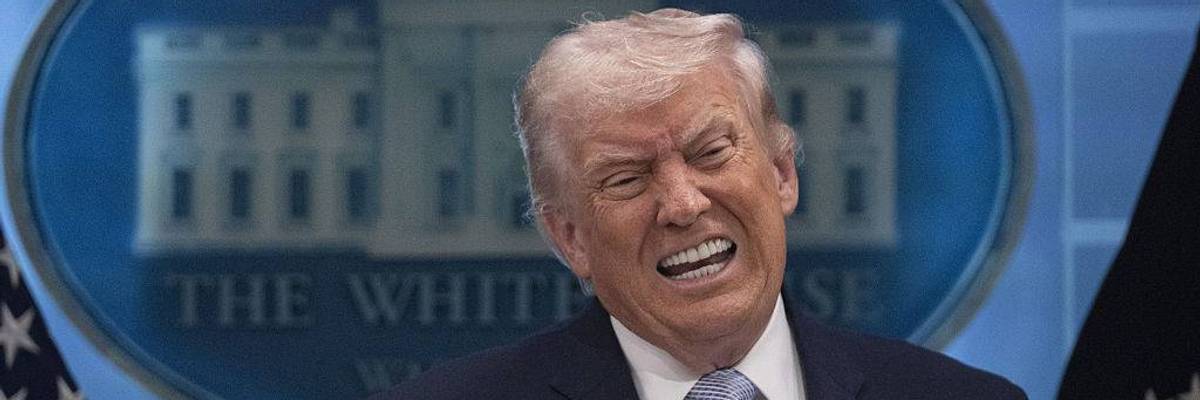
President Donald Trump holds a press conference in the White House on April 6, 2026, in Washington DC.
As inflation has wiped out wage growth, 53% of voters said they were worse off financially than when Trump took office, including nearly a quarter of Republicans.
President Donald Trump's approval rating has hit a new low as the majority of Americans—including many of his own voters—now say they are economically worse off under his second administration.
In a Reuters/Ipsos poll released Monday, just 33% of Americans said they approved of Trump's performance in the White House, while 64% disapproved, a drop from 35% approval earlier in the month. They're the worst marks he's received during this term and are tied with his worst ever, which came in December 2017.
Trump's nadir comes as a majority of Americans say their finances have gotten worse since he came to power. In a Financial Times poll released on Sunday, more than 53% of registered voters said they were worse off since January 2025. This includes 57% of independents, but also nearly a quarter of Republicans.
Voters' economic angst aligns with what the metrics show. After hitting a three-year peak of 4.2% in May, inflation was still higher in July than it was when Trump took office, at 3.4%. Real wages declined as hourly pay failed to keep up with inflation, and the economy shed 23,000 jobs last month.
Trump responded to this bleak report by celebrating that the economy was "doing unbelievably from the standpoint of Wall Street," with the stock market continuing to soar.
The pocketbook issues faced by many Americans have been made worse by Trump's war with Iran, which has caused oil prices to spike, triggering a surge in gasoline prices and inflation that has rippled throughout the economy.
The war began unpopular and has only grown more so as the conflict, which Trump said would be over in weeks, approaches its sixth month. In a Reuters poll released in late July, only about a third of Americans said they supported it.
After backing out of a peace agreement earlier this summer, Trump has doubled down on the war in recent weeks. Americans, regardless of party, are now overwhelmingly doubtful that it will end any time soon.
Among all adults, 4 in 5 said they believed the war would "go on for a long time." This includes 80% of independents, but also 71% of Republicans. Across all parties, just 16% said they believed the war would "end in a matter of weeks."
There are increasing signs that even Trump's core base is beginning to sour on him. An Economist/YouGov poll out last week showed that his overall approval among GOP voters had fallen to a second-term low of 79%.
Even more concerning for him is a decline in enthusiasm among supporters: Where 68% said they "strongly approve" of Trump near the start of his term, just 48% now feel that way.
Democratic voters, meanwhile, appear fired up as November approaches. A Washington Post/Ipsos poll from July showed that Democrats have a 10-point advantage over the GOP among those who say they are certain to vote.
Dear Common Dreams reader, It’s been nearly 30 years since I co-founded Common Dreams with my late wife, Lina Newhouser. We had the radical notion that journalism should serve the public good, not corporate profits. It was clear to us from the outset what it would take to build such a project. No paid advertisements. No corporate sponsors. No millionaire publisher telling us what to think or do. Many people said we wouldn't last a year, but we proved those doubters wrong. Together with a tremendous team of journalists and dedicated staff, we built an independent media outlet free from the constraints of profits and corporate control. Our mission has always been simple: To inform. To inspire. To ignite change for the common good. Building Common Dreams was not easy. Our survival was never guaranteed. When you take on the most powerful forces—Wall Street greed, fossil fuel industry destruction, Big Tech lobbyists, and uber-rich oligarchs who have spent billions upon billions rigging the economy and democracy in their favor—the only bulwark you have is supporters who believe in your work. But here’s the urgent message from me today. It's never been this bad out there. And it's never been this hard to keep us going. At the very moment Common Dreams is most needed, the threats we face are intensifying. We need your support now more than ever. We don't accept corporate advertising and never will. We don't have a paywall because we don't think people should be blocked from critical news based on their ability to pay. Everything we do is funded by the donations of readers like you. When everyone does the little they can afford, we are strong. But if that support retreats or dries up, so do we. Will you donate now to make sure Common Dreams not only survives but thrives? —Craig Brown, Co-founder |
President Donald Trump's approval rating has hit a new low as the majority of Americans—including many of his own voters—now say they are economically worse off under his second administration.
In a Reuters/Ipsos poll released Monday, just 33% of Americans said they approved of Trump's performance in the White House, while 64% disapproved, a drop from 35% approval earlier in the month. They're the worst marks he's received during this term and are tied with his worst ever, which came in December 2017.
Trump's nadir comes as a majority of Americans say their finances have gotten worse since he came to power. In a Financial Times poll released on Sunday, more than 53% of registered voters said they were worse off since January 2025. This includes 57% of independents, but also nearly a quarter of Republicans.
Voters' economic angst aligns with what the metrics show. After hitting a three-year peak of 4.2% in May, inflation was still higher in July than it was when Trump took office, at 3.4%. Real wages declined as hourly pay failed to keep up with inflation, and the economy shed 23,000 jobs last month.
Trump responded to this bleak report by celebrating that the economy was "doing unbelievably from the standpoint of Wall Street," with the stock market continuing to soar.
The pocketbook issues faced by many Americans have been made worse by Trump's war with Iran, which has caused oil prices to spike, triggering a surge in gasoline prices and inflation that has rippled throughout the economy.
The war began unpopular and has only grown more so as the conflict, which Trump said would be over in weeks, approaches its sixth month. In a Reuters poll released in late July, only about a third of Americans said they supported it.
After backing out of a peace agreement earlier this summer, Trump has doubled down on the war in recent weeks. Americans, regardless of party, are now overwhelmingly doubtful that it will end any time soon.
Among all adults, 4 in 5 said they believed the war would "go on for a long time." This includes 80% of independents, but also 71% of Republicans. Across all parties, just 16% said they believed the war would "end in a matter of weeks."
There are increasing signs that even Trump's core base is beginning to sour on him. An Economist/YouGov poll out last week showed that his overall approval among GOP voters had fallen to a second-term low of 79%.
Even more concerning for him is a decline in enthusiasm among supporters: Where 68% said they "strongly approve" of Trump near the start of his term, just 48% now feel that way.
Democratic voters, meanwhile, appear fired up as November approaches. A Washington Post/Ipsos poll from July showed that Democrats have a 10-point advantage over the GOP among those who say they are certain to vote.
President Donald Trump's approval rating has hit a new low as the majority of Americans—including many of his own voters—now say they are economically worse off under his second administration.
In a Reuters/Ipsos poll released Monday, just 33% of Americans said they approved of Trump's performance in the White House, while 64% disapproved, a drop from 35% approval earlier in the month. They're the worst marks he's received during this term and are tied with his worst ever, which came in December 2017.
Trump's nadir comes as a majority of Americans say their finances have gotten worse since he came to power. In a Financial Times poll released on Sunday, more than 53% of registered voters said they were worse off since January 2025. This includes 57% of independents, but also nearly a quarter of Republicans.
Voters' economic angst aligns with what the metrics show. After hitting a three-year peak of 4.2% in May, inflation was still higher in July than it was when Trump took office, at 3.4%. Real wages declined as hourly pay failed to keep up with inflation, and the economy shed 23,000 jobs last month.
Trump responded to this bleak report by celebrating that the economy was "doing unbelievably from the standpoint of Wall Street," with the stock market continuing to soar.
The pocketbook issues faced by many Americans have been made worse by Trump's war with Iran, which has caused oil prices to spike, triggering a surge in gasoline prices and inflation that has rippled throughout the economy.
The war began unpopular and has only grown more so as the conflict, which Trump said would be over in weeks, approaches its sixth month. In a Reuters poll released in late July, only about a third of Americans said they supported it.
After backing out of a peace agreement earlier this summer, Trump has doubled down on the war in recent weeks. Americans, regardless of party, are now overwhelmingly doubtful that it will end any time soon.
Among all adults, 4 in 5 said they believed the war would "go on for a long time." This includes 80% of independents, but also 71% of Republicans. Across all parties, just 16% said they believed the war would "end in a matter of weeks."
There are increasing signs that even Trump's core base is beginning to sour on him. An Economist/YouGov poll out last week showed that his overall approval among GOP voters had fallen to a second-term low of 79%.
Even more concerning for him is a decline in enthusiasm among supporters: Where 68% said they "strongly approve" of Trump near the start of his term, just 48% now feel that way.
Democratic voters, meanwhile, appear fired up as November approaches. A Washington Post/Ipsos poll from July showed that Democrats have a 10-point advantage over the GOP among those who say they are certain to vote.