SUBSCRIBE TO OUR FREE NEWSLETTER
Daily news & progressive opinion—funded by the people, not the corporations—delivered straight to your inbox.
5
#000000
#FFFFFF
To donate by check, phone, or other method, see our More Ways to Give page.
Daily news & progressive opinion—funded by the people, not the corporations—delivered straight to your inbox.
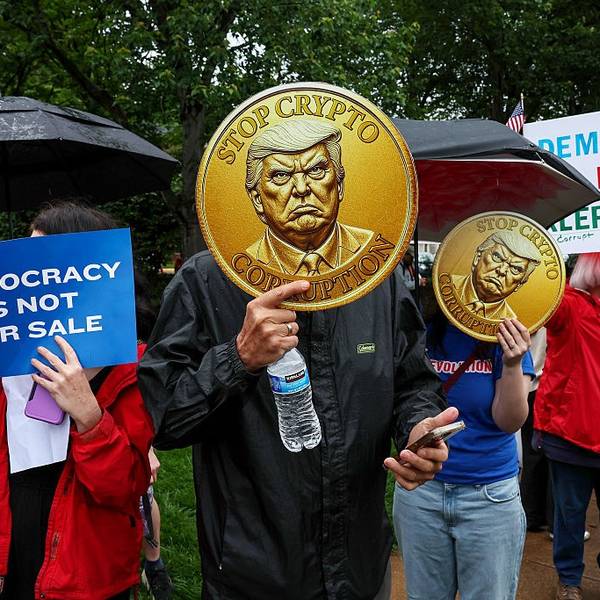
“The cryptocurrency industry has facilitated the Trump family’s corruption at every turn. Lawmakers should be wary of creating new tax loopholes to benefit the Trump family and their donors in the crypto industry."
A government watchdog is warning that new cryptocurrency policies being considered in the House of Representatives would be a major boon to the ultrawealthy, including President Donald Trump's family.
In an analysis published on Monday, the Revolving Door Project (RDP) highlighted new crypto-related tax bills being discussed in the House Ways and Means Committee, including one that "would create a functional subsidy for cryptocurrency firms by allowing them to defer taxes owed on their mined coins indefinitely and without interest, so long as the firms do not sell the coins."
This would allow coin owners to raise money by borrowing against these assets without having paid a cent of taxes on them, the analysis explains, which could be particularly beneficial for Trump's two eldest sons.
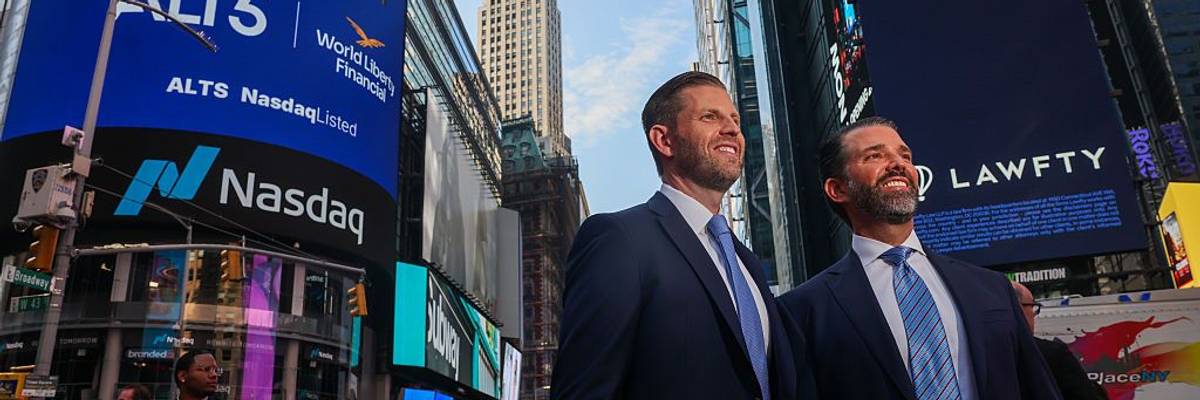
"Eric and Donald Trump Jr. reportedly hold a 20% stake in the bitcoin mining firm American Bitcoin, which mined 817 bitcoin in Q1 of 2026 alone," RDP writes. "At current prices, this represents a value of more than $50 million, while the company has stated that it already intends to hold assets it mines. If passed, this loophole could mean millions of dollars in taxes owed by the Trump sons’ firm could be deferred endlessly."
RDP also published a list of crypto donations to lawmakers on the House Ways and Means Committee. Rep. Steven Horsford (D-Nev.) has received nearly $2 million in support from the industry since 2023, more than any other committee member.
Other top recipients of crypto cash include Reps. Tom Suozzi (D-NY), Jimmy Gomez (D-Calif.), Adrian Smith (R-Neb.), and Jason Smith (R-Mo.), chairman of the committee.
Jeff Hauser, executive director of RDP, said that the bills currently under consideration in the House are essentially a return on the crypto industry's investment in political campaigns.
"The cryptocurrency industry believes it is owed massive tax loopholes and functional subsidies," said Hauser, "because it has bought the president, paid for his ballroom project, and has funded dozens of congressional campaigns. The lack of campaign finance reform is the principal reason that the ludicrously corrupt Trump family is set to enjoy yet another tax loophole to exploit."
Timi Iwayemi, assistant director at RDP, said that "the cryptocurrency industry has facilitated the Trump family's corruption at every turn," while warning members of Congress against doing the industry's bidding.
"Lawmakers should be wary of creating new tax loopholes to benefit the Trump family and their donors in the crypto industry," said Iwayemi. "Rewarding this behavior will embolden the crypto industry and other corporate lobbies eager to seize on our elected representatives’ prioritization of donor interests at public expense."
This country and this world are at a monumental crossroads. US voters have an opportunity to beat back the forces of fascism and confront the billionaires who are rigging the economy, our media system, and our democracy, making it increasingly impossible for ordinary people to get by. We’re not just talking about the election. We’re talking about what must be done once these fascist elements are vanquished from power. We need a bolder set of solutions than what either major party has so far been willing to offer and a working-class movement ready to fight like hell for it. Trump didn't emerge from nowhere. The conditions that fueled MAGA authoritarianism were created by decades of radical neoliberal economic policies and a corrupt political system dominated by corporate interests. They slashed taxes on the super-rich, promising that the benefits would trickle down. They said giveaways to the corporate titans would make life more affordable for the rest of us. It was all bullshit. And when a bitter, betrayed populace searches for someone to blame, right-wing demagogues have little trouble finding scapegoats. People know when they're being lied to, but you won't hear any of this from the corporate media. Only independent journalism—powered and funded by people who believe in building a better world—can deliver truly trustworthy daily news. If you share our vision, please contribute whatever you can to sustain our work. |
A government watchdog is warning that new cryptocurrency policies being considered in the House of Representatives would be a major boon to the ultrawealthy, including President Donald Trump's family.
In an analysis published on Monday, the Revolving Door Project (RDP) highlighted new crypto-related tax bills being discussed in the House Ways and Means Committee, including one that "would create a functional subsidy for cryptocurrency firms by allowing them to defer taxes owed on their mined coins indefinitely and without interest, so long as the firms do not sell the coins."
This would allow coin owners to raise money by borrowing against these assets without having paid a cent of taxes on them, the analysis explains, which could be particularly beneficial for Trump's two eldest sons.
"Eric and Donald Trump Jr. reportedly hold a 20% stake in the bitcoin mining firm American Bitcoin, which mined 817 bitcoin in Q1 of 2026 alone," RDP writes. "At current prices, this represents a value of more than $50 million, while the company has stated that it already intends to hold assets it mines. If passed, this loophole could mean millions of dollars in taxes owed by the Trump sons’ firm could be deferred endlessly."
RDP also published a list of crypto donations to lawmakers on the House Ways and Means Committee. Rep. Steven Horsford (D-Nev.) has received nearly $2 million in support from the industry since 2023, more than any other committee member.
Other top recipients of crypto cash include Reps. Tom Suozzi (D-NY), Jimmy Gomez (D-Calif.), Adrian Smith (R-Neb.), and Jason Smith (R-Mo.), chairman of the committee.
Jeff Hauser, executive director of RDP, said that the bills currently under consideration in the House are essentially a return on the crypto industry's investment in political campaigns.
"The cryptocurrency industry believes it is owed massive tax loopholes and functional subsidies," said Hauser, "because it has bought the president, paid for his ballroom project, and has funded dozens of congressional campaigns. The lack of campaign finance reform is the principal reason that the ludicrously corrupt Trump family is set to enjoy yet another tax loophole to exploit."
Timi Iwayemi, assistant director at RDP, said that "the cryptocurrency industry has facilitated the Trump family's corruption at every turn," while warning members of Congress against doing the industry's bidding.
"Lawmakers should be wary of creating new tax loopholes to benefit the Trump family and their donors in the crypto industry," said Iwayemi. "Rewarding this behavior will embolden the crypto industry and other corporate lobbies eager to seize on our elected representatives’ prioritization of donor interests at public expense."