

SUBSCRIBE TO OUR FREE NEWSLETTER
Daily news & progressive opinion—funded by the people, not the corporations—delivered straight to your inbox.
5
#000000
#FFFFFF
To donate by check, phone, or other method, see our More Ways to Give page.
Daily news & progressive opinion—funded by the people, not the corporations—delivered straight to your inbox.
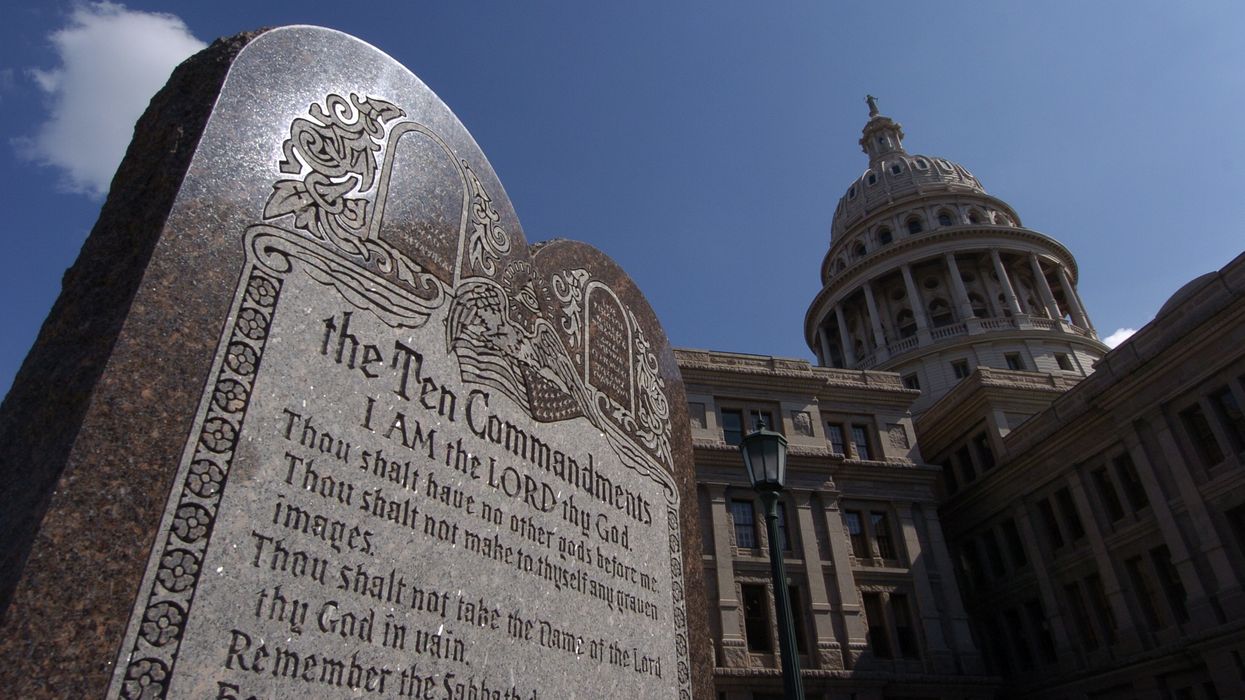
"In a diverse public school environment, all students should be treated with equal respect, regardless of their religious beliefs, or lack thereof," said one plaintiff.
A group of families is asking the US Supreme Court to strike down Texas Senate Bill 10, a state law mandating that a copy of the Ten Commandments be displayed in public school classrooms.
The families, who come from a variety of religious denominations and are being represented by several prominent civil liberties groups, argued in a Monday court filing that SB 10 violates the First Amendment of the US Constitution because it "imposes on public school children, for nearly every hour they are in school, the state's favored scripture."
In making their case, the families argued that a recent appeals court ruling upholding the Texas law ran afoul of multiple past Supreme Court rulings, including the 2022 ruling in Kennedy v. Bremerton School District, which made reference to "problematically coercive" religious messages being "publicly broadcast or recited to a captive audience," and the 1980 ruling in Stone v. Graham, which determined that posting the Ten Commandments in schools violates the Constitution's establishment clause.
Rabbi Joshua Fixler, a plaintiff in the case, said the Texas Ten Commandments law made him "not only worried about my own kids," but "deeply concerned about all the children in my congregation."
"These displays put children in the position of having to defend themselves and their families’ religious beliefs," said Fixler, "against a government mandate that makes them feel different and separate from their classmates."
Fellow plaintiff Nichole Manning, an atheist from Dallas, argued that the Texas law is "interfering with our family’s decisions about how our children engage with religion."
“As a parent, I intentionally choose to have my children attend public school because I prefer an educational environment without any religious affiliation," Manning emphasized. "In a diverse public school environment, all students should be treated with equal respect, regardless of their religious beliefs, or lack thereof."
In an editorial published in the Houston Chronicle on Monday, plaintiff Audrey Nath said that the Texas law was interfering with her right to raise her children to "celebrate the diversity of religious faiths in our families: Hinduism, Jainism, Judaism, and Quakerism."
"My 9-year-old son is proud of his heritage, and he even brought that statue of Shiva to his public school as part of a presentation about his family history," Nath explained. "SB 10 puts a permanent, state-mandated sign above his desk telling him what he carried in is forbidden."
ACLU of Texas staff attorney Chloe Kempf, who is co-representing the families, said that past legal precedents give the current Supreme Court a clear roadmap to overturn the Texas law.
"The US Supreme Court has rejected this kind of government-imposed religion before, and it should do so again,” said Kempf. “Having these posters in Texas classrooms puts students at risk of bullying, stigmatization, and religious coercion. Our nation’s bedrock principle of separating church and state means that families and faith communities—not politicians—get to decide what role religion plays in children’s lives."
Annie Laurie Gaylor, co-president of the Freedom From Religion Foundation, argued that mandating schools display the First Commandment alone is "the antithesis of our First Amendment" because it dictates "which god must be worshipped."
"It is not the government’s role to daily expose young children to a coercive display of one religion’s set of religious edicts in our public schools," Gaylor emphasized. "Our public schools exist to educate, not to proselytize."
"As multiple courts have reaffirmed, the First Amendment safeguards the rights of individuals to choose whether and how they engage with religion, and that protection extends to every classroom," said one lawyer.
The battle over Texas' Senate Bill 10 continued on Monday, with families in the state filing a federal lawsuit to block the display of a Protestant Christian version of the Ten Commandments in a "conspicuous place" in every public school classroom.
"This lawsuit, brought on behalf of a new group of Texas families, underscores a critical principle: Public schools across the state must uphold—not undermine—the constitutional protections afforded to every student," said Jon Youngwood, global co-chair of the litigation department at Simpson Thacher & Bartlett LLP, which represents the plaintiffs.
"As multiple courts have reaffirmed, the First Amendment safeguards the rights of individuals to choose whether and how they engage with religion, and that protection extends to every classroom," Youngwood continued.
The new complaint, filed in the Western District of Texas, explains that "last month, this district court ruled that SB 10 is 'plainly unconstitutional' and likely violates the Establishment and Free Exercise Clauses of the First Amendment... And in June, the US Court of Appeals for the 5th Circuit held the same regarding a Louisiana statute similar to SB 10."
"Despite these precedents, the defendant school districts have pressed forward with actually posting SB 10 displays in classrooms, or have confirmed they will do so shortly—even after receiving a letter from plaintiffs' counsel," the filing explains.
"All students—regardless of their race or religious background—should feel accepted and free to be themselves in Texas public schools."
After US District Judge Fred Biery, an appointee of former President Bill Clinton, issued a preliminary injunction against SB 10 last month, Republican Texas Attorney General Ken Paxton, who is running for US Senate, said that only the school districts involved in that case are affected and all others must abide by the law. Paxton also appealed the previous decision to the 5th Circuit.
With the latest filing, the families are seeking a declaratory judgment that SB 10 is unconstitutional. In both Texas cases, the plaintiffs are represented by not only Simpson Thacher but also Americans United for Separation of Church and State, the state and national ACLU, and the Freedom From Religion Foundation.
"This lawsuit is a continuation of our work to defend the First Amendment and ensure that government officials stay out of personal family decisions," said Chloe Kempf, staff attorney at the ACLU of Texas. "All students—regardless of their race or religious background—should feel accepted and free to be themselves in Texas public schools."
The families behind this latest filing have various beliefs. Nichole Manning, for example, called SB 10 "a calculated step to erode the separation of church and state and the right for my family to exercise our nonreligious beliefs."
Another plaintiff, Lenee Bien-Willner, said that "forcing religion, any religion, on others violates my Jewish faith."
"It troubles me greatly to have Christian displays imposed on my children," she said. "Not only is the text not aligned with Judaism, but the commandments should be taught in the context of a person's faith tradition. State-sponsored religion, however, does not belong in the public classroom."
Even some Christians are opposed to the Texas law. Plaintiff Rev. Kristin Klade said that "as a devout Christian and a Lutheran pastor, the spiritual formation of my children is a privilege I take more seriously than anything else in my life."
"The mandated Ten Commandments displays in my children's public school impede my ability to 'train up my child in the way he should go' (Proverbs 22:6)," she said. "I address questions about God and faith with great care, and I emphatically reject the notion that the state would do this for me."
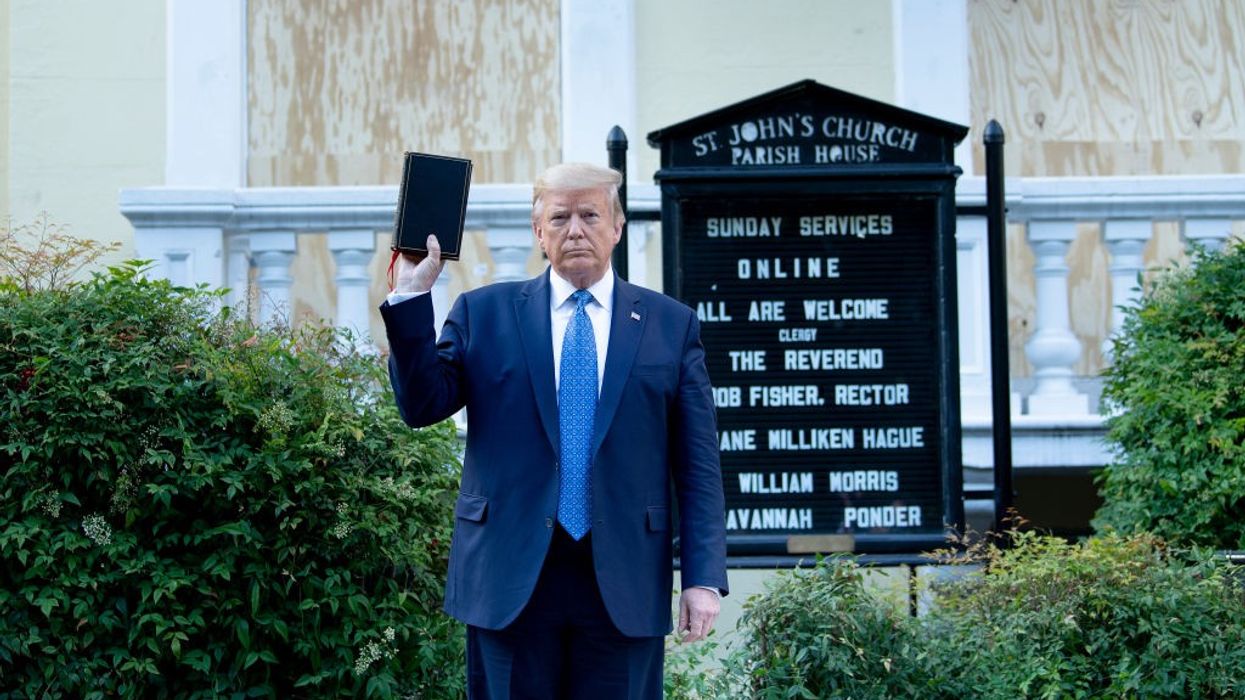
"President Trump is using religion to promote his self-aggrandizement and political agenda, all the while perpetuating the lie that America is a Christian nation and that religion is under attack," said one critic.
Proponents of separating church and state on Monday decried US President Donald Trump's pledge to protect prayer in public schools, warning that the administration is advancing the agenda of far-right Christian nationalists seeking to impose their religious beliefs upon everyone.
Speaking at a meeting of the president's so-called Religious Liberty Commission at the Museum of the Bible in Washington, DC, Trump announced upcoming Department of Education guidance "protecting the right to prayer in our public schools, and it's total protection."
"We're defending our rights and restoring our identity as a nation under God," Trump said. "To have a great nation, you have to have religion. I believe that so strongly. As president, I will always defend our glorious heritage, and we will protect the Judeo-Christian principles of our founding."
The president added that it is "ridiculous" that the nation's public school students are "indoctrinated with anti-religious propaganda, and some are even punished for their religious beliefs."
Trump also launched his "America Prays" initiative, which asks the faithful to "join with at least 10 people to meet each week for one hour to pray" for the country.
In response to the president's speech, the Freedom From Religion Foundation (FFRF) said on social media: "We've never been 'one nation under God.' There's nothing to restore. Our true identity is freedom of conscience—the right to believe in any faith, or none at all."
"A great nation isn't built on religion—it's built on equality, liberty, and justice for all," FFRF added. "Our strength comes from We The People, not belief in a god."
Rachel Laser, president of the group Americans United for Separation of Church and State, said in a statement that Monday's event "once again demonstrated that this commission isn't about religious liberty; it's about rejecting the nation's religious diversity and prioritizing one set of Christian beliefs."
"From the professions of Christian faith to the chorus of 'amens' during Christian prayers to the exclusively Christian speakers this morning, this government hearing was more like a church service," Laser noted. "Once again, President Trump is using religion to promote his self-aggrandizement and political agenda, all the while perpetuating the lie that America is a Christian nation and that religion is under attack."
Laser continued:
The Trump administration is advancing this Christian nationalist agenda with the launch of his 'America Prays' initiative, which calls on Americans to pray for our country. People who care about religious freedom don't need to be told when or how to pray; they need leaders who are committed to separation of church and state.
At a hearing focused on religious freedom and public schools, the commission ignored the most serious threats. From mandates to display the Ten Commandments and teach from the Bible to Christianity-infused curriculum and the installation of school chaplains, Christian nationalists and their political allies are trying to impose their personal religious beliefs on America's public school children.
"Our country's promise of church-state separation means that families—not politicians or public school officials—get to decide how and when children engage with religion," Laser added. "Yet many of the organizations represented at today's meeting and members of the Religious Liberty Commission have tried to undermine this fundamental American principle and turn our public schools into Sunday schools."
Monday's event came as some GOP-led states push forward with plans for more overt displays of religiosity in public schools. Most notably, Texas Attorney General Ken Paxton—a US Senate candidate—is urging schools to display the Ten Commandments in spite of a federal judge's recent injunction on a law requiring the Judeo-Christian religious and ethical directives to be displayed in all classrooms.
Paxton is also urging all schools "to begin the legal process of putting prayer back in the classroom and recommending the Lord's Prayer for students."
Responding to Paxton's push, gun control advocate Fred Guttenberg said last week on social media: "Hey Ken, many have said that you committed adultery. Shouldn't you worry about your own morality before imposing this on others? Looks like you are using religion for personal gain."
Recent polls have shown a significant drop in the number of Americans who identify as Christian in recent decades, an all-time low in belief in "God," and a steady overall decline in religiosity among younger Americans.
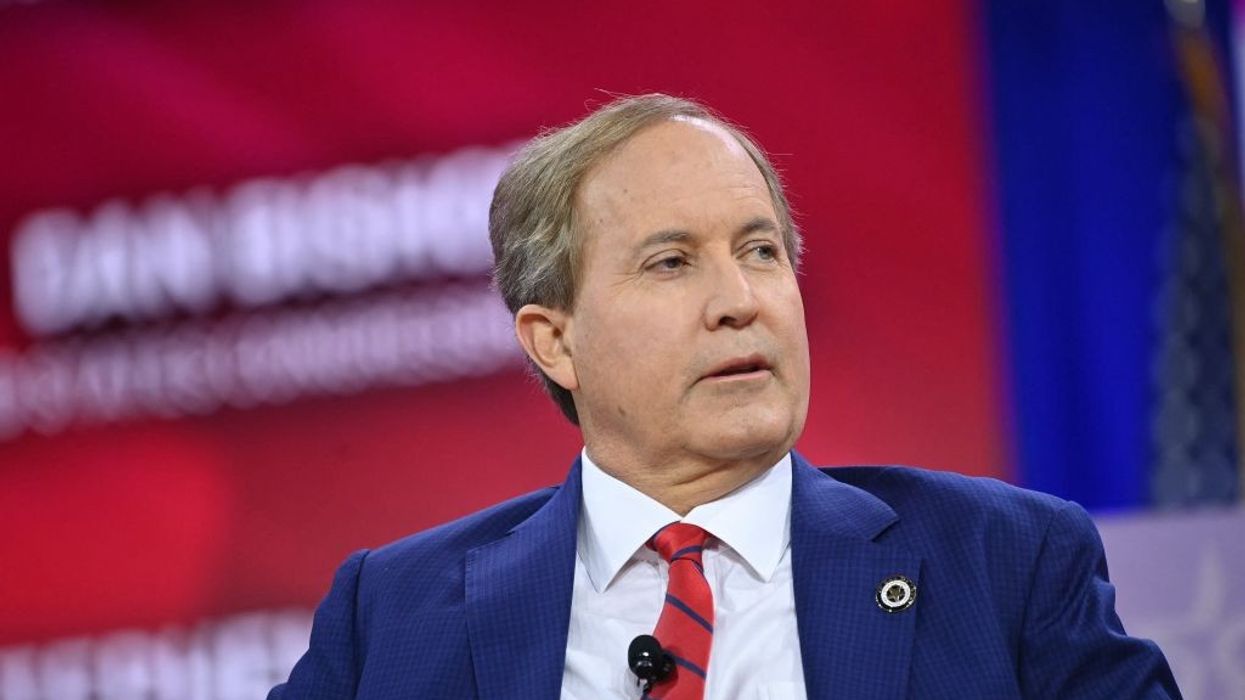
"The Constitution, not the Ten Commandments, built this country," said the Freedom from Religion Foundation in response to Paxton.
Texas Attorney General Ken Paxton on Monday said that the vast majority of schools in the Lone Star State should still plan on displaying the Ten Commandments in classrooms even after a federal judge ruled against it last week.
In a statement, Paxton said that "schools not enjoined by ongoing litigation must abide" by a state law that requires the display of the Ten Commandments in all public and secondary school classrooms.
"The woke radicals seeking to erase our nation's history will be defeated," he said. "I will not back down from defending the virtues and values that built this country."
Paxton asserted that only nine Texas school districts are affected by the injunction and said that all other districts "must abide by the law once it takes effect on September 1, 2025."
The Texas attorney general's defiant stance on the Ten Commandments earned him a quick rebuke from Rep. Joaquin Castro (D-Texas), who accused him of grandstanding instead of doing his job as the state's chief law enforcement official.
"Paxton's job is to uphold the Constitution, which guarantees the separation of church and state—not the Ten Commandments," he wrote on X. "Our public schools should focus on educating Texas students, not stoking culture wars."
The Freedom From Religion Foundation also rebuked Paxton for failing to uphold the Constitution's prohibition of the government establishment of a religion.
"The Constitution, not the Ten Commandments, built this country," the foundation said. "Forcing students to observe one religion’s rules is a blatant violation of the First Amendment regardless of what Ken Paxton claims. Public schools are for education, not religious indoctrination."
Paxton's declaration came less than a week after US District Judge Fred Biery of the United States District Court for the Western District of Texas issued a preliminary injunction against the state law requiring the Ten Commandments to be displayed.
In his ruling, Biery argued that the classroom displays "are likely to pressure the [students] into religious observance, meditation on, veneration, and adoption of the state's favored religious scripture, and into suppressing expression of their own religious or nonreligious background and beliefs while at school."
"Children's religious beliefs should be instilled by parents and faith communities, not politicians and public schools," said a Texas rabbi who sued the state over the law.
A federal judge on Wednesday shot down a Texas law that would have mandated all public school classrooms across the state display the Ten Commandments.
As reported by local news station KSAT, US District Judge Fred Biery of the United States District Court for the Western District of Texas issued a preliminary injunction, ruling that the state's law crossed the line from education to proselytizing on behalf of a specific sect of Christianity.
Noting that "the Ten Commandments set out in Texas's Ten Commandments law differs from the version observed by some Protestant faiths, and most adherents of the Catholic and Jewish faiths," Biery argued that the law violated the First Amendment of the United States Constitution, which states that Congress shall make no law respecting the establishment of a religion.
Biery imagined the uproar that would ensue if the city of Hamtramck, Michigan, which is majority Muslim, passed a law mandating that all public schools post passages from the Quran in all classrooms. He then argued that such a law would be just as unconstitutional as the Texas Ten Commandments law.
"While 'We the people' rule by a majority, the Bill of Rights protects the minority Christians in Hamtramck and those 33% of Texans who do not adhere to any of the Christian denominations," he wrote.
The judge also argued that the classroom displays "are likely to pressure the [students] into religious observance, meditation on, veneration, and adoption of the state's favored religious scripture, and into suppressing expression of their own religious or nonreligious background and beliefs while at school."
Organizations that advocate for the separation of church and state were quick to praise Biery's decision to strike down the law, which had been due to go into effect on September 1.
Tommy Buser-Clancy, senior staff attorney at the ACLU of Texas, said that the ruling affirmed that the state cannot coerce any Texans into adopting a particular religious faith.
“Today's ruling is a major win that protects the constitutional right to religious freedom for Texas families of all backgrounds," he said. "The court affirmed what we have long said: Public schools are for educating, not evangelizing."
Rabbi Mara Nathan, one of the plaintiffs who sued to get the law overturned, welcomed the ruling and stated that "children's religious beliefs should be instilled by parents and faith communities, not politicians and public schools."
Freedom From Religion Foundation co-president Annie Laurie Gaylor similarly said that "religious instruction must be left to parents, not the state, which has no business telling anyone how many gods to have, which gods to have or whether to have any gods at all."
Rachel Laser, president and CEO of Americans United for Separation of Church and State, hailed the ruling and said that it sends a "strong and resounding message across the country that the government respects the religious freedom of every student in our public schools."

"We do not need to—and indeed should not—turn public schools into Sunday schools."
A group of 42 Arkansas faith leaders on Monday called on the General Assembly to reject Republican-led legislation that would force every classroom in the state to display the Ten Commandments and the national motto, "In God We Trust."
"We are faith leaders from across Arkansas who value religious freedom for all. We urge you to vote against S.B. 433, which would require the display of a government-selected version of the Ten Commandments in every classroom of all elementary, secondary, and postsecondary schools and in every other public building or facility maintained with taxpayer funds," a letter to lawmakers signed by the 42 clerics states. The bill was passed by the state Senate on March 19 by a vote of 27-4.
"A government mandate that the Ten Commandments be displayed in all government buildings demeans religious freedom."
State Sen. Jim Dotson (R-34), one of the bill's primary sponsors, called the Ten Commandments "a historical reference point... that has basic things like you shall not kill, steal, commit adultery, those basic foundations of life that is good for everybody to keep front of mind so that we are hopefully living good lives."
However, the faith leaders—41 Christians and one Jew—said that "S.B. 433 is a misguided effort that undermines the faith and freedom we cherish."
"A government mandate that the Ten Commandments be displayed in all government buildings demeans religious freedom," their letter asserts. "The government oversteps its authority when it dictates an official state-approved version of any religious text. The government must respect the rights of individuals and faith communities to make decisions about the sacred texts that inform our religious understandings and practices."
"We do not need to—and indeed should not—turn public schools into Sunday schools," the signers continued. "We remain steadfast and united in affirming the values of religious freedom that are foundational to our democracy and will continue to push back against attempts to impose a singular religious viewpoint into our public institutions."
"Finally, we recognize that the Ten Commandments hold no religious meaning for thousands of Arkansans," the letter acknowledges. "The Ten Commandments are held in a different light for Arkansans who are Muslim, Hindu, Buddhist, Sikh, Unitarian Universalist, or who practice other religions or no religion at all."
Rev. Brittany Stillwell, associate pastor with students and families at Second Baptist Church in Little Rock, said in a statement that "as a Christian, I understand the Ten Commandments as holy and worthy of contemplation and I take them very seriously."
"They do not, however, belong in schools and other public spaces as a kitschy symbol of a shallow faith," she added. "I don't want the students I pastor to become desensitized to the holiness and reverence they are due. Religious liberty protects scripture from the whims of the government so that it might remain the elevated word from God we hold so dear."
Cooperative Baptist Fellowship director of advocacy Rev. Jennifer Hawks said that "growing up, I spent Easter weekends at my family's homestead in Bearden. My Arkansas aunts, uncles, and cousins played a crucial role in my spiritual formation and never needed the government to define for them Christian teachings or practices."
"When the state writes a CliffsNotes version of a religious text and mandates its use, we all lose," Hawks added, referring to the once-ubiquitous series of student study guides. "The state should not waste time trying to usurp our families and religious institutions. Leave religious instruction to us and don't turn public schools into Sunday schools."
Other Republican-controlled state legislatures have passed or introduced bills requiring the posting of the Ten Commandments in schools or other government buildings. Last year, Louisiana became the only state to fully enact such legislation. However, last November, a federal judge blocked the law, calling it "unconstitutional on its face and in all applications."
Groups including the ACLU and Freedom From Religion Foundation oppose such bills, and faith leaders in other states including Missouri and Texas have also urged lawmakers to reject bills similar to Arkansas' S.B. 433.
While campaigning last year, U.S. President Donald Trump—who critics say has violated at least half of the commandments—expressed support for mandatory classroom display of the divine dicta.
In June 2017, a Ten Commandments monument was installed on the grounds of the Arkansas State Capitol. A day later, Michael Tate Reed II drove his car into the granite slab, destroying it. The monument was rebuilt with concrete bollards added for protection. Reed—who hads previously wrecked a similar monument at Oklahoma's Capitol—was later acquitted on mental health grounds.
In response to the Arkansas monument, the Satanic Temple fought for and won the right to install a statue of Baphomet, a goat-headed, winged being, on the state Capitol grounds. The statue—which contains two children fawning over Baphomet—was unveiled in 2018.
"If you're going to have one religious monument up then it should be open to others," Satanic Arkansas co-founder Ivy Forrester
said at the time, "and if you don't agree with that then let's just not have any at all."
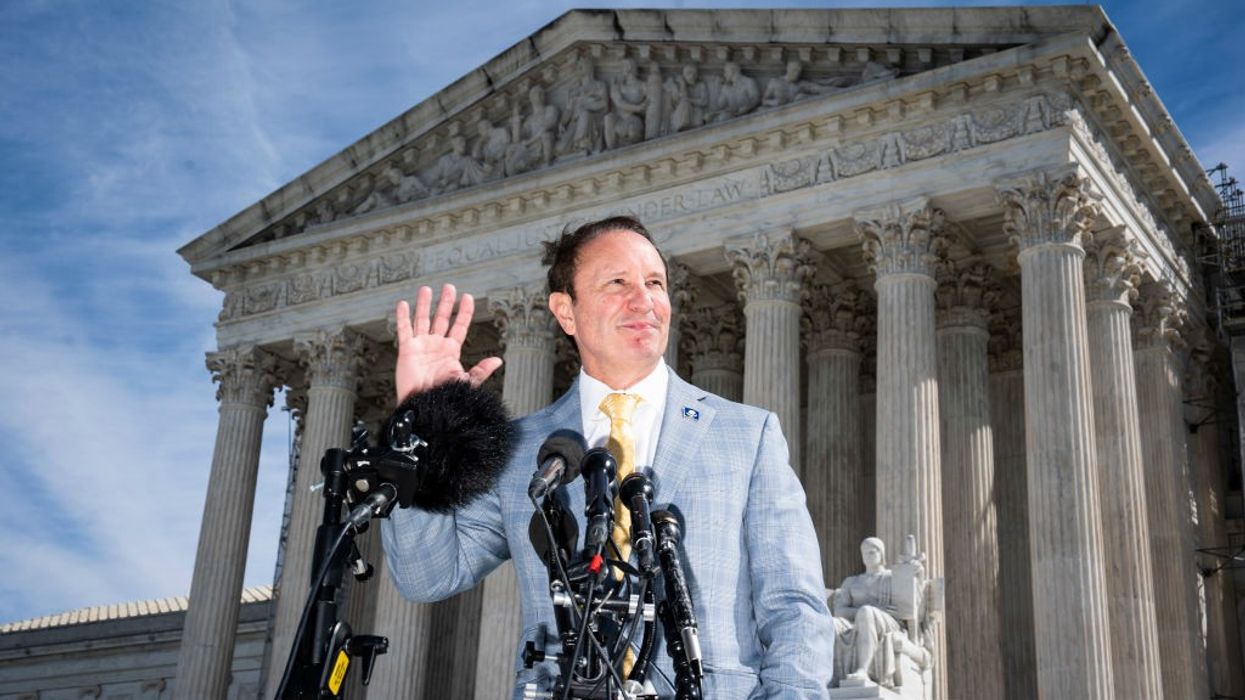
"Public schools are not Sunday schools," said one advocate, "and today's decision ensures that our clients' classrooms will remain spaces where all students, regardless of their faith, feel welcomed."
A federal judge on Tuesday blocked a Louisiana law requiring every public school classroom in the state to display, in large font, a Protestant version of the Ten Commandments—a mandate that the new ruling characterizes as plainly unconstitutional.
The decision by U.S. District Court for the Middle District of Louisiana Judge John deGravelles, an appointee of former Democratic President Barack Obama, prohibits Louisiana's Republican-dominated government from enforcing the Ten Commandments requirement, which was set to take effect on January 1, 2025.
The judge wrote that the law—which President-elect Donald Trump endorsed earlier this year shortly before Louisiana Gov. Jeff Landry signed it—is "unconstitutional on its face and in all applications."
The injunction against H.B. 71 came in response to a lawsuit brought in June by a coalition of Louisiana parents who argued the mandate "substantially interferes with and burdens the right of parents to direct their children's religious education and upbringing."
Louisiana Attorney General Elizabeth Murrill, a Republican, pledged to "immediately appeal" the decision.
Heather Weaver, senior staff attorney for the ACLU's Program on Freedom of Religion and Belief, said in a statement Tuesday that "this ruling should serve as a reality check for Louisiana lawmakers who want to use public schools to convert children to their preferred brand of Christianity."
"Public schools are not Sunday schools, and today's decision ensures that our clients' classrooms will remain spaces where all students, regardless of their faith, feel welcomed," Weaver added.
Rev. Darcy Roake, a plaintiff in the case, called H.B. 71 "a direct infringement of our religious-freedom rights, and we're pleased and relieved that the court ruled in our favor."
"As an interfaith family," Roake added, "we expect our children to receive their secular education in public school and their religious education at home and within our faith communities, not from government officials."
H.B. 71 is the first state law to require public schools to display a government-approved version of the Ten Commandments since the U.S. Supreme Court struck down a similar Kentucky mandate in 1980, calling it a violation of the First Amendment's establishment clause.
Rachel Laser, president and CEO of Americans United for Separation of Church and State, said Tuesday that "this ruling will ensure that Louisiana families—not politicians or public school officials—get to decide if, when, and how their children engage with religion."
"It should send a strong message to Christian nationalists across the country that they cannot impose their beliefs on our nation's public school children," said Laser. "Not on our watch."

"It's not just happening in Oklahoma; we're seeing it from Texas to West Virginia, from Florida to Idaho," said one church-state separation advocate.
Advocates for the separation of church and state said Thursday that they plan to take all necessary steps to stop Christian nationalists across the country "from trampling the religious freedom of public school children and their families" after Oklahoma school superintendent Ryan Walters became the latest right-wing leader to mandate Christian teachings in schools.
Walters announced Thursday that "immediate and strict compliance is expected" for a new policy mandating that public schools teach the Christian Bible as part of the state curriculum.
Including the religious text in class materials is necessary "to teach our kids about the history of this country, to have a complete understanding of Western civilization, to have an understanding of the basis of our legal system," said Walters. "We're talking about the Bible, one of the most foundational documents used for the Constitution and the birth of our country."
The announcement came days after Republican Gov. Jeff Landry of Louisiana signed into state law a new policy requiring all public school classrooms to display the Ten Commandments by 2025.
U.S. House Speaker Mike Johnson (R-La.) endorsed the policy on Wednesday, saying, "I think there's a number of states trying to look to do the same thing, and I don't think it's offensive in any way." Last weekend, former president and presumptive Republican presidential nominee Donald Trump also expressed support for the requirement, saying it could be "the first major step in the revival of religion, which is desperately needed in our country."
Americans United for Separation of Church and State, which has launched a legal challenge against the Louisiana law, said Thursday that Walters' policy is "textbook Christian nationalism" and "a transparent, unconstitutional effort to indoctrinate and religiously coerce public school students."
"This nation must recommit to our foundational principle of church-state separation before it's too late. Public education, religious freedom and democracy are all on the line."
"Public schools are not Sunday schools," said Rachel Laser, president and CEO of Americans United. "Oklahoma Superintendent Ryan Walters has repeatedly made clear that he is incapable of distinguishing the difference and is unfit for office."
"Walters is abusing the power of his public office to impose his religious beliefs on everyone else's children," continued Laser. "Not on our watch. Americans United is ready to step in and protect all Oklahoma public school children and their families from constitutional violations of their religious freedom."
Laser noted that the organization is already challenging Walters and other Oklahoma officials who are pushing to open the first publicly funded religious charter school, which was blocked by the state Supreme Court this week.
That effort, Walters' announcement, and Louisiana's Ten Commandments law all illustrate that "Christian nationalism is on the march across this country," said Laser.
"It's not just happening in Oklahoma; we're seeing it from Texas to West Virginia, from Florida to Idaho," she said. "Christian nationalists and their lawmaker allies want to replace school counselors with religious chaplains; allow teachers and coaches to pray with students; teach Creationism in science classes; and ban books and censor curricula that feature LGBTQ+ people and racial and religious minorities."
"Americans United will do everything in our power to stop Christian nationalists like Ryan Walters from trampling the religious freedom of public school children and their families," added Laser. "This nation must recommit to our foundational principle of church-state separation before it's too late. Public education, religious freedom and democracy are all on the line."
The Freedom From Religion Foundation (FFRF) also said it would take "any necessary steps" to stop Walters from imposing the Bible teaching requirement on Oklahoma educators.
"Walters' concern should be the fact that Oklahoma ranks 49th in education," said FFRF Co-President Dan Barker. "Maybe education would improve if Oklahoma's superintendent of education spent his time promoting education, instead of religion."
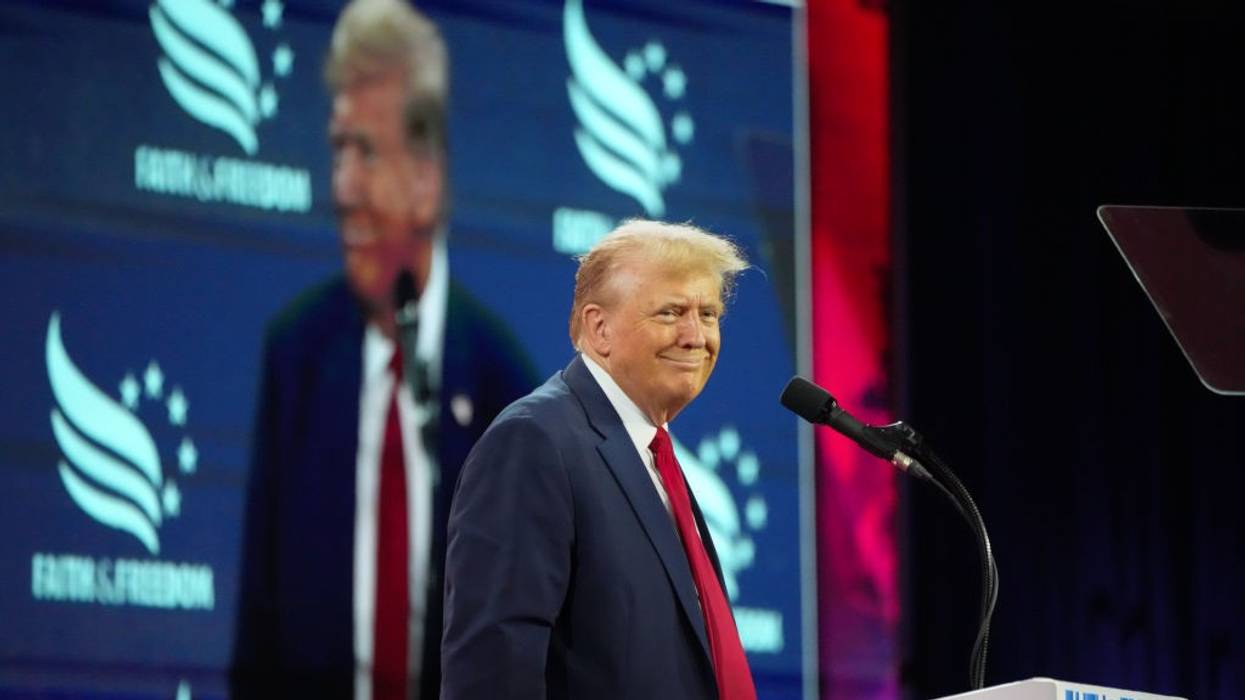
Trump spoke in support of a controversial new Louisiana law that requires the display of the commandments in all public classrooms, which progressives have said is a prime example of Christian nationalism in action.
Presumptive Republican nominee Donald Trump on Saturday endorsed the display of the Ten Commandments in schools while speaking at a conference of religious conservatives, raising concerns among progressives of a rising tide of Christian nationalism.
Trump made the comments as keynote speaker at a Faith and Freedom Coalition conference in Washington, D.C., after Louisiana adopted a law this week that requires the display of the Ten Commandments in all public classrooms.
"Has anyone read the 'Thou shalt not steal'?" he said. "They think it's such a bad thing. I mean, has anybody read this incredible stuff? It’s just incredible," Trump said. “They don’t want it to go up. It’s a crazy world."
Trump: Who likes The Ten Commandments going up in schools? Has anybody read the thou shalt not steal? I mean has anybody read this incredible stuff? pic.twitter.com/o7HFNymLfX
— Acyn (@Acyn) June 22, 2024
Louisiana Gov. Jeff Landry, a Republican, signed the bill into law on Wednesday—the first state to enact such a law in recent memory.
The law requires primary, secondary, and postsecondary classrooms to display the commandments in "large, easily readable font" by the start of 2025. The display must also state that the commandments "were a prominent part of American public education for almost three centuries"—a debatable contention.
Rights groups immediately condemned the law, calling it "blatantly unconstitutional" and announcing a planned lawsuit. The U.S. Supreme Court, which could end up with the case, struck down a similar law from Kentucky in 1980, but is now under a conservative super majority.
Supreme Court Justice Samuel Alito was recently called a "crusader for Christian nationalism" by a critic following a series of controversies, including a leaked audio tape in which he said that the country needs to return to being "a place of godliness" and that there were fundamental issues on which no compromise with "the left" could be brooked.
Trump's endorsement of the Ten Commandments law comes as he seeks to sure up evangelical support even though he declined to support a national abortion ban—the next step on the anti-choice agenda. During his speech, he did say, in an apparent effort to placate his audience, that there was "a vital role for the federal government in protecting unborn life." He also implored attendees, "Go and vote, Christians, please!"
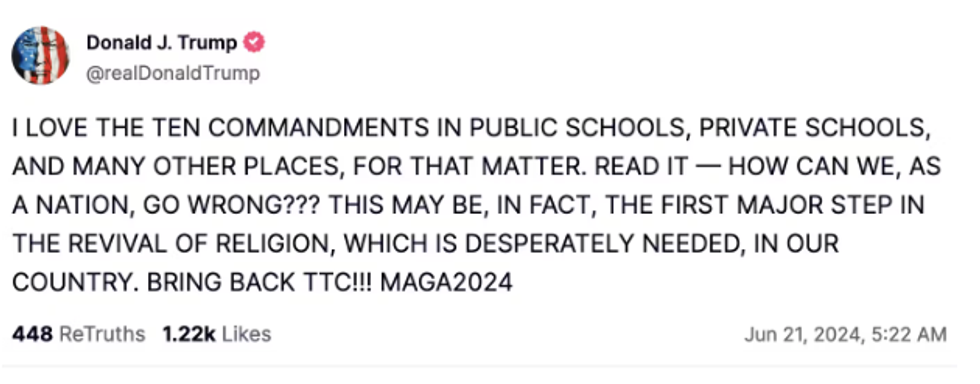
Trump's speech followed a social media post on Friday in which he'd expressed support for the display of the commandments, not just in public schools but other private schools and "many other places."
"This may be, in fact, the first major step in the revival of religion, which is desperately needed in our country," he wrote on Truth Social, which is owned by Trump Media. "Bring back [the Ten Commandments]!!!"
Neither his position on the national abortion ban nor revelations from his personal life have had a noticeable impact on Trump's popularity with evangelicals.
"Somehow, despite his philandering, lying, business fraud, and numerous other violations of the Ten Commandments, he continues to be thought of as a person of faith by 64 percent of Republicans," The New Republic's Hafiz Rashid wrote.
Louisiana's Ten Commandments law is a prime example of Christian nationalism in action, Sarah Jones wrote in New York.
"Christian nationalists are looking to score points against their foes—and win an ideological war in the process," she wrote. "If America is a Christian nation, nobody else truly belongs. Not atheists, not Muslims, not Jews, not even other Christians who disagree with their interpretation of the Bible. That's a lesson Louisiana Republicans hope to impart to Americans as children."
With Trump's success in the Republican primaries and relatively high polling numbers, progressive thinkers have this year ramped up their warnings about the threat that Christian nationalism poses to democracy.
"A society where one set of religious views is imposed on a large number of citizens who disagree with them is not a democracy," Robert Reich wrote in a Common Dreams op-ed in February. "It's a theocracy."

"Our public schools are not Sunday schools," the groups said, "and students of all faiths, or no faith, should feel welcome in them."
Rights groups expressed outrage and promised legal action on Wednesday as Louisiana became the only state to require that the Ten Commandments be displayed in public classrooms.
The law requires all public classrooms, from kindergarten to university-level, to display the commandments in "large, easily readable font" by the start of 2025. Republican Gov. Jeff Landry signed House Bill 71 into law Wednesday after declaring recently that he "could not wait to be sued."
Rights groups immediately condemned the law and vowed to challenge it. In a joint statement, the national and state ACLU as well as the Freedom from Religion Foundation and Americans United for Separation of Church and State called the law "blatantly unconstitutional"—a violation of the separation of church and state.
The religious diversity of Louisiana schools must be respected, the groups said.
"Our public schools are not Sunday schools," the statement said, "and students of all faiths, or no faith, should feel welcome in them."
Yes, Louisiana's new law requiring public schools to post the Ten Commandments in every classroom is unconstitutional, and yes, the @ACLU and @ACLUofLouisiana will be suing to stop it. See you in court, Louisiana.https://t.co/GsOLktVOv7
— Heather Lynn Weaver (@HeatherWeaverDC) June 19, 2024
To strengthen the law against legal challenges, Republicans framed the requirement as a way of teaching American history. The law's language declares the Ten Commandments to be one of the "foundational documents of our state and national government"—a claim many critics dispute.
The commandments must be displayed with a "context statement" declaring that they "were a prominent part of American public education for almost three centuries." The law offers schools the option to also display the Mayflower Compact, the Declaration of Independence, or the Northwest Ordinance.
Lawmakers in Texas, Oklahoma, and Utah have recently proposed similar bills regarding the display of the commandments, The Associated Press reported.
In 1980, the U.S. Supreme Court struck down a similar law in Kentucky, citing the establishment clause of the U.S. Constitution, which allows for no laws "respecting an establishment of religion."
Landry took office in January, replacing Democratic Gov. John Bel Edwards, who had for eight years stymied the agenda of Republican lawmakers. This year, they've brought forth a "flurry of conservative legislation," according to The New York Times.
It is not clear how the U.S. Supreme Court will treat the 1980 precedent. In recent years the court has consistently supported religious rights. In 2022, the six conservative justices ruled that a football coach in Washington who prayed with his players after games was protected by the First Amendment.
The new law—enacted Wednesday amid rising fears of Christian nationalism and its proponents crafting laws across the United States—sparked anger and mockery on social media.
"Apparently Louisiana has enough surplus budget money to defend ridiculous laws?," X user Patti Ringo wrote on the platform.
"The regression of America continues," another X user, David Poland, wrote. "How long will women and people of color be trusted with the vote?"
Even Christian groups have come out against the law. In late May, a group of more than 100 pastors and churchgoers sent Landry an open letter calling for him to veto the bill, arguing that it was not the place of the government to control religious education and that the law "disrespects religious diversity."
The group also criticized the authors of the law, which mandates exact wording of the commandments, for choosing an official version of the Ten Commandments, when different faith traditions have different versions and interpretations.
"To me that is a clear case of the government saying this religion is more important than the others," Rev. Jon Parks, senior co-pastor at University Baptist Church in Baton Rouge and a signer of the open letter, told The Advocate, a Louisiana newspaper. "There are places where the Ten Commandments belong—and the classroom is not it."