SUBSCRIBE TO OUR FREE NEWSLETTER
Daily news & progressive opinion—funded by the people, not the corporations—delivered straight to your inbox.
5
#000000
#FFFFFF
To donate by check, phone, or other method, see our More Ways to Give page.
Daily news & progressive opinion—funded by the people, not the corporations—delivered straight to your inbox.

A teen girl uses her cellphone in this undated stock photo.
"We cannot allow Meta to put its short-term profits above the emotional well-being of our kids," said Sen. Bernie Sanders.
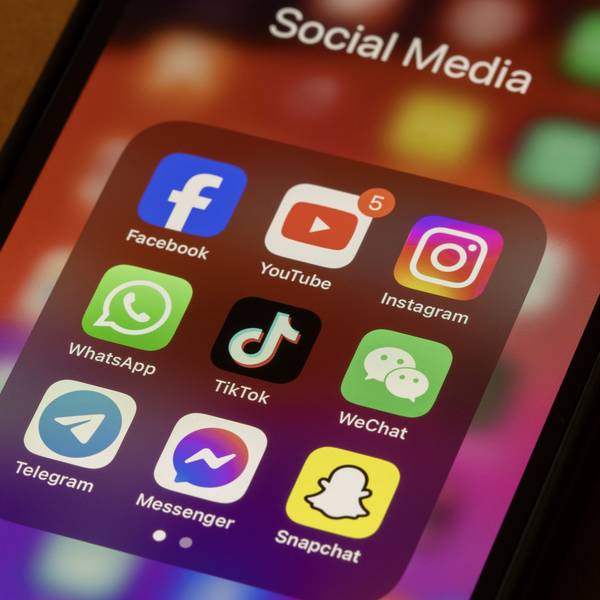
A New Mexico court on Thursday ruled that Meta must pay an additional $567 million fine on top of the $375 million a jury fined the tech giant in March for harms caused to teens and children who use its Instagram and Facebook social media platforms.
First Judicial District Judge Bryan Biedscheid said in his 68-pager ruling that "significant numbers of people in New Mexico experience harm from Meta’s products due to risks of sexual exploitation, interference with education, and adverse mental health outcomes."
"The harm to the impacted New Mexicans is not doubtful, eventual, or contingent, but an immediate, temporally connected, and highly probable result of Meta’s actions," he continued.
"The youth mental health crisis has inflicted significant and widespread harm in New Mexico in terms of the number of youth suffering mental health harms, the profound suffering they and those in their families suffer, and the resulting interferences with the functioning of the schools, law enforcement, [and] healthcare systems in New Mexico," the judge added.
The case centered on allegations that Meta knowingly designed and operated Facebook and Instagram in ways that exposed children to harmful content, encouraged excessive use, and failed to adequately protect minors from exploitation. New Mexico officials argued that internal company knowledge and outside warnings showed Meta was aware of risks associated with its platforms but did not act sufficiently to address them.
Most of the new fine—$420 million—will go toward funding youth treatment services, while the rest is designated for awareness and prevention, screening services, and other costs.
Biedscheid's order also compels Meta to make changes to its platforms in New Mexico, including removing "like" counts and only showing them to minors with parental consent, and prohibiting overnight push notifications for users under age 18.
"Regardless of whether it is labeled as an 'addiction' or 'problematic use,' the evidence at trial proved that design elements, such as autoplay, infinite scroll, 'like counts,' and push notifications create a product that, particularly for adolescent users, is highly rewarding psychologically and neurochemically," he wrote. "As a result, for many, it is irresistibly compelling to start scrolling and very difficult to stop or abstain from its use."
"In addition," the judge added, "algorithmic content recommendations can create harmful feedback loops and 'rabbit hole' users. Within a similar vein, 'like counts'... can provide a potentially harmful focus for adolescent users."
Meta spokesperson Andy Stone said the company would appeal the ruling, claiming: “We work hard to keep people safe on our platforms and have been transparent about the challenges of identifying and removing bad actors and harmful content. We remain confident in our record of protecting teens online and will continue to defend ourselves against claims that misrepresent the facts."
New Mexico Attorney General Raúl Torrez hailed the ruling, saying that “Meta built products it knew would fuel addiction, deepen a youth mental health crisis, and expose children to sexual exploitation, then lied to parents and policymakers about the danger. Today, it pays for that choice.”
At Fairplay—a children's advocacy group—executive director Josh Golin hailed the "landmark ruling" as "the clearest indication yet that the tide is turning when it comes to protecting kids from social media."
"For the first time, Meta is being compelled by a court to change its dangerous and harmful design," he continued. "And with so many states lined up to sue Meta and other social media companies, we should expect to see a lot more injunctive relief to make online platforms used by young people safer."
“This ruling also clearly indicates why families need the Kids Online Safety Act," Golin added, referring to a controversial bill advanced this week by the Senate Commerce Committee. "The judge said it was up to Congress to address the addictive features on Instagram and other social media platforms. KOSA’s duty of care against compulsive use is the key to ensuring that Meta and other social media companies stop designing for addiction, as addictive design is the root of all social media harms.”
Justin Mazzola, deputy director of research at Amnesty International USA, said in a statement: "This verdict is an important step towards creating safer social media for children and young people. For years, Amnesty International has warned that major social media platforms have been designed to maximize engagement and profit, while failing to adequately protect children’s rights."
“Crucially, the court went beyond imposing a financial penalty," he continued. "By ordering changes to platform features, including removing 'like' counts for people under 18 and restricting overnight notifications, the ruling recognizes that the harms children experience online are often the result of deliberate design choices."
“Amnesty has been calling for exactly this kind of action," Mazzola added. "Child safety must be built into platforms from the start, not added as an afterthought once harms are identified. This decision sends a clear message that social media companies cannot continue to prioritize engagement at the expense of children’s well-being and rights.”
Congresswoman Pramila Jayapal (D-Wash.) said on Bluesky: "This is good news. For far too long, Big Tech corporations have put their bottom lines ahead of the health and safety of kids on their platforms."
"Congress must continue to push for accountability and real guardrails for companies like Meta as tech giants continue to grow," added Jayapal, who was critical of the Kids Internet and Digital Safety Act approved by the House of Representatives in June.
US Sen. Bernie Sanders (I-Vt.) also welcomed the ruling, posting on X that billionaire Meta CEO Mark Zuckerberg's "greed is fueling a youth mental health crisis in America."
"Today, a judge ordered Meta to pay a $567 million fine for the damage it has done to our kids," Sanders added. "Good start. We cannot allow Meta to put its short-term profits above the emotional well-being of our kids."
Dear Common Dreams reader, It’s been nearly 30 years since I co-founded Common Dreams with my late wife, Lina Newhouser. We had the radical notion that journalism should serve the public good, not corporate profits. It was clear to us from the outset what it would take to build such a project. No paid advertisements. No corporate sponsors. No millionaire publisher telling us what to think or do. Many people said we wouldn't last a year, but we proved those doubters wrong. Together with a tremendous team of journalists and dedicated staff, we built an independent media outlet free from the constraints of profits and corporate control. Our mission has always been simple: To inform. To inspire. To ignite change for the common good. Building Common Dreams was not easy. Our survival was never guaranteed. When you take on the most powerful forces—Wall Street greed, fossil fuel industry destruction, Big Tech lobbyists, and uber-rich oligarchs who have spent billions upon billions rigging the economy and democracy in their favor—the only bulwark you have is supporters who believe in your work. But here’s the urgent message from me today. It's never been this bad out there. And it's never been this hard to keep us going. At the very moment Common Dreams is most needed, the threats we face are intensifying. We need your support now more than ever. We don't accept corporate advertising and never will. We don't have a paywall because we don't think people should be blocked from critical news based on their ability to pay. Everything we do is funded by the donations of readers like you. When everyone does the little they can afford, we are strong. But if that support retreats or dries up, so do we. Will you donate now to make sure Common Dreams not only survives but thrives? —Craig Brown, Co-founder |
A New Mexico court on Thursday ruled that Meta must pay an additional $567 million fine on top of the $375 million a jury fined the tech giant in March for harms caused to teens and children who use its Instagram and Facebook social media platforms.
First Judicial District Judge Bryan Biedscheid said in his 68-pager ruling that "significant numbers of people in New Mexico experience harm from Meta’s products due to risks of sexual exploitation, interference with education, and adverse mental health outcomes."
"The harm to the impacted New Mexicans is not doubtful, eventual, or contingent, but an immediate, temporally connected, and highly probable result of Meta’s actions," he continued.
"The youth mental health crisis has inflicted significant and widespread harm in New Mexico in terms of the number of youth suffering mental health harms, the profound suffering they and those in their families suffer, and the resulting interferences with the functioning of the schools, law enforcement, [and] healthcare systems in New Mexico," the judge added.
The case centered on allegations that Meta knowingly designed and operated Facebook and Instagram in ways that exposed children to harmful content, encouraged excessive use, and failed to adequately protect minors from exploitation. New Mexico officials argued that internal company knowledge and outside warnings showed Meta was aware of risks associated with its platforms but did not act sufficiently to address them.
Most of the new fine—$420 million—will go toward funding youth treatment services, while the rest is designated for awareness and prevention, screening services, and other costs.
Biedscheid's order also compels Meta to make changes to its platforms in New Mexico, including removing "like" counts and only showing them to minors with parental consent, and prohibiting overnight push notifications for users under age 18.
"Regardless of whether it is labeled as an 'addiction' or 'problematic use,' the evidence at trial proved that design elements, such as autoplay, infinite scroll, 'like counts,' and push notifications create a product that, particularly for adolescent users, is highly rewarding psychologically and neurochemically," he wrote. "As a result, for many, it is irresistibly compelling to start scrolling and very difficult to stop or abstain from its use."
"In addition," the judge added, "algorithmic content recommendations can create harmful feedback loops and 'rabbit hole' users. Within a similar vein, 'like counts'... can provide a potentially harmful focus for adolescent users."
Meta spokesperson Andy Stone said the company would appeal the ruling, claiming: “We work hard to keep people safe on our platforms and have been transparent about the challenges of identifying and removing bad actors and harmful content. We remain confident in our record of protecting teens online and will continue to defend ourselves against claims that misrepresent the facts."
New Mexico Attorney General Raúl Torrez hailed the ruling, saying that “Meta built products it knew would fuel addiction, deepen a youth mental health crisis, and expose children to sexual exploitation, then lied to parents and policymakers about the danger. Today, it pays for that choice.”
At Fairplay—a children's advocacy group—executive director Josh Golin hailed the "landmark ruling" as "the clearest indication yet that the tide is turning when it comes to protecting kids from social media."
"For the first time, Meta is being compelled by a court to change its dangerous and harmful design," he continued. "And with so many states lined up to sue Meta and other social media companies, we should expect to see a lot more injunctive relief to make online platforms used by young people safer."
“This ruling also clearly indicates why families need the Kids Online Safety Act," Golin added, referring to a controversial bill advanced this week by the Senate Commerce Committee. "The judge said it was up to Congress to address the addictive features on Instagram and other social media platforms. KOSA’s duty of care against compulsive use is the key to ensuring that Meta and other social media companies stop designing for addiction, as addictive design is the root of all social media harms.”
Justin Mazzola, deputy director of research at Amnesty International USA, said in a statement: "This verdict is an important step towards creating safer social media for children and young people. For years, Amnesty International has warned that major social media platforms have been designed to maximize engagement and profit, while failing to adequately protect children’s rights."
“Crucially, the court went beyond imposing a financial penalty," he continued. "By ordering changes to platform features, including removing 'like' counts for people under 18 and restricting overnight notifications, the ruling recognizes that the harms children experience online are often the result of deliberate design choices."
“Amnesty has been calling for exactly this kind of action," Mazzola added. "Child safety must be built into platforms from the start, not added as an afterthought once harms are identified. This decision sends a clear message that social media companies cannot continue to prioritize engagement at the expense of children’s well-being and rights.”
Congresswoman Pramila Jayapal (D-Wash.) said on Bluesky: "This is good news. For far too long, Big Tech corporations have put their bottom lines ahead of the health and safety of kids on their platforms."
"Congress must continue to push for accountability and real guardrails for companies like Meta as tech giants continue to grow," added Jayapal, who was critical of the Kids Internet and Digital Safety Act approved by the House of Representatives in June.
US Sen. Bernie Sanders (I-Vt.) also welcomed the ruling, posting on X that billionaire Meta CEO Mark Zuckerberg's "greed is fueling a youth mental health crisis in America."
"Today, a judge ordered Meta to pay a $567 million fine for the damage it has done to our kids," Sanders added. "Good start. We cannot allow Meta to put its short-term profits above the emotional well-being of our kids."
A New Mexico court on Thursday ruled that Meta must pay an additional $567 million fine on top of the $375 million a jury fined the tech giant in March for harms caused to teens and children who use its Instagram and Facebook social media platforms.
First Judicial District Judge Bryan Biedscheid said in his 68-pager ruling that "significant numbers of people in New Mexico experience harm from Meta’s products due to risks of sexual exploitation, interference with education, and adverse mental health outcomes."
"The harm to the impacted New Mexicans is not doubtful, eventual, or contingent, but an immediate, temporally connected, and highly probable result of Meta’s actions," he continued.
"The youth mental health crisis has inflicted significant and widespread harm in New Mexico in terms of the number of youth suffering mental health harms, the profound suffering they and those in their families suffer, and the resulting interferences with the functioning of the schools, law enforcement, [and] healthcare systems in New Mexico," the judge added.
The case centered on allegations that Meta knowingly designed and operated Facebook and Instagram in ways that exposed children to harmful content, encouraged excessive use, and failed to adequately protect minors from exploitation. New Mexico officials argued that internal company knowledge and outside warnings showed Meta was aware of risks associated with its platforms but did not act sufficiently to address them.
Most of the new fine—$420 million—will go toward funding youth treatment services, while the rest is designated for awareness and prevention, screening services, and other costs.
Biedscheid's order also compels Meta to make changes to its platforms in New Mexico, including removing "like" counts and only showing them to minors with parental consent, and prohibiting overnight push notifications for users under age 18.
"Regardless of whether it is labeled as an 'addiction' or 'problematic use,' the evidence at trial proved that design elements, such as autoplay, infinite scroll, 'like counts,' and push notifications create a product that, particularly for adolescent users, is highly rewarding psychologically and neurochemically," he wrote. "As a result, for many, it is irresistibly compelling to start scrolling and very difficult to stop or abstain from its use."
"In addition," the judge added, "algorithmic content recommendations can create harmful feedback loops and 'rabbit hole' users. Within a similar vein, 'like counts'... can provide a potentially harmful focus for adolescent users."
Meta spokesperson Andy Stone said the company would appeal the ruling, claiming: “We work hard to keep people safe on our platforms and have been transparent about the challenges of identifying and removing bad actors and harmful content. We remain confident in our record of protecting teens online and will continue to defend ourselves against claims that misrepresent the facts."
New Mexico Attorney General Raúl Torrez hailed the ruling, saying that “Meta built products it knew would fuel addiction, deepen a youth mental health crisis, and expose children to sexual exploitation, then lied to parents and policymakers about the danger. Today, it pays for that choice.”
At Fairplay—a children's advocacy group—executive director Josh Golin hailed the "landmark ruling" as "the clearest indication yet that the tide is turning when it comes to protecting kids from social media."
"For the first time, Meta is being compelled by a court to change its dangerous and harmful design," he continued. "And with so many states lined up to sue Meta and other social media companies, we should expect to see a lot more injunctive relief to make online platforms used by young people safer."
“This ruling also clearly indicates why families need the Kids Online Safety Act," Golin added, referring to a controversial bill advanced this week by the Senate Commerce Committee. "The judge said it was up to Congress to address the addictive features on Instagram and other social media platforms. KOSA’s duty of care against compulsive use is the key to ensuring that Meta and other social media companies stop designing for addiction, as addictive design is the root of all social media harms.”
Justin Mazzola, deputy director of research at Amnesty International USA, said in a statement: "This verdict is an important step towards creating safer social media for children and young people. For years, Amnesty International has warned that major social media platforms have been designed to maximize engagement and profit, while failing to adequately protect children’s rights."
“Crucially, the court went beyond imposing a financial penalty," he continued. "By ordering changes to platform features, including removing 'like' counts for people under 18 and restricting overnight notifications, the ruling recognizes that the harms children experience online are often the result of deliberate design choices."
“Amnesty has been calling for exactly this kind of action," Mazzola added. "Child safety must be built into platforms from the start, not added as an afterthought once harms are identified. This decision sends a clear message that social media companies cannot continue to prioritize engagement at the expense of children’s well-being and rights.”
Congresswoman Pramila Jayapal (D-Wash.) said on Bluesky: "This is good news. For far too long, Big Tech corporations have put their bottom lines ahead of the health and safety of kids on their platforms."
"Congress must continue to push for accountability and real guardrails for companies like Meta as tech giants continue to grow," added Jayapal, who was critical of the Kids Internet and Digital Safety Act approved by the House of Representatives in June.
US Sen. Bernie Sanders (I-Vt.) also welcomed the ruling, posting on X that billionaire Meta CEO Mark Zuckerberg's "greed is fueling a youth mental health crisis in America."
"Today, a judge ordered Meta to pay a $567 million fine for the damage it has done to our kids," Sanders added. "Good start. We cannot allow Meta to put its short-term profits above the emotional well-being of our kids."