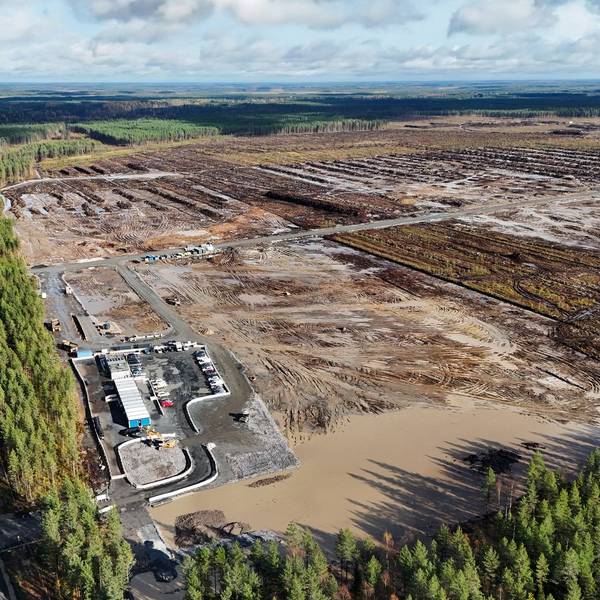


Rural Michigan residents rally against the $7 billion Stargate data center planned on local farmland in Saline, Michigan on December 1, 2025.
230+ Environmental Groups Call On Congress to Impose Moratorium on New AI Data Centers
“The rapid, largely unregulated rise of data centers to fuel the AI and crypto frenzy is disrupting communities across the country and threatening Americans’ economic, environmental, climate, and water security.”
Environmental and economic justice advocates alike have been sounding the alarm for months regarding the Trump administration's push to build massive data centers to support artificial intelligence and cryptocurrency in communities across the United States—regardless of local opposition—and on Monday Congress heard from a coalition of more than 200 groups demanding action to stop what they called "one of the biggest environmental and social threats of our generation."
Led by Food and Water Watch (FWW), which originally demanded a moratorium on new AI data centers in October, more than 230 organizations have signed a letter warning that thus far, Congress has failed to take action to stop the rapid expansion despite the fact that "the harms of data center growth are increasingly well-established, and they are massive."
The national and state groups, including Greenpeace USA, Oil Change International, and the Nebraska-based Save Rural America, pointed to a number of harms associated with the expansion of data centers in places including rural Michigan, Wisconsin, and northern Virginia.
They warned that pushing the build-out onto communities—many of which have protested the approval of the centers to no avail—will lead to:
- Enormous electricity consumption, with a tripling of data centers in the next five years projected to result in the facilities consuming as much electricity as about 30 million households;
- Unsustainable water consumption, with those data centers requiring the amount of water normally used by 18.5 million households, just for cooling the computer servers;
- The worsening of the climate emergency, with 56% of the energy used to power data centers sourced from planet-heating fossil fuels;
- Surging electricity costs for people living in the vicinity of energy-sucking data centers; and
- Skyrocketing job losses as half of all entry-level white-collar jobs are projected to become obsolete due to the growth of AI and companies' investments in the technology, even as corporations report they're not seeing a significant positive impact on their bottom lines.
"The rapid, largely unregulated rise of data centers to fuel the AI and crypto frenzy is disrupting communities across the country and threatening Americans’ economic, environmental, climate, and water security," the groups told Congress. "We urge you to join our call for a national moratorium on new data centers until adequate regulations can be enacted to fully protect our communities, our families, our environment, and our health from the runaway damage this industry is already inflicting."
The groups noted that electricity costs have risen 21.3% since 2021, a rate that "drastically" outpaces inflation, driven by the "rapid build-out of data centers."
As CNBC reported last month, residential utility bills rose 6% in August compared with last summer, and though price increases can be due to a host of reasons, electricity prices rose "much faster than the national average" this year in states with high concentrations of data centers. Consumers in Virginia paid 13% more, while those in Illinois paid 16% more and people in Ohio saw their costs go up 12%.
Emily Wurth, managing director of organizing at FWW, told the Guardian that rising utility costs are driving much of the grassroots action against data centers in places like Wisconsin—where a woman was violently dragged out of a community meeting by police last week after speaking out against plans for a new facility in her town—and Tucson, Arizona, where residents successfully pushed the City Council this year to block a data center project linked to Amazon.
“I’ve been amazed by the groundswell of grassroots, bipartisan opposition to this, in all types of communities across the US,” Wurth told the Guardian. “Everyone is affected by this, the opposition has been across the political spectrum. A lot of people don’t see the benefits coming from AI and feel they will be paying for it with their energy bills and water... We’ve seen outrageous utility price rises across the country and we are going to lean into this. Prices are going up across the board and this is something Americans really do care about.”
Data center projects worth a total of $64 billion have been blocked or delayed in states including Texas, Oregon, and Tennessee, and Reuters reported last week that a sizable portion of the opposition is coming from parts of the country that heavily supported President Donald Trump in last year's election.
Hundreds of people attended a recent meeting in Montour County, Pennsylvania, where Trump won by 20 points last year, raising alarm over plans to rezone 1,300 acres for Talen Energy to build a data center.
While raising prices for households that are already coping with high grocery and healthcare bills, the unregulated growth in AI data centers is also expected to add up to 44 million tons of carbon dioxide to the atmosphere in just the next five years—the equivalent of putting 10 million new fossil fuel-powered cars on the road at a time when planetary heating has already been linked to recent US weather disasters like Hurricane Helene and deadly heatwaves.
The groups appealed to Congress as Trump said he plans to sign an executive order preempting state-level AI regulations, saying that states, "many of them bad actors," should not be "involved in RULES and the APPROVAL PROCESS.”
Republicans in Congress have also recently suggested they could try to ban state-level AI regulations in the National Defense Authorization Act.
The Trump administration and its allies in the industry have issued warnings to communities that oppose the construction of AI data centers, with the White House's AI Action Plan demanding the fast-tracking of permits for building the facilities and former Sen. Kyrsten Sinema (I-Ariz.) lobbying for the industry and recently telling local officials in Chandler, Arizona that "federal preemption is coming" and they must approve plans for a 20,000-square foot data center in the city.
A Morning Consult poll taken last month found that public support for the centers is falling as rapidly as companies try to take over rural and suburban communities with new data centers. More than 40% said they supported a ban on the construction of new facilities, up from 37% just a month prior.
We are at a crossroads
This country and this world are at a monumental crossroads. In a few short weeks, US voters will have an opportunity to beat back the forces of fascism and confront the billionaires who are rigging the economy, our media system, and our democracy, making it increasingly impossible for ordinary people to get by. We’re not just talking about the election. We’re talking about what must be done once these fascist elements are vanquished from power. We need a bolder set of solutions than what either major party has so far been willing to offer and a working-class movement ready to fight like hell for it. Trump didn't emerge from nowhere. The conditions that fueled MAGA authoritarianism were created by decades of radical neoliberal economic policies and a corrupt political system dominated by corporate interests. They slashed taxes on the super-rich, promising that the benefits would trickle down. They said giveaways to the corporate titans would make life more affordable for the rest of us. It was all bullshit. And when a bitter, betrayed populace searches for someone to blame, right-wing demagogues have little trouble finding scapegoats. People know when they're being lied to, but you won't hear any of this from the corporate media. Only independent journalism—powered and funded by people who believe in building a better world—can deliver truly trustworthy daily news. Our Fall Campaign is underway, and we need your help. To power our newsroom through the rest of the year, we need to raise $125,000 by midnight on October 31. So if you share our vision, please contribute whatever you can to sustain our work. |
Environmental and economic justice advocates alike have been sounding the alarm for months regarding the Trump administration's push to build massive data centers to support artificial intelligence and cryptocurrency in communities across the United States—regardless of local opposition—and on Monday Congress heard from a coalition of more than 200 groups demanding action to stop what they called "one of the biggest environmental and social threats of our generation."
Led by Food and Water Watch (FWW), which originally demanded a moratorium on new AI data centers in October, more than 230 organizations have signed a letter warning that thus far, Congress has failed to take action to stop the rapid expansion despite the fact that "the harms of data center growth are increasingly well-established, and they are massive."
The national and state groups, including Greenpeace USA, Oil Change International, and the Nebraska-based Save Rural America, pointed to a number of harms associated with the expansion of data centers in places including rural Michigan, Wisconsin, and northern Virginia.
They warned that pushing the build-out onto communities—many of which have protested the approval of the centers to no avail—will lead to:
- Enormous electricity consumption, with a tripling of data centers in the next five years projected to result in the facilities consuming as much electricity as about 30 million households;
- Unsustainable water consumption, with those data centers requiring the amount of water normally used by 18.5 million households, just for cooling the computer servers;
- The worsening of the climate emergency, with 56% of the energy used to power data centers sourced from planet-heating fossil fuels;
- Surging electricity costs for people living in the vicinity of energy-sucking data centers; and
- Skyrocketing job losses as half of all entry-level white-collar jobs are projected to become obsolete due to the growth of AI and companies' investments in the technology, even as corporations report they're not seeing a significant positive impact on their bottom lines.
"The rapid, largely unregulated rise of data centers to fuel the AI and crypto frenzy is disrupting communities across the country and threatening Americans’ economic, environmental, climate, and water security," the groups told Congress. "We urge you to join our call for a national moratorium on new data centers until adequate regulations can be enacted to fully protect our communities, our families, our environment, and our health from the runaway damage this industry is already inflicting."
The groups noted that electricity costs have risen 21.3% since 2021, a rate that "drastically" outpaces inflation, driven by the "rapid build-out of data centers."
As CNBC reported last month, residential utility bills rose 6% in August compared with last summer, and though price increases can be due to a host of reasons, electricity prices rose "much faster than the national average" this year in states with high concentrations of data centers. Consumers in Virginia paid 13% more, while those in Illinois paid 16% more and people in Ohio saw their costs go up 12%.
Emily Wurth, managing director of organizing at FWW, told the Guardian that rising utility costs are driving much of the grassroots action against data centers in places like Wisconsin—where a woman was violently dragged out of a community meeting by police last week after speaking out against plans for a new facility in her town—and Tucson, Arizona, where residents successfully pushed the City Council this year to block a data center project linked to Amazon.
“I’ve been amazed by the groundswell of grassroots, bipartisan opposition to this, in all types of communities across the US,” Wurth told the Guardian. “Everyone is affected by this, the opposition has been across the political spectrum. A lot of people don’t see the benefits coming from AI and feel they will be paying for it with their energy bills and water... We’ve seen outrageous utility price rises across the country and we are going to lean into this. Prices are going up across the board and this is something Americans really do care about.”
Data center projects worth a total of $64 billion have been blocked or delayed in states including Texas, Oregon, and Tennessee, and Reuters reported last week that a sizable portion of the opposition is coming from parts of the country that heavily supported President Donald Trump in last year's election.
Hundreds of people attended a recent meeting in Montour County, Pennsylvania, where Trump won by 20 points last year, raising alarm over plans to rezone 1,300 acres for Talen Energy to build a data center.
While raising prices for households that are already coping with high grocery and healthcare bills, the unregulated growth in AI data centers is also expected to add up to 44 million tons of carbon dioxide to the atmosphere in just the next five years—the equivalent of putting 10 million new fossil fuel-powered cars on the road at a time when planetary heating has already been linked to recent US weather disasters like Hurricane Helene and deadly heatwaves.
The groups appealed to Congress as Trump said he plans to sign an executive order preempting state-level AI regulations, saying that states, "many of them bad actors," should not be "involved in RULES and the APPROVAL PROCESS.”
Republicans in Congress have also recently suggested they could try to ban state-level AI regulations in the National Defense Authorization Act.
The Trump administration and its allies in the industry have issued warnings to communities that oppose the construction of AI data centers, with the White House's AI Action Plan demanding the fast-tracking of permits for building the facilities and former Sen. Kyrsten Sinema (I-Ariz.) lobbying for the industry and recently telling local officials in Chandler, Arizona that "federal preemption is coming" and they must approve plans for a 20,000-square foot data center in the city.
A Morning Consult poll taken last month found that public support for the centers is falling as rapidly as companies try to take over rural and suburban communities with new data centers. More than 40% said they supported a ban on the construction of new facilities, up from 37% just a month prior.
- More Americans Fall Behind on Utility Bills as AI Data Centers, Trump Attacks on Renewables Raise Costs ›
- As AI Data Centers Disrupt US Cities, Wisconsin Woman Violently Arrested After Speaking Out ›
- Nationwide Backlash Brewing Against Big Tech's Energy-Devouring AI Data Centers ›
- 'Good!' Declares AOC After Arizona City Council Rejects Data Center Pushed by Sinema | Common Dreams ›
- Data Center Giant Secures $14 Million Deal to Consume 40% of Pennsylvania Town's Excess Water | Common Dreams ›
- Bucking 'Huge Consensus' at India Summit, Trump Admin Opposes Global AI Guardrails | Common Dreams ›
- Opinion | Why Pausing the Data Center Buildout Is the (Humanly) Intelligent Choice | Common Dreams ›
- Opinion | Forests, Not Data Centers: A Better Plan for Rural Prosperity | Common Dreams ›
- Small Wisconsin City Overwhelmingly Passes First-of-Its-Kind Measure Restricting AI Data Centers | Common Dreams ›
- Citing 'Irreversible Harm,' 100+ Groups Urge Congress to Reject Rushed Data Center Approvals | Common Dreams ›
- Opinion | The Harm Data Centers Cause Isn't Only Local | Common Dreams ›
- Ocasio-Cortez Corners EPA Administrator on Water Quality Near Data Centers | Common Dreams ›
- 'We're Not a Company Town': Tech Hub Seattle Passes Data Center Moratorium | Common Dreams ›
- Alarmed by 'Rapid, Unregulated Rise' of AI Data Centers, 500+ Groups Demand Congress Pass Moratorium | Common Dreams ›
- As Millions Endure Extreme Heat, Climate Group Tells Congress: 'Protect People, Not Data Centers' | Common Dreams ›
- Opinion | Nevada’s Data Centers Power a Surveillance Pipeline That Ends at Our Doorstep | Common Dreams ›
- Amazon Says New Texas Data Center Won't Raise Utility Bills—But It Will Supercharge Pollution | Common Dreams ›
- Opinion | Almost Overnight, the Data Centers Were Everywhere in My Community—Don't Let This Happen to You | Common Dreams ›
- 'Have Your Friend Elon Build One at Mar-a-Lago,' Says Sanders After Trump Comments on Data Centers | Common Dreams ›
- Opinion | Rural Residents Can Learn From the Factor-Farm Rollout to Resist Data Centers | Common Dreams ›
- 'This Is an Emergency': Congressional Inaction in Spotlight After Existential Warnings From AI Insiders | Common Dreams ›
- Trump EPA Accused of Endangering Public as Study Details 'Hidden Health Costs' of Data Centers | Common Dreams ›
Environmental and economic justice advocates alike have been sounding the alarm for months regarding the Trump administration's push to build massive data centers to support artificial intelligence and cryptocurrency in communities across the United States—regardless of local opposition—and on Monday Congress heard from a coalition of more than 200 groups demanding action to stop what they called "one of the biggest environmental and social threats of our generation."
Led by Food and Water Watch (FWW), which originally demanded a moratorium on new AI data centers in October, more than 230 organizations have signed a letter warning that thus far, Congress has failed to take action to stop the rapid expansion despite the fact that "the harms of data center growth are increasingly well-established, and they are massive."
The national and state groups, including Greenpeace USA, Oil Change International, and the Nebraska-based Save Rural America, pointed to a number of harms associated with the expansion of data centers in places including rural Michigan, Wisconsin, and northern Virginia.
They warned that pushing the build-out onto communities—many of which have protested the approval of the centers to no avail—will lead to:
- Enormous electricity consumption, with a tripling of data centers in the next five years projected to result in the facilities consuming as much electricity as about 30 million households;
- Unsustainable water consumption, with those data centers requiring the amount of water normally used by 18.5 million households, just for cooling the computer servers;
- The worsening of the climate emergency, with 56% of the energy used to power data centers sourced from planet-heating fossil fuels;
- Surging electricity costs for people living in the vicinity of energy-sucking data centers; and
- Skyrocketing job losses as half of all entry-level white-collar jobs are projected to become obsolete due to the growth of AI and companies' investments in the technology, even as corporations report they're not seeing a significant positive impact on their bottom lines.
"The rapid, largely unregulated rise of data centers to fuel the AI and crypto frenzy is disrupting communities across the country and threatening Americans’ economic, environmental, climate, and water security," the groups told Congress. "We urge you to join our call for a national moratorium on new data centers until adequate regulations can be enacted to fully protect our communities, our families, our environment, and our health from the runaway damage this industry is already inflicting."
The groups noted that electricity costs have risen 21.3% since 2021, a rate that "drastically" outpaces inflation, driven by the "rapid build-out of data centers."
As CNBC reported last month, residential utility bills rose 6% in August compared with last summer, and though price increases can be due to a host of reasons, electricity prices rose "much faster than the national average" this year in states with high concentrations of data centers. Consumers in Virginia paid 13% more, while those in Illinois paid 16% more and people in Ohio saw their costs go up 12%.
Emily Wurth, managing director of organizing at FWW, told the Guardian that rising utility costs are driving much of the grassroots action against data centers in places like Wisconsin—where a woman was violently dragged out of a community meeting by police last week after speaking out against plans for a new facility in her town—and Tucson, Arizona, where residents successfully pushed the City Council this year to block a data center project linked to Amazon.
“I’ve been amazed by the groundswell of grassroots, bipartisan opposition to this, in all types of communities across the US,” Wurth told the Guardian. “Everyone is affected by this, the opposition has been across the political spectrum. A lot of people don’t see the benefits coming from AI and feel they will be paying for it with their energy bills and water... We’ve seen outrageous utility price rises across the country and we are going to lean into this. Prices are going up across the board and this is something Americans really do care about.”
Data center projects worth a total of $64 billion have been blocked or delayed in states including Texas, Oregon, and Tennessee, and Reuters reported last week that a sizable portion of the opposition is coming from parts of the country that heavily supported President Donald Trump in last year's election.
Hundreds of people attended a recent meeting in Montour County, Pennsylvania, where Trump won by 20 points last year, raising alarm over plans to rezone 1,300 acres for Talen Energy to build a data center.
While raising prices for households that are already coping with high grocery and healthcare bills, the unregulated growth in AI data centers is also expected to add up to 44 million tons of carbon dioxide to the atmosphere in just the next five years—the equivalent of putting 10 million new fossil fuel-powered cars on the road at a time when planetary heating has already been linked to recent US weather disasters like Hurricane Helene and deadly heatwaves.
The groups appealed to Congress as Trump said he plans to sign an executive order preempting state-level AI regulations, saying that states, "many of them bad actors," should not be "involved in RULES and the APPROVAL PROCESS.”
Republicans in Congress have also recently suggested they could try to ban state-level AI regulations in the National Defense Authorization Act.
The Trump administration and its allies in the industry have issued warnings to communities that oppose the construction of AI data centers, with the White House's AI Action Plan demanding the fast-tracking of permits for building the facilities and former Sen. Kyrsten Sinema (I-Ariz.) lobbying for the industry and recently telling local officials in Chandler, Arizona that "federal preemption is coming" and they must approve plans for a 20,000-square foot data center in the city.
A Morning Consult poll taken last month found that public support for the centers is falling as rapidly as companies try to take over rural and suburban communities with new data centers. More than 40% said they supported a ban on the construction of new facilities, up from 37% just a month prior.
- More Americans Fall Behind on Utility Bills as AI Data Centers, Trump Attacks on Renewables Raise Costs ›
- As AI Data Centers Disrupt US Cities, Wisconsin Woman Violently Arrested After Speaking Out ›
- Nationwide Backlash Brewing Against Big Tech's Energy-Devouring AI Data Centers ›
- 'Good!' Declares AOC After Arizona City Council Rejects Data Center Pushed by Sinema | Common Dreams ›
- Data Center Giant Secures $14 Million Deal to Consume 40% of Pennsylvania Town's Excess Water | Common Dreams ›
- Bucking 'Huge Consensus' at India Summit, Trump Admin Opposes Global AI Guardrails | Common Dreams ›
- Opinion | Why Pausing the Data Center Buildout Is the (Humanly) Intelligent Choice | Common Dreams ›
- Opinion | Forests, Not Data Centers: A Better Plan for Rural Prosperity | Common Dreams ›
- Small Wisconsin City Overwhelmingly Passes First-of-Its-Kind Measure Restricting AI Data Centers | Common Dreams ›
- Citing 'Irreversible Harm,' 100+ Groups Urge Congress to Reject Rushed Data Center Approvals | Common Dreams ›
- Opinion | The Harm Data Centers Cause Isn't Only Local | Common Dreams ›
- Ocasio-Cortez Corners EPA Administrator on Water Quality Near Data Centers | Common Dreams ›
- 'We're Not a Company Town': Tech Hub Seattle Passes Data Center Moratorium | Common Dreams ›
- Alarmed by 'Rapid, Unregulated Rise' of AI Data Centers, 500+ Groups Demand Congress Pass Moratorium | Common Dreams ›
- As Millions Endure Extreme Heat, Climate Group Tells Congress: 'Protect People, Not Data Centers' | Common Dreams ›
- Opinion | Nevada’s Data Centers Power a Surveillance Pipeline That Ends at Our Doorstep | Common Dreams ›
- Amazon Says New Texas Data Center Won't Raise Utility Bills—But It Will Supercharge Pollution | Common Dreams ›
- Opinion | Almost Overnight, the Data Centers Were Everywhere in My Community—Don't Let This Happen to You | Common Dreams ›
- 'Have Your Friend Elon Build One at Mar-a-Lago,' Says Sanders After Trump Comments on Data Centers | Common Dreams ›
- Opinion | Rural Residents Can Learn From the Factor-Farm Rollout to Resist Data Centers | Common Dreams ›
- 'This Is an Emergency': Congressional Inaction in Spotlight After Existential Warnings From AI Insiders | Common Dreams ›
- Trump EPA Accused of Endangering Public as Study Details 'Hidden Health Costs' of Data Centers | Common Dreams ›