SUBSCRIBE TO OUR FREE NEWSLETTER
Daily news & progressive opinion—funded by the people, not the corporations—delivered straight to your inbox.
5
#000000
#FFFFFF
To donate by check, phone, or other method, see our More Ways to Give page.
Daily news & progressive opinion—funded by the people, not the corporations—delivered straight to your inbox.
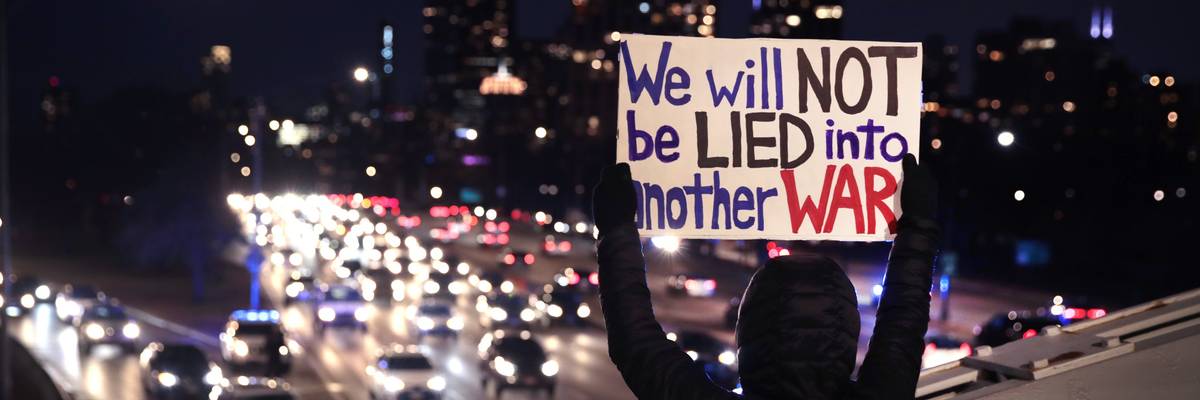
Demonstrators protest the possibility of War with Iran from a pedestrian bridge over Lakeshore Drive during rush hour on January 09, 2020 in Chicago, Illinois.
And Trump, in particular, does not have time on his side when taking into account both economic and political realities, and even some military factors.
For all practical purposes, the US-Iran Memorandum of (Mis)Understanding is over. The dispute over how to manage the Strait of Hormuz in the interim has pushed the two sides back into open war. But to what end?
There is little reason to believe another round of fighting can alter the fundamentals enough to change the reality from which the two sides must ultimately negotiate. If they are fortunate, the MOU’s collapse may yield another round of talks in which the allure of reshaping facts on the ground through force has finally faded.
As I have written elsewhere, the dispute over the Strait turns, at least on the surface, on Paragraph 5 of the MOU: whether Iran is responsible for safe passage throughout the Strait for the duration of the agreement, or only for the waterway’s northern corridor.
Beneath the surface, however, lies a more fundamental strategic disagreement. Even before the MOU was signed, Tehran believed Washington's objective was to establish a southern shipping corridor through Omani waters that would gradually erode Iran's control over the Strait. Such a corridor would require Oman's cooperation, which may explain why Trump at one point threatened to bomb Oman unless it abandoned its proposal for joint management of the Strait, with administrative fees collected by Muscat and Tehran.
The corridor would remain operational even if war resumed and Iran sought once again to close the Strait. From Tehran's perspective, Washington used the MOU to strengthen this alternative route, and the US military's escort of commercial shipping without coordinating with Iran marked a significant step in that direction. If successful, the strategy would deprive Iran of its most important source of leverage — which is precisely why it appeals to Washington.
This is why Tehran has insisted that all ships transiting the Strait — regardless of the corridor they use — coordinate with Iran, consistent with its reading of Paragraph 5 of the MOU. Washington, by contrast, argues that the MOU merely assigns Iran responsibility for ensuring the safe passage of commercial vessels, without granting it operational control over all maritime traffic.
Before the funeral of former Supreme Leader Ayatollah Khamenei, the two sides explored a compromise under which ships would coordinate their transit with both Iran and a designated Gulf Cooperation Council (GCC) state. As I wrote in my Substack, “Under such an arrangement, ships would notify Tehran while also reporting to a GCC maritime authority, balancing Iran's demand for oversight with Washington's desire to avoid granting Tehran exclusive control.” But no agreement was reached before diplomacy was suspended for the duration of the funeral.
Accounts of what transpired in Muscat over the weekend naturally differ, but three proposals emerged. Iran advanced a variation of the earlier compromise: a dual-notification system for all vessels transiting the Strait. Qatar proposed three channels—an Iranian corridor in the north, an Omani corridor in the south, and a neutral corridor in the middle. For Tehran, this was a nonstarter, as it would effectively restore the Strait to its pre-February status.
According to Tehran, the United States and Oman favored separate management of the Iranian and Omani corridors: Iran could require coordination for vessels using its corridor, while Oman's would remain unrestricted.
Tehran saw this as an attempt to formalize what it had long suspected was Washington's strategy: creating a southern corridor through the Strait beyond Iran's influence, leaving Tehran no means of challenging it short of war with Oman. Iran also contends that Muscat advanced the proposal only under intense US pressure, noting that Oman had previously supported a joint management system.
Washington disputes this account. US officials maintain they were open to several arrangements, provided commercial vessels could transit the Strait safely. According to the American version, the talks unraveled only after Iranian Foreign Minister Abbas Araghchi consulted Tehran regarding a joint Iranian-Omani statement declaring the Strait open. From Washington's perspective, negotiations had been progressing until Araghchi was overruled by hardliners in the IRGC, who chose confrontation over compromise.
Whether such a fracture proved decisive in this instance is unclear. What is clear is that the outlook of Iranian strategists has hardened markedly in recent weeks as they have become increasingly convinced that Trump intends to restart the war. Several developments have reinforced that belief. First, Trump's rhetoric shifted dramatically: he called the Iranians "scum," declared the ceasefire over, and said he might resume bombing to "finish the job."
Second, as I argued here, Tehran believes Washington brokered the Lebanese-Israeli agreement — which contradicts the US-Iran MOU by conditioning Israel's withdrawal from Lebanon on Hezbollah's disarmament — to enable Israel to retain key positions that would weaken Hezbollah's ability to support Iran in the next war.
Third, White House officials leaked the US demand that Tehran declare the Strait open and, at least implicitly, accept responsibility for attacks on shipping. Rather than seeing the leak as political posturing to make Trump appear tough, Tehran increasingly viewed it as a deliberate attempt to derail the talks and steer the crisis back toward military confrontation.
Taken together, these developments convinced Tehran that Washington was preparing to resume the war. From that perspective, Iran's best option was to close the Strait immediately. Rather than an attempt to extract additional concessions or an instance of overplaying its hand, Tehran's decision appears to have been driven by the fear of losing its most important source of leverage before the next round of fighting.
In the view of Iranian decision-makers, closing the Strait would not trigger war because war was already coming. (If their assessment was incorrect, however, Tehran’s own actions have likely created a self-fulfilling prophecy by taking actions that made a military response from Washington next to inevitable).
Still, much indicates that another round of war will not fundamentally change realities on the ground or the balance between the US and Iran. Trump, in particular, does not have time on his side when taking into account both economic and political realities, and even some military factors.
By almost every meaningful measure, the global oil inventory position is materially weaker today than it was before the February war. Since the end of February, observed global oil inventories have fallen by roughly 360–370 million barrels, with only about 21 million barrels rebuilt after the US-Iran MOU—recovering just 5% of the wartime draw.
More importantly, the apparent recovery reflects oil in transit rather than replenished storage: oil on water increased by 117 million barrels, while onshore inventories fell by 96 million barrels. OECD inventories declined by another 62 million barrels in June alone, including roughly 44 million barrels released from government emergency stocks.
The United States also enters any renewed conflict with a substantially smaller strategic cushion. It has fallen from about 415 million barrels before the war to roughly 337 million barrels, while commercial crude, gasoline and distillate inventories all remain below their five-year seasonal averages. Consequently, Washington has significantly less capacity than in February to absorb another major disruption to global oil flows.
In addition, the United States is now only four months away from the midterm elections, dramatically shortening Trump's economic and political pain threshold. In February, the administration could plausibly argue that the oil shock was temporary and that prices would normalize before voters went to the polls. A renewed conflict today would push its most visible economic consequences directly into the campaign: higher gasoline prices, inflation, interest rates, and rising food, airline, freight, and utility costs.
As a Pentagon source told me last year, Iran builds missiles faster than the United States produces missile interceptors. And while Washington must divide its attention and resources among multiple theaters—from Ukraine to Taiwan—Iran has only one.
Thus, although the United States could, given enough time, degrade Iran's ability to threaten shipping in the Persian Gulf, there is little reason to believe it could do so before the economic and political costs became prohibitive for Trump. It is essentially the same strategic reality he confronted in February. The difference is that he lacked the benefit of hindsight then. Now he has it—though it does not appear to have mattered.
Dear Common Dreams reader, It’s been nearly 30 years since I co-founded Common Dreams with my late wife, Lina Newhouser. We had the radical notion that journalism should serve the public good, not corporate profits. It was clear to us from the outset what it would take to build such a project. No paid advertisements. No corporate sponsors. No millionaire publisher telling us what to think or do. Many people said we wouldn't last a year, but we proved those doubters wrong. Together with a tremendous team of journalists and dedicated staff, we built an independent media outlet free from the constraints of profits and corporate control. Our mission has always been simple: To inform. To inspire. To ignite change for the common good. Building Common Dreams was not easy. Our survival was never guaranteed. When you take on the most powerful forces—Wall Street greed, fossil fuel industry destruction, Big Tech lobbyists, and uber-rich oligarchs who have spent billions upon billions rigging the economy and democracy in their favor—the only bulwark you have is supporters who believe in your work. But here’s the urgent message from me today. It's never been this bad out there. And it's never been this hard to keep us going. At the very moment Common Dreams is most needed, the threats we face are intensifying. We need your support now more than ever. We don't accept corporate advertising and never will. We don't have a paywall because we don't think people should be blocked from critical news based on their ability to pay. Everything we do is funded by the donations of readers like you. When everyone does the little they can afford, we are strong. But if that support retreats or dries up, so do we. Will you donate now to make sure Common Dreams not only survives but thrives? —Craig Brown, Co-founder |
For all practical purposes, the US-Iran Memorandum of (Mis)Understanding is over. The dispute over how to manage the Strait of Hormuz in the interim has pushed the two sides back into open war. But to what end?
There is little reason to believe another round of fighting can alter the fundamentals enough to change the reality from which the two sides must ultimately negotiate. If they are fortunate, the MOU’s collapse may yield another round of talks in which the allure of reshaping facts on the ground through force has finally faded.
As I have written elsewhere, the dispute over the Strait turns, at least on the surface, on Paragraph 5 of the MOU: whether Iran is responsible for safe passage throughout the Strait for the duration of the agreement, or only for the waterway’s northern corridor.
Beneath the surface, however, lies a more fundamental strategic disagreement. Even before the MOU was signed, Tehran believed Washington's objective was to establish a southern shipping corridor through Omani waters that would gradually erode Iran's control over the Strait. Such a corridor would require Oman's cooperation, which may explain why Trump at one point threatened to bomb Oman unless it abandoned its proposal for joint management of the Strait, with administrative fees collected by Muscat and Tehran.
The corridor would remain operational even if war resumed and Iran sought once again to close the Strait. From Tehran's perspective, Washington used the MOU to strengthen this alternative route, and the US military's escort of commercial shipping without coordinating with Iran marked a significant step in that direction. If successful, the strategy would deprive Iran of its most important source of leverage — which is precisely why it appeals to Washington.
This is why Tehran has insisted that all ships transiting the Strait — regardless of the corridor they use — coordinate with Iran, consistent with its reading of Paragraph 5 of the MOU. Washington, by contrast, argues that the MOU merely assigns Iran responsibility for ensuring the safe passage of commercial vessels, without granting it operational control over all maritime traffic.
Before the funeral of former Supreme Leader Ayatollah Khamenei, the two sides explored a compromise under which ships would coordinate their transit with both Iran and a designated Gulf Cooperation Council (GCC) state. As I wrote in my Substack, “Under such an arrangement, ships would notify Tehran while also reporting to a GCC maritime authority, balancing Iran's demand for oversight with Washington's desire to avoid granting Tehran exclusive control.” But no agreement was reached before diplomacy was suspended for the duration of the funeral.
Accounts of what transpired in Muscat over the weekend naturally differ, but three proposals emerged. Iran advanced a variation of the earlier compromise: a dual-notification system for all vessels transiting the Strait. Qatar proposed three channels—an Iranian corridor in the north, an Omani corridor in the south, and a neutral corridor in the middle. For Tehran, this was a nonstarter, as it would effectively restore the Strait to its pre-February status.
According to Tehran, the United States and Oman favored separate management of the Iranian and Omani corridors: Iran could require coordination for vessels using its corridor, while Oman's would remain unrestricted.
Tehran saw this as an attempt to formalize what it had long suspected was Washington's strategy: creating a southern corridor through the Strait beyond Iran's influence, leaving Tehran no means of challenging it short of war with Oman. Iran also contends that Muscat advanced the proposal only under intense US pressure, noting that Oman had previously supported a joint management system.
Washington disputes this account. US officials maintain they were open to several arrangements, provided commercial vessels could transit the Strait safely. According to the American version, the talks unraveled only after Iranian Foreign Minister Abbas Araghchi consulted Tehran regarding a joint Iranian-Omani statement declaring the Strait open. From Washington's perspective, negotiations had been progressing until Araghchi was overruled by hardliners in the IRGC, who chose confrontation over compromise.
Whether such a fracture proved decisive in this instance is unclear. What is clear is that the outlook of Iranian strategists has hardened markedly in recent weeks as they have become increasingly convinced that Trump intends to restart the war. Several developments have reinforced that belief. First, Trump's rhetoric shifted dramatically: he called the Iranians "scum," declared the ceasefire over, and said he might resume bombing to "finish the job."
Second, as I argued here, Tehran believes Washington brokered the Lebanese-Israeli agreement — which contradicts the US-Iran MOU by conditioning Israel's withdrawal from Lebanon on Hezbollah's disarmament — to enable Israel to retain key positions that would weaken Hezbollah's ability to support Iran in the next war.
Third, White House officials leaked the US demand that Tehran declare the Strait open and, at least implicitly, accept responsibility for attacks on shipping. Rather than seeing the leak as political posturing to make Trump appear tough, Tehran increasingly viewed it as a deliberate attempt to derail the talks and steer the crisis back toward military confrontation.
Taken together, these developments convinced Tehran that Washington was preparing to resume the war. From that perspective, Iran's best option was to close the Strait immediately. Rather than an attempt to extract additional concessions or an instance of overplaying its hand, Tehran's decision appears to have been driven by the fear of losing its most important source of leverage before the next round of fighting.
In the view of Iranian decision-makers, closing the Strait would not trigger war because war was already coming. (If their assessment was incorrect, however, Tehran’s own actions have likely created a self-fulfilling prophecy by taking actions that made a military response from Washington next to inevitable).
Still, much indicates that another round of war will not fundamentally change realities on the ground or the balance between the US and Iran. Trump, in particular, does not have time on his side when taking into account both economic and political realities, and even some military factors.
By almost every meaningful measure, the global oil inventory position is materially weaker today than it was before the February war. Since the end of February, observed global oil inventories have fallen by roughly 360–370 million barrels, with only about 21 million barrels rebuilt after the US-Iran MOU—recovering just 5% of the wartime draw.
More importantly, the apparent recovery reflects oil in transit rather than replenished storage: oil on water increased by 117 million barrels, while onshore inventories fell by 96 million barrels. OECD inventories declined by another 62 million barrels in June alone, including roughly 44 million barrels released from government emergency stocks.
The United States also enters any renewed conflict with a substantially smaller strategic cushion. It has fallen from about 415 million barrels before the war to roughly 337 million barrels, while commercial crude, gasoline and distillate inventories all remain below their five-year seasonal averages. Consequently, Washington has significantly less capacity than in February to absorb another major disruption to global oil flows.
In addition, the United States is now only four months away from the midterm elections, dramatically shortening Trump's economic and political pain threshold. In February, the administration could plausibly argue that the oil shock was temporary and that prices would normalize before voters went to the polls. A renewed conflict today would push its most visible economic consequences directly into the campaign: higher gasoline prices, inflation, interest rates, and rising food, airline, freight, and utility costs.
As a Pentagon source told me last year, Iran builds missiles faster than the United States produces missile interceptors. And while Washington must divide its attention and resources among multiple theaters—from Ukraine to Taiwan—Iran has only one.
Thus, although the United States could, given enough time, degrade Iran's ability to threaten shipping in the Persian Gulf, there is little reason to believe it could do so before the economic and political costs became prohibitive for Trump. It is essentially the same strategic reality he confronted in February. The difference is that he lacked the benefit of hindsight then. Now he has it—though it does not appear to have mattered.
For all practical purposes, the US-Iran Memorandum of (Mis)Understanding is over. The dispute over how to manage the Strait of Hormuz in the interim has pushed the two sides back into open war. But to what end?
There is little reason to believe another round of fighting can alter the fundamentals enough to change the reality from which the two sides must ultimately negotiate. If they are fortunate, the MOU’s collapse may yield another round of talks in which the allure of reshaping facts on the ground through force has finally faded.
As I have written elsewhere, the dispute over the Strait turns, at least on the surface, on Paragraph 5 of the MOU: whether Iran is responsible for safe passage throughout the Strait for the duration of the agreement, or only for the waterway’s northern corridor.
Beneath the surface, however, lies a more fundamental strategic disagreement. Even before the MOU was signed, Tehran believed Washington's objective was to establish a southern shipping corridor through Omani waters that would gradually erode Iran's control over the Strait. Such a corridor would require Oman's cooperation, which may explain why Trump at one point threatened to bomb Oman unless it abandoned its proposal for joint management of the Strait, with administrative fees collected by Muscat and Tehran.
The corridor would remain operational even if war resumed and Iran sought once again to close the Strait. From Tehran's perspective, Washington used the MOU to strengthen this alternative route, and the US military's escort of commercial shipping without coordinating with Iran marked a significant step in that direction. If successful, the strategy would deprive Iran of its most important source of leverage — which is precisely why it appeals to Washington.
This is why Tehran has insisted that all ships transiting the Strait — regardless of the corridor they use — coordinate with Iran, consistent with its reading of Paragraph 5 of the MOU. Washington, by contrast, argues that the MOU merely assigns Iran responsibility for ensuring the safe passage of commercial vessels, without granting it operational control over all maritime traffic.
Before the funeral of former Supreme Leader Ayatollah Khamenei, the two sides explored a compromise under which ships would coordinate their transit with both Iran and a designated Gulf Cooperation Council (GCC) state. As I wrote in my Substack, “Under such an arrangement, ships would notify Tehran while also reporting to a GCC maritime authority, balancing Iran's demand for oversight with Washington's desire to avoid granting Tehran exclusive control.” But no agreement was reached before diplomacy was suspended for the duration of the funeral.
Accounts of what transpired in Muscat over the weekend naturally differ, but three proposals emerged. Iran advanced a variation of the earlier compromise: a dual-notification system for all vessels transiting the Strait. Qatar proposed three channels—an Iranian corridor in the north, an Omani corridor in the south, and a neutral corridor in the middle. For Tehran, this was a nonstarter, as it would effectively restore the Strait to its pre-February status.
According to Tehran, the United States and Oman favored separate management of the Iranian and Omani corridors: Iran could require coordination for vessels using its corridor, while Oman's would remain unrestricted.
Tehran saw this as an attempt to formalize what it had long suspected was Washington's strategy: creating a southern corridor through the Strait beyond Iran's influence, leaving Tehran no means of challenging it short of war with Oman. Iran also contends that Muscat advanced the proposal only under intense US pressure, noting that Oman had previously supported a joint management system.
Washington disputes this account. US officials maintain they were open to several arrangements, provided commercial vessels could transit the Strait safely. According to the American version, the talks unraveled only after Iranian Foreign Minister Abbas Araghchi consulted Tehran regarding a joint Iranian-Omani statement declaring the Strait open. From Washington's perspective, negotiations had been progressing until Araghchi was overruled by hardliners in the IRGC, who chose confrontation over compromise.
Whether such a fracture proved decisive in this instance is unclear. What is clear is that the outlook of Iranian strategists has hardened markedly in recent weeks as they have become increasingly convinced that Trump intends to restart the war. Several developments have reinforced that belief. First, Trump's rhetoric shifted dramatically: he called the Iranians "scum," declared the ceasefire over, and said he might resume bombing to "finish the job."
Second, as I argued here, Tehran believes Washington brokered the Lebanese-Israeli agreement — which contradicts the US-Iran MOU by conditioning Israel's withdrawal from Lebanon on Hezbollah's disarmament — to enable Israel to retain key positions that would weaken Hezbollah's ability to support Iran in the next war.
Third, White House officials leaked the US demand that Tehran declare the Strait open and, at least implicitly, accept responsibility for attacks on shipping. Rather than seeing the leak as political posturing to make Trump appear tough, Tehran increasingly viewed it as a deliberate attempt to derail the talks and steer the crisis back toward military confrontation.
Taken together, these developments convinced Tehran that Washington was preparing to resume the war. From that perspective, Iran's best option was to close the Strait immediately. Rather than an attempt to extract additional concessions or an instance of overplaying its hand, Tehran's decision appears to have been driven by the fear of losing its most important source of leverage before the next round of fighting.
In the view of Iranian decision-makers, closing the Strait would not trigger war because war was already coming. (If their assessment was incorrect, however, Tehran’s own actions have likely created a self-fulfilling prophecy by taking actions that made a military response from Washington next to inevitable).
Still, much indicates that another round of war will not fundamentally change realities on the ground or the balance between the US and Iran. Trump, in particular, does not have time on his side when taking into account both economic and political realities, and even some military factors.
By almost every meaningful measure, the global oil inventory position is materially weaker today than it was before the February war. Since the end of February, observed global oil inventories have fallen by roughly 360–370 million barrels, with only about 21 million barrels rebuilt after the US-Iran MOU—recovering just 5% of the wartime draw.
More importantly, the apparent recovery reflects oil in transit rather than replenished storage: oil on water increased by 117 million barrels, while onshore inventories fell by 96 million barrels. OECD inventories declined by another 62 million barrels in June alone, including roughly 44 million barrels released from government emergency stocks.
The United States also enters any renewed conflict with a substantially smaller strategic cushion. It has fallen from about 415 million barrels before the war to roughly 337 million barrels, while commercial crude, gasoline and distillate inventories all remain below their five-year seasonal averages. Consequently, Washington has significantly less capacity than in February to absorb another major disruption to global oil flows.
In addition, the United States is now only four months away from the midterm elections, dramatically shortening Trump's economic and political pain threshold. In February, the administration could plausibly argue that the oil shock was temporary and that prices would normalize before voters went to the polls. A renewed conflict today would push its most visible economic consequences directly into the campaign: higher gasoline prices, inflation, interest rates, and rising food, airline, freight, and utility costs.
As a Pentagon source told me last year, Iran builds missiles faster than the United States produces missile interceptors. And while Washington must divide its attention and resources among multiple theaters—from Ukraine to Taiwan—Iran has only one.
Thus, although the United States could, given enough time, degrade Iran's ability to threaten shipping in the Persian Gulf, there is little reason to believe it could do so before the economic and political costs became prohibitive for Trump. It is essentially the same strategic reality he confronted in February. The difference is that he lacked the benefit of hindsight then. Now he has it—though it does not appear to have mattered.