SUBSCRIBE TO OUR FREE NEWSLETTER
Daily news & progressive opinion—funded by the people, not the corporations—delivered straight to your inbox.
5
#000000
#FFFFFF
To donate by check, phone, or other method, see our More Ways to Give page.
Daily news & progressive opinion—funded by the people, not the corporations—delivered straight to your inbox.
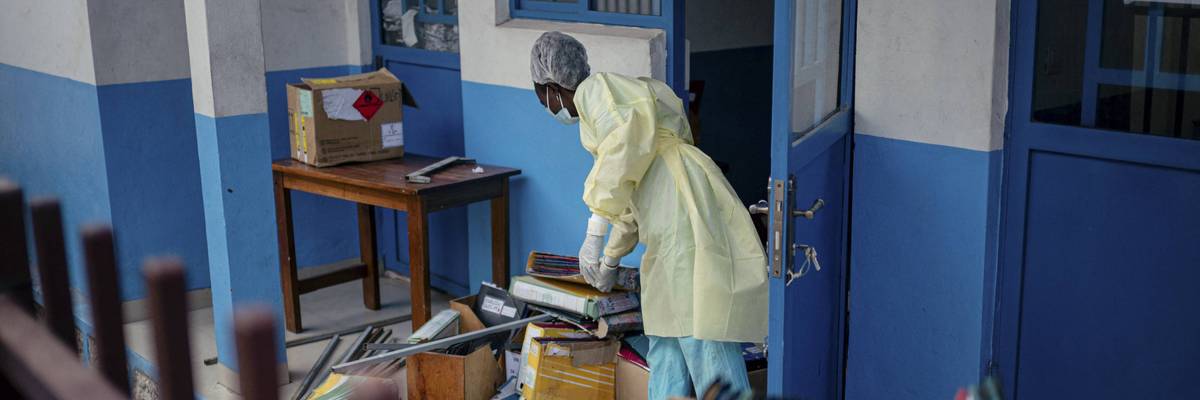
Staff members at CBCA Virunga Hospital prepare rooms intended for possible suspected Ebola cases following official announcements that the disease had been detected in Goma, Democratic Republic of Congo, on May 17, 2026.
"Before the second Trump administration, USAID would have been on the ground," said one public health expert.
The World Health Organization's official designation of an Ebola virus outbreak in the Democratic Republic of Congo and Uganda as a public health emergency of international concern on Sunday came just a day after the world learned that the disease was spreading at all—a highly unusual chain of events, public health experts said, and one that suggested the virus has been circulating for weeks without the outbreak being detected.
WHO Director-General Tedros Adhanom Ghebreyesus said Sunday that eight laboratory-confirmed cases, 246 suspected cases, and 80 suspected deaths had been reported in at least three health zones across Ituri Province in the DRC. In Kampala, the densely populated capital of neighboring Uganda, two lab-confirmed cases and one death were reported within 24 hours of each other.
The victims in Kampala had no apparent link to one another; both had recently traveled from Congo.
The confirmed cases in Congo include some that have been reported in Kinshasa, the capital. The fact that the disease has been able to spread to two large cities with international airports, and the "clusters of deaths across the province of Ituri" point to "a potentially much larger outbreak than what is currently being detected and reported, with significant local and regional risk of spread," said WHO.
"At least four deaths among healthcare workers in a clinical context suggestive of viral haemorrhagic fever have been reported from the affected area, raising concerns regarding healthcare-associated transmission, gaps in infection prevention and control measures, and the potential for amplification within health facilities," the agency said.
Dr. Ashish Jha, who served as the White House Covid-19 response coordinator, said the numbers being reported could make the outbreak "one of the 10 biggest Ebola outbreaks in history."
"We're just hearing about this now? That makes no sense. Those numbers take weeks to accumulate," said Jha, adding that the fact that suspected cases have been detected in capital cities as well as Bunia, the provincial capital of Ituri, "matters enormously for spread."
Tedros emphasized that the outbreak is considered "extraordinary" because there is no approved vaccine or therapeutics for Ebola caused by the Bundibugyo virus, as this strain is. WHO sent a team to investigate in Ituri after first being notified of suspected Ebola cases on May 5, but initial samples tested negative, as available field equipment was only able to detect the Zaire strain of the disease.
The US Centers for Disease Control and Prevention (CDC) and global partners "need to surge resources in," Jha said. "A slow response creates unnecessary risks to people everywhere."
WHO, which President Donald Trump withdrew the US from last year, said the public health emergency designation was made to ramp up surveillance and infection prevention in the countries where the outbreak is occurring, enhance preparedness in bordering countries, and spread awareness in the international community.
The Ebola outbreak is the second to hit Uganda since Trump slashed foreign assistance funding, including by dismantling the US Agency for International Development. Earlier this month, CNN reported that the administration plans to divert $2 billion in global health program funding to cover the cost of closing USAID.
US foreign spending dropped by 56.9% after Trump shut down the agency as well as smaller aid programs and pushed Congress to rescind previously approved foreign assistance. USAID played a critical role in responding to the 2014 Ebola outbreak in West Africa.
In March 2025, when an Ebola outbreak was reported in Uganda, US officials warned that Trump's actions on foreign assistance at that point, including the termination of USAID grants, was impeding the Ugandan government's ability to procure lab supplies, diagnostic equipment, and protective gear for medical workers.
Dr. Herbert Luswata, president of the Uganda Medical Association, told The New York Times at the time that the country's ability to respond to Ebola was notably different than it had been during a previous outbreak in 2022, when dozens of medical workers volunteered to help treat patients.
The lack of funds and protective equipment had "left many afraid to help this time," the Times reported.
“With no USAID money and CDC expertise, it was like Uganda was left to die," Luswata told the Times.
Dr. Craig Spencer, an emergency medicine physician who survived Ebola in 2014, told CBS Saturday that "before the second Trump administration, USAID would have been on the ground" to respond to the current outbreak.
"The CDC would have been on the ground at a moment's notice, maybe even before a moment's notice, of a new outbreak of Ebola because we were in a bunch of countries," said Spencer. "We created relationships beforehand."
Last year, Trump megadonor Elon Musk, who was then leading efforts to slash government spending at the Department of Government Efficiency, said DOGE had "accidentally" canceled US support for Ebola prevention but claimed the funding had been "restored...and there was no interruption.”
But a number of Ebola-related contracts were in fact cut, accounting for $1.6 million out of $2.2 million that had previously gone toward the prevention efforts.
In recent weeks, public health experts have also warned that Trump's cuts to the CDC and other public health programs have left the US ill-prepared to respond to the hantavirus outbreak that originated on a cruise ship.
Jeremy Konyndyk, president of Refugees International and former leader on USAID's Covid-19 and disaster relief response work, said the current Ebola outbreak is "very worrying" and appeared to be the result of a "massive surveillance failure."
"It is really unusual for an Ebola outbreak to get to this scale before being detected; particularly in DRC, which has a lot of Ebola experience," said Konyndyk.
"I can't help but wonder," said Konyndyk, "if the drawdown of USAID and CDC health interventions by DOGE undermined some of the surveillance and detection initiatives that might have helped to catch this earlier."
WHO emphasized that the current crisis in DRC and Uganda requires "international coordination and cooperation to understand the extent of the outbreak, to coordinate surveillance, prevention, and response efforts, to scale up and strengthen operations and ensure ability to implement control measures."
Dear Common Dreams reader, It’s been nearly 30 years since I co-founded Common Dreams with my late wife, Lina Newhouser. We had the radical notion that journalism should serve the public good, not corporate profits. It was clear to us from the outset what it would take to build such a project. No paid advertisements. No corporate sponsors. No millionaire publisher telling us what to think or do. Many people said we wouldn't last a year, but we proved those doubters wrong. Together with a tremendous team of journalists and dedicated staff, we built an independent media outlet free from the constraints of profits and corporate control. Our mission has always been simple: To inform. To inspire. To ignite change for the common good. Building Common Dreams was not easy. Our survival was never guaranteed. When you take on the most powerful forces—Wall Street greed, fossil fuel industry destruction, Big Tech lobbyists, and uber-rich oligarchs who have spent billions upon billions rigging the economy and democracy in their favor—the only bulwark you have is supporters who believe in your work. But here’s the urgent message from me today. It's never been this bad out there. And it's never been this hard to keep us going. At the very moment Common Dreams is most needed, the threats we face are intensifying. We need your support now more than ever. We don't accept corporate advertising and never will. We don't have a paywall because we don't think people should be blocked from critical news based on their ability to pay. Everything we do is funded by the donations of readers like you. When everyone does the little they can afford, we are strong. But if that support retreats or dries up, so do we. Will you donate now to make sure Common Dreams not only survives but thrives? —Craig Brown, Co-founder |
The World Health Organization's official designation of an Ebola virus outbreak in the Democratic Republic of Congo and Uganda as a public health emergency of international concern on Sunday came just a day after the world learned that the disease was spreading at all—a highly unusual chain of events, public health experts said, and one that suggested the virus has been circulating for weeks without the outbreak being detected.
WHO Director-General Tedros Adhanom Ghebreyesus said Sunday that eight laboratory-confirmed cases, 246 suspected cases, and 80 suspected deaths had been reported in at least three health zones across Ituri Province in the DRC. In Kampala, the densely populated capital of neighboring Uganda, two lab-confirmed cases and one death were reported within 24 hours of each other.
The victims in Kampala had no apparent link to one another; both had recently traveled from Congo.
The confirmed cases in Congo include some that have been reported in Kinshasa, the capital. The fact that the disease has been able to spread to two large cities with international airports, and the "clusters of deaths across the province of Ituri" point to "a potentially much larger outbreak than what is currently being detected and reported, with significant local and regional risk of spread," said WHO.
"At least four deaths among healthcare workers in a clinical context suggestive of viral haemorrhagic fever have been reported from the affected area, raising concerns regarding healthcare-associated transmission, gaps in infection prevention and control measures, and the potential for amplification within health facilities," the agency said.
Dr. Ashish Jha, who served as the White House Covid-19 response coordinator, said the numbers being reported could make the outbreak "one of the 10 biggest Ebola outbreaks in history."
"We're just hearing about this now? That makes no sense. Those numbers take weeks to accumulate," said Jha, adding that the fact that suspected cases have been detected in capital cities as well as Bunia, the provincial capital of Ituri, "matters enormously for spread."
Tedros emphasized that the outbreak is considered "extraordinary" because there is no approved vaccine or therapeutics for Ebola caused by the Bundibugyo virus, as this strain is. WHO sent a team to investigate in Ituri after first being notified of suspected Ebola cases on May 5, but initial samples tested negative, as available field equipment was only able to detect the Zaire strain of the disease.
The US Centers for Disease Control and Prevention (CDC) and global partners "need to surge resources in," Jha said. "A slow response creates unnecessary risks to people everywhere."
WHO, which President Donald Trump withdrew the US from last year, said the public health emergency designation was made to ramp up surveillance and infection prevention in the countries where the outbreak is occurring, enhance preparedness in bordering countries, and spread awareness in the international community.
The Ebola outbreak is the second to hit Uganda since Trump slashed foreign assistance funding, including by dismantling the US Agency for International Development. Earlier this month, CNN reported that the administration plans to divert $2 billion in global health program funding to cover the cost of closing USAID.
US foreign spending dropped by 56.9% after Trump shut down the agency as well as smaller aid programs and pushed Congress to rescind previously approved foreign assistance. USAID played a critical role in responding to the 2014 Ebola outbreak in West Africa.
In March 2025, when an Ebola outbreak was reported in Uganda, US officials warned that Trump's actions on foreign assistance at that point, including the termination of USAID grants, was impeding the Ugandan government's ability to procure lab supplies, diagnostic equipment, and protective gear for medical workers.
Dr. Herbert Luswata, president of the Uganda Medical Association, told The New York Times at the time that the country's ability to respond to Ebola was notably different than it had been during a previous outbreak in 2022, when dozens of medical workers volunteered to help treat patients.
The lack of funds and protective equipment had "left many afraid to help this time," the Times reported.
“With no USAID money and CDC expertise, it was like Uganda was left to die," Luswata told the Times.
Dr. Craig Spencer, an emergency medicine physician who survived Ebola in 2014, told CBS Saturday that "before the second Trump administration, USAID would have been on the ground" to respond to the current outbreak.
"The CDC would have been on the ground at a moment's notice, maybe even before a moment's notice, of a new outbreak of Ebola because we were in a bunch of countries," said Spencer. "We created relationships beforehand."
Last year, Trump megadonor Elon Musk, who was then leading efforts to slash government spending at the Department of Government Efficiency, said DOGE had "accidentally" canceled US support for Ebola prevention but claimed the funding had been "restored...and there was no interruption.”
But a number of Ebola-related contracts were in fact cut, accounting for $1.6 million out of $2.2 million that had previously gone toward the prevention efforts.
In recent weeks, public health experts have also warned that Trump's cuts to the CDC and other public health programs have left the US ill-prepared to respond to the hantavirus outbreak that originated on a cruise ship.
Jeremy Konyndyk, president of Refugees International and former leader on USAID's Covid-19 and disaster relief response work, said the current Ebola outbreak is "very worrying" and appeared to be the result of a "massive surveillance failure."
"It is really unusual for an Ebola outbreak to get to this scale before being detected; particularly in DRC, which has a lot of Ebola experience," said Konyndyk.
"I can't help but wonder," said Konyndyk, "if the drawdown of USAID and CDC health interventions by DOGE undermined some of the surveillance and detection initiatives that might have helped to catch this earlier."
WHO emphasized that the current crisis in DRC and Uganda requires "international coordination and cooperation to understand the extent of the outbreak, to coordinate surveillance, prevention, and response efforts, to scale up and strengthen operations and ensure ability to implement control measures."
The World Health Organization's official designation of an Ebola virus outbreak in the Democratic Republic of Congo and Uganda as a public health emergency of international concern on Sunday came just a day after the world learned that the disease was spreading at all—a highly unusual chain of events, public health experts said, and one that suggested the virus has been circulating for weeks without the outbreak being detected.
WHO Director-General Tedros Adhanom Ghebreyesus said Sunday that eight laboratory-confirmed cases, 246 suspected cases, and 80 suspected deaths had been reported in at least three health zones across Ituri Province in the DRC. In Kampala, the densely populated capital of neighboring Uganda, two lab-confirmed cases and one death were reported within 24 hours of each other.
The victims in Kampala had no apparent link to one another; both had recently traveled from Congo.
The confirmed cases in Congo include some that have been reported in Kinshasa, the capital. The fact that the disease has been able to spread to two large cities with international airports, and the "clusters of deaths across the province of Ituri" point to "a potentially much larger outbreak than what is currently being detected and reported, with significant local and regional risk of spread," said WHO.
"At least four deaths among healthcare workers in a clinical context suggestive of viral haemorrhagic fever have been reported from the affected area, raising concerns regarding healthcare-associated transmission, gaps in infection prevention and control measures, and the potential for amplification within health facilities," the agency said.
Dr. Ashish Jha, who served as the White House Covid-19 response coordinator, said the numbers being reported could make the outbreak "one of the 10 biggest Ebola outbreaks in history."
"We're just hearing about this now? That makes no sense. Those numbers take weeks to accumulate," said Jha, adding that the fact that suspected cases have been detected in capital cities as well as Bunia, the provincial capital of Ituri, "matters enormously for spread."
Tedros emphasized that the outbreak is considered "extraordinary" because there is no approved vaccine or therapeutics for Ebola caused by the Bundibugyo virus, as this strain is. WHO sent a team to investigate in Ituri after first being notified of suspected Ebola cases on May 5, but initial samples tested negative, as available field equipment was only able to detect the Zaire strain of the disease.
The US Centers for Disease Control and Prevention (CDC) and global partners "need to surge resources in," Jha said. "A slow response creates unnecessary risks to people everywhere."
WHO, which President Donald Trump withdrew the US from last year, said the public health emergency designation was made to ramp up surveillance and infection prevention in the countries where the outbreak is occurring, enhance preparedness in bordering countries, and spread awareness in the international community.
The Ebola outbreak is the second to hit Uganda since Trump slashed foreign assistance funding, including by dismantling the US Agency for International Development. Earlier this month, CNN reported that the administration plans to divert $2 billion in global health program funding to cover the cost of closing USAID.
US foreign spending dropped by 56.9% after Trump shut down the agency as well as smaller aid programs and pushed Congress to rescind previously approved foreign assistance. USAID played a critical role in responding to the 2014 Ebola outbreak in West Africa.
In March 2025, when an Ebola outbreak was reported in Uganda, US officials warned that Trump's actions on foreign assistance at that point, including the termination of USAID grants, was impeding the Ugandan government's ability to procure lab supplies, diagnostic equipment, and protective gear for medical workers.
Dr. Herbert Luswata, president of the Uganda Medical Association, told The New York Times at the time that the country's ability to respond to Ebola was notably different than it had been during a previous outbreak in 2022, when dozens of medical workers volunteered to help treat patients.
The lack of funds and protective equipment had "left many afraid to help this time," the Times reported.
“With no USAID money and CDC expertise, it was like Uganda was left to die," Luswata told the Times.
Dr. Craig Spencer, an emergency medicine physician who survived Ebola in 2014, told CBS Saturday that "before the second Trump administration, USAID would have been on the ground" to respond to the current outbreak.
"The CDC would have been on the ground at a moment's notice, maybe even before a moment's notice, of a new outbreak of Ebola because we were in a bunch of countries," said Spencer. "We created relationships beforehand."
Last year, Trump megadonor Elon Musk, who was then leading efforts to slash government spending at the Department of Government Efficiency, said DOGE had "accidentally" canceled US support for Ebola prevention but claimed the funding had been "restored...and there was no interruption.”
But a number of Ebola-related contracts were in fact cut, accounting for $1.6 million out of $2.2 million that had previously gone toward the prevention efforts.
In recent weeks, public health experts have also warned that Trump's cuts to the CDC and other public health programs have left the US ill-prepared to respond to the hantavirus outbreak that originated on a cruise ship.
Jeremy Konyndyk, president of Refugees International and former leader on USAID's Covid-19 and disaster relief response work, said the current Ebola outbreak is "very worrying" and appeared to be the result of a "massive surveillance failure."
"It is really unusual for an Ebola outbreak to get to this scale before being detected; particularly in DRC, which has a lot of Ebola experience," said Konyndyk.
"I can't help but wonder," said Konyndyk, "if the drawdown of USAID and CDC health interventions by DOGE undermined some of the surveillance and detection initiatives that might have helped to catch this earlier."
WHO emphasized that the current crisis in DRC and Uganda requires "international coordination and cooperation to understand the extent of the outbreak, to coordinate surveillance, prevention, and response efforts, to scale up and strengthen operations and ensure ability to implement control measures."