SUBSCRIBE TO OUR FREE NEWSLETTER
Daily news & progressive opinion—funded by the people, not the corporations—delivered straight to your inbox.
5
#000000
#FFFFFF
To donate by check, phone, or other method, see our More Ways to Give page.
Daily news & progressive opinion—funded by the people, not the corporations—delivered straight to your inbox.
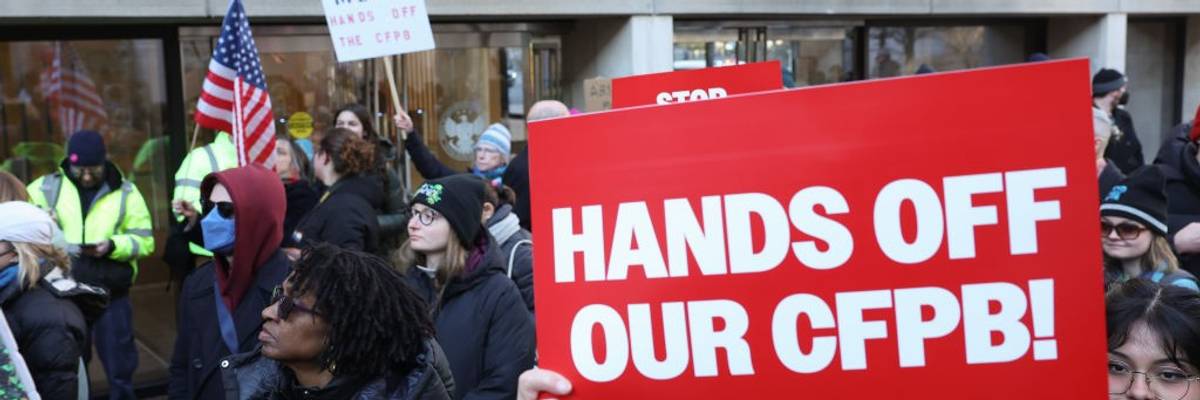
Demonstrators raise signs and posters as Congressional Democrats and CFPB workers hold a rally to protest the closing of the Consumer Financial Protection Bureau and the work-from-home order issued by CFPB Director Russell Vought outside its headquarters on February 10, 2025 in Washington, DC.
Congress can’t allow the White House to eliminate an agency that’s helped millions of Americans, with billions of dollars returned to them by scams, fraudsters, and megabanks that prey on low-income citizens.
Over the past year, the Trump administration has sought to gut the Consumer Financial Protection Bureau through cuts and layoffs, and by hamstringing its enforcement powers, claiming the agency is hurting large banks through overregulation. Acting CFPB Director Russ Vought has sought to reduce the agency's staff by 90% and to freeze spending since February.
A group of 21 states, plus the District of Columbia, sued the Trump administration in December to stop it from defunding the CFPB. The administration responded by telling the court that the government is legally barred from seeking new funding from the Federal Reserve, the bureau’s primary source of money, alluding to the fact that the agency will eventually go broke later this year. The next step in the case will be the DC Court of Appeals to hear arguments in late February.
The CFPB's enforcement actions, like the 22 pending cases against banks, highlight its vital role in safeguarding consumers from unfair practices, which the current threats jeopardize.
So, what does this mean for the country? The CFPB's weakening could leave consumers vulnerable to predatory practices, unfair fees, and fraud, risking their financial stability.
The Biden administration's pressure on banks and financial institutions on the issue led them to agree to refund more than $240 million to customers, a win secured by actual, formal regulation. Trump and Vought have rolled that back, too.
The CFPB’s Small Dollar Rule was created to curb abusive payday lending practices, especially repeated debit attempts that drain bank accounts and trigger cascading overdraft and Non-Sufficient Funds (NSF) fees. That goal is sound and worthy. The problem is not the rule’s intent, but how it operates alongside bank fee structures and in a financial marketplace devoid of smart, progressive-minded credit options.
The small dollar rule makes automatic repayments—which help keep the cost of borrowing to the bare minimum—incredibly tricky to execute. After two consecutive failed payment attempts, covered lenders generally cannot try again unless the borrower specifically authorizes another attempt, which can leave payments stalled when ordinary life disruptions intervene. Regulators have warned that charging multiple NSF fees tied to re-presented transactions can harm consumers. This is true not just because a single missed payment can still trigger NSF fee collection and financial harm, undermining a rule meant to protect borrowers acting in good faith. It’s also because lenders are now further limiting credit to the most high-risk borrowers, including gig economy workers, who are also those most in need of emergency credit, forcing them to borrow via ultra-expensive bank and credit union overdrafts and NSFs. And when payments are not made, inevitably, borrowers’ personal credit ratings take a hit. Of course, this affects poor people and those with bad credit harder than anyone else.
Trump and Vought's shuttering of the CFPB without fixing this situation, including by pushing banks hard to provide credit to consumers at lower cost and even by standing up a viable alternative to current credit options through something like Postal Banking, would make the problem of high-interest debt worse for Americans. Moreover, because Trump and Vought refuse to act against extortionate overdraft and NSF fees, as the Biden administration did, they’re exposing consumers to high-cost debt, where they effectively borrow from the bank, too. The Biden administration's pressure on banks and financial institutions on the issue led them to agree to refund more than $240 million to customers, a win secured by actual, formal regulation. Trump and Vought have rolled that back, too.
The CFPB has largely helped people when they have problems with a financial institution, product, or transaction by allowing customers to submit complaints, which the agency then works on their behalf. Since its inception, 98% of the 9 million total complaints have received “timely responses” from the institutions or companies to which customers reported them to the CFPB. Of all the complaints, almost 400,000 were submitted by US military members, and nearly 200,000 were submitted by seniors.
The results have been staggering. CFPB data as of December, 2024 shows a whopping $21 billion has been returned to more than 205 million Americans who were financially harmed by institutions. In addition, over $5 billion in civil penalties have been imposed on guilty banks and individuals.
Congress can’t allow the White House to eliminate an agency that’s helped millions of Americans, with billions of dollars returned to them by scams, fraudsters, and megabanks that prey on low-income citizens. And if the Trump administration is determined to do so, it’s time for congressional Democrats to focus on developing credit alternatives that can allow consumers to escape some of the financial madness.
Dear Common Dreams reader, It’s been nearly 30 years since I co-founded Common Dreams with my late wife, Lina Newhouser. We had the radical notion that journalism should serve the public good, not corporate profits. It was clear to us from the outset what it would take to build such a project. No paid advertisements. No corporate sponsors. No millionaire publisher telling us what to think or do. Many people said we wouldn't last a year, but we proved those doubters wrong. Together with a tremendous team of journalists and dedicated staff, we built an independent media outlet free from the constraints of profits and corporate control. Our mission has always been simple: To inform. To inspire. To ignite change for the common good. Building Common Dreams was not easy. Our survival was never guaranteed. When you take on the most powerful forces—Wall Street greed, fossil fuel industry destruction, Big Tech lobbyists, and uber-rich oligarchs who have spent billions upon billions rigging the economy and democracy in their favor—the only bulwark you have is supporters who believe in your work. But here’s the urgent message from me today. It's never been this bad out there. And it's never been this hard to keep us going. At the very moment Common Dreams is most needed, the threats we face are intensifying. We need your support now more than ever. We don't accept corporate advertising and never will. We don't have a paywall because we don't think people should be blocked from critical news based on their ability to pay. Everything we do is funded by the donations of readers like you. When everyone does the little they can afford, we are strong. But if that support retreats or dries up, so do we. Will you donate now to make sure Common Dreams not only survives but thrives? —Craig Brown, Co-founder |
Over the past year, the Trump administration has sought to gut the Consumer Financial Protection Bureau through cuts and layoffs, and by hamstringing its enforcement powers, claiming the agency is hurting large banks through overregulation. Acting CFPB Director Russ Vought has sought to reduce the agency's staff by 90% and to freeze spending since February.
A group of 21 states, plus the District of Columbia, sued the Trump administration in December to stop it from defunding the CFPB. The administration responded by telling the court that the government is legally barred from seeking new funding from the Federal Reserve, the bureau’s primary source of money, alluding to the fact that the agency will eventually go broke later this year. The next step in the case will be the DC Court of Appeals to hear arguments in late February.
The CFPB's enforcement actions, like the 22 pending cases against banks, highlight its vital role in safeguarding consumers from unfair practices, which the current threats jeopardize.
So, what does this mean for the country? The CFPB's weakening could leave consumers vulnerable to predatory practices, unfair fees, and fraud, risking their financial stability.
The Biden administration's pressure on banks and financial institutions on the issue led them to agree to refund more than $240 million to customers, a win secured by actual, formal regulation. Trump and Vought have rolled that back, too.
The CFPB’s Small Dollar Rule was created to curb abusive payday lending practices, especially repeated debit attempts that drain bank accounts and trigger cascading overdraft and Non-Sufficient Funds (NSF) fees. That goal is sound and worthy. The problem is not the rule’s intent, but how it operates alongside bank fee structures and in a financial marketplace devoid of smart, progressive-minded credit options.
The small dollar rule makes automatic repayments—which help keep the cost of borrowing to the bare minimum—incredibly tricky to execute. After two consecutive failed payment attempts, covered lenders generally cannot try again unless the borrower specifically authorizes another attempt, which can leave payments stalled when ordinary life disruptions intervene. Regulators have warned that charging multiple NSF fees tied to re-presented transactions can harm consumers. This is true not just because a single missed payment can still trigger NSF fee collection and financial harm, undermining a rule meant to protect borrowers acting in good faith. It’s also because lenders are now further limiting credit to the most high-risk borrowers, including gig economy workers, who are also those most in need of emergency credit, forcing them to borrow via ultra-expensive bank and credit union overdrafts and NSFs. And when payments are not made, inevitably, borrowers’ personal credit ratings take a hit. Of course, this affects poor people and those with bad credit harder than anyone else.
Trump and Vought's shuttering of the CFPB without fixing this situation, including by pushing banks hard to provide credit to consumers at lower cost and even by standing up a viable alternative to current credit options through something like Postal Banking, would make the problem of high-interest debt worse for Americans. Moreover, because Trump and Vought refuse to act against extortionate overdraft and NSF fees, as the Biden administration did, they’re exposing consumers to high-cost debt, where they effectively borrow from the bank, too. The Biden administration's pressure on banks and financial institutions on the issue led them to agree to refund more than $240 million to customers, a win secured by actual, formal regulation. Trump and Vought have rolled that back, too.
The CFPB has largely helped people when they have problems with a financial institution, product, or transaction by allowing customers to submit complaints, which the agency then works on their behalf. Since its inception, 98% of the 9 million total complaints have received “timely responses” from the institutions or companies to which customers reported them to the CFPB. Of all the complaints, almost 400,000 were submitted by US military members, and nearly 200,000 were submitted by seniors.
The results have been staggering. CFPB data as of December, 2024 shows a whopping $21 billion has been returned to more than 205 million Americans who were financially harmed by institutions. In addition, over $5 billion in civil penalties have been imposed on guilty banks and individuals.
Congress can’t allow the White House to eliminate an agency that’s helped millions of Americans, with billions of dollars returned to them by scams, fraudsters, and megabanks that prey on low-income citizens. And if the Trump administration is determined to do so, it’s time for congressional Democrats to focus on developing credit alternatives that can allow consumers to escape some of the financial madness.
Over the past year, the Trump administration has sought to gut the Consumer Financial Protection Bureau through cuts and layoffs, and by hamstringing its enforcement powers, claiming the agency is hurting large banks through overregulation. Acting CFPB Director Russ Vought has sought to reduce the agency's staff by 90% and to freeze spending since February.
A group of 21 states, plus the District of Columbia, sued the Trump administration in December to stop it from defunding the CFPB. The administration responded by telling the court that the government is legally barred from seeking new funding from the Federal Reserve, the bureau’s primary source of money, alluding to the fact that the agency will eventually go broke later this year. The next step in the case will be the DC Court of Appeals to hear arguments in late February.
The CFPB's enforcement actions, like the 22 pending cases against banks, highlight its vital role in safeguarding consumers from unfair practices, which the current threats jeopardize.
So, what does this mean for the country? The CFPB's weakening could leave consumers vulnerable to predatory practices, unfair fees, and fraud, risking their financial stability.
The Biden administration's pressure on banks and financial institutions on the issue led them to agree to refund more than $240 million to customers, a win secured by actual, formal regulation. Trump and Vought have rolled that back, too.
The CFPB’s Small Dollar Rule was created to curb abusive payday lending practices, especially repeated debit attempts that drain bank accounts and trigger cascading overdraft and Non-Sufficient Funds (NSF) fees. That goal is sound and worthy. The problem is not the rule’s intent, but how it operates alongside bank fee structures and in a financial marketplace devoid of smart, progressive-minded credit options.
The small dollar rule makes automatic repayments—which help keep the cost of borrowing to the bare minimum—incredibly tricky to execute. After two consecutive failed payment attempts, covered lenders generally cannot try again unless the borrower specifically authorizes another attempt, which can leave payments stalled when ordinary life disruptions intervene. Regulators have warned that charging multiple NSF fees tied to re-presented transactions can harm consumers. This is true not just because a single missed payment can still trigger NSF fee collection and financial harm, undermining a rule meant to protect borrowers acting in good faith. It’s also because lenders are now further limiting credit to the most high-risk borrowers, including gig economy workers, who are also those most in need of emergency credit, forcing them to borrow via ultra-expensive bank and credit union overdrafts and NSFs. And when payments are not made, inevitably, borrowers’ personal credit ratings take a hit. Of course, this affects poor people and those with bad credit harder than anyone else.
Trump and Vought's shuttering of the CFPB without fixing this situation, including by pushing banks hard to provide credit to consumers at lower cost and even by standing up a viable alternative to current credit options through something like Postal Banking, would make the problem of high-interest debt worse for Americans. Moreover, because Trump and Vought refuse to act against extortionate overdraft and NSF fees, as the Biden administration did, they’re exposing consumers to high-cost debt, where they effectively borrow from the bank, too. The Biden administration's pressure on banks and financial institutions on the issue led them to agree to refund more than $240 million to customers, a win secured by actual, formal regulation. Trump and Vought have rolled that back, too.
The CFPB has largely helped people when they have problems with a financial institution, product, or transaction by allowing customers to submit complaints, which the agency then works on their behalf. Since its inception, 98% of the 9 million total complaints have received “timely responses” from the institutions or companies to which customers reported them to the CFPB. Of all the complaints, almost 400,000 were submitted by US military members, and nearly 200,000 were submitted by seniors.
The results have been staggering. CFPB data as of December, 2024 shows a whopping $21 billion has been returned to more than 205 million Americans who were financially harmed by institutions. In addition, over $5 billion in civil penalties have been imposed on guilty banks and individuals.
Congress can’t allow the White House to eliminate an agency that’s helped millions of Americans, with billions of dollars returned to them by scams, fraudsters, and megabanks that prey on low-income citizens. And if the Trump administration is determined to do so, it’s time for congressional Democrats to focus on developing credit alternatives that can allow consumers to escape some of the financial madness.