SUBSCRIBE TO OUR FREE NEWSLETTER
Daily news & progressive opinion—funded by the people, not the corporations—delivered straight to your inbox.
5
#000000
#FFFFFF
To donate by check, phone, or other method, see our More Ways to Give page.
Daily news & progressive opinion—funded by the people, not the corporations—delivered straight to your inbox.
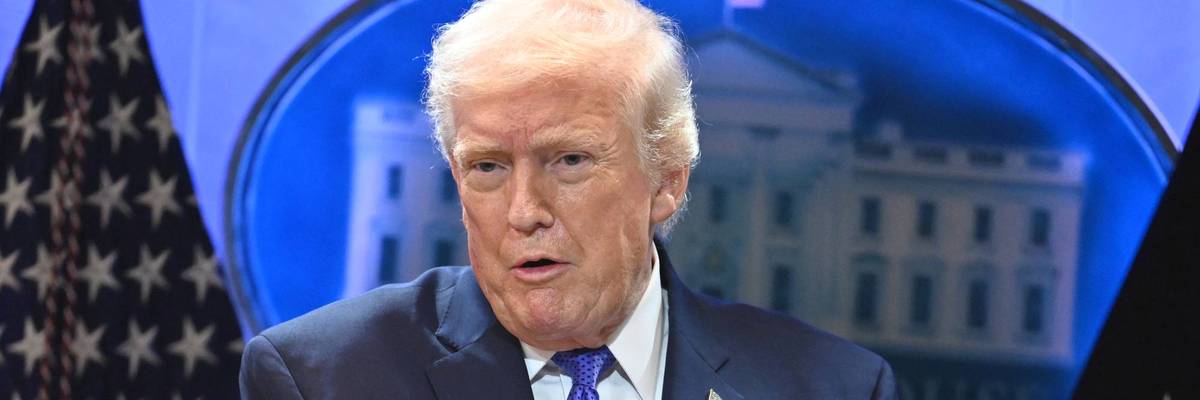
US President Donald Trump speaks during a press briefing at the White House on February 20, 2026, in Washington, DC.
In just one year, Republicans' 2025 budget package is expected to increase income inequality at quadruple the rate seen over the past 40 years.
President Donald Trump's economic agenda "will make ordinary families reliably poorer in the future," according to the author of a report published Tuesday by the Economic Policy Institute.
Josh Bivens, EPI's chief economist, said Trump's slashing of federal spending and jobs, mass deportations, chaotic tariffs, and anti-labor policies were suppressing hiring and wages, draining household and business spending, and slowing economic growth.
While a recession is not yet inevitable, Bivens argued that worrying signs are already on the horizon, with 1.4 million fewer new jobs than expected in 2025 and unemployment ticking up to 4.4%, up from the low of 3.4% in April 2023.
For low-wage earners, the past year has been particularly rough. After seeing unusually fast growth during the presidency of Joe Biden, real wages for the bottom 10% of earners fell by 0.3% in 2025.
The report predicts that Republicans' 2025 budget package will reduce “aggregate demand” in the coming years. The so-called One Big Beautiful Bill Act cuts $100 billion annually from Medicaid and the Supplemental Nutrition Assistance Program (SNAP), while allowing health insurance subsidies that saved families thousands to expire, which the report projects will cause many families who rely on these benefits to pull back spending in the economy.
While the law reduced taxes, the vast majority of those benefits went to the wealthiest earners, whose spending was already much less constrained by their incomes.
The report notes the astonishing increase in inequality caused by the law. Between the years of 1979 and 2019, which were considered to have seen an explosion of wealth inequality, the share of income claimed by the richest 10% increased by about 0.25% per year.
It found that the GOP budget law will, in just one year, increase the top decile's share of wealth by a full percentage point. In other words, the rate of inequality will "quadruple in its first year."
Aside from this major driver of inequality, the report also says that the Trump administration's hostility toward collective bargaining rights and its mass firings of federal workers would further suppress wages by making the labor market less competitive, and that the president's erratic tariff regime would make those wages less valuable by fueling inflation.
“Disastrous policy choices that led to excess unemployment, slower growth in the economy’s productive capacity, and rising inequality have made life less affordable for typical families in recent decades," Bivens said. "The Trump administration’s policies double down on the worst policy decisions of this period and will make ordinary families reliably poorer in the future, even if an outright recession or spiking inflation does not happen."
Dear Common Dreams reader, It’s been nearly 30 years since I co-founded Common Dreams with my late wife, Lina Newhouser. We had the radical notion that journalism should serve the public good, not corporate profits. It was clear to us from the outset what it would take to build such a project. No paid advertisements. No corporate sponsors. No millionaire publisher telling us what to think or do. Many people said we wouldn't last a year, but we proved those doubters wrong. Together with a tremendous team of journalists and dedicated staff, we built an independent media outlet free from the constraints of profits and corporate control. Our mission has always been simple: To inform. To inspire. To ignite change for the common good. Building Common Dreams was not easy. Our survival was never guaranteed. When you take on the most powerful forces—Wall Street greed, fossil fuel industry destruction, Big Tech lobbyists, and uber-rich oligarchs who have spent billions upon billions rigging the economy and democracy in their favor—the only bulwark you have is supporters who believe in your work. But here’s the urgent message from me today. It's never been this bad out there. And it's never been this hard to keep us going. At the very moment Common Dreams is most needed, the threats we face are intensifying. We need your support now more than ever. We don't accept corporate advertising and never will. We don't have a paywall because we don't think people should be blocked from critical news based on their ability to pay. Everything we do is funded by the donations of readers like you. When everyone does the little they can afford, we are strong. But if that support retreats or dries up, so do we. Will you donate now to make sure Common Dreams not only survives but thrives? —Craig Brown, Co-founder |
President Donald Trump's economic agenda "will make ordinary families reliably poorer in the future," according to the author of a report published Tuesday by the Economic Policy Institute.
Josh Bivens, EPI's chief economist, said Trump's slashing of federal spending and jobs, mass deportations, chaotic tariffs, and anti-labor policies were suppressing hiring and wages, draining household and business spending, and slowing economic growth.
While a recession is not yet inevitable, Bivens argued that worrying signs are already on the horizon, with 1.4 million fewer new jobs than expected in 2025 and unemployment ticking up to 4.4%, up from the low of 3.4% in April 2023.
For low-wage earners, the past year has been particularly rough. After seeing unusually fast growth during the presidency of Joe Biden, real wages for the bottom 10% of earners fell by 0.3% in 2025.
The report predicts that Republicans' 2025 budget package will reduce “aggregate demand” in the coming years. The so-called One Big Beautiful Bill Act cuts $100 billion annually from Medicaid and the Supplemental Nutrition Assistance Program (SNAP), while allowing health insurance subsidies that saved families thousands to expire, which the report projects will cause many families who rely on these benefits to pull back spending in the economy.
While the law reduced taxes, the vast majority of those benefits went to the wealthiest earners, whose spending was already much less constrained by their incomes.
The report notes the astonishing increase in inequality caused by the law. Between the years of 1979 and 2019, which were considered to have seen an explosion of wealth inequality, the share of income claimed by the richest 10% increased by about 0.25% per year.
It found that the GOP budget law will, in just one year, increase the top decile's share of wealth by a full percentage point. In other words, the rate of inequality will "quadruple in its first year."
Aside from this major driver of inequality, the report also says that the Trump administration's hostility toward collective bargaining rights and its mass firings of federal workers would further suppress wages by making the labor market less competitive, and that the president's erratic tariff regime would make those wages less valuable by fueling inflation.
“Disastrous policy choices that led to excess unemployment, slower growth in the economy’s productive capacity, and rising inequality have made life less affordable for typical families in recent decades," Bivens said. "The Trump administration’s policies double down on the worst policy decisions of this period and will make ordinary families reliably poorer in the future, even if an outright recession or spiking inflation does not happen."
President Donald Trump's economic agenda "will make ordinary families reliably poorer in the future," according to the author of a report published Tuesday by the Economic Policy Institute.
Josh Bivens, EPI's chief economist, said Trump's slashing of federal spending and jobs, mass deportations, chaotic tariffs, and anti-labor policies were suppressing hiring and wages, draining household and business spending, and slowing economic growth.
While a recession is not yet inevitable, Bivens argued that worrying signs are already on the horizon, with 1.4 million fewer new jobs than expected in 2025 and unemployment ticking up to 4.4%, up from the low of 3.4% in April 2023.
For low-wage earners, the past year has been particularly rough. After seeing unusually fast growth during the presidency of Joe Biden, real wages for the bottom 10% of earners fell by 0.3% in 2025.
The report predicts that Republicans' 2025 budget package will reduce “aggregate demand” in the coming years. The so-called One Big Beautiful Bill Act cuts $100 billion annually from Medicaid and the Supplemental Nutrition Assistance Program (SNAP), while allowing health insurance subsidies that saved families thousands to expire, which the report projects will cause many families who rely on these benefits to pull back spending in the economy.
While the law reduced taxes, the vast majority of those benefits went to the wealthiest earners, whose spending was already much less constrained by their incomes.
The report notes the astonishing increase in inequality caused by the law. Between the years of 1979 and 2019, which were considered to have seen an explosion of wealth inequality, the share of income claimed by the richest 10% increased by about 0.25% per year.
It found that the GOP budget law will, in just one year, increase the top decile's share of wealth by a full percentage point. In other words, the rate of inequality will "quadruple in its first year."
Aside from this major driver of inequality, the report also says that the Trump administration's hostility toward collective bargaining rights and its mass firings of federal workers would further suppress wages by making the labor market less competitive, and that the president's erratic tariff regime would make those wages less valuable by fueling inflation.
“Disastrous policy choices that led to excess unemployment, slower growth in the economy’s productive capacity, and rising inequality have made life less affordable for typical families in recent decades," Bivens said. "The Trump administration’s policies double down on the worst policy decisions of this period and will make ordinary families reliably poorer in the future, even if an outright recession or spiking inflation does not happen."