SUBSCRIBE TO OUR FREE NEWSLETTER
Daily news & progressive opinion—funded by the people, not the corporations—delivered straight to your inbox.
5
#000000
#FFFFFF
To donate by check, phone, or other method, see our More Ways to Give page.
Daily news & progressive opinion—funded by the people, not the corporations—delivered straight to your inbox.
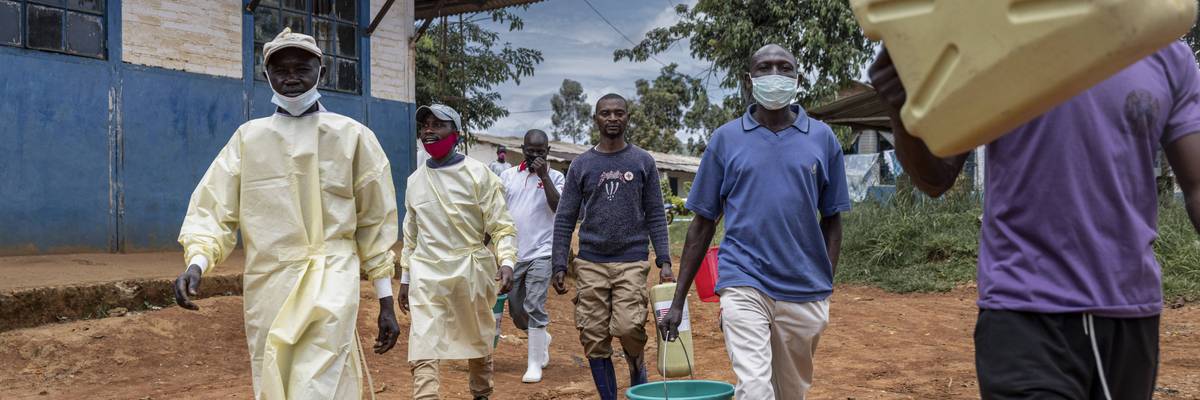
Health workers and local volunteers carry disinfectant containers and sanitation equipment outside the General Referral Hospital during the Ebola outbreak response on May 21, 2026 in Mongbwalu, Democratic Republic of Congo.
"The people of the DRC deserve the world’s attention, resources, care, and solidarity," said one advocate.
As the Ebola crisis that was first detected in the Democratic Republic of Congo in May became the deadliest outbreak of the disease in the country's history on Monday, one global public health expert in the United Kingdom pointed to the key difference between the 2014 epidemic in West Africa and the one that has now killed at least 2,325 people in the DRC.
In 2014, wrote Devi Sridhar, chair of global public health at the University of Edinburgh, in The Guardian, the US and other wealthy countries "worked with the World Health Organization (WHO) to escalate a response, bringing military-like coordination, necessary resources, logistics, and trained personnel."
Now, said Sridhar, "we’ve had two 'America-First'" terms of President Donald Trump.
"The US is no longer part of the WHO or working multilaterally, favoring a 'go-it-alone' response," she wrote.
In Trump's second term, the president cut tens of billions of dollars in foreign aid spending. Data released by the Organization for Economic Cooperation and Development in April showed the US spent 56.9% less on foreign assistance last year after Trump dismantled the US Agency for International Development (USAID), cut smaller programs, and demanded that Congress rescind billions that had already been appropriated for countries and programs in need.
Ebola has become the DRC's worst-ever outbreak in just three months, wrote Sridhar, "in the context of the defunding of foreign aid, the censorship of scientists, the closure of USAID, the implosion of the Centers for Disease Control and Prevention, and a 'Make America Healthy Again' movement."
By the time officials announced that the outbreak had been detected in May, they had already recorded 246 suspected cases and 80 suspected deaths in Ituri province—suggesting that US aid and public health cuts had "undermined some of the surveillance and detection initiatives that might have helped to catch this earlier," as Jeremy Konyndyk of Refugees International said at the time.
Months after getting a significant head start in spreading throughout the population, Ebola has now been detected in six of the DRC's 26 provinces, and the country's public health institute has recorded at least 4,945 cases, with 101 detected in the 24 hours preceding Monday's announcement.
Ebola "is winning in the Democratic Republic of the Congo,” said the United Nations last Friday, noting that the epidemic was killing one person every 30 minutes.
Amnesty International called on the globa; community to urgently try to make up for the surveillance failures that happened earlier this year and mobilize to slow the outbreak.
"We call for global solidarity as eastern DRC faces its deadliest Ebola outbreak in the country's history," said Amnesty. "Human rights must continue to be prioritized as health workers treat the disease across the region."
The US State Department said earlier this month that it has provided $512 million in direct assistance to help respond to the outbreak—far less than the $5.4 billion the US enacted in December 2014 to fight the epidemic in West Africa.
US spending is lagging as the outbreak has become the fastest-growing in the history of the virus, as The Guardian reported Monday. The 2014 outbreak took five months to reach 1,000 deaths, but more than 2,000 people have died of Ebola in less than three months since the disease was detected.
Thomas Parisch, a public health specialist with Doctors Without Borders in the DRC, told The Guardian that the country still appears to be struggling with the limits imposed by aid cuts.
"Normally, as an outbreak progresses, the case fatality ratio should fall as contact tracing improves and patients are identified and treated earlier," said Parisch. "Instead, we’re still seeing many cases detected very late, when treatment is less likely to succeed, with many identified only after they die in the community.”
The outbreak also differs from previous epidemics in that the current Ebola infections are being caused by the rare Bundibugyo virus. There are no approved vaccines or treatments for the strain, but WHO Director-General Tedros Adhanom Ghebreyesus said recently that two new vaccines were being tested on people.
Lawyer and advocate Bernice King urged the public to "refuse to look away."
"Nonviolence is an active commitment to protect life," said King. "The people of the DRC deserve the world’s attention, resources, care, and solidarity."
Dear Common Dreams reader, It’s been nearly 30 years since I co-founded Common Dreams with my late wife, Lina Newhouser. We had the radical notion that journalism should serve the public good, not corporate profits. It was clear to us from the outset what it would take to build such a project. No paid advertisements. No corporate sponsors. No millionaire publisher telling us what to think or do. Many people said we wouldn't last a year, but we proved those doubters wrong. Together with a tremendous team of journalists and dedicated staff, we built an independent media outlet free from the constraints of profits and corporate control. Our mission has always been simple: To inform. To inspire. To ignite change for the common good. Building Common Dreams was not easy. Our survival was never guaranteed. When you take on the most powerful forces—Wall Street greed, fossil fuel industry destruction, Big Tech lobbyists, and uber-rich oligarchs who have spent billions upon billions rigging the economy and democracy in their favor—the only bulwark you have is supporters who believe in your work. But here’s the urgent message from me today. It's never been this bad out there. And it's never been this hard to keep us going. At the very moment Common Dreams is most needed, the threats we face are intensifying. We need your support now more than ever. We don't accept corporate advertising and never will. We don't have a paywall because we don't think people should be blocked from critical news based on their ability to pay. Everything we do is funded by the donations of readers like you. When everyone does the little they can afford, we are strong. But if that support retreats or dries up, so do we. Will you donate now to make sure Common Dreams not only survives but thrives? —Craig Brown, Co-founder |
As the Ebola crisis that was first detected in the Democratic Republic of Congo in May became the deadliest outbreak of the disease in the country's history on Monday, one global public health expert in the United Kingdom pointed to the key difference between the 2014 epidemic in West Africa and the one that has now killed at least 2,325 people in the DRC.
In 2014, wrote Devi Sridhar, chair of global public health at the University of Edinburgh, in The Guardian, the US and other wealthy countries "worked with the World Health Organization (WHO) to escalate a response, bringing military-like coordination, necessary resources, logistics, and trained personnel."
Now, said Sridhar, "we’ve had two 'America-First'" terms of President Donald Trump.
"The US is no longer part of the WHO or working multilaterally, favoring a 'go-it-alone' response," she wrote.
In Trump's second term, the president cut tens of billions of dollars in foreign aid spending. Data released by the Organization for Economic Cooperation and Development in April showed the US spent 56.9% less on foreign assistance last year after Trump dismantled the US Agency for International Development (USAID), cut smaller programs, and demanded that Congress rescind billions that had already been appropriated for countries and programs in need.
Ebola has become the DRC's worst-ever outbreak in just three months, wrote Sridhar, "in the context of the defunding of foreign aid, the censorship of scientists, the closure of USAID, the implosion of the Centers for Disease Control and Prevention, and a 'Make America Healthy Again' movement."
By the time officials announced that the outbreak had been detected in May, they had already recorded 246 suspected cases and 80 suspected deaths in Ituri province—suggesting that US aid and public health cuts had "undermined some of the surveillance and detection initiatives that might have helped to catch this earlier," as Jeremy Konyndyk of Refugees International said at the time.
Months after getting a significant head start in spreading throughout the population, Ebola has now been detected in six of the DRC's 26 provinces, and the country's public health institute has recorded at least 4,945 cases, with 101 detected in the 24 hours preceding Monday's announcement.
Ebola "is winning in the Democratic Republic of the Congo,” said the United Nations last Friday, noting that the epidemic was killing one person every 30 minutes.
Amnesty International called on the globa; community to urgently try to make up for the surveillance failures that happened earlier this year and mobilize to slow the outbreak.
"We call for global solidarity as eastern DRC faces its deadliest Ebola outbreak in the country's history," said Amnesty. "Human rights must continue to be prioritized as health workers treat the disease across the region."
The US State Department said earlier this month that it has provided $512 million in direct assistance to help respond to the outbreak—far less than the $5.4 billion the US enacted in December 2014 to fight the epidemic in West Africa.
US spending is lagging as the outbreak has become the fastest-growing in the history of the virus, as The Guardian reported Monday. The 2014 outbreak took five months to reach 1,000 deaths, but more than 2,000 people have died of Ebola in less than three months since the disease was detected.
Thomas Parisch, a public health specialist with Doctors Without Borders in the DRC, told The Guardian that the country still appears to be struggling with the limits imposed by aid cuts.
"Normally, as an outbreak progresses, the case fatality ratio should fall as contact tracing improves and patients are identified and treated earlier," said Parisch. "Instead, we’re still seeing many cases detected very late, when treatment is less likely to succeed, with many identified only after they die in the community.”
The outbreak also differs from previous epidemics in that the current Ebola infections are being caused by the rare Bundibugyo virus. There are no approved vaccines or treatments for the strain, but WHO Director-General Tedros Adhanom Ghebreyesus said recently that two new vaccines were being tested on people.
Lawyer and advocate Bernice King urged the public to "refuse to look away."
"Nonviolence is an active commitment to protect life," said King. "The people of the DRC deserve the world’s attention, resources, care, and solidarity."
As the Ebola crisis that was first detected in the Democratic Republic of Congo in May became the deadliest outbreak of the disease in the country's history on Monday, one global public health expert in the United Kingdom pointed to the key difference between the 2014 epidemic in West Africa and the one that has now killed at least 2,325 people in the DRC.
In 2014, wrote Devi Sridhar, chair of global public health at the University of Edinburgh, in The Guardian, the US and other wealthy countries "worked with the World Health Organization (WHO) to escalate a response, bringing military-like coordination, necessary resources, logistics, and trained personnel."
Now, said Sridhar, "we’ve had two 'America-First'" terms of President Donald Trump.
"The US is no longer part of the WHO or working multilaterally, favoring a 'go-it-alone' response," she wrote.
In Trump's second term, the president cut tens of billions of dollars in foreign aid spending. Data released by the Organization for Economic Cooperation and Development in April showed the US spent 56.9% less on foreign assistance last year after Trump dismantled the US Agency for International Development (USAID), cut smaller programs, and demanded that Congress rescind billions that had already been appropriated for countries and programs in need.
Ebola has become the DRC's worst-ever outbreak in just three months, wrote Sridhar, "in the context of the defunding of foreign aid, the censorship of scientists, the closure of USAID, the implosion of the Centers for Disease Control and Prevention, and a 'Make America Healthy Again' movement."
By the time officials announced that the outbreak had been detected in May, they had already recorded 246 suspected cases and 80 suspected deaths in Ituri province—suggesting that US aid and public health cuts had "undermined some of the surveillance and detection initiatives that might have helped to catch this earlier," as Jeremy Konyndyk of Refugees International said at the time.
Months after getting a significant head start in spreading throughout the population, Ebola has now been detected in six of the DRC's 26 provinces, and the country's public health institute has recorded at least 4,945 cases, with 101 detected in the 24 hours preceding Monday's announcement.
Ebola "is winning in the Democratic Republic of the Congo,” said the United Nations last Friday, noting that the epidemic was killing one person every 30 minutes.
Amnesty International called on the globa; community to urgently try to make up for the surveillance failures that happened earlier this year and mobilize to slow the outbreak.
"We call for global solidarity as eastern DRC faces its deadliest Ebola outbreak in the country's history," said Amnesty. "Human rights must continue to be prioritized as health workers treat the disease across the region."
The US State Department said earlier this month that it has provided $512 million in direct assistance to help respond to the outbreak—far less than the $5.4 billion the US enacted in December 2014 to fight the epidemic in West Africa.
US spending is lagging as the outbreak has become the fastest-growing in the history of the virus, as The Guardian reported Monday. The 2014 outbreak took five months to reach 1,000 deaths, but more than 2,000 people have died of Ebola in less than three months since the disease was detected.
Thomas Parisch, a public health specialist with Doctors Without Borders in the DRC, told The Guardian that the country still appears to be struggling with the limits imposed by aid cuts.
"Normally, as an outbreak progresses, the case fatality ratio should fall as contact tracing improves and patients are identified and treated earlier," said Parisch. "Instead, we’re still seeing many cases detected very late, when treatment is less likely to succeed, with many identified only after they die in the community.”
The outbreak also differs from previous epidemics in that the current Ebola infections are being caused by the rare Bundibugyo virus. There are no approved vaccines or treatments for the strain, but WHO Director-General Tedros Adhanom Ghebreyesus said recently that two new vaccines were being tested on people.
Lawyer and advocate Bernice King urged the public to "refuse to look away."
"Nonviolence is an active commitment to protect life," said King. "The people of the DRC deserve the world’s attention, resources, care, and solidarity."