SUBSCRIBE TO OUR FREE NEWSLETTER
Daily news & progressive opinion—funded by the people, not the corporations—delivered straight to your inbox.
5
#000000
#FFFFFF
To donate by check, phone, or other method, see our More Ways to Give page.
Daily news & progressive opinion—funded by the people, not the corporations—delivered straight to your inbox.
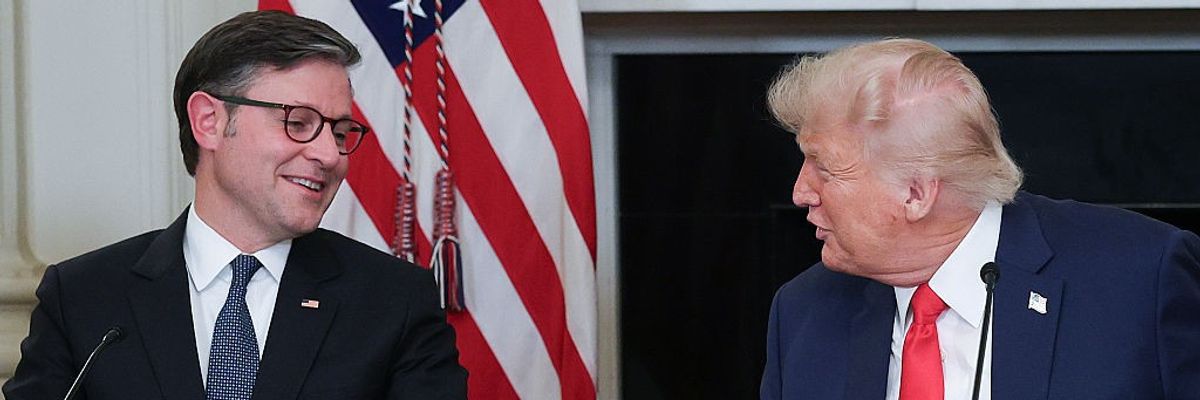
US President Donald Trump talks with Speaker of the House Mike Johnson (R-La.) during a roundtable at the White House in Washington, DC on June 9, 2025.
"Congress—and only Congress—passes budgets. Because the president's job is to take care the laws are faithfully executed, he must spend the money as directed," said Rep. Jamie Raskin, a constitutional scholar.
Democracy defenders and members of Congress are condemning US President Donald Trump's effort to use a "pocket rescission" process to block $4.9 billion in foreign aid as authoritarian and illegal.
The Office of Management and Budget (OMB) on Friday shared on social media Trump's letter to House Speaker Mike Johnson (R-La.) about the move. According to a White House fact sheet linked in a subsequent post, much of the money was headed for the US Department of State and the United States Agency for International Development (USAID), which Trump has gutted.
As The Associated Press explained:
The 1974 Impoundment Control Act gives the president the authority to propose canceling funds approved by Congress. Congress can within 45 days vote on pulling back the funds or sustaining them, but by proposing the rescission so close to September 30 the White House argues that the money won’t be spent and the funding lapses.
What was essentially the last pocket rescission occurred in 1977 by Democratic then-President Jimmy Carter, and the Trump administration argues it's a legally permissible tool despite some murkiness as Carter had initially proposed the clawback well ahead of the 45-day deadline.
Shortly after the OMB social media posts, Secretary of State Marco Rubio said that OMB Director Russ Vought was helping shutter USAID, writing on the platform X: "Since January, we've saved the taxpayers tens of billions of dollars. And with a small set of core programs moved over to the State Department, USAID is officially in closeout mode. Russ is now at the helm to oversee the closeout of an agency that long ago went off the rails. Congrats, Russ."
Meanwhile, Rubio's former congressional colleagues and others are sounding the alarm over the administration's effort.
"America is staring down next month's government funding deadline on September 30," said Senate Minority Leader Chuck Schumer (D-N.Y.). "It's clear neither Trump nor congressional Republicans have any plan to avoid a painful and entirely unnecessary shutdown. With Trump's illegal 'pocket rescission': They seem eager to inflict further pain on the American people, raising their healthcare costs, compromising essential services, and further damaging our national security."
Congressman Joaquin Castro (D-Texas) also put pressure on GOP lawmakers, saying that "this is wrong—and illegal. Not only is Trump gutting $5 billion in foreign aid that saves lives and advances America's interests, but he's doing so using an unlawful 'pocket recission' method that undermines Congress' power of the purse. I urge my Republican colleagues to say hell no."
While most Republicans on Capitol Hill have backed Trump's endeavors to claw back funding previously appropriated by Congress, GOP Sens. Susan Collins (Maine) and Lisa Murkowski (Alaska) voted against his $9 billion rescission package earlier this year.
Collins, chair of the Senate Appropriations Committee, also spoke out against Trump's new move, noting in a Friday statement that under the US Constitution, Congress has "the power of the purse," and the Government Accountability Office "has concluded that this type of rescission is unlawful and not permitted by the Impoundment Control Act."
Congressman Jamie Raskin (D-Md.), a constitutional scholar, similarly stressed that "Congress—and only Congress—passes budgets. Because the president's job is to take care the laws are faithfully executed, he must spend the money as directed. Trump's 'pocket recissions' are lawless and absurd. If a president opposes legislative spending decisions, he can veto them, subject to override, but once passed, he must execute on them."
Lisa Gilbert, co-president of the watchdog group Public Citizen, declared in a Friday statement that with the pocket rescission move, the Trump administration "demonstrated yet again its contempt for Congress' power of the purse and the Constitution's separation of powers."
"With this Constitution-mocking action, the administration is bringing us closer to a shutdown on September 30, and it doesn't seem to care," Gilbert said. "We call on Congress to push back, pass and abide by appropriations packages, and fight the administration’s illegal impoundments that harm regular Americans."
"This is not just a constitutional crisis, it's a matter of global justice," she added. "The congressionally appropriated funds that the Trump administration illegally aims to cancel support economic development programs to empower the world's most vulnerable and impoverished, and address some of the ravage of catastrophic climate change in developing nations."
Dear Common Dreams reader, It’s been nearly 30 years since I co-founded Common Dreams with my late wife, Lina Newhouser. We had the radical notion that journalism should serve the public good, not corporate profits. It was clear to us from the outset what it would take to build such a project. No paid advertisements. No corporate sponsors. No millionaire publisher telling us what to think or do. Many people said we wouldn't last a year, but we proved those doubters wrong. Together with a tremendous team of journalists and dedicated staff, we built an independent media outlet free from the constraints of profits and corporate control. Our mission has always been simple: To inform. To inspire. To ignite change for the common good. Building Common Dreams was not easy. Our survival was never guaranteed. When you take on the most powerful forces—Wall Street greed, fossil fuel industry destruction, Big Tech lobbyists, and uber-rich oligarchs who have spent billions upon billions rigging the economy and democracy in their favor—the only bulwark you have is supporters who believe in your work. But here’s the urgent message from me today. It's never been this bad out there. And it's never been this hard to keep us going. At the very moment Common Dreams is most needed, the threats we face are intensifying. We need your support now more than ever. We don't accept corporate advertising and never will. We don't have a paywall because we don't think people should be blocked from critical news based on their ability to pay. Everything we do is funded by the donations of readers like you. When everyone does the little they can afford, we are strong. But if that support retreats or dries up, so do we. Will you donate now to make sure Common Dreams not only survives but thrives? —Craig Brown, Co-founder |
Democracy defenders and members of Congress are condemning US President Donald Trump's effort to use a "pocket rescission" process to block $4.9 billion in foreign aid as authoritarian and illegal.
The Office of Management and Budget (OMB) on Friday shared on social media Trump's letter to House Speaker Mike Johnson (R-La.) about the move. According to a White House fact sheet linked in a subsequent post, much of the money was headed for the US Department of State and the United States Agency for International Development (USAID), which Trump has gutted.
As The Associated Press explained:
The 1974 Impoundment Control Act gives the president the authority to propose canceling funds approved by Congress. Congress can within 45 days vote on pulling back the funds or sustaining them, but by proposing the rescission so close to September 30 the White House argues that the money won’t be spent and the funding lapses.
What was essentially the last pocket rescission occurred in 1977 by Democratic then-President Jimmy Carter, and the Trump administration argues it's a legally permissible tool despite some murkiness as Carter had initially proposed the clawback well ahead of the 45-day deadline.
Shortly after the OMB social media posts, Secretary of State Marco Rubio said that OMB Director Russ Vought was helping shutter USAID, writing on the platform X: "Since January, we've saved the taxpayers tens of billions of dollars. And with a small set of core programs moved over to the State Department, USAID is officially in closeout mode. Russ is now at the helm to oversee the closeout of an agency that long ago went off the rails. Congrats, Russ."
Meanwhile, Rubio's former congressional colleagues and others are sounding the alarm over the administration's effort.
"America is staring down next month's government funding deadline on September 30," said Senate Minority Leader Chuck Schumer (D-N.Y.). "It's clear neither Trump nor congressional Republicans have any plan to avoid a painful and entirely unnecessary shutdown. With Trump's illegal 'pocket rescission': They seem eager to inflict further pain on the American people, raising their healthcare costs, compromising essential services, and further damaging our national security."
Congressman Joaquin Castro (D-Texas) also put pressure on GOP lawmakers, saying that "this is wrong—and illegal. Not only is Trump gutting $5 billion in foreign aid that saves lives and advances America's interests, but he's doing so using an unlawful 'pocket recission' method that undermines Congress' power of the purse. I urge my Republican colleagues to say hell no."
While most Republicans on Capitol Hill have backed Trump's endeavors to claw back funding previously appropriated by Congress, GOP Sens. Susan Collins (Maine) and Lisa Murkowski (Alaska) voted against his $9 billion rescission package earlier this year.
Collins, chair of the Senate Appropriations Committee, also spoke out against Trump's new move, noting in a Friday statement that under the US Constitution, Congress has "the power of the purse," and the Government Accountability Office "has concluded that this type of rescission is unlawful and not permitted by the Impoundment Control Act."
Congressman Jamie Raskin (D-Md.), a constitutional scholar, similarly stressed that "Congress—and only Congress—passes budgets. Because the president's job is to take care the laws are faithfully executed, he must spend the money as directed. Trump's 'pocket recissions' are lawless and absurd. If a president opposes legislative spending decisions, he can veto them, subject to override, but once passed, he must execute on them."
Lisa Gilbert, co-president of the watchdog group Public Citizen, declared in a Friday statement that with the pocket rescission move, the Trump administration "demonstrated yet again its contempt for Congress' power of the purse and the Constitution's separation of powers."
"With this Constitution-mocking action, the administration is bringing us closer to a shutdown on September 30, and it doesn't seem to care," Gilbert said. "We call on Congress to push back, pass and abide by appropriations packages, and fight the administration’s illegal impoundments that harm regular Americans."
"This is not just a constitutional crisis, it's a matter of global justice," she added. "The congressionally appropriated funds that the Trump administration illegally aims to cancel support economic development programs to empower the world's most vulnerable and impoverished, and address some of the ravage of catastrophic climate change in developing nations."
Democracy defenders and members of Congress are condemning US President Donald Trump's effort to use a "pocket rescission" process to block $4.9 billion in foreign aid as authoritarian and illegal.
The Office of Management and Budget (OMB) on Friday shared on social media Trump's letter to House Speaker Mike Johnson (R-La.) about the move. According to a White House fact sheet linked in a subsequent post, much of the money was headed for the US Department of State and the United States Agency for International Development (USAID), which Trump has gutted.
As The Associated Press explained:
The 1974 Impoundment Control Act gives the president the authority to propose canceling funds approved by Congress. Congress can within 45 days vote on pulling back the funds or sustaining them, but by proposing the rescission so close to September 30 the White House argues that the money won’t be spent and the funding lapses.
What was essentially the last pocket rescission occurred in 1977 by Democratic then-President Jimmy Carter, and the Trump administration argues it's a legally permissible tool despite some murkiness as Carter had initially proposed the clawback well ahead of the 45-day deadline.
Shortly after the OMB social media posts, Secretary of State Marco Rubio said that OMB Director Russ Vought was helping shutter USAID, writing on the platform X: "Since January, we've saved the taxpayers tens of billions of dollars. And with a small set of core programs moved over to the State Department, USAID is officially in closeout mode. Russ is now at the helm to oversee the closeout of an agency that long ago went off the rails. Congrats, Russ."
Meanwhile, Rubio's former congressional colleagues and others are sounding the alarm over the administration's effort.
"America is staring down next month's government funding deadline on September 30," said Senate Minority Leader Chuck Schumer (D-N.Y.). "It's clear neither Trump nor congressional Republicans have any plan to avoid a painful and entirely unnecessary shutdown. With Trump's illegal 'pocket rescission': They seem eager to inflict further pain on the American people, raising their healthcare costs, compromising essential services, and further damaging our national security."
Congressman Joaquin Castro (D-Texas) also put pressure on GOP lawmakers, saying that "this is wrong—and illegal. Not only is Trump gutting $5 billion in foreign aid that saves lives and advances America's interests, but he's doing so using an unlawful 'pocket recission' method that undermines Congress' power of the purse. I urge my Republican colleagues to say hell no."
While most Republicans on Capitol Hill have backed Trump's endeavors to claw back funding previously appropriated by Congress, GOP Sens. Susan Collins (Maine) and Lisa Murkowski (Alaska) voted against his $9 billion rescission package earlier this year.
Collins, chair of the Senate Appropriations Committee, also spoke out against Trump's new move, noting in a Friday statement that under the US Constitution, Congress has "the power of the purse," and the Government Accountability Office "has concluded that this type of rescission is unlawful and not permitted by the Impoundment Control Act."
Congressman Jamie Raskin (D-Md.), a constitutional scholar, similarly stressed that "Congress—and only Congress—passes budgets. Because the president's job is to take care the laws are faithfully executed, he must spend the money as directed. Trump's 'pocket recissions' are lawless and absurd. If a president opposes legislative spending decisions, he can veto them, subject to override, but once passed, he must execute on them."
Lisa Gilbert, co-president of the watchdog group Public Citizen, declared in a Friday statement that with the pocket rescission move, the Trump administration "demonstrated yet again its contempt for Congress' power of the purse and the Constitution's separation of powers."
"With this Constitution-mocking action, the administration is bringing us closer to a shutdown on September 30, and it doesn't seem to care," Gilbert said. "We call on Congress to push back, pass and abide by appropriations packages, and fight the administration’s illegal impoundments that harm regular Americans."
"This is not just a constitutional crisis, it's a matter of global justice," she added. "The congressionally appropriated funds that the Trump administration illegally aims to cancel support economic development programs to empower the world's most vulnerable and impoverished, and address some of the ravage of catastrophic climate change in developing nations."