SUBSCRIBE TO OUR FREE NEWSLETTER
Daily news & progressive opinion—funded by the people, not the corporations—delivered straight to your inbox.
5
#000000
#FFFFFF
To donate by check, phone, or other method, see our More Ways to Give page.
Daily news & progressive opinion—funded by the people, not the corporations—delivered straight to your inbox.
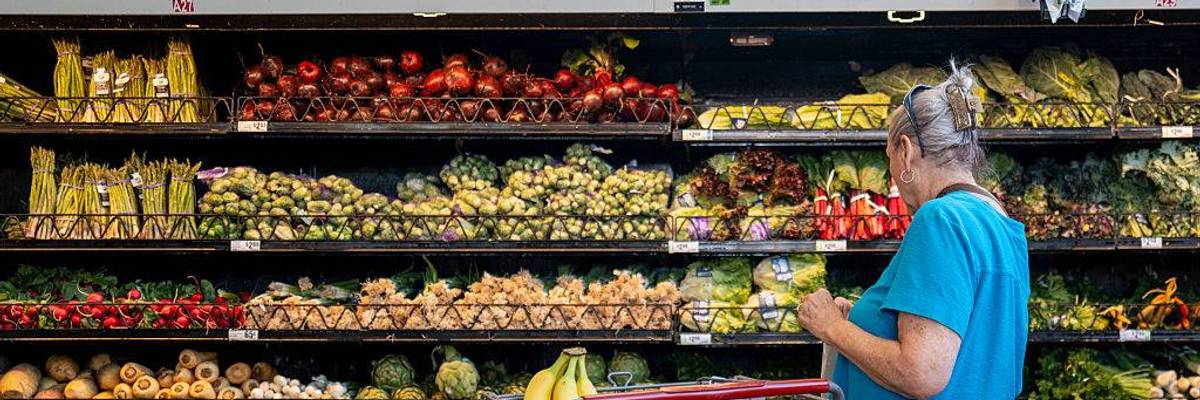
A customer shops for produce at an H-E-B grocery store on May 11, 2026 in Austin, Texas.
"Food is going to become less affordable, and consumers should be prepared for it," said one expert.
US shoppers have been struggling with the price of groceries for years now, and prices are only set to climb higher in the coming months.
As reported by Bloomberg on Wednesday, a combination of President Donald Trump's tariffs, his illegal war with Iran, and a potential "super El Niño" weather pattern is projected to lower food supply while increasing food production costs, all of which will mean higher prices at US grocery stores.
According to Bloomberg, weather forecasters are now projecting that an unusually strong El Niño will form in August "that will persist into 2027 and push global average temperatures higher," potentially causing droughts in nations that grow staple crops such as rice, coffee, and cocoa.
And even without an El Niño, noted Bloomberg, farmers in the US have already endured the warmest-ever start to a planting season, which "prompted some domestic crops to begin blossoming weeks ahead of schedule instead of remaining dormant throughout the winter, leaving them exposed to subsequent frosts."
Ricky Volpe, agribusiness professor at California Polytechnic State University, told Bloomberg that 2026 would be a "challenging year" for agriculture, warning that "food is going to become less affordable, and consumers should be prepared for it."
Unusually warm weather isn't the only factor pushing up food prices. In a report published earlier this month, The New York Times found that Trump's tariffs on foreign steel have been pushing up prices of canned foods.
According to data from the US Bureau of Labor Statistics (BLS), the price of canned fruit and vegetables in March posted 5.7% increase from the year before, driven in large part by a tariff-induced rise in tin plate prices.
"Over 80% of the tin plate used in the United States last year was imported, according to Harbor Intelligence, a metals markets analysis firm," noted the Times. "Tin plate is produced in much lower volumes than the steel used to make cars and buildings, making it a less attractive business for large steel companies."
While Trump has tried to brush off the rise in grocery and fuel prices in recent weeks—going so far as to say "I don’t think about Americans’ financial situation"—his Republican Party is bracing for potential political consequences.
CNBC reported on Wednesday that the GOP is staring down an inflation "abyss" and fears that Democrats are well poised to at least retake the US House of Representatives.
Rep. Don Bacon (R-Neb.), who is retiring at the end of this term, told CNBC that his fellow Republicans have been unwilling to serve as a check on what he described as Trump's self-destructive tariffs that had hit Americans' pocketbooks.
"I think tariffs are bad policy," said Bacon. "Milton Friedman, Adam Smith, they’re the bibles of conservatism, and we have violated those... We should not have rolled over on that here in Congress."
This country and this world are at a monumental crossroads. US voters have an opportunity to beat back the forces of fascism and confront the billionaires who are rigging the economy, our media system, and our democracy, making it increasingly impossible for ordinary people to get by. We’re not just talking about the election. We’re talking about what must be done once these fascist elements are vanquished from power. We need a bolder set of solutions than what either major party has so far been willing to offer and a working-class movement ready to fight like hell for it. Trump didn't emerge from nowhere. The conditions that fueled MAGA authoritarianism were created by decades of radical neoliberal economic policies and a corrupt political system dominated by corporate interests. They slashed taxes on the super-rich, promising that the benefits would trickle down. They said giveaways to the corporate titans would make life more affordable for the rest of us. It was all bullshit. And when a bitter, betrayed populace searches for someone to blame, right-wing demagogues have little trouble finding scapegoats. People know when they're being lied to, but you won't hear any of this from the corporate media. Only independent journalism—powered and funded by people who believe in building a better world—can deliver truly trustworthy daily news. If you share our vision, please contribute whatever you can to sustain our work. |
US shoppers have been struggling with the price of groceries for years now, and prices are only set to climb higher in the coming months.
As reported by Bloomberg on Wednesday, a combination of President Donald Trump's tariffs, his illegal war with Iran, and a potential "super El Niño" weather pattern is projected to lower food supply while increasing food production costs, all of which will mean higher prices at US grocery stores.
According to Bloomberg, weather forecasters are now projecting that an unusually strong El Niño will form in August "that will persist into 2027 and push global average temperatures higher," potentially causing droughts in nations that grow staple crops such as rice, coffee, and cocoa.
And even without an El Niño, noted Bloomberg, farmers in the US have already endured the warmest-ever start to a planting season, which "prompted some domestic crops to begin blossoming weeks ahead of schedule instead of remaining dormant throughout the winter, leaving them exposed to subsequent frosts."
Ricky Volpe, agribusiness professor at California Polytechnic State University, told Bloomberg that 2026 would be a "challenging year" for agriculture, warning that "food is going to become less affordable, and consumers should be prepared for it."
Unusually warm weather isn't the only factor pushing up food prices. In a report published earlier this month, The New York Times found that Trump's tariffs on foreign steel have been pushing up prices of canned foods.
According to data from the US Bureau of Labor Statistics (BLS), the price of canned fruit and vegetables in March posted 5.7% increase from the year before, driven in large part by a tariff-induced rise in tin plate prices.
"Over 80% of the tin plate used in the United States last year was imported, according to Harbor Intelligence, a metals markets analysis firm," noted the Times. "Tin plate is produced in much lower volumes than the steel used to make cars and buildings, making it a less attractive business for large steel companies."
While Trump has tried to brush off the rise in grocery and fuel prices in recent weeks—going so far as to say "I don’t think about Americans’ financial situation"—his Republican Party is bracing for potential political consequences.
CNBC reported on Wednesday that the GOP is staring down an inflation "abyss" and fears that Democrats are well poised to at least retake the US House of Representatives.
Rep. Don Bacon (R-Neb.), who is retiring at the end of this term, told CNBC that his fellow Republicans have been unwilling to serve as a check on what he described as Trump's self-destructive tariffs that had hit Americans' pocketbooks.
"I think tariffs are bad policy," said Bacon. "Milton Friedman, Adam Smith, they’re the bibles of conservatism, and we have violated those... We should not have rolled over on that here in Congress."