SUBSCRIBE TO OUR FREE NEWSLETTER
Daily news & progressive opinion—funded by the people, not the corporations—delivered straight to your inbox.
5
#000000
#FFFFFF
To donate by check, phone, or other method, see our More Ways to Give page.
Daily news & progressive opinion—funded by the people, not the corporations—delivered straight to your inbox.
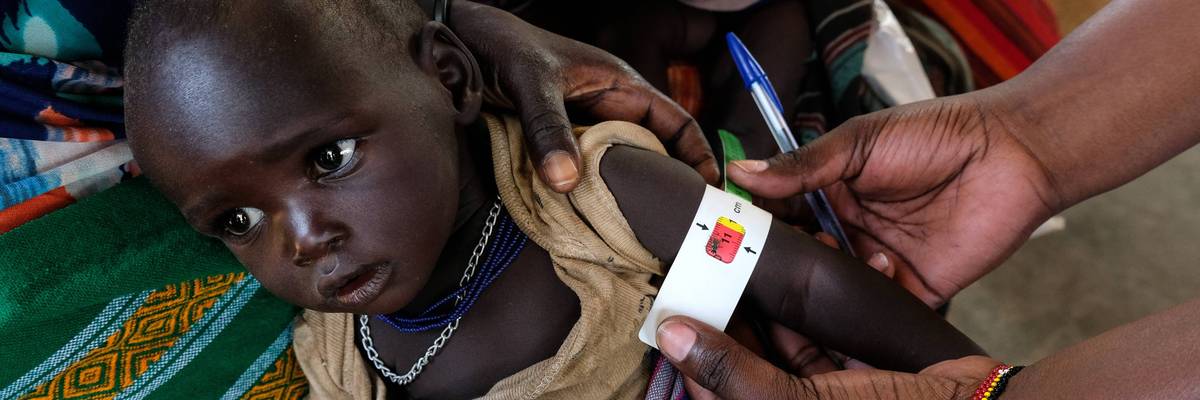
A health worker measures a child's arm circumference during a nutrition screening on July 23, 2025 in Karamoja region, Uganda.
"Governments must restore their aid budgets, and shore up the global humanitarian system that faces its most serious crisis in decades," said an advocate with the international charity Oxfam.
The global anti-poverty group Oxfam International warned this week that US President Donald Trump’s decision to slash foreign aid by more than half could kill nearly 10 million people by the end of the decade.
Responding to new data released Thursday by the Organization for Economic Cooperation and Development (OECD) showing the largest annual drop in the history of official development assistance, Oxfam said “wealthy governments are turning their backs on the lives of millions of women, men, and children in the Global South.”
The OECD released preliminary data on international aid that was provided last year by member countries of the organization's Development Assistance Committee (DAC), finding the largest annual drop in the history of official development assistance.
OECD member countries provided $174.3 billion in aid last year, according to the new data, representing 0.26% of the countries' combined gross national income.
In 2024, the countries sent $215.1 billion, or 0.34% of their gross national income to developing countries, including across the Global South—helping to provide nutritional assistance and healthcare initiatives among other programs.
US foreign aid spending dropped by 56.9% after Trump dismantled the US Agency for International Development, cut smaller aid programs, and pushed Congress to rescind previously approved foreign assistance.
"At a time when aid cuts are already driving instability and fostering greater inequality, government donors are cutting life-saving aid budgets while financing conflict and militarization."
Overall, wealthy OECD countries provided 23.1% less in foreign aid last year than they did in 2024—a greater decline than what the Institute of Global Health in Barcelona projected in February when it released a study in The Lancet, evaluating the impact of development assistance funding declines around the world.
The institute found that aid cuts in 2025 alone, which it assumed would represent a 21% decrease in funding, would lead to 695,238 excess deaths. If cuts continued at the same rate, an estimated 9,416,417 people could die of preventable diseases like malaria and AIDS, starvation, and other impacts by 2030.
The drop in foreign aid spending would suggest even more people could be killed by the cuts over the next four years.
“We are in a time of increasing humanitarian needs; strong pressures on the poorest and most fragile countries; and facing growing global uncertainties and massive insecurity," said Carsten Staur, chair of the OECD's Development Assistance Committee (DAC), which compiled the data. "In this situation, the world needs more ODA, not less—to help fight extreme poverty, improve resilience, and mobilize more private resources."
Trump's cuts helped make Germany the largest provider of development assistance for the first time ever, providing $29.1 billion to countries in need. The US sent $29 billion while the United Kingdom provided $17.2 billion, Japan sent $16.2 billion, and France sent $14.5 billion. All five of the top ODA providers reduced their foreign aid spending, accounting for 95.7% of the total decline.
Eight out of the DAC's 34 member countries either maintained or increased their development aid spending, and four countries—Denmark, Luxembourg, Norway, and Sweden—exceeded the United Nations' target of spending 0.7% of their gross national income on ODA.
Didier Jacobs, development finance lead for Oxfam, emphasized that while "recklessly" cutting foreign aid, "the Trump administration has been preparing to ask Congress for tens of billions in additional funding for bombs, ammunition, and other military equipment relating to its unlawful war against Iran."
"At a time when aid cuts are already driving instability and fostering greater inequality, government donors are cutting life-saving aid budgets while financing conflict and militarization. Cuts from donors including Germany, France and the UK will be felt by the world’s poorest," said Jacobs.
In addition to slashing military spending instead of crucial foreign aid, he said, "there are other ways to find tens of billions, such as by taxing the $2.84 trillions of dollars that the super-rich hide in tax havens.”
"Governments must restore their aid budgets," he said, "and shore up the global humanitarian system that faces its most serious crisis in decades."
Dear Common Dreams reader, It’s been nearly 30 years since I co-founded Common Dreams with my late wife, Lina Newhouser. We had the radical notion that journalism should serve the public good, not corporate profits. It was clear to us from the outset what it would take to build such a project. No paid advertisements. No corporate sponsors. No millionaire publisher telling us what to think or do. Many people said we wouldn't last a year, but we proved those doubters wrong. Together with a tremendous team of journalists and dedicated staff, we built an independent media outlet free from the constraints of profits and corporate control. Our mission has always been simple: To inform. To inspire. To ignite change for the common good. Building Common Dreams was not easy. Our survival was never guaranteed. When you take on the most powerful forces—Wall Street greed, fossil fuel industry destruction, Big Tech lobbyists, and uber-rich oligarchs who have spent billions upon billions rigging the economy and democracy in their favor—the only bulwark you have is supporters who believe in your work. But here’s the urgent message from me today. It's never been this bad out there. And it's never been this hard to keep us going. At the very moment Common Dreams is most needed, the threats we face are intensifying. We need your support now more than ever. We don't accept corporate advertising and never will. We don't have a paywall because we don't think people should be blocked from critical news based on their ability to pay. Everything we do is funded by the donations of readers like you. When everyone does the little they can afford, we are strong. But if that support retreats or dries up, so do we. Will you donate now to make sure Common Dreams not only survives but thrives? —Craig Brown, Co-founder |
The global anti-poverty group Oxfam International warned this week that US President Donald Trump’s decision to slash foreign aid by more than half could kill nearly 10 million people by the end of the decade.
Responding to new data released Thursday by the Organization for Economic Cooperation and Development (OECD) showing the largest annual drop in the history of official development assistance, Oxfam said “wealthy governments are turning their backs on the lives of millions of women, men, and children in the Global South.”
The OECD released preliminary data on international aid that was provided last year by member countries of the organization's Development Assistance Committee (DAC), finding the largest annual drop in the history of official development assistance.
OECD member countries provided $174.3 billion in aid last year, according to the new data, representing 0.26% of the countries' combined gross national income.
In 2024, the countries sent $215.1 billion, or 0.34% of their gross national income to developing countries, including across the Global South—helping to provide nutritional assistance and healthcare initiatives among other programs.
US foreign aid spending dropped by 56.9% after Trump dismantled the US Agency for International Development, cut smaller aid programs, and pushed Congress to rescind previously approved foreign assistance.
"At a time when aid cuts are already driving instability and fostering greater inequality, government donors are cutting life-saving aid budgets while financing conflict and militarization."
Overall, wealthy OECD countries provided 23.1% less in foreign aid last year than they did in 2024—a greater decline than what the Institute of Global Health in Barcelona projected in February when it released a study in The Lancet, evaluating the impact of development assistance funding declines around the world.
The institute found that aid cuts in 2025 alone, which it assumed would represent a 21% decrease in funding, would lead to 695,238 excess deaths. If cuts continued at the same rate, an estimated 9,416,417 people could die of preventable diseases like malaria and AIDS, starvation, and other impacts by 2030.
The drop in foreign aid spending would suggest even more people could be killed by the cuts over the next four years.
“We are in a time of increasing humanitarian needs; strong pressures on the poorest and most fragile countries; and facing growing global uncertainties and massive insecurity," said Carsten Staur, chair of the OECD's Development Assistance Committee (DAC), which compiled the data. "In this situation, the world needs more ODA, not less—to help fight extreme poverty, improve resilience, and mobilize more private resources."
Trump's cuts helped make Germany the largest provider of development assistance for the first time ever, providing $29.1 billion to countries in need. The US sent $29 billion while the United Kingdom provided $17.2 billion, Japan sent $16.2 billion, and France sent $14.5 billion. All five of the top ODA providers reduced their foreign aid spending, accounting for 95.7% of the total decline.
Eight out of the DAC's 34 member countries either maintained or increased their development aid spending, and four countries—Denmark, Luxembourg, Norway, and Sweden—exceeded the United Nations' target of spending 0.7% of their gross national income on ODA.
Didier Jacobs, development finance lead for Oxfam, emphasized that while "recklessly" cutting foreign aid, "the Trump administration has been preparing to ask Congress for tens of billions in additional funding for bombs, ammunition, and other military equipment relating to its unlawful war against Iran."
"At a time when aid cuts are already driving instability and fostering greater inequality, government donors are cutting life-saving aid budgets while financing conflict and militarization. Cuts from donors including Germany, France and the UK will be felt by the world’s poorest," said Jacobs.
In addition to slashing military spending instead of crucial foreign aid, he said, "there are other ways to find tens of billions, such as by taxing the $2.84 trillions of dollars that the super-rich hide in tax havens.”
"Governments must restore their aid budgets," he said, "and shore up the global humanitarian system that faces its most serious crisis in decades."
The global anti-poverty group Oxfam International warned this week that US President Donald Trump’s decision to slash foreign aid by more than half could kill nearly 10 million people by the end of the decade.
Responding to new data released Thursday by the Organization for Economic Cooperation and Development (OECD) showing the largest annual drop in the history of official development assistance, Oxfam said “wealthy governments are turning their backs on the lives of millions of women, men, and children in the Global South.”
The OECD released preliminary data on international aid that was provided last year by member countries of the organization's Development Assistance Committee (DAC), finding the largest annual drop in the history of official development assistance.
OECD member countries provided $174.3 billion in aid last year, according to the new data, representing 0.26% of the countries' combined gross national income.
In 2024, the countries sent $215.1 billion, or 0.34% of their gross national income to developing countries, including across the Global South—helping to provide nutritional assistance and healthcare initiatives among other programs.
US foreign aid spending dropped by 56.9% after Trump dismantled the US Agency for International Development, cut smaller aid programs, and pushed Congress to rescind previously approved foreign assistance.
"At a time when aid cuts are already driving instability and fostering greater inequality, government donors are cutting life-saving aid budgets while financing conflict and militarization."
Overall, wealthy OECD countries provided 23.1% less in foreign aid last year than they did in 2024—a greater decline than what the Institute of Global Health in Barcelona projected in February when it released a study in The Lancet, evaluating the impact of development assistance funding declines around the world.
The institute found that aid cuts in 2025 alone, which it assumed would represent a 21% decrease in funding, would lead to 695,238 excess deaths. If cuts continued at the same rate, an estimated 9,416,417 people could die of preventable diseases like malaria and AIDS, starvation, and other impacts by 2030.
The drop in foreign aid spending would suggest even more people could be killed by the cuts over the next four years.
“We are in a time of increasing humanitarian needs; strong pressures on the poorest and most fragile countries; and facing growing global uncertainties and massive insecurity," said Carsten Staur, chair of the OECD's Development Assistance Committee (DAC), which compiled the data. "In this situation, the world needs more ODA, not less—to help fight extreme poverty, improve resilience, and mobilize more private resources."
Trump's cuts helped make Germany the largest provider of development assistance for the first time ever, providing $29.1 billion to countries in need. The US sent $29 billion while the United Kingdom provided $17.2 billion, Japan sent $16.2 billion, and France sent $14.5 billion. All five of the top ODA providers reduced their foreign aid spending, accounting for 95.7% of the total decline.
Eight out of the DAC's 34 member countries either maintained or increased their development aid spending, and four countries—Denmark, Luxembourg, Norway, and Sweden—exceeded the United Nations' target of spending 0.7% of their gross national income on ODA.
Didier Jacobs, development finance lead for Oxfam, emphasized that while "recklessly" cutting foreign aid, "the Trump administration has been preparing to ask Congress for tens of billions in additional funding for bombs, ammunition, and other military equipment relating to its unlawful war against Iran."
"At a time when aid cuts are already driving instability and fostering greater inequality, government donors are cutting life-saving aid budgets while financing conflict and militarization. Cuts from donors including Germany, France and the UK will be felt by the world’s poorest," said Jacobs.
In addition to slashing military spending instead of crucial foreign aid, he said, "there are other ways to find tens of billions, such as by taxing the $2.84 trillions of dollars that the super-rich hide in tax havens.”
"Governments must restore their aid budgets," he said, "and shore up the global humanitarian system that faces its most serious crisis in decades."